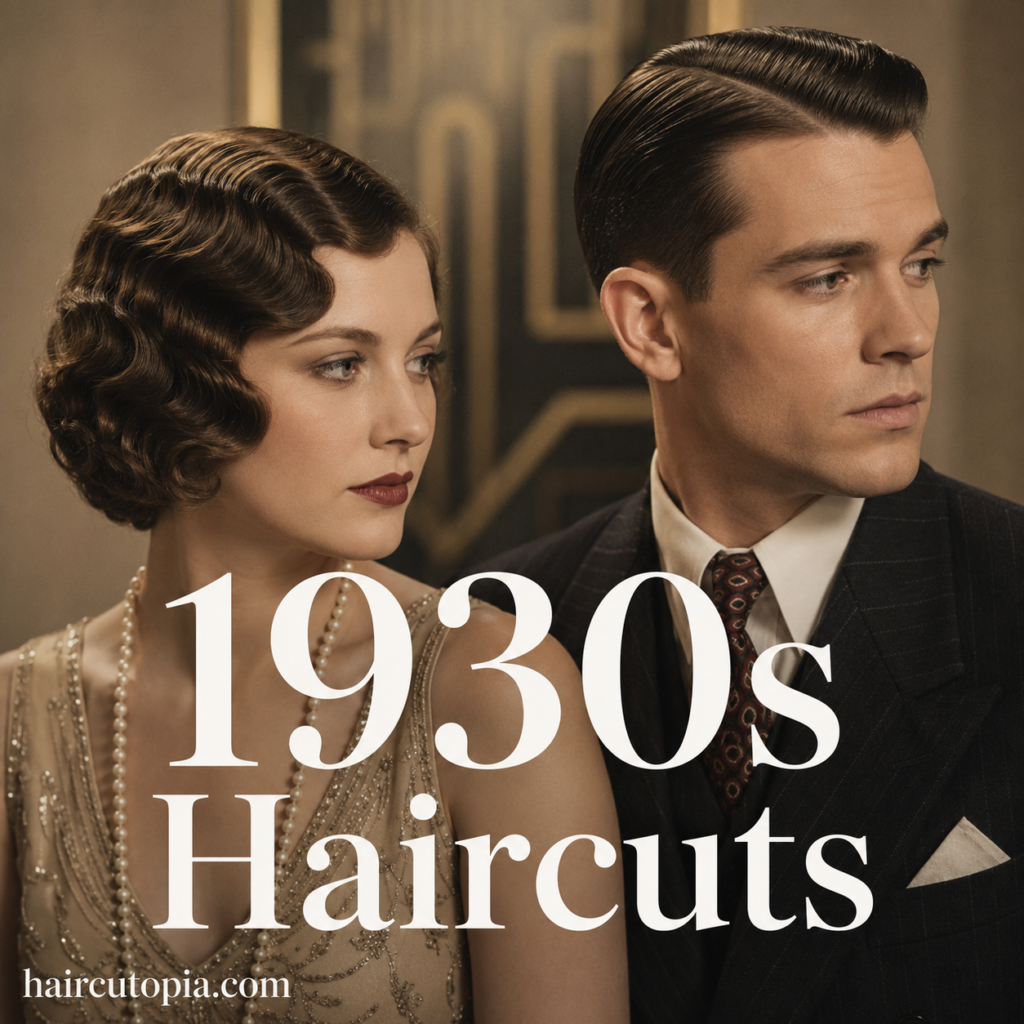
The 1930s were a fascinating period for hair. Coming out of the bold experimentation of the 1920s, hairstyles began to look softer, more polished, and carefully shaped. The sharpest flapper-era cuts didn’t disappear overnight, but they gradually gave way to sculpted waves, elegant bobs, neat tapers, and styles designed to look refined from every angle.
Hollywood played an enormous role in shaping these trends. Movie stars appeared on screen with glossy finger waves, perfectly arranged curls, slick side parts, and immaculate grooming. Those looks quickly became aspirational, even for people who didn’t have access to professional stylists.
At the same time, the Great Depression influenced everyday grooming. A hairstyle needed to look good, but practicality mattered. Many popular 1930s haircuts could be maintained at home, reshaped as the hair grew, or styled in several different ways without requiring an entirely new cut.
From softly waved bobs to clean barbershop tapers, 1930s haircuts combined practicality with unmistakable vintage elegance.
What Did Haircuts Look Like in the 1930s?
Haircuts of the 1930s generally looked more controlled and polished than the deliberately rebellious styles associated with the previous decade.
For women, hair remained relatively short during the early part of the decade, although many styles gradually became longer. Rather than the extremely straight, severe bob, softer outlines became fashionable. Hair might sit around the jaw, reach the nape, or extend toward the shoulders.
Waves and curls were especially important. Finger waves could transform a fairly simple haircut into an elaborate-looking style, while pin curls helped create movement around the temples, cheeks, and neckline.
Men’s haircuts followed a different but equally polished approach. Short sides and backs were paired with enough length on top to create a defined side part or slicked-back shape.
Common characteristics of 1930s hair included:
- Defined side parts
- Finger waves and sculpted waves
- Short to medium-length bobs
- Soft curls around the face
- Longer, more feminine silhouettes later in the decade
- Short tapered sides and backs for men
- Longer hair on top for combing and styling
- Pomade-assisted shine and control
- Carefully maintained necklines
- Neat, intentional shapes
The overall goal was rarely to make hair appear effortless. A finished hairstyle was supposed to look groomed.
Why 1930s Hairstyles Became Softer
The transition from the 1920s into the 1930s brought a noticeable change in beauty ideals.
During the 1920s, dramatically short bobs had represented modernity and independence. By the following decade, many people still wore shorter hair, but styling became softer and more romantic.
Instead of emphasizing straight geometric lines, hairstyling increasingly relied on waves, curls, and rounded silhouettes.
This shift was particularly visible around the face. Hair could be shaped into an S-wave along the forehead, curled near the cheekbones, or arranged into small curls near the ears.
The haircut created the foundation, but styling created much of the finished appearance.
Popular 1930s Haircuts and Hairstyles for Women
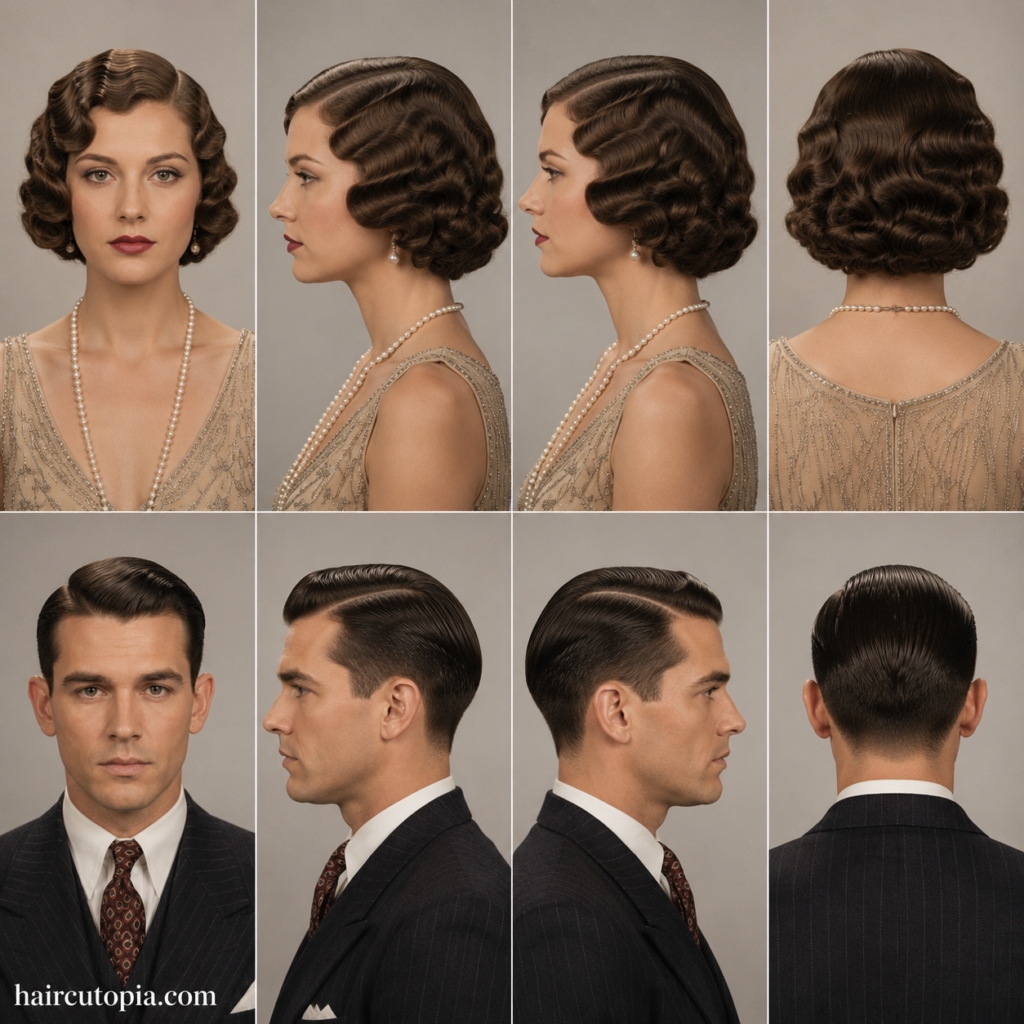
Women’s hair changed considerably throughout the decade. Early-1930s styles still carried strong influences from the bob craze, while later hairstyles often featured additional length and volume.
1. The Soft Waved Bob
The waved bob was one of the defining hairstyles of the early 1930s.
Instead of hanging completely straight, the hair was shaped into controlled waves that followed the head. The ends might curve toward the jaw or form small curls near the neckline.
This gave the bob a softer appearance than many versions worn during the previous decade.
Typical features included:
- Jaw-length or slightly longer hair
- A deep side part
- Sculpted waves
- Curved or curled ends
- A close-to-the-head silhouette
A modern version can preserve the same basic shape while using lighter styling products for more natural movement.
2. The Finger-Waved Bob
Few hairstyles immediately communicate “1930s” as effectively as finger waves.
Finger waving is technically a styling technique rather than a haircut, but the underlying haircut was extremely important. Shorter bobs provided an ideal base because the hair could be shaped closely against the head.
The characteristic S-shaped waves were created by manipulating damp hair into ridges.
The result was glamorous, controlled, and highly photogenic.
3. The Side-Parted Bob
Deep side parts appeared throughout 1930s hairstyling.
A bob could be parted dramatically toward one side, allowing the heavier section to sweep across the forehead before transitioning into waves or curls.
The asymmetry made an otherwise simple haircut appear more sophisticated.
Side-parted bobs work especially well for recreating the decade without committing to an extremely theatrical vintage hairstyle.
4. The Curly Bob
Not every 1930s bob was tightly waved against the head.
Curls became increasingly important, particularly when placed around the ends of the hair. A relatively smooth crown could transition into clusters of curls around the ears, jaw, or nape.
Compared with the geometric bob, the curly bob looked softer and more romantic.
5. The Eton Crop
The Eton crop is most strongly associated with the late 1920s, but very short cuts remained visible into the early 1930s.
This haircut was extremely close to the head, exposing much of the ears and neckline. Styling could be sleek and sculpted, sometimes incorporating small waves around the forehead or temples.
By the middle and later parts of the decade, longer and softer hairstyles had largely overtaken such severe crops as mainstream fashion.
6. The Nape-Length Bob
For people growing out shorter 1920s cuts, a nape-length bob offered a natural transition.
Hair extended below the jaw toward the back of the neck, providing more room for waves and curls.
This extra length also helped create the increasingly feminine silhouettes associated with mid-1930s fashion.
7. The Pageboy
Pageboy-inspired shapes became another option as hairstyles grew longer.
The hair generally followed a smooth, rounded outline, with the ends curving inward. Rather than relying entirely on tight waves, the pageboy emphasized a sleek surface and controlled shape.
Later versions of the style would become especially recognizable in subsequent decades, but its development fit naturally with the movement toward longer hair during the 1930s.
8. Shoulder-Length Waves
By the later 1930s, women’s hair was noticeably getting longer.
Shoulder-length cuts allowed larger waves to develop through the lengths rather than remaining tightly pressed against the scalp.
These styles helped establish the glamorous longer hairstyles that would become even more prominent during the 1940s.
9. Side-Swept Waves
A dramatic side sweep was another hallmark of the decade.
Hair was parted deeply and directed across the forehead before flowing into sculpted waves.
The style could work with a bob or somewhat longer hair, making it adaptable as haircut lengths changed.
10. Curled Ends
Sometimes the defining feature wasn’t the entire haircut but the finish.
Medium-length hair could remain relatively smooth through the crown and mid-lengths before curling near the bottom.
Turning the ends inward created a controlled silhouette, while more pronounced curls produced a softer and more glamorous effect.
11. Sculpted Marcel-Style Waves
Marcel waving had already become popular before the 1930s, but structured waves remained influential throughout the period.
Unlike completely natural texture, these waves were deliberately shaped into repeating curves.
The technique created a highly polished appearance that worked especially well for evening hairstyles and formal occasions.
12. The Grown-Out Bob
One of the most important changes of the decade was simply allowing the bob to grow.
Instead of immediately cutting the hair back to jaw length, women could retain additional length around the neck and shoulders.
Stylists then shaped that length with waves and curls.
This transitional haircut helped move women’s fashion away from the dramatically short styles of the 1920s and toward the longer silhouettes of the following decade.
Popular 1930s Haircuts for Men
Men’s hairstyles of the 1930s were usually conservative, clean, and carefully styled.
The sides and back were generally kept shorter than the top, but the dramatic skin fades common in modern barbering were not the defining look. Transitions tended to appear more gradual.
Enough length was left on top to establish a strong direction.
13. The Classic Side Part
The side part was one of the quintessential men’s hairstyles of the decade.
Hair was parted neatly on one side and combed into place, usually with styling product.
A typical version featured:
- Short, tapered sides
- A clean neckline
- Moderate length on top
- A clearly defined side part
- A smooth, polished finish
This haircut remains wearable today with very few modifications.
14. The Slicked-Back Taper
Some men preferred combing the top backward instead of creating a strong side sweep.
The sides and back remained neatly tapered while the longer top was slicked away from the face.
Pomades and similar grooming products helped maintain the shape and provide the glossy finish associated with period hairstyles.
15. The Side-Swept Taper
This style combined the structure of a classic taper with more movement across the top.
Rather than being combed directly backward, the hair traveled diagonally across the head.
The effect was polished without appearing completely flat.
16. The Short Back and Sides
Practicality also mattered.
A straightforward short-back-and-sides haircut was easy to maintain while still fitting the decade’s preference for tidy grooming.
The top generally retained more length than the sides, giving the wearer enough hair to comb neatly into place.
17. The Pomaded Comb-Over
The term “comb-over” has a different association today, but combing the hair cleanly from a side part was a standard styling approach during the period.
The hair was directed across the top while pomade helped keep individual strands controlled.
When paired with a traditional taper, the result was one of the most recognizable men’s looks of the era.
18. The Slick Side Sweep
For a slightly more dramatic appearance, longer top hair could be swept strongly toward one side.
This created a smooth flowing shape while maintaining the clean sides expected from traditional men’s grooming.
It was particularly suited to straight and wavy hair.
19. The Natural Wavy Side Part
Men with naturally wavy hair didn’t necessarily need to flatten every bit of texture.
A side part could provide structure while allowing waves to remain visible through the top.
This created a slightly softer appearance than heavily slicked styles while remaining appropriately groomed.
20. The Formal Slick-Back
Formal hairstyles often emphasized an especially smooth finish.
Hair was combed backward and controlled with product so that very little texture appeared out of place.
Although contemporary versions may use matte products, authentic interpretations generally look noticeably shinier.
How Hollywood Influenced 1930s Hair
The rise of Hollywood helped hairstyles spread more quickly and widely than ever before.
Cinema audiences could see actors’ hairstyles from multiple angles and in close-up. Movie magazines, promotional photographs, and advertisements further circulated those images.
Jean Harlow became famous for her platinum-blonde image and glamorous waves. Marlene Dietrich represented another version of sophisticated 1930s glamour, often appearing with carefully sculpted hair and dramatic styling.
Men’s grooming was similarly influenced by stars such as Clark Gable and Cary Grant, whose polished side-parted hairstyles helped establish an enduring image of classic men’s grooming.
Celebrity influence on hair certainly wasn’t invented during the 1930s, but cinema gave it unprecedented visual reach.
Haircuts During the Great Depression
The glamour associated with 1930s Hollywood existed alongside a much harsher economic reality.
The Great Depression affected household spending, employment, clothing, and personal grooming. Not everyone could regularly visit a salon or barber.
That made adaptable hairstyles especially useful.
A basic haircut could be transformed at home through:
- Finger waving
- Pin curling
- Brushing
- Combing
- Setting the hair overnight
- Changing the location of the part
- Using grooming products strategically
Hair could also be maintained as it grew rather than constantly reshaped into a completely different cut.
This helps explain one of the contradictions that makes 1930s beauty so interesting: the decade produced some exceptionally glamorous images during a period when many people needed to be highly economical.
How Women Styled Their Hair in the 1930s
Creating a fashionable hairstyle often involved considerably more work than simply getting the right haircut.
Finger Waves
Finger waves were formed while the hair was damp.
Hair was combed into alternating ridges and curves, producing the distinctive S-shaped pattern associated with vintage styling.
Shorter hair made it easier to create waves that hugged the head.
Pin Curls
Pin curls offered another important styling method.
Small sections of hair were wound into curls and secured close to the scalp while setting. Once released, those curls could be brushed, separated, or arranged into the desired shape.
Different curl placement produced dramatically different results.
Marcel Waves
Heated waving techniques could create smooth, repeating waves with more structure.
These styles required skill, particularly because temperature control on early heated tools was far less sophisticated than on modern styling equipment.
Setting Lotion
Setting products helped waves and curls maintain their shape.
The goal wasn’t necessarily the soft, touchable finish preferred today. Controlled styling and longevity were priorities.
Men’s Grooming and Barbering in the 1930s
A man’s haircut was only part of the finished look.
Regular combing and product application helped maintain the clean silhouette.
Barbers typically kept the neckline and areas around the ears tidy while gradually transitioning toward longer hair above.
Styling products provided control and shine, particularly for slicked-back and side-parted hairstyles.
This produced a noticeably different finish from many modern men’s cuts, where matte clay and deliberately messy texture are common.
1930s Hair Products
Hair products were essential for creating many fashionable looks.
Popular product categories included:
- Hair pomades
- Brilliantine
- Hair oils
- Setting lotions
- Hair tonics
- Shampoos
- Wave-setting products
For men, pomade and brilliantine helped create the sleek appearance seen in advertisements and films.
For women, setting products were particularly useful because waves and curls needed to hold their carefully arranged shapes.
Modern recreations don’t require vintage formulas. Contemporary pomades, gels, mousses, setting sprays, and curl products can achieve similar visual results with greater flexibility.
Early 1930s vs. Late 1930s Haircuts
Hair fashion wasn’t static throughout the decade.
Looking at the early and late 1930s side by side makes the evolution easier to see.
Early 1930s
Women’s styles commonly featured:
- Short bobs
- Finger waves
- Close-to-the-head shapes
- Deep side parts
- Small sculpted curls
- Continued influence from the 1920s
Men’s styles emphasized:
- Short tapered sides
- Defined side parts
- Slick styling
- Neatly controlled top hair
Mid-1930s
Women’s hair increasingly showed:
- More length
- Softer curls
- Fuller shapes
- Longer bobs
- Greater movement around the neckline
Men’s hairstyles remained relatively consistent, although individual styling could range from heavily slicked to naturally waved.
Late 1930s
Women’s styles increasingly featured:
- Shoulder-grazing lengths
- Larger waves
- Fuller curls
- More volume
- Softer silhouettes
These developments foreshadowed many hairstyles that would become associated with the early 1940s.
1920s vs. 1930s Haircuts
Although the two decades shared certain styles, their overall aesthetics were noticeably different.
1920s Hair
The 1920s are strongly associated with:
- Very short bobs
- Shingles
- Eton crops
- Straight geometric shapes
- Close-fitting hairstyles
- A deliberately modern appearance
1930s Hair
The following decade moved toward:
- Softer bobs
- Longer lengths
- Sculpted waves
- More curls
- Romantic silhouettes
- Polished Hollywood glamour
The change was gradual rather than immediate. Early-1930s photographs can still look distinctly 1920s, while late-1930s hairstyles can already hint at the 1940s.
1930s vs. 1940s Haircuts
The transition into the 1940s brought another change in silhouette.
Many 1930s styles remained relatively close to the head, particularly earlier in the decade. By the 1940s, hairstyles often became fuller and more structured.
Rolls, larger curls, and increased volume became much more prominent.
Men’s haircuts remained comparatively stable, with short sides and longer combed tops continuing to dominate. Wartime practicality would also influence grooming during the following decade.
How to Ask for a 1930s-Inspired Haircut Today
You don’t need to request an exact historical reproduction to capture the character of the decade.
For a shorter feminine style, ask for a jaw- or nape-length bob that leaves enough hair for waves or curls.
For a longer interpretation, consider shoulder-length hair with a soft perimeter and sufficient length to create larger waves.
For a traditionally masculine version, request:
- A classic scissor taper rather than an extremely aggressive modern fade.
- Shorter sides and back with noticeable length remaining on top.
- Enough top length to establish a side part or slicked-back shape.
- A clean, natural-looking neckline.
- Styling that emphasizes control rather than intentionally messy texture.
Reference photos are particularly valuable for historical cuts. Terms such as “1930s haircut” can mean very different things depending on which part of the decade you’re trying to recreate.
How to Make a 1930s Haircut Look Modern
Historical inspiration doesn’t require looking like you’re wearing a costume.
The easiest approach is to borrow one or two defining characteristics rather than reproducing every detail.
For example:
- Pair a modern bob with a deep side part.
- Add loose S-waves instead of tightly sculpted finger waves.
- Keep a classic men’s taper but use less product.
- Preserve natural texture rather than slicking every strand into place.
- Use softer curls around the face.
- Choose a longer vintage-inspired shape with modern layering.
The result can reference the decade without appearing overly theatrical.
Are 1930s Haircuts Still Popular?
Many individual elements of 1930s hair have never completely disappeared.
The classic side part remains a staple men’s hairstyle. Bobs regularly return to fashion, and Hollywood waves continue to appear at weddings, red-carpet events, and formal occasions.
Finger waves have also experienced repeated revivals, particularly in fashion and editorial hairstyling.
What changes is the finish.
A modern bob may have more natural texture. A contemporary taper may use matte styling products instead of glossy pomade. Vintage waves may be brushed into a looser shape.
The underlying ideas remain remarkably familiar.
Who Can Wear a 1930s-Inspired Haircut?
Almost anyone can borrow elements from the decade.
Rather than treating historical hairstyles as rigid gender rules, modern wearers can focus on shape, length, texture, and styling.
A short sculpted crop can be worn by anyone. So can a slick side part, waved bob, tapered haircut, or shoulder-length set.
Hair texture will influence how easily a particular historical finish can be recreated, but modern cutting and styling techniques make these looks much more adaptable.
Maintaining a 1930s-Inspired Haircut
Maintenance depends heavily on the haircut you choose.
Short bobs and precise tapered cuts generally require more frequent trimming to preserve their outlines. Longer waved styles provide more flexibility as the hair grows.
For a vintage-inspired routine:
- Maintain the haircut’s overall silhouette.
- Use lightweight styling products for modern interpretations.
- Experiment with wet-setting techniques for authentic waves.
- Protect hair before using heated tools.
- Use a comb for cleaner side parts.
- Brush curls together when creating smooth vintage waves.
- Avoid overloading fine hair with heavy pomade or oil.
You can also alternate between vintage and contemporary styling without changing the haircut itself.
Frequently Asked Questions About 1930s Haircuts
What was the most popular haircut in the 1930s?
There wasn’t one universal haircut, but short and medium-length waved styles were especially prominent for women, while tapered side-parted cuts were extremely common for men.
The bob remained important early in the decade before gradually becoming longer and softer.
Did women have short hair in the 1930s?
Yes. Short hair remained fashionable, particularly during the early 1930s.
However, women’s hairstyles generally became longer as the decade progressed. By the late 1930s, shoulder-length styles were increasingly visible.
Did men have fades in the 1930s?
Men commonly wore hair shorter on the sides and back with more length on top, but these cuts shouldn’t automatically be equated with today’s high-contrast skin fades.
Traditional tapering created a more gradual transition and typically preserved a conservative, polished silhouette.
Were finger waves popular in the 1930s?
Yes. Finger waves were an important styling technique, particularly with shorter women’s hair.
They created the sculpted S-shaped patterns that are now strongly associated with 1920s and 1930s hairstyling.
What hair products did men use in the 1930s?
Pomades, brilliantine, hair oils, and tonics were among the grooming products used to control hair and create a polished finish.
Shine was much more characteristic of the period than the dry, matte texture popular in many modern hairstyles.
What is the difference between 1920s and 1930s hair?
1920s women’s hairstyles were generally shorter and more geometric, while the 1930s gradually introduced additional length, softer waves, curls, and more romantic shapes.
There was considerable overlap during the transition between the decades.
How did people curl their hair in the 1930s?
Pin curls, finger waving, setting techniques, and heated waving methods could all be used to create curls and waves.
Hair was often arranged while damp and allowed to set before being brushed or shaped into the finished hairstyle.
Can you wear a 1930s haircut without vintage styling?
Absolutely.
Many of the underlying haircuts are surprisingly timeless. A classic bob or men’s scissor taper can look completely contemporary when styled with natural texture and modern products.
The Lasting Influence of 1930s Haircuts
1930s haircuts occupy an interesting place in hairstyle history.
The decade retained some of the short, daring ideas of the 1920s while gradually moving toward the softer, longer, and more voluminous hairstyles that would define the 1940s.
Women’s hair evolved from compact bobs and tightly sculpted waves toward longer curls and shoulder-length silhouettes. Men’s grooming centered on neat tapers, defined parts, and carefully controlled top hair.
Hollywood added another layer of influence, turning beautifully styled hair into an image of glamour that could be seen by audiences around the world.
Nearly a century later, many of those ideas still feel familiar.
The products have improved and styling has become less rigid, but bobs, side parts, waves, curls, and classic tapers remain fundamental haircut choices. That’s what makes 1930s haircuts useful for more than historical inspiration—they’re also a reminder of how many supposedly modern hairstyles have much deeper roots.
Related Posts
 1930s Hairstyles: Classic Hair Trends That Defined the Decade
 1920s Hairstyles: Iconic Hair Trends From the Roaring Twenties
 Bangs Haircuts for Diamond Faces: 25 Flattering Fringe Styles to Highlight Your Best Features
 Low Maintenance Butterfly Cut Haircuts: 29 Easy Layered Styles That Look Great Every Day