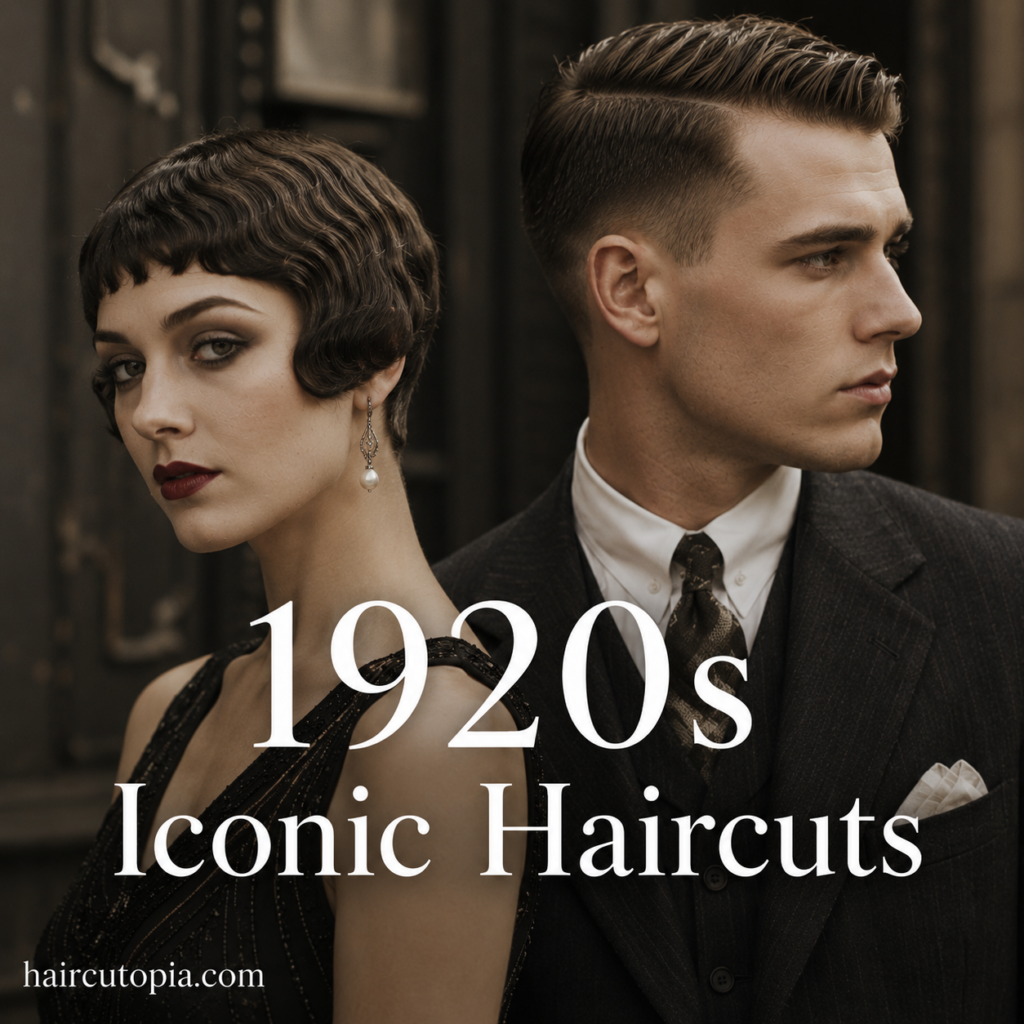
Few decades changed the image of hair quite like the 1920s.
For women especially, cutting the hair short became one of the defining fashion shifts of the era. The bob moved from something unconventional to one of the most recognizable looks of the Roaring Twenties, while shorter variations such as the shingle and Eton crop pushed the silhouette even further.
Men’s haircuts weren’t transformed quite as dramatically, but they developed their own unmistakable identity. Neatly tapered sides, longer tops, clean outlines, and enough length for a polished side part created a classic look that still feels familiar today.
Some of these cuts lasted only as strong symbols of their time. Others became foundations for modern hairstyles.
From the classic bob to sharply groomed men’s cuts, these are the iconic 1920s haircuts that helped define an era.
What Made a Haircut Iconic in the 1920s?
The most memorable 1920s haircuts weren’t necessarily the most complicated.
What made them important was how clearly they reflected changing fashion.
For women, shorter hair represented a dramatic break from the long styles that had dominated previous generations. A bob could completely alter the shape of the head and face while working naturally with the streamlined clothing and close-fitting hats of the period.
Men’s cuts emphasized precision instead.
The sides and back were generally kept neat, while additional length on top allowed the hair to be parted, slicked, or combed into place.
Several features became especially recognizable:
- Shorter women’s lengths
- Jaw- and ear-level bobs
- Closely tapered napes
- Compact silhouettes
- Straight or shaped fringes
- Short sides and backs for men
- Longer, combable tops
- Clean outlines around the ears and neckline
Styling could change the appearance dramatically, but the haircut underneath created the foundation.
1. The Classic Bob
No haircut is more closely associated with the 1920s than the bob.
The defining change was length.
Instead of hair extending far below the shoulders, it was cut somewhere around the ears, cheeks, or jaw.
That sounds completely ordinary today. At the time, it could be a dramatic transformation.
The classic bob created a compact silhouette that framed the face and exposed more of the neck.
It could be worn straight, curled, or waved without changing the basic cut.
Why the Bob Became Iconic
The bob captured the modern spirit of the decade.
It complemented the increasingly streamlined fashions of the period and worked particularly well beneath cloche hats.
It was also versatile.
A simple bob could look relatively practical during the day and become dramatically glamorous once styled with waves or decorative accessories.
Most importantly, the bob helped normalize short hair for women.
That influence extended far beyond the 1920s.
2. The Blunt Bob
The blunt bob emphasized the geometry of short hair.
Rather than relying on heavy layering, the perimeter remained relatively strong and defined.
Depending on the version, the hair could fall around the ears, cheeks, or jaw.
Straight styling made the shape especially noticeable.
A blunt bob could also be paired with a straight fringe, creating an even stronger frame around the face.
The result was simple but visually powerful.
Modern blunt bobs still use essentially the same idea: a strong perimeter, limited graduation, and a clean silhouette.
3. The Bob With Bangs
Adding bangs changed the character of the bob without requiring an entirely different haircut.
Full fringes created a striking frame around the eyes.
Some were relatively straight and heavy. Others were shorter or subtly curved.
The combination worked particularly well with smooth hair because the clean fringe reinforced the geometric appearance of the cut.
A bob with bangs could also be styled with waves through the sides while keeping the fringe more controlled.
That flexibility helped make the look one of the decade’s most memorable combinations.
4. The Shingle Bob
The shingle bob took short hair in a more sculpted direction.
Instead of keeping the back at the same length as the sides, the hair toward the nape was cut progressively shorter.
The result followed the shape of the head and exposed the neckline.
Longer sections around the sides could still maintain the appearance of a bob from the front.
Turn around, however, and the shorter tapered back became visible.
This contrast made the shingle one of the era’s most distinctive cuts.
What Did a Shingle Bob Look Like?
A typical shingle featured:
- Longer hair around the front and sides
- A closely shaped back
- Gradual shortening toward the nape
- A visible neckline
- A compact overall silhouette
Some versions were relatively subtle.
Others were cut dramatically close through the lower back of the head.
The shingle could then be worn smooth or styled with waves.
5. The Shingled Crop
As short hair became more accepted, some cuts moved beyond the traditional bob silhouette altogether.
The shingled crop shortened more of the hair while retaining the carefully tapered shape associated with shingling.
The ears and neckline became increasingly visible.
This created a lighter, more fitted appearance than a fuller bob.
It also demonstrated how quickly women’s haircutting was evolving during the decade.
Once the idea of cutting long hair had been challenged, there was room to experiment with increasingly shorter shapes.
6. The Eton Crop
The Eton crop was one of the boldest women’s haircuts associated with the 1920s.
It was extremely short compared with conventional women’s hair of earlier generations.
Hair sat close to the head, creating a sleek and somewhat androgynous silhouette.
The cut took its name from the short hairstyles associated with boys at England’s Eton College.
On women, that traditionally masculine reference became part of the style’s daring appeal.
Why the Eton Crop Stood Out
The Eton crop didn’t simply shorten a bob.
It changed the entire visual relationship between women’s hair and the face.
The ears, neck, and facial features became much more exposed.
Hair could be styled smoothly or shaped into small waves around the forehead and temples.
Either way, the underlying cut remained unmistakably short.
Modern pixie cuts and close crops share some of the same design principles.
7. The Boyish Crop
The broader trend toward boyish short hair extended beyond any one named haircut.
Women increasingly experimented with compact cuts that reduced volume and emphasized the shape of the head.
These cuts might retain slightly more length than an Eton crop while still appearing considerably shorter than a traditional bob.
The silhouette was often:
- Close around the head
- Short through the back
- Relatively neat around the ears
- Longer toward the front
- Easy to shape with waves
The boyish crop reflected the decade’s growing interest in more androgynous fashion.
8. The Ear-Length Bob
Not every bob reached the jaw.
Some versions sat much higher, ending around the ears.
The shorter length created a lighter silhouette and made the neckline more visible.
Depending on the exact shape, the ears might be fully exposed or partially covered.
An ear-length bob could be worn sleek or transformed with curls and waves.
This length also created a useful middle ground between the traditional bob and dramatically cropped styles.
Today, very short French bobs and micro bobs sometimes create a surprisingly similar silhouette.
9. The Jaw-Length Bob
The jaw-length bob offered a slightly longer interpretation.
Hair ended roughly around the jawline, giving the face a clear frame while maintaining enough length for different styling options.
This version could look especially elegant when paired with waves.
It could also be worn straight for a cleaner, more geometric appearance.
Compared with the shortest crops, a jaw-length bob was relatively conservative.
That made it a practical way to embrace the short-hair movement without choosing an extreme cut.
10. The Tapered Bob
Tapering allowed hairdressers to shape a bob more closely around the head.
Instead of creating one uniform perimeter, sections toward the back could gradually become shorter.
The result was a smoother transition into the neckline.
Some tapered bobs remained relatively full around the sides, while others approached the more dramatic appearance of a shingle.
This kind of shaping helped establish ideas that remain fundamental in modern haircutting.
Graduation, tapering, and careful weight distribution are still used to control the silhouette of short hair.
11. The Curved Bob
Not every bob was designed to appear sharply geometric.
Some cuts created a softer, more rounded outline.
The hair could curve toward the cheeks or jaw, giving the silhouette a smooth, fitted shape.
Styling enhanced that effect, but the haircut itself provided the necessary length and weight.
The curved bob worked especially well with the decade’s preference for hairstyles that followed the shape of the head rather than expanding outward with excessive volume.
12. The Men’s Short Back and Sides
Women’s cuts usually receive most of the attention when discussing 1920s hair, but men’s haircuts established several enduring standards of their own.
The short-back-and-sides structure was fundamental.
Hair around the ears, neckline, and lower sides was kept noticeably shorter than the top.
Additional length through the upper sections gave men enough hair to comb into a side part or slick backward.
The transitions were generally neat and controlled.
The result formed the basis for many traditional men’s cuts that remain popular today.
13. The Classic Men’s Taper
The taper was an important element of polished men’s grooming.
Rather than keeping every section at one length, hair gradually became shorter toward the ears and neckline.
This produced a clean silhouette without the dramatic contrast of many modern skin fades.
The top remained longer.
That length was important because styling played such a large role in men’s appearance.
A man could use the same basic tapered cut for a side part, slick back, or neatly combed wavy style.
1920s Taper vs. Modern Fade
The two concepts are related, but they don’t necessarily look the same.
A modern fade may transition all the way down to extremely short hair or bare skin.
Traditional 1920s-inspired cuts generally look softer and more blended.
For a modern haircut with a stronger historical influence, a classic low taper often works better than an aggressive high skin fade.
14. The Side-Part Haircut
Although the side part itself is technically styling, men’s cuts were frequently designed to support it.
The top needed enough length to lie neatly toward one side.
The sides remained shorter and controlled so they wouldn’t compete with the top.
A barber could also create a clean outline around the ears and neckline to reinforce the polished appearance.
The result was a haircut built around one of the decade’s most important grooming details.
Its longevity is remarkable.
A well-cut side-part hairstyle can still look completely current today.
15. The Slick-Back Cut
Men who preferred to comb their hair backward needed a similar balance of lengths.
The top remained long enough to sweep away from the forehead, while the sides and back were kept shorter and tidier.
Unlike many contemporary slick backs, historical versions generally avoided extreme disconnection between the top and sides.
The silhouette looked more blended.
Styling product created the glossy finish, but the haircut underneath made the shape possible.
16. The Wavy Men’s Cut
Naturally wavy hair could also be incorporated into fashionable men’s cuts.
The basic structure remained neat: shorter sides and back with more usable length through the top.
Instead of flattening every wave, the top could retain some natural movement while being directed backward or toward one side.
This created a softer version of the classic groomed look.
The key was that the waves remained controlled.
The haircut provided enough structure to keep the overall appearance polished.
What Was the Most Iconic Women’s Haircut of the 1920s?
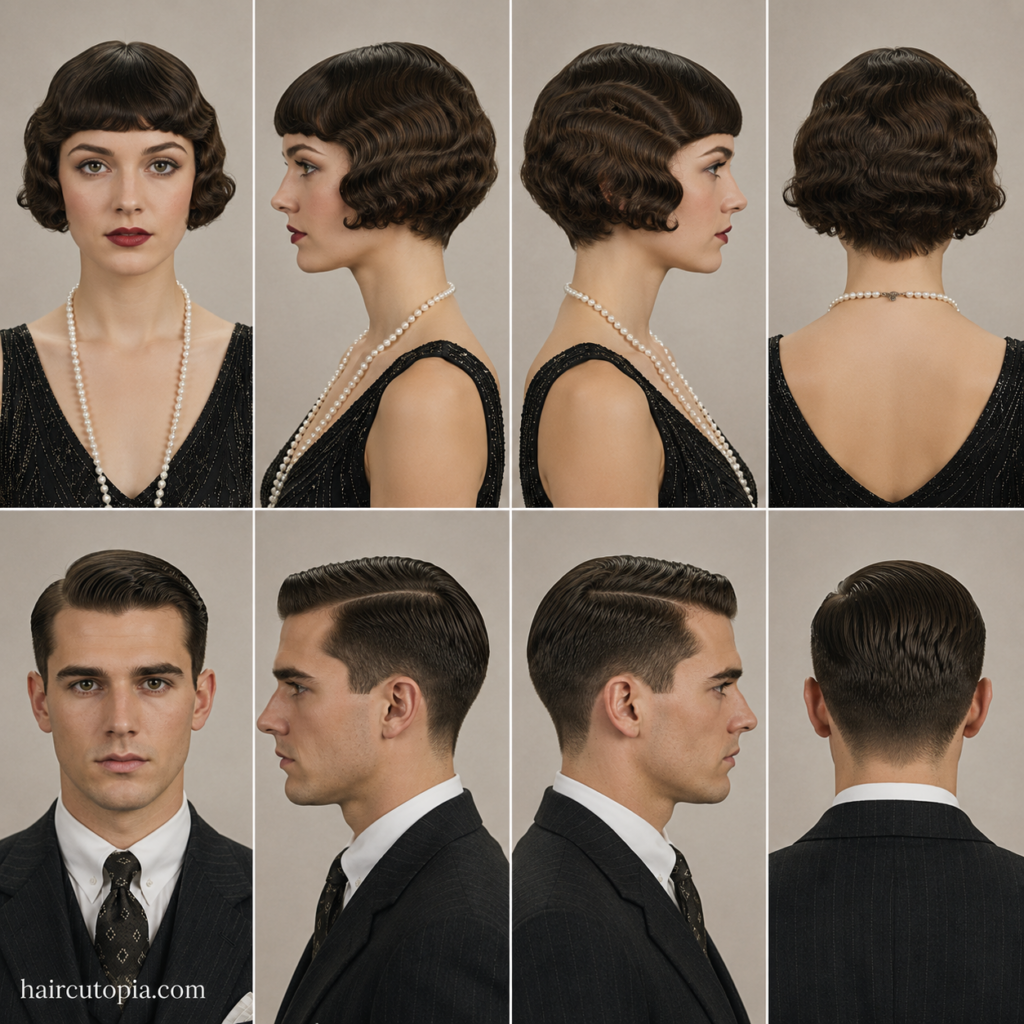
The bob takes the title easily.
Other cuts may have been shorter, more daring, or more technically interesting, but none became as closely associated with the decade.
The bob also served as a starting point for numerous variations.
It could become:
- Blunt
- Shingled
- Ear-length
- Jaw-length
- Tapered
- Curved
- Fringed
Styling added even more possibilities.
That combination of simplicity and adaptability helped transform the bob from a fashion statement into a permanent part of haircutting.
What Was the Most Iconic Men’s Haircut of the 1920s?
Men’s hair doesn’t have one single named cut equivalent to the women’s bob.
Instead, the defining look was a structure: short and neat around the sides and back with enough length on top for polished styling.
A classic taper combined with a side part probably comes closest to the quintessential 1920s men’s haircut.
The same basic structure could also support slicked-back or naturally wavy styling.
Its influence remains visible in traditional barber cuts today.
How 1920s Haircuts Differed From Hairstyles
It’s easy to mix up historical haircuts and hairstyles.
The haircut is the underlying shape created by cutting the hair.
The hairstyle is what happens afterward.
For example, a woman might have a jaw-length bob haircut.
She could then wear that same cut:
- Straight
- Finger-waved
- Marcel-waved
- Side-parted
- Curled at the ends
Likewise, a man might have a traditional tapered haircut and style it with a side part one day and slick it backward another.
Separating the cut from the styling makes it easier to understand just how versatile 1920s hair could be.
How to Ask for a 1920s-Inspired Haircut Today
You don’t need to walk into a salon or barbershop and request an exact historical reproduction.
In many cases, a modern interpretation will be more practical.
For a women’s 1920s-inspired cut, you might ask for:
- A blunt jaw-length bob
- An ear-length bob
- A short French-style bob
- A tapered bob
- A close crop with longer front sections
- A short bob with full bangs
For a men’s interpretation, consider:
- A classic taper
- A traditional side-part cut
- Short back and sides with a longer top
- A low taper with enough length to slick back
- A scissor-cut top with softly tapered sides
Reference photos are especially useful because historical haircut names can mean slightly different things depending on the source.
How to Make an Iconic 1920s Cut Look Modern
The easiest approach is to keep the underlying shape and update the finish.
A blunt bob can be worn with natural texture rather than a perfectly polished surface.
A short crop can have softer edges.
A men’s taper can retain the classic proportions while using a matte styling product instead of a glossy finish.
Other options include:
- Adding subtle layers to a bob
- Keeping natural curls visible
- Using softer bangs
- Choosing a less severe taper
- Leaving more texture through men’s hair
- Using finger waves only around the front
- Pairing a historical silhouette with contemporary styling
The haircut provides the reference to the era without requiring the entire look to feel vintage.
Which 1920s Haircuts Are Still Popular Today?
Several iconic cuts survived remarkably well.
The bob is the clearest example.
Blunt bobs, French bobs, micro bobs, jaw-length bobs, and short cropped bobs all continue to appear in modern salons.
Women’s close crops also became permanent parts of hair fashion.
Men’s traditional tapers never really disappeared either.
The biggest survivors include:
- Blunt bobs
- Jaw-length bobs
- Ear-length bobs
- Short crops
- Classic men’s tapers
- Short-back-and-sides cuts
- Side-part-friendly men’s cuts
What changed most was the styling surrounding them.
Modern versions may use more texture, less shine, softer finishing, or more individualized shapes.
The basic haircut ideas remain surprisingly familiar.
Frequently Asked Questions About 1920s Iconic Haircuts
What haircut defined the 1920s?
The bob was the defining women’s haircut of the 1920s. Its popularity helped make short hair a mainstream fashion choice and inspired numerous variations throughout the decade.
What is a 1920s shingle haircut?
A shingle is a short women’s cut in which the hair becomes progressively shorter toward the back and nape. Longer sections around the sides can preserve some of the appearance of a bob.
What was the Eton crop?
The Eton crop was an extremely short women’s haircut associated with the 1920s. It sat close to the head and created a sleek, somewhat androgynous silhouette.
Did everyone have a bob in the 1920s?
No. Although bobbed hair became highly fashionable, many women continued to wear their hair long. Long hair could be pinned, rolled, or styled into a faux bob to imitate a shorter silhouette.
What haircuts did men have in the 1920s?
Men typically wore relatively short sides and backs with additional length on top. Classic tapers and short-back-and-sides cuts supported popular side-parted and slicked-back hairstyles.
Did men have fades in the 1920s?
Men’s hair was tapered shorter toward the sides and neckline, but these cuts generally shouldn’t be confused with the dramatic skin fades common today. The transitions were typically softer and more traditionally blended.
Are 1920s haircuts still fashionable?
Yes. Bobs, short crops, traditional men’s tapers, and short-back-and-sides haircuts remain popular. Modern styling often makes them look contemporary rather than overtly vintage.
What’s the difference between a bob and a shingle?
A traditional bob maintains more length around the perimeter. A shingle becomes significantly shorter toward the back and nape, creating a closer, more tapered silhouette.
Why 1920s Haircuts Still Matter
The iconic haircuts of the 1920s matter because many of them changed what people considered normal.
The bob helped establish short hair as a lasting option for women.
The shingle and Eton crop pushed that idea further, demonstrating that women’s hair could be cropped, tapered, and shaped in ways previously associated more strongly with men’s grooming.
Meanwhile, men’s classic tapers and short-back-and-sides cuts helped establish barbering silhouettes that have survived for generations.
That’s the lasting legacy of 1920s haircuts.
Some immediately evoke the Roaring Twenties. Others have become so deeply integrated into modern hair fashion that we barely think of them as historical anymore.
A century later, we’re still cutting variations of them.

Related Posts
 1920s Haircuts and Hairstyles: The Complete Guide to the Decade That Changed Hair Forever
 1920s Women’s Hair: Iconic Haircuts and Hairstyles of the Roaring Twenties
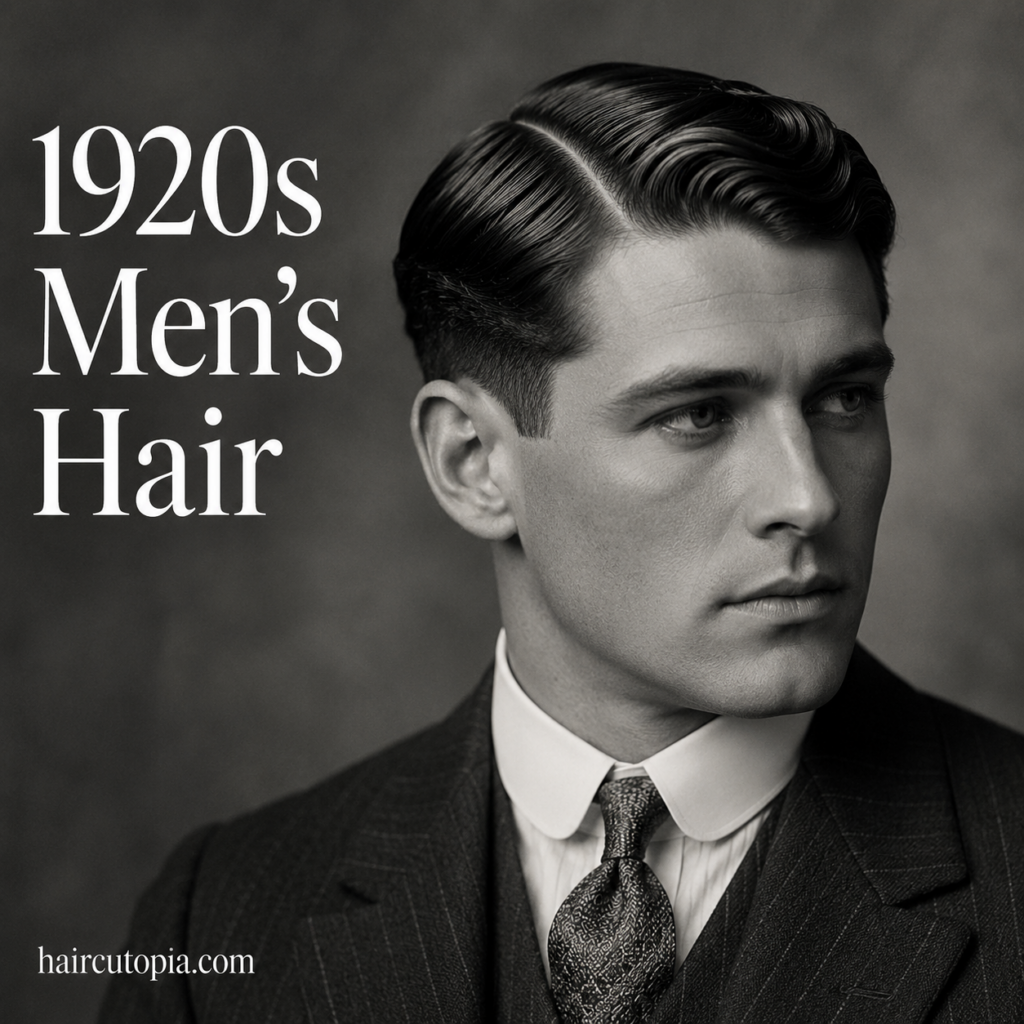 1920s Men’s Hair: Classic Haircuts and Hairstyles of the Roaring Twenties
 1930s Haircuts and Hairstyles: The Complete Guide to Elegant Vintage Hair Trends