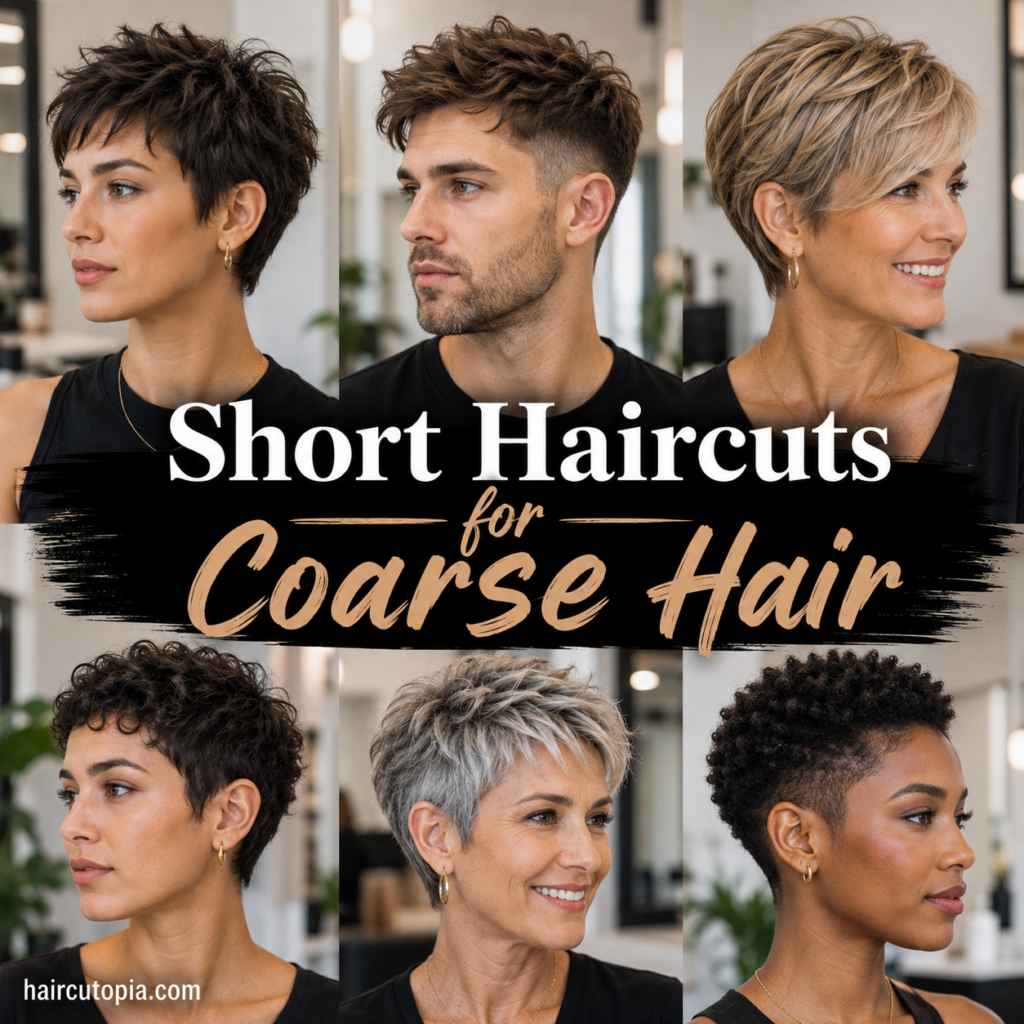
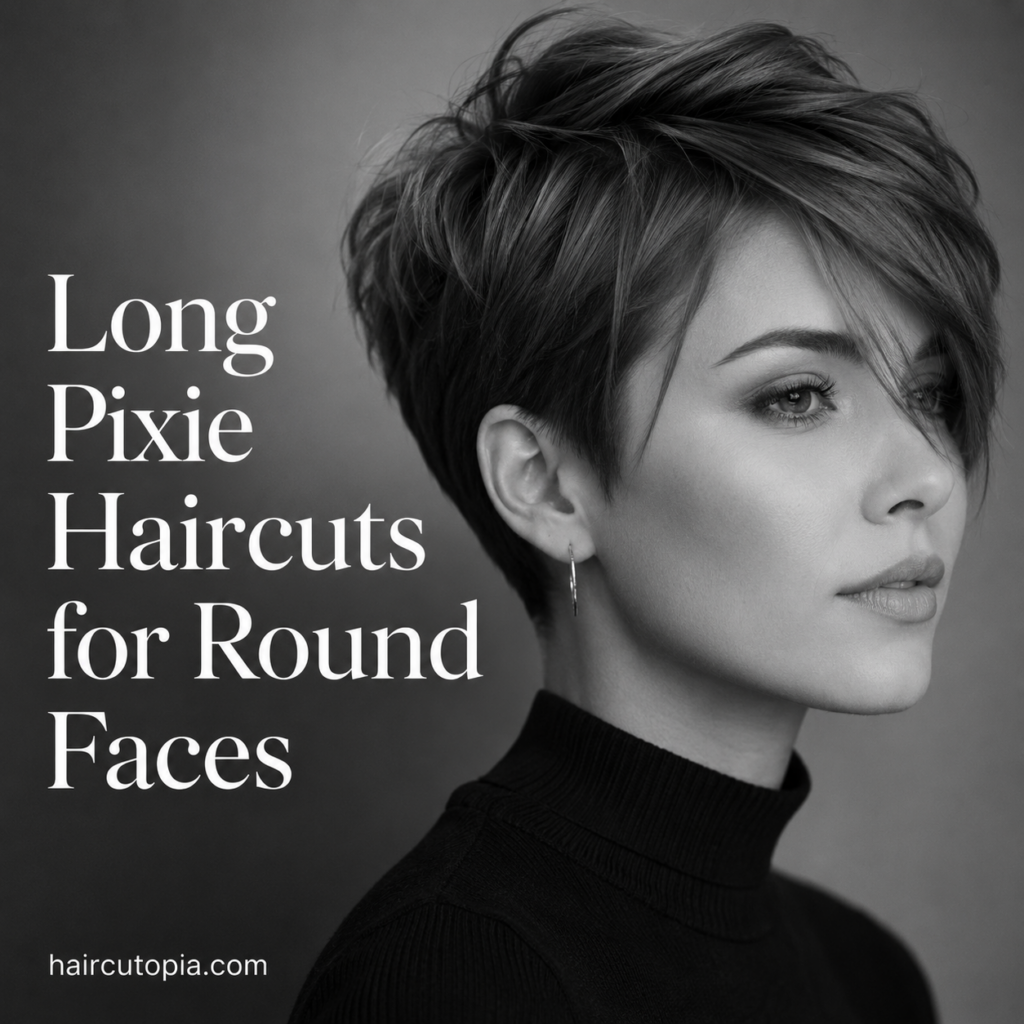
Long pixie haircuts can be surprisingly flattering on round faces. The key is choosing a shape that creates movement, adds visual height, and keeps the haircut from feeling too wide around the cheeks.
Unlike a traditional short pixie, a long pixie leaves extra length through the top, fringe, or sides. That additional hair gives you more styling options and allows your stylist to customize the cut around your facial features.
You can wear it sleek and polished one day, then tousled and textured the next. Side-swept bangs, choppy layers, and longer crown sections can also subtly elongate the appearance of a round face without making the haircut feel overly structured.
If you’re thinking about going shorter but aren’t ready for an ultra-cropped style, a long pixie may be the ideal middle ground.
Why Long Pixie Haircuts Work for Round Faces
Round faces typically have softer angles, fuller cheeks, and similar measurements through the width and length of the face. That doesn’t mean you need to “hide” your face shape. A good haircut simply works with those natural proportions.
Long pixie cuts are particularly versatile because the shape can be adjusted in several areas.
A stylist can leave more length at the crown to create height. The sides can be kept slightly closer to the head, while longer bangs can move diagonally across the forehead.
These details help guide the eye vertically rather than emphasizing width.
Some of the most flattering elements include:
- Volume concentrated at the crown
- Longer, side-swept bangs
- Asymmetrical shapes
- Piecey or choppy texture
- Tapered sides and nape
- Layers that move away from the cheeks
- Deep side parts
The goal isn’t to follow a strict set of face-shape rules. Think of these features as tools your stylist can use to balance the overall silhouette of your haircut.
Best Long Pixie Haircuts for Round Faces
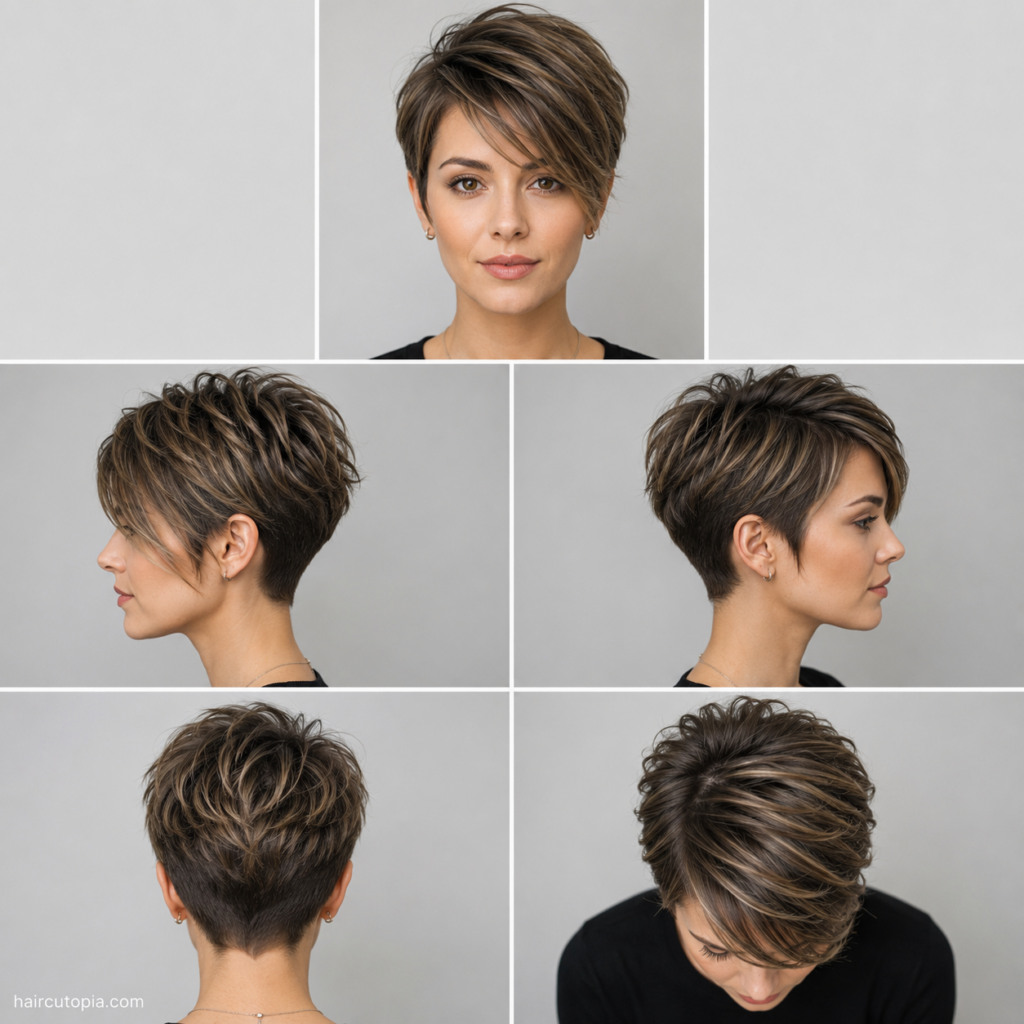
There isn’t just one version of a long pixie. Depending on your hair texture, density, and styling preferences, the cut can look soft, edgy, polished, or intentionally undone.
Long Pixie with Side-Swept Bangs
Side-swept bangs are one of the easiest additions to a long pixie haircut for a round face.
Instead of cutting the fringe straight across the forehead, the bangs are left longer and styled diagonally toward one side. This creates an angled line across the face and adds movement around the forehead.
The bangs can be soft and feathered or slightly heavier depending on your hair density.
For a more relaxed finish, allow a few pieces to separate naturally rather than styling the fringe into one solid section.
Layered Long Pixie Cut
Layers give a long pixie shape and movement.
For round faces, layers are often most effective when they create volume toward the upper part of the haircut rather than adding excessive fullness near the cheeks.
Shorter crown layers can provide lift, while longer pieces through the front maintain softness.
A layered pixie also works well for women who like a slightly tousled hairstyle. A small amount of texturizing product can define individual sections without making the hair look stiff.
Asymmetrical Long Pixie
An asymmetrical pixie features noticeably more length on one side of the haircut.
The longer side may fall toward the cheekbone or jaw, while the opposite side remains shorter and more tapered.
This uneven shape creates strong visual movement and can make a round face appear slightly longer.
An asymmetrical pixie is also a good choice if you want something modern without committing to an undercut or extremely short sides.
Long Pixie with Volume on Top
Strategically placed volume can completely change the appearance of a pixie haircut.
Instead of creating width around the sides, the hair is styled upward or slightly backward at the crown.
This vertical shape visually lengthens the overall silhouette.
You don’t need dramatic height. Even subtle root lift can make a difference.
A lightweight volumizing mousse or root spray can help support the crown without making the hair feel heavy.
Choppy Long Pixie Haircut
Choppy layers create a more casual, textured finish.
The stylist uses varied layer lengths to prevent the haircut from appearing too rounded or uniform. Individual pieces naturally separate, giving the pixie more dimension.
This style works particularly well with naturally straight or slightly wavy hair.
For styling, use a small amount of matte paste or texture cream. Work the product through the ends with your fingertips rather than applying it heavily at the roots.
Long Pixie Bob
A pixie bob sits somewhere between a traditional pixie and a short bob.
The back is usually shorter and shaped around the nape, while the front sections remain noticeably longer.
For round faces, a pixie bob can be especially flattering when the front pieces extend below the cheekbones.
A side part can further enhance the angled shape.
This haircut is a great option for anyone who wants a short hairstyle but still likes having some length around the face.
Long Pixie with Curtain Bangs
Curtain bangs aren’t limited to long hair.
A longer pixie can incorporate soft fringe that separates near the center or slightly off-center. The bangs then move outward toward the temples.
For round faces, the fringe should generally remain light and airy rather than thick and completely covering the forehead.
Longer curtain pieces can create subtle framing around the cheekbones.
Shaggy Long Pixie
A shaggy pixie has an intentionally relaxed appearance.
Layers are distributed throughout the haircut, creating movement and a slightly messy texture. The crown often has additional volume, while the ends remain light and piecey.
This haircut is ideal for women who prefer hairstyles that don’t need to look perfectly polished.
Natural waves can enhance the shaggy texture, but straight hair can achieve a similar finish with texturizing spray.
Long Pixie with a Deep Side Part
Sometimes changing the part can be just as important as changing the haircut.
A deep side part creates an asymmetrical line across the top of the head. One side gains additional volume while the other remains smoother.
This contrast can help break up the naturally symmetrical appearance of a round face.
Longer front layers can then sweep across the forehead or tuck behind the ear.
Tapered Long Pixie
A tapered pixie gradually becomes shorter toward the sides and nape.
The top remains longer, giving you plenty of styling flexibility.
Keeping the lower portion of the haircut close to the head prevents unnecessary width around the face. Meanwhile, the longer crown can be styled with volume or texture.
A tapered pixie can look sophisticated when worn smooth or more modern when styled with separated layers.
Long Pixie with Wispy Bangs
Wispy bangs create softness without forming a heavy horizontal line across the forehead.
The fringe is lightly textured so small sections of the forehead remain visible.
This can work beautifully with a round face because the bangs add detail without visually shortening the face.
Wispy fringe also blends naturally into longer side layers.
Wavy Long Pixie Haircut
Natural waves can add beautiful movement to a long pixie.
The important consideration is where the volume sits.
Instead of encouraging maximum fullness around the cheeks, your stylist may shape the layers so the waves build texture through the crown and upper sections.
A lightweight curl cream can help define the wave pattern.
Allowing the hair to air-dry can create a softer, more natural finish.
Sleek Long Pixie
A sleek pixie creates a clean, polished silhouette.
The hair may be styled with a deep side part and smooth front section that follows the shape of the head.
For round faces, keeping some height at the crown can prevent the haircut from appearing overly flat.
A smoothing cream and light finishing spray can control flyaways without removing all natural movement.
Long Pixie with an Undercut
An undercut removes additional length from one or both sides beneath the longer top section.
The contrast creates a bold, modern shape.
Because the sides remain close to the head, the longer top becomes the main visual focus. Styling the upper layers upward or diagonally can create additional length through the silhouette.
If a visible undercut feels too dramatic, ask your stylist about a hidden undercut beneath the longer layers.
Choosing Bangs for a Round Face and Long Pixie
Bangs can dramatically influence the shape of a long pixie haircut.
For many round faces, diagonal or textured fringe works particularly well because it creates movement across the forehead.
Popular options include:
- Side-swept bangs
- Wispy fringe
- Long asymmetrical bangs
- Soft curtain bangs
- Piecey textured fringe
Blunt, heavy bangs can still work, but they create a stronger horizontal line. If you love that look, your stylist may add texture or slightly vary the length to soften the overall shape.
Your forehead height, hairline, and natural growth pattern should also influence your fringe choice.
Cowlicks aren’t necessarily a problem. In some cases, they can actually help create natural lift or movement.
How Long Should a Pixie Be for a Round Face?
There is no exact length that works for every person.
However, long pixie haircuts generally leave enough hair through the top or front to create visible movement.
The fringe may reach the eyebrows, cheekbones, or even the jaw depending on the style.
For a pixie bob, the front sections often extend past the cheekbones while the back remains significantly shorter.
The crown length is equally important. Leaving several inches through the top allows the hair to be styled upward, backward, or toward the side.
When discussing length with your stylist, bring reference photos that show both the front and side views of the haircut you like.
Long Pixie Haircuts for Different Hair Textures
Your natural hair texture plays an important role in how a pixie behaves between salon visits.
Fine Hair
Fine hair can benefit from strategic layering, but excessive texturizing may remove too much density.
A stylist may keep the overall shape slightly fuller while adding shorter layers near the crown.
Volumizing mousse and lightweight texture spray can help create lift.
Avoid applying heavy waxes or oils near the roots.
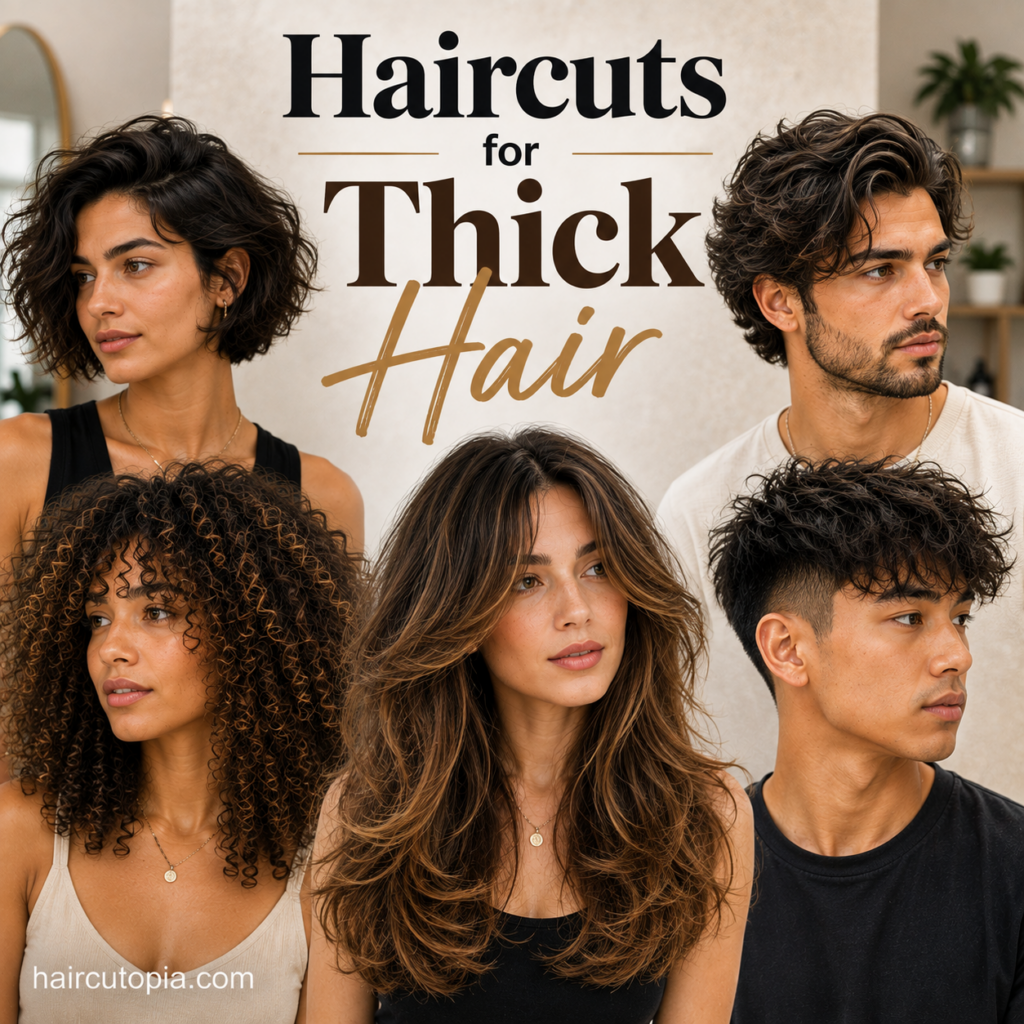
Thick Hair
Thick hair often needs internal weight removal to prevent a long pixie from becoming bulky.
Your stylist may use point cutting or other texturizing techniques to create movement within the haircut.
Tapered sides can also help control excessive width.
The longer top layers can then be styled into a smooth sweep or piecey texture.
Wavy Hair
Wavy hair naturally creates movement, making it ideal for relaxed pixie styles.
A layered or shaggy pixie can encourage the natural wave pattern.
Use lightweight styling products that provide definition without making the hair crunchy.
You may also find that your haircut looks slightly different each day, which can be part of its appeal.
Curly Hair
Curly pixie cuts can be shaped to create height and definition.
A stylist experienced with curly hair can distribute volume through the crown while controlling the overall width of the haircut.
Longer curls around the front can create beautiful movement.
Because curls shrink as they dry, discuss your preferred finished length before the haircut begins.
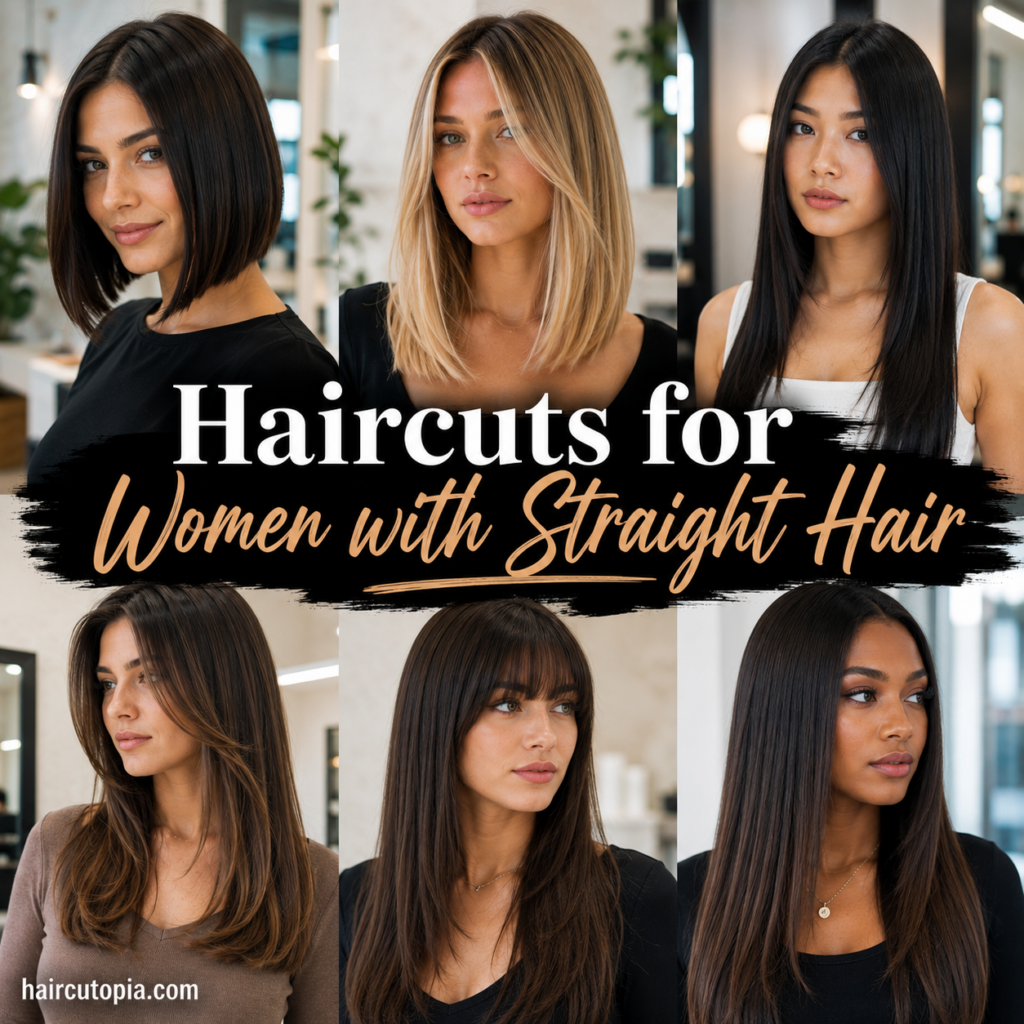
Straight Hair
Straight hair works well with sleek, asymmetrical, and choppy pixie styles.
Texture can be added through layering and styling products.
If your hair naturally lies very flat, shorter crown layers may help create lift.
A round brush or small styling brush can also add shape while blow-drying.
How to Style a Long Pixie for a Round Face
One advantage of a long pixie is that styling doesn’t need to be complicated.
A simple routine can usually create plenty of shape.
- Start with damp, towel-dried hair.
- Apply a lightweight volumizing product near the roots.
- Blow-dry the crown upward or slightly backward.
- Direct the front layers diagonally toward your preferred side.
- Use your fingers to separate individual pieces.
- Apply a small amount of texture cream or paste to the ends.
- Finish with flexible-hold hairspray if needed.
Avoid applying too much product at once. Pixie cuts can quickly look heavy when overloaded with wax or styling cream.
Start with a small amount and add more only where you need additional definition.
Easy Styling Ideas for a Long Pixie
You don’t need to wear your pixie the same way every day.
Try experimenting with different finishes.
Tousled and Textured
Apply texture spray and gently scrunch the hair with your fingers.
Lift the crown slightly and allow the front pieces to fall naturally.
Smooth and Side-Swept
Create a deep side part.
Blow-dry the longer fringe across the forehead and finish with smoothing cream.
Brushed Back
Direct the longer top layers away from the face.
Use a lightweight styling cream to maintain movement.
Piecey and Defined
Apply a small amount of matte paste to your fingertips.
Pinch individual ends to create visible separation.
Soft and Wavy
Use your natural wave pattern or create a few loose bends with a small styling iron.
Keep the waves relaxed rather than perfectly uniform.
What to Ask Your Stylist For
Clear communication can make a major difference when getting a pixie haircut.
Instead of simply asking for “a long pixie,” describe the specific shape you want.
You might say:
“I’d like a long pixie with extra length through the top and front. I want some height at the crown and a side-swept fringe, but I’d prefer the sides to stay fairly close to my head.”
You can also discuss:
- How much daily styling you’re comfortable doing
- Whether you normally air-dry or blow-dry
- How often you’re willing to get trims
- Whether you want to tuck the hair behind your ears
- Your preferred fringe length
- How much texture you like
Reference photos are extremely helpful. Ideally, choose examples with hair texture similar to your own.
How Often Does a Long Pixie Need Trimming?
Most long pixie haircuts benefit from a trim every six to eight weeks.
Shorter tapered styles may need maintenance closer to every four to six weeks.
The haircut won’t suddenly stop working after that point, but the shape will gradually change as the sides and nape grow.
Longer pixie bobs can often go slightly longer between appointments.
If you’re growing your pixie out, your stylist can adjust the layers during each visit to keep the haircut balanced throughout the transition.
Common Long Pixie Mistakes to Avoid
A long pixie is highly customizable, but a few styling and cutting choices can make the haircut more difficult to manage.
Common mistakes include:
- Creating too much volume directly beside the cheeks
- Overusing heavy styling products
- Removing too much density from fine hair
- Ignoring natural cowlicks and growth patterns
- Cutting bangs without considering shrinkage or wave
- Choosing a haircut based only on a front-view photo
- Skipping regular shape-maintenance trims
Your hair texture and natural growth pattern matter just as much as face shape.
A haircut that works with your hair will usually be easier to style than one that requires constant correction.
Are Long Pixie Haircuts Good for Round Faces?
Yes. Long pixie haircuts can be extremely flattering for round faces because they offer so much control over shape, height, and movement.
Longer crown layers can create vertical lift. Side-swept bangs introduce diagonal lines, while tapered sides help maintain a streamlined silhouette.
You can also adapt the haircut to match your personal style.
A sleek asymmetrical pixie feels polished and modern. A shaggy layered pixie has a softer, more relaxed personality. A long pixie bob offers additional length for anyone who isn’t ready for a dramatically short haircut.
The most important factor is customization.
Rather than choosing a pixie solely because it’s labeled “good for round faces,” look at your hair texture, density, styling routine, and favorite features. A skilled stylist can adjust the length and layers to create a haircut that feels natural to you.
Final Thoughts
Long pixie haircuts for round faces can be soft, sophisticated, edgy, or effortlessly casual.
The extra length of a long pixie gives you room to experiment with side-swept bangs, asymmetrical layers, crown volume, and textured finishes. Small changes in styling can also transform the haircut from smooth and polished to messy and piecey.
If you’re considering a pixie, focus on creating a balanced silhouette rather than following rigid face-shape rules.
Choose a version that works with your natural texture and fits the amount of styling you actually want to do each morning.
With the right layers and shape, a long pixie can feel lightweight, modern, and surprisingly versatile.