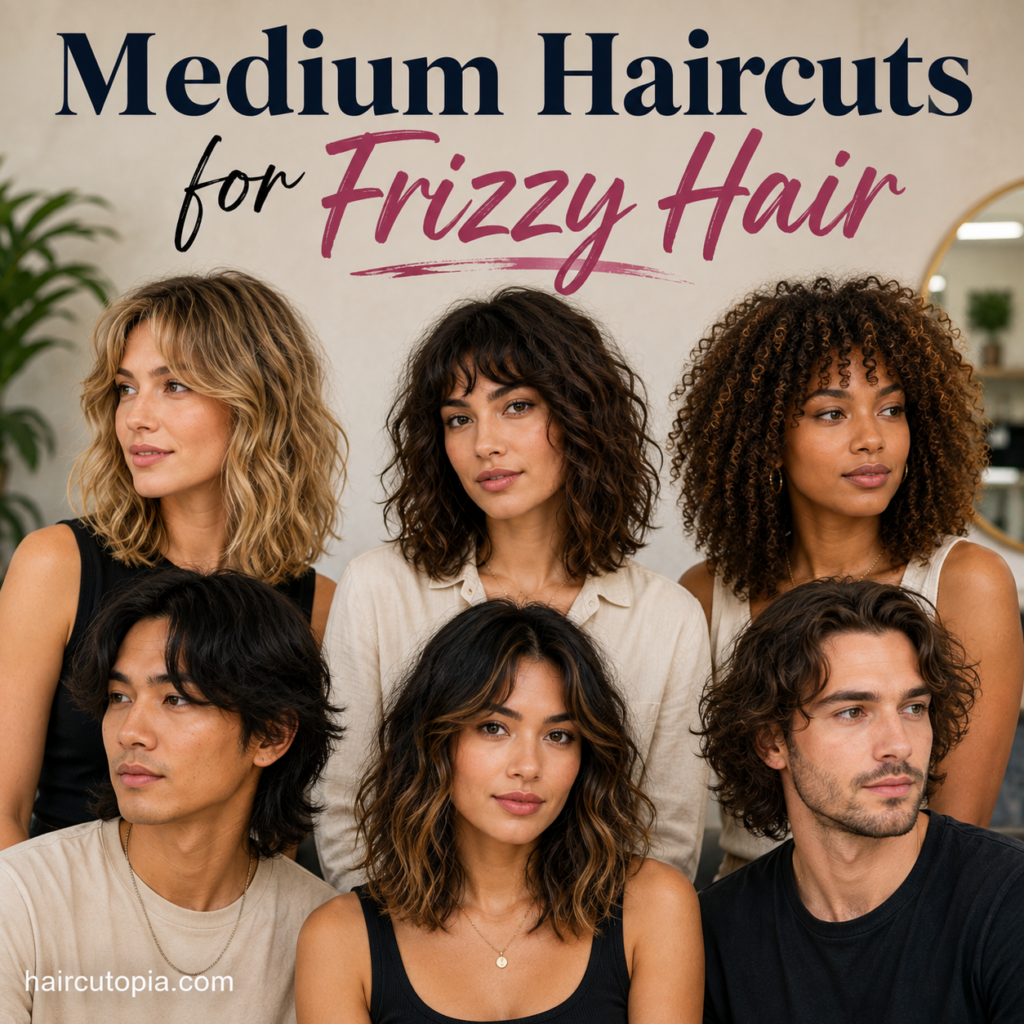
Medium-length hair can be a sweet spot when you’re dealing with frizz. You have enough length for the hair’s natural weight to help control excess volume, but not so much that styling becomes an all-day project.
The trick is finding the right shape.
Frizzy hair doesn’t automatically need heavy thinning or dozens of layers. Depending on whether your hair is fine, thick, wavy, curly, or mostly straight, those techniques can sometimes make frizz even more noticeable.
A good medium haircut works with the way your hair naturally expands, bends, or curls. From collarbone-length lobs to soft shags and longer layered cuts, there are plenty of options that let you keep your texture without constantly reaching for a flat iron.
Why Medium-Length Hair Works Well for Frizzy Hair
One of the biggest advantages of medium hair is weight.
When frizz-prone hair is cut very short, removing length can also remove some of the weight that keeps it controlled. Hair that seemed relatively tame at shoulder length may suddenly become much fuller when cut above the jaw.
Medium hair gives you more room to balance that volume.
It also offers plenty of styling flexibility. You can wear it naturally wavy or curly, straighten it occasionally, pull it into a ponytail, or put it into a loose updo when you don’t feel like styling it.
For many people, somewhere between the shoulders and collarbone is particularly manageable.
Best Medium Haircuts for Frizzy Hair
The right haircut depends on more than frizz alone. Hair density, natural texture, shrinkage, and your daily styling routine all matter.
Here are some of the most versatile medium-length options.
1. Textured Lob
The textured lob is an easy starting point for frizz-prone hair.
Usually falling somewhere around the shoulders or collarbone, it provides enough length to maintain weight while subtle texture keeps the shape from feeling heavy.
This cut works especially well for naturally wavy hair because it doesn’t need to look perfectly smooth.
A slightly tousled finish actually suits the style.
2. Collarbone-Length Lob
If you’re nervous about removing too much length, try a collarbone-length lob.
It’s long enough to tie back while still giving you the fresh feeling of a noticeably shorter haircut.
The extra length can also help weigh down hair that tends to expand dramatically in humidity.
You can keep the perimeter fairly full or introduce subtle layers depending on your density.
3. Shoulder-Length Blunt Cut
Layers aren’t mandatory for frizzy hair.
A blunt shoulder-length cut can be particularly flattering for fine or medium-density hair because it maintains fullness through the ends.
The stronger perimeter also gives the haircut a deliberate shape even when individual strands aren’t perfectly smooth.
For very thick hair, however, some internal weight removal may be needed to prevent the bottom from becoming overly bulky.
4. Medium Layered Haircut
Well-placed layers can transform thick, frizzy hair.
Instead of allowing all the volume to collect around the ends, layers redistribute movement throughout the haircut.
The key is moderation.
Too many short layers can cause frizz-prone hair to expand. Longer layers tend to provide movement while preserving enough weight to keep the shape manageable.
5. Long-Layered Lob
Want layers without dramatically changing the overall shape?
A long-layered lob is a good compromise.
The perimeter stays relatively substantial while longer layers create movement through the middle and ends.
This can work especially well for thick hair that feels heavy but becomes fluffy when aggressively layered.
6. Wavy Lob
If your hair naturally forms waves, you don’t necessarily need to straighten them out.
A wavy lob is designed around movement.
The length gives waves enough room to form while preventing the hair from becoming excessively heavy. Slight frizz can blend naturally into the texture rather than standing out as an obvious problem.
For everyday styling, a lightweight curl or wave product may be all you need.
7. Curly Lob
A medium-length curly lob gives curls plenty of room to form while keeping the overall shape manageable.
Depending on your curl pattern, the cut can sit around the shoulders when dry or extend closer to the collarbone.
Dry length is important here.
Curly hair can shrink considerably, so discuss where you want the finished haircut to fall rather than judging the length only while the hair is wet.
8. Medium Shag
The shag is a natural match for hair with texture.
Its layered shape encourages movement and doesn’t depend on a perfectly smooth finish. Waves, curls, and a bit of frizz can actually enhance the deliberately undone look.
A medium shag usually includes layers around the crown and throughout the length.
If your hair is especially thick or prone to expanding, consider a softer shag with longer layers rather than very short, choppy ones.
9. Soft Shag
Not everyone wants the dramatic layers of a traditional shag.
A soft shag keeps the same relaxed character but uses less extreme layering.
It’s particularly useful if you want movement around the face and crown while maintaining weight through the lower portion of the hair.
The result feels casual without looking overly choppy.
10. Shoulder-Length Hair with Face-Framing Layers
Sometimes you only need layers around the front.
Face-framing pieces can soften a medium haircut without removing a large amount of weight from the rest of your hair.
Depending on your face shape and texture, these pieces might begin around the cheekbones, jawline, or chin.
They’re also a simple way to refresh an existing shoulder-length haircut without making a dramatic change.
11. Medium Hair with Curtain Bangs
Curtain bangs pair naturally with medium-length hair.
Because they’re longer and parted rather than cut straight across the forehead, they can be more forgiving when humidity or natural texture changes the way your hair sits.
They look especially good with:
- Medium shags
- Wavy lobs
- Layered shoulder-length cuts
- Collarbone-length hair
- Curly and textured styles
If your bangs are particularly prone to frizz, keeping them slightly longer usually gives you more styling options.
12. Rounded Medium Cut
Thick, curly, and highly textured hair doesn’t always need to be made smaller.
Sometimes the better approach is giving the volume a deliberate shape.
A rounded medium haircut distributes fullness around the head rather than allowing it to collect at the bottom.
This can create a beautifully balanced silhouette on curls and coils.
13. U-Shaped Medium Cut
A U-shaped haircut is slightly longer through the center back and gradually shorter toward the sides.
The difference can be subtle, but it helps soften the perimeter compared with a completely straight line.
Long layers can also be incorporated into the shape for additional movement.
This is a good option if you like keeping some length but want your haircut to feel less heavy.
14. Clavicut
As the name suggests, the clavicut typically falls around the clavicle or collarbone.
It’s essentially that comfortable middle ground between a traditional bob and longer hair.
For frizz-prone hair, this length offers an important advantage: weight.
There’s enough hair to help control expansion while still creating a defined medium-length silhouette.
It also grows out gracefully, which is helpful if you don’t want frequent salon appointments.
15. Side-Parted Medium Cut
Sometimes changing the shape around your face makes as much difference as adding more layers.
A medium haircut with a side part can create natural volume at the crown and allow textured hair to fall asymmetrically around the face.
This works particularly well for waves and loose curls.
You can pair the part with long layers or keep the overall haircut relatively blunt.
Medium Haircuts for Thick, Frizzy Hair
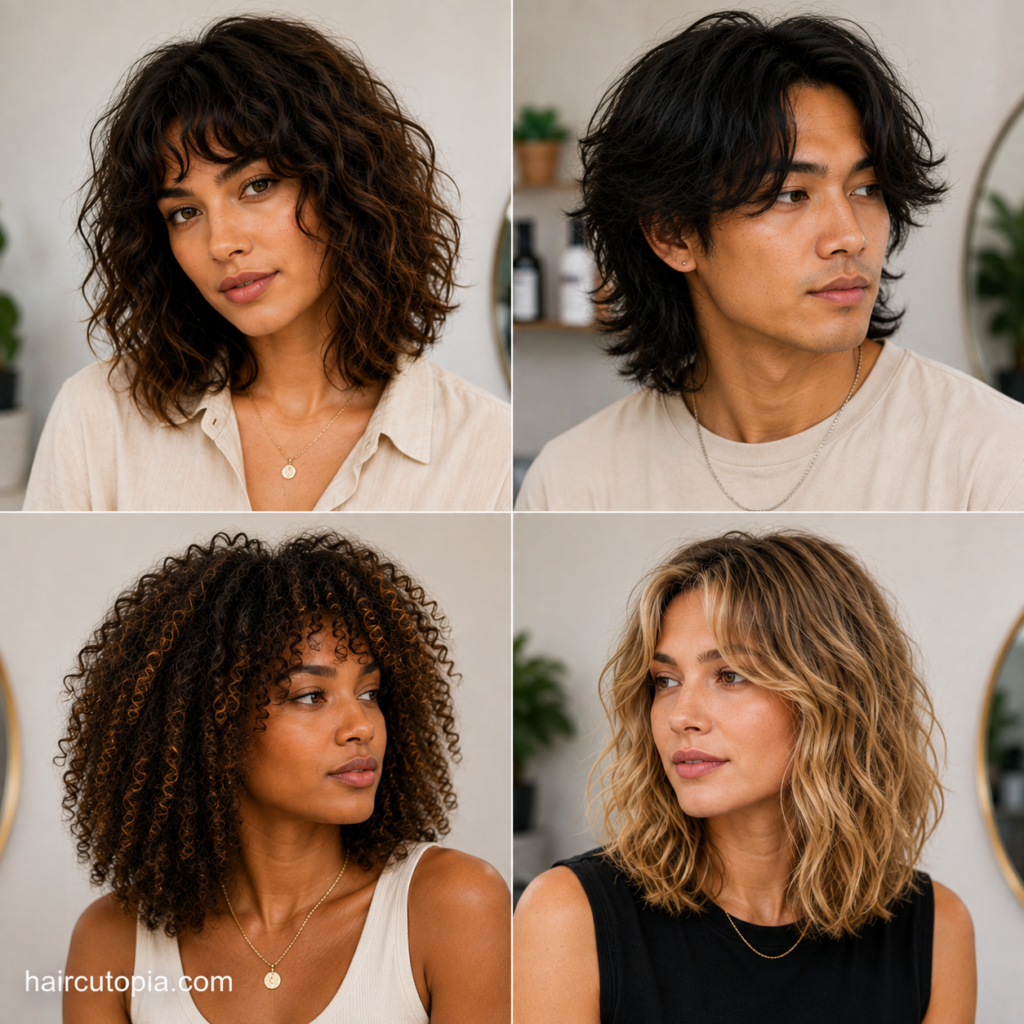
Thick frizzy hair presents an interesting challenge.
You may want to remove some of the bulk, but removing too much can create even more volume.
The goal is usually strategic weight distribution.
Good medium haircuts for thick, frizzy hair include:
- Long-layered lobs
- Collarbone-length cuts
- Soft shags
- Medium layered cuts
- Rounded curly cuts
- U-shaped cuts
Instead of automatically asking your stylist to thin your hair heavily, explain which areas feel bulky.
Internal layering or targeted weight removal may give you the shape you want without creating lots of short pieces that become difficult to control.
Medium Haircuts for Fine, Frizzy Hair
Fine hair can become frizzy without having much overall volume.
That’s why excessive layering can be counterproductive. Removing too much density may leave the ends looking thin while flyaways become more noticeable.
Cuts with a stronger perimeter often work well.
Consider:
- Blunt shoulder-length cuts
- Collarbone-length lobs
- Lightly textured lobs
- Clavicuts
- Medium cuts with minimal face-framing layers
Keep styling products lightweight too.
Heavy oils and rich creams may reduce some visible frizz but can quickly make fine hair look flat.
Medium Haircuts for Wavy, Frizzy Hair
Medium length and wavy hair are a particularly useful combination.
There’s enough length for waves to develop naturally, while carefully placed layers can prevent the hair from forming a heavy triangular shape.
Wavy lobs, medium shags, long layers, and collarbone-length cuts are all worth considering.
Before choosing a haircut from a photo, look at the model’s natural texture.
A style photographed on straight hair after a professional blowout may behave very differently on naturally wavy hair.
Look for examples that resemble the way you actually wear your hair.
Medium Haircuts for Curly, Frizzy Hair
With curly hair, frizz isn’t necessarily a sign that something has gone wrong.
A certain amount of frizz can simply be part of the hair’s natural texture.
A good medium curly haircut focuses on shape and curl distribution rather than trying to eliminate every flyaway.
Popular options include:
- Curly lobs
- Rounded medium cuts
- Layered curly cuts
- Soft curly shags
- Shoulder-length curls with face-framing pieces
Shrinkage should always factor into the decision.
If your curls become significantly shorter as they dry, tell your stylist exactly where you’d like the finished shape to sit.
Are Layers Good for Medium Frizzy Hair?
They can be.
Layers are useful for creating movement and redistributing bulk, particularly on thick, wavy, or curly hair.
But more layers aren’t automatically better.
Short layers remove weight. On hair that already tends to expand, that can create additional volume around the crown or sides.
Longer layers are often a safer starting point because they provide movement while maintaining some control.
Fine hair may need even less layering to preserve density through the ends.
The best approach depends on how your hair behaves when it’s dry, not simply whether it’s frizzy.
Should Frizzy Hair Be Thinned Out?
This is one of those questions without a universal yes-or-no answer.
Removing some internal bulk from extremely thick hair can make a haircut feel lighter and easier to manage.
Aggressive thinning, however, isn’t always ideal.
When lots of shorter pieces are created throughout the hair, those pieces may spring outward instead of lying with the longer strands. Depending on your texture, this can make the overall haircut appear frizzier.
Ask your stylist about strategic weight removal rather than simply requesting that your hair be “thinned out.”
Is Medium or Short Hair Better for Frizzy Hair?
Neither is automatically better.
Medium hair retains more weight, which can help control hair that expands easily. It also gives you more options for tying the hair back.
Short hair removes that weight but can simplify styling and create a more defined shape.
If you’re unsure about going short, medium length is a useful transition.
You can always remove more later.
How to Style Medium Frizzy Hair
The right haircut makes styling easier, but your routine still matters.
Fortunately, you don’t need ten different products.
Apply Products to Damp Hair
It’s generally easier to manage frizz before the hair has completely dried.
Depending on your texture, that might mean using:
- Leave-in conditioner
- Lightweight styling cream
- Curl cream
- Mousse
- Gel
- Anti-frizz serum
You don’t necessarily need all of them. Choose products based on your hair’s density and natural texture.
Dry Gently
Roughly rubbing wet hair with a towel creates friction and can disturb waves and curls.
Instead, squeeze or blot out excess moisture.
A microfiber towel or soft cotton T-shirt can be useful if traditional towels leave your hair noticeably fluffier.
Use a Diffuser for Waves and Curls
If you don’t have time to air-dry, a diffuser can help dry textured hair without blasting the curl pattern apart.
Try not to constantly move or touch the hair while it’s drying.
The more you disturb forming waves and curls, the more separation and frizz you’re likely to create.
Use Heat Protection
If you prefer a smooth blowout or occasionally straighten your hair, use an appropriate heat protectant.
Medium hair gives you plenty of styling versatility, but frequent high heat can leave the hair feeling dry and make frizz more noticeable over time.
Finish Lightly
It’s easy to go overboard with finishing products.
Start small.
A tiny amount of serum or lightweight oil through the ends may be enough. Applying too much can turn a soft, airy haircut into one that looks heavy or greasy.
What to Ask Your Stylist
Photos are helpful, but your stylist also needs to understand how your hair behaves when you’re not sitting in a salon chair.
Before getting your haircut, explain:
- Whether you usually air-dry or blow-dry.
- How often you straighten your hair.
- Where your hair becomes the most frizzy or bulky.
- How much your waves or curls shrink.
- Whether you need to be able to tie your hair back.
- How much styling time you want to spend each morning.
- What you dislike about your current haircut.
You can also bring photos of your own hair on a typical day.
That can be more informative than arriving with freshly straightened hair if you normally wear it naturally.
Common Haircut Mistakes With Frizzy Hair
A few seemingly harmless choices can make medium frizzy hair harder to manage.
Adding Too Many Short Layers
Short layers can create beautiful volume, but they’re not ideal for everyone.
If your hair already expands easily, excessive layering can make the shape wider than expected.
Removing Too Much Weight
This is particularly important with thick hair.
Reducing bulk can help, but aggressively thinning the hair may create shorter strands that don’t blend smoothly with the rest of the haircut.
Choosing a Style Based Only on Straightened Hair
If you wear your natural texture most days, choose a haircut that works with it.
A cut that looks incredible after a professional blowout but awkward after air-drying probably isn’t going to make your life easier.
Forgetting About Shrinkage
This matters most for waves, curls, and coils.
Always consider where the haircut will sit when completely dry.
Cutting Bangs Too Short
Frizz and humidity can make bangs shrink, bend, or lift.
Longer curtain bangs and sweeping fringe generally provide more room for adjustment than very short bangs.
How Often Should Medium Frizzy Hair Be Trimmed?
Medium hair tends to be fairly forgiving as it grows.
Many people find that trimming somewhere around every eight to twelve weeks keeps the shape looking fresh, although your ideal schedule may be shorter or longer.
Highly structured cuts may need reshaping sooner.
A shag, long-layered lob, or clavicut can often grow for longer without looking noticeably overdue.
Instead of following a strict schedule, pay attention to how your haircut behaves. If the ends are becoming difficult to style or the shape starts feeling bulky and unbalanced, it’s probably time for a trim.
How to Choose the Best Medium Haircut for Your Frizz
Start by considering what your hair does naturally.
Does it form loose waves? Tight curls? Does it stay relatively straight but develop flyaways? Is it extremely thick, or are the individual strands fine?
Those details matter more than frizz alone.
Next, consider your routine.
Someone who loves blow-drying and styling their hair can choose a very different haircut from someone who wants to shower, apply one product, and leave the house.
Finally, look for haircut inspiration featuring people with hair similar to yours.
You don’t need to find an exact match, but seeing how a particular shape behaves on comparable density and texture can give you a much more realistic idea of the result.
Final Thoughts
Medium haircuts are a great option for frizzy hair because they provide a useful balance between control and movement.
You still have enough length to benefit from the hair’s natural weight, but you can introduce layers, texture, and face-framing pieces without committing to a very short cut.
Textured lobs, clavicuts, soft shags, curly shoulder-length cuts, and long-layered styles are all strong options. The right one depends on your density, natural texture, and how much styling you’re willing to do.
And remember, the goal doesn’t have to be completely eliminating frizz.
A haircut that works with natural volume and texture will usually be easier to live with than one that requires you to make your hair perfectly smooth every morning.
Related Posts
 Haircuts for Frizzy Hair: The Complete Guide to Cuts for Every Length and Texture
 Haircuts for Coarse Hair: The Complete Guide to Cuts for Every Length and Texture
 Haircuts for Thick Hair: The Complete Guide to Flattering Cuts for Every Length and Texture
 Haircuts for Women with Frizzy Hair: 15 Flattering Styles for Natural Texture