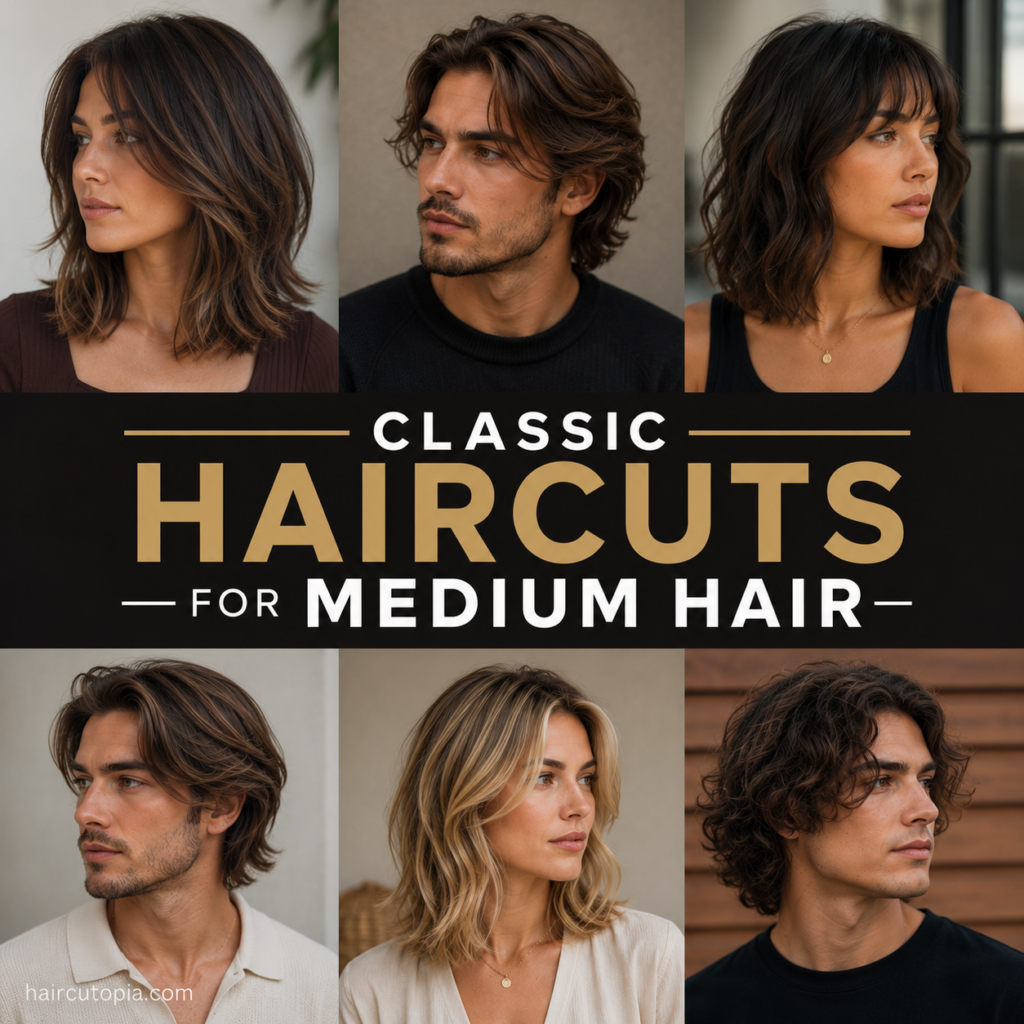
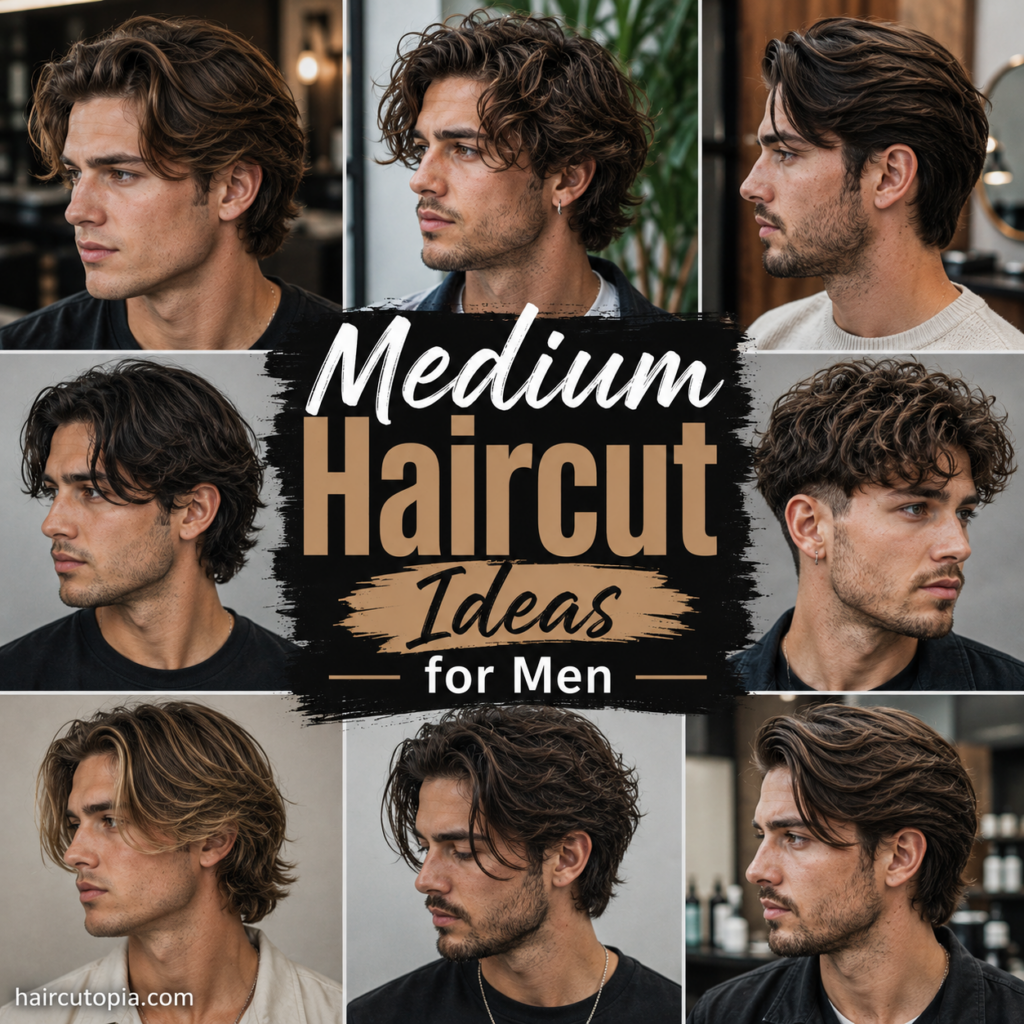
Medium-length hair hits a sweet spot for a lot of men. There’s enough length to create texture, movement, volume, and different shapes, but it usually doesn’t come with the commitment of genuinely long hair.
That flexibility is what makes medium haircuts so useful.
You can keep things polished with a side part or swept-back style, go casual with loose texture, embrace natural curls and waves, or combine a longer top with tapered or faded sides. Even small changes in length can give the same haircut a completely different personality.
If you’re thinking about growing out a short cut or simply want something with more styling options, these medium haircut ideas for men cover classic, modern, professional, textured, curly, wavy, and low-maintenance styles.
What Is Considered Medium-Length Hair for Men?
There isn’t one exact measurement that defines medium hair.
Generally, men’s medium-length hair is long enough to noticeably move, part, sweep back, or fall forward but isn’t yet long enough to behave like a traditional long hairstyle.
That often means roughly 3 to 6 inches of length, although the appearance varies considerably depending on texture.
Three inches of tightly curled hair, for example, will look very different from three inches of straight hair.
Medium hair also doesn’t mean every part of the haircut needs to be the same length. Many popular styles keep substantial length on top while tapering or fading the sides.
Classic Medium Haircuts for Men
Classic styles are a good starting point if you want additional length without chasing a particular trend.
Medium Side Part
The side part is one of the most versatile men’s hairstyles.
With medium-length hair, there’s enough length for the part to develop naturally while still allowing the hair to sweep across the top.
You can keep the sides relatively full for a traditional appearance or taper them for a cleaner silhouette.
A medium side part works particularly well when you want a haircut that can transition easily between professional and casual settings.
Medium Slick Back
A slick back uses the additional length of medium hair to direct everything away from the forehead.
The finished style doesn’t necessarily have to look wet or heavily gelled. Modern slick backs often use lighter products that allow some natural texture to remain visible.
For a more relaxed version, use your fingers instead of a comb.
Classic Taper
A classic taper gradually shortens the hair around the sideburns and neckline while retaining more length throughout the sides and top.
Unlike a dramatic fade, the transition tends to be subtle.
That makes the taper especially useful when you’re growing your hair longer but still want the edges to look intentional and tidy.
Medium Scissor Cut
Not every men’s haircut needs clippers.
A medium scissor cut maintains more natural weight and movement throughout the head. Instead of creating a sharp contrast between long and short sections, the barber can use layers to shape the hair and control bulk.
This approach works particularly well for wavy, thick, and naturally textured hair.
Modern Medium Haircut Ideas for Men
Medium hairstyles have become increasingly relaxed. Rather than forcing every strand into a precise shape, many modern cuts work with natural texture.
Textured Medium Hair
Texture prevents medium hair from looking like one solid block.
Layers can create separation and movement, while styling products can emphasize the natural shape of individual sections.
Textured medium hair works well with:
- Straight hair
- Thick hair
- Wavy hair
- Loose curls
- Tapered sides
- Faded sides
It can be styled forward, upward, backward, or simply allowed to fall naturally.
Messy Medium Hair
The messy look works especially well once hair gains enough length to move.
The goal isn’t to leave your hair completely unstyled. A good messy hairstyle still has an intentional shape underneath.
Ask your barber or stylist for enough layering to encourage movement, then use a small amount of lightweight product to separate sections with your fingers.
Medium Hair With Tapered Sides
If you like having length but don’t want the sides becoming bulky, a taper provides a useful compromise.
The hair becomes gradually shorter around the edges without removing as much length as a traditional fade.
This can make the haircut easier to grow out because the transition between the top and sides remains relatively soft.
Medium Hair With a Fade
A fade creates more contrast.
The sides become progressively shorter while medium-length hair remains above. Depending on how dramatic you want the difference to be, you can choose a low, mid, or high fade.
The combination works with quiffs, curls, textured tops, pompadours, and swept-back hairstyles.
Medium Fade Haircut Ideas
Fade placement changes the proportions of a medium haircut more than you might expect.
Low Fade With Medium Top
A low fade begins close to the ears and neckline, leaving most of the sides relatively full.
This produces a softer transition into a medium-length top.
It’s a good choice if you want the clean finish of a fade without creating an extreme difference between the sides and top.
Mid Fade With Medium Hair
The mid fade begins higher on the sides and creates more visible contrast.
It works particularly well when the top has noticeable texture or volume because the shorter sides make that shape stand out.
High Fade With Medium Top
A high fade removes significantly more hair from the sides.
The result is a bolder haircut where almost all of the visual weight sits on top.
High fades can work well with thick hair because they remove considerable bulk, although the contrast isn’t for everyone.
Drop Fade With Medium Hair
A drop fade curves downward behind the ears rather than following a straight line around the head.
That curved transition can complement textured tops, curls, and hairstyles that maintain more length toward the back.
Medium Textured Haircut Ideas for Men
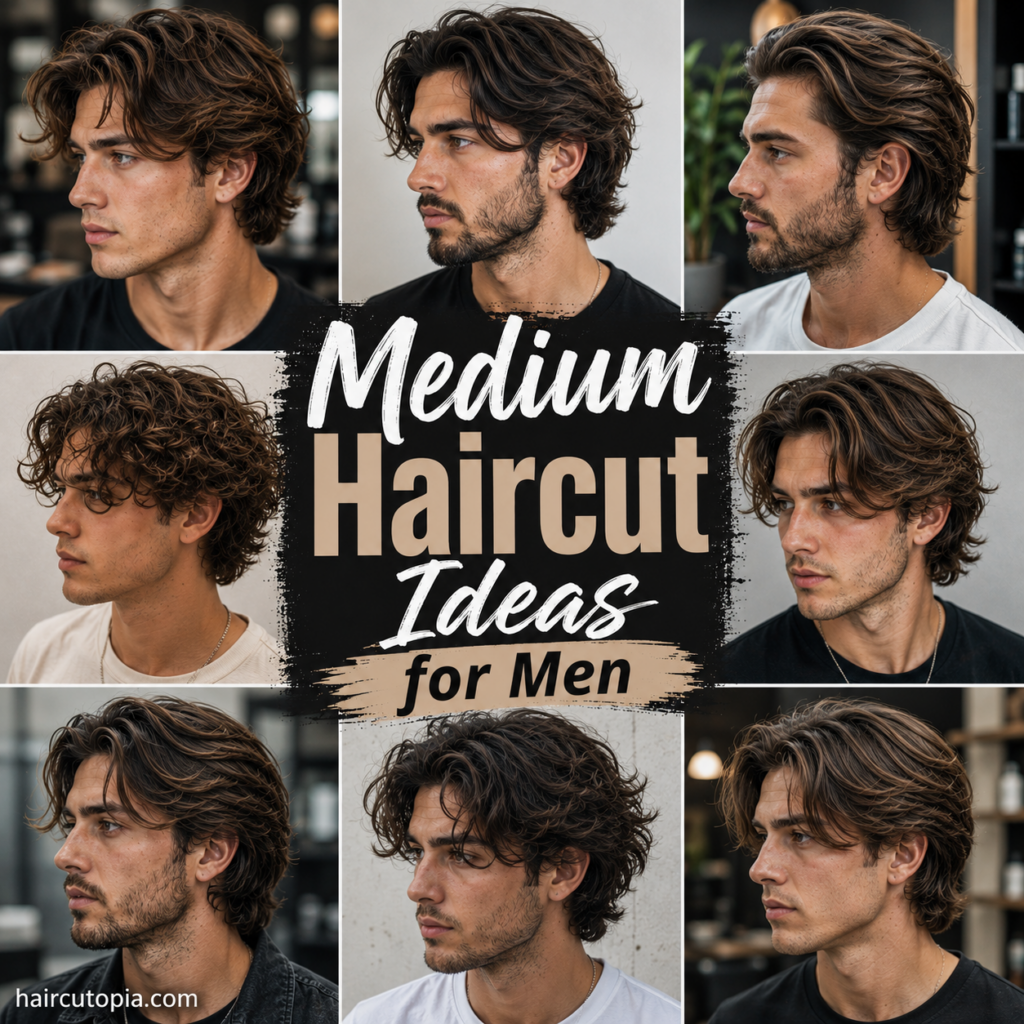
Medium length gives you much more room to experiment with texture than a very short haircut.
Textured Quiff
A textured quiff creates height toward the front without requiring every strand to be perfectly aligned.
The hair can be lifted upward and slightly backward, with visible separation throughout.
A matte clay, paste, or lightweight styling product can help create the shape while preserving a natural finish.
Textured Fringe
Instead of pushing the hair away from the forehead, a textured fringe allows some of it to fall forward.
The fringe can be straight, choppy, uneven, wavy, or curly.
It’s an especially useful option if you prefer hairstyles that don’t require a defined part.
Tousled Medium Hair
Tousled hair has a softer appearance than a structured quiff or slick back.
Layers help the hair move naturally rather than sitting in one uniform shape.
This style can be particularly effective with naturally wavy hair because much of the texture is already there.
Layered Medium Hair
Layers remove weight from selected areas while allowing other sections to retain length.
For thick hair, layering can prevent the hairstyle from becoming overly bulky. For wavy or curly hair, it can help individual sections move more freely.
The exact layering pattern should be adapted to your hair density and texture rather than applied uniformly.
Medium Haircuts for Straight Hair
Straight hair can show the shape of a medium haircut very clearly.
That can be an advantage for structured styles such as side parts, curtains, slick backs, and layered cuts.
Good options include:
- Medium side part
- Swept-back hair
- Layered scissor cut
- Medium quiff
- Curtains
- Textured fringe
- Bro flow
If your hair naturally lies very flat, layering can create movement while blow-drying can add temporary volume.
Medium Haircuts for Wavy Hair
Natural waves and medium length are an especially useful combination.
At shorter lengths, the wave pattern may not have enough room to develop. As the hair grows, those bends become more noticeable and can provide texture without much styling.
Wavy Side Part
A side part doesn’t need to be perfectly straight or polished.
Allowing waves to remain visible creates a softer version of the traditional style.
Wavy Fringe
A medium fringe can highlight your natural wave pattern around the forehead.
It can be worn loosely across the front or directed slightly to one side.
Wavy Bro Flow
Bro flow allows medium-length hair to move backward and away from the face naturally.
Instead of creating a rigid slicked-back shape, the hair retains its bends, volume, and movement.
This is a good option if you’re gradually moving from medium to longer hair.
Wavy Taper
A taper cleans up the sideburns and neckline without removing the natural waves throughout the rest of the haircut.
It’s a simple way to make grown-out hair look more deliberate.
Medium Haircuts for Curly Hair
Medium length allows curls to develop considerably more definition and personality.
Rather than cutting the curls extremely short, you can use the additional length to make them a central part of the hairstyle.
Medium Curly Top
Keeping curls longer on top while shortening the sides creates a clear shape without sacrificing texture.
The sides can be tapered, faded, or cut with scissors depending on how much contrast you prefer.
Curly Fringe
A curly fringe lets several curls fall naturally toward the forehead.
The length can range from a subtle front section to a more substantial fringe.
Because curls shrink as they dry, it’s important to account for shrinkage when deciding how short to cut them.
Curly Taper
A taper can keep medium curly hair neat around the edges while preserving volume throughout the rest of the head.
This creates a softer appearance than a high or skin fade.
Curly Fade
For greater contrast, pair medium curls with faded sides.
Low fades preserve more overall fullness, while higher fades place much more emphasis on the curls above.
Medium Haircuts for Thick Hair
Thick hair gives you plenty of material to work with, but medium length can become bulky if the haircut isn’t shaped properly.
Simply cutting everything shorter isn’t always the answer.
Strategic layering, texturizing, and weight removal can help the hair move without eliminating its natural density.
Consider:
- Layered medium cuts
- Textured quiffs
- Medium taper cuts
- Swept-back styles
- Wavy scissor cuts
- Medium fades
- Side-part hairstyles
Talk to your barber about where your hair feels heaviest. Removing weight selectively can often produce a better result than aggressive thinning throughout the entire head.
Medium Haircuts for Fine or Thin Hair
Medium length can work with fine hair, but going too long may cause it to lie flat.
The goal is usually to preserve enough density while introducing some movement.
Styles worth considering include:
- Medium side part
- Loose quiff
- Textured fringe
- Layered top
- Natural sweep
- Medium taper
Avoid automatically assuming that more layers will create more volume. Excessive layering can sometimes make fine hair appear thinner by removing too much density.
Lightweight products are generally a better choice than heavy waxes or gels that cause strands to clump together.
Medium-Length Fringe Haircuts
Fringes offer a completely different direction from styles that expose the forehead.
Straight Fringe
A straight fringe creates a defined shape across the front.
It can be cut cleanly for a sharper appearance or softened with texture.
Side-Swept Fringe
Instead of allowing the fringe to fall directly forward, the hair is directed diagonally across the forehead.
This works especially well when transitioning from shorter hair because it doesn’t require extreme length.
Messy Fringe
A messy fringe uses uneven texture and separation to create a relaxed appearance.
Rather than establishing a perfect line across the forehead, different sections fall naturally.
Curtain Fringe
Curtain hairstyles divide the front into two sections, usually around the middle or slightly off-center.
The hair then moves outward on either side of the face.
Medium length is ideal for this because the front needs enough length to create the characteristic sweeping movement.
Curtain Haircuts for Men
Curtains have returned in different forms over the years, and modern versions don’t necessarily look like the heavily styled center parts of previous decades.
The part can be:
- Directly in the center
- Slightly off-center
- Loose and undefined
- Combined with waves
- Combined with a taper
- Layered around the face
Straight hair can create a cleaner curtain shape, while waves give the style more movement.
Curtains are also useful when growing your hair because the longer front sections can transition naturally into other medium and long hairstyles.
Medium Quiff Haircuts
A quiff directs the front of the hair upward and backward, creating height.
With medium hair, you have enough length to create substantial volume without needing an especially long haircut.
Classic Medium Quiff
The classic version tends to have a smoother finish and clearly defined shape.
Messy Quiff
A messy quiff retains the height but introduces more texture and separation.
Quiff With Taper
Tapered sides create a subtle transition while maintaining some fullness around the head.
Quiff With Fade
A fade increases the contrast between the voluminous top and shorter sides.
The higher the fade, the more dramatic that contrast becomes.
Medium Pompadour Haircuts
The pompadour shares some similarities with the quiff, but the hair is generally swept farther backward and styled into a more continuous shape.
Medium length provides enough hair to create volume at the front while carrying that shape toward the crown.
Modern pompadours don’t always need a shiny finish. Matte products can create a looser, more contemporary version.
If your hair is particularly thick, some internal weight removal may make the style easier to control.
Bro Flow Hairstyles
Bro flow is designed around natural movement rather than sharp structure.
The hair is typically brushed or encouraged backward, where it naturally bends around the sides of the head.
It works especially well with:
- Wavy hair
- Thick hair
- Medium-to-long hair
- Natural texture
One advantage of bro flow is that it can serve as a transitional hairstyle while growing your hair longer. If that’s your goal, exploring long haircut ideas for men can help you decide whether you’re ultimately aiming for shoulder-length hair, longer layers, waves, curls, or tied-back styles.
Instead of constantly trimming the top, you can focus on cleaning up the neckline and controlling excess bulk as the length develops.
Shaggy Medium Haircuts for Men
A shag uses layers to create movement throughout the haircut.
Rather than keeping the perimeter perfectly neat, shaggy styles deliberately embrace a less structured silhouette.
Modern men’s shags can include:
- Layered fringes
- Longer side sections
- Texture around the crown
- Natural waves
- Loose curls
- Tapered edges
This isn’t necessarily a low-maintenance haircut from the barber’s perspective. Good layering is important if you want the style to look intentionally relaxed instead of simply overgrown.
Medium Hair With an Undercut
An undercut creates a stronger separation between the top and sides than a fade or taper.
The top remains medium or longer while the sides are cut significantly shorter, often without a gradual blend connecting the two lengths.
You can wear the top:
- Slicked back
- Side parted
- Textured
- Messy
- Swept forward
- In a quiff
Because of the dramatic length difference, an undercut tends to have a bolder appearance than a classic taper.
Professional Medium Haircuts for Men
Medium hair can absolutely work in professional environments.
The key is usually maintaining a deliberate shape rather than simply allowing a short haircut to grow indefinitely.
Good professional options include:
- Classic taper
- Medium side part
- Neat scissor cut
- Controlled slick back
- Ivy League grown to medium length
- Subtle quiff
- Swept-back hairstyle
Keeping the neckline and areas around the ears tidy can make longer hair look significantly more polished.
You can also choose a flexible cut that looks structured at work but becomes more relaxed when styled with your fingers outside the office.
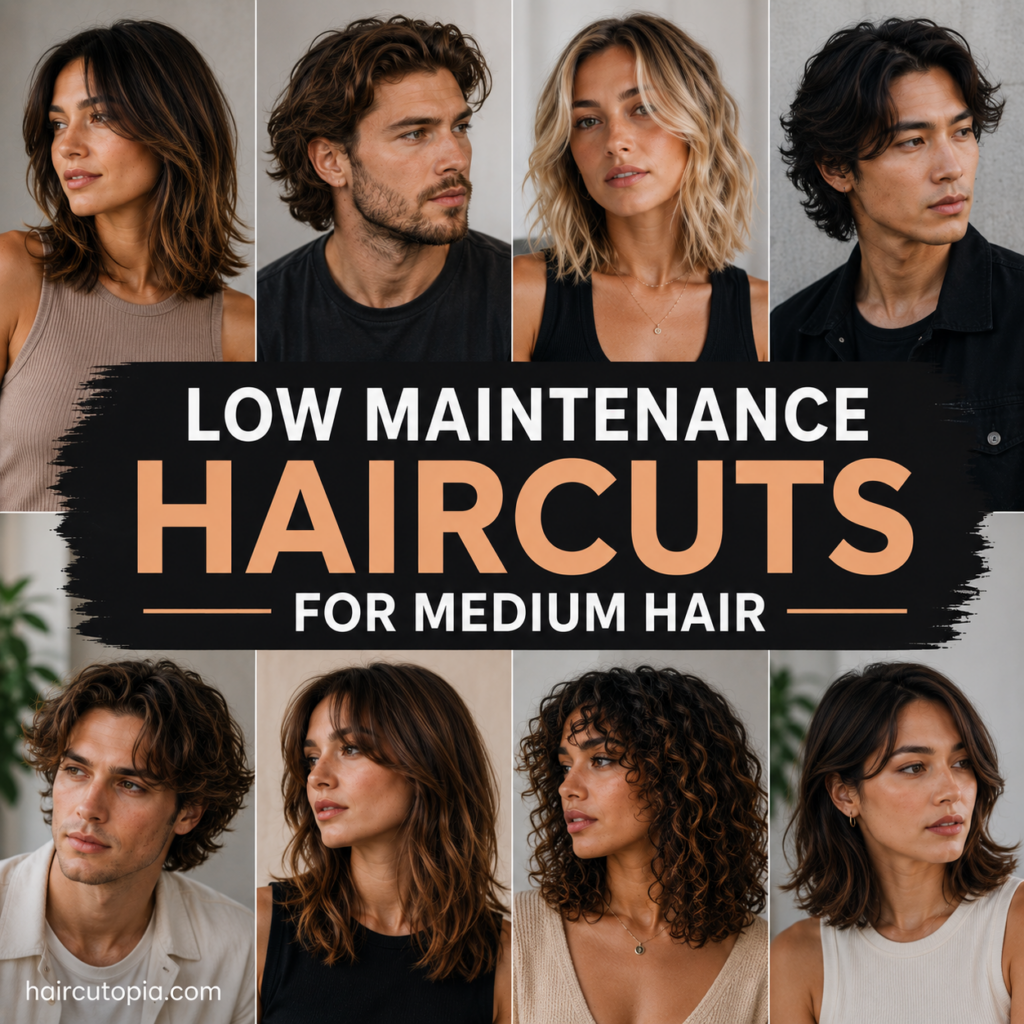
Low-Maintenance Medium Haircuts for Men
Medium hair generally requires more attention than a buzz cut, but some styles are easier than others.
If you don’t want to spend much time styling, work with your natural growth pattern rather than fighting it.
Good options include:
- Natural wavy scissor cut
- Medium taper
- Bro flow
- Loose side part
- Textured crop grown to medium length
- Layered curly cut
- Tousled medium hairstyle
The easier your haircut works with your natural texture, the less effort you’ll typically need to put into daily styling.
Medium Haircut Ideas With Beards
Medium hair and facial hair can create a balanced combination, especially when the transition around the sideburns is carefully shaped.
You don’t need your beard and haircut to have identical lengths.
In fact, contrast can work well.
Try combinations such as:
- Medium textured hair with stubble
- Slick back with a short boxed beard
- Wavy bro flow with a full beard
- Medium taper with a trimmed beard
- Curly top with short facial hair
- Side part with a classic beard
A taper or fade around the sideburns can help visually connect the haircut and beard.
Choosing a Medium Haircut for Your Face Shape
Face shape can provide some direction, but it shouldn’t determine your haircut by itself.
Hair texture, density, hairline, growth pattern, facial hair, and personal preference matter too.
Round Face
Styles with height and tighter sides can visually lengthen the face.
A quiff, swept-back style, or medium top with tapered sides can work well.
Square Face
Square faces pair naturally with both structured and textured medium hairstyles.
Consider side parts, swept-back styles, textured quiffs, and layered cuts.
Oval Face
Oval faces can usually accommodate a wide range of medium hairstyles.
Curtains, quiffs, slick backs, fringes, bro flow, and textured cuts are all possibilities.
Long or Oblong Face
Be careful about adding excessive height on top while removing too much volume from the sides.
Curtains, fringes, layered scissor cuts, and medium styles that retain some side volume can help maintain balance.
Heart-Shaped Face
Medium hairstyles that introduce texture and movement around the forehead and sides can complement a narrower jaw.
Curtains, side-swept fringes, layered cuts, and loose waves are all worth considering.
How to Grow Short Hair Into a Medium Hairstyle
Growing your hair out sounds simple—just stop cutting it—but transitioning from short haircut ideas for men into medium-length styles can involve some awkward stages.
Instead, continue getting occasional cleanup cuts.
Ask your barber or stylist to preserve the length you’re growing while addressing areas that become bulky or untidy.
A typical grow-out strategy might look like this:
- Decide roughly what hairstyle you’re growing toward.
- Allow the top and front to gain length.
- Keep the neckline relatively tidy.
- Reduce excess bulk around the sides when necessary.
- Gradually change how you style the hair as it gets longer.
- Avoid repeatedly cutting off the areas you’re trying to grow.
Reference photos are particularly useful during this process because they show your barber the eventual shape you’re trying to achieve.
How to Ask Your Barber for a Medium Haircut
“Medium length” can mean very different things to different people.
Instead of relying entirely on terminology, bring a few reference photos showing the length and shape you like.
Then discuss:
- How much length you want on top
- How long you want the fringe
- Whether the sides should remain full
- Whether you want a taper or fade
- How much weight should be removed
- Whether you want visible layers
- Your natural hair texture
- How you normally style your hair
- Whether you’re growing it longer
- How much maintenance you’re comfortable with
It’s also helpful to explain what you don’t like about your current haircut.
Sometimes knowing which problems you’re trying to solve is more useful than naming a particular style.
How to Style Medium-Length Hair for Men
Medium hair usually benefits from a little more preparation than short hair.
You don’t necessarily need an elaborate routine, though.
Try this basic approach:
- Start with clean or slightly damp hair.
- Gently remove excess moisture with a towel.
- Apply a small amount of appropriate styling product.
- Use a blow dryer if you need additional direction or volume.
- Shape the hair with your fingers or a comb.
- Add a small amount of finishing product only if necessary.
Avoid starting with too much product. Medium hair can become heavy surprisingly quickly.
It’s easier to add more than to remove excess product once it’s distributed through the hair.
Styling Products for Medium Hair
Different products create very different finishes.
Matte Clay
Clay can provide texture, separation, and stronger control without much shine.
It’s useful for quiffs and textured styles.
Styling Paste
Paste usually offers flexible hold and is easier to manipulate throughout the day.
It works well for casual, textured hairstyles.
Pomade
Pomade is a natural choice for slick backs, pompadours, and defined side parts.
Choose the level of shine based on the finish you want.
Styling Cream
Cream can provide light control while maintaining natural movement.
It’s particularly useful when you don’t want the hair to feel stiff.
Sea Salt Spray
Sea salt spray can enhance texture and create a more tousled appearance, especially on naturally wavy hair.
It can also provide some grip before blow-drying.
Curl Cream
For curly and wavy hair, curl creams can help encourage definition while reducing the need for heavy styling products.
How Often Should You Trim Medium Hair?
Medium hairstyles are generally more forgiving than very short fades when it comes to visible growth.
How frequently you need a trim depends on the style you’re maintaining.
A precise fade combined with a medium top may require relatively frequent cleanups because the short sides quickly lose definition.
A layered scissor cut or bro flow can often grow considerably longer before the overall shape changes.
Look for signs such as:
- Excessive bulk around the sides
- Hair becoming difficult to style
- The fringe falling farther than you want
- Layers losing their shape
- An untidy neckline
- Split or damaged ends
If you’re actively growing your hair, make that clear before the haircut begins so your barber doesn’t remove more length than necessary.
How to Choose the Right Medium Haircut
The best medium haircut isn’t necessarily the one that looks best in a single photo.
Think about how the style will work on an ordinary morning when you have five minutes to get ready.
Start with your natural hair.
If you have waves, a hairstyle that allows those waves to move freely may be easier than trying to straighten everything into place. If your hair is thick, a layered cut may be more manageable than keeping all that density at one length.
Then consider maintenance.
Do you want to blow-dry your hair every morning? Are you comfortable using styling products? How frequently do you want to visit the barber?
Finally, think about versatility.
Medium hair gives you room to change things up. A well-designed cut might be worn parted one day, swept backward the next, and loosely textured on the weekend.
That ability to experiment is one of the biggest advantages of medium-length hair.
Frequently Asked Questions About Medium Haircuts for Men
How long is medium-length hair for men?
There isn’t a universal measurement, but medium men’s hair is often around 3 to 6 inches long. Hair texture and the proportions of the haircut can make the same length appear shorter or longer.
What are good medium haircuts for men?
Popular options include side parts, textured quiffs, curtains, bro flow, slick backs, layered scissor cuts, medium fades, curly tops, fringes, and classic tapers.
Is medium-length hair hard to maintain?
It usually requires more styling than very short hair but can actually require fewer barber visits. Choosing a cut that works with your natural texture can significantly reduce daily maintenance.
Can men with thin hair have medium-length hairstyles?
Yes. Medium side parts, loose quiffs, textured fringes, and carefully layered styles can work with fine or thinning hair. Avoid excessive layering or heavy products that make the hair look separated or weighed down.
What medium haircut works best for thick hair?
Layered scissor cuts, textured quiffs, tapers, swept-back hairstyles, and medium fades can all help manage thick hair. Strategic weight removal is often more important than simply cutting the hair shorter.
What is a good medium hairstyle for curly hair?
Medium curly tops, curly fringes, tapered curls, and curly fades allow the natural curl pattern to remain visible while controlling the overall shape.
Should I get a taper or fade with medium hair?
Choose a taper if you want a softer, more gradual transition that preserves length around the sides. Choose a fade if you want greater contrast between the sides and the medium-length hair above.
Can medium hair look professional?
Yes. Classic tapers, side parts, controlled slick backs, neat scissor cuts, and subtle quiffs can all work well in professional environments. Keeping the neckline and edges tidy helps maintain a polished appearance.
What should I tell my barber when growing my hair out?
Explain the hairstyle or approximate length you’re working toward and make it clear that you want to preserve growth. Ask for a cleanup and reshaping rather than automatically requesting your usual haircut.