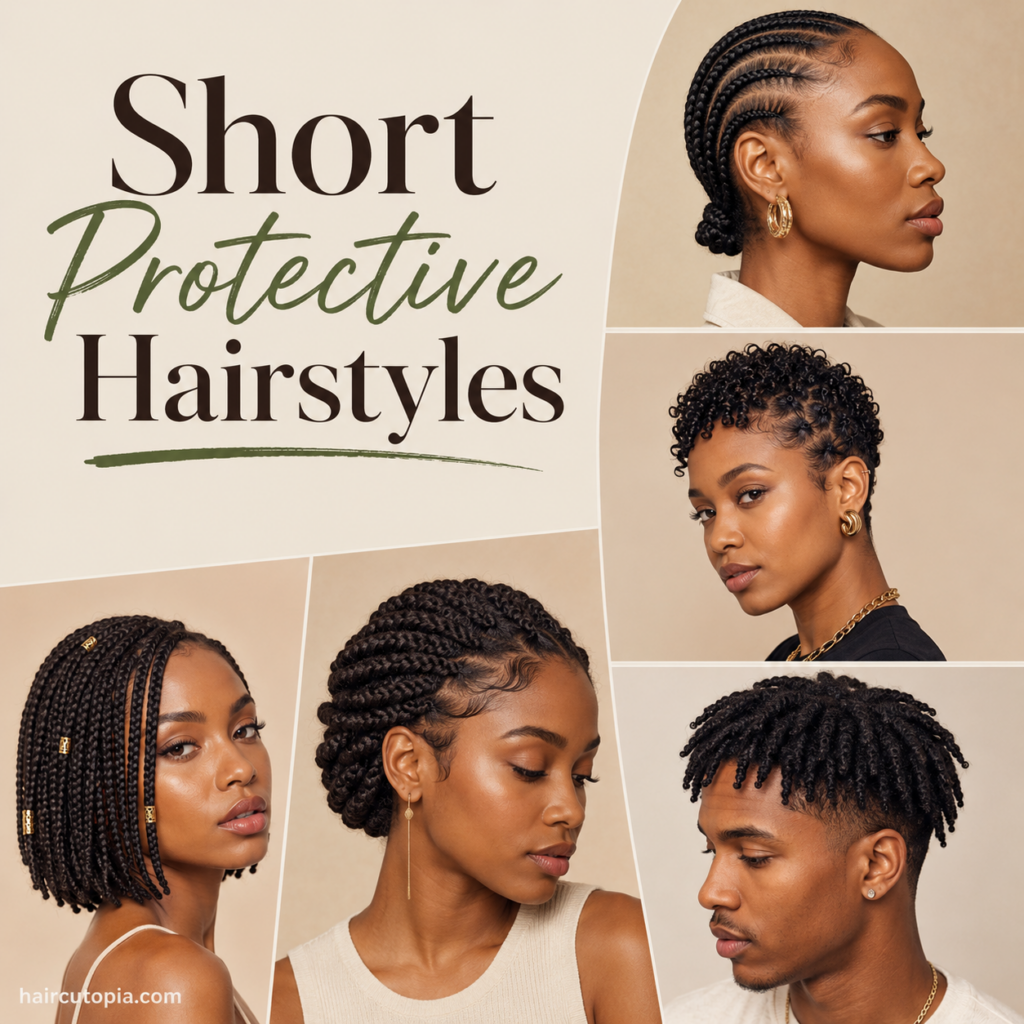
Protective hairstyles don’t have to mean waist-length braids, hours in the styling chair, or a ton of extra hair. Short protective hairstyles can be just as versatile while keeping things lighter, easier to maintain, and often more comfortable for everyday wear.
From cropped box braids and short twists to braided bobs and tucked natural styles, there are plenty of ways to protect your hair without committing to lots of length. The right style can reduce daily manipulation, keep your ends tucked away, and still give you a polished look that works for work, weekends, vacations, and special occasions.
If you’re looking for something manageable that doesn’t sacrifice style, these short protective hairstyle ideas are a great place to start.
What Is a Protective Hairstyle?
A protective hairstyle is designed to minimize how often your natural hair needs to be handled and styled. Many protective looks also keep the ends of the hair tucked away, which can help reduce exposure to friction, tangling, and everyday wear.
Protective styles are especially popular for curly, coily, and textured hair, although the exact technique depends on your hair type and needs.
A good protective style should feel comfortable. It shouldn’t require excessive tension or leave your scalp feeling sore for days afterward.
Short protective styles offer another advantage: less weight.
Long extensions can look beautiful, but they can also feel heavy, especially when worn for several weeks. Shorter styles tend to be easier to sleep in, wash around, and incorporate into an active routine.
Best Short Protective Hairstyles to Try
There’s no single protective hairstyle that works for everyone. Your natural hair length, texture, density, lifestyle, and desired maintenance level all matter.
Here are some of the most versatile short options.
Short Box Braids
Box braids are a classic for a reason. Instead of taking them down the back, try stopping the braids around the chin, jawline, or shoulders.
A short box-braid bob feels fresh and modern while still offering many of the practical benefits of traditional braids.
You can wear them:
- With a middle or side part
- Chin-length for a true bob shape
- Slightly longer in front
- With curled or decorative ends
- With subtle beads, cuffs, or other accessories
Medium or small braids can create a fuller look, while larger sections make the style quicker to install and take down.
Short Knotless Braids
If you like the appearance of box braids but want a softer transition at the roots, short knotless braids are worth considering.
Knotless techniques gradually incorporate extension hair rather than starting with a traditional knot. The result is usually flatter and more natural-looking around the scalp.
Keeping the braids short makes the finished style especially lightweight. A shoulder-length or bob-length version can also be easier to pull back when needed.
Mini Twists
Mini twists are one of those styles that can look surprisingly different depending on how you part and shape them.
They can be created with natural hair or with added hair for extra fullness. On shorter natural hair, mini twists create texture and definition without requiring daily restyling.
Try a center part for a balanced look, a deep side part for more volume, or gently pin a few twists back from the face.
Because the twists are relatively small, they also give you more styling flexibility than chunky twists.
Two-Strand Twists
If mini twists sound like too much installation time, slightly larger two-strand twists are an easier alternative.
They’re simple, versatile, and can work especially well when you want a protective style without adding extensions.
The finished look can be neat and structured or intentionally soft and fluffy. The difference often comes down to section size and how tightly the twists are created.
Flat Twists
Flat twists sit close to the scalp and can be styled in numerous patterns. Think of them as a twist-based alternative to traditional cornrows.
You can wear flat twists going straight back, create a side-swept pattern, or direct them toward a tucked bun or twisted section.
They’re also useful when you want something that stays close to the head rather than hanging around your face.
Cornrows
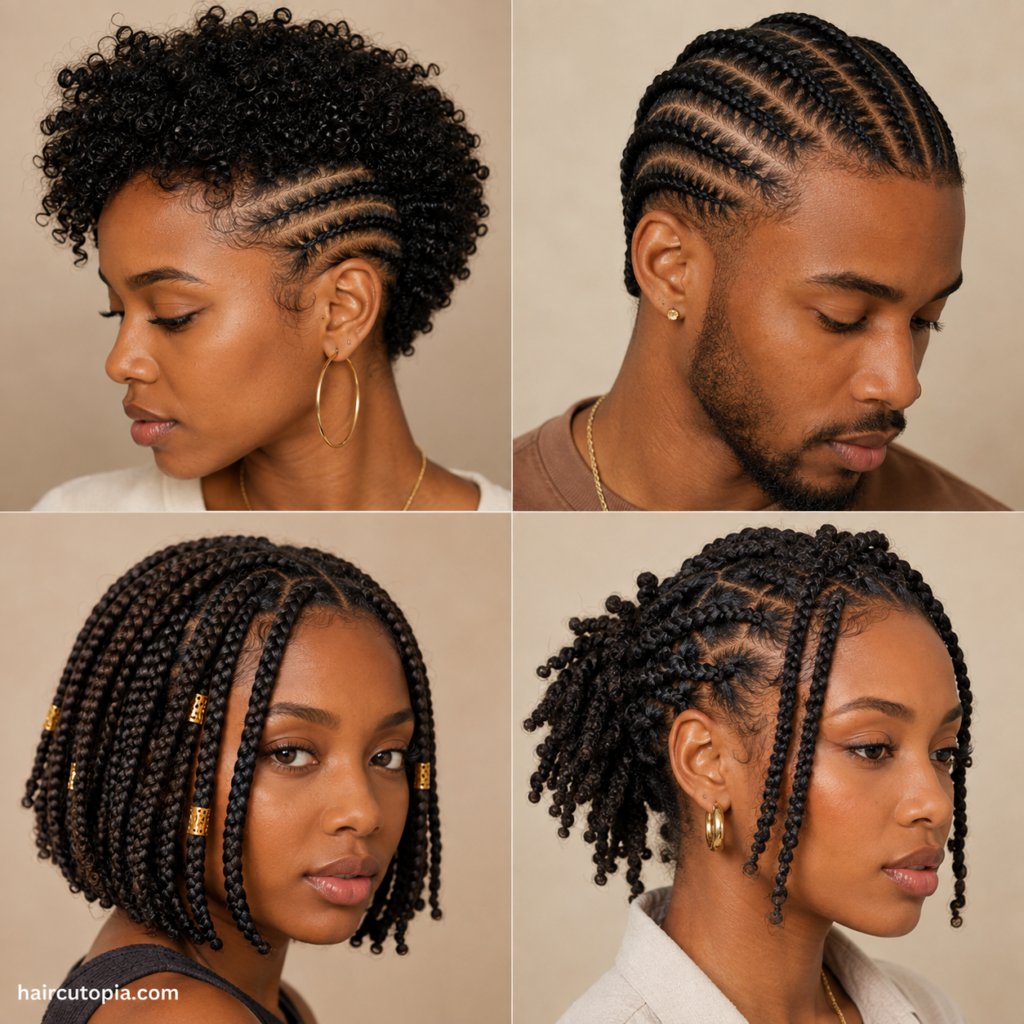
Cornrows are one of the most versatile protective styling techniques, and they certainly don’t require long extensions.
Simple straight-back cornrows create a clean, timeless look. More intricate parts can turn the style into something much more distinctive.
Popular short cornrow variations include:
- Straight-back rows
- Side-swept cornrows
- Curved or geometric patterns
- Feed-in cornrows
- Cornrows ending in small twists
- Braided designs with a defined center or side part
A simpler pattern can be ideal if easy maintenance is the priority.
Short Passion Twists
Passion twists have a softer, more relaxed texture than many traditional twisted styles. They work particularly well if you like a slightly undone or bohemian finish.
A bob-length version keeps the volume while eliminating much of the weight associated with longer passion twists.
Because the texture itself creates visual interest, you don’t need an elaborate cut or complicated styling routine.
Short Senegalese Twists
For something smoother and more defined, consider short Senegalese twists.
These twists typically have a sleek, rope-like appearance that can look especially polished when cut around the shoulders or jawline.
A blunt bob creates a stronger shape, while slightly varied lengths can give the style more movement.
Braided Bob
The braided bob has become a protective-style staple because it combines a recognizable haircut shape with the convenience of braids.
It can be blunt and graphic or softer and slightly layered in appearance.
The length makes a big difference. A jaw-length braided bob has a bolder feel, while one that sits just above the shoulders tends to offer more styling flexibility.
Adding curled ends can soften the shape even further.
Short Boho Braids
Boho braids combine traditional braiding with loose, curly pieces for a more relaxed finish.
While they’re often worn long, a shorter version can be easier to manage and gives the style a different personality. The loose curls add movement around the face without requiring extremely long braids.
Keep in mind that the loose portions may need a little more maintenance than fully braided hair because they’re more exposed to tangling.
Bantu Knots
Bantu knots are compact, sculptural, and don’t require long hair to make an impact.
The hair is divided into sections, twisted, and wrapped into small knots across the head. You can keep the parting simple or use triangles, diamonds, and other patterns to make the overall style more decorative.
Bantu knots also put the focus on the face, making earrings or other accessories stand out beautifully.
Tucked and Rolled Natural Styles
Not every protective hairstyle requires extensions or intricate braiding.
Tucked styles can work particularly well on short-to-medium natural hair. The ends are rolled or folded inward and secured so they’re less exposed.
Depending on your hair length, you might try:
- A low tucked roll
- Side rolls
- A faux bob
- Flat twists leading into a tucked section
- A rolled updo
- A tucked crown style
These can be useful when you want a temporary protective look rather than something you’ll wear for several weeks.
Short Faux Locs
Faux locs can be dramatic even at shorter lengths.
A bob-length faux-loc style creates plenty of texture without the weight of long loc extensions. You can choose a neat, uniform finish or go with a more distressed look for added dimension.
Short faux locs can also frame the face beautifully, particularly when the length falls between the chin and shoulders.
Short Butterfly Locs
Butterfly locs have a deliberately textured appearance, with loops and irregularities that give each loc a softer, less uniform finish.
They work especially well at bob length because the combination of volume and texture creates a strong shape without needing additional length.
For an effortless-looking protective style, this is one of the more distinctive options.
Short Protective Hairstyles Without Extensions
Extensions aren’t necessary for a protective style.
In fact, using your own hair can make the style lighter and simplify the takedown process. It’s also a good choice when you’d rather avoid adding synthetic or human hair.
Depending on your natural length, options can include:
- Mini twists
- Two-strand twists
- Flat twists
- Cornrows
- Bantu knots
- Tucked styles
- Braided updos
- Flat-twist crowns
The key is choosing a style that works with your current length rather than forcing your hair into something that requires too much tension.
Short Protective Hairstyles for Natural Hair
Natural hair offers plenty of possibilities for short protective styling.
If your hair is long enough to twist comfortably, mini twists can preserve some of your natural volume while reducing daily manipulation. If it’s shorter, flat twists and cornrows can keep the hair secure without requiring much free-hanging length.
You can also combine techniques.
For example, flat twist the sides while leaving two-strand twists through the top. Or create cornrows at the front that transition into twists toward the back.
Combining styles can make a practical protective hairstyle feel much more personalized.
How to Choose the Right Short Protective Style
It’s easy to choose a hairstyle based entirely on a photo, but think about how the style will actually fit into your routine.
Consider Your Hair Length
Some styles require enough natural length to grip and twist comfortably.
If your hair is very short, scalp-based styles such as cornrows or flat twists may be easier than individual twists. Extensions can also create additional styling possibilities, but they shouldn’t require excessive pulling to stay attached.
Think About Weight
One of the biggest reasons to choose a short protective hairstyle is comfort.
If heavy styles bother your scalp or neck, avoid adding more extension hair than necessary. Shorter braids and twists can still look full without being excessively heavy.
Decide How Much Maintenance You Want
Protective doesn’t necessarily mean maintenance-free.
Styles with loose curls, exposed natural hair, or intricate parts may require more upkeep than simple braids or twists.
If your goal is convenience, choose something you can realistically maintain between wash days.
Think About Your Lifestyle
Your everyday routine matters too.
Someone who exercises frequently may prefer a style that can be easily secured away from the face. If you wear hats or helmets regularly, a flatter style may be more comfortable than bulky twists or knots.
And if you simply don’t like spending much time on your hair in the morning, choose a style that looks finished as soon as you remove your bonnet or scarf.
How Long Can You Keep a Short Protective Hairstyle?
How long a style lasts depends on the technique, your hair, your scalp, and how well the style is maintained.
Some natural twist and tucked styles may be worn for several days or a couple of weeks, while professionally installed braids or loc-style extensions may last several weeks.
Longer isn’t automatically better.
Once the style becomes excessively frizzy, the roots become heavily tangled, buildup becomes difficult to manage, or the hairstyle starts causing discomfort, it may be time to take it down.
Your natural hair and scalp still need attention underneath the style.
How to Maintain Short Protective Hairstyles
A little maintenance can help your style stay neater while keeping your hair and scalp more comfortable.
Protect Your Hair at Night
Use a satin or silk bonnet, scarf, or pillowcase while sleeping.
This reduces friction against the hair and can help keep braids and twists from becoming fuzzy as quickly.
Short styles have an advantage here: there’s less hair to gather and secure before bed.
Keep Your Scalp Clean
Protective styling doesn’t mean ignoring your scalp.
How frequently you cleanse will depend on your hair, scalp, activity level, and the style itself. The goal is to avoid allowing sweat, oil, and product buildup to accumulate indefinitely.
When washing braids or twists, focus on the scalp and avoid aggressively rubbing the style.
Use Products Lightly
It’s tempting to keep layering products onto a protective style, especially when the hair starts looking dry.
More isn’t always better.
Heavy oils, creams, and gels can accumulate around the roots and make the eventual takedown more difficult. Use only what your hair and scalp actually need.
Watch for Excessive Tension
A protective hairstyle shouldn’t hurt.
Some mild sensitivity immediately after certain styles may occur, but persistent pain, headaches, bumps, or a pulling sensation shouldn’t simply be ignored.
Pay particular attention around the hairline, where the hair can be more delicate.
How to Make Short Protective Hairstyles Look More Stylish
Short hair already creates a strong silhouette, so small details can make a surprisingly big difference.
Try changing the part first. A deep side part can completely transform a braided bob or short twist style that you’ve been wearing down the middle.
You can also experiment with:
- Metallic braid cuffs
- Minimal beads
- Decorative clips
- Hair jewelry
- Colored extensions
- Curled ends
- Asymmetrical lengths
- Creative parting patterns
- A few face-framing pieces
You don’t need to add everything at once. One or two intentional details usually have more impact than piling on accessories.
Are Short Protective Hairstyles Easier to Maintain?
In many cases, yes.
Less length generally means less weight, less hair to wrap at night, and fewer ends to deal with during washing and styling. Short braids and twists are also less likely to get caught under clothing, bag straps, or jackets.
That doesn’t mean every short style is automatically easy.
A tiny braided bob with dozens of individual braids might take longer to install than a much longer style with larger sections. Likewise, boho styles with loose curls can require more attention than straightforward twists.
Think about the entire process—not just the finished length.
Short Protective Hairstyles for Work and Everyday Wear
If you want a protective hairstyle that transitions easily between different settings, keep the overall shape relatively simple.
A shoulder-length knotless-braid style, mini twists, a braided bob, or neatly arranged flat twists can all look polished without feeling overly formal.
For professional settings, you can keep accessories minimal and focus on clean parting and a defined silhouette. Outside of work, the same style can be dressed up with clips, cuffs, scarves, or different part placements.
That’s one of the biggest benefits of going short: even simple styles can feel intentional.
Short Protective Hairstyles for Special Occasions
Protective styles can absolutely work for weddings, parties, dinners, and other special events.
Instead of completely changing the hairstyle, use the existing texture as your foundation.
Short braids can be swept to one side and secured with decorative pins. Twists can be pinned into a small updo or half-up style. A braided bob can be accessorized with understated metallic cuffs, while short faux locs can be styled with a dramatic side part.
For a dressier look, concentrate the detail in one area rather than trying to restyle everything.
Common Protective Styling Mistakes to Avoid
The word “protective” doesn’t automatically make every style gentle on your hair.
Avoid these common mistakes:
- Installing braids or twists too tightly.
- Using excessively heavy extensions on small sections of natural hair.
- Leaving the style installed longer than your hair or scalp can comfortably tolerate.
- Neglecting your scalp because the hair is braided.
- Constantly pulling the style into tight ponytails or buns.
- Using too much product and creating heavy buildup.
- Rushing through takedown and accidentally breaking or cutting your natural hair.
The goal is to reduce unnecessary stress on your hair, not simply keep it covered.
Frequently Asked Questions
What is the easiest short protective hairstyle?
Two-strand twists are one of the simplest options for many people with natural hair because they can be created without extensions and don’t require complicated braiding techniques.
For a longer-lasting professionally installed option, short box braids or knotless braids are popular choices.
Can short natural hair be put into a protective style?
Yes. Cornrows, flat twists, Bantu knots, and certain extension styles can work with relatively short natural hair.
Exactly how short depends on your hair texture and the technique being used. Avoid forcing very short hair into a style if maintaining it requires excessive tension.
Do protective hairstyles help hair grow?
Protective hairstyles don’t make hair grow faster on their own. Hair continues through its normal growth cycle.
What a well-chosen protective style can do is reduce some of the daily manipulation, friction, and breakage that can make retaining length more difficult.
Are short braids better than long braids?
Neither is universally better.
Short braids are generally lighter and can be easier to maintain, while long braids provide more styling possibilities. If weight, sleeping comfort, or convenience is important to you, the shorter option may be more practical.
Can I wash my hair while wearing a protective style?
Many protective styles can be gently cleansed while installed. The appropriate method depends on the hairstyle and your hair needs.
Focus primarily on keeping the scalp clean and avoid aggressive rubbing that could create unnecessary tangling or frizz.
How do I protect my edges with braids?
Avoid excessive tension around the hairline and don’t repeatedly pull braids into tight styles.
If the edges feel painful or look overly stretched immediately after installation, the style may be too tight.
Final Thoughts
Short protective hairstyles prove that you don’t need dramatic length to create a versatile look.
A chin-length braided bob can feel sleek and modern. Mini twists can keep things simple and natural. Short faux locs and butterfly locs bring plenty of texture, while cornrows and flat twists offer endless possibilities for creative patterns.
The best choice is ultimately the one that works with your hair rather than against it.
Keep tension reasonable, choose a length and weight that feel comfortable, maintain your scalp while the style is installed, and don’t feel obligated to keep a hairstyle longer simply because it’s supposed to be protective.
Sometimes going shorter is exactly what makes a protective style easier to live with.