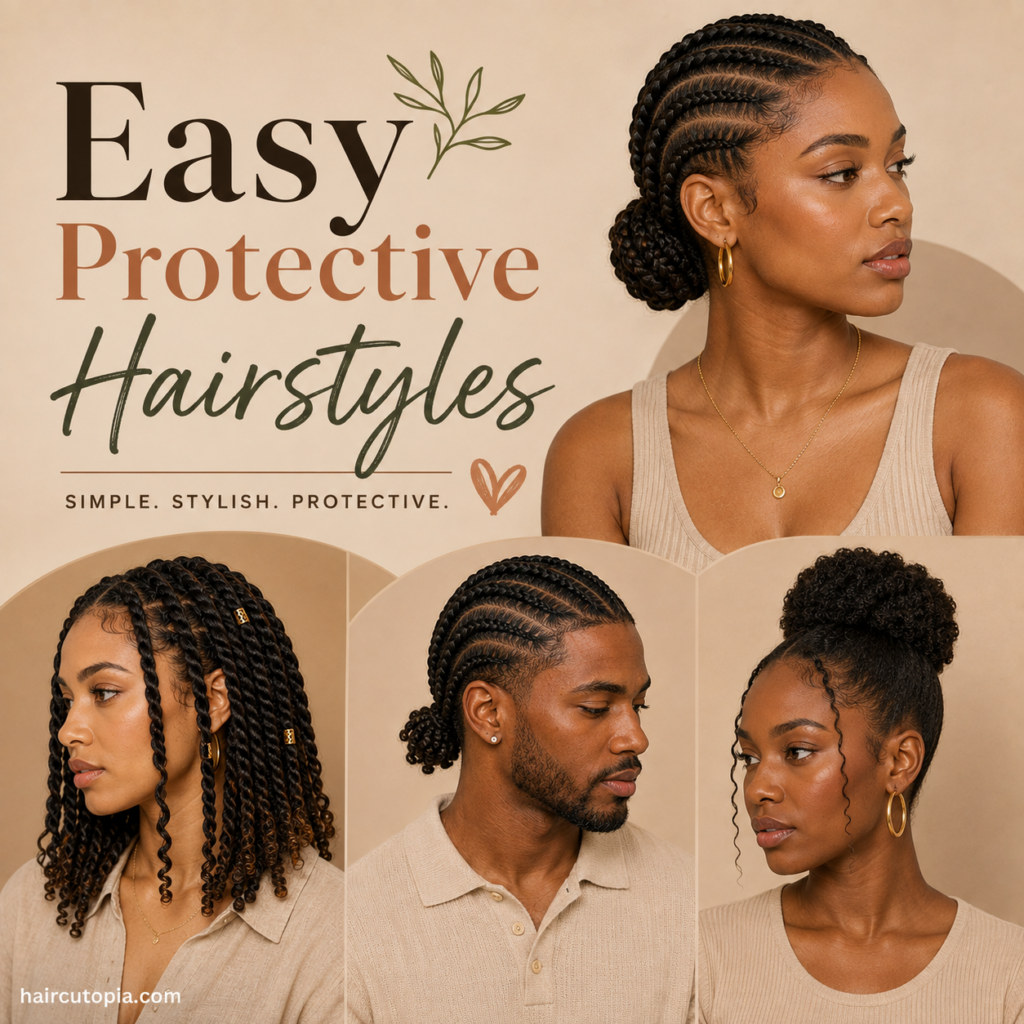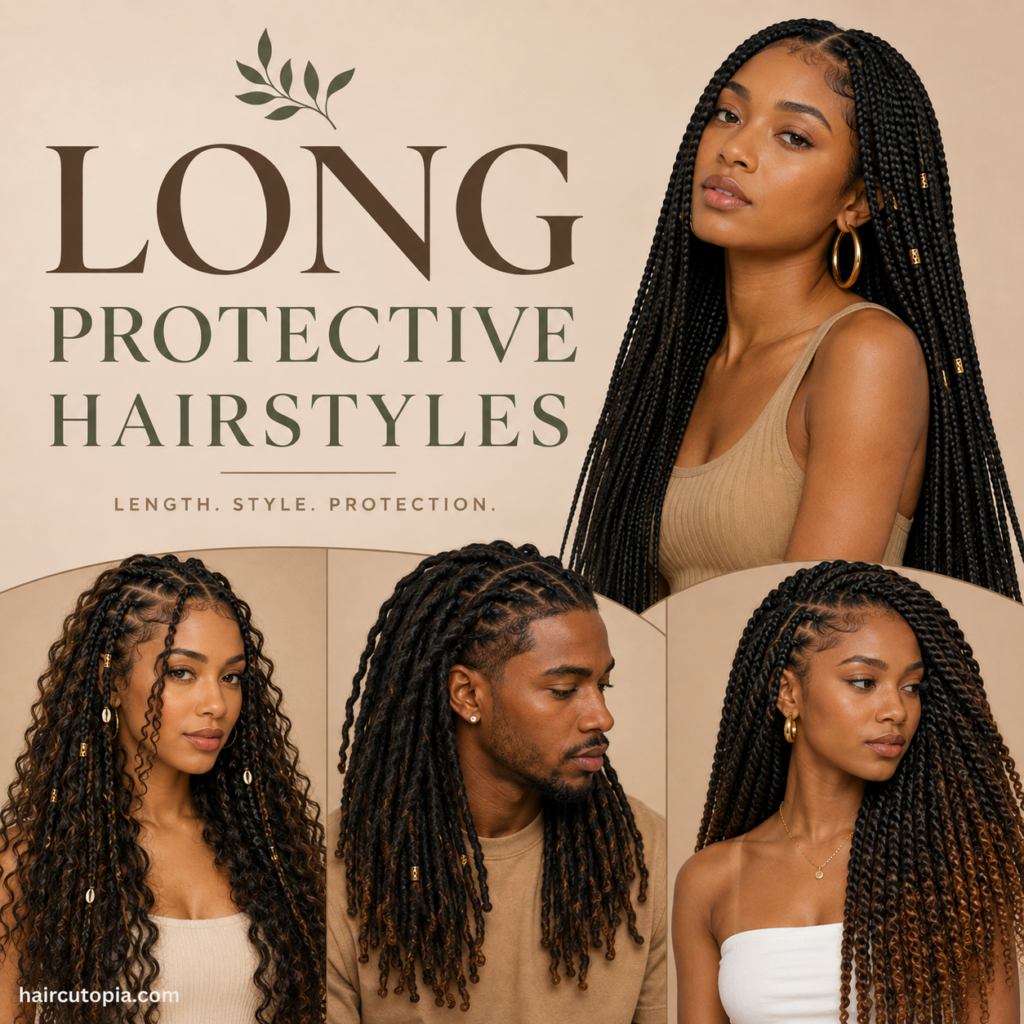
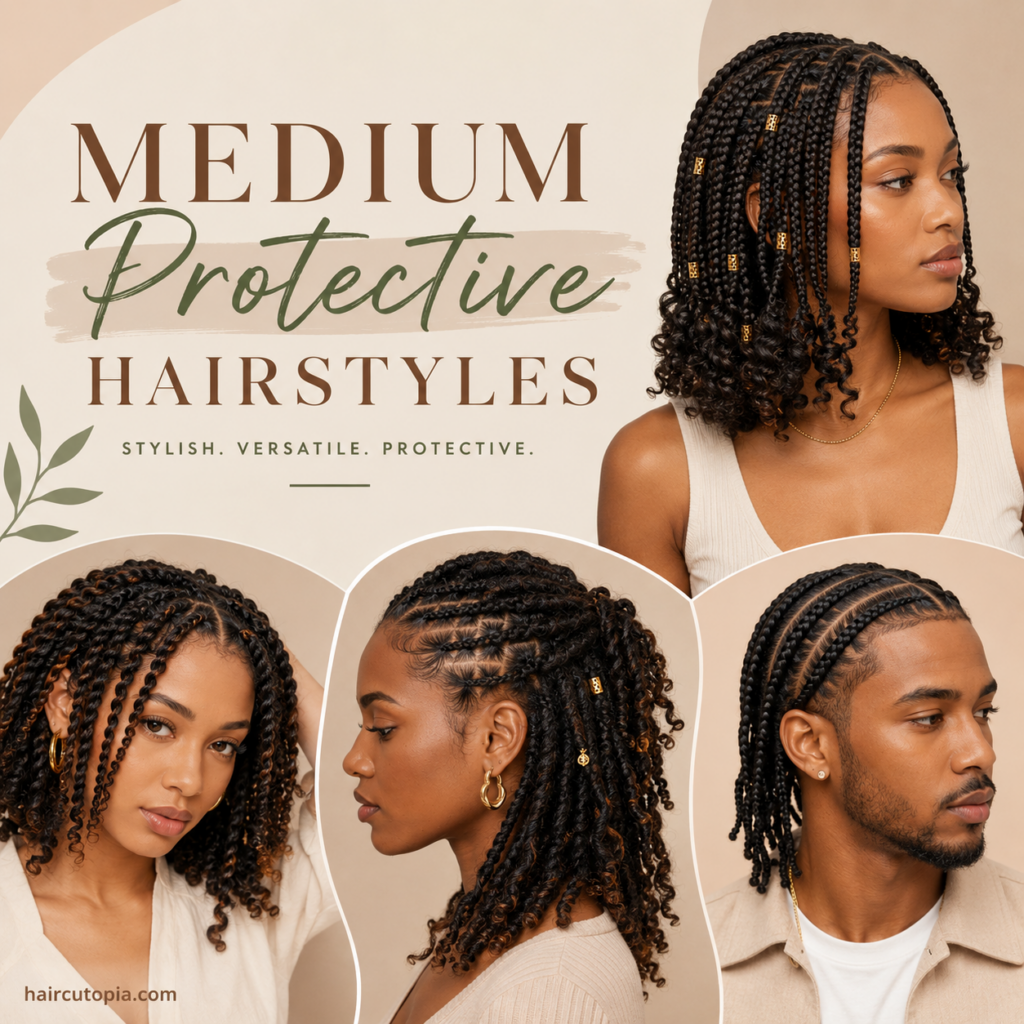
Protective hairstyles don’t have to be super short or extend all the way down your back. Medium protective hairstyles sit comfortably in the middle, giving you enough length to experiment with different looks without the extra weight and upkeep that can come with very long styles.
Think shoulder-length knotless braids, medium twists, braided lobs, faux locs, cornrow combinations, and natural styles that keep your ends tucked away. There’s enough length for movement and styling, but most options are still manageable for everyday wear.
That balance is what makes medium-length protective styles so appealing. You can wear them down one day, pull them back the next, and dress them up when the occasion calls for it.
Here are some of the best medium protective hairstyles to consider, along with tips for choosing and maintaining a style that works for you.
What Are Medium Protective Hairstyles?
Protective hairstyles are designed to reduce frequent manipulation of your natural hair. Many styles also keep the ends tucked or secured, helping limit some of the friction, tangling, and everyday wear that can contribute to breakage.
“Medium” doesn’t have one exact measurement. For protective styles, it generally means somewhere around shoulder to upper-chest length.
That gives you more styling freedom than a short bob without committing to the weight of waist-length braids or twists.
Popular medium protective styles include:
- Knotless braids
- Box braids
- Two-strand twists
- Passion twists
- Senegalese twists
- Marley twists
- Faux locs
- Butterfly locs
- Cornrows
- Feed-in braids
- Braided ponytails
- Natural mini twists
- Flat-twist styles
Some use extensions, while others can be created entirely with natural hair.
Best Medium Protective Hairstyles to Try
The right style depends on your hair texture, natural length, desired maintenance level, and how long you plan to wear it.
Here are some ideas that work especially well at medium length.
Medium Knotless Braids
Knotless braids have become a go-to protective style because of their smooth transition from the natural hair into the braid.
At medium length, they offer plenty of movement without feeling overwhelmingly long.
Wear them loose with a center part, sweep them over one shoulder, or pull the front sections into a half-up style. Medium knotless braids are also long enough for a low ponytail without creating an enormous bundle of braids at the back.
For a fuller appearance, choose smaller braids. Medium or larger sections create a lighter look and can reduce installation and takedown time.
Medium Box Braids
Traditional box braids are another classic that works beautifully at shoulder or chest length.
Unlike very long box braids, medium versions don’t dominate the entire look. The hairstyle frames the face while still giving you enough length to experiment with different parts and simple updos.
Try adding subtle cuffs or a few beads if you want extra detail without making the style feel overly decorated.
Shoulder-Length Braided Lob
A lob—or long bob—is one of the easiest ways to give protective braids a defined shape.
Instead of stopping at the chin like a traditional braided bob, the braids fall around the shoulders or collarbone.
The extra few inches make a noticeable difference. You can still get that structured bob-like silhouette while having enough length to pull the hair back.
A blunt finish creates a stronger shape, while slightly uneven or layered-looking ends feel softer and more relaxed.
Medium Boho Braids
Boho braids combine braided sections with loose curls, creating a softer look than fully braided hair.
Medium length works especially well because the curls have room to move without becoming excessively long or difficult to manage.
You can keep the curly pieces minimal for a subtle effect or add more throughout the style for extra volume.
Just remember that the loose hair is more exposed than the braided portions, so boho styles often require a little more upkeep.
Medium Passion Twists
Passion twists have a soft, slightly undone texture that makes them ideal if you don’t want a perfectly uniform hairstyle.
At medium length, they create plenty of volume around the shoulders.
A middle part gives the style a balanced shape, while a deep side part can create more movement around the face. You can also pull the front twists back for an easy half-up look.
Medium Senegalese Twists
If you prefer something smoother, Senegalese twists offer a more polished alternative.
Their rope-like appearance gives them a clean, defined finish. Medium-length Senegalese twists can be worn down, swept to one side, or gathered into a low ponytail.
They’re especially striking when the individual twists are kept fairly consistent in size.
Marley Twists
Marley twists have a fuller, more textured appearance that blends beautifully with many natural hair textures.
Medium Marley twists can create a substantial hairstyle without requiring extreme length. The texture itself adds visual interest, so the style doesn’t need many accessories.
Try chunky twists for a bold look or smaller sections if you want more movement and styling flexibility.
Medium Two-Strand Twists
Extensions aren’t required to create a great medium protective style.
If your natural hair has enough length, two-strand twists can be one of the simplest options. They’re relatively straightforward to install and can showcase your natural texture while reducing the need for daily styling.
You can vary the section sizes depending on the result you want. Smaller twists tend to offer more movement, while chunky twists make a stronger statement.
Mini Twists on Natural Hair
Mini twists are an excellent option if you want a protective style that still looks and feels very much like your natural hair.
They can take patience to install, but once they’re done, styling is fairly simple.
Wear them loose, create a side part, pull the top half back, or gather them into a low ponytail if your length allows.
Because mini twists are lightweight, they can also be comfortable for sleeping and exercising.
Medium Faux Locs
Faux locs bring texture and dimension to medium-length hair without requiring the commitment of permanent locs.
Shoulder-to-chest-length faux locs create a strong silhouette while remaining easier to manage than extra-long versions.
You can choose a smooth, polished loc or something more distressed and textured depending on your personal style.
Adding a few cuffs can create subtle contrast without overwhelming the look.
Medium Butterfly Locs
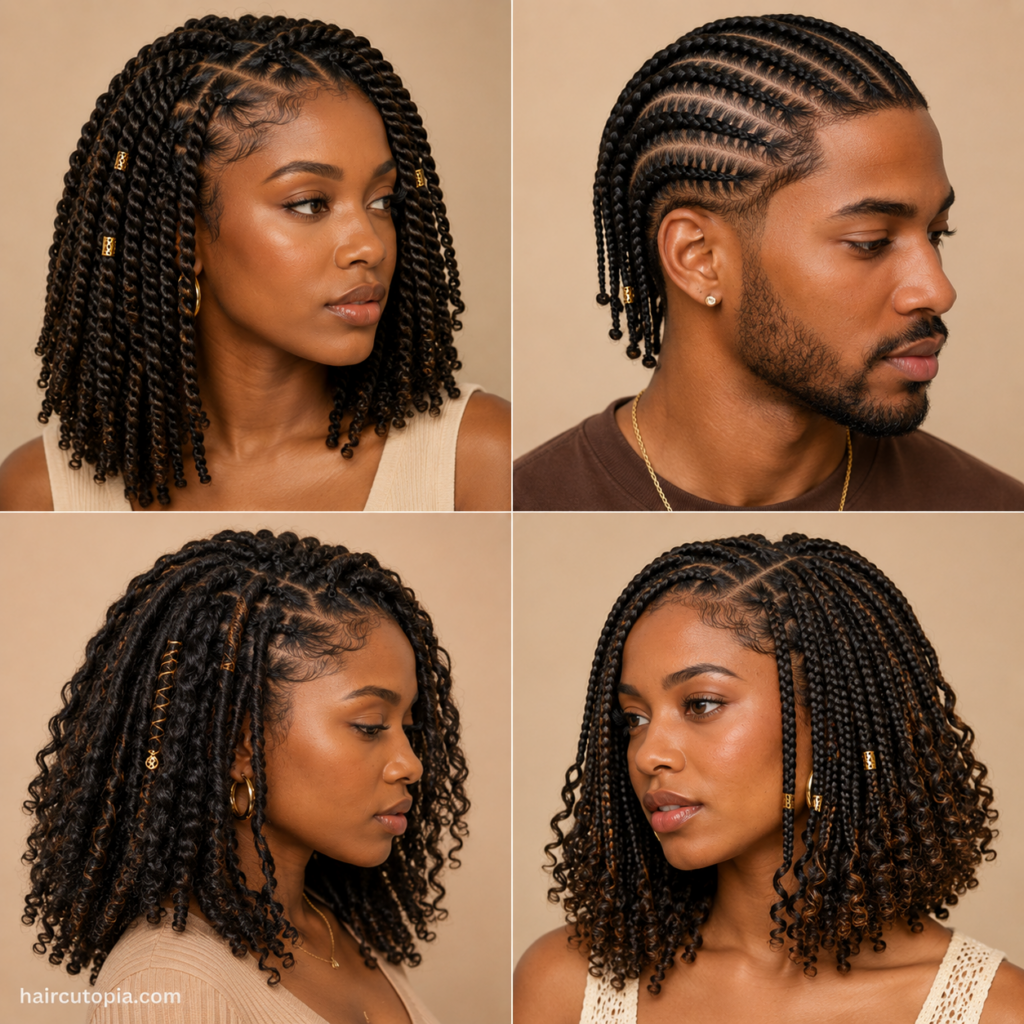
Butterfly locs are intentionally imperfect, with loops and textured sections creating their recognizable appearance.
At medium length, they feel substantial but not excessively heavy.
They’re a good choice if you like protective hairstyles with a little personality. Rather than every strand looking identical, the variation is part of the appeal.
A shoulder-length butterfly-loc style can also frame the face beautifully.
Cornrows With Medium-Length Twists
Can’t decide between cornrows and twists? Combine them.
Cornrows can be used through the front or sides of the hair before transitioning into loose medium-length twists.
This gives you interesting detail around the scalp while preserving movement through the lengths.
There are plenty of variations. Try cornrows on one side for an asymmetrical look, braid the front half and twist the back, or create a defined pattern leading into the loose sections.
Feed-In Braids
Feed-in braids gradually incorporate additional hair into the braid, creating a smoother transition from the scalp.
You don’t have to make them extremely long.
Medium feed-in braids can stop around the shoulders or upper chest for a cleaner, lighter result. Straight-back styles are timeless, while curved or side-directed patterns can make the look more distinctive.
Medium Cornrows
Cornrows themselves can also be the entire hairstyle.
Straight-back cornrows offer a simple, streamlined option, while geometric and curved patterns create something more decorative.
You can finish the braids around shoulder length if you’re adding extensions, or work entirely with your natural hair.
Cornrows are also useful if you want a hairstyle that stays close to the head rather than creating lots of volume around your face.
Braided Ponytail
A medium braided ponytail offers a little extra length without going overboard.
The natural hair is braided or secured before extension hair is incorporated into the ponytail. The result can be sleek and simple or more textured depending on the type of braid you choose.
Keep the ponytail around shoulder-blade length for a medium look that’s easier to manage than an extra-long version.
Avoid making the base excessively tight, particularly around the hairline.
Flat Twists Into Loose Twists
Flat twists can create structure around the scalp before transitioning into individual twists.
This combination works especially well when you want your hair away from your face but still want movement in the back.
You might flat twist both sides toward the center, create a side-swept pattern, or use several flat twists across the front as an accent.
Crochet Protective Styles
Crochet techniques can create a wide range of medium protective hairstyles, from twists and locs to curly textures.
The natural hair is typically braided underneath before the crochet hair is installed.
One advantage is variety. You can create a shoulder-length curly look, medium twists, faux locs, or other textures without individually installing every strand in the same way as traditional braids.
The amount and weight of added hair still matter, so more volume isn’t necessarily better.
Medium Protective Hairstyles Without Extensions
You don’t have to add hair to create a protective style.
If your natural hair reaches somewhere around shoulder length when stretched, you may already have plenty of options.
Consider:
- Mini twists
- Two-strand twists
- Flat twists
- Cornrows
- Braided crowns
- Tucked styles
- Rolled updos
- Low twisted buns
- Flat twists combined with loose twists
Working with your natural hair eliminates the added weight of extensions and can make takedown easier.
It also gives you an opportunity to work with your natural density and texture rather than covering it completely.
Medium Protective Hairstyles for Natural Hair
Medium-length natural hair is especially versatile because there’s usually enough length to twist, braid, roll, or tuck the ends.
Two-strand twists are one of the easiest places to start. If you want something more detailed, combine flat twists around the front with individual twists throughout the rest of the hair.
Tucked styles are another option.
Instead of allowing the ends to remain loose, they can be rolled inward and secured with pins. This can create the appearance of a short updo while keeping the ends protected.
Don’t be afraid to combine techniques. Protective styling doesn’t have to follow one formula.
Medium Protective Hairstyles for Work and Everyday Wear
For everyday styling, versatility usually matters more than creating the most elaborate look possible.
Medium knotless braids, mini twists, shoulder-length box braids, and Senegalese twists are all easy to transition between casual and more polished settings.
You can wear them down during the day and pull them into a low ponytail when you need the hair out of your face.
If you prefer something more understated, try:
- Medium twists with a center part
- Shoulder-length braids
- Simple straight-back cornrows
- Flat twists
- A low braided ponytail
- Natural mini twists
The goal doesn’t have to be making your hair look completely different every morning. One of the advantages of a protective style is being able to keep your routine simple.
Medium Protective Hairstyles for Special Occasions
Medium-length styles can also be dressed up surprisingly easily.
A few strategically placed accessories can completely change the look without requiring you to reinstall or dramatically restyle your hair.
Try adding:
- Gold or silver braid cuffs
- Decorative hairpins
- A minimal headband
- A few beads
- Hair jewelry
- A scarf
- Metallic thread
Medium braids and twists can also be arranged into half-up styles, side-swept looks, or low buns depending on their length and thickness.
Sometimes changing the part is enough to make a familiar hairstyle feel different.
Why Choose a Medium-Length Protective Style?
Medium styles offer a useful compromise between short and long protective hairstyles.
They’re Easier to Manage
There’s simply less hair to deal with than there is with waist-length braids or twists.
That can make washing, sleeping, exercising, and everyday styling easier.
They Still Offer Styling Flexibility
Unlike very short protective styles, medium hair often has enough length for ponytails, half-up looks, side-swept styles, and simple buns.
You get options without needing extreme length.
They Can Feel Lighter
Extension hair adds weight.
Keeping the overall style shorter can reduce some of that weight, especially if you also choose medium or larger sections instead of hundreds of tiny braids.
They Frame the Face
Shoulder and collarbone lengths naturally bring attention toward the face.
Changing the part, volume, or shape can make the same general length work with many different personal styles.
How to Choose the Right Medium Protective Hairstyle
A hairstyle can look great in a photo and still be completely wrong for your daily routine.
Before choosing one, consider a few practical factors.
Start With Your Natural Hair
Think about your current length, density, texture, and overall condition.
A style shouldn’t require excessive tension just to keep shorter sections secured.
If you’re unsure whether your hair is long enough for a particular technique, a professional stylist can help determine what’s realistic without putting unnecessary stress on the hair.
Decide How Much Weight You Want
Medium doesn’t automatically mean lightweight.
Small braids with lots of extension hair can still become heavy, even if they only reach your shoulders.
If comfort is important, consider fewer sections, lighter extension hair, or a style that uses your natural hair.
Think About Installation Time
Tiny braids and mini twists can look incredible, but they take time.
If you don’t enjoy sitting through long appointments—or spending hours doing your own hair—larger twists, feed-in braids, or simpler cornrow patterns may be more practical.
Consider Your Routine
Do you exercise frequently? Wear hats? Swim? Need your hair pulled back for work?
Those details should influence the style you choose.
A hairstyle that fits your actual routine will usually be easier to maintain than one you have to constantly work around.
How Long Do Medium Protective Hairstyles Last?
There’s no universal timeline for protective styles.
How long yours lasts depends on the technique, your hair and scalp, how quickly your hair grows, your activity level, and how you maintain the style.
Some natural twists may be worn for a shorter period, while professionally installed braids, twists, or loc-style extensions may remain in place for several weeks.
Pay attention to your hair rather than trying to reach a specific number of weeks.
Heavy buildup, significant tangling at the roots, persistent itching, loosening extensions, or discomfort can all be signs that it’s time to take the style down.
Leaving a protective hairstyle in longer isn’t necessarily more protective.
How to Maintain Medium Protective Hairstyles
Good maintenance can help your hairstyle stay fresh while keeping your natural hair and scalp comfortable underneath.
Protect Your Hair While Sleeping
A satin or silk bonnet, scarf, or pillowcase can help reduce friction while you sleep.
For medium braids or twists, loosely gather the hair before covering it rather than pulling everything into a tight ponytail.
Keep Your Scalp Clean
Your scalp still needs care when your hair is in a protective style.
Cleansing needs vary from person to person, but sweat, oil, and product shouldn’t be allowed to accumulate indefinitely.
When washing, concentrate on the scalp and avoid aggressively rubbing the braids or twists.
Don’t Overload Your Hair With Products
More product doesn’t automatically mean more moisture.
Repeatedly adding heavy creams and oils can create buildup, particularly around the roots.
Use products based on what your hair and scalp actually need rather than following a rigid routine.
Be Gentle With Your Hairline
The edges can be especially vulnerable to repeated tension.
Avoid constantly pulling braids and twists into tight ponytails or buns. If the style itself feels painfully tight around the hairline, address the tension rather than waiting for it to loosen on its own.
Common Protective Styling Mistakes
Protective styles work best when they’re actually gentle enough to protect the hair.
Some common mistakes include:
- Installing braids or twists too tightly.
- Adding too much extension hair to small sections.
- Ignoring persistent scalp discomfort.
- Leaving the style installed for too long.
- Constantly pulling the hair into tight updos.
- Allowing heavy product buildup around the roots.
- Neglecting the natural hair underneath.
- Rushing through takedown.
Takedown deserves particular attention. After several weeks, shed hairs can become wrapped around the roots and extensions.
Work slowly, detangle carefully, and make sure you know where your natural hair ends before cutting extensions.
Frequently Asked Questions
What are the best medium protective hairstyles?
Knotless braids, box braids, mini twists, Senegalese twists, passion twists, faux locs, butterfly locs, cornrows, and flat-twist combinations are all popular options.
The best one depends on your natural hair, lifestyle, and preferred maintenance level.
What length is considered medium for protective hairstyles?
Medium protective hairstyles generally fall somewhere around the shoulders to upper chest.
There’s no strict measurement, though. The idea is simply to create enough length for styling versatility without moving into very long braid, twist, or loc territory.
Can medium protective hairstyles be done without extensions?
Absolutely.
Mini twists, two-strand twists, cornrows, flat twists, tucked styles, and braided updos can all be created using natural hair when there’s enough length for the chosen technique.
Are medium braids easier to maintain than long braids?
They often can be.
Medium braids have less length to manage while sleeping, washing, and exercising. They may also feel lighter, although the overall weight still depends on the number of braids and how much extension hair is used.
Can you put medium protective hairstyles in a ponytail?
Many medium styles are long enough for low ponytails and half-up styles.
Very thick braids or twists may be more difficult to gather comfortably, so keep that in mind if ponytails are important to your routine.
Do protective hairstyles make your hair grow?
Protective hairstyles don’t directly increase the rate at which hair grows.
Their benefit is primarily reducing some of the daily manipulation and friction that can contribute to breakage. That may make it easier to retain length when the style is installed and maintained appropriately.
How do I know if a protective hairstyle is too tight?
Persistent pain, headaches, bumps, significant pulling around the hairline, or a scalp that feels excessively tender can indicate too much tension.
A protective style should not require you to tolerate ongoing pain.
Final Thoughts
Medium protective hairstyles hit a sweet spot that’s difficult to beat.
They’re long enough to give you styling options but short enough to remain manageable. You can keep things classic with shoulder-length box braids, go softer with passion twists or boho braids, add texture with butterfly locs, or skip extensions altogether with mini twists and flat-twist styles.
There’s plenty of room to make the look your own.
More importantly, choose a style that works with your natural hair and everyday routine. Keep the weight reasonable, avoid unnecessary tension, care for your scalp, and don’t leave the style installed simply because you feel like you should get another week out of it.
A protective hairstyle should make your routine easier—not become another thing you have to fight with.