The 1950s gave us some of the most recognizable hairstyles in modern history. Think carefully sculpted curls, glossy waves, polished updos, slicked-back men’s hair, and the unmistakable height of a classic pompadour.
Hair during this decade rarely looked accidental. Even casual styles tended to have a defined shape, whether that meant curled ends, a smooth side part, or carefully arranged volume around the crown.
At the same time, 1950s hairstyles weren’t all alike. Hollywood glamour influenced sophisticated women’s styles, while teenagers and rock-and-roll culture helped introduce a more rebellious approach to men’s grooming. By the end of the decade, bigger hair was beginning to appear, setting the stage for the dramatic volume of the 1960s.
Below, we’ll explore the most memorable 1950s hairstyles, how they were created, and why so many of them continue to inspire modern looks.
What Were Hairstyles Like in the 1950s?
The defining feature of 1950s hair was styling.
A haircut provided the foundation, but rollers, pin curls, pomade, brushing, backcombing, and careful shaping created the finished look.
Women’s hairstyles frequently emphasized:
- Soft or structured curls
- Sculpted waves
- Rounded silhouettes
- Curled-under or flipped ends
- Short, carefully styled hair
- Polished updos
- Volume around the crown
- Decorative scarves and headbands
Men’s hairstyles generally featured:
- Neatly combed sides
- Defined side parts
- Slick finishes
- Short back and sides
- Longer hair through the front
- Pompadours and quiffs
- Carefully shaped waves
This attention to styling is one reason photographs from the decade have such a distinctive appearance.
Popular 1950s Hairstyles for Women
Women’s hair in the 1950s ranged from short and playful to highly polished and glamorous.
Hollywood was enormously influential, but everyday styles also needed to be practical enough to maintain at home.
1. Short Glamorous Curls
Short curls are one of the quintessential women’s hairstyles of the 1950s.
Hair was usually curled with rollers or pin curls before being brushed and arranged into a soft, rounded shape. Rather than looking naturally tousled, the curls were intentionally placed.
The style framed the face beautifully and worked particularly well with shorter hair.
Marilyn Monroe helped make short, voluminous curls one of the most enduring images of 1950s Hollywood glamour.
Modern versions can achieve a similar silhouette without requiring quite as much structure.
2. The Poodle Hairstyle
The poodle hairstyle was particularly recognizable during the early part of the decade.
Instead of brushing curls into smooth waves, the hair was arranged into numerous small, defined curls. These were often concentrated toward the top and front of the head.
Lucille Ball became closely associated with curly hairstyles that reflected this aesthetic.
The style could be worn on shorter hair or incorporated into an updo, with the curls creating the main visual feature.
3. The Pageboy
Smooth and controlled, the pageboy offered a different look from the decade’s heavily curled styles.
Hair was generally worn around chin to shoulder length and curved inward at the ends. The result was a rounded shape that followed the jaw and neck.
Some versions incorporated bangs, while others used a side part.
The pageboy remains easy to recognize because of its distinctive turned-under ends.
4. The Italian-Inspired Hairstyle
Short Italian-inspired hair became fashionable during the decade.
These styles typically featured short, softly tousled curls with plenty of movement around the face. Compared with highly polished roller sets, they could appear slightly more relaxed.
They still required styling, but the finished look had an appealing softness.
This was an important development in women’s hair because it showed that short hairstyles didn’t need to look severe or overly structured.
5. The 1950s Pixie
The pixie offered one of the shortest women’s hairstyles of the period.
Hair was cropped around the ears and neckline, often with delicate bangs or short pieces framing the forehead.
Audrey Hepburn helped popularize the elegant possibilities of very short hair during the era.
A pixie placed much more attention on facial features than the larger curled styles around it.
Today’s pixie cuts may include additional layers and texture, but the basic idea remains remarkably similar.
6. Soft Waves
Not every 1950s hairstyle relied on tight curls.
Soft waves created a smoother, more understated alternative.
Hair could be set in rollers or pin curls and then thoroughly brushed until individual curls blended together. This produced flowing waves rather than separate ringlets.
A deep side part added even more drama.
The result worked particularly well for evening and formal hairstyles.
7. Curled-Under Ends
Sometimes the defining feature of a hairstyle was simply what happened at the ends.
Medium-length hair could be brushed smooth and curled inward toward the neck. This created the rounded silhouette commonly seen in 1950s photographs and advertisements.
The technique worked with bobs, pageboys, and longer hairstyles.
It was polished without requiring elaborate curls across the entire head.
8. Flipped Ends
Hair could also be curled in the opposite direction.
Instead of turning inward, the ends were styled outward to create a playful flip.
Flipped hairstyles became increasingly noticeable as fashion moved toward the early 1960s. They worked particularly well on medium-length hair and could be paired with a smooth crown or additional volume.
The style is still used today when recreating mid-century looks.
9. The Bouffant
Toward the end of the 1950s, hair began getting bigger.
The bouffant emphasized height and rounded volume around the crown. Hair was set with rollers and could be lightly backcombed underneath to create additional lift.
The outer layer was then smoothed over the teased foundation.
This technique allowed the hairstyle to appear polished even though considerable structure was hidden underneath.
The bouffant became much more prominent during the 1960s, but its development began changing fashionable hair before the 1950s were over.
10. The 1950s Ponytail
The ponytail became an especially recognizable casual hairstyle for younger women and teenagers.
Hair was gathered high or around the middle of the back of the head and secured neatly. The ponytail itself could be curled to give it additional bounce.
Short bangs or a softly curled front section were sometimes added.
A scarf tied around the ponytail could complete the look.
Compared with elaborate salon styles, the ponytail was youthful, practical, and easy to wear.
11. Rolled Updos
Formal occasions called for more elaborate styling.
Medium and long hair could be rolled, pinned, curled, and arranged at the back or top of the head. Some styles incorporated smooth sections while others displayed carefully arranged curls.
The exact arrangement varied considerably.
That flexibility makes rolled updos useful for anyone recreating 1950s formal hair today. You don’t necessarily need to copy one precise historical style to capture the period’s aesthetic.
12. The Chignon
The chignon offered a particularly elegant option for longer hair.
Hair was gathered toward the nape and arranged into a smooth bun or roll. The front could remain sleek or include waves and volume.
Compared with highly curled hairstyles, a chignon created a cleaner silhouette.
It worked especially well for formal clothing and evening looks.
Popular 1950s Hairstyles for Men
Men’s hairstyles tell another side of the decade’s story.
Neat, conservative grooming remained common, but rock and roll helped transform men’s hair into a visible symbol of youth and rebellion.
13. The Classic Side Part
The side part was everywhere.
Hair was neatly divided and combed across the top, with the sides kept smooth and controlled. Styling products helped maintain the shape throughout the day.
It could be worn with relatively short hair, making it suitable for school, offices, and formal occasions.
The style has never really disappeared.
Modern versions generally use less product and allow more natural texture to remain visible.
14. The Slick Back
Slicked-back hair created a sharper appearance.
Rather than separating the hair into a prominent side part, the top was combed backward away from the forehead.
Pomade provided hold and the glossy finish associated with many mid-century men’s styles.
Hair needed enough length through the top to stay swept backward, although the sides could remain considerably shorter.
15. The Pompadour
The pompadour became one of the defining hairstyles of 1950s youth culture.
Hair at the front was brushed upward before sweeping backward, creating substantial height above the forehead.
The sides were generally combed backward and kept much flatter.
Elvis Presley became inseparable from the look as rock and roll exploded into popular culture.
The pompadour stood out precisely because it wasn’t subtle. It gave young men a hairstyle that felt noticeably different from the conservative grooming of previous generations.
16. The Ducktail
The ducktail was another hairstyle strongly associated with 1950s rebellious fashion.
Hair on each side of the head was combed backward until the sections met along the center at the rear. This created a seam resembling a duck’s tail.
The front could then be styled upward into a pompadour or quiff.
Pomade was essential for keeping the shape together.
The ducktail was particularly associated with greaser culture and remains one of the easiest hairstyles to identify as distinctly 1950s.
17. The Quiff
The quiff provided volume without necessarily reaching full pompadour proportions.
Longer hair at the front was brushed upward and backward while the sides remained controlled.
Depending on the person, the result could be neat or intentionally rebellious.
The style has evolved considerably since then. Modern quiffs frequently incorporate fades, textured tops, and matte styling products, but the basic silhouette remains connected to mid-century men’s grooming.
18. The Greaser Hairstyle
“Greaser hair” wasn’t necessarily one specific hairstyle.
Instead, the term describes the slick, product-heavy aesthetic associated with certain youth subcultures of the era.
Popular variations included:
- Pompadours
- Ducktails
- Slick backs
- Quiffs
- Sculpted waves
The defining characteristic was often the glossy, carefully shaped finish.
Hair products made it possible to keep relatively dramatic styles controlled throughout the day.
19. The Elephant Trunk
The elephant trunk was a more distinctive variation of 1950s men’s styling.
The sides were combed backward while the longer front sections were shaped forward or inward so that a lock of hair could fall toward the forehead.
This created a dramatic front feature that contrasted with the slicked-back sides.
It wasn’t as universally worn as the traditional side part, but it became associated with the more rebellious side of 1950s fashion.
20. The Neat Collegiate Style
Not everyone wanted rock-and-roll hair.
Short, neatly groomed styles remained extremely common among students and young professionals.
The hair might be brushed to the side with just enough length at the front to create a small wave.
The result was understated and tidy.
This aesthetic eventually became closely associated with Ivy League-style grooming and remains a foundation for classic men’s hairstyles today.
Teenage Hairstyles in the 1950s
The 1950s were particularly important because teenagers were emerging as a distinct cultural and consumer group.
Hair naturally became part of that identity.
Young women could wear ponytails, curled bobs, short bangs, or softly waved styles. Scarves and headbands added personality without requiring an entirely different haircut.
Young men had an even more obvious way to distinguish themselves.
A conservative short haircut communicated something very different from a tall pompadour and slick ducktail.
Music played a major role in that divide.
Rock-and-roll performers gave teenagers highly visible style references, and hairstyles increasingly became part of the image surrounding the music.
Hollywood Hairstyles of the 1950s
Hollywood had enormous influence over beauty trends.
Movie stars appeared in films, magazines, advertisements, and publicity photographs, giving audiences plenty of hairstyle inspiration.
Marilyn Monroe’s glamorous curls became one of the era’s most famous looks. Audrey Hepburn demonstrated the elegance of shorter hair, while actresses such as Elizabeth Taylor appeared with polished waves and carefully shaped curls.
Men experienced the same celebrity influence.
Elvis Presley’s voluminous hair became part of his image, while actors such as James Dean helped popularize a more youthful, relaxed approach to men’s grooming.
Celebrity hair wasn’t always copied exactly. Often, people borrowed the general shape or styling technique and adapted it to their own hair.
How Women Styled Their Hair in the 1950s
Creating a polished hairstyle could take considerably more preparation than it appears to in finished photographs.
Roller Sets
Rollers were one of the most useful tools for creating 1950s hair.
The process generally involved:
- Starting with damp hair.
- Dividing it into manageable sections.
- Rolling each section in a planned direction.
- Allowing the hair to dry completely.
- Removing the rollers.
- Brushing and shaping the curls.
Roller placement mattered because it determined where the hair would curve and how much volume it would have.
Pin Curls
Pin curling offered even more control.
A small section of damp hair was shaped into a curl and secured against the scalp. Numerous pin curls could be positioned around the head to establish the foundation of the hairstyle.
After drying, the curls were released and brushed.
The result depended heavily on how those curls had originally been positioned.
Brush-Outs
The brush-out was an essential part of many vintage styles.
Freshly released curls could look much tighter than the finished hairstyle. Brushing blended them together and transformed separate curls into smooth waves.
This is why recreating vintage hair isn’t simply a matter of curling it.
The shaping afterward is just as important.
Backcombing
Backcombing became useful as larger hairstyles developed.
Hair near the roots was combed backward toward the scalp to create a hidden cushion of volume. The visible outer layer was then smoothed over it.
This provided the structural foundation for bouffants and other high-volume styles.
How Men Styled Their Hair in the 1950s
Men relied less on curling and more on combing, shaping, and product.
Pomade was especially useful because it provided both control and shine.
A typical slick style involved working product through the hair before using a comb to establish the final shape.
For a pompadour, the front needed to be lifted rather than simply flattened backward. For a ducktail, the sides had to be directed toward the center at the back.
The comb was therefore one of the most important styling tools in men’s grooming.
Popular 1950s Hair Accessories
Accessories could completely change a hairstyle without changing the underlying cut.
Popular choices included:
- Headscarves
- Headbands
- Decorative hair combs
- Barrettes
- Hairpins
- Ribbons
- Flowers
- Small decorative clips
Scarves were particularly versatile.
They could be wrapped around the head, tied around a ponytail, or used to keep hair controlled while still adding color and personality.
1950s Hairstyles for Short Hair
Short hair was extremely fashionable during the decade.
For women, good vintage-inspired options include:
- Short sculpted curls
- Pixie styles
- Poodle curls
- Italian-inspired curls
- Short brushed waves
For men, short hair could be styled into:
- Side parts
- Collegiate styles
- Short quiffs
- Neatly combed waves
The key is creating a deliberate silhouette rather than relying on length alone.
1950s Hairstyles for Medium Hair
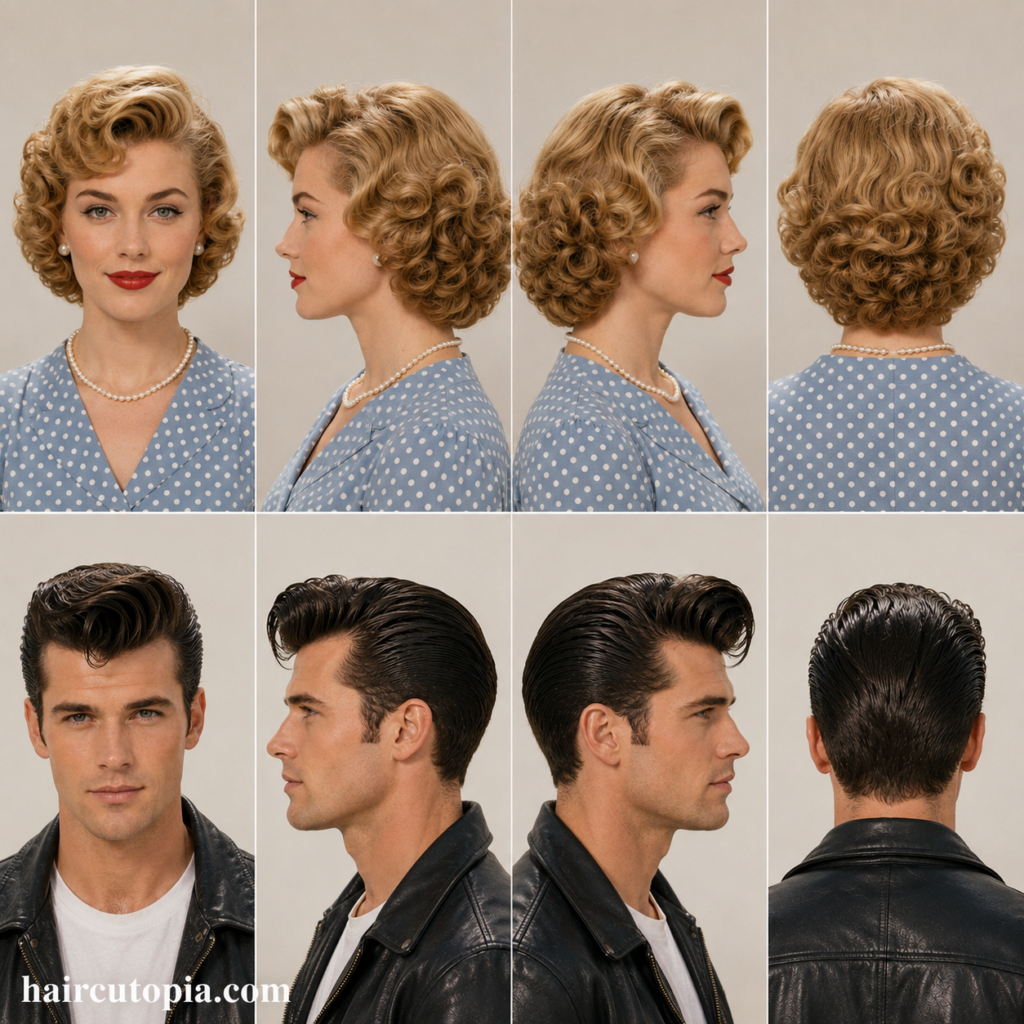
Medium hair provides plenty of possibilities for recreating the decade.
Women’s options include:
- Pageboys
- Curled-under styles
- Flipped ends
- Roller-set waves
- Ponytails
- Chignons
- Half-up styles
Men with medium-length hair can recreate:
- Pompadours
- Ducktails
- Slick backs
- Quiffs
- Greaser styles
Medium length is particularly useful because it provides enough hair to shape without becoming difficult to control.
1950s Hairstyles for Long Hair
Long hair could be worn down, but many recognizable 1950s looks involved arranging it rather than leaving it completely loose.
Popular approaches included:
- Soft waves
- Ponytails
- Rolled updos
- Chignons
- Half-up hairstyles
- Curled ends
Long hair also provided plenty of material for elaborate formal styles.
For an authentic appearance, the front and crown were usually styled as carefully as the lengths.
How to Create a Modern 1950s Hairstyle
You don’t need to reproduce every historical styling technique to capture the decade.
A modern interpretation can be much easier.
Start by choosing one recognizable feature rather than combining every vintage element at once.
For example:
- Add brushed-out waves to a modern bob.
- Style a pixie with a soft vintage fringe.
- Curl the ends of shoulder-length hair inward.
- Add crown volume inspired by a bouffant.
- Turn a modern men’s haircut into a quiff.
- Style longer men’s hair into a loose pompadour.
- Replace matte styling products with a little shine for a slicker finish.
This keeps the inspiration recognizable without making the hairstyle feel like a costume.
1950s Hairstyles vs. 1950s Haircuts
The terms are closely related, but they aren’t exactly the same thing.
A haircut describes how the hair itself is cut: its length, layers, shape, and proportions.
A hairstyle describes how that hair is arranged.
This distinction was especially important in the 1950s.
The same medium-length haircut could potentially be styled into waves, curled ends, a ponytail, or an updo. A men’s cut with additional length through the top might become a side part one day and a pompadour another.
Understanding that difference makes vintage hair much easier to recreate.
You don’t always need an entirely different haircut. Sometimes you simply need the right styling technique.
1950s Hairstyles vs. 1940s Hairstyles
The transition between the 1940s and 1950s happened gradually.
Women’s 1940s hairstyles frequently featured structured rolls, pin curls, and practical arrangements influenced by wartime life.
Many curling techniques continued into the 1950s, but the silhouettes changed.
Shorter cuts became increasingly fashionable. Hollywood curls flourished, and larger crown volume began appearing toward the end of the decade.
Men’s grooming also changed.
Traditional short styles remained popular, but rock and roll introduced dramatically different imagery. Pompadours, ducktails, and slick greaser styles became symbols of a new youth culture.
How 1950s Hairstyles Led Into the 1960s
By the late 1950s, fashionable hair was already changing.
Volume was increasing.
Bouffants lifted hair higher around the crown. Flipped ends created more dramatic silhouettes. Backcombing offered new possibilities for building height.
These ideas would expand significantly during the 1960s.
Men’s hair would change too, although the transformation took longer. The neat short cuts and pompadours of the 1950s gradually gave way to longer, more natural hairstyles as the 1960s progressed.
Looking at late-1950s hair therefore gives you an early glimpse of what was coming next.
Why 1950s Hairstyles Are Still Popular
1950s hairstyles have survived because their shapes are distinctive without being impossible to reinterpret.
A few brushed waves can create subtle vintage character. A full roller set can produce a much more authentic look.
The same applies to men’s hair.
A loose modern quiff barely feels retro, while a glossy pompadour paired with a ducktail immediately evokes the decade.
That range gives 1950s hair unusual versatility.
It can look classic, glamorous, rebellious, elegant, playful, or surprisingly modern depending on how strongly the original styling is emphasized.
Frequently Asked Questions About 1950s Hairstyles
What was the most popular hairstyle in the 1950s?
There wasn’t one hairstyle worn throughout the decade. Short curls, pageboys, pixies, ponytails, and waves were popular among women, while side parts, pompadours, quiffs, and slicked-back styles were popular among men.
How did women wear their hair in the 1950s?
Women wore their hair in short curls, soft waves, pageboys, pixies, ponytails, chignons, and curled or flipped medium-length styles. Roller sets and pin curls were frequently used to create the desired shape.
How did men wear their hair in the 1950s?
Many men wore short, neatly combed hairstyles with side parts. Younger men also popularized pompadours, ducktails, quiffs, and slicked-back hairstyles influenced by rock-and-roll culture.
What was greaser hair?
Greaser hair generally refers to glossy, heavily styled men’s hairstyles associated with 1950s youth culture. Pompadours, ducktails, quiffs, and slick backs were common examples.
How were 1950s curls created?
Rollers and pin curls were common methods. Hair was usually set while damp, allowed to dry, and then brushed and shaped into the finished hairstyle.
Did women wear ponytails in the 1950s?
Yes. Ponytails were particularly associated with younger women and teenagers. They could be worn high or at mid-height and were sometimes paired with bangs, curls, ribbons, or scarves.
Were bouffants popular in the 1950s?
Bouffant hairstyles began gaining popularity toward the end of the 1950s and became even more prominent during the early 1960s.
Can you recreate a 1950s hairstyle without cutting your hair?
In many cases, yes. Roller sets, pin curls, waves, ponytails, rolls, and updos can create a vintage appearance without significantly changing the haircut.
Final Thoughts
1950s hairstyles were about much more than perfectly curled hair and shiny pompadours.
They reflected a decade caught between tradition and change.
Polished Hollywood glamour remained enormously influential, but teenagers were developing their own styles. Rock and roll transformed men’s grooming, short women’s hair became increasingly fashionable, and bigger silhouettes began hinting at the dramatic hairstyles that would dominate the 1960s.
That’s what makes the decade so interesting.
There isn’t just one 1950s look.
You can find elegant waves, playful ponytails, cropped pixies, sculpted curls, neat side parts, rebellious ducktails, and towering pompadours within the same era.
And because so many of those styling ideas still work today, you don’t have to recreate the decade exactly. Sometimes a brushed-out curl, glossy side part, flipped end, or little extra volume is enough to bring a touch of the 1950s into a modern hairstyle.