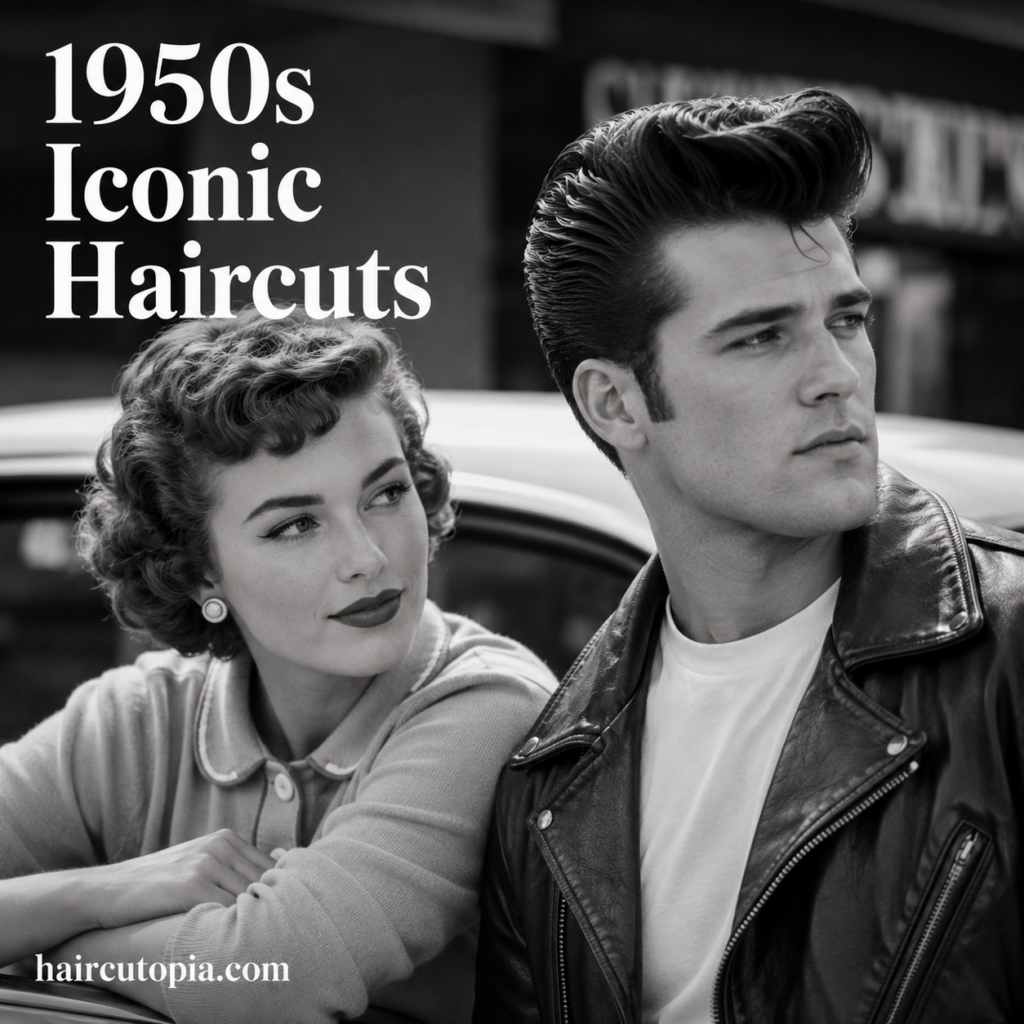
Few eras produced as many instantly recognizable haircuts as the 1950s.
Picture a tall pompadour swept away from the forehead, a glossy ducktail meeting neatly at the back, a sharply groomed crew cut, or a short women’s cut shaped into soft curls. Even without seeing the clothing, you can often guess the decade.
That visual identity didn’t happen by accident.
Hollywood stars were becoming powerful beauty influences. Rock and roll gave young people new style icons. Teenagers were developing their own culture, while salons and barbershops helped turn celebrity looks into hairstyles ordinary people could actually wear.
Some 1950s haircuts were already established before the decade began. Others evolved rapidly during it. What made them iconic was their connection to the people, music, movies, and changing attitudes of the era.
Here are the legendary 1950s haircuts that left the biggest mark.
What Made a Haircut Iconic in the 1950s?
Popularity alone doesn’t necessarily make a haircut iconic.
Some everyday styles were worn by huge numbers of people but aren’t immediately associated with the decade today. Other hairstyles became cultural symbols because they were connected with celebrities, youth movements, or a distinctive visual identity.
The most iconic 1950s haircuts generally had at least one of these qualities:
- A recognizable silhouette
- Strong Hollywood influence
- Association with rock and roll
- Connection to teenage culture
- A distinctive styling technique
- Major influence on later hairstyles
- Continued popularity in modern barbering or hairstyling
The decade also produced two very different approaches to hair.
There was the polished, traditional side of the 1950s: crew cuts, side parts, softly curled women’s cuts, and carefully groomed shapes.
Then there was the emerging rebellious side.
Pompadours grew taller. Ducktails appeared at the back. Short women’s hair challenged assumptions about femininity. Hair became increasingly useful as a form of personal expression.
Iconic 1950s Haircuts for Women
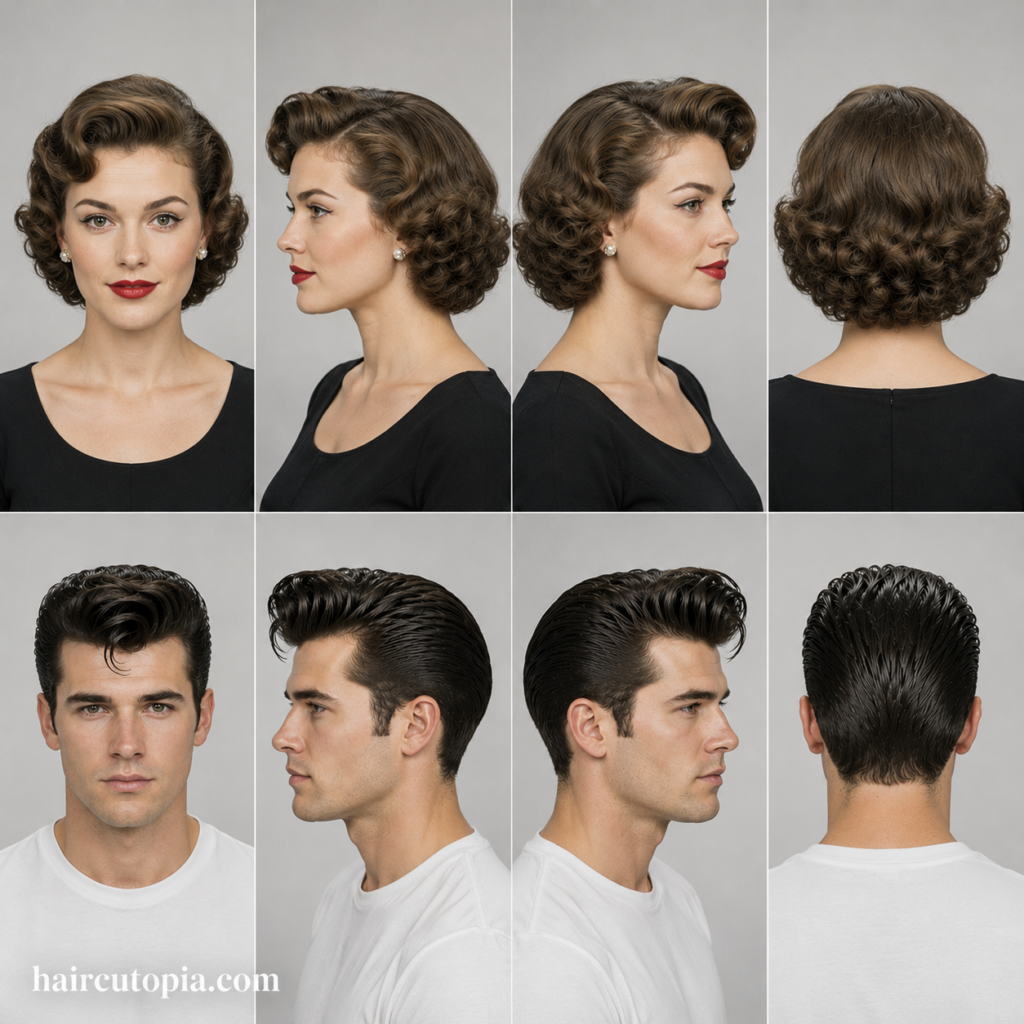
Women’s hair changed considerably during the decade.
Shorter lengths became fashionable, and many cuts were designed specifically to work with curls, waves, and roller sets.
1. The 1950s Pixie Cut
The pixie was one of the decade’s boldest short haircuts.
Hair was cropped closely around the sides, ears, and neckline, with slightly more length through the top and front. A short fringe could soften the forehead and frame the face.
Audrey Hepburn became one of the most memorable short-hair influences of the era.
What made the pixie remarkable was its simplicity.
Many fashionable women’s hairstyles relied on curls and volume. The pixie removed much of that structure and placed the focus directly on the face.
It was elegant, practical, and unmistakably modern.
Why the 1950s Pixie Became Iconic
The pixie represented a significant departure from the idea that glamorous women’s hair needed substantial length.
It also proved surprisingly timeless.
Modern pixies may use more layering, texture, and softer edges, but the fundamental cropped silhouette remains closely related to its mid-century predecessors.
2. The Italian Cut
The Italian cut became another influential short style.
It generally featured relatively short hair with curls or waves arranged around the face and sides. Compared with highly sculpted roller-set styles, the finished shape could appear softer and slightly tousled.
The cut worked especially well for women who wanted short hair without going as closely cropped as a pixie.
Its combination of movement and sophistication helped make short, textured hair an important part of 1950s fashion.
Why the Italian Cut Became Iconic
The Italian cut helped expand what short women’s hair could look like.
It wasn’t severe.
Instead, curls and texture gave the haircut softness and movement, making it an important bridge between traditional curled hairstyles and increasingly modern short cuts.
3. The Short Curly Cut
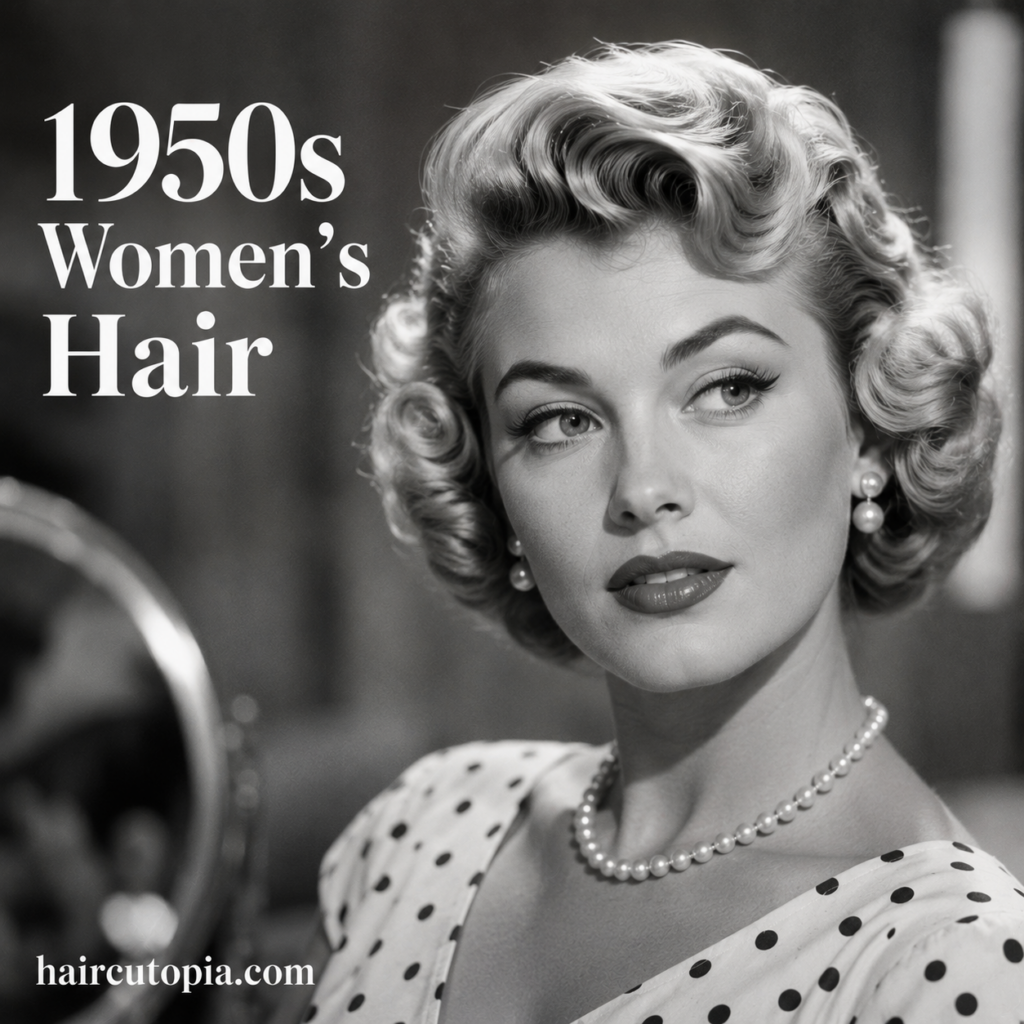
Few women’s looks capture 1950s glamour as immediately as a short haircut styled with curls.
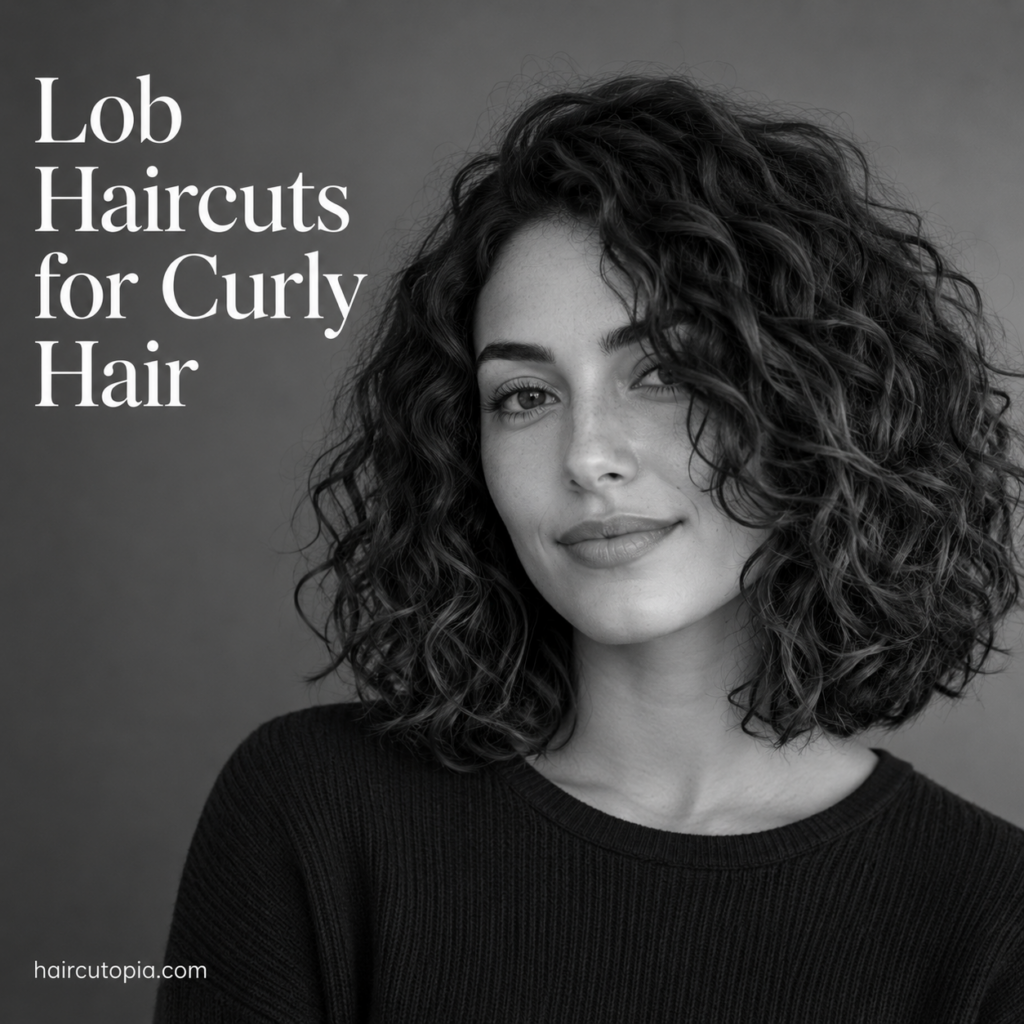
The underlying hair was often cut somewhere around ear to chin length, giving enough room for rollers or pin curls to create a rounded silhouette.
Once the set was released, the curls could be brushed and shaped around the face.
Marilyn Monroe became one of the most enduring visual references for glamorous short curls and waves.
Why Short Curls Became Iconic
They captured the polished beauty aesthetic of the decade.
Short curls could look sophisticated without requiring long hair, and the basic haircut allowed considerable styling flexibility.
A tighter set could create defined curls. A thorough brush-out could transform the same hair into softer waves.
4. The Poodle Cut
The poodle cut was one of the most distinctive hairstyles of the early 1950s.
Hair was generally cut short enough to support a compact shape and styled into clusters of small curls, often concentrated around the top and sides.
Lucille Ball became closely associated with highly recognizable curly styling during the period.
The name came from the resemblance between the tightly arranged curls and a poodle’s coat.
Why the Poodle Cut Became Iconic
Very few hairstyles capture the highly curled aesthetic of early-1950s hair quite as clearly.
It was playful, structured, and immediately noticeable.
Although rarely reproduced exactly today outside vintage styling, its distinctive silhouette remains closely associated with the decade.
5. The 1950s Bob
The bob wasn’t invented anywhere near the 1950s, but the decade created its own softer interpretation.
Rather than emphasizing severe geometric lines, many bobs were shaped around the chin and styled with:
- Curled-under ends
- Soft waves
- Side parts
- Short bangs
- Rounded volume
The haircut provided a useful foundation for numerous hairstyles.
Why the 1950s Bob Became Iconic
Versatility kept the bob relevant.
It could look youthful or sophisticated, smooth or curled, casual or glamorous.
That adaptability has helped the bob survive virtually every fashion cycle since.
6. The Pageboy
The pageboy was another recognizable mid-century cut.
Hair generally fell around chin to shoulder length, with the ends curved inward toward the neck.
The overall silhouette was smooth and rounded.
Bangs could be added, although a side part was another common option.
Why the Pageboy Became Iconic
The pageboy created a polished appearance without requiring curls throughout the entire hairstyle.
Its defining feature was shape rather than texture.
That made it visually distinct from the heavily curled styles surrounding it.
Modern versions continue to appear periodically, often with sharper lines or more visible layering.
Iconic 1950s Haircuts for Men
Men’s hair tells an especially interesting story.
The decade began with conservative short cuts firmly established as the norm. Those styles remained popular, but youth culture introduced increasingly dramatic alternatives.
The result was one of the most diverse periods in classic men’s grooming.
7. The Pompadour
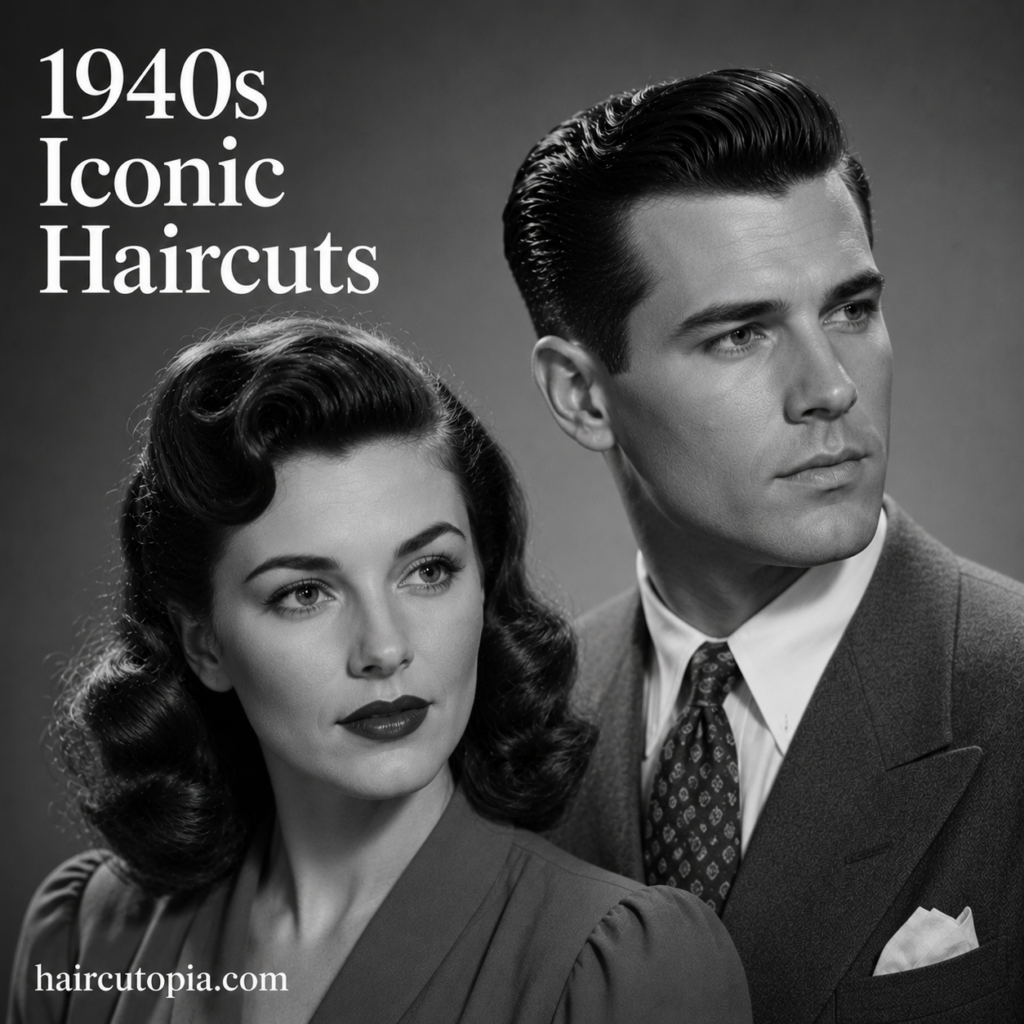
If one men’s haircut silhouette represents the 1950s in popular culture, it’s probably the pompadour.
Hair was kept significantly longer through the front and top so it could be lifted upward and swept backward.
The front created the characteristic height.
The sides remained more controlled, helping emphasize the volume above the forehead.
Elvis Presley helped turn voluminous, swept-back men’s hair into one of the defining visual symbols of rock and roll.
Why the Pompadour Became Iconic
It stood out.
A crew cut was designed to look neat and practical. A pompadour was meant to be noticed.
The additional height made men’s hair part of a larger fashion statement, especially among younger people influenced by musicians and entertainers.
The pompadour remains popular today, although modern versions often incorporate fades, texture, and matte styling products.
8. The Ducktail
The ducktail is another haircut almost inseparable from 1950s imagery.
It was sometimes known as the D.A., an abbreviation based on its more colorful nickname.
Hair was left long enough around the sides to be combed backward toward the center of the head.
At the back, the two sides met in a vertical seam.
That seam created the tail-like shape.
Why the Ducktail Became Iconic
The haircut looked completely different from conventional short men’s grooming.
It also required deliberate styling.
The front could be shaped into a pompadour or quiff while the back created the signature ducktail.
That combination became closely connected with greaser culture and the rebellious image of 1950s youth.
9. The Crew Cut
Not every iconic haircut was rebellious.
The crew cut represented the clean-cut side of the decade.
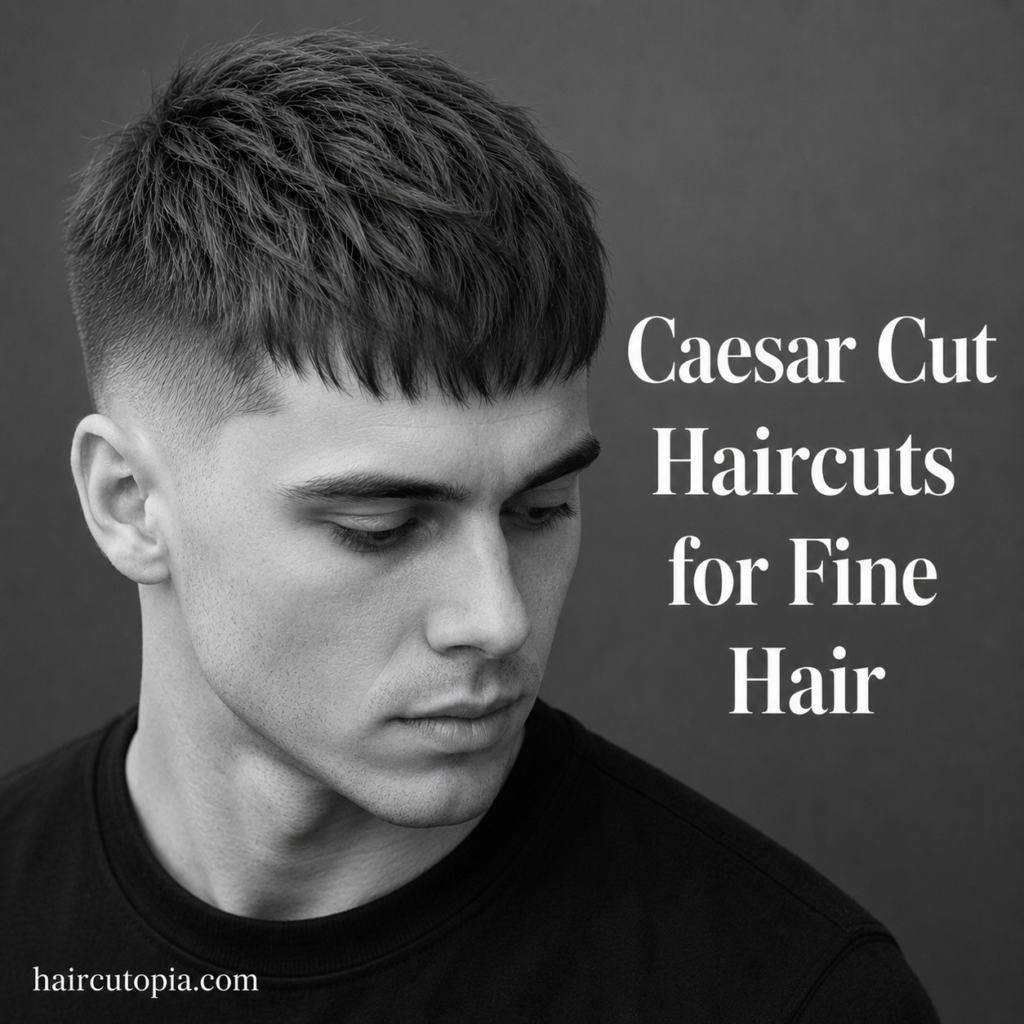
Hair was clipped short around the sides and back, with slightly more length remaining across the top.
It required little styling and created a tidy, athletic appearance.
Why the Crew Cut Became Iconic
The crew cut reflected several major influences on men’s grooming:
- Military haircuts
- College culture
- Athletics
- Conservative fashion
- Practicality
It became particularly associated with young men who wanted a neat appearance without the styling requirements of longer hair.
Unlike some distinctly vintage hairstyles, the crew cut never really disappeared.
10. The Flat Top
The flat top took short barbering in a more architectural direction.
Hair along the sides was cut very short, while the top was left long enough to stand upright.
The barber then shaped the upper surface into a relatively level plane.
The result was squared and precise.
Why the Flat Top Became Iconic
The haircut demonstrated the technical possibilities of clipper work.
Its strong geometric silhouette also made it easy to recognize.
The flat top would remain influential in later military, athletic, and subcultural hairstyles, periodically returning in different forms.
11. The Ivy League
The Ivy League sat somewhere between a crew cut and a longer side-parted haircut.
The sides and back remained short, but the top had enough length to create a subtle part or sweep through the front.
The result was polished without appearing overly formal.
Why the Ivy League Became Iconic
It captured the collegiate, clean-cut aesthetic strongly associated with mid-century men’s fashion.
More importantly, the proportions proved timeless.
A modern Ivy League can look almost completely contemporary with only minor adjustments to texture and tapering.
12. The Classic Side-Part Cut
The side part was one of the most widely worn men’s looks of the era.
Hair remained relatively short around the sides and back while the top was long enough to comb neatly across.
A clearly defined part created structure.
Styling products could then provide control and shine.
Why the Side Part Became Iconic
The side part represented conventional men’s grooming.
It wasn’t designed to shock anyone.
That was precisely its strength.
It worked for school, work, formal events, and everyday life. The haircut became a standard that more rebellious styles could contrast against.
13. The Quiff
The quiff offered another way to use additional length through the front.
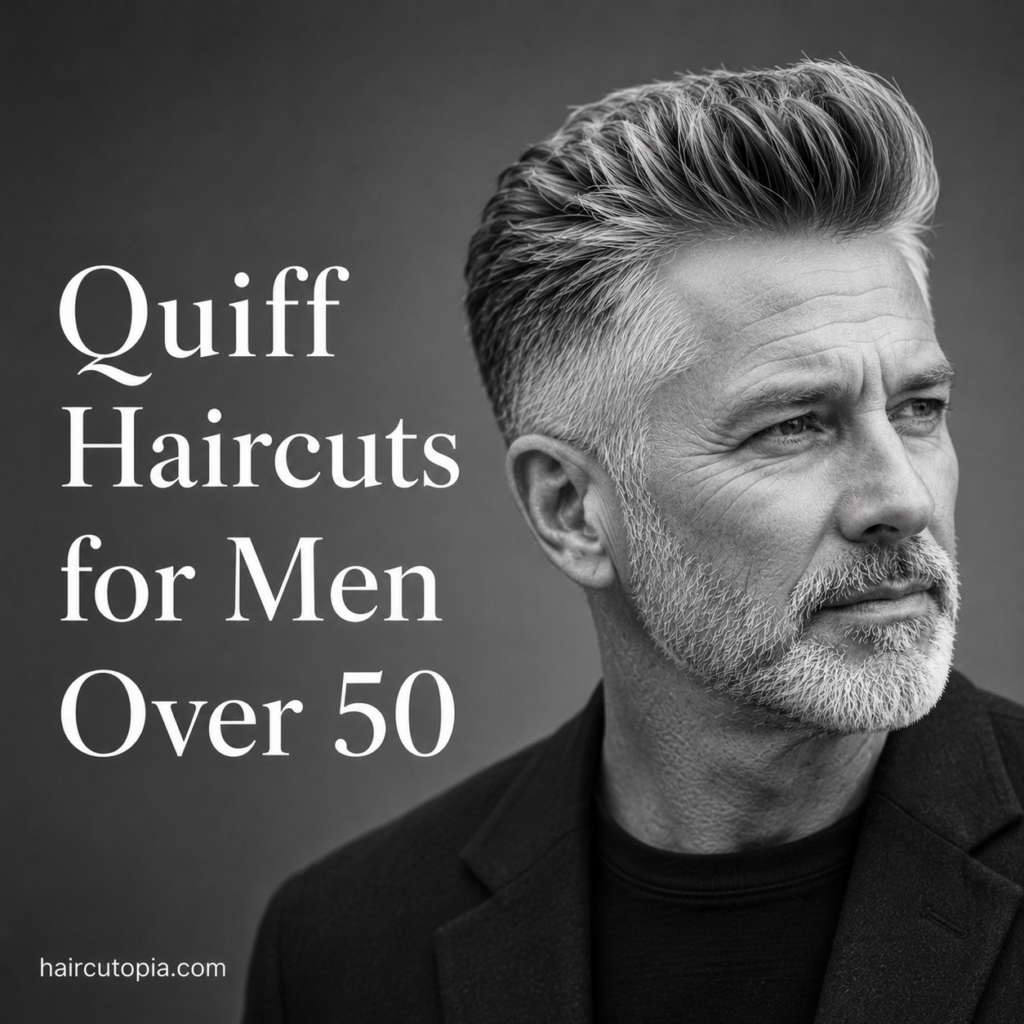
Hair above the forehead was lifted upward and directed backward, creating volume without necessarily reaching full pompadour height.
The sides remained shorter and more controlled.
Why the Quiff Became Iconic
The quiff was adaptable.
It could be relatively neat or deliberately dramatic.
That allowed it to sit somewhere between conservative men’s grooming and full rock-and-roll styling.
Modern quiffs continue to use essentially the same principle.
14. The Slick-Back Cut
Longer hair could also be combed directly backward.
The slick back required enough length through the top for the hair to stay directed away from the forehead.
Pomade helped maintain the shape.
Traditional products also produced the glossy finish associated with many 1950s men’s styles.
Why the Slick Back Became Iconic
The slick back was simple but visually powerful.
It exposed the forehead, emphasized the shape of the haircut, and worked naturally with the era’s preference for controlled styling.
It also became closely associated with the greaser aesthetic.
15. The Elephant Trunk
The elephant trunk was one of the more dramatic men’s styles associated with the decade.
Longer hair around the front was shaped so that a section curved forward toward the forehead while the sides remained swept backward.
The result created a distinctive hanging or rolled front feature.
Why the Elephant Trunk Became Iconic
It pushed the decade’s interest in sculpted men’s hair even further.
While never as universal as the crew cut or side part, it became part of the visual vocabulary associated with rebellious 1950s youth.
The Greaser Haircut Became a Cultural Symbol
“Greaser haircut” doesn’t refer to one exact cut.
Instead, it describes a family of longer men’s styles associated with a particular youth aesthetic.
These included:
- Pompadours
- Ducktails
- Quiffs
- Slick backs
- Elephant trunks
What connected them was the styling.
Hair was deliberately shaped and often finished with considerable shine.
Leather jackets, denim, motorcycles, customized cars, and rock-and-roll imagery later became intertwined with this hairstyle aesthetic in popular culture.
The result is one of the strongest visual stereotypes associated with the decade.
Hollywood Made Haircuts Famous
The growing influence of movies and celebrity culture helped transform hairstyles into recognizable trends.
People could see actors repeatedly through movies, magazines, newspapers, advertisements, and publicity photographs.
That visibility mattered.
A haircut worn by a major celebrity could suddenly become desirable far beyond Hollywood.
Marilyn Monroe’s short curls became a beauty reference.
Audrey Hepburn demonstrated the sophistication of cropped hair.
Grace Kelly became associated with polished elegance.
For men, performers such as Elvis Presley helped popularize voluminous styling, while James Dean contributed to the broader image of youthful rebellion.
People didn’t necessarily request exact celebrity replicas.
Often, they borrowed the length, silhouette, curl pattern, or styling approach.
Rock and Roll Changed Men’s Haircuts
Music became one of the decade’s strongest style influences.
Rock and roll offered young men a visual identity that looked noticeably different from conventional adult grooming.
The contrast was easy to see.
Traditional hair:
- Short
- Practical
- Neatly parted
- Closely controlled
Rock-and-roll hair:
- Longer through the top
- Higher at the front
- More sculpted
- Often shinier
- Deliberately noticeable
That made hair an easy way for teenagers to participate in a new cultural movement.
The relationship between music and hairstyles would only grow stronger in the decades that followed.
How 1950s Haircuts Were Styled
A historically accurate haircut was only part of the equation.
Styling created many of the decade’s recognizable silhouettes.
Women’s Styling
Women frequently relied on:
- Rollers
- Pin curls
- Setting products
- Hairpins
- Brushes
- Backcombing
- Finishing spray
Hair could be set while damp and allowed to dry before being brushed into shape.
The brush-out was particularly important.
Fresh curls often looked much tighter than the finished hairstyle. Brushing allowed those curls to blend into larger waves and smoother shapes.
Men’s Styling
Men relied heavily on:
- Combs
- Pomade
- Hair tonic
- Styling creams
- Careful directional combing
Pompadours required lift through the front.
Ducktails required the sides to meet precisely at the back.
Side parts needed a clean division.
The haircut provided the structure, but the comb and product created the finished style.
Early 1950s vs. Late 1950s Haircuts
Hair didn’t remain unchanged throughout the decade.
Early 1950s
Women’s hair often featured:
- Short curled cuts
- Poodle-inspired shapes
- Rounded bobs
- Compact silhouettes
Men frequently wore:
- Crew cuts
- Side parts
- Short collegiate styles
- Neatly combed cuts
The overall appearance remained strongly polished.
Mid-1950s
Youth culture became increasingly influential.
More visible styles included:
- Pixie cuts
- Short Hollywood curls
- Pompadours
- Quiffs
- Ducktails
- Slick backs
Hair was becoming more expressive.
Late 1950s
Women’s hair gradually moved toward larger silhouettes.
Volume around the crown increased, preparing the way for the bouffants of the early 1960s.
Men continued wearing both conservative short cuts and rock-and-roll-inspired styles.
The divide between traditional and youthful grooming remained one of the decade’s defining features.
1950s Iconic Haircuts That Still Work Today
A surprising number of 1950s haircuts remain completely wearable.
Some barely look vintage anymore.
Styles that continue to appear include:
- Pixie cuts
- Bobs
- Crew cuts
- Flat tops
- Ivy League cuts
- Side parts
- Pompadours
- Quiffs
- Slick backs
Modern interpretations usually change the texture rather than the fundamental shape.
For example, a contemporary pompadour might use a low fade and matte clay.
A modern pixie might incorporate choppy layers.
An Ivy League might use a softer taper and textured top.
The architecture remains familiar even when the finish changes.
How to Ask for a 1950s-Inspired Haircut Today
If you’re taking vintage inspiration to a modern salon or barbershop, reference photos are extremely useful.
Don’t rely only on the hairstyle’s name.
Instead:
- Show the stylist or barber the exact silhouette you want.
- Point out the desired length around the sides and back.
- Explain how much volume you want through the top.
- Discuss whether you want an authentic or modern finish.
- Consider how much daily styling you’re willing to do.
- Ask how the haircut will behave with your natural texture.
That final point is important.
Some iconic 1950s looks depend heavily on styling.
A pompadour without product and blow-drying may fall forward. A vintage curled cut without a roller set may look considerably different.
Choose the haircut with your everyday routine in mind.
How to Modernize an Iconic 1950s Haircut
You don’t need to reproduce a vintage haircut exactly.
Often, the most wearable approach is to preserve its recognizable silhouette while relaxing the styling.
Try:
- A textured pompadour instead of a glossy one
- A tapered Ivy League with natural movement
- A loose quiff with matte finish
- A softer pixie with additional layering
- A modern bob with subtle vintage curves
- A slick back with less product
- A contemporary flat top with cleaner fading
You can always increase the vintage styling when you want a stronger 1950s appearance.
That flexibility is one reason these cuts continue to survive.
Frequently Asked Questions About Iconic 1950s Haircuts
What was the most iconic men’s haircut of the 1950s?
The pompadour is one of the most recognizable men’s styles associated with the decade, particularly because of its connection with rock-and-roll culture. Crew cuts, ducktails, side parts, and quiffs were also highly recognizable.
What was the most iconic women’s haircut of the 1950s?
Short curled cuts, pixies, bobs, pageboys, and Italian-inspired cuts were among the decade’s most recognizable women’s styles. Celebrity influence played a major role in making short hair fashionable.
What haircut did greasers have?
There wasn’t one universal greaser haircut. Pompadours, ducktails, quiffs, slick backs, and other longer sculpted styles were commonly associated with greaser fashion.
What is a 1950s ducktail haircut?
A ducktail is a men’s hairstyle in which hair along the sides is combed backward until it meets along the center of the back of the head, forming a vertical seam resembling a duck’s tail.
Were crew cuts popular in the 1950s?
Yes. Crew cuts were extremely compatible with the decade’s clean-cut, collegiate, athletic, and military-influenced grooming styles.
Did women have pixie cuts in the 1950s?
Yes. Very short women’s hair became fashionable during the decade, with Audrey Hepburn becoming one of the best-known celebrity references for elegant cropped hair.
What products were used for 1950s men’s hair?
Pomades, hair tonics, and styling creams helped create the smooth, controlled, and often glossy finish associated with men’s hairstyles of the period.
Can 1950s haircuts look modern?
Absolutely. Pixies, bobs, crew cuts, Ivy League cuts, pompadours, quiffs, and slick backs all have modern versions. Using softer texture, contemporary tapering, or less shine can make the style feel current.
Final Thoughts
The most iconic 1950s haircuts weren’t simply popular hairstyles.
They became symbols.
The pixie represented a bold new approach to short women’s hair. Glamorous curled cuts captured Hollywood beauty. Crew cuts reflected the clean-cut side of men’s grooming, while pompadours and ducktails became visual shorthand for rock and roll, teenagers, and rebellion.
That contrast is what gives the decade such a strong identity.
The 1950s could be polished and conservative one moment, youthful and rebellious the next.
Hair reflected both.
And perhaps the strongest sign of the decade’s influence is how many of these haircuts are still around. Walk into a modern salon or barbershop and you’ll still encounter pixies, bobs, crew cuts, Ivy Leagues, quiffs, slick backs, and pompadours.
The styling has evolved.
The iconic shapes haven’t gone anywhere.