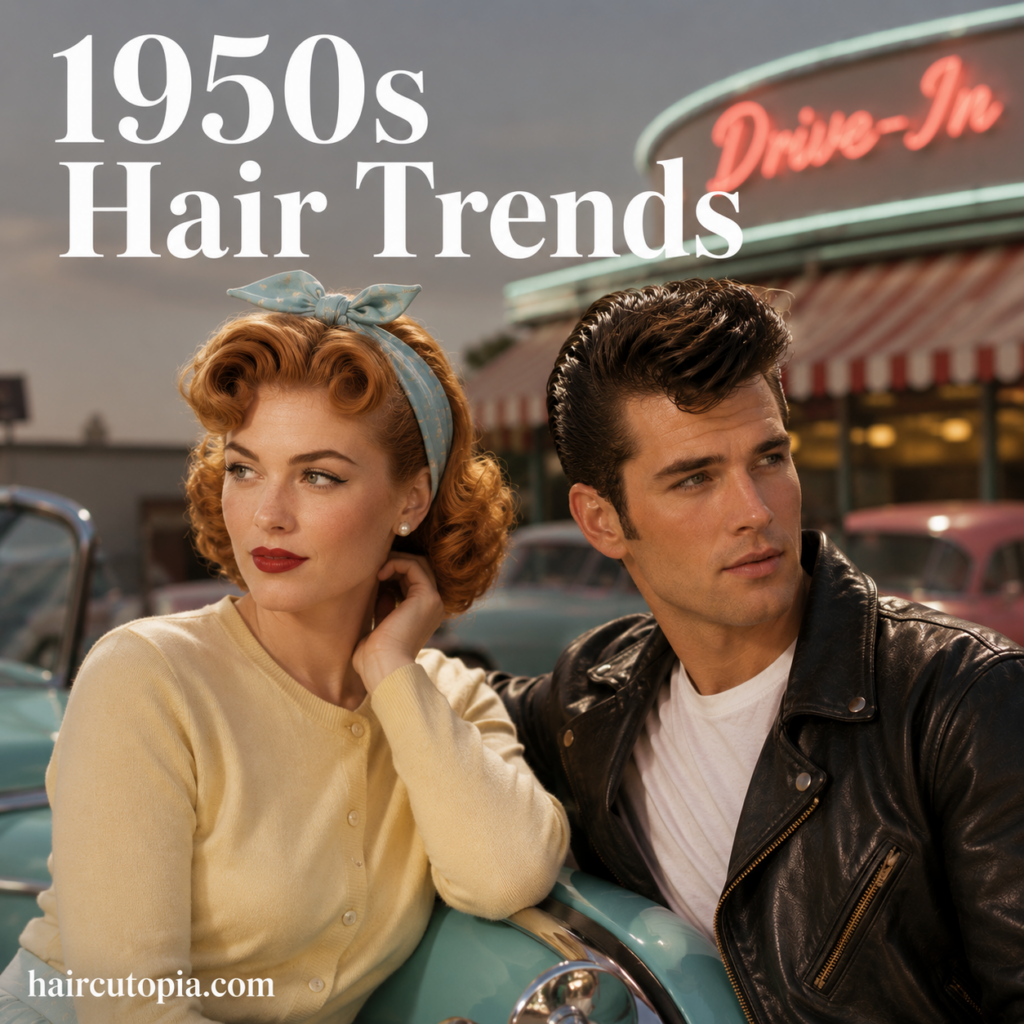
Few decades have a hair identity as recognizable as the 1950s.
Women’s hair became shorter, curlier, and increasingly sculpted. Men’s grooming ranged from conservative crew cuts and side parts to glossy pompadours associated with the growing rock-and-roll scene. Toward the end of the decade, volume started climbing higher, offering an early preview of the dramatic hairstyles that would dominate the 1960s.
But 1950s hair trends weren’t simply about individual hairstyles.
Hollywood stars influenced what people requested at salons. Teenagers emerged as a powerful cultural group with their own fashion preferences. New styling products and home hair-care routines made fashionable looks easier to recreate. Hair color became increasingly visible as part of a person’s overall style.
The result was a decade where hair could communicate glamour, neatness, sophistication, youth, or rebellion.
Here’s a closer look at the major 1950s hair trends and why so many of them remain influential today.
What Defined 1950s Hair Trends?
The overall direction of hair during the 1950s can be summed up in one word: polished.
Hair usually looked styled rather than untouched.
Women’s curls were set and brushed into place. Men’s hair was neatly combed or deliberately sculpted with styling product. Even casual hairstyles tended to have a recognizable shape.
Several major trends defined the decade:
- Shorter hairstyles for women
- Structured curls and waves
- Increasing volume
- Smooth, glossy men’s hair
- Pompadours and quiffs
- Carefully defined side parts
- Hollywood-inspired glamour
- Rock-and-roll influence
- Ponytails and youthful styles
- Hair accessories
- Growing interest in hair color
- More elaborate home styling routines
These trends didn’t appear simultaneously. Hair changed throughout the decade, and late-1950s styles could look noticeably different from those worn just a few years earlier.
Women’s Hair Became Shorter
One of the most important women’s hair trends of the 1950s was the popularity of shorter lengths.
Short hair certainly wasn’t new. Women had worn bobs and cropped styles for decades. But the 1950s produced a particularly wide range of fashionable short looks.
Pixies, short curls, Italian-inspired cuts, and sculpted bobs all became prominent.
Audrey Hepburn demonstrated how elegant extremely short hair could look, while other celebrities showed off chin-length curls and softly shaped styles.
Shorter hair also worked beautifully with the decade’s emphasis on setting.
Rollers and pin curls could transform a relatively simple short haircut into a carefully sculpted hairstyle with volume concentrated exactly where it was wanted.
Curls Were Everywhere
If there’s one styling feature strongly associated with women’s hair in the 1950s, it’s curls.
They appeared in many different forms.
Some women wore tight, defined curls. Others brushed their curls until they blended into smooth waves. Hair could be curled around the face, concentrated toward the crown, or turned inward at the ends.
Popular variations included:
- Short sculpted curls
- Poodle-style curls
- Soft Hollywood waves
- Curled-under bobs
- Curled ponytails
- Rolled updos
- Pin-curled fringes
The finished appearance depended heavily on how the curls were brushed and arranged after setting.
That distinction is important. Vintage 1950s curls often weren’t meant to remain exactly as they looked when the rollers came out.
The brush-out created the final shape.
Hollywood Glamour Had a Major Influence
Movies and celebrity culture helped shape beauty ideals throughout the decade.
Marilyn Monroe became closely associated with glamorous short blonde curls and waves.
Audrey Hepburn offered a completely different type of inspiration with her short hair and distinctive fringe.
Elizabeth Taylor appeared with beautifully shaped curls and polished dark hair, while Grace Kelly became associated with an elegant, controlled aesthetic.
Women could see these looks in films, magazines, advertisements, and publicity photographs.
They might not recreate a celebrity hairstyle exactly, but the influence could still appear in the length, curl pattern, part, or overall silhouette.
Celebrity hair was becoming a powerful trendsetter.
The Poodle Look Became a 1950s Signature
The poodle hairstyle represents the highly curled side of early-1950s fashion.
Hair was arranged into clusters of small curls, often concentrated around the top or front of the head.
Lucille Ball became famous for distinctive curly hairstyles that reflected this broader trend.
The poodle look demonstrated something important about the decade: texture was often intentionally created rather than left entirely natural.
Women could use pin curls, rollers, and setting techniques to build the shape they wanted.
It was less about effortless texture and more about controlled texture.
Hair Began Getting Bigger
The early 1950s are frequently associated with relatively compact curls and shorter silhouettes.
By the end of the decade, things were changing.
Volume was increasing around the crown.
Rollers could provide lift, while backcombing created a hidden foundation underneath the visible hair. The outer surface was then smoothed over that structure.
This led to early bouffant hairstyles.
The trend would become considerably more dramatic during the 1960s, but its roots were already clearly visible in late-1950s fashion.
Hair was moving upward.
Ponytails Became a Youthful Trend
Not every fashionable hairstyle required a complicated salon set.
The ponytail became strongly associated with teenagers and younger women.
It was practical, easy to personalize, and worked naturally with the growing visibility of youth fashion.
A 1950s ponytail might include:
- A curled ponytail
- Short bangs
- A scarf tied around the base
- A ribbon
- Smooth sides
- A curled front section
The style also contrasted nicely with the more elaborate hairstyles worn by adults.
That difference mattered because teenagers were becoming a much more distinct cultural group during the decade.
Hair Accessories Became Part of the Look
Accessories provided another way to personalize hair.
Scarves were especially versatile.
A scarf could be tied around a ponytail, wrapped around the head, or used practically to protect a carefully styled set.
Other accessories included:
- Headbands
- Ribbons
- Barrettes
- Decorative combs
- Hairpins
- Flowers
- Small clips
Accessories could make a simple hairstyle feel much more intentional.
They also helped coordinate hair with clothing, reinforcing the polished head-to-toe styling associated with the era.
Curled-Under Ends Created a Polished Silhouette
Not every woman wore curls throughout her entire hairstyle.
Sometimes the emphasis was concentrated at the ends.
Hair could be brushed relatively smooth before curving inward toward the neck or jawline.
This worked particularly well with:
- Bobs
- Pageboys
- Shoulder-length hair
- Smooth medium-length styles
The curled-under shape gave hair a neat, rounded silhouette without requiring tight curls everywhere.
It’s one of the subtler 1950s trends and one of the easiest to adapt today.
Flipped Ends Began Appearing
Hair didn’t always curl inward.
Outward flips became increasingly fashionable as the decade progressed.
Instead of tucking toward the neck, the ends kicked away from the face.
The effect could be subtle or noticeably playful.
Flipped ends became even more recognizable during the early 1960s, making them another example of a late-1950s trend that helped bridge the two decades.
Men’s Hair Split Between Conservative and Rebellious
Men’s hair in the 1950s is particularly interesting because two very different aesthetics existed at the same time.
On one side was traditional grooming.
Short hair, crew cuts, side parts, and neat collegiate styles remained extremely common. These looks emphasized cleanliness, order, and professionalism.
On the other side was an emerging youth aesthetic.
Hair became taller, slicker, and more dramatic.
Pompadours, quiffs, ducktails, and slick backs gave younger men ways to distinguish themselves visually.
The contrast between these approaches became one of the defining characteristics of men’s hair during the decade.
The Side Part Remained a Standard
Despite all the attention given to rebellious 1950s hairstyles, plenty of men still wore straightforward side parts.
Hair was cut relatively short and combed neatly across the top.
A styling product could provide control and a polished finish.
The style worked almost anywhere:
- Offices
- Schools
- Formal occasions
- Everyday settings
Its versatility explains why the side part has remained part of men’s grooming ever since.
Today’s version tends to have more texture and less shine, but the underlying idea hasn’t changed much.
Crew Cuts Reflected the Clean-Cut Look
The crew cut represented another major side of 1950s men’s fashion.
Short, practical, and easy to maintain, it became particularly associated with athletic, military, and collegiate aesthetics.
The sides and back were kept short while slightly more length remained through the top.
Compared with a pompadour, very little daily styling was required.
This clean-cut appearance became an important contrast to the more rebellious hairstyles emerging among some younger men.
Rock and Roll Changed Men’s Hair
Few cultural developments affected 1950s hair as visibly as rock and roll.
Music gave teenagers new style icons.
Elvis Presley became one of the most influential examples. His voluminous, carefully styled hair helped turn the pompadour silhouette into an enduring symbol of the era.
Rock-and-roll hairstyles looked noticeably different from conventional short men’s grooming.
They were larger.
They required more styling.
And perhaps most importantly, they attracted attention.
Hair became part of a performer’s image, and teenagers could adapt that image for themselves.
Pompadours Became a Symbol of Youth Culture
The pompadour wasn’t invented in the 1950s, but the decade gave the men’s version enormous cultural visibility.
Hair was left longer at the front and styled upward before sweeping backward.
This created height above the forehead.
The sides were usually combed backward and kept much flatter.
Pomade helped maintain the shape and produced the glossy appearance commonly associated with the style.
The bigger the front became, the more dramatic the overall look.
Modern pompadours frequently incorporate fades and matte styling products, but the basic silhouette remains instantly recognizable.
The Ducktail Became a Rebel Favorite
Another unmistakable trend was the ducktail.
The hairstyle got its name from the way the back was arranged.
Hair from both sides was slicked toward the center until the sections met in a vertical seam, creating a shape reminiscent of a duck’s tail.
The front could be styled into a pompadour or quiff.
The ducktail became closely associated with greaser fashion and youthful rebellion.
It required enough length to shape and plenty of product to keep everything controlled.
Slick Hair Was a Major Men’s Trend
Shine was much more visible in many men’s hairstyles than it is in contemporary grooming.
Pomades and similar products helped create slick, highly controlled finishes.
They were useful for:
- Pompadours
- Ducktails
- Side parts
- Slick backs
- Quiffs
- Sculpted waves
This glossy appearance became especially associated with greaser culture.
Modern men’s hair products often aim for a matte or natural finish, so adding shine is one of the quickest ways to give a contemporary hairstyle a stronger vintage character.
The Greaser Look Became a Cultural Icon
The greaser aesthetic is now one of the most recognizable images associated with 1950s youth culture.
Hair was a major part of the look.
It was generally longer than conservative men’s cuts, heavily styled, and deliberately noticeable.
Leather jackets, denim, T-shirts, and slick hair became part of a visual identity that would later be repeatedly recreated in movies, television, fashion, and popular culture.
James Dean helped represent the broader image of youthful rebellion during the period, even though men’s styling varied considerably from person to person.
The important shift was cultural.
Hair could now communicate that someone belonged to a younger generation with its own tastes.
Teenagers Became Hair Trendsetters
The growing importance of teenagers is essential to understanding 1950s hair trends.
Earlier generations certainly had youth fashion, but the postwar period saw teenagers increasingly recognized as a distinct consumer group.
Music, movies, magazines, clothing, and hairstyles began targeting them more directly.
Young women could choose ponytails and playful accessories.
Young men could experiment with pompadours and ducktails.
Hair became one of the easiest ways to participate in youth culture without completely changing a wardrobe.
That relationship between teenagers and hairstyle trends would grow even stronger during the following decades.
Hair Color Became Increasingly Important
Hair color also contributed to the decade’s beauty identity.
Blonde hair received enormous visibility through Hollywood, particularly through stars such as Marilyn Monroe.
Dark brunette shades could create an equally glamorous appearance, while red hair became visually distinctive through celebrities such as Lucille Ball.
Color wasn’t necessarily meant to appear subtle.
A striking shade could become part of someone’s signature image.
The growing beauty industry also made hair coloring increasingly accessible to consumers, helping establish the home and salon coloring culture that would expand dramatically in later decades.
Home Hair Styling Was a Routine
Creating fashionable hair often required preparation.
Many women regularly set their hair rather than styling it quickly each morning.
A typical routine could involve:
- Washing and preparing the hair.
- Dividing it into sections.
- Setting sections with rollers or pin curls.
- Allowing the hair to dry completely.
- Removing the set.
- Brushing the curls into shape.
- Pinning or arranging specific sections.
- Using finishing products to help maintain the style.
The setting stage created the foundation.
The brushing stage created the hairstyle.
Understanding that process helps explain why vintage hair can be difficult to recreate simply by using a modern curling iron.
Roller Sets Shaped Women’s Hair
Rollers were fundamental to many 1950s looks.
Different roller sizes produced different results.
Smaller rollers could create tighter curls, while larger rollers produced softer movement and volume.
Direction mattered too.
Rolling hair toward or away from the face changed how it behaved once released.
That meant a roller set wasn’t simply about making hair curly. It was essentially a blueprint for the finished hairstyle.
Pin Curls Offered More Control
Pin curls provided another important setting method.
Small sections of damp hair were shaped into curls and secured against the scalp.
Their placement determined how the hair would eventually move.
After the hair dried, the pins were removed and the curls could be brushed into waves or arranged into more defined shapes.
Pin curls were especially useful around the front and sides, where precise direction could dramatically affect the final silhouette.
The Brush-Out Was Essential
One of the most overlooked aspects of vintage hair is brushing.
Modern curling routines often encourage people to preserve individual curls.
1950s styling frequently did the opposite.
Curls were deliberately brushed together.
As the hair was brushed and shaped, individual curls began forming larger waves and smooth curves.
This created the controlled, polished finish visible in many photographs from the period.
The technique is one reason authentic vintage waves look different from modern curling-iron curls.
Hair Products Helped Everything Stay in Place
Structured hairstyles needed hold.
Men relied heavily on pomades and grooming products to maintain slick styles.
Women used setting products and finishing sprays to help curls and carefully shaped sections last.
Compared with today’s preference for touchable, effortless-looking texture, 1950s hair was often expected to maintain a specific silhouette.
Movement wasn’t necessarily the goal.
Control was.
Early 1950s vs. Late 1950s Hair Trends
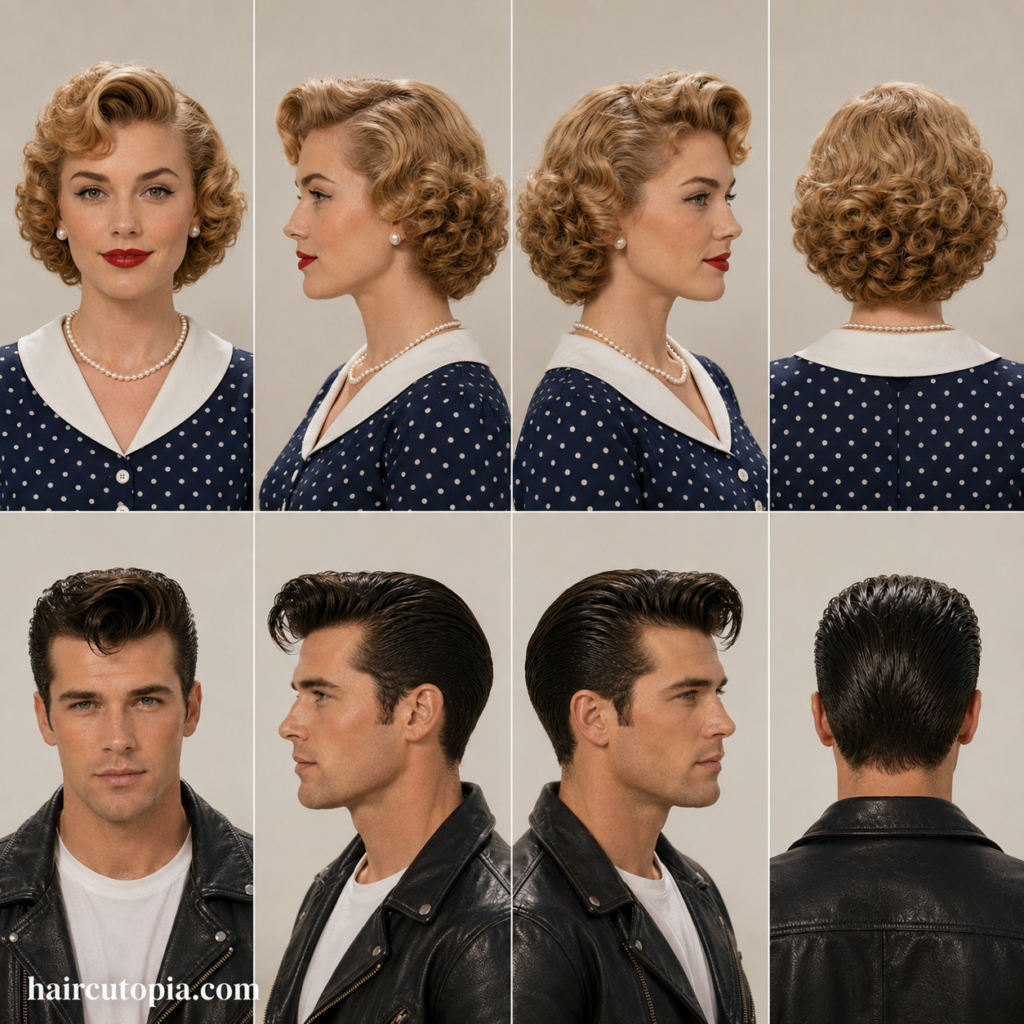
The decade wasn’t stylistically static.
Early 1950s Hair
Earlier styles often emphasized:
- Compact curls
- Poodle-inspired hairstyles
- Short sculpted cuts
- Smooth men’s side parts
- Crew cuts
- Controlled silhouettes
There was still considerable continuity with the styling methods of the 1940s.
Mid-1950s Hair
As the decade progressed, celebrity and youth influences became increasingly visible.
Trends included:
- Hollywood curls
- Short pixies
- Ponytails
- Pompadours
- Quiffs
- Ducktails
- Greaser styling
Hair was becoming more expressive.
Late 1950s Hair
By the end of the decade, silhouettes were beginning to change again.
Women increasingly experimented with:
- Crown volume
- Bouffant shapes
- Flipped ends
- Larger roller sets
- Backcombing
These developments pointed directly toward the early 1960s.
How 1950s Hair Trends Differed From the 1940s
There was plenty of overlap between the two decades.
Rollers, pin curls, waves, and structured styling existed in both.
But the cultural context changed.
1940s hair had developed during wartime conditions when practicality played an important role in everyday fashion.
The 1950s brought a different environment.
Hollywood glamour expanded. Consumer culture grew. Teenagers became trendsetters. Rock and roll emerged.
Women’s hairstyles became shorter and eventually more voluminous, while men’s hair developed a clear divide between conservative and rebellious looks.
Hair became increasingly connected to personal identity.
How 1950s Hair Trends Influenced the 1960s
The transition into the 1960s is especially visible in women’s hair.
Volume continued growing.
Bouffants became larger. Backcombing became more important. Flipped ends became more pronounced, and hairstyles moved farther away from the smaller curls of the early 1950s.
The change in men’s hair happened more gradually.
Short cuts remained common in the early 1960s, but younger men eventually began growing their hair longer as music and fashion changed.
The polished 1950s silhouette was slowly giving way to something less controlled.
1950s Hair Trends That Are Still Popular Today
Many elements of 1950s hair have never disappeared.
They’ve simply been modernized.
Styles and techniques still seen today include:
- Pixie cuts
- Curled bobs
- Side parts
- Crew cuts
- Ivy League cuts
- Pompadours
- Quiffs
- Slick backs
- Vintage waves
- Flipped ends
- Ponytails
- Bouffant-inspired volume
The main difference is usually the finish.
Modern hair tends to have more visible texture, movement, and softness.
A contemporary pompadour might use matte clay rather than shiny pomade. Vintage curls might be loosened rather than brushed into a rigid shape.
The inspiration remains, but the execution changes.
How to Add 1950s Influence to Modern Hair
You don’t have to recreate a complete vintage hairstyle.
Small details can reference the decade without making your hair look like part of a costume.
Try:
- Adding volume to the front of a men’s hairstyle
- Creating a loose pompadour
- Wearing a polished side part
- Brushing curls into soft vintage waves
- Flipping the ends of medium-length hair
- Adding a scarf to a ponytail
- Curling a bob inward
- Creating subtle crown volume
- Using a little shine instead of a completely matte finish
The silhouette usually matters more than historical perfection.
Choose one or two recognizable elements and adapt them to your current haircut and hair texture.
Frequently Asked Questions About 1950s Hair Trends
What was the biggest hair trend of the 1950s?
Structured styling was one of the decade’s biggest overall trends. Women’s hair emphasized curls, waves, and increasingly short or voluminous shapes, while men’s hair ranged from neat side parts and crew cuts to pompadours and slicked-back styles.
What hairstyles were trendy for women in the 1950s?
Popular trends included short curls, pixies, poodle hairstyles, pageboys, ponytails, curled-under ends, waves, and eventually bouffant-inspired volume.
What hairstyles were trendy for men in the 1950s?
Crew cuts and side parts remained common, while pompadours, ducktails, quiffs, and slick backs became strongly associated with younger and more rebellious styles.
Why was men’s hair so shiny in the 1950s?
Pomades and other grooming products were commonly used to provide hold and control. These products often created the glossy finish associated with pompadours, ducktails, slick backs, and greaser hairstyles.
Did women wear short hair in the 1950s?
Yes. Short hair was extremely fashionable. Pixies, short curled cuts, Italian-inspired styles, and sculpted bobs were among the popular choices.
Did people tease their hair in the 1950s?
Backcombing became increasingly important toward the end of the decade as larger hairstyles and early bouffants gained popularity. The technique became even more prominent during the 1960s.
Were ponytails popular in the 1950s?
Yes. Ponytails were particularly popular among teenagers and younger women. They were often curled or decorated with scarves and ribbons.
What influenced 1950s hair trends?
Hollywood, popular music, fashion magazines, youth culture, consumer beauty products, and rock and roll all helped shape hair trends during the decade.
Final Thoughts
The 1950s weren’t defined by one haircut or hairstyle.
They were defined by a changing attitude toward hair.
Polished grooming remained important, but people were gaining more ways to express themselves. Women experimented with short cuts, curls, ponytails, hair color, and increasing volume. Men could choose between conservative crew cuts and side parts or embrace the dramatic pompadours and ducktails associated with youth culture.
Hollywood supplied glamour.
Rock and roll supplied rebellion.
Teenagers helped turn both into trends.
By the end of the decade, hair was already moving toward the larger, bolder styles of the 1960s.
That’s what makes 1950s hair trends so influential. Many of the individual styles have changed, but the decade helped establish something that remains central to hair culture today: your hairstyle isn’t simply grooming. It’s part of how you present yourself.