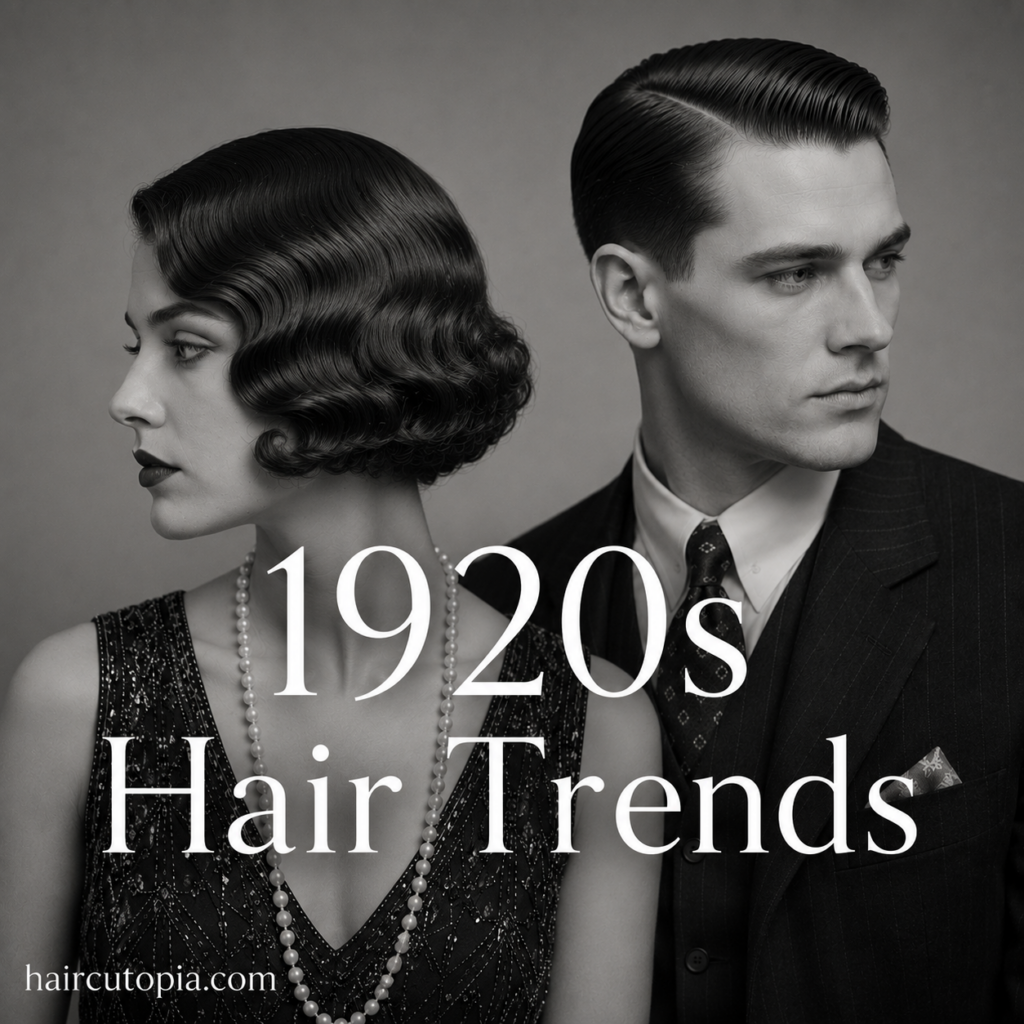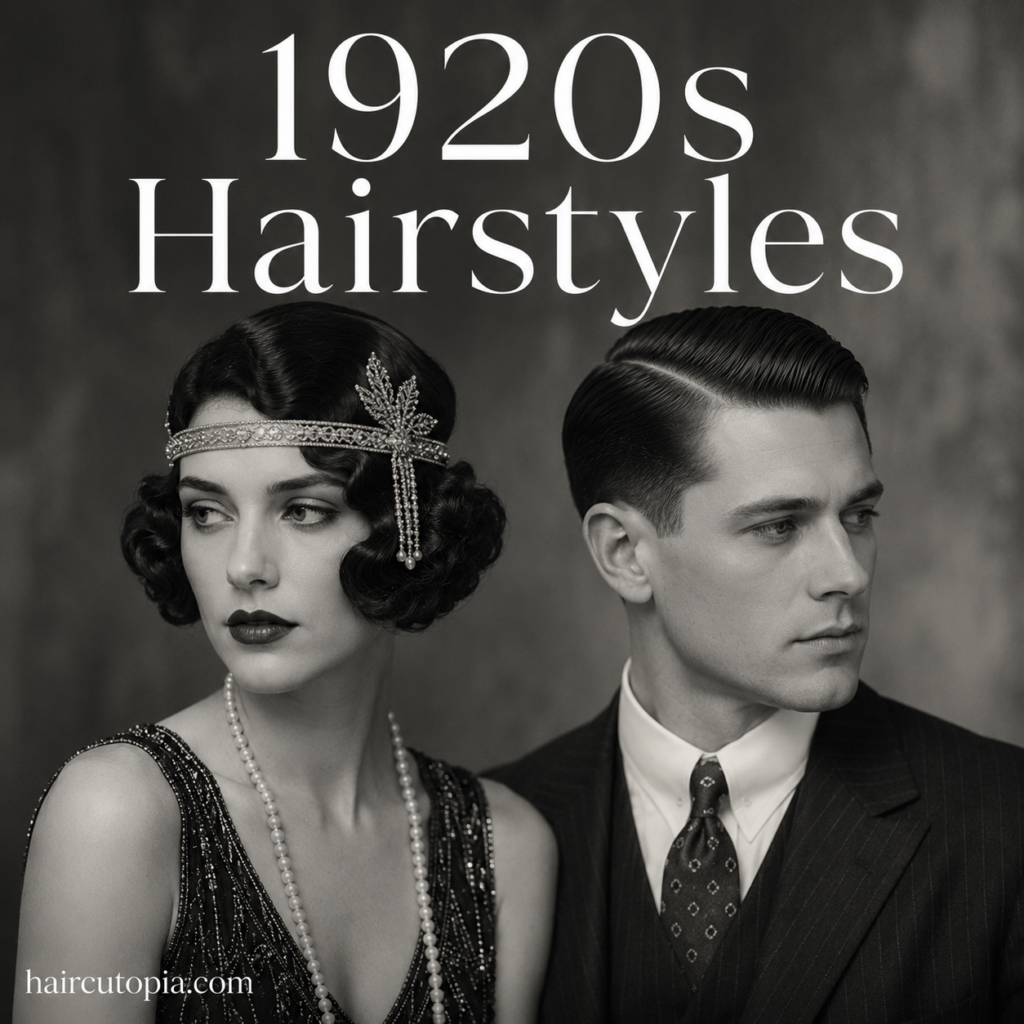
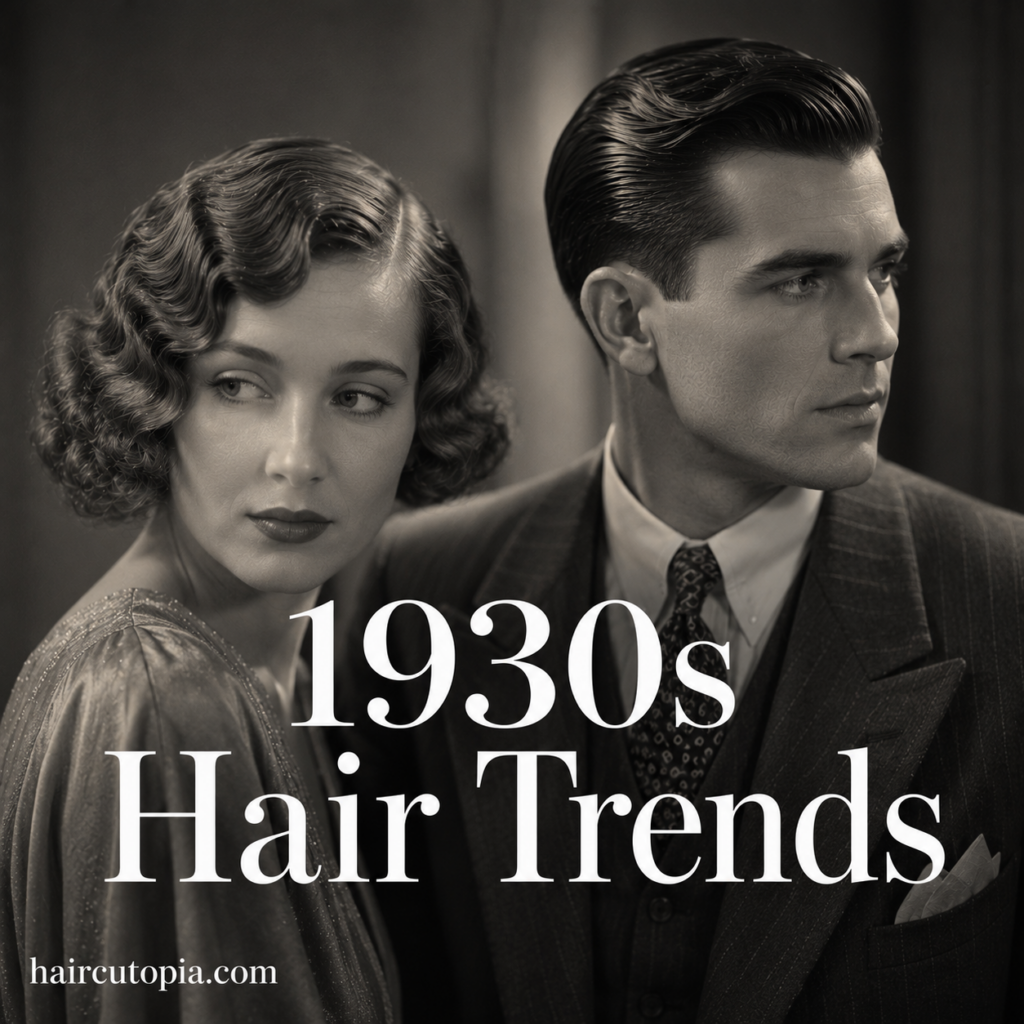
Hair in the 1930s was all about polish.
The decade moved away from some of the sharp, rebellious looks of the 1920s and toward something softer, more glamorous, and carefully controlled. Short hair was still fashionable, especially early in the decade, but it gradually grew longer. Waves became smoother, curls became fuller, and Hollywood helped turn beautifully styled hair into an increasingly visible part of popular culture.
Men’s grooming followed a similarly polished direction. Clean side parts, tapered sides, slicked-back hair, and glossy finishes became defining features of the well-groomed 1930s look.
But fashion wasn’t developing in isolation. The Great Depression shaped everyday life, Hollywood offered an escape through glamour, beauty products became increasingly important, and changing ideas about fashion influenced how people cut, styled, colored, and maintained their hair.
Looking at 1930s hair trends as a whole reveals more than a collection of vintage hairstyles. It shows a decade in transition—from the compact bobs of the Jazz Age to the longer, fuller hair that would become familiar during the 1940s.
What Were the Biggest 1930s Hair Trends?
Several trends appeared repeatedly throughout the decade, even as individual hairstyles changed.
For women, the biggest movement was toward softness and length. The extremely short cuts associated with the previous decade gradually gave way to longer bobs, nape-length hair, and eventually shoulder-grazing styles.
For men, the emphasis remained on neat grooming and controlled styling.
Major 1930s hair trends included:
- Hair gradually becoming longer for women
- Deep side parts
- Sculpted finger waves
- Soft curls around the face
- Waved and curled bobs
- Smooth, controlled crowns
- Increasing volume later in the decade
- Shoulder-length styles becoming more visible
- Glossy styling products
- Defined side parts for men
- Slicked-back men’s hair
- Neatly tapered sides and backs
- Hollywood-inspired glamour
- Growing interest in hair color
- Home setting and styling techniques
These trends didn’t all peak at the same time. Hair changed considerably between 1930 and 1939.
Women’s Hair Started Getting Longer
One of the most important hair trends of the 1930s was the gradual return of length.
The 1920s had transformed women’s hair fashion. Bobs, shingle cuts, and extremely short crops challenged older expectations about how women should wear their hair.
The 1930s didn’t suddenly reverse that change. Instead, hair grew out gradually.
Early in the decade, jaw-length and nape-length styles remained fashionable. As the years progressed, hair increasingly reached toward the shoulders.
This additional length changed the possibilities for styling.
Longer hair could support:
- Larger waves
- Fuller curls
- More movement around the neck
- Curled-under ends
- Side-swept arrangements
- Softer silhouettes
By the late 1930s, women’s hair was already beginning to resemble the longer, more voluminous styles that would become prominent during the 1940s.
Waves Replaced Sharp, Geometric Shapes
Another major shift involved the overall silhouette.
Many iconic 1920s hairstyles emphasized strong lines and compact shapes. During the 1930s, hair generally became softer.
Waves played a major role in creating that change.
Instead of hanging straight from the head, hair could curve around the forehead, temples, cheeks, and ears.
The effect was elegant rather than severe.
Waves could be tightly sculpted against the head or brushed into larger, softer patterns depending on the length and desired style.
Finger Waves Remained Fashionable
Finger waves didn’t begin in the 1930s, but they remained an important trend—particularly during the early part of the decade.
The technique created distinctive S-shaped ridges through damp hair.
On short hair, those waves could follow the contours of the head closely. Small curls were sometimes added near the ears or neckline.
Finger waves worked especially well with:
- Short bobs
- Deep side parts
- Nape-length cuts
- Formal hairstyles
- Sculpted evening looks
As hair became longer later in the decade, looser waves and larger curls increasingly shared the spotlight.
Deep Side Parts Defined the Era
The side part was one of the most consistent trends in 1930s hair.
For women, a deep part created asymmetry and allowed the heavier side of the hair to sweep dramatically across the forehead.
That section could then transition into waves or curls.
For men, the side part became a foundation of everyday grooming. Hair was divided cleanly and combed into place, often with pomade or another styling product.
The popularity of the side part is one reason many 1930s hairstyles still look surprisingly familiar today.
Curls Became Softer and Fuller
Curls became increasingly important as women’s hair grew longer.
Early in the decade, curls were often small and carefully positioned around the ears, cheeks, or neckline.
Later styles had more room to move.
Medium and shoulder-length hair could support larger curls through the lower sections while the crown remained relatively smooth.
This created a balanced silhouette: controlled near the head, fuller toward the ends.
The change also foreshadowed the more voluminous curl patterns of the 1940s.
The Waved Bob Evolved
The bob didn’t disappear when the 1920s ended.
Instead, it evolved.
A 1930s bob could be considerably softer than the sharply defined versions associated with the previous decade. Waves and curls broke up straight lines, while slightly longer lengths changed the overall shape.
Popular variations included:
- Finger-waved bobs
- Side-parted bobs
- Curly bobs
- Nape-length bobs
- Bobs with curled-under ends
- Softly waved grown-out bobs
The bob’s ability to adapt helped it survive changing fashion.
Nearly a century later, that adaptability is still one of the reasons bob hairstyles continually return.
Smooth Crowns Were a Major Styling Trend
Volume wasn’t distributed evenly throughout many 1930s hairstyles.
The crown often remained smooth and relatively controlled, particularly during the earlier years.
Waves and curls were then concentrated around the sides and lower portions of the hair.
This created a sleek head shape without making the entire hairstyle flat.
Later in the decade, volume increased, but carefully shaped crowns remained common.
Hair Became Fuller Toward the End of the Decade
The difference between early and late 1930s hair becomes especially obvious when looking at volume.
Early hairstyles often hugged the head.
By the end of the decade, women’s hair could appear noticeably fuller around the sides and ends.
Several factors contributed to this change:
- Increasing hair length
- Larger curl patterns
- Brushed-out sets
- More movement around the shoulders
- Changing fashion silhouettes
This gradual expansion in volume would continue into the following decade.
Hollywood Glamour Became a Major Hair Influence
Few forces shaped the popular image of 1930s beauty as strongly as Hollywood.
Cinema audiences could see performers in close-up, while movie magazines and promotional photographs spread their images far beyond theaters.
Hair became part of a star’s recognizable image.
Jean Harlow became famous for platinum-blonde hair styled into glamorous waves.
Marlene Dietrich represented a sophisticated version of the decade’s beauty aesthetic, often appearing with sculpted waves and dramatic side parts.
Greta Garbo was another influential screen presence whose softly styled hair reflected the movement toward elegant waves.
Hollywood’s male stars influenced grooming as well.
Clark Gable became closely associated with the polished leading-man appearance of the period, while Cary Grant helped reinforce the enduring appeal of neatly combed, side-parted hair.
People had followed celebrity fashion before the 1930s, but movies made those influences more immediate and visual.
Platinum Blonde Became an Iconic Hair Color
Hair color became an increasingly visible part of Hollywood beauty culture.
One of the decade’s most recognizable looks was platinum blonde.
Jean Harlow’s famous image helped make extremely light blonde hair synonymous with glamorous 1930s Hollywood.
The trend stood out dramatically on black-and-white film and in publicity photography.
It also demonstrated something increasingly important about modern beauty culture: hair color could become part of a person’s public identity.
Not everyone adopted such dramatic shades, of course. But Hollywood’s fascination with distinctive hair color helped expand interest in changing and enhancing natural color.
Glossy Hair Was Fashionable
Modern styling frequently celebrates matte texture and an intentionally effortless finish.
1930s hair often moved in the opposite direction.
Shine communicated control and polish.
Men’s hair in particular could have a noticeably glossy appearance from pomades, brilliantine, oils, and grooming products.
Women’s waves also benefited from smooth surfaces that reflected light and emphasized their shape.
The goal wasn’t greasy-looking hair. It was hair that appeared groomed, sleek, and deliberately finished.
Pin Curls Became an Essential Styling Technique
Pin curls were less a single hairstyle than a tool for creating many hairstyles.
Sections of hair were wound into curls and secured against the head while setting.
After the hair dried, the curls could be released and arranged in different ways.
Depending on how they were placed and brushed, pin curls could produce:
- Defined curls
- Loose waves
- Face-framing curls
- Curled ends
- Fuller sides
- Smooth wave patterns
This versatility made pin curling especially valuable for home styling.
A person didn’t necessarily need a new haircut to change their appearance. A different set could produce a noticeably different hairstyle.
Home Hairstyling Was Important
The Great Depression created severe economic hardship for millions of households.
That context matters when looking at beauty trends.
The glamorous hairstyles shown on movie stars didn’t mean everyone could regularly visit a professional salon. Techniques that could be performed or maintained at home had obvious practical advantages.
Women could reset their hair using:
- Pin curls
- Finger waves
- Wet sets
- Rollers and setting methods
- Combs
- Setting products
- Strategic brushing
A single haircut could therefore produce multiple looks.
That flexibility helped people maintain fashionable appearances without constantly changing the underlying cut.
Men’s Hair Was Short, Sleek and Controlled
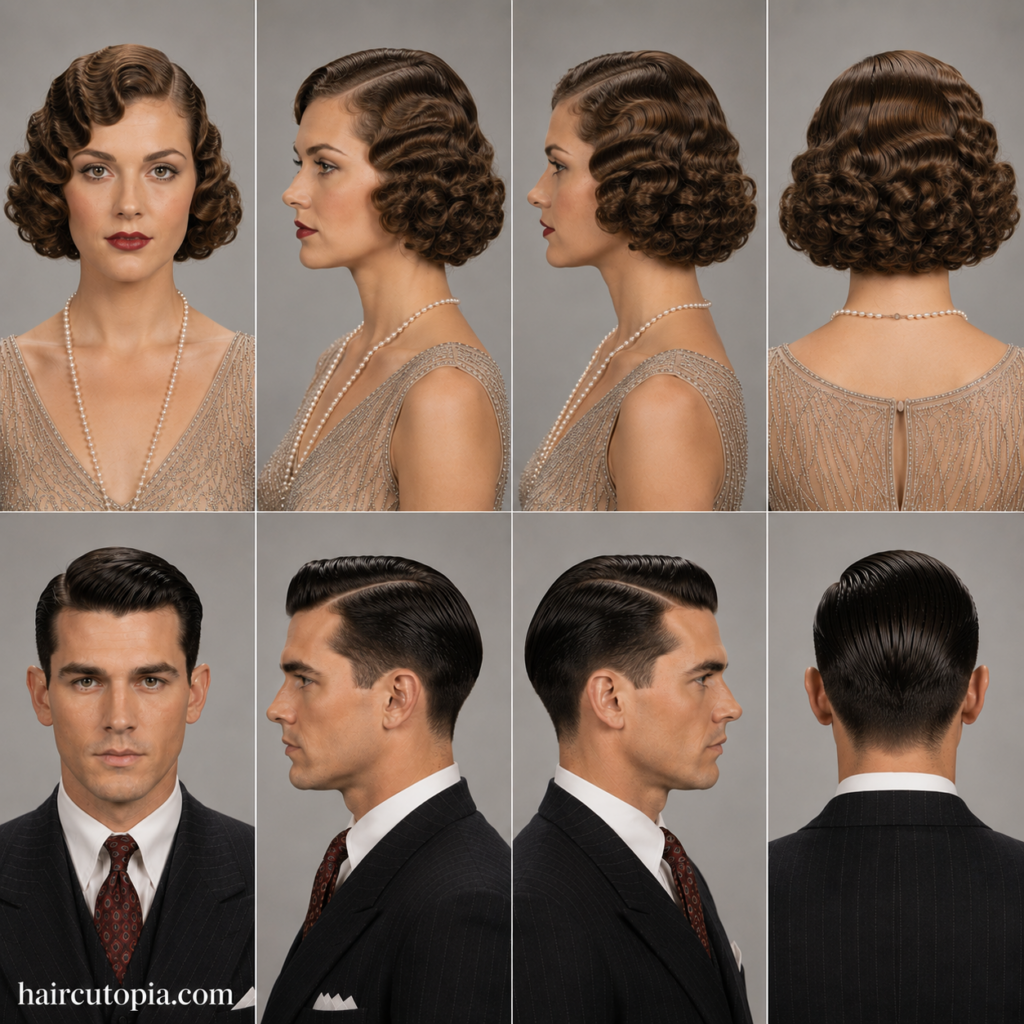
Men’s hair trends changed less dramatically than women’s trends during the decade.
The typical fashionable shape kept the sides and back shorter while preserving enough length on top for styling.
The top could then be:
- Side-parted
- Swept diagonally
- Combed backward
- Slicked close to the head
- Styled with natural waves
A clean outline was important.
Modern barbers sometimes recreate these styles with skin fades, but extremely high-contrast contemporary fades aren’t necessary for an authentic 1930s-inspired appearance.
Traditional tapering produces a softer transition between lengths.
The Men’s Side Part Became a Grooming Standard
If one men’s hairstyle represents the decade, the classic side part is a strong candidate.
It was straightforward, adaptable, and compatible with the formal clothing styles of the period.
Hair was parted clearly on one side and combed into a controlled shape.
The sides could be tapered while the top retained enough length to lie smoothly.
Styling products helped maintain the part throughout the day.
It’s one of the clearest examples of a 1930s hair trend that never completely disappeared.
Slicked-Back Hair Was Another Major Men’s Trend
Not every man wore a pronounced side part.
Longer top hair could also be combed backward away from the forehead.
Pomade or similar products kept the hair controlled and helped create a smooth surface.
The traditional version generally maintained some weight through the sides rather than creating the disconnected appearance common in certain modern slick-back styles.
This produced a more continuous silhouette from the top into the sides.
Natural Waves Were Incorporated Into Men’s Styles
Although slick hair is strongly associated with the decade, naturally wavy hair wasn’t always flattened completely.
Men could establish a side part while allowing some wave pattern to remain through the top.
The important distinction was control.
The texture still followed an intentional direction rather than appearing deliberately messy.
This gave wavy styles character while preserving the groomed appearance expected at the time.
Hair Products Became Central to the Finished Look
Many signature 1930s hairstyles depended on styling products.
Men used products to create hold, direction, and shine.
Women relied on setting products to help waves and curls maintain their carefully arranged shapes.
Common product categories of the period included:
- Pomades
- Brilliantine
- Hair oils
- Hair tonics
- Setting lotions
- Shampoos
- Wave-setting products
The formulas were different from modern styling products, but their basic purpose is familiar.
Today’s gels, mousses, pomades, curl creams, setting sprays, and hairsprays perform many of the same jobs with considerably more options for texture and hold.
Hair Accessories Complemented 1930s Trends
Although sculpted hair was often allowed to remain visible, accessories also played a role in the overall look.
Hats were particularly important to fashion during the period, and hairstyles often needed to work with them rather than compete against them.
Depending on the occasion, hair might also be complemented by decorative clips, combs, pins, or other accessories.
Placement mattered.
Because many hairstyles emphasized waves around the sides of the face, an accessory could highlight the shape without covering the entire hairstyle.
Evening Hair Became More Glamorous
Daytime and evening styling didn’t always look identical.
A practical daytime hairstyle might be relatively restrained, while evening hair could feature stronger waves, more defined curls, and a noticeably polished finish.
Hollywood helped reinforce this glamorous evening aesthetic.
Formal hairstyles often emphasized:
- Sculpted waves
- Deep side parts
- Glossy finishes
- Carefully arranged curls
- Smooth surfaces
This idea of transforming everyday hair into a more glamorous evening version remains familiar today.
Early 1930s Hair Trends
The beginning of the decade remained closely connected to the 1920s.
Women’s hair was generally shorter, and styles often stayed close to the head.
Major early-decade trends included:
- Short bobs
- Finger waves
- Deep side parts
- Small sculpted curls
- Smooth crowns
- Nape-length hair
- Compact silhouettes
Men already favored the short-sided, longer-on-top formula that would remain fashionable throughout the decade.
Mid-1930s Hair Trends
By the middle of the decade, the transition toward longer women’s hair was becoming more apparent.
Bobs grew past the jaw, waves became softer, and curls gained additional room around the sides and back.
Popular characteristics included:
- Longer bobs
- Softer waves
- More visible curls
- Increased movement
- Fuller lower sections
- Side-swept styling
The hairstyle was still controlled, but the silhouette wasn’t as compact as it had been earlier.
Late 1930s Hair Trends
By the end of the decade, the shift was unmistakable.
Women’s hair increasingly approached shoulder length.
Curls became larger, waves flowed farther down the hair, and the overall silhouette gained volume.
Late-1930s trends included:
- Shoulder-grazing hair
- Larger curls
- Fuller sides
- Brushed-out waves
- More volume around the ends
- Softer, romantic silhouettes
These trends created a direct bridge into 1940s hair fashion.
1920s vs. 1930s Hair Trends
The change between the decades wasn’t immediate, but their dominant aesthetics were noticeably different.
1920s Hair Trends
The 1920s emphasized:
- Dramatically short hair
- Bob cuts
- Shingle cuts
- Eton crops
- Geometric shapes
- Close-fitting silhouettes
- A deliberately modern appearance
Cutting the hair short could itself make a fashion statement.
1930s Hair Trends
The 1930s increasingly emphasized:
- Growing hair longer
- Softer silhouettes
- Sculpted waves
- More curls
- Deep side parts
- Hollywood glamour
- Shoulder-length styles
- Polished finishes
Rather than abandoning short hair completely, the decade transformed it.
1930s vs. 1940s Hair Trends
The late 1930s and early 1940s have considerable visual overlap.
Women’s hair was already becoming longer before the 1940s began.
The following decade generally pushed those trends further with:
- Greater volume
- Larger curls
- Rolled sections
- More elaborate arrangements
- Shoulder-length silhouettes
- Victory rolls
The compact waves of the early 1930s had evolved into something much fuller.
Men’s hairstyles remained more consistent across the transition, although wartime conditions would bring their own practical influences.
How to Bring 1930s Hair Trends Into a Modern Style
Vintage inspiration doesn’t require copying an old photograph exactly.
A modern hairstyle can reference the decade through individual details.
For women’s or gender-neutral styles, consider:
- A deep side part
- Soft S-waves
- A waved bob
- Brushed-out curls
- Curled-under ends
- Shoulder-length Hollywood waves
- Sculpted face-framing sections
For traditionally masculine styles, consider:
- A classic scissor taper
- A defined side part
- A slick-back with natural sides
- Controlled natural waves
- A side sweep with moderate shine
Modern styling products can soften the finish if a fully authentic vintage appearance feels too formal.
Why 1930s Hair Trends Still Feel Familiar
Many of the decade’s defining ideas never disappeared.
Bobs remain fundamental haircut choices.
Hollywood waves still appear at weddings, formal events, photo shoots, and red carpets.
Deep side parts cycle in and out of mainstream fashion.
Classic men’s tapers and side parts have remained barbershop standards for generations.
Even slicked-back hair continues to return in different forms.
What changes is the interpretation.
Modern versions usually incorporate more natural texture, lighter products, different cutting techniques, and a broader range of hair types.
The foundation, however, can often be traced surprisingly far back.
Frequently Asked Questions About 1930s Hair Trends
What was the biggest hair trend of the 1930s?
One of the most significant trends was women’s hair gradually becoming longer and softer.
Short bobs and finger waves remained popular early in the decade, but longer waves, curls, and shoulder-length styles became increasingly fashionable toward the end.
What hairstyles were trendy in the 1930s?
Popular women’s styles included finger waves, waved bobs, pin-curl sets, side-swept waves, curly bobs, and longer waved styles.
Men commonly wore side parts, slick-backs, side sweeps, and neatly tapered hairstyles.
Were bobs still popular in the 1930s?
Yes.
The bob remained fashionable but evolved from many of the sharp, short shapes associated with the 1920s.
1930s bobs were often longer, softer, waved, or curled.
Were finger waves a 1920s or 1930s trend?
Finger waves are associated with both decades.
They became strongly fashionable during the 1920s and continued into the 1930s, particularly during the earlier years.
What hair color was popular in the 1930s?
Hollywood helped make platinum blonde one of the decade’s most recognizable glamour looks, particularly through stars such as Jean Harlow.
Natural brunette, blonde, red, and darker hair colors remained common, of course. The significance of platinum blonde lies more in its visibility as a fashion statement than in suggesting everyone wore it.
Did women have long hair in the 1930s?
Yes, although shorter styles were particularly prominent early in the decade.
Women’s fashionable hair generally grew longer throughout the 1930s, with shoulder-length styles becoming more visible toward the end.
Why did 1930s hair look so shiny?
Styling products helped produce the sleek, controlled appearance fashionable at the time.
Pomades, brilliantine, oils, tonics, and setting products could all contribute to a smoother and shinier finish.
What hair trends were popular for men in the 1930s?
Defined side parts, slicked-back hair, side sweeps, tapered sides, and glossy finishes were among the dominant trends.
The overall goal was typically neat, controlled grooming.
How did the Great Depression affect hair trends?
Economic hardship made practical and adaptable grooming particularly valuable.
Home setting techniques such as pin curls and finger waves allowed fashionable styles to be created or maintained without necessarily requiring frequent professional styling.
How did Hollywood influence 1930s hair trends?
Movies and celebrity photography exposed large audiences to the hairstyles of popular actors.
Sculpted waves, platinum-blonde glamour, polished men’s side parts, and other screen-inspired looks became highly visible fashion references.
What changed in hair fashion between 1930 and 1939?
Women’s hair generally became longer, softer, and fuller.
The compact bobs and sculpted waves of the early decade gradually evolved into larger curls and shoulder-length styles by the late 1930s.
Men’s hairstyles changed less dramatically, with side parts and slicked styles remaining popular throughout the period.
Are 1930s hair trends wearable today?
Absolutely.
Side parts, bobs, Hollywood waves, brushed curls, slick-backs, and classic men’s tapers all have modern equivalents.
Using lighter products and allowing more natural texture can make vintage-inspired styling feel contemporary rather than costume-like.
The Lasting Influence of 1930s Hair Trends
The 1930s were a transitional decade for hair.
Women’s styles began with many of the short shapes inherited from the 1920s but gradually became longer, softer, and more voluminous. Finger waves remained important, curls became fuller, and shoulder-length hair increasingly appeared as the decade approached its end.
Men’s grooming revolved around a formula that proved remarkably durable: shorter sides, longer hair on top, a strong direction, and a polished finish.
Hollywood amplified these trends by presenting glamorous hairstyles to enormous audiences, while everyday realities encouraged practical styling methods that could transform the same haircut again and again.
By 1939, hair fashion looked noticeably different from where it had started nine years earlier.
And that’s what makes 1930s hair trends particularly interesting. The decade wasn’t defined by one haircut or hairstyle. It was defined by change—the gradual movement from the compact silhouettes of the Jazz Age toward the longer, fuller, increasingly glamorous hair that would shape the 1940s.