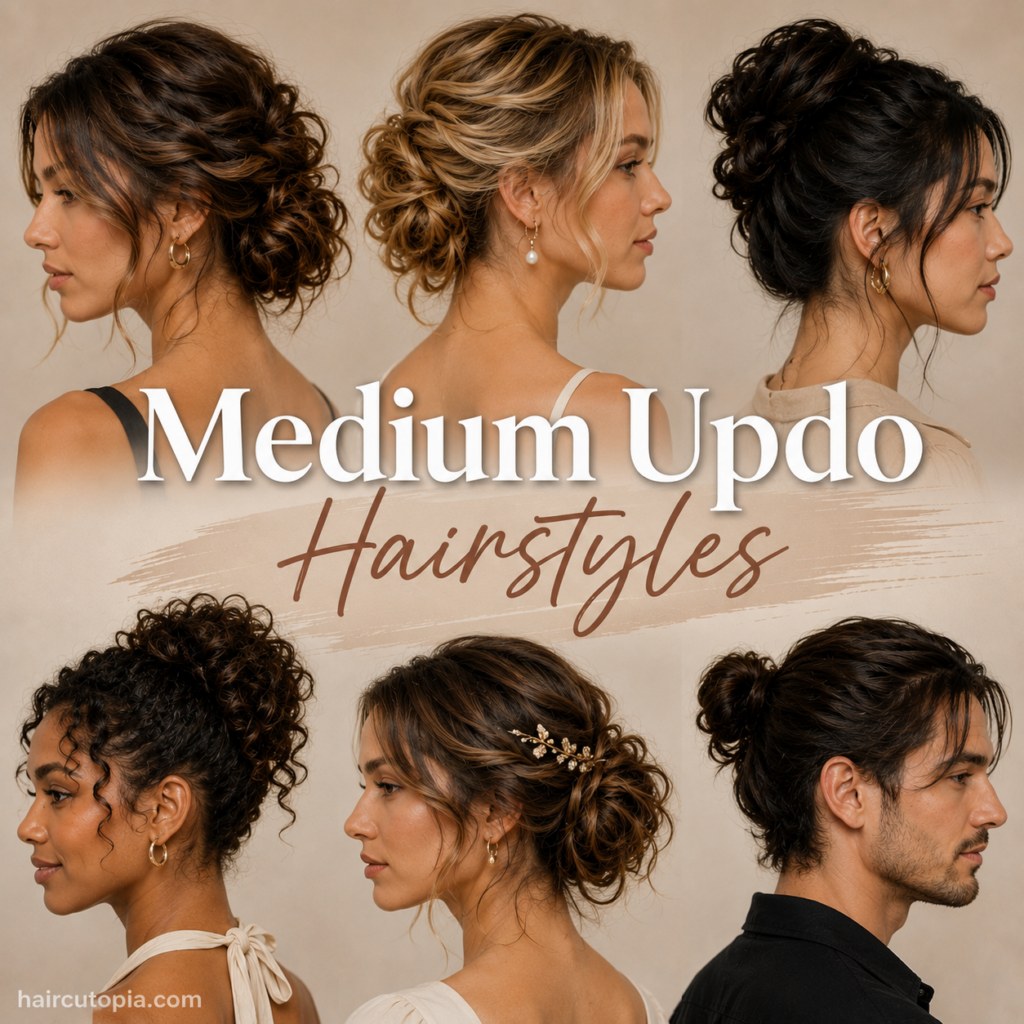
Medium-length hair sits in a pretty convenient sweet spot when it comes to updos. There’s usually enough length to create a real bun, braid, twist, or chignon, but not so much hair that every style becomes heavy or takes half an hour to pin into place.
That versatility is what makes medium updo hairstyles worth experimenting with. You can keep things loose and casual for everyday wear, smooth everything back for a polished look, or build a more detailed style for a wedding or formal event.
And you don’t need perfectly even, one-length hair. Layers, bangs, curls, waves, and different textures can all work with an updo. In many cases, those details are what make the finished hairstyle interesting.
Whether your hair falls around your shoulders or a few inches below them, these medium-length updo ideas offer plenty of ways to get it off your neck while still making the most of your length.
Can You Do an Updo With Medium-Length Hair?
Definitely. Medium hair is actually one of the easiest lengths for updos.
There’s enough hair to work with, but you’re less likely to deal with the weight and bulk that can come with very long hair.
Depending on your cut and texture, you can try:
- Messy buns
- Low buns
- High buns
- French twists
- Braided updos
- Chignons
- Claw clip twists
- Half-up styles
- Curly updos
- Sleek updos
- Ponytail updos
- Twisted styles
Shoulder-length hair may require a few extra bobby pins around the nape, particularly if you have layers. Hair that falls below the shoulders usually gives you even more flexibility.
1. Messy Bun for Medium Hair
There’s a reason the messy bun sticks around. It’s quick, forgiving, and works with almost any casual outfit.
Gather your hair into a ponytail wherever you want the bun to sit. Twist the length loosely around the base and secure it with another elastic or several bobby pins.
Then loosen it.
Gently pull at the bun to create more volume and allow a few pieces to fall naturally around your face.
The trick is making the style look intentionally relaxed rather than accidentally unfinished. A little texture before styling helps tremendously.
Best for:
- Everyday wear
- Wavy hair
- Layered cuts
- Second-day hair
- Casual outings
2. Low Bun Updo
A low bun is one of the most versatile medium updo hairstyles because small changes can completely alter its appearance.
Wear it smooth and centered for something polished, or loosen the hair around your crown and temples for a softer finish.
You can also move the bun slightly to one side.
For shoulder-length hair, don’t worry if the bun isn’t huge. A compact low bun can look just as intentional as a larger one.
3. French Twist for Medium-Length Hair
The classic French twist works beautifully with medium hair.
Gather your hair toward the back as though you’re creating a low ponytail. Twist it upward against your head, tuck the ends inside, and secure the twist vertically with bobby pins.
For a traditional finish, smooth the sides before pinning.
For something more contemporary, loosen the crown slightly and leave a few face-framing strands free.
Medium hair is particularly suited to this style because there usually isn’t a huge amount of excess length to hide inside the twist.
4. Braided Low Bun
Adding a braid is an easy way to make a basic bun feel more detailed.
Start with a low ponytail and braid it normally. Wrap the braid around the base of the ponytail, tuck the ends underneath, and secure everything with pins.
For a fuller bun, gently loosen the braid before wrapping it.
Another option is to braid one or both sides of your hair and incorporate those braids into a regular low bun.
5. Claw Clip Updo
A claw clip might be the quickest route from hair-down to hair-up.
Gather your hair at the back, twist it upward, and secure the twist with a claw clip. Let the ends fall over the top or tuck them underneath for a cleaner finish.
Medium hair gives you plenty of room to experiment with different clip sizes.
A large clip works well for thick hair, while fine or shoulder-length hair may stay more secure with a medium-sized clip.
6. Sleek High Bun
For a cleaner, sharper look, take the bun higher.
Brush your hair toward the crown and secure it into a high ponytail. Apply a small amount of gel or smoothing product around the hairline if needed.
Twist the ponytail around its base and pin the ends underneath.
The finished style works especially well when you want your hair completely away from your face.
A middle part can give a sleek bun a more structured appearance, while brushing everything straight back creates a classic finish.
7. Loose Romantic Updo
Not every updo needs obvious structure.
A loose romantic updo is built around soft texture, imperfect twists, and strategically placed pins.
Start with waves or curls. Take small sections of hair and twist them loosely toward the back, pinning each section around the nape.
Continue until most of the length is secured.
Leave a few strands around your face and gently loosen the crown.
This style works especially well for weddings, date nights, parties, and other occasions where you want something polished without looking overly formal.
8. Braided Crown Updo
A braided crown draws attention to the shape and texture of the hair while keeping everything away from your face.
Create braids on both sides of your head and bring them toward the back or across the crown. Pin the ends underneath the opposite braid where possible.
For a softer result, gently pull apart the edges of each braid.
You can leave some hair loose at the nape or incorporate everything into the braided style.
9. Curly Updo for Medium Hair
Curls bring their own volume, which makes them ideal for updos.
Rather than smoothing everything into one tight bun, gather your curls loosely and pin individual sections into place.
This lets the natural curl pattern remain visible.
You can position the updo high, low, or somewhere in between depending on the look you want.
Leaving a few curls free around your face can also help the hairstyle feel balanced rather than overly structured.
10. Twisted Low Updo
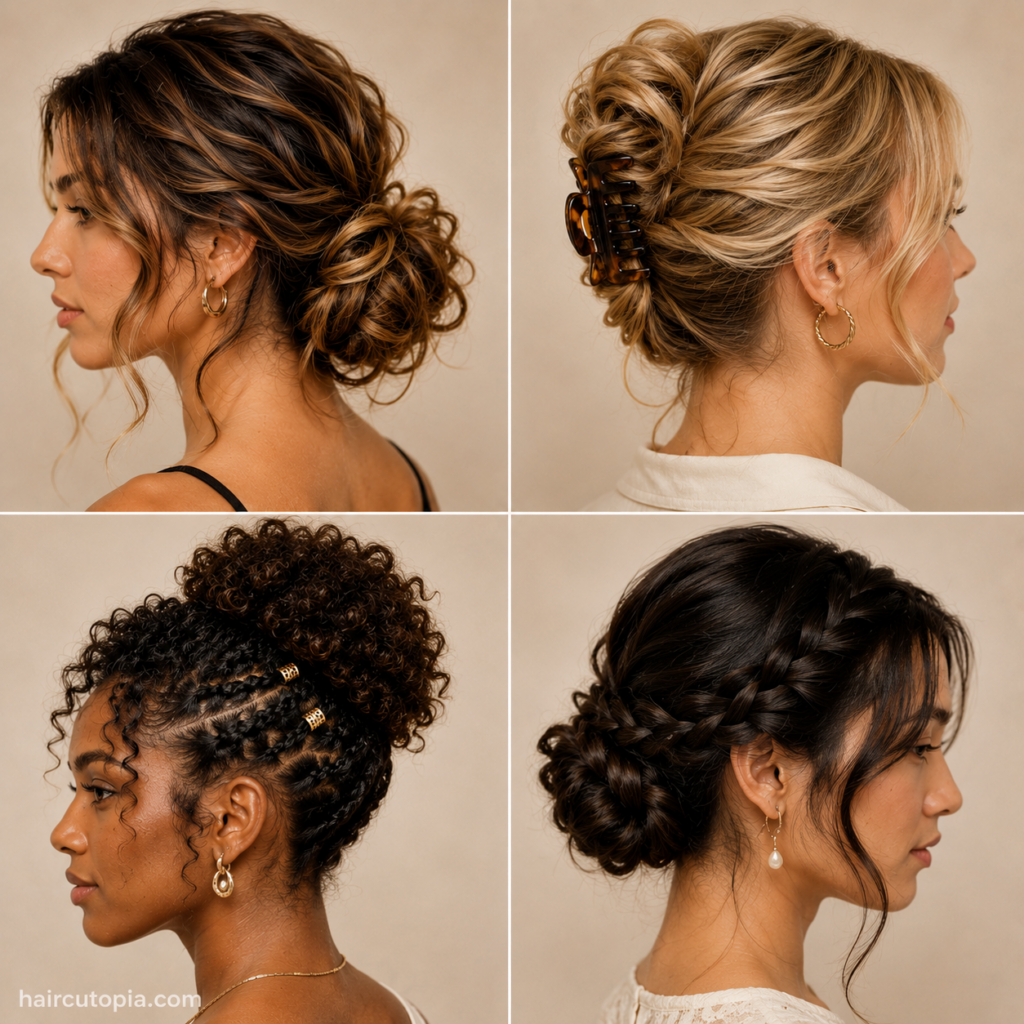
A twisted updo looks intricate but doesn’t necessarily require complicated styling.
Divide your hair into several sections. Twist each section toward the back and pin it around the nape.
Overlap the twists slightly so the pins and ends disappear underneath surrounding hair.
This method is especially useful for medium layered hair because you’re working with smaller sections instead of expecting every piece to fit neatly into one ponytail.
11. Half-Up Bun
Some days you want your hair out of your face without putting all of it up.
That’s where the half-up bun comes in.
Gather the top half of your hair and secure it into a small ponytail. Twist that section into a bun and leave the bottom half loose.
You can wear the remaining hair straight, wavy, or curly.
For a casual look, position the bun high on the crown. For something more subtle, place it lower toward the back of your head.
12. Low Chignon
A chignon is similar to a low bun but usually has a softer, tucked appearance.
Gather the hair at the nape and create a loose roll or loop. Tuck the ends underneath and secure them with bobby pins.
You can keep the top smooth or add volume around the crown.
This is one of those hairstyles that can move easily between settings. Keep it loose for dinner or a wedding, or smooth it down for a more professional look.
13. High Textured Bun
A textured bun is a good alternative when a sleek high bun feels too severe.
Start by adding waves or texture throughout your hair. Pull it into a high ponytail without flattening all the volume at the roots.
Loosely wrap sections of the ponytail around the base and pin them individually.
This creates a larger, less uniform bun.
You can also pull out a few pieces around the hairline for an intentionally undone finish.
14. Side Bun Updo
Moving a bun just a few inches off center changes the entire hairstyle.
Gather your hair toward one side of the nape and create a loose bun or chignon.
Keep the opposite side smooth for contrast, or add a braid or twist leading into the bun.
Side buns are particularly useful for formal occasions because they show more detail from the front than a bun positioned directly behind the head.
15. Dutch Braid Into a Bun
If you enjoy braided hairstyles, combine a Dutch braid with a bun.
Start the braid near your hairline and continue toward the back of your head. Once you’ve reached the point where you want the bun, gather the remaining hair together.
Secure it into a ponytail and create your bun.
You can use one braid along the side or create two braids that meet in the back.
Gently pulling apart the braid afterward can make the style look fuller.
16. Medium Updo With Face-Framing Pieces
Face-framing pieces can soften almost any updo.
Before securing your hair, leave a small section free near each temple. Style the rest into a bun, twist, chignon, or ponytail.
Once the updo is finished, adjust the front pieces.
You can curl them slightly, leave them naturally wavy, or keep them straight.
This technique works particularly well with:
- Curtain bangs
- Long bangs
- Butterfly layers
- Face-framing layers
- Shaggy cuts
- Wavy hair
Avoid pulling out too much hair. A couple of carefully chosen sections usually create a more intentional result.
17. Medium Updo With Bangs
Bangs and updos naturally work together because the contrast gives the hairstyle structure.
Straight bangs can look striking with a high or low bun, while curtain bangs complement softer chignons and messy updos.
You can also incorporate longer bangs into the hairstyle.
Twist them away from the face and secure them into the side of your updo, or create a small braid along the hairline.
There’s no rule that says an updo means every strand needs to be pulled back.
18. Ponytail Updo
A ponytail can become the foundation for an easy updo.
Create a low or mid-height ponytail and divide it into several sections. Twist each section and pin it around the ponytail base.
This gives you more control over the final shape than wrapping the entire ponytail into one bun.
You can make the result neat and symmetrical or intentionally loose and textured.
It’s also a useful technique for layered hair because individual sections are easier to secure.
19. Medium Updo for a Wedding
Medium-length hair gives you plenty of formal styling options for weddings, whether you’re the bride, part of the wedding party, or attending as a guest.
Some styles particularly suited to weddings include:
- Low textured chignons
- Braided buns
- Loose curled updos
- French twists
- Side buns
- Braided crowns
- Twisted low updos
Accessories can add detail without overwhelming the hairstyle.
Pearl pins, flowers, decorative combs, delicate clips, and hair vines can all work well with medium hair.
If the hairstyle needs to last from the ceremony through the reception, make sure the foundation is secure before worrying about the loose, effortless-looking pieces.
20. Easy Everyday Updo
You don’t always need an elaborate hairstyle. Sometimes you just need your hair up in five minutes.
A simple everyday option starts with a low ponytail.
Create a small opening in the hair directly above the elastic and flip the ponytail through it. You can leave the ends hanging for a twisted ponytail or continue rolling and tucking them underneath.
Secure the tucked section with pins.
It’s quick enough for everyday wear but looks more intentional than a standard ponytail.
Medium Updos for Different Hair Types
Hair length matters, but texture and density can make an equally big difference when choosing an updo.
Here’s how to adapt your style.
Medium Updos for Fine Hair
Fine hair can sometimes lose volume when it’s pulled back.
Before styling, try applying dry shampoo or texturizing spray. A little root volume can prevent the finished updo from sitting completely flat against your head.
Loose braids, twists, and textured buns are particularly useful because you can gently pull them apart after they’re secured.
A few other tricks include:
- Curling the hair before creating the updo
- Lightly teasing the crown
- Avoiding overly tight elastics
- Loosening the bun after pinning
- Using texture products for grip
You don’t necessarily need more hair. You just want to avoid compressing the hair you already have.
Medium Updos for Thick Hair
Thick medium hair usually gives you plenty of volume, but keeping it secured can be the challenge.
Use sturdy elastics and strong bobby pins.
For heavier styles, divide the hair into sections rather than expecting one elastic or pin to hold everything.
Low buns and chignons can also feel more comfortable than very high updos because the weight sits closer to the head.
Medium Updos for Curly Hair
Curly hair doesn’t need to be straightened before putting it up.
In fact, maintaining the natural curl pattern can create beautiful texture throughout the hairstyle.
Gather curls loosely and pin them individually rather than brushing everything flat. This keeps more definition visible and can create a fuller-looking updo.
Medium Updos for Straight Hair
Straight hair works especially well with sleek buns, French twists, ponytail updos, and structured chignons.
If your hair is extremely smooth, however, you may need a little additional grip.
Texture spray or dry shampoo can help pins stay in place and prevent twists from sliding apart.
Medium Updos for Wavy Hair
Natural waves are particularly easy to work with because they provide texture without requiring much preparation.
Loose buns, twisted styles, braided updos, and romantic chignons all complement wavy hair.
Try not to over-brush before styling if you want to preserve that natural movement.
How to Make an Updo Stay in Medium-Length Hair
Creating the hairstyle is only half the job. You also want it to stay put.
A few simple techniques can help.
Don’t start with overly slippery hair
Freshly conditioned hair can sometimes be difficult to style because pins slide through it.
That doesn’t mean your hair needs to be dirty. Adding a little texturizing spray, mousse, or dry shampoo can provide enough grip to make styling easier.
Anchor your pins
Slide bobby pins into the hairstyle so they catch both the updo and the hair underneath it.
For stubborn sections, cross two pins into an X.
Secure the foundation first
If you’re creating a complicated bun or chignon, make sure the underlying ponytail, braid, or twist feels secure before loosening sections for appearance.
A loose-looking updo doesn’t need to have a loose foundation.
Work with your layers
Medium layered hair may have shorter pieces around the sides and nape.
Instead of repeatedly trying to force them into the main ponytail, twist or pin those sections separately.
Use hairspray selectively
You don’t need to make your hair feel like a helmet.
Apply hairspray around areas that genuinely need additional hold, particularly the nape, sides, and any sections that tend to slip.
What Hair Length Works Best for Medium Updos?
Medium-length hair generally includes cuts that fall from around the shoulders to several inches below them.
Within that range, your styling options gradually increase as the hair gets longer.
Shoulder-length hair
Low buns, claw clip twists, half-up buns, French twists, and pinned styles tend to work particularly well.
Shorter pieces around the nape may need additional pins.
Collarbone-length hair
At this length, most classic updos become easier.
You should have enough hair for braided buns, chignons, high buns, and more elaborate twists.
Hair below the collarbone
Longer medium hair can usually handle nearly any traditional updo while still being relatively easy to manage.
Braided styles also become easier because there’s more length available to create visible braid patterns.
What Do You Need for a Medium Hair Updo?
You can create many medium updos with just an elastic and a handful of bobby pins.
Still, keeping a few basic styling tools nearby gives you more options.
Consider having:
- Bobby pins
- Clear mini elastics
- Regular hair ties
- Claw clips
- Dry shampoo
- Texturizing spray
- Hairspray
- Smoothing cream or gel
- Wide-tooth comb
- Brush
- Curling iron or flat iron
You don’t need to use everything at once.
For casual styles, an elastic and a few pins may be enough. Formal hairstyles usually benefit from additional preparation and finishing products.
How to Choose the Right Medium Updo
Instead of choosing an updo based only on a photo, consider how it will work with your actual hair.
Start with your texture.
If your hair is naturally curly or wavy, a loose textured updo lets that movement become part of the finished style. Straight hair lends itself naturally to sleek buns, twists, and structured shapes.
Then think about your layers.
Heavily layered medium hair often behaves better in twisted or individually pinned styles, while one-length hair can be easier to wrap into buns and chignons.
Finally, consider what you’ll actually be doing while wearing it.
A loose romantic chignon might be perfect for dinner but annoying during a workout. A secure high bun might be practical during the day but feel more severe than you want for a wedding.
The best hairstyle isn’t necessarily the most complicated one. It’s the one that works with your hair, your plans, and the amount of time you want to spend getting ready.
Frequently Asked Questions About Medium Updo Hairstyles
Is medium-length hair long enough for an updo?
Yes. Shoulder-length and longer hair can usually be styled into buns, twists, chignons, braids, ponytail updos, and half-up styles. Shorter layers may simply need to be pinned separately.
What is the easiest updo for medium hair?
Messy buns, low buns, claw clip twists, and half-up buns are among the easiest options. Most can be created in just a few minutes with an elastic and several bobby pins.
What updo is best for shoulder-length hair?
Low buns, French twists, twisted chignons, claw clip styles, and pinned curly updos work particularly well with shoulder-length hair because they don’t require a lot of excess length.
How do you make a medium-length updo look fuller?
Add texture or curls before putting your hair up, lightly tease the crown, and avoid pulling the style too tightly. After securing braids, buns, and twists, gently loosen them to create more volume.
Can layered medium hair be put into an updo?
Absolutely. Instead of trying to gather every layer into a single ponytail, secure the longest hair first and pin shorter sections into the finished style individually.
What medium updos work for weddings?
Low chignons, braided buns, French twists, curled updos, side buns, and loose romantic updos are all popular choices for weddings. Hair accessories can make even a relatively simple updo feel more formal.
Are updos damaging to your hair?
An occasional updo generally isn’t a problem, but repeatedly wearing extremely tight hairstyles can put unnecessary tension on the hair and scalp. Avoid pulling excessively around the hairline and rotate where you position buns and ponytails.
Final Thoughts on Medium Updo Hairstyles
Medium-length hair gives you an impressive amount of styling freedom.
It’s long enough for classic buns, French twists, chignons, braids, and more elaborate formal styles, while still being manageable enough for quick everyday updos.
You don’t need perfect length or texture, either.
Layers can become part of a loose updo. Curls can provide natural volume. Fine hair can be built up with texture, and thick hair can be divided into sections to make it easier to secure.
Start with something simple, such as a low bun or claw clip twist, and experiment from there. Once you’re comfortable working with your length, the same basic techniques—twisting, braiding, wrapping, and pinning—can be combined into dozens of different medium updo hairstyles.