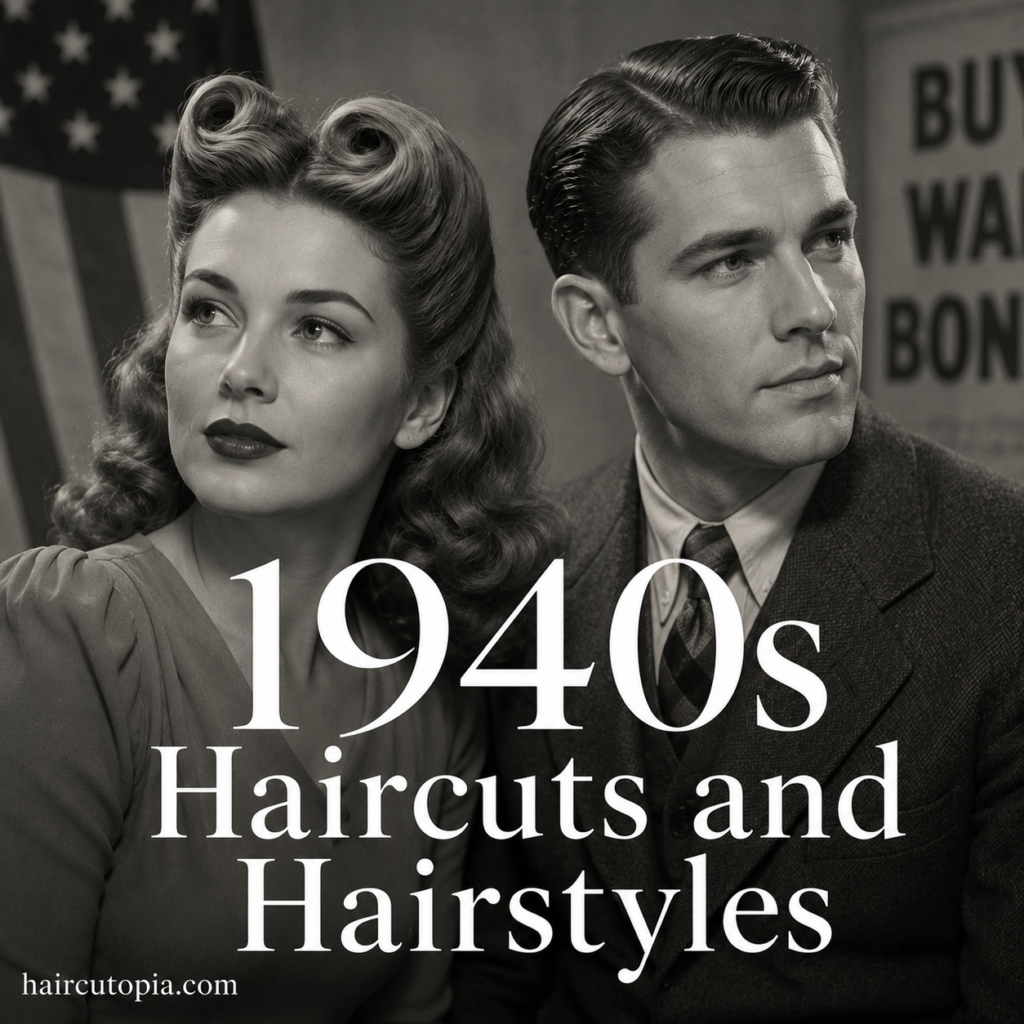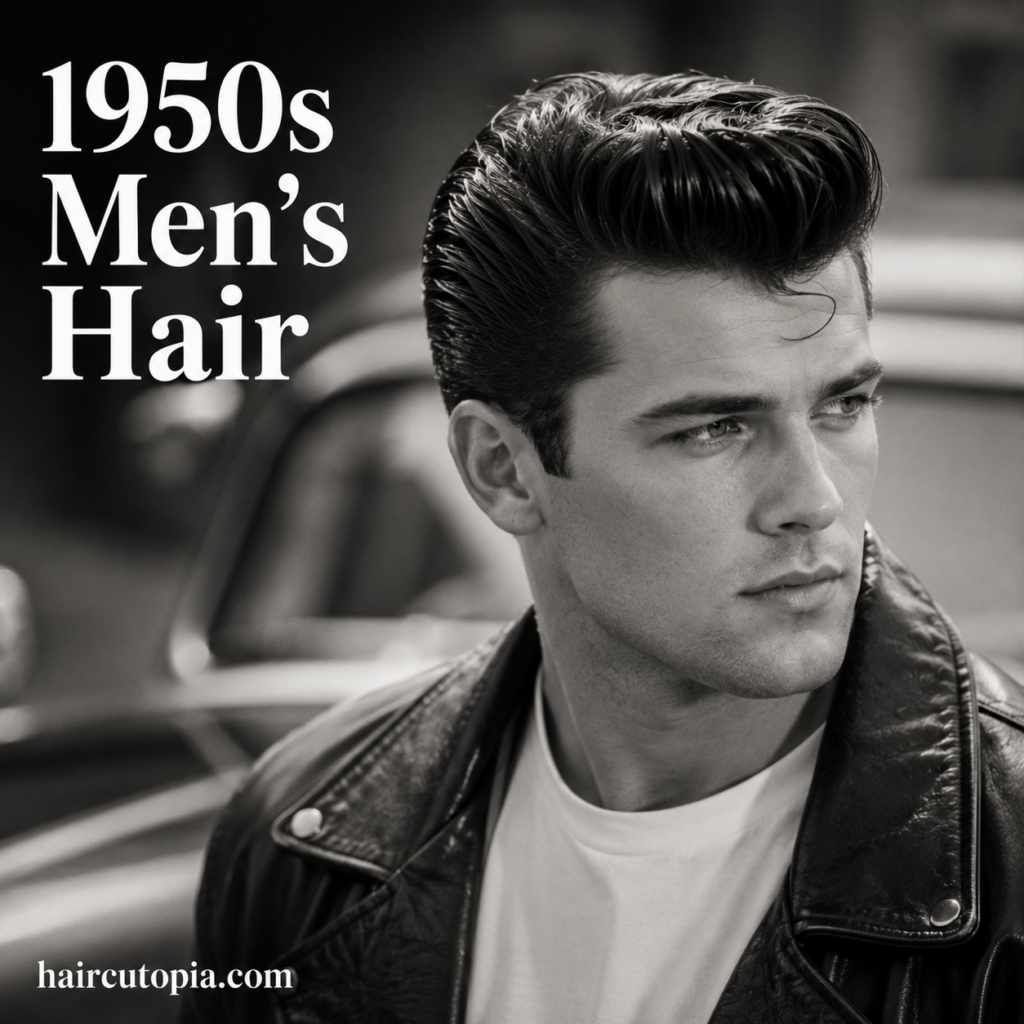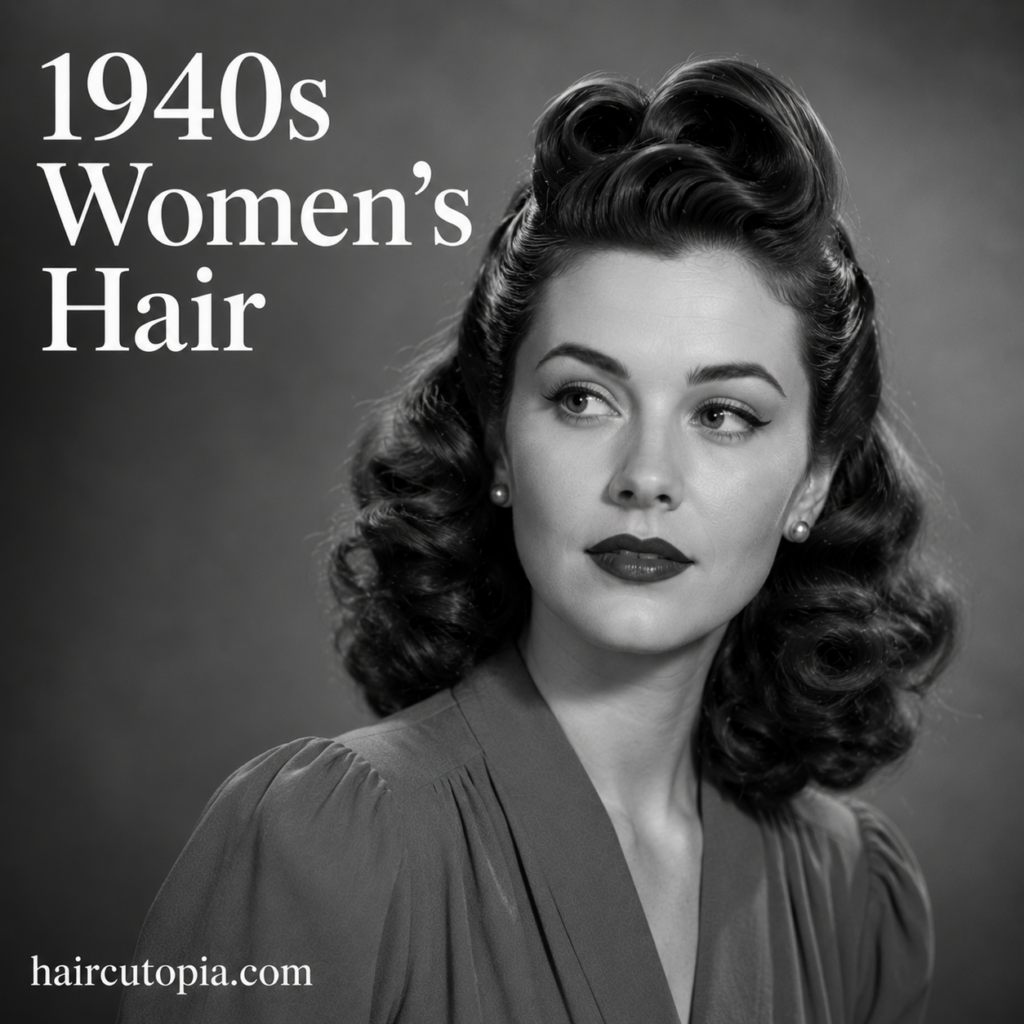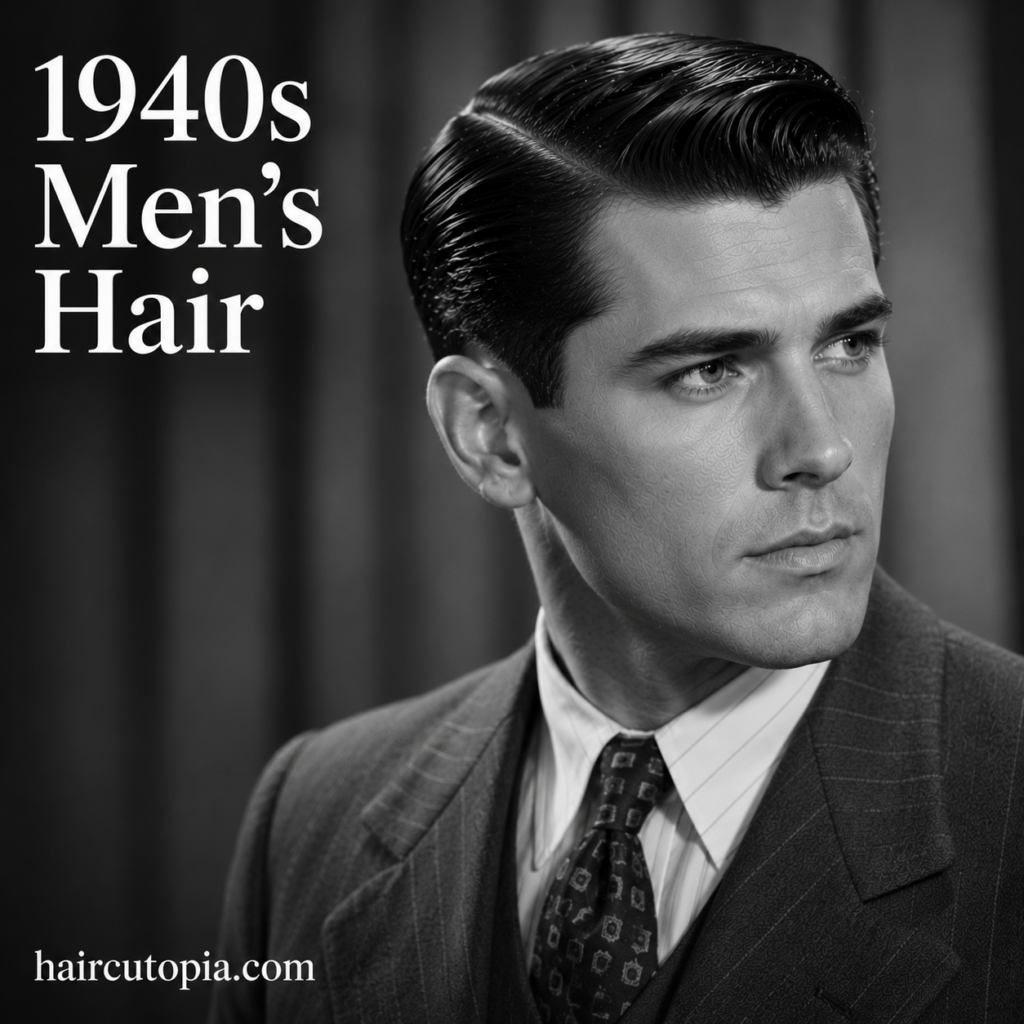
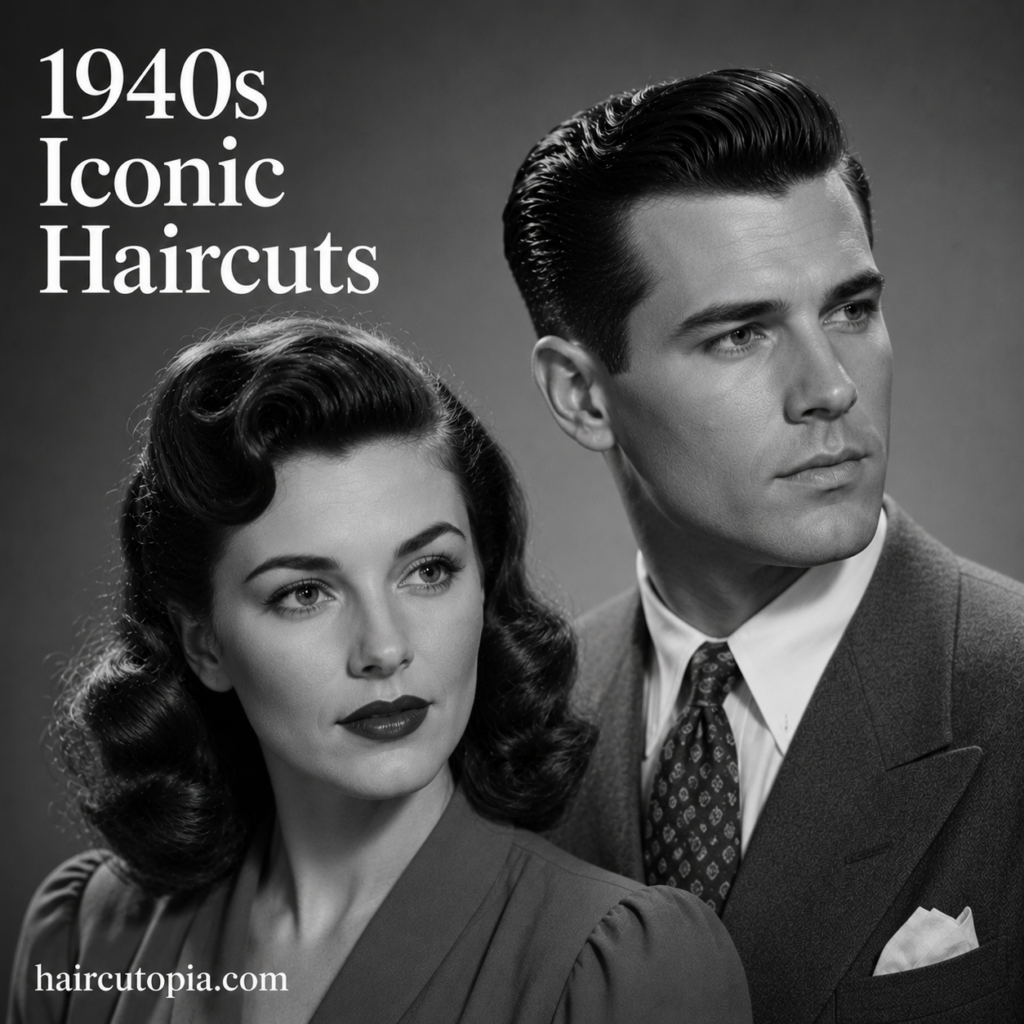
The 1940s gave us some of the most recognizable hair looks in modern history. Sculpted women’s cuts designed for waves and rolls, neatly tapered men’s styles, polished side parts, and military-influenced short cuts all helped create the decade’s distinctive appearance.
Of course, the haircut was only part of the story.
Women frequently transformed medium-length hair with pin curls, victory rolls, and carefully brushed waves. Men used pomades and tonics to shape relatively simple cuts into smooth side parts, waves, and brushed-back styles.
World War II also changed what people needed from their hair. Practicality mattered. Women entering factories needed hair that could be secured safely, while military grooming influenced men’s preference for shorter, manageable cuts.
The result was a collection of 1940s haircuts that balanced function with unmistakable style.
Here are the iconic cuts and shapes that best represent the decade.
What Made a Haircut Iconic in the 1940s?
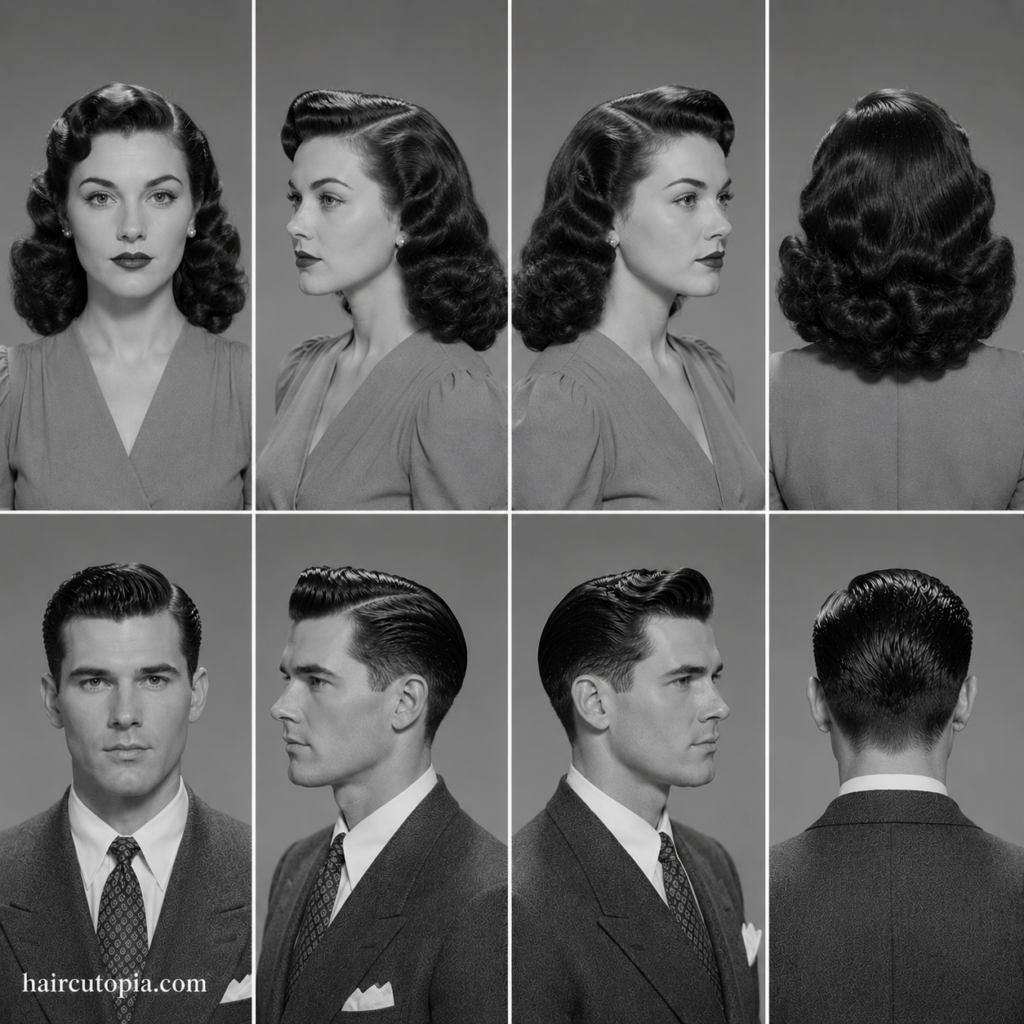
A recognizable 1940s haircut usually had a strong underlying shape that supported the styling techniques of the period.
Women’s cuts often needed enough length to curl, roll, and pin. Instead of relying on today’s heavily textured layers, the hair was shaped to produce smooth, controlled silhouettes once it was set.
Men’s cuts followed a more straightforward formula.
The sides and back were generally shorter, while additional length remained on top for combing and styling.
Some of the defining characteristics included:
- Medium-length women’s cuts
- Carefully planned layers
- Rounded silhouettes
- Shoulder-length shapes
- Curled-under ends
- Short men’s sides and backs
- Longer styling length on top
- Traditional tapers
- Clean side-part shapes
- Military-influenced short cuts
- Moderate front volume
One important distinction is that many looks we associate with the 1940s were technically hairstyles rather than separate haircuts.
Victory rolls are a perfect example. They’re created through styling, but the underlying haircut determines how easily those rolls can be formed.
Understanding both pieces gives a much clearer picture of 1940s hair.
The Middy Haircut
Few women’s cuts are as closely connected with authentic 1940s styling as the middy.
The middy was designed specifically to work with curled and set hairstyles.
Rather than simply cutting everything to one length, the hair was shaped in carefully planned sections. When curled and brushed, those sections helped create the rounded, controlled silhouettes fashionable during the era.
Different variations existed, but the general principle remained the same: the haircut supported the finished hairstyle.
The middy worked particularly well for:
- Pin-curl sets
- Victory rolls
- Brushed waves
- Rolled styles
- Vintage updos
- Curled-under shapes
When worn without its traditional styling, a historical middy can look quite different from the glamorous finished styles seen in period photographs.
The transformation happened during the set and brush-out.
That’s one reason recreating authentic 1940s hair isn’t always as simple as copying what the finished hairstyle looks like.
The Middy Plus
The middy wasn’t limited to a single length or configuration.
Longer variations offered additional styling flexibility while retaining the carefully shaped structure that made vintage sets work.
A longer middy-style cut could provide more hair for rolls, curls, and updos while maintaining a balanced silhouette when the set was brushed out.
This made longer versions useful for women who wanted the characteristic shapes of the era without committing to a shorter cut.
Today, someone pursuing historically inspired hair may choose a modified middy rather than an exact period cut.
That can make the hair easier to wear naturally between vintage styling sessions.
The 1940s Pageboy
The pageboy created one of the decade’s smoothest silhouettes.
Hair generally fell around shoulder length or somewhat shorter and curved inward around the ends.
Compared with heavily curled styles, the pageboy looked simple.
But simple didn’t mean shapeless.
The rounded lower edge gave the cut its identity, while the smooth top created a polished finish.
A side part could add asymmetry and help frame the face.
The pageboy remains a useful reference for anyone who wants vintage character without victory rolls or elaborate pin-curl arrangements.
The Shoulder-Length Cut
Shoulder-length hair was extremely versatile during the 1940s.
It offered enough length for styling without becoming difficult to control.
The same basic cut could be:
- Worn in waves
- Set in curls
- Rolled at the front
- Pinned into an updo
- Tucked into a snood
- Secured beneath a scarf
- Rolled underneath at the ends
This flexibility was particularly valuable during a decade when women might need practical hair during the day and a more glamorous style later.
The haircut itself didn’t necessarily need to look dramatic.
Much of its personality appeared once the hair was curled and shaped.
The Curled Bob
Shorter hair was very much part of the 1940s.
The bob could be transformed with curled ends, sculpted waves, or volume around the sides.
Unlike many contemporary bobs that emphasize intentionally tousled texture, period versions usually looked more controlled.
A side part might lead into smooth waves, while the ends could be curled inward or arranged into larger curls around the jawline.
The resulting silhouette looked polished without requiring the length needed for larger rolled styles.
A curled bob is also one of the easier 1940s-inspired looks to adapt today.
The Side-Parted Women’s Cut
A side part could completely change the balance of a women’s haircut.
Instead of creating equal volume on both sides, the deeper part allowed one side to carry more height or movement.
That worked beautifully with the decade’s waves and curls.
The fuller side might sweep away from the forehead before flowing into curled lengths, while the opposite side remained smoother.
This asymmetry helped create the glamorous silhouettes associated with period film stars.
The underlying cut could remain relatively simple, making the styling responsible for much of the final effect.
The Victory-Roll-Friendly Cut
Victory rolls weren’t technically a haircut, but some cuts made them considerably easier to create.
The front needed enough length to roll smoothly without excessive short pieces escaping.
At the same time, the rest of the hair needed to support whatever finished shape the wearer wanted.
A victory-roll-friendly cut therefore generally benefited from:
- Adequate front length
- Manageable layering
- Enough density for full rolls
- Medium overall length
- Sections that could hold a curl
Modern heavily layered cuts can still be styled into victory rolls, but shorter layers may make clean, historically inspired rolls more difficult.
For an authentic recreation, the underlying structure matters.
The Rolled-Under Cut
Curled-under ends created a neat, rounded outline.
Rather than allowing the ends to flip outward or fall into loose texture, the hair was directed inward.
This technique worked especially well with medium-length cuts and pageboy-inspired shapes.
The result was understated compared with large victory rolls, but it captured the decade’s preference for deliberately finished hair.
Today, simply curling the ends inward can give an otherwise modern cut a subtle vintage character.
Classic Men’s Short Back and Sides
For men, the short-back-and-sides haircut is one of the clearest representatives of the era.
The basic idea was straightforward.
Hair became shorter around the sides and back while enough length remained through the top for styling.
Unlike many contemporary fades, the transition didn’t necessarily expose large areas of skin.
The silhouette generally retained more weight around the sides.
The top could then be styled with:
- A side part
- A front wave
- A brushed-back finish
- A modest pompadour
- A smooth combed shape
This versatility helped make the cut a dependable choice.
It also explains why a traditional short back and sides can still look completely current today.
The Classic Side-Part Haircut
The men’s side part became one of the defining grooming looks of the decade.
The haircut left enough length through the top to establish a clean part and comb the hair across.
Sides remained neat without necessarily being extremely short.
The front could lie relatively flat or incorporate a controlled wave.
Styling products helped hold everything together.
A traditional side-part haircut generally included:
- Tapered sides
- A tidy neckline
- Moderate top length
- Additional length near the front
- A natural transition between top and sides
It’s one of the easiest iconic 1940s haircuts to request from a modern barber.
The biggest adjustment may simply be avoiding an overly aggressive modern fade.
The 1940s Taper
Before today’s high-contrast skin fades became commonplace, traditional tapering created a softer transition.
Hair gradually shortened toward the ears and neckline.
This produced a clean appearance without creating a dramatic disconnect between the top and sides.
A taper worked naturally with the conservative grooming standards of the decade.
It could support a side part, brushed-back top, wave, or modest pompadour.
Modern classic barbering still uses the same fundamental idea, which is why this silhouette doesn’t immediately look vintage.
The Military Haircut
World War II made military grooming one of the defining influences on men’s hair during the decade.
Military hair needed to be practical and manageable.
Cuts varied according to service, circumstances, and individual grooming requirements, so there wasn’t one universal “1940s military haircut.”
Still, shorter sides and backs with limited excess length became strongly associated with servicemen.
The influence extended beyond the military.
With so many men serving, short and tidy grooming became an unavoidable part of the decade’s visual culture.
Military-inspired cuts also required less styling than longer civilian hairstyles.
The Crew Cut
The crew cut provided another iconic short silhouette.
Hair remained relatively short overall, with more length toward the top than around the sides and back.
It was straightforward, practical, and easy to maintain.
The cut appeared naturally in military and athletic environments and eventually became a long-lasting part of American men’s grooming.
Modern crew cuts often use tighter fades around the sides.
For a more period-inspired version, maintaining a softer taper can help preserve the traditional shape.
The Ivy League-Style Cut
Longer variations of short, collegiate-style cuts offered additional styling flexibility.
By retaining more length through the top, the hair could be parted or combed while still maintaining a compact silhouette.
This created a middle ground between a very short crew cut and a longer traditional side-part haircut.
The overall appearance remained neat and conservative.
Modern versions of the Ivy League continue to follow a similar formula, making this another vintage-influenced cut that doesn’t feel obviously dated.
The Slicked-Back Cut
Slicked-back hair depended partly on styling, but the underlying cut needed sufficient top length.
Hair was brushed away from the forehead and held in place with grooming product.
The sides and back remained relatively neat, preventing the overall silhouette from becoming too bulky.
The top could retain some natural height.
This is an important distinction from simply flattening the hair against the scalp.
Men with thicker or naturally wavy hair could create particularly effective brushed-back shapes.
The Wavy Side-Part Cut
Natural waves added character to an otherwise traditional men’s haircut.
The sides and back could follow the same tapered structure as a conventional side-part cut, while additional length through the front allowed a wave to form.
Rather than eliminating natural texture, the hair was guided into a controlled shape.
The finished result looked polished but less rigid than a heavily slicked style.
This haircut translated especially well to the glamorous side of men’s 1940s grooming.
The 1940s Pompadour Cut
The pompadour was already developing before it became closely linked with 1950s rock-and-roll.
For a pompadour, additional length through the front was essential.
That hair could be lifted upward and swept backward, creating visible height above the forehead.
The sides remained controlled so the front became the main feature.
1940s pompadours were often more restrained than the larger styles associated with the following decade.
As the late 1940s approached, however, increased front volume began pointing toward what would come next.
Hollywood-Inspired Men’s Cuts
Hollywood helped establish an aspirational version of men’s grooming.
Actors appeared with smooth side parts, controlled waves, brushed-back tops, and carefully maintained silhouettes.
The haircuts themselves were often variations on familiar shapes rather than radically different cuts.
What distinguished them was the finish.
Hair looked deliberate, glossy, and well groomed.
This is useful to remember when recreating a 1940s men’s look today.
The right styling can sometimes matter more than choosing an unusually specific haircut.
Hollywood-Inspired Women’s Cuts
The same principle applied to women.
Hollywood stars helped popularize polished waves, glamorous curls, and dramatic side parts.
The underlying hair might be relatively straightforward, but the setting and brush-out transformed it.
Medium-length cuts were especially useful because they offered enough flexibility for different screen-ready shapes.
The finished hair could look soft and flowing while still being carefully controlled.
These Hollywood-inspired silhouettes remain among the most wearable vintage looks today.
How World War II Shaped Iconic 1940s Haircuts
World War II affected almost every aspect of daily life, and hair was no exception.
For men, military service reinforced shorter and more manageable cuts.
For women, the situation was different.
Many women entering factories and industrial workplaces still had medium or longer hair. Instead of necessarily cutting all of it short, they found ways to secure it.
Hair was:
- Rolled
- Pinned
- Tucked away
- Covered with scarves
- Placed inside snoods
- Secured with hairnets
This is why the haircut and hairstyle need to be considered separately when looking at the era.
A woman might have a medium-length cut underneath a scarf during work and transform that same hair into polished curls later.
Versatility mattered.
Why 1940s Women’s Cuts Worked So Well With Curls
Many women’s cuts were designed around the assumption that the hair would be set.
That changes how the haircut should be understood.
A cut that appears unusual when straight may produce a perfectly balanced silhouette once curled.
Different lengths can stack together after setting, helping create volume in specific areas.
The brush-out then connects those curls into a unified shape.
This is why simply copying a modern layered haircut may not produce exactly the same result as a historically informed vintage cut.
The styling process was built into the design.
Early 1940s Iconic Haircuts
Early-1940s hair retained influences from the late 1930s while adapting quickly to wartime conditions.
Women’s cuts supported waves, curls, and practical pinned arrangements.
Medium lengths remained highly useful.
Men’s grooming became increasingly shaped by military service, reinforcing shorter sides and tidy silhouettes.
Traditional side parts and controlled tops remained common in civilian styling.
Mid-1940s Iconic Haircuts
The middle of the decade contains many of the silhouettes now most strongly associated with wartime hair.
For women, medium cuts provided the foundation for victory rolls, pin curls, snoods, and scarves.
Men continued favoring short, neatly tapered cuts.
Side parts, waves, and brushed-back tops offered ways to personalize these relatively conservative shapes.
This combination of practicality and polish became a defining feature of the era.
Late 1940s Iconic Haircuts
By the late 1940s, hair was gradually moving toward the postwar styles of the 1950s.
The change wasn’t immediate.
Women’s hair continued emphasizing curls and polished shapes, but softer silhouettes became increasingly visible.
Men could retain more volume through the front, helping the pompadour evolve.
Traditional short sides and tapered backs remained important.
Late-1940s cuts therefore provide an interesting bridge between restrained wartime grooming and the more expressive styles of the following decade.
1940s Haircuts vs. 1930s Haircuts
The transition from the 1930s to the 1940s was gradual.
Women’s 1930s hair often featured polished waves and relatively close-fitting silhouettes.
Those influences continued into the 1940s, but visible rolls, additional volume, and practical pinned styling became increasingly recognizable.
Men’s cuts remained traditionally short and groomed across both decades.
Military influence, however, became far more prominent during the 1940s.
The result was an era that maintained the sophistication of earlier grooming while becoming more practical.
1940s Haircuts vs. 1950s Haircuts
The 1950s expanded on several ideas already developing during the late 1940s.
Men’s pompadours became more dramatic as youth culture and rock-and-roll influenced fashion.
Women’s cuts diversified into numerous short, curled, and sculpted silhouettes.
The 1940s generally maintained a more restrained character.
Practicality, wartime conditions, traditional grooming, and Hollywood glamour shaped the decade.
Still, the overlap is considerable.
Some hairstyles strongly associated with the early 1950s had already begun developing several years earlier.
How to Ask for a 1940s-Inspired Women’s Haircut Today
First decide whether you want historical accuracy or simply a vintage influence.
For a wearable modern interpretation, you might ask your stylist for:
- Medium or shoulder-length hair
- Enough front length for rolls
- A shape that works with curling
- Limited short face-framing pieces
- A rounded silhouette when styled
- Ends that can easily curl inward
If you regularly plan to create authentic vintage sets, tell your stylist.
A haircut intended for pin curls and brush-outs may need different proportions from a modern cut designed primarily for air-drying or heat styling.
Reference photographs are especially useful.
How to Ask for a 1940s-Inspired Men’s Haircut Today
A traditional barber should recognize many of the basic elements.
Ask for:
- A classic taper
- Shorter sides and back
- Enough weight through the sides
- Longer hair on top
- Extra front length for a wave or pompadour
- A clean side-part shape
- A natural-looking neckline
If historical accuracy matters, be cautious with very high skin fades and sharp disconnected transitions.
Those details can make the haircut feel much more contemporary.
A softer taper generally creates a more convincing period silhouette.
Which Iconic 1940s Haircuts Still Work Today?
Many of them.
That’s one of the interesting things about this decade.
Men’s traditional tapers, side parts, crew cuts, and brushed-back styles remain common.
Women’s medium-length cuts, curled bobs, pageboy-inspired shapes, and side-parted styles can all be adapted without looking like costume hair.
Some of the easiest options to modernize include:
- Shoulder-length women’s cuts
- Curled bobs
- Pageboy-inspired cuts
- Deep side-part shapes
- Men’s classic tapers
- Side-part cuts
- Crew cuts
- Brushed-back cuts
- Moderate pompadours
The styling determines how strongly the historical influence comes through.
Frequently Asked Questions About Iconic 1940s Haircuts
What was the most iconic women’s haircut of the 1940s?
The middy is one of the haircuts most closely associated with authentic 1940s women’s styling because its carefully planned lengths supported pin curls, waves, rolls, and vintage brush-outs. Medium and shoulder-length cuts were also highly versatile.
What was the most iconic men’s haircut of the 1940s?
A short-back-and-sides or traditionally tapered cut with additional length on top is one of the most representative men’s shapes. It could be styled with a side part, wave, brushed-back finish, or modest pompadour.
Were victory rolls a haircut?
No. Victory rolls are a hairstyle rather than a specific haircut. However, having sufficient front length and a compatible underlying cut makes them easier to create.
What was the middy haircut?
The middy was a structured women’s haircut designed to work particularly well with curled and set hairstyles. Its different lengths helped form the rounded silhouettes associated with vintage styling once the hair was curled and brushed.
Did women have short hair in the 1940s?
Yes. Although medium-length hair was highly versatile, women also wore shorter cuts and curled bobs. The styling often emphasized waves, curls, and controlled shapes.
What haircut did soldiers have in the 1940s?
Military haircuts varied rather than following one universal style. In general, practical shorter grooming was favored, contributing to the decade’s strong association with neat sides, tidy backs, and manageable lengths.
Did men have fades in the 1940s?
Men’s hair was tapered from shorter lengths into longer sections, but the extremely high-contrast skin fades common today aren’t representative of the typical 1940s look. A softer traditional taper generally creates a more convincing period silhouette.
What is the easiest 1940s haircut to wear today?
For men, a classic taper with a side part is particularly easy to modernize. For women, a shoulder-length or bob-length cut that can be styled with polished waves offers a subtle vintage influence.
Do you need an authentic vintage haircut for 1940s hairstyles?
Not necessarily. Many modern haircuts can be styled with 1940s-inspired waves, curls, rolls, and side parts. A historically informed cut becomes more useful when you’re trying to recreate period hairstyles regularly and accurately.
Why 1940s Iconic Haircuts Still Matter
The most iconic 1940s haircuts weren’t necessarily extreme.
Their strength came from versatility.
Women’s cuts provided foundations that could be curled, rolled, pinned, covered, or transformed into glamorous waves. The same head of hair could work for a practical daytime arrangement and a completely different evening look.
Men’s cuts followed an equally adaptable formula.
Shorter sides and backs provided neatness, while additional length on top left room for side parts, waves, brushed-back styles, and pompadours.
World War II reinforced practicality, while Hollywood kept glamour firmly in the picture.
That combination produced haircuts that were closely tied to their historical moment yet surprisingly durable.
More than eight decades later, traditional tapers, side parts, crew cuts, curled bobs, shoulder-length shapes, and vintage-inspired waves still look familiar.
The styling tools have changed. The underlying appeal hasn’t.