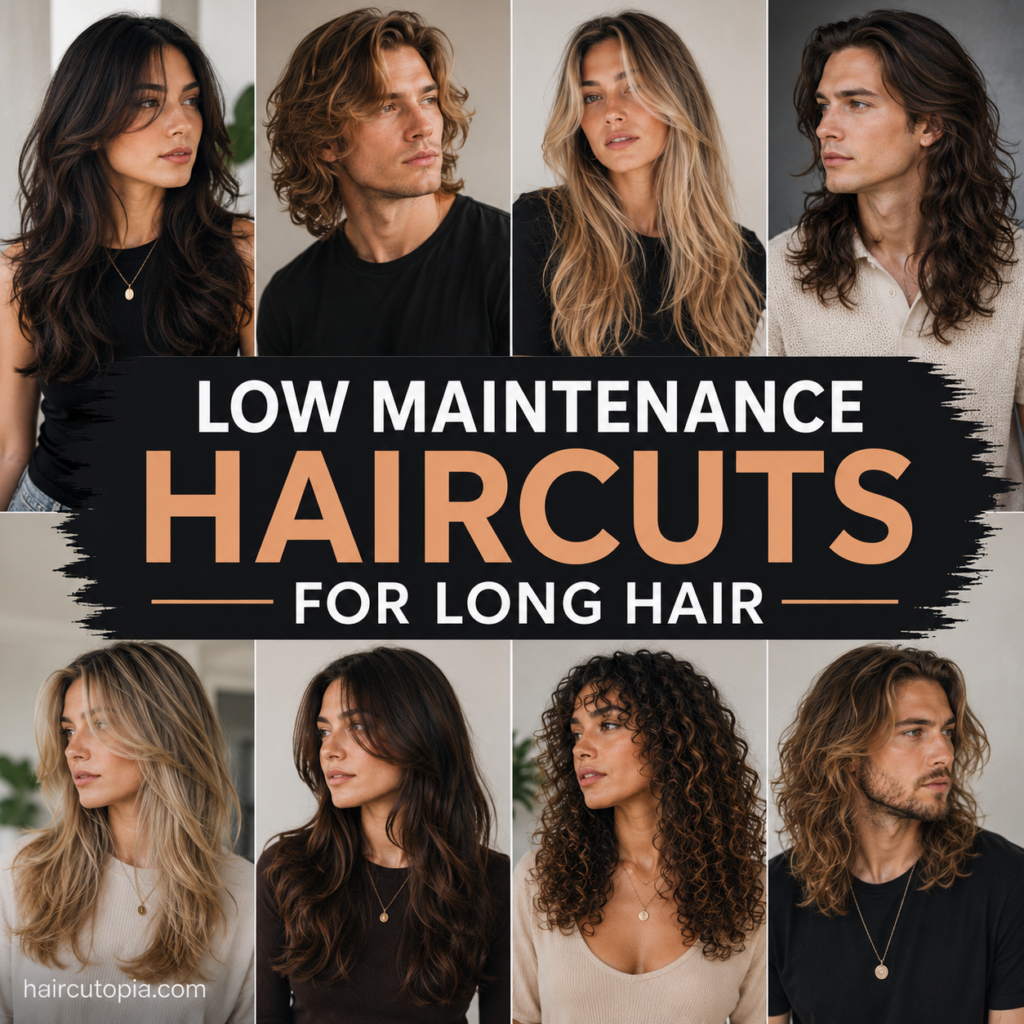
Long hair has a reputation for being high maintenance, but the length itself isn’t always the problem. Often, it’s the haircut.
A cut with too many short layers may need regular styling to sit properly. Heavy, one-length hair can take forever to dry. Bangs can turn a simple morning routine into a daily appointment with a blow dryer.
The right long haircut can make things much easier.
Low maintenance haircuts for long hair are designed to work with natural texture, reduce unnecessary bulk, and maintain their shape as they grow. They also preserve one of the biggest advantages of having long hair: when you don’t feel like styling it, you can simply pull it back.
From barely-there layers to shags, natural curls, and classic one-length cuts, there are plenty of ways to keep long hair without making it a full-time job.
What Makes a Long Haircut Low Maintenance?
With long hair, low maintenance usually means finding the right balance between shape and simplicity.
You want enough structure that the hair doesn’t feel heavy or shapeless, but not so much that every layer needs individual attention.
An easy long haircut generally:
- Works with your natural texture
- Air-dries into a flattering shape
- Can be pulled into a ponytail or bun
- Doesn’t require constant heat styling
- Maintains its shape as it grows
- Avoids excessive bulk
- Doesn’t require frequent salon visits
Hair density matters too.
Someone with fine, straight hair may find a simple one-length cut incredibly easy. Someone with thick, wavy hair might need strategic layers to prevent the same haircut from becoming heavy and difficult to manage.
1. One-Length Long Hair
Sometimes the simplest haircut really is the easiest.
A one-length cut keeps most of the hair at the same length, creating a clean perimeter without complicated layering.
It works particularly well for straight or slightly wavy hair.
Because there aren’t many short pieces, the hair is easy to:
- Brush
- Braid
- Pull into a ponytail
- Wear in a bun
- Style half-up
The strong perimeter can also make fine hair appear fuller.
If your hair is extremely thick, however, completely avoiding layers may create too much weight.
2. Long Hair With Minimal Layers
If one-length hair feels too heavy but you don’t want a heavily layered haircut, minimal layering offers a good compromise.
A few strategically placed layers can remove weight while preserving the overall length and fullness.
Because the layers are subtle, they don’t need much individual styling.
This is an especially practical option if you regularly wear your hair in ponytails or braids.
3. Long Layers
Long layers are one of the most versatile choices for long hair.
Instead of dramatically shortening sections, the layers gradually blend through the length.
They create movement, reduce bulk, and can prevent long hair from looking flat.
Most importantly, long layers tend to grow out gracefully.
You don’t need to return to the salon the moment they gain another inch.
4. Soft Layers
Soft layers create subtle movement without producing a heavily layered appearance.
The transitions are blended, which helps the haircut look natural whether it’s styled or air-dried.
This type of layering works particularly well if you want your hair to move more freely but don’t want lots of shorter sections around your head.
It’s simple, versatile, and relatively forgiving.
5. Invisible Layers
Invisible layers remove weight from within the haircut rather than creating obviously different lengths on the surface.
They’re particularly useful for thick or dense long hair.
From the outside, the hair can still appear long and full. Internally, some of the bulk has been removed.
That can make washing, drying, and styling easier without sacrificing the appearance of length.
6. Internal Layers
Internal layering follows a similar concept.
Rather than cutting dramatic visible layers, the stylist selectively removes weight from inside the haircut.
This can help thick hair move more naturally and prevent the ends from becoming excessively bulky.
It’s a good option if you like the appearance of one-length hair but not the weight that comes with it.
7. U-Shaped Long Haircut
A U-shaped haircut creates a softly rounded perimeter when viewed from behind.
The center remains slightly longer while the sides gradually become shorter.
The difference doesn’t have to be dramatic.
This shape adds movement while preserving plenty of density through the ends.
It also tends to grow out naturally because there aren’t sharp transitions between sections.
8. V-Shaped Long Haircut
A V-shaped cut creates a more noticeable point through the center of the back.
It’s a stronger shape than the U-cut but still maintains substantial length.
This can help very long hair feel less heavy and visually flat.
The style works especially well when combined with subtle long layers.
If you prefer wearing your hair down frequently, the shape can add interest without requiring additional daily styling.
9. Rounded Long Haircut
A rounded perimeter offers a softer alternative to both blunt and V-shaped cuts.
The edges gradually curve rather than ending in a straight line.
This creates natural movement while keeping the overall shape simple.
It’s especially useful if you want your long hair to look intentional without adding extensive layering.
10. Long Hair With Face-Framing Layers
Face-framing layers can refresh long hair without changing most of the length.
Shorter pieces are placed around the front while the back remains largely untouched.
For the easiest version, keep those front layers relatively long.
They can then blend naturally into ponytails, buns, and braids without constantly falling into your face.
11. Long Hair With Curtain Bangs
Curtain bangs are one of the more manageable ways to combine bangs with long hair.
They’re longer than traditional fringe and divide toward the sides.
Because they gradually blend into the rest of the haircut, they also grow out more gracefully.
They may still need occasional styling, particularly after sleeping, but they’re generally more forgiving than short blunt bangs.
12. Long Hair With Side-Swept Bangs
Side-swept bangs provide softness around the face without creating a heavy fringe.
The longer shape allows them to move naturally into the rest of the hair.
As they grow, they gradually become face-framing layers.
That makes them a practical choice if you like changing your hairstyle but don’t want to commit to constant bang maintenance.
13. Long Hair With Long Fringe
Sometimes the easiest bangs are barely bangs at all.
A long fringe falls somewhere around the cheekbones or jaw and blends naturally into the haircut.
You can wear it loose, tuck it behind your ears, or pull it back with the rest of your hair.
Because it’s already long, growth doesn’t dramatically change the style.
14. Long Shag
The shag uses layers to create movement and an intentionally relaxed finish.
For long hair, those layers can also remove substantial weight.
This style works particularly well for naturally wavy or textured hair.
Instead of trying to smooth every strand, the haircut encourages separation, bends, waves, and volume.
The slightly undone appearance is part of the appeal.
15. Soft Long Shag
A soft shag keeps the same general idea but uses longer, more blended layers.
The result is less dramatic and easier to transition between casual and polished styling.
It can also be a better choice if you frequently pull your hair back.
Keeping the shortest layers long enough to reach your ponytail will make everyday styling much easier.
16. Wavy Long Shag
Natural waves and shag layers work particularly well together.
Long hair can sometimes weigh waves down, making the roots look flat while texture develops only near the ends.
Layering removes some of that weight.
The result can be more natural movement without requiring a curling iron.
A little styling cream, mousse, or texture spray may be all you need.
17. Curly Long Shag
A curly shag uses layers to distribute volume throughout long curly hair.
Without layering, long curls can become heavy enough to stretch the curl pattern near the roots.
Strategically placed layers can encourage more movement and create a balanced silhouette.
The haircut itself does much of the shaping, leaving your regular curl routine to handle definition.
18. Long Butterfly Cut
The butterfly haircut uses shorter face-framing layers combined with longer layers throughout the hair.
It’s known for creating movement while preserving overall length.
However, there’s an important distinction if low maintenance is your goal.
The dramatic butterfly styles you see after professional blowouts can require significant styling.
Ask for a softer version designed to look good when air-dried. Keeping the layers longer can make the haircut much easier to manage.
19. Long Hair With Feathered Layers
Feathered layers create soft movement around the face and through the lengths.
Modern versions can be much subtler than the heavily styled feathered cuts associated with past decades.
The easiest approach is to keep the layers long.
That way, they can move naturally rather than needing to be individually curled or blown outward every morning.
20. Long Hair With Wispy Layers
Wispy layers soften the edges of long hair and create a lighter overall appearance.
They’re particularly useful if a completely blunt perimeter feels too heavy.
The effect should be subtle.
Too much thinning can make the ends appear sparse, especially on fine hair, so the amount of texture should be adapted to your density.
21. Long Wavy Hair With Layers
Naturally wavy long hair often benefits from some layering.
Without it, the weight of the hair can pull waves downward.
Long layers allow different sections to move more freely while preserving length.
For everyday styling, you may only need to apply a lightweight product, scrunch the hair, and let it dry.
The goal isn’t to make every wave identical.
22. Long Beachy Layers
Beachy layers are designed to create loose movement rather than a highly structured finish.
They work best on hair that already has some natural bend or wave.
Because the style is supposed to look relaxed, minor frizz and irregular texture don’t necessarily ruin it.
This can make the cut especially forgiving during humid weather or on days when you don’t want to heat style.
23. Long Curly Layers
Curly hair often needs a different approach to layering than straight hair.
Well-placed long layers can reduce weight while maintaining enough length for curls to form properly.
The goal is balance.
Too few layers can leave the bottom overly heavy. Too many short layers can create more volume than you want.
A stylist experienced with curly hair can shape the cut around your specific curl pattern.
24. Long Rounded Curly Cut
A rounded shape can give long curls a more balanced silhouette.
Instead of allowing all the volume to accumulate near the bottom, the haircut distributes fullness through the sides and lengths.
This approach works especially well with dense curls.
Once the shape is established, daily styling can focus on moisture and definition rather than creating the silhouette from scratch.
25. Long Natural Curls
Sometimes the easiest way to maintain long curly hair is to stop trying to make it behave like straight hair.
A cut designed around the natural curl pattern can dramatically simplify styling.
Your routine might focus on:
- Gentle cleansing
- Conditioning
- Detangling
- Leave-in conditioner
- Curl cream or gel
- Air-drying or diffusing
The haircut should make that routine easier, not add another set of steps.
26. Long Coily Hair
Long coily hair can be incredibly versatile, but the right shape matters.
Strategic layering can distribute volume while preserving overall length.
Moisture and gentle detangling are usually more important than daily styling.
Longer hair also provides plenty of options for protective and low-manipulation styles when you want a break from wearing it loose.
27. Long Layered Natural Hair
Layering can help curly and coily long hair maintain a balanced shape.
The amount of layering depends heavily on density, shrinkage, and the desired silhouette.
Done properly, layers can prevent the bottom from becoming excessively heavy while allowing the natural texture to create movement throughout the haircut.
This is one area where working with a stylist familiar with your specific texture can make a noticeable difference.
28. Long Hair With a Center Part
Sometimes changing the haircut isn’t necessary.
A simple long cut with a center part can create a clean, modern appearance without complicated styling.
This works particularly well with:
- One-length hair
- Long layers
- Natural waves
- Face-framing layers
If your hair naturally separates near the center, working with that part can eliminate the effort of forcing it in another direction every morning.
29. Long Hair With an Off-Center Part
Not everyone has a natural center part.
An off-center part can be just as easy and often works better with natural growth patterns.
It can also add subtle volume to the roots without requiring teasing or heavy styling.
The lowest-maintenance part is usually the one your hair naturally wants to create.
30. Long Wash-and-Wear Haircut
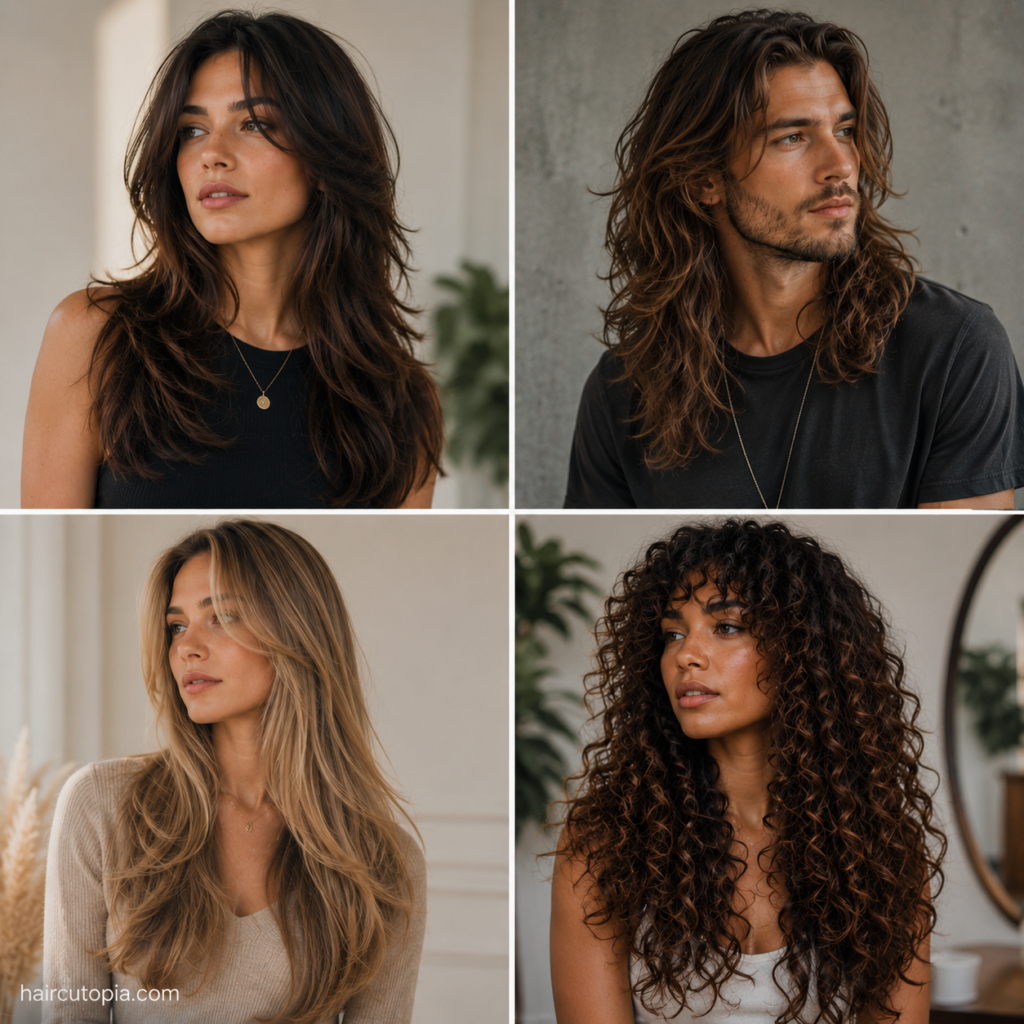
The ultimate easy long haircut isn’t defined by one specific shape.
It’s designed around what your hair naturally does after washing.
A stylist creating a wash-and-wear cut should consider:
- Natural texture
- Hair density
- Growth patterns
- Wave or curl formation
- Preferred part
- How the hair air-dries
- How frequently you wear it up
- How much styling you’re realistically willing to do
The finished haircut should still look intentional when you haven’t used a blow dryer or curling iron.
That’s what genuinely low-maintenance hair looks like.
Best Low Maintenance Long Haircuts by Hair Type
The same long haircut can behave completely differently depending on texture and density.
Choosing a style that complements your natural hair is one of the easiest ways to reduce daily work.
Straight Hair
Straight long hair generally works well with simpler shapes.
Consider:
- One-length hair
- U-shaped cut
- Minimal layers
- Long layers
- Face-framing layers
- Rounded perimeter
Fine straight hair may benefit from keeping more density through the ends.
Wavy Hair
Wavy hair often becomes easier when some weight is removed.
Good options include:
- Long layers
- Soft shag
- Wavy shag
- U-shaped cut
- Beachy layers
- Butterfly-inspired layers
Allowing waves to form naturally can eliminate the need to recreate texture with hot tools.
Curly Hair
Curly long hair benefits from careful weight distribution.
Consider:
- Long curly layers
- Curly shag
- Rounded curly cut
- Long natural curls
- Face-framing curly layers
Always account for shrinkage before deciding how short the layers should be.
Coily Hair
Long coily hair can benefit from shaping that works with its natural volume.
Options include:
- Long layered natural hair
- Rounded shapes
- Long coily cuts
- Face-framing layers
The best cut will depend heavily on shrinkage, density, and how you normally wear your hair.
Fine Hair
Fine long hair can appear thinner when excessively layered.
Consider:
- One-length hair
- U-shaped cut
- Minimal layers
- Subtle face-framing pieces
- Soft long layers
Maintaining fullness through the perimeter can help the ends look denser.
Thick Hair
Thick long hair often benefits the most from strategic layering.
Good options include:
- Invisible layers
- Internal layers
- Long layers
- Long shag
- Butterfly-inspired layers
- U-shaped cut
Removing weight can reduce drying time and make the hair easier to move without sacrificing overall length.
Which Long Haircuts Grow Out the Best?
Long hair has a major advantage when it comes to salon maintenance.
An extra inch usually doesn’t completely change the haircut.
Styles that tend to grow out particularly well include:
- One-length cuts
- U-shaped cuts
- Long layers
- Soft layers
- Invisible layers
- Long face-framing layers
- Soft shags
- Long curtain bangs
Avoid highly precise, short sections if you want to stretch the time between salon appointments.
Longer, blended transitions tend to change much more gradually.
Are Layers or One-Length Hair Easier to Maintain?
It depends on your hair.
For fine or straight hair, one-length or minimally layered cuts can be extremely easy. There are fewer pieces to control, and the strong perimeter can create a fuller appearance.
For thick or textured hair, layers may actually reduce maintenance.
Removing excess weight can make the hair:
- Faster to dry
- Easier to detangle
- Less bulky
- More naturally shaped
- Easier to air-dry
The goal isn’t to avoid layers automatically.
It’s to use only as much layering as your hair actually needs.
Are Bangs Low Maintenance With Long Hair?
Usually, bangs are one of the higher-maintenance parts of any haircut.
Short blunt bangs need frequent trimming and can require daily styling.
Longer fringe is easier.
If you want bangs without dramatically increasing your routine, consider:
- Curtain bangs
- Long side-swept bangs
- Long wispy fringe
- Cheekbone-length fringe
- Face-framing pieces
These options can gradually blend into the rest of the haircut as they grow.
How Often Should Long Hair Be Trimmed?
Long hair generally doesn’t need to be reshaped as frequently as short hair.
A rough starting point is:
- One-length long hair: around every 10–16 weeks
- Long layered hair: around every 10–14 weeks
- Long shag: around every 8–12 weeks
- Long curly layers: around every 10–16 weeks
- Long hair with bangs: fringe may need attention sooner
These aren’t strict rules.
If your haircut still looks good and the ends remain healthy, you may be comfortable waiting longer.
Chemical treatments, frequent heat styling, and environmental damage can all affect how often the ends need attention.
How to Make Long Hair Easier to Maintain
A low-maintenance haircut helps, but the routine around it matters too.
Choose a Cut That Air-Dries Well
If you rarely blow-dry your hair, tell your stylist.
A haircut designed around a round-brush blowout may behave very differently when left to dry naturally.
Your stylist needs to know which version of your hair you actually wear most often.
Keep Layers Ponytail-Friendly
If you regularly wear your hair up, don’t overlook this.
Ask your stylist to keep shorter layers long enough to reach your ponytail whenever possible.
Otherwise, you may end up pinning multiple pieces back every time you tie your hair up.
Don’t Fight Your Natural Texture Every Day
If your hair is wavy, let the haircut support waves.
If it’s curly, build the shape around curls.
If it’s straight, you don’t need to add artificial texture every morning unless you genuinely enjoy doing it.
Heat styling can always be an option rather than a requirement.
Keep Products Simple
Long hair may require more conditioner than short hair, but it doesn’t necessarily need more styling products.
Depending on your texture, a straightforward routine may include:
- Leave-in conditioner
- Lightweight styling cream
- Curl cream
- Mousse
- Smoothing serum
- Texture spray
Use products because they solve a specific problem, not simply because they’re part of a complicated routine.
Protect the Ends
The ends of long hair are the oldest part of the hair.
That makes them more vulnerable to dryness and breakage.
Gentle detangling, conditioning, limiting excessive heat, and avoiding unnecessarily tight hairstyles can help preserve the length between trims.
Is Long Hair Actually High Maintenance?
It can be, but it doesn’t have to be.
Long hair takes longer to wash, dry, and detangle simply because there’s more of it.
But it has advantages too.
Long hair can quickly be:
- Put into a ponytail
- Twisted into a bun
- Braided
- Worn half-up
- Clipped back
That means you don’t necessarily have to style it every morning.
Short hair may dry faster, but if a pixie isn’t sitting correctly, you can’t simply put it into a ponytail and forget about it.
Maintenance depends as much on your lifestyle as it does on length.
What to Ask Your Hairstylist
Rather than simply requesting “low-maintenance long hair,” explain your normal routine.
You might say:
“I want to keep my length, but I usually air-dry and wear my hair in a ponytail pretty often. I’d like some movement without having lots of short layers to style.”
Also mention:
- Your natural texture
- How often you wash your hair
- Whether you air-dry
- How often you use hot tools
- Whether you frequently wear your hair up
- How often you want salon appointments
- Whether your hair feels too heavy
- Whether your ends feel thin
- How much styling you’re willing to do
Those details help your stylist choose the right type and amount of layering.
What Is the Lowest Maintenance Haircut for Long Hair?
For naturally straight or slightly wavy hair, a one-length or minimally layered cut is difficult to beat.
It’s simple, easy to pull back, and grows out well.
For thick hair, however, long or invisible layers may actually require less work because they reduce bulk.
Wavy hair often benefits from long layers or a soft shag, while curly hair may become much easier with layers designed around the curl pattern.
There isn’t one universally easiest long haircut.
The simplest option is the one that makes your natural texture easier to manage.
Choosing the Best Low Maintenance Haircut for Long Hair
Start by deciding what you want to keep.
If maintaining maximum length is your priority, try a U-shaped cut, minimal layers, or subtle face-framing pieces.
If your hair feels heavy, consider long, internal, or invisible layers.
If you have natural waves, a soft shag or long layered cut can help them appear without constant styling.
For curls and coils, choose a shape designed around the natural texture rather than trying to force the hair into a completely different pattern.
Most importantly, choose a haircut that fits the routine you already have.
Long hair doesn’t need to be perfectly blown out, curled, or styled every morning to look good. With the right shape, natural texture and a simple routine can do most of the work.
That’s what makes the best low maintenance haircuts for long hair so useful: you keep the length and versatility you love without feeling like your hair controls your schedule.

Related Posts
 Low Maintenance Long Layers Haircuts: 31 Easy Styles That Stay Beautiful with Minimal Effort
 Low Maintenance Long Pixie Haircuts: 30 Easy Styles That Still Look Great
 Low Maintenance Long Bob Haircuts: 25 Easy Lob Styles That Always Look Great
 Lob Haircuts for Busy Moms: 25 Stylish, Low-Maintenance Long Bob Ideas