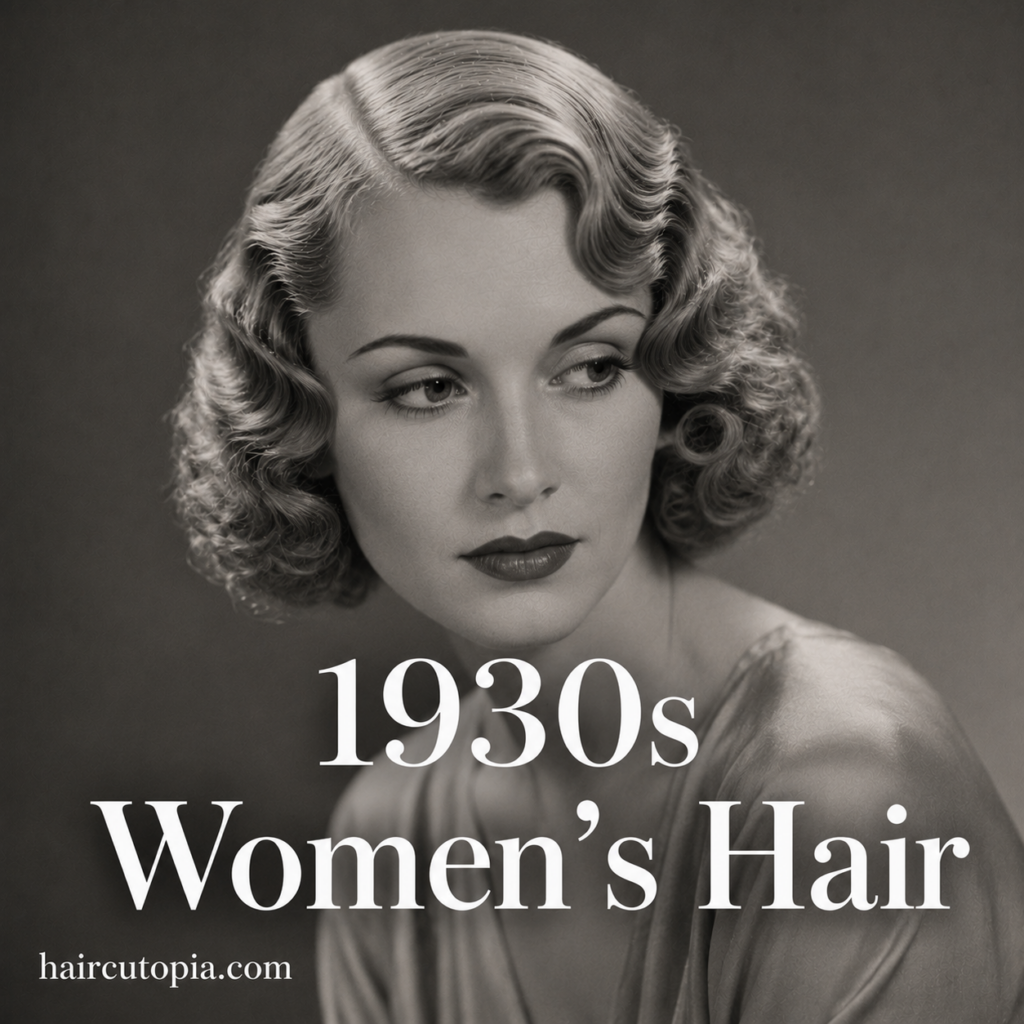
Women’s hair in the 1930s was elegant, polished, and constantly evolving.
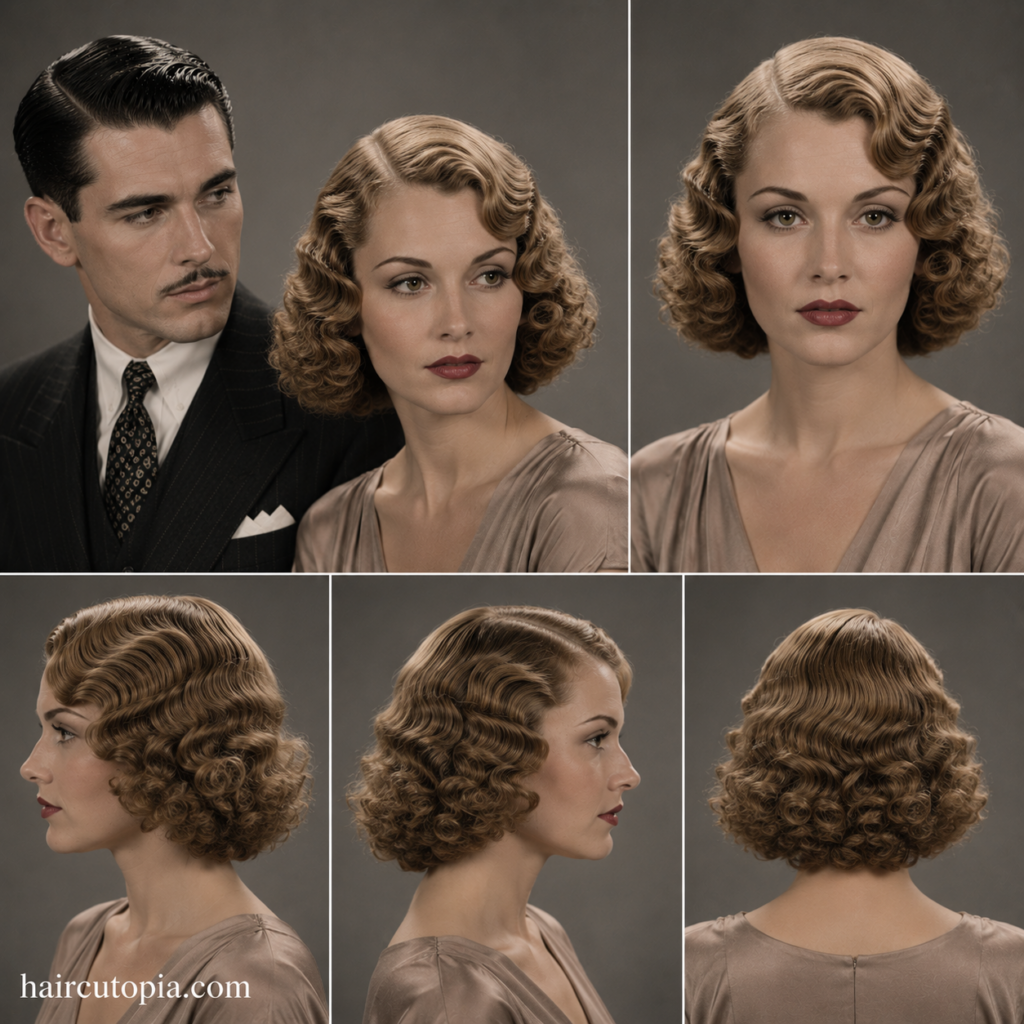
At the beginning of the decade, short hair was still everywhere. The bob revolution of the 1920s hadn’t simply disappeared, and many women continued wearing jaw-length or nape-length cuts. What changed was the way those cuts were styled. Sharp lines softened into sculpted waves, curls framed the face, and deep side parts created a more glamorous silhouette.
Then hair began to grow.
As the decade progressed, bobs became longer, curls became fuller, and hair increasingly reached toward the shoulders. By the late 1930s, women’s styles were already moving toward the longer, more voluminous looks that would become familiar in the 1940s.
Hollywood played an enormous role in shaping the fashionable image of the era. Movie stars appeared with immaculate waves and curls, while magazines and publicity photographs carried those looks into homes around the country.
But everyday 1930s women’s hair wasn’t always movie-star elaborate. Home setting techniques, practical cuts, and adaptable styles allowed women to create fashionable looks without completely changing their hair.
From finger waves and curly bobs to longer Hollywood waves, here’s how women wore their hair throughout the 1930s.
What Did Women’s Hair Look Like in the 1930s?
There wasn’t one single 1930s women’s hairstyle.
Hair changed noticeably between 1930 and 1939.
Early styles tended to be shorter and closer to the head. Later styles became longer, softer, and fuller.
Common characteristics included:
- Deep side parts
- Finger waves
- Waved bobs
- Curly bobs
- Pin curls
- Sculpted S-waves
- Smooth crowns
- Curls around the ears and neckline
- Nape-length cuts
- Curled-under ends
- Brushed-out waves
- Increasingly longer hair
- Shoulder-length styles
- Polished, glossy finishes
The defining quality was control.
Even when curls looked soft, their placement was usually deliberate. Hair was shaped into a finished silhouette rather than intentionally left tousled.
1. Finger Waves
Finger waves are among the most recognizable women’s hairstyles associated with the era.
The technique had already become fashionable during the 1920s, but it remained important in the early 1930s.
Hair was dampened and shaped into repeating S-curves using the fingers and a comb.
Once set, the waves followed the contours of the head.
A classic finger-wave look often included:
- A deep side part
- Smooth, sculpted ridges
- Close-fitting sides
- Small curls near the ears
- A polished finish
Short and nape-length hair worked particularly well because the wave pattern remained clearly visible.
Today, finger waves are still used in vintage styling, editorial looks, formal hair, and modern interpretations across different hair textures.
2. The Waved Bob
The bob remained an important haircut throughout the early 1930s.
However, it generally looked softer than many of the sharp geometric bobs associated with the previous decade.
Waves transformed the shape.
Instead of falling straight from the head, the hair curved around the forehead, temples, ears, and cheeks.
The ends might be turned inward or curled around the neckline.
The waved bob became a perfect bridge between two eras: it retained the shorter length made fashionable in the 1920s while embracing the softer beauty aesthetic of the 1930s.
3. The Curly Bob
Curls offered another way to soften short hair.
A curly bob typically kept the crown fairly controlled while concentrating volume around the sides and ends.
Depending on the set, the curls could be:
- Small and defined
- Soft and brushed
- Concentrated near the ears
- Arranged around the neckline
- Combined with waves
The style could look playful during the day or sophisticated when carefully arranged for evening.
As the decade progressed, larger curls became increasingly common.
4. Deep Side-Parted Hair
The deep side part was one of the defining details of 1930s women’s hair.
Moving the part away from the center immediately created asymmetry.
The heavier section could sweep dramatically across the forehead before flowing into waves or curls.
This worked at several lengths.
A short bob gained drama.
Medium-length hair gained movement.
Longer late-1930s hair could sweep across the face before falling into larger curls.
The side part became so closely associated with glamorous styling that it remains a common feature of vintage-inspired hair today.
5. Sculpted S-Waves
Not every wave was created with exactly the same technique, but the smooth S-shaped pattern became a defining visual feature.
The hair moved back and forth in controlled curves.
These waves could lie close to the scalp or become softer farther down the length.
The pattern looked especially striking with a deep side part because the waves naturally followed the asymmetrical direction of the hairstyle.
For a highly authentic vintage appearance, defined S-waves remain one of the strongest references to the period.
6. Small Face-Framing Curls
Short curls around the face were another characteristic detail.
They could appear near:
- The temples
- The ears
- The cheeks
- The jawline
- The nape
These curls softened short cuts without requiring significant length.
They were particularly effective when the rest of the hair remained smooth or waved.
A few strategically placed curls could completely change the silhouette of a bob.
7. Pin-Curl Hairstyles
Pin curls were an important styling technique rather than one specific hairstyle.
Sections of damp hair were wound into small coils and secured against the head while drying.
Once released, those curls could be arranged or brushed into different patterns.
A pin-curl set could produce:
- Defined curls
- Soft waves
- Curled ends
- Face-framing curls
- Fuller sides
- Brushed Hollywood waves
The direction and placement of each curl affected the final result.
That versatility made pin curling useful for both salon and home styling.
8. The Nape-Length Bob
As women began growing out shorter hair, the nape-length bob became increasingly useful.
It retained the basic bob silhouette while providing additional length around the back of the neck.
That extra length opened up new styling options.
The hair could support larger waves, fuller curls, and more movement around the neckline.
It also represented an important stage in the decade’s gradual shift toward longer hair.
9. The Grown-Out Bob
Growing out a short bob didn’t necessarily mean passing through an awkward period with no fashionable options.
The extra length could become part of the style.
Waves helped control the shape while curls disguised uneven-looking transitional lengths.
The result was softer than a sharply cut short bob.
By allowing hair to grow rather than continually cutting it back to the jaw, women gradually moved toward the medium lengths that became increasingly fashionable later in the decade.
10. Soft Medium-Length Hair
Medium-length hair became more prominent as the 1930s progressed.
The added length offered much more flexibility.
Women could wear it:
- In waves
- In curls
- With curled-under ends
- Side-swept
- Brushed into larger wave patterns
- Smooth at the crown and fuller below
The hairstyle still looked controlled, but it had more movement.
This was one of the clearest changes from the beginning of the decade.
11. Curled-Under Ends
Not every hairstyle required waves throughout the entire head.
A woman could wear relatively smooth hair with the ends curved inward.
This created a neat, rounded silhouette.
The style worked particularly well on medium-length hair and longer bobs.
Compared with highly sculpted finger waves, it offered a simpler appearance while maintaining the polished finish fashionable during the period.
12. Brushed-Out Curls
A curl set didn’t always remain visibly curly.
Brushing changed everything.
Once set curls were completely dry, careful brushing could encourage individual sections to merge into smooth, continuous waves.
The resulting pattern looked softer and more fluid.
This technique became particularly useful as hair grew longer.
Instead of many individual curls, the hair could form broad waves that moved together.
That smooth, brushed finish remains central to what we now call Hollywood waves.
13. Side-Swept Waves
Side-swept waves combined two major trends: the deep side part and sculpted movement.
The heavier side traveled across the forehead and then flowed into waves along the face.
This created an elegant asymmetrical silhouette.
The style was especially effective on medium and longer hair because the wave pattern could continue toward the shoulders.
For evening wear, a smooth side sweep could create instant glamour without requiring an elaborate updo.
14. Shoulder-Length Waves
By the late 1930s, shoulder-length hair was becoming much more visible.
This was a major shift.
The short bob had been one of the great fashion statements of the previous decade. Now women were allowing their hair to grow significantly longer.
Shoulder-length hair made it possible to create:
- Larger waves
- Fuller curls
- More movement
- Greater volume around the ends
- Softer silhouettes
These styles began to resemble the hair that would dominate the early 1940s.
15. Hollywood Waves
The glamorous wave patterns associated with Hollywood are among the decade’s most enduring looks.
Hair was typically arranged into smooth, continuous waves rather than intentionally separated curls.
A deep side part often provided the foundation.
The crown remained polished while the lengths moved through broad curves.
The finished result looked luxurious and camera-ready.
Modern red-carpet hairstyles still borrow heavily from this approach.
How Women’s Hair Changed Throughout the 1930s
Looking at the decade as a single period can hide how much women’s hair actually changed.
The easiest way to understand the evolution is to divide it into early, middle, and late phases.
Early 1930s Women’s Hair
The beginning of the decade remained closely connected to the 1920s.
Short hair was common.
Typical styles included:
- Short bobs
- Finger waves
- Sculpted S-waves
- Small curls
- Deep side parts
- Close-fitting silhouettes
Hair often followed the shape of the head.
Volume was controlled, and curls were frequently concentrated around the sides or bottom.
Mid-1930s Women’s Hair
By the middle of the decade, hair was noticeably softening.
Bobs were growing longer.
Nape-length and medium styles gave women additional room for curls and waves.
Common characteristics included:
- Longer bobs
- Softer waves
- Larger curls
- More movement around the neck
- Curled-under ends
- Fuller lower sections
The crown often remained smooth while volume developed farther down.
Late 1930s Women’s Hair
By the late 1930s, the transition toward longer hair was unmistakable.
Shoulder-length styles became increasingly visible.
Waves grew larger and curls gained volume.
Late-decade hair commonly featured:
- Shoulder-grazing lengths
- Large brushed waves
- Fuller curls
- Side-swept styling
- Smooth crowns
- More volume through the ends
These styles provided the foundation for many recognizable 1940s looks.
Why Did Women’s Hair Get Longer?
Fashion naturally moves through cycles, and the dramatic short-hair revolution of the 1920s eventually gave way to new silhouettes.
The change wasn’t immediate.
Women didn’t collectively abandon their bobs and grow waist-length hair.
Instead, lengths gradually moved downward.
Jaw-length hair became nape-length hair. Nape-length cuts grew toward the shoulders.
Styling evolved alongside the changing length.
Short hair supported compact finger waves, while longer hair allowed larger curls and flowing waves.
By the end of the decade, additional length had created an entirely different silhouette.
Hollywood’s Influence on 1930s Women’s Hair
Hollywood had enormous influence over the popular image of women’s beauty.
Movies brought stars into theaters around the world, while magazines and publicity photographs allowed audiences to study their clothes, makeup, and hair.
Jean Harlow became one of the decade’s most distinctive beauty icons. Her platinum-blonde hair and glamorous waves made her instantly recognizable.
Marlene Dietrich represented another version of sophisticated 1930s glamour, often appearing with beautifully controlled waves and dramatic side parts.
Greta Garbo helped popularize a softer image, with elegant waves that complemented the changing hair lengths of the period.
Carole Lombard also became associated with the polished waves and curls of Hollywood beauty.
The influence extended beyond individual hairstyles.
Hollywood reinforced the idea of hair as part of a complete glamorous image.
Everyday Women’s Hair vs. Hollywood Hair
A studio portrait isn’t necessarily an accurate picture of what every woman wore to work or around the house.
Hollywood stars had access to professional hairstylists, makeup artists, lighting, and carefully staged photography.
Everyday styling needed to be more practical.
A woman might maintain a relatively straightforward bob or medium-length cut and create variety through setting.
Changing the part or curl pattern could make the same haircut look noticeably different.
Home techniques were therefore important.
They allowed fashionable styling without requiring a completely new haircut every time the desired look changed.
How the Great Depression Affected Women’s Hair
The economic hardship of the Great Depression shaped everyday life throughout the decade.
Beauty didn’t disappear, but practicality mattered.
A versatile haircut could be styled repeatedly in different ways.
Women could use techniques such as:
- Pin curling
- Finger waving
- Wet setting
- Brushing
- Curling the ends
- Changing the part
These techniques allowed one haircut to produce several finished looks.
The contrast between economic hardship and Hollywood glamour is one of the most interesting aspects of 1930s beauty culture.
Movies offered aspirational images, while everyday women found practical ways to interpret fashionable ideas.
1930s Hair Products for Women
Creating structured waves and curls required control.
Setting products helped hair maintain the desired shape as it dried.
Products and grooming aids associated with women’s hair care included:
- Setting lotions
- Hair oils
- Brilliantine-type products
- Shampoos
- Wave-setting products
- Hair tonics
The exact formulas differed considerably from modern products.
The goal, however, remains familiar: create hold, smooth the surface, enhance shine, and keep the hairstyle in place.
Today, mousse, gel, setting spray, curl creams, and hairspray can accomplish similar jobs.
Why Was 1930s Women’s Hair So Shiny?
Shine suited the polished aesthetic of the period.
Smooth surfaces made sculpted waves more visible.
Light reflected along the ridges and curves, emphasizing the shape of the hairstyle.
This was particularly effective in photography and film.
Modern vintage recreations don’t necessarily need the same degree of shine.
A light styling cream or medium-shine product can preserve definition while producing a softer contemporary finish.
Hair Color in the 1930s
Women naturally wore the full range of hair colors, but Hollywood helped make certain shades especially visible.
Platinum blonde became one of the decade’s most famous beauty statements.
Jean Harlow was so closely associated with the color that platinum hair became part of her screen identity.
Very light blonde stood out dramatically in black-and-white film and photography.
Brunette and darker hair could produce equally striking effects because sculpted waves reflected studio lighting beautifully.
Red hair also had its place among the era’s recognizable screen looks.
The broader trend was important: hair color was increasingly becoming something that could be deliberately altered as part of personal style.
Accessories and 1930s Women’s Hair
Hair didn’t exist separately from the rest of fashion.
Hats were especially important during the decade, meaning hairstyles often needed to work underneath or alongside them.
A carefully positioned hat could leave sculpted waves visible around the forehead or sides.
Decorative hair accessories could also complement formal styling.
Depending on the occasion, women might use:
- Hair combs
- Decorative clips
- Pins
- Barrettes
- Headpieces
The accessory generally supported the hairstyle rather than overwhelming it.
Straight Hair in the 1930s
Women with naturally straight hair could use wet setting and curling techniques to create the waves fashionable at the time.
Short straight hair could be finger-waved.
Longer hair could be pin-curled and brushed into softer patterns.
Straight hair also worked well with smooth, curled-under styles.
The styling process was often more important than the natural texture.
Wavy Hair in the 1930s
Naturally wavy hair already provided some of the movement fashionable during the decade.
The challenge was shaping that texture into a deliberate pattern.
A deep side part could establish direction, while setting techniques helped organize individual waves into a cohesive silhouette.
Modern recreations can be much less rigid.
Natural waves can simply be enhanced while borrowing the side part and overall shape of the era.
Curly Hair in the 1930s
Naturally curly hair could support the decade’s emphasis on defined shape and volume.
Rather than treating every curl individually, styling could focus on creating an intentional silhouette.
For a modern 1930s-inspired look, curls might be:
- Side-parted
- Sculpted around the face
- Defined through the sides
- Smoothed slightly at the crown
- Arranged into a rounded bob shape
The goal doesn’t need to be reproducing the exact texture shown in historical Hollywood photography.
The period can be referenced through shape and styling direction.
Coily Hair and 1930s-Inspired Styling
Popular modern summaries of 1930s hair often focus too narrowly on white Hollywood actresses and don’t represent the full range of women living and styling their hair during the era.
For contemporary vintage-inspired styling, coily and tightly textured hair can reference the period without being forced to imitate another natural texture.
Useful elements include:
- Sculpted waves
- Defined side parts
- Smooth or controlled sections
- Rounded silhouettes
- Carefully shaped curls
- Decorative placement around the face
Vintage inspiration works best when the defining design principles are adapted to the person’s actual hair.
1920s vs. 1930s Women’s Hair
The transition between these decades is one of the most interesting periods in modern hair history.
1920s Women’s Hair
The 1920s became famous for:
- Very short bobs
- Shingle cuts
- Eton crops
- Sharp outlines
- Compact silhouettes
- Finger waves
Cutting the hair short could itself be a statement of modernity.
1930s Women’s Hair
The following decade gradually moved toward:
- Longer bobs
- Softer shapes
- More curls
- Larger waves
- Nape-length hair
- Medium lengths
- Shoulder-length styles
Finger waves remained, particularly early on, but the overall silhouette changed.
Hair became softer and increasingly longer.
1930s vs. 1940s Women’s Hair
The late 1930s flowed naturally into the early 1940s.
Women already had more length to work with.
During the 1940s, that length supported:
- Larger curls
- Rolled sections
- Victory rolls
- Fuller silhouettes
- Structured front sections
- Shoulder-length arrangements
The compact styles of the early 1930s had essentially expanded outward.
This is why late-1930s and early-1940s hair can sometimes look quite similar.
How to Ask for a 1930s-Inspired Women’s Haircut
First decide whether you prefer the early or late part of the decade.
They require different lengths.
For an Early-1930s Look
Ask for a bob around the jaw or nape.
Keeping enough weight in the cut can make structured waves easier to create.
If historical styling is your goal, tell your stylist that you plan to finger-wave or set the hair.
For a Mid-1930s Look
Consider a longer bob or medium-length cut.
You want enough length for curls and waves while preserving a relatively smooth silhouette.
For a Late-1930s Look
Shoulder-grazing hair provides more room for larger curls and Hollywood-style waves.
Bring reference photos whenever possible.
The phrase “1930s hair” covers nearly an entire decade of changing lengths, so visual references help communicate exactly what you want.
How to Create 1930s Women’s Hair Today
You don’t necessarily need historical products or equipment.
Modern tools make many vintage styles considerably easier to recreate.
For Finger Waves
Start with damp hair and apply a product that provides control.
Use a fine-tooth comb and your fingers to shape the hair into alternating S-curves.
Allow the pattern to set completely before disturbing it.
For Pin Curls
Divide damp hair into manageable sections.
Wind each section into a curl and secure it against the head.
Once fully dry, remove the pins.
Leave the curls defined or brush them into waves.
For Hollywood Waves
Create a deep side part and curl the hair in a consistent direction.
Allow the curls to cool completely.
Then brush them together until they form smooth, continuous waves.
Finish lightly to preserve the pattern.
How to Modernize 1930s Women’s Hair
The easiest way to modernize the look is to reduce the rigidity.
You can keep the historical silhouette while allowing more natural movement.
Try:
- Looser waves
- Less shine
- Softer side parts
- Natural curl definition
- Lighter styling products
- Fewer perfectly sculpted sections
- More movement through the ends
A modern bob with a deep side part and soft waves can reference the 1930s without looking like costume styling.
The same applies to longer hair.
Hollywood waves remain completely wearable today because the underlying idea has never really disappeared.
Which 1930s Women’s Hairstyle Is Best for You?
The best option depends on your length, texture, and how much styling you’re willing to do.
Choose Finger Waves If:
You want a strongly vintage look with visible structure.
Choose a Waved Bob If:
You like shorter hair but want a softer, glamorous silhouette.
Choose a Curly Bob If:
You prefer more volume around the sides and ends.
Choose Medium-Length Waves If:
You want vintage influence with more styling flexibility.
Choose Hollywood Waves If:
You want a glamorous formal look that still feels current.
Choose Shoulder-Length Curls If:
You prefer the softer, fuller appearance associated with the end of the decade.
Are 1930s Women’s Hairstyles Still Popular?
Many of them are.
They simply aren’t always labeled as 1930s styles.
Hollywood waves remain popular for:
- Weddings
- Formal events
- Red carpets
- Photo shoots
- Evening hairstyles
Bobs remain fundamental salon cuts.
Deep side parts continue to cycle through fashion.
Finger waves still appear in editorial styling and modern creative looks.
Even brushed-out curl sets remain useful for creating smooth vintage-inspired waves.
The techniques may have evolved, but many of the basic ideas survived.
Frequently Asked Questions About 1930s Women’s Hair
What was the most popular women’s hairstyle in the 1930s?
There wasn’t one hairstyle that dominated all ten years.
Waved bobs and finger waves were especially recognizable early in the decade, while longer waves and curls became increasingly fashionable later.
How did women wear their hair in the 1930s?
Women wore short bobs, finger waves, pin curls, side-parted waves, curly bobs, medium-length styles, and increasingly shoulder-length hair toward the end of the decade.
Did women have short hair in the 1930s?
Yes.
Short hair remained very common during the early 1930s because of the enormous popularity of bobs during the previous decade.
Hair gradually became longer as the decade progressed.
Did women have long hair in the 1930s?
Yes, although the fashionable mainstream silhouette increasingly favored medium and shoulder-length hair rather than the extremely long loose styles seen in some other periods.
Hair length varied considerably between individuals.
Were finger waves popular in the 1930s?
Yes.
Finger waves continued from the 1920s and remained especially prominent during the early years of the 1930s.
Were bobs popular in the 1930s?
Yes.
The bob remained an important haircut, but it generally became softer and longer.
Waves and curls helped distinguish many 1930s versions from sharper earlier bobs.
What hair color was popular in the 1930s?
Natural shades remained common, but platinum blonde became an especially recognizable Hollywood beauty trend.
Jean Harlow’s image was strongly associated with very light blonde hair.
Why did women wear waves in the 1930s?
Waves softened short cuts and complemented the polished beauty aesthetic of the decade.
They also offered considerable styling flexibility as women’s hair gradually grew longer.
How did women curl their hair in the 1930s?
Pin curls, wet setting, finger waving, and professional waving techniques could all be used to create curls and waves.
The exact method depended on the desired style and resources available.
What is the difference between 1920s and 1930s women’s hair?
The 1920s are particularly associated with dramatically short, geometric cuts.
During the 1930s, hair gradually became longer, softer, curlier, and fuller.
What is the easiest 1930s hairstyle to wear today?
A deep side part with soft waves is one of the easiest options.
It references the decade clearly without requiring an elaborate historical set.
How can I make 1930s hair look modern?
Keep the side part, wave pattern, or bob shape but use lighter products and allow more natural texture.
You don’t need every strand to be perfectly sculpted.
Why 1930s Women’s Hair Still Inspires Modern Styles
Women’s hair changed dramatically during the 1930s.
The decade began with the influence of the bob still firmly in place. Hair was short, waves followed the head closely, and carefully positioned curls created detail around the face.
Then the silhouette started to loosen.
Bobs grew toward the nape. Medium-length cuts became more common. Waves became broader, curls became fuller, and hair gradually approached the shoulders.
Hollywood amplified the transformation by turning beautifully styled hair into part of the movie-star image.
By the end of the decade, the foundations of 1940s hair were already clearly visible.
Yet many of the most recognizable 1930s ideas never disappeared.
The bob remains a salon staple. Deep side parts continue to return. Hollywood waves are still a formal-hair favorite. Finger waves remain instantly recognizable nearly a century later.
That’s what gives 1930s women’s hair such lasting appeal.
It was glamorous without depending on a single haircut, and structured without being completely static. Most importantly, the decade demonstrated just how much waves, curls, parting, and styling could transform even a relatively simple cut.
The products and techniques may have changed, but the influence is still easy to see in modern hair today.
Related Posts
 1950s Haircuts and Hairstyles: The Complete Guide to the Decade of Classic Glamour
 2000s Iconic Haircuts: The Most Memorable Y2K Styles That Defined a Generation
 1920s Men’s Hair: Classic Haircuts and Hairstyles of the Roaring Twenties
 1920s Women’s Hair: Iconic Haircuts and Hairstyles of the Roaring Twenties