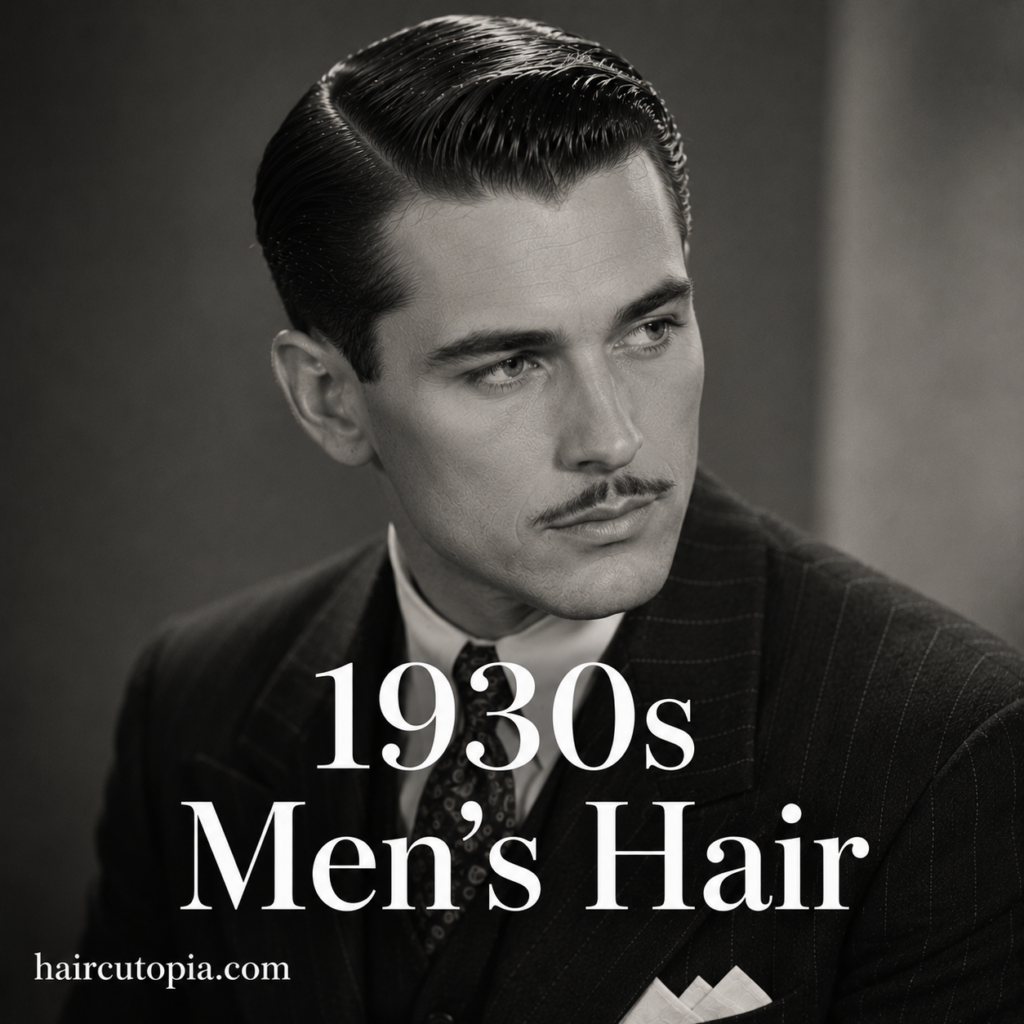
Men’s hair in the 1930s had a clear identity: neat, polished, and deliberately styled.
The typical haircut kept the sides and back relatively short while leaving enough length on top to create a strong side part, sweep the hair backward, or work with natural waves. Styling products added control and often a noticeable shine. Even relatively simple haircuts were expected to look groomed rather than casually tousled.
It’s an aesthetic that has aged remarkably well.
Take away the vintage suit and old-fashioned grooming products, and many 1930s men’s hairstyles wouldn’t look out of place in a modern barbershop. Classic tapers, side parts, slick-backs, and short-back-and-sides cuts are still widely worn today.
Hollywood helped turn these polished looks into symbols of masculine style, but everyday men’s grooming was usually much simpler. A practical haircut, comb, and styling product could go a long way.
Here’s how men wore their hair during the 1930s, from the decade’s most recognizable cuts to the grooming techniques behind them.
What Did Men’s Hair Look Like in the 1930s?
Most fashionable men’s hair followed a relatively straightforward formula.
The sides and back were kept shorter, while the top retained enough length to comb into place.
Unlike many contemporary haircuts, there wasn’t always an extreme difference between the top and sides. The transition was generally smoother and more gradual.
Common characteristics included:
- Short, tapered sides
- Neatly trimmed backs
- Longer hair on top
- Defined side parts
- Slicked-back styling
- Side-swept tops
- Controlled natural waves
- Clean necklines
- Smooth transitions between lengths
- Glossy finishes
- Minimal deliberately messy texture
The finished appearance mattered just as much as the haircut.
Hair was usually given a clear direction rather than left loose or intentionally disheveled.
1. The Classic Side Part
The side part is probably the most recognizable men’s hairstyle associated with the 1930s.
Hair was divided clearly on one side and combed across the top. The sides remained tidy, while styling product helped maintain the shape.
A typical version featured:
- A defined part
- Moderate length on top
- Shorter sides and back
- A smooth surface
- A controlled finish
The part could be subtle or more pronounced depending on the individual’s hair and preferred style.
One reason this look became so enduring is its versatility. It could work with formal clothing, everyday workwear, straight hair, or naturally wavy texture.
The same basic hairstyle is still worn today.
2. The Classic Taper
Underneath many 1930s men’s hairstyles was a traditional tapered haircut.
Hair gradually shortened toward the ears and neckline rather than changing abruptly from very long to extremely short.
This created a smooth silhouette.
The top remained longer so it could be styled.
A classic taper could serve as the foundation for:
- Side parts
- Slick-backs
- Side sweeps
- Wavy styles
- Neatly combed everyday hair
Modern barbering still relies heavily on tapering, making this one of the easiest historical cuts to adapt today.
3. Slicked-Back Hair
Slicked-back hair was another defining men’s look.
Instead of establishing a prominent side part, the longer top was combed away from the forehead and toward the back.
Product helped keep everything in position.
The traditional 1930s version usually retained some weight through the sides, creating a continuous shape from front to back.
This differs from some modern slick-backs, where a very long top is paired with a dramatically short or shaved fade.
For a more period-inspired appearance, the transition should generally feel softer.
4. Side-Swept Hair
Not every hairstyle was rigidly parted or combed directly backward.
A side sweep offered another option.
The hair traveled diagonally across the top, creating movement while still looking groomed.
Compared with a sharply defined side part, the result could feel slightly more relaxed.
However, “relaxed” in a 1930s context still meant controlled.
The hair wasn’t intentionally messy. It simply had a softer direction.
5. Wavy Side-Part Hair
Natural waves could work beautifully with the polished aesthetic of the decade.
Rather than flattening every bit of texture, men could establish a side part and allow the top to retain visible movement.
The waves followed the direction of the hairstyle.
This gave the hair character without sacrificing neatness.
A wavy side part works particularly well as a modern interpretation because it combines a historical silhouette with the current preference for natural texture.
6. Short Back and Sides
The short-back-and-sides haircut was practical and adaptable.
As the name suggests, hair was kept shorter around the back and sides while additional length remained through the top.
That top section could then be styled according to preference.
It might be:
- Side-parted
- Swept across
- Combed backward
- Worn with natural waves
- Simply combed neatly
The haircut didn’t require an elaborate styling routine, which made it useful for everyday grooming.
7. The Slick Side Part
Combine the side part with a generous amount of control and you get another unmistakably 1930s look.
The hair was parted sharply and smoothed close to the head.
A grooming product helped define the comb lines and create shine.
Compared with a softer side-part style, this version looked particularly polished.
It worked naturally with formal clothing and the tailored aesthetic associated with fashionable men of the period.
8. The Wavy Slick-Back
Men with naturally wavy hair could also comb it backward rather than sideways.
The hair was directed away from the face while some of its natural wave pattern remained visible.
This produced more texture than a completely flat slick-back.
The overall outline, however, remained controlled.
For a modern version, a lighter pomade or styling cream can preserve the movement without making the hair look excessively wet.
9. The Neatly Combed Short Cut
Not every man wore movie-star hair.
A straightforward short haircut could be combed into place with minimal effort.
The top might have only enough length for a subtle side part or gentle sweep.
This was an everyday look rather than a dramatic fashion statement.
Its defining characteristics were simply:
- A tidy outline
- Short sides
- A clean neckline
- Combed top hair
- Minimal stray texture
Simple grooming played an important role in men’s appearance during the decade.
10. The Formal Slick-Back
Formal occasions allowed for an especially polished version of the slick-back.
The hair could be combed tightly away from the forehead, with product creating both hold and shine.
The finished surface looked smooth and deliberate.
This style complemented tuxedos, evening suits, and the sophisticated image presented by Hollywood leading men.
It’s also one of the looks most frequently recreated for vintage-themed events today.
11. The Longer Side Sweep
Not all 1930s men’s hair was extremely short on top.
Leaving additional length through the front created more opportunity for movement.
The hair could sweep across and slightly backward from the forehead.
This gave the hairstyle a fuller appearance without producing the tall volume associated with later pompadour styles.
The key was keeping the sides tidy enough to balance the additional top length.
12. The Natural Wave
Some of the best men’s styles of the period worked with the hair rather than against it.
Men with naturally wavy hair could maintain a traditional short-sided haircut while letting the top develop a gentle wave.
A comb established the direction, while product controlled flyaways and preserved the shape.
The result looked polished without being completely flat.
Did Men Have Fades in the 1930s?
This is one of the most common questions when comparing vintage and modern men’s haircuts.
Men certainly wore hair that transitioned from shorter lengths around the sides and back into longer hair above.
In other words, tapering absolutely existed.
However, the extremely dramatic skin fades associated with contemporary barbering aren’t the best default reference for a typical 1930s hairstyle.
Period-inspired cuts generally benefit from a softer transition.
A classic taper leaves more visual continuity between the top and sides.
If you’re recreating the look today, asking for a traditional taper or scissor taper will often produce a more convincing silhouette than requesting a high skin fade.
How Short Were the Sides?
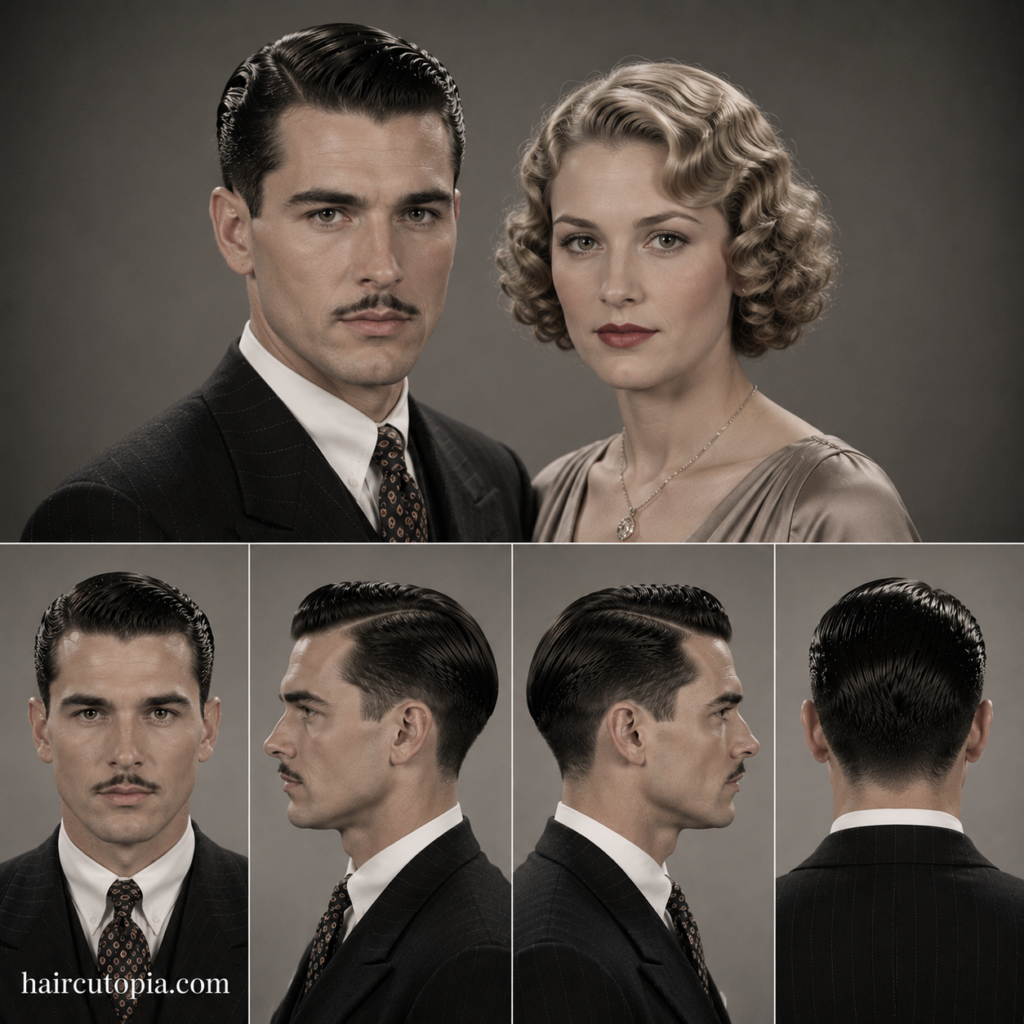
There wasn’t one universal length.
The sides could be cut relatively close while still maintaining enough hair to comb and blend smoothly into the top.
The important feature was the transition.
Rather than making the sides the main attraction, the haircut used them to create a clean foundation for the styled top.
The neckline was also kept tidy.
Depending on the haircut, the back might gradually taper toward the neck rather than ending in an aggressively sharp modern outline.
How Long Was Men’s Hair on Top?
The top needed enough length to respond to a comb.
That’s an important part of recreating the style.
If the top is cut extremely short, it becomes difficult to achieve the sweeping side parts and slicked-back shapes associated with the decade.
Depending on hair texture and the desired style, several inches could provide enough flexibility to:
- Establish a side part
- Sweep the front backward
- Create visible waves
- Comb the hair across
- Slick the top close to the head
The exact length mattered less than whether the hair could hold the intended shape.
The Importance of the Side Part
The side part did more than divide the hair.
It created the architecture of the hairstyle.
Once the part was established, the top could be directed across and slightly backward while the opposite side remained controlled.
This immediately produced an orderly appearance.
The placement could vary depending on the natural growth pattern and facial features.
Some men wore a strong, visible part. Others used a softer division that blended naturally into the hairstyle.
Either way, the side part became one of the defining visual elements of men’s grooming during the period.
1930s Hair Products for Men
The sleek appearance of men’s hair often depended on grooming products.
Dry, fluffy texture wasn’t usually the goal.
Products helped add:
- Hold
- Direction
- Control
- Smoothness
- Shine
Common categories included pomades, brilliantine, hair oils, and tonics.
Pomade
Pomade helped keep longer top hair in place.
It worked particularly well for side parts and slick-backs because the product allowed the hair to remain smooth and controlled.
Brilliantine
Brilliantine was associated with adding gloss and helping hair look neatly groomed.
The shiny finish complemented the polished aesthetic of the period.
Hair Tonics
Hair tonics formed another part of men’s grooming routines.
Depending on the product, they could be used as part of scalp and hair care while helping the hair feel groomed.
Hair Oils
Oils could contribute additional smoothness and shine.
As with modern products, the amount used mattered. The goal was controlled hair, not necessarily hair overwhelmed with product.
Why Was 1930s Men’s Hair So Shiny?
Look at vintage photographs and one feature often stands out: men’s hair can appear much shinier than contemporary styles.
That was intentional.
Modern men’s styling has spent long periods favoring matte clay, dry texture, and deliberately natural finishes.
The 1930s aesthetic valued polish.
Grooming products smoothed the surface and reflected light, helping the hair appear carefully maintained.
Shine also made comb lines and the direction of the hairstyle more visible.
For a modern 1930s-inspired style, you don’t need an extremely wet finish. A medium-shine pomade can capture the idea while remaining wearable.
Hollywood’s Influence on 1930s Men’s Hair
Movies gave men’s grooming an enormous visual platform.
Audiences repeatedly saw actors presented as sophisticated, confident, and impeccably groomed leading men.
Clark Gable became one of the era’s defining male stars. His neatly styled hair and polished appearance helped embody the classic Hollywood leading-man image.
Cary Grant became another enduring reference for elegant men’s grooming, particularly neatly controlled hair with a strong sense of direction.
Fred Astaire was also closely associated with the sophisticated formal style of the period.
Gary Cooper represented another version of the clean-cut masculine appearance seen on screen.
Hollywood didn’t mean every man copied a particular actor’s haircut exactly.
Its larger influence was aspirational. Film helped reinforce the idea that polished hair was part of a complete, well-dressed appearance.
Everyday Men’s Hair vs. Hollywood Hair
There’s an important difference between a studio publicity portrait and an ordinary morning grooming routine.
Hollywood actors had access to professional styling, carefully controlled lighting, and people whose job was to make them camera-ready.
Everyday men needed practical haircuts.
A traditional short-back-and-sides or tapered cut could be maintained relatively easily and styled with a comb and product.
That might mean nothing more complicated than:
- Dampen the hair.
- Apply a small amount of grooming product.
- Establish the part.
- Comb the top into position.
- Smooth the sides.
The result wouldn’t necessarily look like a movie publicity photograph, but it followed the same basic grooming principles.
How the Great Depression Influenced Men’s Grooming
The 1930s were shaped by the Great Depression, and everyday grooming existed within that economic reality.
Practicality mattered.
A straightforward haircut that could be maintained and styled repeatedly made sense.
Men didn’t need a complicated cut to look presentable. Shorter sides, a manageable top, a comb, and a grooming product could create a polished appearance.
This simplicity is part of what makes the era’s men’s hair so enduring.
The underlying haircuts weren’t dependent on elaborate techniques.
1930s Men’s Hair and Facial Hair
When people imagine 1930s men’s style, they sometimes picture a thin mustache along with slicked hair.
There’s some basis for that image, particularly because Hollywood stars helped make carefully maintained mustaches recognizable.
Clark Gable’s mustache became an especially famous part of his appearance.
Still, clean-shaven faces were also common.
Facial hair styles that fit the polished aesthetic tended to be carefully maintained rather than large or intentionally rugged.
The overall grooming philosophy remained consistent: precision mattered.
Straight Hair in the 1930s
Straight hair was naturally suited to the slick and side-parted styles fashionable during the decade.
A comb and styling product could establish a strong direction without needing to reshape the natural texture significantly.
Straight hair worked particularly well for:
- Slick side parts
- Slick-backs
- Side sweeps
- Neatly combed short styles
A traditional taper kept the overall silhouette balanced.
Wavy Hair in the 1930s
Wavy hair added natural movement.
Instead of removing the texture, men could use a side part to organize it.
The waves then followed the overall direction of the style.
This produced some of the most visually interesting men’s looks of the period.
For a modern interpretation, wavy hair can often use considerably less product while still capturing the vintage shape.
Curly and Coily Hair in the 1930s
The popular historical imagery most often reproduced today doesn’t represent the full range of men’s hair textures or experiences during the 1930s.
For modern vintage-inspired styling, curly and coily hair doesn’t need to be forced into the exact texture shown in a Hollywood publicity photograph.
The period can instead be referenced through:
- Clean outlines
- Intentional parts where appropriate
- Controlled silhouettes
- Shorter sides with more length above
- Sculpted natural texture
- Polished finishing
The goal can be to borrow the decade’s sense of shape and grooming while working with the natural characteristics of the hair.
Early 1930s Men’s Hair
Men’s hair changed less dramatically throughout the decade than women’s hair.
During the early 1930s, short sides and neatly combed top hair were already well established.
Common features included:
- Side parts
- Slick styling
- Traditional tapers
- Controlled waves
- Short backs and sides
The polished appearance associated with the decade was already clearly visible.
Mid-1930s Men’s Hair
By the middle of the decade, the same basic grooming principles remained strong.
Hollywood continued reinforcing the appeal of sophisticated, neatly styled hair.
Men could vary the top through:
- Stronger side sweeps
- Slick-backs
- Natural waves
- Defined parts
Rather than radical haircut changes, the differences often came from styling.
Late 1930s Men’s Hair
By the end of the decade, men’s hair remained relatively conservative compared with the rapidly evolving women’s styles.
Traditional tapers and longer tops continued to dominate.
These haircuts would transition naturally into the 1940s, when wartime practicality would further influence men’s grooming.
1920s vs. 1930s Men’s Hair
The difference between men’s hair in these decades is less dramatic than the change in women’s fashion.
Both periods favored relatively short, groomed hair.
During the 1930s, however, the polished Hollywood side-part and slick-back aesthetic became particularly recognizable.
Men’s hair commonly emphasized:
- Clear direction
- Smooth surfaces
- Moderate top length
- Traditional tapering
- Visible shine
The look felt refined rather than experimental.
1930s vs. 1940s Men’s Hair
Men’s hair moved fairly smoothly from the late 1930s into the early 1940s.
Short sides and longer top hair remained practical and fashionable.
The 1940s brought wartime influences that encouraged straightforward grooming, particularly for men in military service.
Civilian styles still included side parts, waves, and slicked-back hair.
This continuity is one reason identifying an exact year from a man’s haircut alone can be difficult.
How to Ask Your Barber for a 1930s Men’s Haircut
Start with the underlying haircut rather than the styling product.
Tell your barber you want a classic tapered shape with enough length on top for traditional styling.
A useful request might include:
- Keep enough length on top for a side part or slick-back.
- Taper the sides and back gradually.
- Avoid an extremely high or disconnected fade.
- Maintain some weight around the upper sides.
- Keep the neckline clean and traditional.
- Adapt the length to your natural texture.
Reference photos are especially helpful.
“1930s haircut” can mean several different things, so showing the exact silhouette you want removes ambiguity.
How to Style 1930s Men’s Hair Today
You don’t need vintage grooming products to recreate the look.
Start with slightly damp hair.
For a Classic Side Part
- Apply a small amount of pomade or styling cream.
- Find your natural part.
- Comb the heavier section across and slightly backward.
- Smooth the opposite side into place.
- Refine the front until the shape looks balanced.
For a stronger vintage finish, use a product with noticeable shine.
For a modern version, choose something lighter.
For a Slick-Back
Work the product through the top and comb the hair backward from the forehead.
Avoid creating excessive height.
The traditional look generally follows the head more closely than a large modern pompadour.
For Wavy Hair
Use the comb to establish the overall direction without trying to flatten every wave.
Allowing some natural movement often produces a more interesting result.
How to Modernize 1930s Men’s Hair
The underlying cuts are already highly wearable.
Most modernizing happens through the finish.
Try:
- Using less product
- Choosing low or medium shine
- Preserving natural texture
- Loosening the side part
- Using fingers after initially combing the hair
- Keeping the taper natural rather than extremely tight
A modern side part doesn’t need to look perfectly sculpted.
Likewise, a slick-back can retain some texture rather than appearing completely flat.
These small changes preserve the 1930s influence without making the style look like a historical costume.
Which 1930s Men’s Haircut Is Best for You?
The best choice depends on your texture, length, and preferred amount of styling.
Choose a Classic Side Part If:
You want a versatile haircut that works equally well with casual and formal clothing.
Choose a Slick-Back If:
You prefer hair away from your forehead and don’t mind using styling product.
Choose a Wavy Side Part If:
You have natural movement and want to preserve it.
Choose a Short Back and Sides If:
You want a straightforward, low-complexity haircut that can still be styled several ways.
Choose a Traditional Taper If:
You want the most adaptable foundation.
A taper can support nearly every major men’s hairstyle associated with the decade.
Are 1930s Men’s Hairstyles Still Popular?
Very much so.
They just aren’t always described as 1930s hairstyles.
Traditional tapers remain standard barbershop cuts.
Side parts continue to move in and out of peak fashion.
Slick-backs remain popular for both everyday and formal styling.
Natural wavy side parts are also common.
What has changed most is the product.
Modern men have access to matte clays, creams, fibers, gels, water-based pomades, texture sprays, and numerous other options.
That makes it possible to keep the historical shape while completely changing the finish.
Frequently Asked Questions About 1930s Men’s Hair
What was the most popular men’s hairstyle in the 1930s?
The side part was one of the most common and recognizable styles.
It typically combined shorter, tapered sides with longer top hair that was neatly combed across.
How did men wear their hair in the 1930s?
Men commonly wore short sides and backs with longer hair on top.
The top could be side-parted, slicked backward, swept across, or styled around natural waves.
Did men have long hair in the 1930s?
Long hair in the modern sense wasn’t a defining mainstream men’s trend.
However, the top could be several inches long to provide enough hair for side parts, waves, and slicked-back styling.
Did men have fades in the 1930s?
Men wore tapered haircuts with progressively shorter sides and backs.
For a historically inspired look today, a gradual taper is generally a better reference than an extremely high-contrast modern skin fade.
What did men put in their hair in the 1930s?
Pomades, brilliantine, hair oils, and tonics were among the grooming products associated with men’s hair care and styling.
These products helped provide control, smoothness, and shine.
Why did men slick their hair back?
Slicking the hair created the neat, controlled appearance fashionable during the period.
It also worked naturally with longer top hair and the grooming products available at the time.
Did men use pomade in the 1930s?
Yes, pomade was one option for creating controlled, glossy hairstyles.
Other grooming products could also provide shine and manageability.
Did men wear side parts in the 1930s?
Yes.
The side part was one of the defining features of men’s hair during the decade and appeared in both everyday and formal styles.
What haircut should I ask for to get 1930s hair?
Ask for a traditional taper with enough length on top to establish a side part or slick the hair backward.
Avoid an extreme modern fade if historical accuracy is important.
Can you wear a 1930s men’s haircut without looking vintage?
Absolutely.
Keep the traditional taper but use less product, preserve natural texture, and choose a softer side part.
The underlying haircut works perfectly well as a contemporary style.
Why 1930s Men’s Hair Still Works Today
There’s a reason 1930s men’s hair keeps resurfacing.
The basic formula is incredibly practical.
Keep the sides and back neat. Leave enough length on top to style. Give the hair a clear direction. Adjust the product and finish to suit the occasion.
That formula worked in the 1930s, and it still works now.
Hollywood stars helped make slick side parts and perfectly combed hair symbols of sophistication, but the underlying cuts were often straightforward. Traditional tapers and short-back-and-sides shapes gave men flexible foundations that could be styled in several ways.
Modern products have made those cuts even more adaptable.
A glossy pomade can create an unmistakably vintage finish. A light cream can turn the same haircut into a relaxed contemporary side part.
That’s the lasting appeal of 1930s men’s hair.
Nearly a century later, the details may have changed, but the fundamental combination of clean tapering, manageable length, and intentional styling remains one of the most reliable approaches to men’s hair.