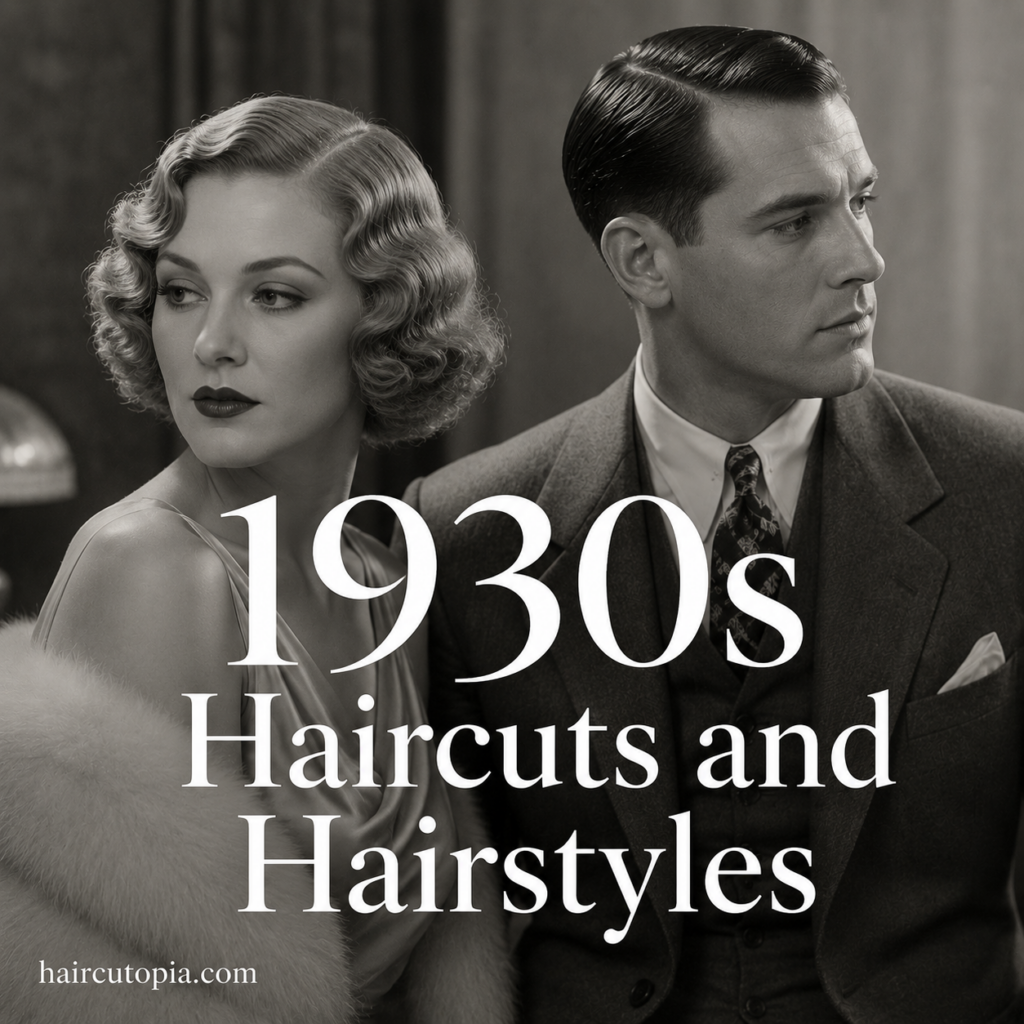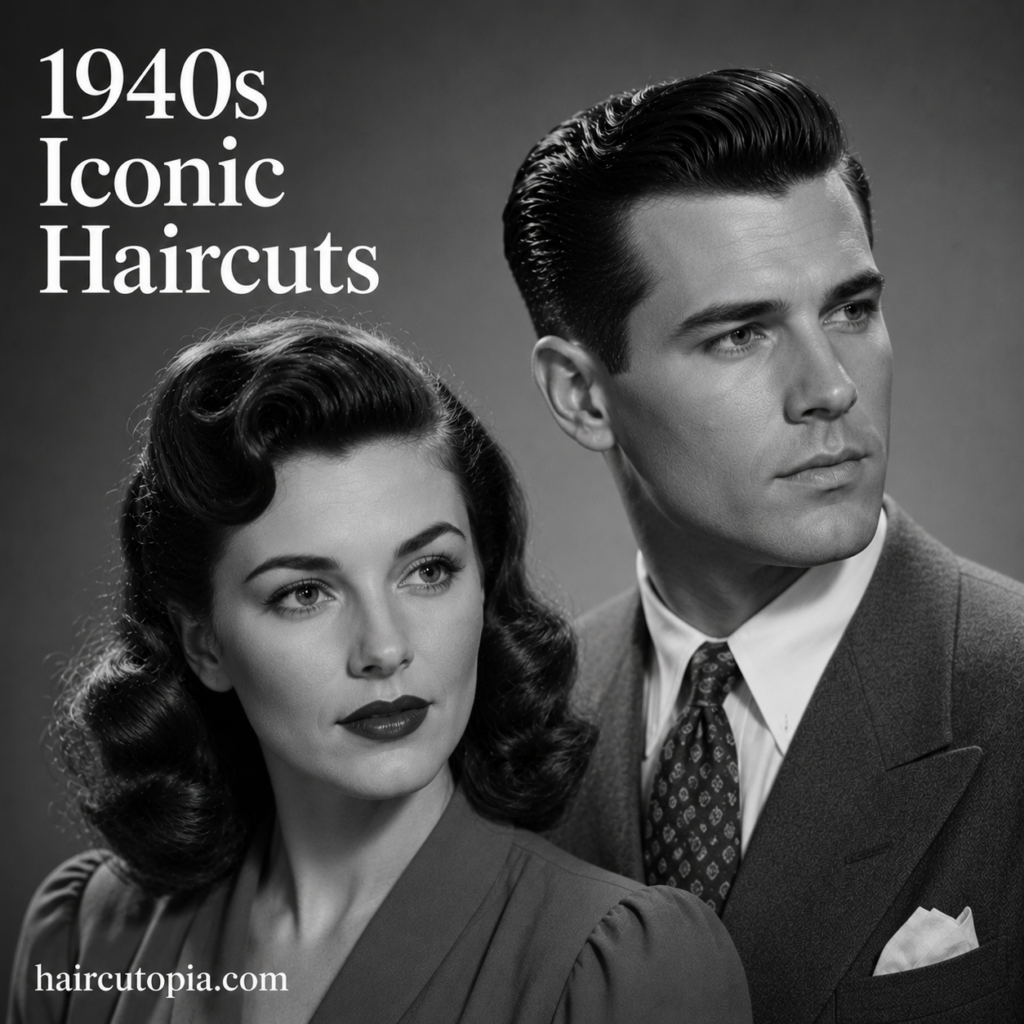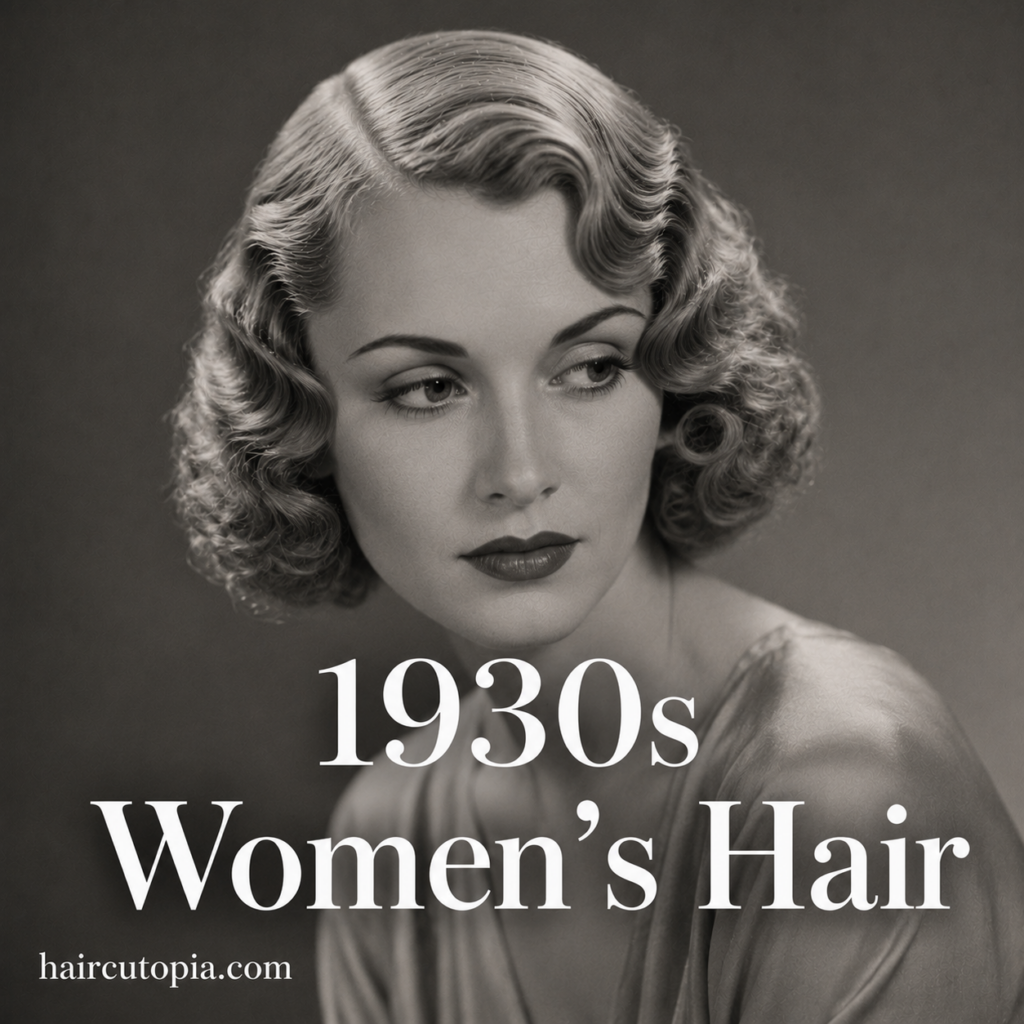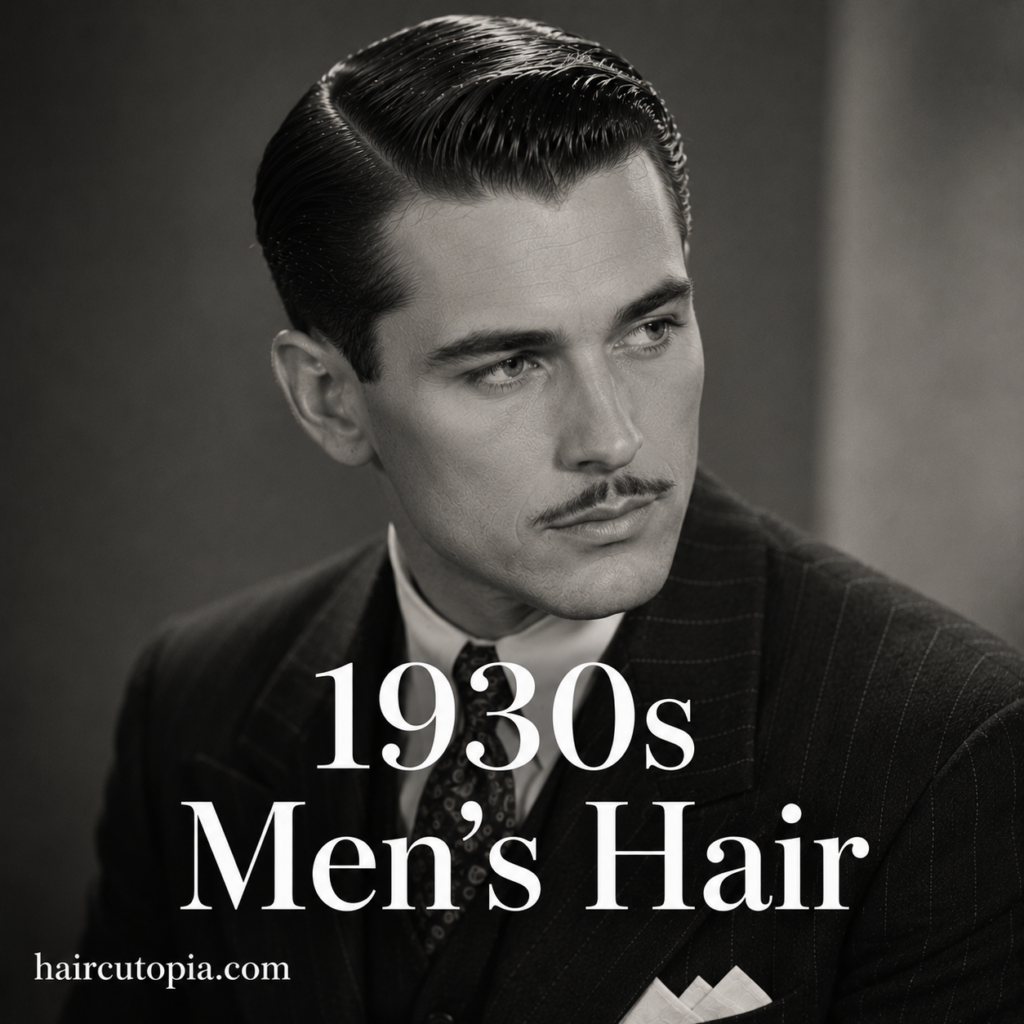
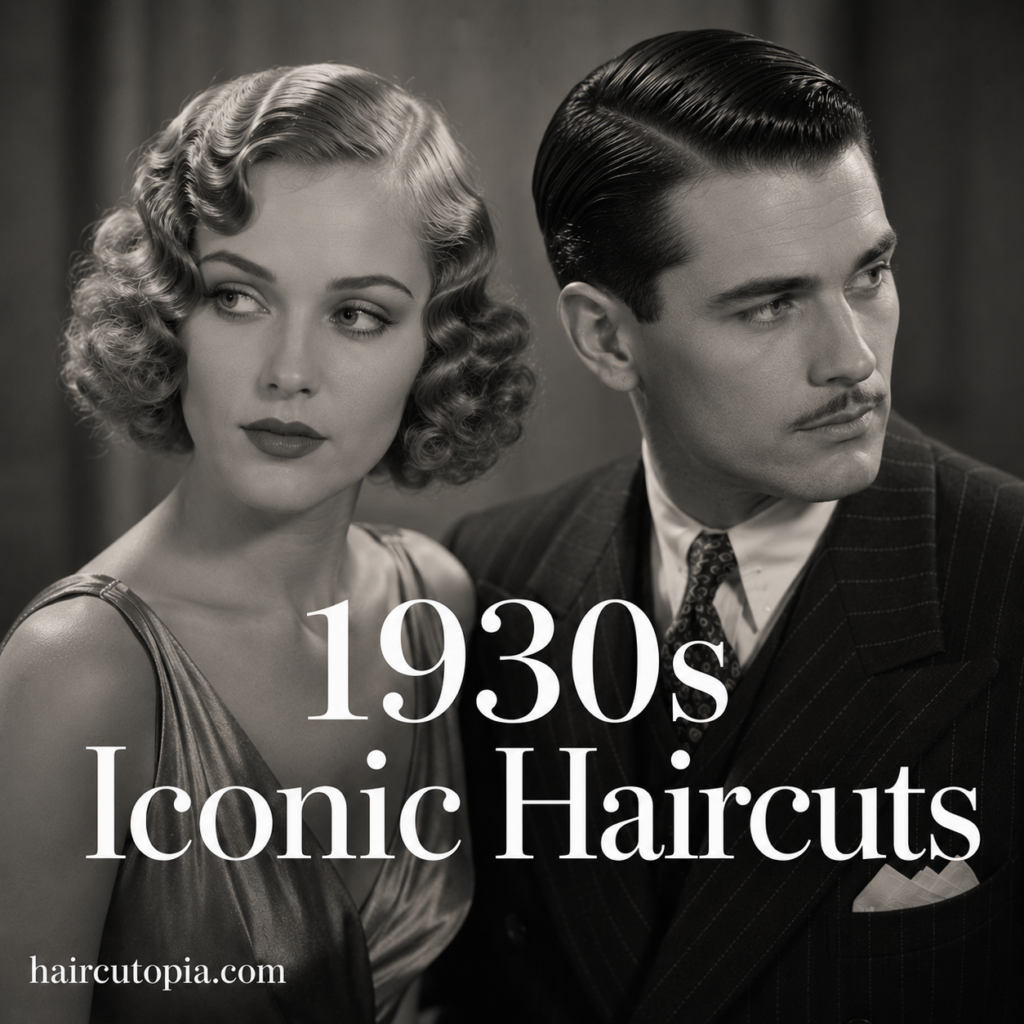
The 1930s gave us some of the most recognizable hair looks in vintage style. Sculpted bobs framed the face with polished waves, longer cuts began replacing the extremely short shapes of the previous decade, and men’s hair settled into a clean formula of tapered sides with enough length on top for a sharp side part or slicked-back finish.
What makes the decade especially interesting is that it sits between two very different eras.
The 1920s had made dramatically short women’s hair fashionable. By the 1940s, longer curls, rolls, and fuller silhouettes would take center stage. The 1930s connected the two, gradually transforming short geometric cuts into softer, longer shapes.
Men’s hair evolved more subtly. Neat tapers, side parts, and combed-back cuts became standards that still look familiar almost a century later.
Some 1930s haircuts were fashionable for only part of the decade. Others proved remarkably durable.
These are the iconic 1930s haircuts that best capture the era.
What Made a Haircut Iconic in the 1930s?
The most recognizable haircuts of the decade weren’t defined by length alone.
Shape mattered.
A good cut provided the foundation for the waves, curls, parts, and polished finishes that dominated 1930s hair.
For women, that often meant enough structure to create a controlled silhouette while leaving room for finger waves or curls.
For men, it usually meant shorter sides and back with noticeably more length through the top.
Some of the defining features included:
- Jaw- to nape-length bobs
- Soft, rounded perimeters
- Longer grown-out bobs
- Short sculpted crops early in the decade
- Increasing length toward the shoulders
- Smooth shapes that worked with waves
- Short tapered sides for men
- Longer top sections
- Defined side parts
- Clean necklines
- Scissor-cut transitions
- Controlled, polished styling
It’s also useful to separate the haircut from the hairstyle.
Finger waves, for example, are a styling technique rather than a haircut. A bob is the underlying cut; finger waves can then be used to transform it.
That distinction helps explain why the same basic haircut could produce several iconic 1930s looks.
1. The Waved Bob
The waved bob is one of the defining women’s cuts of the early 1930s.
Bobs had already revolutionized women’s fashion during the 1920s, but they didn’t simply vanish when the decade ended.
Instead, they evolved.
The 1930s bob generally moved toward a softer appearance. Rather than emphasizing a severe, perfectly straight perimeter, the cut could be styled into smooth waves with curls around the ends.
Typical characteristics included:
- Jaw or slightly longer length
- A soft perimeter
- Enough length for waves
- A close-fitting overall silhouette
- Curved or curled ends
The cut was versatile because changing the wave pattern could dramatically change its appearance.
A deep side part and sculpted waves made it glamorous. Softer curls gave the same basic cut a more romantic finish.
2. The Finger-Wave Bob
Although finger waving describes the styling rather than the cutting technique, the finger-wave bob deserves recognition because the combination became so visually distinctive.
Short hair provided an excellent canvas for sculpted S-shaped waves.
The bob’s length allowed the wave pattern to follow the head without being overwhelmed by excess hair.
The ends could then transition into small curls around the ears or nape.
This combination is one of the quickest visual references for early-1930s glamour.
A typical finger-wave bob featured:
- Short to nape-length hair
- A deep side part
- Smooth sides
- Sculpted waves
- Small curls near the bottom
Modern versions can preserve the same basic haircut while using looser waves for a less theatrical finish.
3. The Soft Curly Bob
Not every iconic 1930s bob relied on tightly sculpted waves.
The curly bob offered a softer alternative.
The crown could remain relatively smooth while curls became more prominent around the ears, jaw, and nape.
That placement created width through the lower part of the haircut without making the entire style excessively voluminous.
Compared with many 1920s bobs, the overall effect was less geometric and more romantic.
The curly bob also illustrates the broader direction of the decade: hair was gradually moving away from severe short shapes toward softer silhouettes.
4. The Side-Parted Bob
A deep side part could completely transform a simple bob.
Instead of dividing the hair evenly, the part shifted toward one side. The heavier section then swept across the forehead before flowing into waves or curls.
This created asymmetry and made the haircut appear more dramatic.
Side-parted bobs were especially effective because the basic cut remained simple.
The styling did much of the visual work.
That made the haircut adaptable for everyday wear as well as more polished occasions.
5. The Nape-Length Bob
As the decade progressed, the bob started growing.
The nape-length bob became an important transitional haircut because it sat between the short cuts of the 1920s and the longer styles that would dominate later.
Hair extended below the jaw and toward the back of the neck.
That additional length created more room for:
- Waves
- Pin curls
- Curled ends
- Fuller sides
- Softer movement
The result retained the recognizable structure of a bob while feeling noticeably less severe.
For anyone looking for a wearable modern interpretation of 1930s hair, this is one of the easiest cuts to adapt.
6. The Grown-Out Bob
Sometimes an iconic haircut develops simply because people stop cutting an older style so short.
The grown-out bob became increasingly relevant during the 1930s as women allowed previously short hair to gain length.
Instead of immediately reshaping the hair into an entirely different cut, the extra length could be incorporated into waves and curls.
This produced a softer silhouette around the neck.
The grown-out bob matters historically because it illustrates the transition taking place throughout the decade.
Women’s hair wasn’t suddenly long again. It got there gradually.
7. The Eton Crop
The Eton crop reached its strongest fashion moment during the 1920s, but very short cuts continued to influence the early 1930s.
This was a dramatically short haircut.
The ears and neckline were exposed, and the hair sat close to the head.
Small waves could be added around the forehead or temples to soften the appearance.
Typical characteristics included:
- Very short length
- Exposed ears
- A clean neckline
- Close-fitting styling
- Sculpted details around the hairline
As the 1930s progressed, such severe crops became less representative of mainstream women’s fashion as longer, softer hair gained popularity.
Still, the cut belongs in the story of early-1930s hair because fashion transitions rarely happen on January 1 of a new decade.
8. The Shingle-Inspired Cut
Like the Eton crop, the shingle is more strongly identified with the 1920s, but its influence carried into the early years of the following decade.
A shingle-style cut typically featured short hair at the nape with more length toward the sides and top.
The result could be carefully shaped to follow the head.
By the 1930s, softer styling helped reduce some of the severe geometry associated with earlier versions.
Waves and curls made these short cuts feel more consistent with the evolving aesthetic of the decade.
9. The Pageboy-Inspired Cut
As women’s hair became longer, smooth rounded cuts gained importance.
Pageboy-inspired shapes offered a controlled silhouette without requiring extremely short hair.
The hair could fall toward the nape or shoulders, with the ends curving inward.
Compared with a heavily finger-waved bob, the visual emphasis shifted toward the overall outline of the cut.
Typical characteristics included:
- Medium length
- Smooth surface
- Rounded perimeter
- Curved-under ends
- Controlled volume
The pageboy would become even more recognizable in later fashion eras, but the movement toward longer, rounded cuts was already underway during the 1930s.
10. The Shoulder-Length Cut
One of the biggest haircut developments of the late 1930s wasn’t an unusual new shape.
It was length.
Shoulder-length hair became increasingly visible as women continued moving away from the dramatically short cuts that had defined the previous decade.
The extra length made larger waves and curls possible.
Instead of keeping all movement close to the head, hair could flow around the neck and shoulders.
This cut provided a foundation for many styles that would become even more prominent during the 1940s.
11. The Soft Medium-Length Cut
Between the bob and shoulder-length hair was another important category: the medium-length cut.
Hair might fall somewhere around the neck or just above the shoulders.
That length was especially versatile.
It could be:
- Waved
- Curled
- Side-parted
- Brushed smooth
- Turned under
- Set into larger curls
Because styling was so important during the decade, a flexible medium-length cut could support numerous looks without requiring a dramatic haircut change.
12. The Curled-Under Medium Cut
A smooth medium-length cut with turned-under ends became another polished option.
Rather than filling the entire hairstyle with curls, movement was concentrated near the bottom.
The crown remained smooth while the ends curved inward toward the neck.
This produced a rounded silhouette and emphasized the growing length of women’s hair.
It also created a cleaner alternative to heavily waved styles.
13. The Classic Men’s Taper
For men, few haircuts are as representative of the 1930s as the classic taper.
The basic idea remains familiar today.
Hair gradually became shorter as it moved down the sides and back, while more length remained on top.
The transition was generally smooth rather than dramatically disconnected.
A traditional 1930s-inspired taper might include:
- Short sides
- A tapered back
- A clean neckline
- Longer hair on top
- Enough length for a side part
- A gradual transition between lengths
The haircut’s simplicity is one reason it has aged so well.
It can still be requested in a barbershop today without looking like a costume.
14. The Side-Part Taper
Combine a traditional taper with longer top hair and you get one of the most iconic men’s cuts of the decade.
The side-part taper allowed the hair to be divided clearly and combed into place.
Styling product helped maintain the shape and created the polished finish fashionable at the time.
The cut itself provided the necessary structure.
Shorter sides kept everything neat, while the longer top allowed enough movement to create a strong sweep.
This basic formula became a men’s grooming standard that lasted far beyond the 1930s.
15. The Slick-Back Taper
Men who preferred to comb their hair away from the forehead could use essentially the same tapered foundation.
Instead of directing the top toward one side, the hair was swept backward.
Enough length needed to remain through the front and top for the hair to stay in position.
Pomade or another grooming product provided hold.
Traditional versions generally looked smoother and less disconnected than many contemporary slick-back haircuts.
A modern skin fade beneath a long slicked top creates a much stronger contrast than the gradual taper typical of the period.
16. The Side-Swept Taper
The side-swept taper provided more movement than an extremely precise side part.
Hair could travel diagonally across the head rather than lying completely flat.
This worked particularly well for men with slightly longer top hair.
Natural texture could remain visible as long as the overall shape looked controlled.
The result was polished without appearing excessively rigid.
17. The Wavy Taper
Men with naturally wavy hair didn’t necessarily need to eliminate their texture.
A traditional taper could be combined with a side part while allowing the top to retain visible waves.
The part provided structure.
The wave provided character.
This variation is particularly easy to modernize because contemporary men’s styling often favors visible natural texture.
Using less product creates a softer interpretation while preserving the underlying 1930s shape.
18. The Short Back and Sides
A straightforward short-back-and-sides haircut was practical and versatile.
The sides and back remained neat while the top retained enough length to comb.
It wasn’t necessarily as glamorous as a Hollywood leading man’s perfectly styled hair, but it fit the broader grooming standards of the era.
The haircut could be worn with:
- A subtle side part
- A stronger side sweep
- A slicked top
- Natural waves
- A simple combed finish
For everyday life, straightforward cuts like this were highly practical.
What Made Women’s 1930s Haircuts Different From 1920s Cuts?
The difference wasn’t simply short versus long.
Many women still had short hair during the early 1930s.
The bigger change involved shape and styling.
1920s Cuts Often Emphasized
- Very short lengths
- Strong geometric outlines
- Exposed necklines
- Shingles and crops
- Sharp bob shapes
- Compact silhouettes
The haircut itself could make a dramatic statement.
1930s Cuts Gradually Emphasized
- Additional length
- Softer perimeters
- More room for curls
- Longer bobs
- Nape-length shapes
- Medium-length cuts
- Shoulder-grazing hair
Rather than abandoning the bob, women gradually transformed it.
That’s why early-1930s and late-1930s hair can look surprisingly different.
Early 1930s Iconic Haircuts
At the beginning of the decade, short cuts remained highly visible.
The strongest influences included:
- Short waved bobs
- Finger-wave bobs
- Eton-inspired crops
- Shingle-influenced cuts
- Side-parted bobs
- Nape-length styles
Hair generally remained relatively close to the head.
Styling provided softness through waves and small curls.
Mid-1930s Iconic Haircuts
By the middle of the decade, growing length was changing the silhouette.
Women increasingly wore:
- Longer bobs
- Grown-out bobs
- Nape-length cuts
- Soft medium-length shapes
- Curled-under cuts
These lengths gave stylists more room for larger curls and waves.
Men’s cuts remained more consistent, with tapers and short-back-and-sides styles continuing to dominate.
Late 1930s Iconic Haircuts
Late-decade women’s cuts clearly pointed toward the 1940s.
Hair increasingly reached the shoulders.
The most characteristic shapes included:
- Shoulder-length cuts
- Medium-length rounded cuts
- Longer waved shapes
- Softly layered-looking silhouettes created through styling
- Cuts designed to support larger curls
Volume also increased.
The tightly controlled silhouette of the early decade was gradually being replaced by something fuller and more flowing.
Hollywood and the Iconic 1930s Haircut
Hollywood helped turn certain hair silhouettes into lasting cultural images.
Audiences could study the appearance of movie stars through films, publicity portraits, advertisements, and fan magazines.
Jean Harlow became famous for her platinum-blonde image and short-to-medium glamorous waves.
Marlene Dietrich represented a sophisticated version of 1930s glamour, frequently appearing with sculpted, side-parted hair.
Greta Garbo was another influential figure whose softly waved styles reflected the changing silhouettes of the period.
Men’s hair was similarly shaped by the image of Hollywood leading men.
Clark Gable became an enduring reference for polished men’s grooming, while Cary Grant helped cement the appeal of neatly controlled, side-parted hair.
These stars didn’t necessarily invent the cuts they wore. Their visibility helped make certain silhouettes memorable.
How the Great Depression Influenced Haircuts
The glamorous image of 1930s Hollywood existed alongside the difficult economic realities of the Great Depression.
That matters when considering everyday hair.
A versatile haircut offered practical advantages.
Rather than changing the cut constantly, women could change its appearance through styling.
A bob or medium-length cut might be transformed with:
- Finger waves
- Pin curls
- A different part
- Curled ends
- Brushed waves
- Different curl placement
Growing a short haircut longer could also create a new silhouette without requiring an entirely new style.
Men’s cuts were similarly practical.
A traditional taper or short-back-and-sides cut could be maintained and styled in several ways with a comb and grooming product.
The Difference Between a 1930s Haircut and Hairstyle
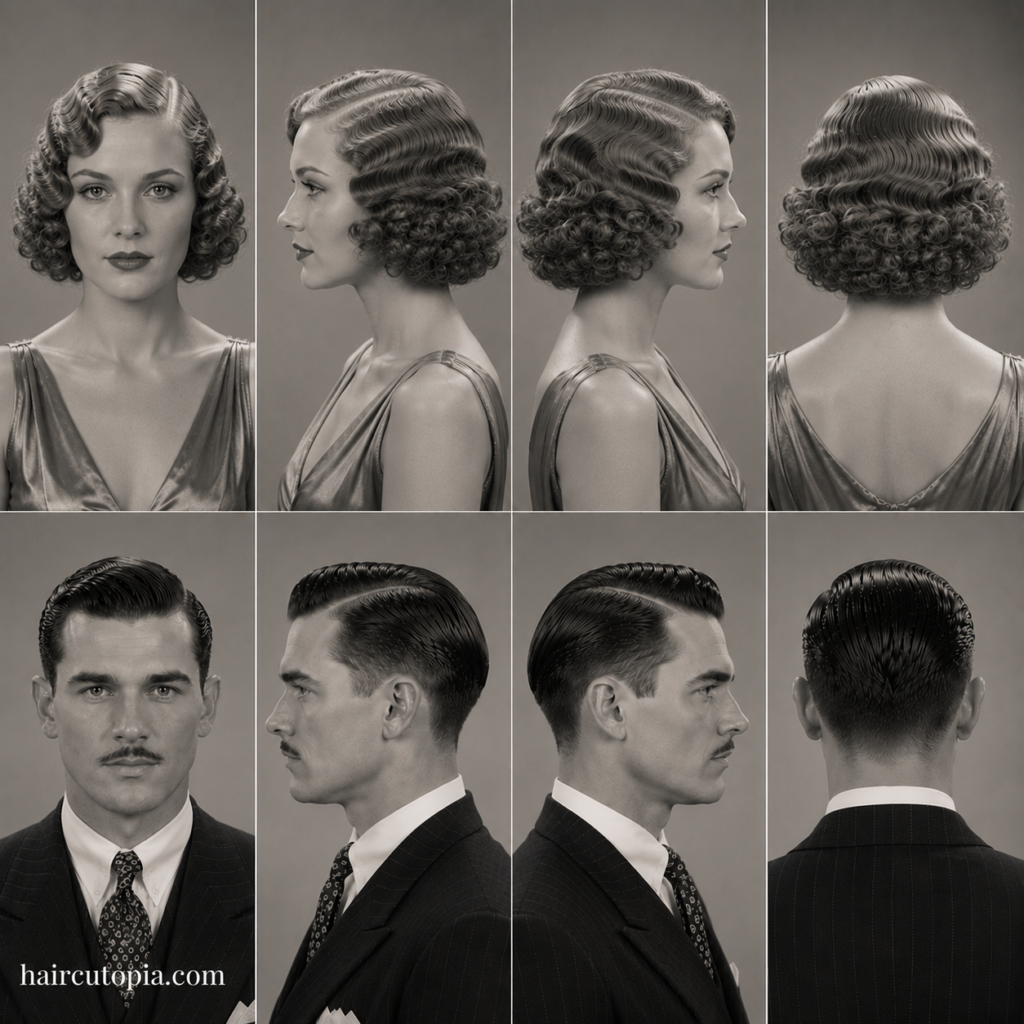
These terms are often used interchangeably, but they’re not quite the same.
A haircut describes the underlying structure.
That includes:
- Length
- Perimeter
- Taper
- Weight
- Overall shape
A hairstyle describes what happens after the cut.
That includes:
- Finger waves
- Pin curls
- Side parts
- Slicking
- Brushing
- Curl placement
For example, a woman might have a nape-length bob haircut and wear it in finger waves one day and softer brushed curls another.
A man might have a classic tapered haircut and style it with a side part, side sweep, or slick-back.
This distinction is especially useful when recreating historical hair because many iconic photographs show elaborate styling on top of relatively straightforward cuts.
How to Ask for a 1930s-Inspired Women’s Haircut Today
Start by deciding which part of the decade you’re referencing.
For an early-1930s look, consider a jaw- or nape-length bob.
Tell your stylist you want enough length and weight to create structured waves rather than an extremely layered modern shape.
For a later-1930s interpretation, consider a medium or shoulder-length cut that can support larger curls and brushed waves.
Bring reference photos whenever possible.
Useful details to discuss include:
- Where you want the perimeter to fall.
- Whether you’ll actually style the hair in waves.
- How much natural texture you want to preserve.
- Whether you prefer an authentic or modernized finish.
- How often you’re willing to maintain the cut.
A stylist can then adapt the historical silhouette to your hair density and texture.
How to Ask for a 1930s-Inspired Men’s Haircut
For a classic men’s version, focus on the taper rather than requesting a modern fade automatically.
Ask for shorter sides and back with a gradual transition into longer top hair.
Leave enough length on top to establish a strong direction.
If you want a side part, explain whether you prefer it subtle or sharply defined.
For a period-inspired result, consider:
- A traditional scissor taper
- Moderate length on top
- A clean neckline
- Natural weight through the sides
- Enough front length for combing
- No extreme disconnection
Styling can then determine whether the finished look feels authentically vintage or contemporary.
How to Modernize an Iconic 1930s Haircut
You don’t need to reproduce every historical detail.
The easiest approach is to preserve the haircut’s silhouette while relaxing the styling.
A modern waved bob might use loose texture instead of tightly sculpted finger waves.
A shoulder-length cut could incorporate soft Hollywood waves without a heavily lacquered finish.
A men’s taper could retain natural texture and use a low-shine product.
Try combining historical structure with modern finishing:
- Keep the bob but loosen the waves.
- Keep the side part but reduce the shine.
- Keep the taper but allow natural texture.
- Keep the medium length but use softer curls.
- Keep the slick-back shape but avoid excessive product.
That usually produces a recognizable vintage influence without making the haircut feel like part of a costume.
Which 1930s Haircuts Are Still Popular Today?
Several have survived remarkably well.
The Bob
The bob remains one of the most important women’s and gender-neutral haircut shapes in modern hairdressing.
Lengths and techniques change, but the basic concept continues to return.
The Medium-Length Cut
Medium hair remains popular partly because of its versatility.
It can be straight, curled, waved, layered, or styled formally without the commitment of very long hair.
The Shoulder-Length Cut
Shoulder-grazing hair is still one of the most wearable lengths.
Modern versions may use more layers and texture, but the overall silhouette would have been recognizable by the late 1930s.
The Classic Taper
Traditional men’s tapering never really disappeared.
Modern barbers have expanded the concept dramatically, but the gradual short-to-long transition remains fundamental.
The Side-Part Cut
Side-parted men’s hair has moved in and out of peak fashion without ever becoming truly obsolete.
It remains one of the clearest examples of an iconic historical haircut that still looks completely normal today.
1930s Haircuts vs. 1940s Haircuts
The transition into the 1940s continued many developments already underway.
Women’s hair became increasingly suited to:
- Larger curls
- Rolls
- Fuller sides
- Structured front sections
- Shoulder-length arrangements
Victory rolls and other recognizable 1940s styles depended on the additional length that had already become fashionable during the later 1930s.
Men’s haircuts changed less dramatically.
Shorter sides with longer, combable top hair continued to provide a practical foundation.
Frequently Asked Questions About 1930s Iconic Haircuts
What was the most iconic haircut of the 1930s?
For women, the waved bob is one of the strongest candidates because it captures the transition from the short bob craze of the 1920s into the softer aesthetic of the 1930s.
For men, the classic side-part taper is one of the decade’s most enduring cuts.
What haircut did women have in the 1930s?
Women wore a range of lengths, including short bobs, nape-length bobs, grown-out bobs, medium-length cuts, and increasingly shoulder-length hair toward the end of the decade.
Did women still have bobs in the 1930s?
Yes.
Bobs remained important, particularly during the early and middle parts of the decade.
They generally became softer and gradually longer as fashion changed.
What haircut did men have in the 1930s?
Many men’s cuts featured shorter, tapered sides and back with additional length on top.
The longer hair could then be side-parted, swept across, or slicked backward.
Did men have fades in the 1930s?
Hair was certainly tapered from shorter lengths into longer ones, but the dramatic high-contrast skin fades common in contemporary barbering aren’t the best default reference for a classic 1930s look.
A gradual traditional taper is generally more representative.
Were 1930s haircuts short?
Many early-1930s women’s cuts were short, but fashionable hair became progressively longer throughout the decade.
Men generally kept the sides and back short while retaining more length on top.
Is a finger wave a haircut?
No.
Finger waving is a styling technique.
It can be applied to different short and medium-length cuts, although bobs provide one of the most recognizable foundations.
What is the difference between a 1920s bob and a 1930s bob?
The distinction isn’t absolute, but 1920s bobs are often associated with shorter, sharper, more geometric shapes.
During the 1930s, bobs generally became softer, longer, and increasingly styled with waves and curls.
What 1930s haircut is easiest to wear today?
A nape-length bob, shoulder-length cut, classic men’s taper, or side-part haircut can all be worn today with minimal modification.
The styling determines how strongly vintage the final result appears.
Did 1930s haircuts lead to 1940s hairstyles?
Yes.
The gradual increase in women’s hair length during the 1930s provided the foundation for many of the larger curls, rolls, and fuller hairstyles associated with the following decade.
Why 1930s Iconic Haircuts Still Matter
The iconic haircuts of the 1930s weren’t simply a collection of vintage looks. Together, they document a major transition in hair fashion.
Women’s hair entered the decade carrying the influence of the bob revolution. Short cuts, finger-wave bobs, and close-fitting silhouettes remained visible.
Then the shapes softened.
Bobs reached the nape. Grown-out cuts became medium-length styles. Hair eventually approached the shoulders, creating room for the larger waves and curls that would define the years ahead.
Men’s hair followed a steadier path.
Traditional tapers, short-back-and-sides cuts, and longer combable tops established a grooming formula that proved remarkably durable.
That’s why many iconic 1930s haircuts don’t look entirely foreign today.
Remove the vintage clothing, reduce the styling product, and loosen the finish, and several of these cuts could walk straight out of a modern salon or barbershop.
The decade may be remembered for finger waves and Hollywood glamour, but its deeper legacy is in the haircut shapes underneath them—bobs, medium lengths, tapers, and side-part cuts that continue to influence hair nearly a century later.