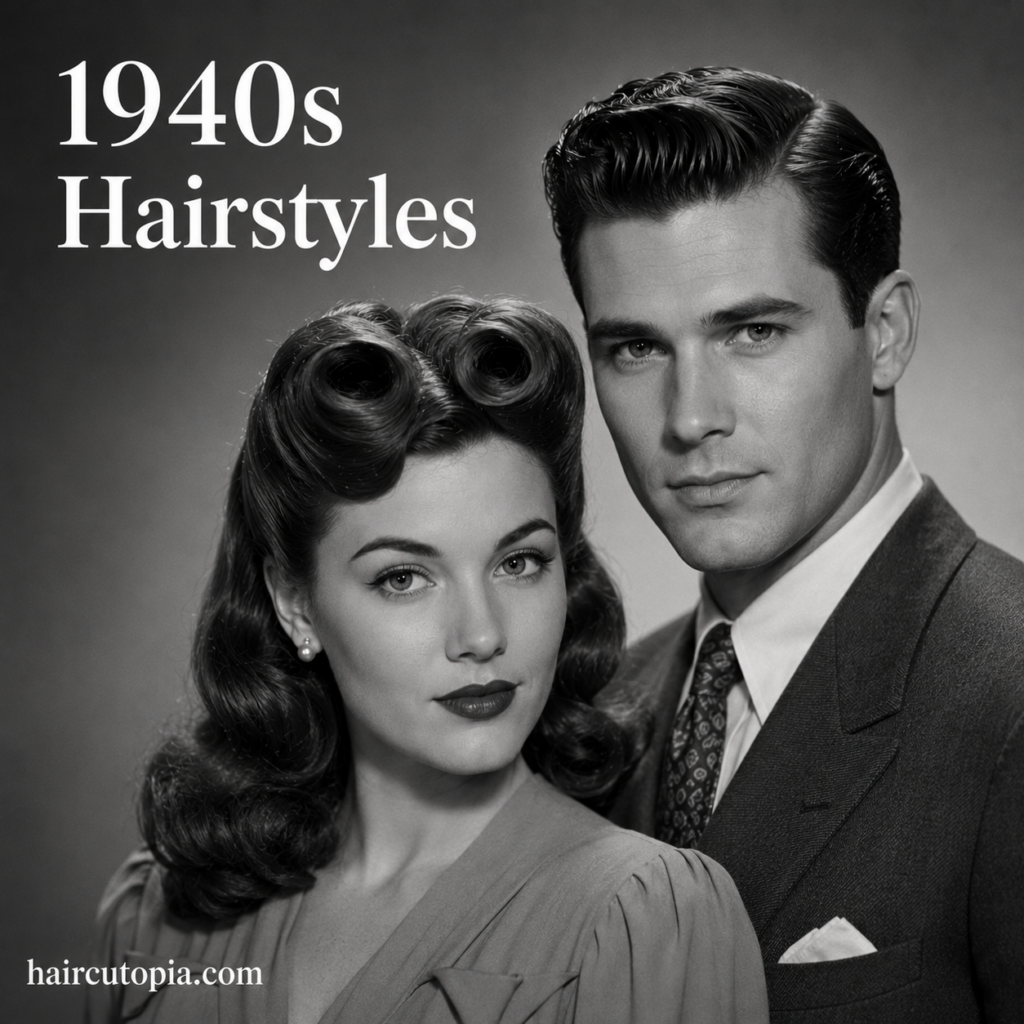
Few decades produced hairstyles as instantly recognizable as the 1940s. Victory rolls, carefully brushed waves, sculpted curls, neat side parts, and polished pompadours all helped define the era.
But 1940s hairstyles weren’t just about appearance. The decade was shaped by World War II, and everyday grooming adapted along with it. Women needed practical ways to keep their hair secure while working, while men’s styles reflected both military grooming and the polished appearance popular in civilian life.
At the same time, Hollywood offered a completely different kind of inspiration. Movie stars brought glamorous waves, dramatic curls, and sophisticated styling to screens around the world.
The result was a decade where practicality and glamour existed side by side.
From victory rolls and pin curls to classic men’s side parts, here’s a closer look at the hairstyles that defined the 1940s and why so many of them still influence hair today.
What Did 1940s Hairstyles Look Like?
The typical 1940s hairstyle was polished, controlled, and deliberately shaped.
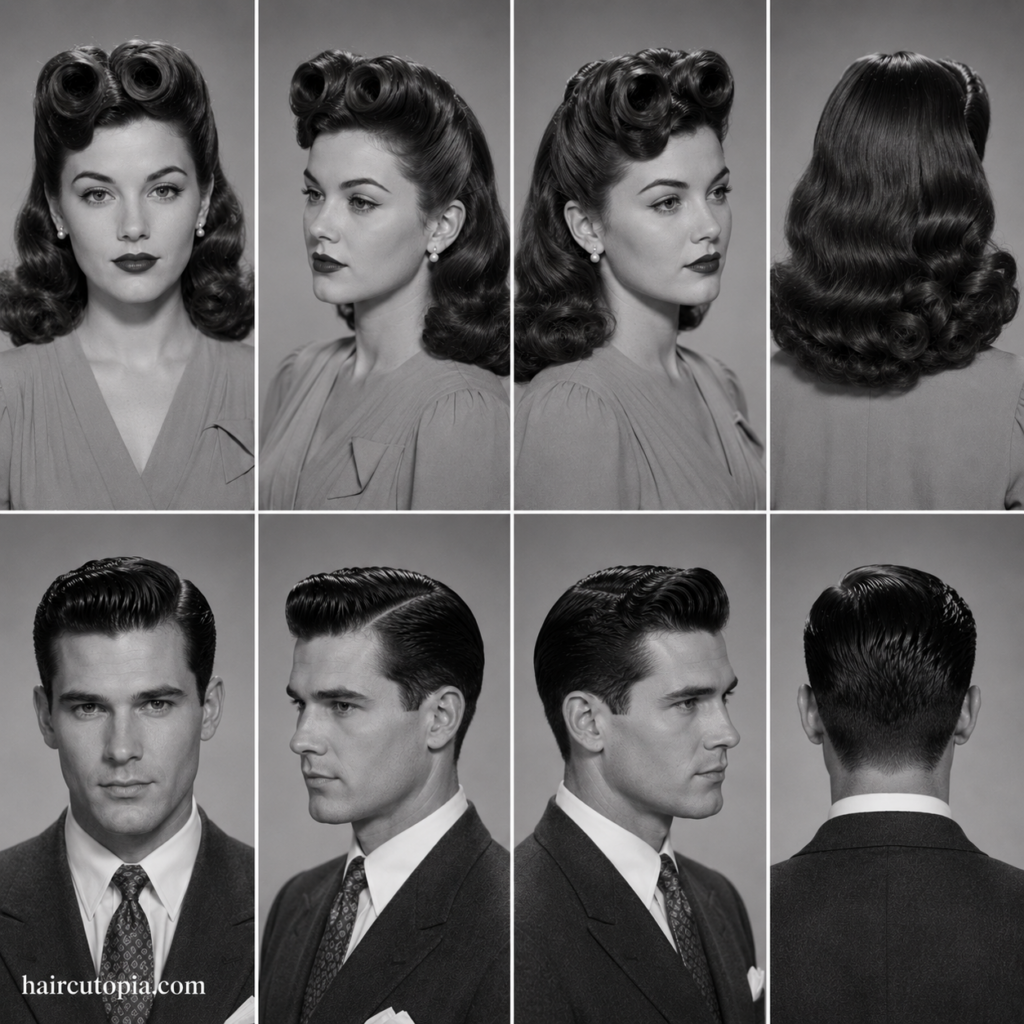
Women’s hair frequently featured curls and waves arranged around the face, with medium-length hair providing enough flexibility for rolls, updos, and other structured styles. Hair might be swept away from the forehead during the day and transformed into softer waves for a more glamorous evening look.
Men’s hairstyles generally followed a cleaner formula. Shorter sides and backs were combined with enough length on top for a side part, wave, pompadour, or slicked-back finish.
Common characteristics of 1940s hair included:
- Victory rolls
- Pin curls
- Deep side parts
- Brushed waves
- Rolled bangs
- Shoulder-length curls
- Pompadours
- Snoods and hair scarves
- Short, neat men’s sides
- Slicked or combed-back men’s hair
- Controlled volume around the front
- Carefully shaped silhouettes
Hair rarely looked accidental. Even softer styles typically had some underlying structure.
Popular 1940s Hairstyles for Women
Women’s hairstyles are responsible for many of the decade’s most recognizable looks.
Hair was curled, rolled, pinned, wrapped, and brushed into a surprisingly wide range of shapes. The same basic haircut could often produce several different hairstyles depending on how it was set.
Victory Rolls
Victory rolls are perhaps the hairstyle most closely associated with 1940s women.
Sections near the front of the head were rolled into large cylindrical shapes and secured with pins. The rolls could sit high on the head, toward the sides, or somewhere in between.
Double victory rolls created a particularly dramatic appearance, with one roll positioned on either side of the head.
The remaining hair could be:
- Worn in curls
- Rolled underneath
- Pinned into an updo
- Secured beneath a snood
- Left in soft waves
Victory rolls could be adapted for both practical and glamorous styling, which helped make variations of the look so distinctive during the decade.
Pin Curls
Pin curls were an essential part of 1940s hairstyling.
Small sections of damp hair were wound into curls and pinned flat against the scalp. Once the hair dried, the pins were removed and the resulting curls could be arranged or brushed into a finished hairstyle.
The direction and placement of each curl affected the final result.
Pin curls could create everything from tight curls to smooth waves, making them less of a single hairstyle and more of a foundation for numerous 1940s looks.
Side-Parted Waves
Not every 1940s hairstyle required elaborate rolls.
Soft waves with a deep side part offered a glamorous alternative.
The hair was usually curled and then brushed into smooth, continuous waves rather than being left as individually defined curls. This created the flowing, polished appearance often associated with Hollywood stars of the era.
The style could be worn around shoulder length or slightly shorter.
Today, side-parted vintage waves are one of the easiest ways to reference 1940s glamour without recreating a complete period hairstyle.
Rolled Bangs
The front section of the hair became a styling feature of its own during the 1940s.
Instead of allowing bangs to fall naturally across the forehead, women could roll the hair into a smooth barrel-like shape.
Rolled bangs worked especially well with:
- Victory rolls
- Curled shoulder-length hair
- Snoods
- Updos
- Scarves and turbans
The roll could be relatively subtle or deliberately oversized depending on the desired look.
1940s Pompadour Hairstyles for Women
Women’s pompadours lifted the front of the hair upward and away from the face.
Unlike the men’s pompadours that later became strongly associated with rock-and-roll culture, women’s versions were often incorporated into larger arrangements of rolls and curls.
The raised front created height while keeping hair away from the forehead.
This combination of practicality and drama made the pompadour well suited to the decade.
Pageboy Hairstyles
The pageboy offered a smoother, more understated silhouette.
Hair was typically worn around shoulder length, with the ends curved or rolled inward to create a rounded shape.
Compared with victory rolls or complex updos, the pageboy could appear relatively simple. However, achieving the smooth finish still required careful setting and brushing.
The style remains one of the most recognizable vintage options for anyone who prefers a polished look without elaborate curls across the top of the head.
Snood Hairstyles
A snood helped contain the back portion of the hair inside a decorative net or fabric covering.
Women could style the visible front sections into rolls, waves, or curls while keeping the remaining hair controlled.
This made snoods especially useful during a period when practical hair management mattered.
They could also be decorative, allowing the accessory to become part of the overall outfit rather than simply serving a functional purpose.
Scarf Hairstyles
Hair scarves became another memorable part of 1940s styling.
A scarf could help secure hair while leaving carefully arranged curls or rolls visible at the front.
The look became particularly associated with working women during World War II, when keeping longer hair away from machinery was an important safety consideration.
Scarves could be tied in several ways, making them useful for both practical and casual styling.
Turban Hairstyles
Turbans provided even more coverage.
Some styles covered most of the hair while leaving a rolled or curled section visible near the forehead. Others incorporated folds and knots into the overall design.
Like scarves and snoods, turbans demonstrated how accessories could turn practical hair management into part of the fashion itself.
Curled Bob Hairstyles
Shorter hair could still embrace the decade’s love of curls.
A bob might be styled with structured waves, curled ends, or additional volume around the sides.
Instead of the deliberately messy texture found in many contemporary bobs, 1940s versions tended to emphasize controlled movement and a clearly defined shape.
Updos and Pinned Curls
Longer hair could be arranged into elaborate pinned styles.
Rather than leaving long lengths hanging freely, sections were often rolled or curled and secured around the back or sides of the head.
This made longer hair appear shorter while creating a sophisticated silhouette.
It was also practical. Once securely pinned, the hairstyle could remain controlled throughout the day.
Popular 1940s Hairstyles for Men
Men’s 1940s hairstyles were usually less elaborate, but they weren’t without personality.
The basic formula was relatively consistent: neat sides, controlled length on top, and a carefully groomed finish.
The differences came from how the top was parted, waved, lifted, or brushed backward.
Classic Side Part
The side part was one of the decade’s defining men’s hairstyles.
Hair was divided cleanly on one side and combed into position. The front might sit relatively flat or incorporate a small amount of lift.
The style worked particularly well with the short sides and longer top commonly worn during the period.
Its simplicity also explains its longevity. A traditional side part still looks completely natural in a modern barbershop.
Slicked-Back Hair
Another option was to brush the top backward rather than creating a prominent part.
Styling products helped keep the hair smooth and controlled.
The result was sleek without necessarily being flat. Men with thicker or wavier hair could maintain some natural volume while still achieving the polished appearance expected at the time.
Side-Parted Waves
Naturally wavy hair worked especially well with 1940s men’s styling.
Instead of eliminating the texture, hair could be combed into a side part while allowing a controlled wave to develop through the front.
This created a softer silhouette than a completely slicked-back style.
The important difference between a period-inspired wave and a modern textured hairstyle is control. The overall shape remained intentional and tidy.
Men’s Pompadour
The pompadour brought more height to the front.
Hair was lifted upward and swept backward, creating a fuller silhouette while the sides remained relatively neat.
Although larger pompadours are strongly associated with the 1950s, versions of the style were already present during the 1940s.
The late 1940s in particular helped establish some of the styling ideas that would become more prominent during the following decade.
Brushed-Back Hairstyles
For men who didn’t want a sharply defined side part, the top could simply be brushed backward.
This created a natural transition from the forehead toward the crown.
Depending on hair texture, the style could be smooth or slightly wavy.
The result remained conservative enough for the period while giving the hair more movement than a tightly slicked style.
Military-Inspired Hairstyles
Military grooming had an unavoidable influence on men’s hair during World War II.
Short, practical hairstyles were easier to maintain and suited military requirements. Closely controlled sides and backs became especially familiar during the era.
Civilian hairstyles weren’t identical to military cuts, but the broader preference for neat, manageable hair fit naturally with the wartime environment.
Crew-Cut Styles
Crew cuts offered another short option.
Hair remained longer toward the top while becoming progressively shorter around the sides and back.
Compared with side-parted hairstyles, crew cuts required less daily styling and worked particularly well in military and athletic environments.
Their straightforward shape has allowed the style to remain popular long after the 1940s ended.
How World War II Changed Women’s Hairstyles
World War II had a particularly significant impact on women’s hair.
As more women entered factories and industrial workplaces, loose hair could become dangerous around moving machinery.
Keeping hair secured became more than a fashion preference.
Women used:
- Scarves
- Turbans
- Snoods
- Hairnets
- Pins
- Rolls
- Updos
These methods kept longer hair away from equipment while still allowing room for personal style.
Front sections could be curled or rolled even when the rest of the hair was covered.
That combination became one of the defining visual characteristics of wartime hair.
How Hollywood Influenced 1940s Hair
If wartime workplaces represented the practical side of 1940s hairstyles, Hollywood represented the glamorous side.
Film stars appeared with perfectly arranged waves, glossy curls, dramatic side parts, and sophisticated updos.
These hairstyles weren’t necessarily what someone would wear while working in a factory, but they influenced beauty ideals and special-occasion styling.
Soft waves around the shoulders became particularly glamorous.
The hair could appear effortless on screen, but creating those smooth shapes often required careful curling, setting, brushing, and pinning.
Men’s Hollywood hairstyles were equally polished. Side parts, waves, and brushed-back styles complemented the tailored suits and formal clothing of leading actors.
How Women Styled Their Hair in the 1940s
Modern hairstyling often revolves around heated tools. Styling hair in the 1940s relied much more heavily on setting.
Pin curls and rollers allowed damp hair to dry into predetermined shapes.
A simplified routine might look like this:
- Dampen or wash the hair.
- Divide it into sections.
- Wind individual sections into pin curls or rollers.
- Secure everything carefully.
- Allow the hair to dry completely.
- Remove the pins or rollers.
- Brush the curls into the desired shape.
- Form rolls or waves where needed.
- Secure the finished style with hairpins.
The brushing stage was especially important.
Today, people often try to preserve individual curls after using a curling iron. Vintage styling frequently did the opposite.
Individual curls were brushed together until they formed larger, smoother waves.
This is one reason authentic-looking 1940s hair has such a distinctive shape.
Hair Accessories of the 1940s
Accessories played both functional and decorative roles.
Common choices included:
- Hairpins
- Combs
- Scarves
- Snoods
- Turbans
- Hairnets
- Decorative clips
- Flowers
- Ribbons
During wartime, practicality was particularly important.
A scarf or snood could help keep hair contained during work, while decorative accessories could transform the same basic hairstyle for another occasion.
Hair Products Used for 1940s Hairstyles
The styling aisle looked considerably different in the 1940s.
Men often used pomades, hair tonics, and similar grooming products to keep their hair smooth and controlled.
Women relied heavily on setting methods to create lasting curls and waves. Styling preparations could assist with hold, but the physical process of setting and pinning the hair did much of the work.
Hairpins were essential.
A hairstyle involving multiple rolls and curls might depend on carefully hidden pins to maintain its shape throughout the day.
Everyday 1940s Hair vs. Evening Hairstyles
Not every woman walked around with elaborate victory rolls every day.
Just like today, hairstyles varied according to the occasion.
Everyday Hair
Daytime hairstyles generally benefited from practicality.
Hair might be:
- Pinned away from the face
- Covered with a scarf
- Secured in a snood
- Arranged into simple rolls
- Worn in manageable curls
Working environments especially encouraged secure hairstyles.
Evening Hair
Evening styles could place greater emphasis on glamour.
Soft waves, polished curls, decorative accessories, and more elaborate arrangements became appropriate for social occasions.
Hollywood provided plenty of inspiration for this side of 1940s beauty.
Early 1940s vs. Late 1940s Hairstyles
Fashion evolved throughout the decade, so there isn’t one hairstyle that represents every year equally.
Early 1940s Hairstyles
Wartime practicality strongly influenced the early part of the decade.
Women frequently wore controlled curls, rolls, scarves, and other styles that kept hair away from the face.
Men’s hairstyles remained neat and conservative, with military grooming becoming particularly visible.
Late 1940s Hairstyles
By the end of the decade, hairstyles were beginning to move toward the aesthetics that would become familiar during the 1950s.
Women’s hair could take on softer, increasingly glamorous shapes.
Men’s hairstyles began showing more noticeable volume through the front while retaining the clean sides associated with traditional grooming.
The change was gradual rather than sudden.
Looking at hairstyles from 1949 and 1950, for example, you won’t find a sharp dividing line between the decades.
How to Recreate a 1940s Women’s Hairstyle Today
You don’t need authentic 1940s tools to create a convincing vintage hairstyle.
Modern equipment can make the process considerably easier.
For a simple vintage-inspired look:
- Create a deep side part.
- Curl the hair in consistent sections.
- Allow the curls to cool.
- Gently brush them together.
- Shape the hair into smooth waves.
- Add volume around the front.
- Pin sections into place where necessary.
- Finish with hairspray.
For a more recognizable 1940s look, add victory rolls or a rolled fringe.
The biggest mistake is often focusing too heavily on individual curls. Brushing and shaping the curls together usually produces a more authentic vintage silhouette.
How to Recreate a 1940s Men’s Hairstyle Today
A men’s 1940s hairstyle starts with the right proportions.
The sides and back should generally remain neat while leaving enough length on top for controlled styling.
For a classic side-part look:
- Start with slightly damp hair.
- Establish a clean side part.
- Apply a small amount of styling product.
- Comb the sides neatly into place.
- Sweep the top across and slightly backward.
- Add subtle lift through the front if desired.
- Finish without creating excessive height or texture.
Avoid an extremely tight skin fade if historical appearance is the goal.
Leaving a little more weight through the sides usually creates a silhouette closer to period photographs.
Modern 1940s-Inspired Hairstyles
You don’t need to look like you’re attending a costume party to borrow ideas from the decade.
A subtle interpretation often works better for everyday wear.
Women can try:
- Deep side parts
- Brushed Hollywood waves
- A single victory roll
- Curled-under ends
- Vintage-inspired bobs
- Soft rolled bangs
Men can experiment with:
- Traditional side parts
- Brushed-back tops
- Controlled front waves
- Moderate pompadours
- Classic tapered sides
Combining one vintage feature with an otherwise contemporary hairstyle can create a much more wearable result.
1940s Hairstyles vs. 1950s Hairstyles
Because the decades sit next to each other, 1940s and 1950s hairstyles are frequently confused.
There is plenty of overlap, but the cultural context changed significantly.
Wartime practicality heavily influenced 1940s hair. Women’s styles frequently incorporated ways to control and secure the hair, while men’s cuts reflected conservative and military-influenced grooming.
During the 1950s, hairstyles increasingly reflected postwar fashion and emerging youth culture.
Men’s pompadours became more dramatic, particularly as rock-and-roll gained popularity. Women’s hairstyles expanded into a wide range of shorter cuts, curled looks, and carefully sculpted silhouettes.
The transition happened gradually, so late-1940s hairstyles can sometimes resemble early-1950s looks.
Why 1940s Hairstyles Are Still Popular
1940s hairstyles have never completely disappeared.
Victory rolls remain popular within vintage and pin-up fashion. Hollywood waves continue to appear on red carpets. Men’s side parts and brushed-back hairstyles are still everyday barbershop staples.
The decade also offers something for different levels of commitment.
Someone looking for a dramatic vintage hairstyle can recreate full victory rolls and pin curls. Someone who wants only a hint of the era can simply add a deep side part and brushed waves.
That versatility has helped the aesthetic survive for generations.
Frequently Asked Questions About 1940s Hairstyles
What was the most popular women’s hairstyle in the 1940s?
There wasn’t a single hairstyle worn by everyone, but victory rolls are among the most recognizable styles associated with 1940s women. Pin curls, shoulder-length waves, rolled bangs, pageboy styles, snoods, and scarf hairstyles were also characteristic of the decade.
What hairstyles did men wear in the 1940s?
Popular men’s styles included side parts, slicked-back hair, brushed-back styles, controlled waves, pompadours, crew cuts, and short military-influenced hairstyles.
Why were victory rolls popular in the 1940s?
Victory rolls provided a distinctive way to arrange the front sections of the hair into sculpted shapes while keeping hair controlled and away from the face. They became strongly associated with wartime-era fashion and remain one of the decade’s most recognizable looks.
How did women curl their hair in the 1940s?
Pin curls and rollers were important methods for setting hair. Damp hair could be arranged into curls, allowed to dry, and then brushed and shaped into waves, rolls, or other finished styles.
Why did women wear scarves over their hair in the 1940s?
Scarves could help secure and protect hair, which was especially useful for women working around machinery during World War II. They also became a fashionable part of casual wartime styling.
Did women wear their hair down in the 1940s?
Yes. Shoulder-length hair could be worn down in curls or smooth waves, particularly for glamorous and evening styles. Hair was also frequently pinned, rolled, or partially secured depending on the setting.
Were 1940s hairstyles short or long?
Both existed, although medium-length hair was particularly versatile for women’s styling because it could be curled, rolled, pinned, or worn down. Men’s hairstyles were generally shorter around the sides and back with more styling length on top.
What is the easiest 1940s hairstyle to recreate?
For women, deep side-parted waves offer an accessible way to create a 1940s-inspired appearance without constructing elaborate rolls. For men, a neatly tapered side-part hairstyle is one of the simplest options.
Can 1940s hairstyles work with modern haircuts?
Yes. Modern cuts can borrow individual elements from the decade, such as victory rolls, polished waves, deep side parts, pompadour volume, or brushed-back styling. The result doesn’t have to be historically exact to capture the era’s character.
The Lasting Influence of 1940s Hairstyles
The hairstyles of the 1940s tell a larger story than curls and pomade.
They reflect a decade shaped by war, changing workplaces, Hollywood glamour, practicality, and personal expression.
Women’s hairstyles turned functional techniques such as pinning, rolling, scarves, and snoods into distinctive fashion. Men’s styles emphasized clean grooming while leaving enough room for waves, side parts, and carefully controlled volume.
Those ideas haven’t disappeared.
Vintage waves still appear at formal events. Victory rolls remain instantly recognizable. Classic side parts continue to cycle through men’s grooming trends without ever truly going away.
That’s what makes 1940s hairstyles worth revisiting. They’re unmistakably connected to their era, yet many of their defining elements still feel surprisingly wearable today.