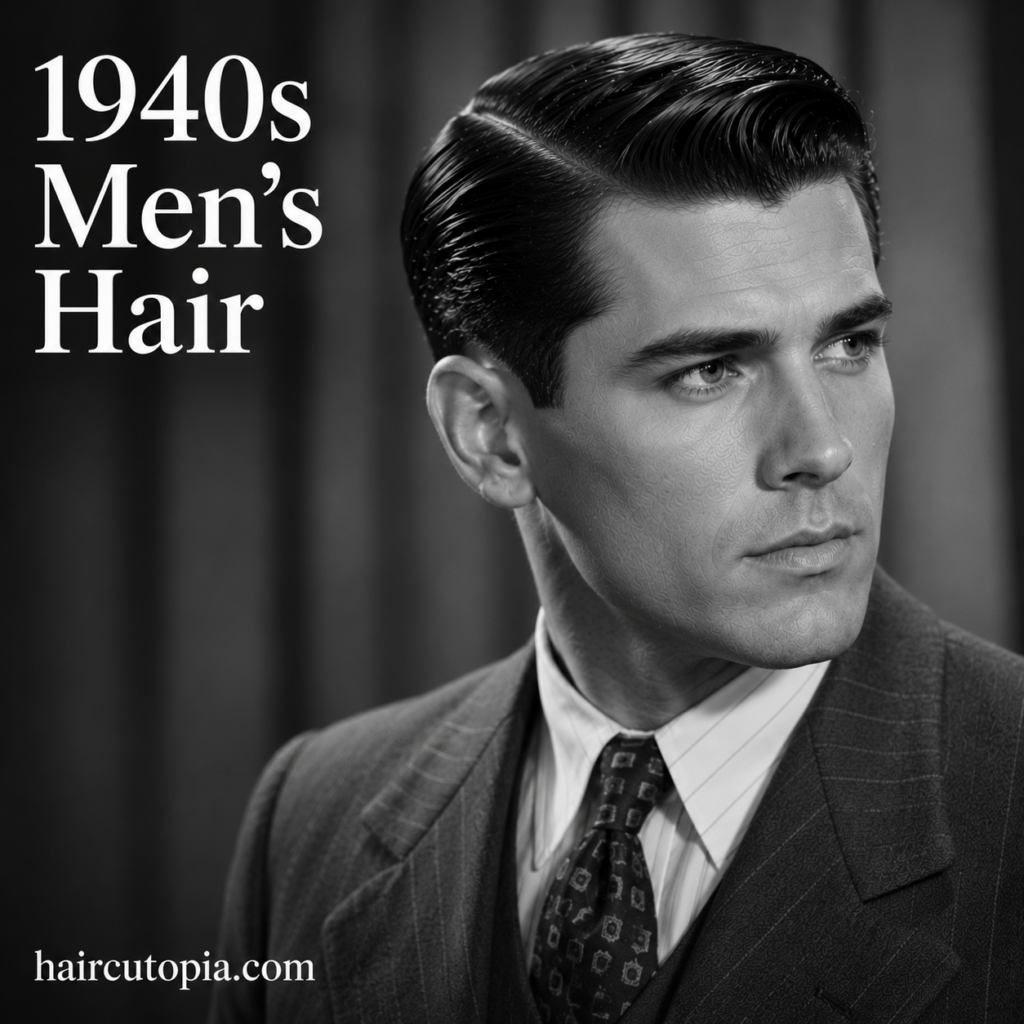
Men’s hair in the 1940s was clean, controlled, and unmistakably polished. Whether a man wore a sharp side part, a brushed-back style, a natural wave, or a practical military cut, the overall goal was usually the same: look neat and well groomed.
It was also a decade when circumstances had a major influence on appearance.
World War II put millions of men into military service, making short, manageable hair an everyday sight. Civilian styles remained somewhat longer on top, giving men enough hair to create side parts, waves, and modest pompadours. Hollywood added another influence, with leading men appearing on screen with immaculate combed styles and glossy finishes.
Compared with many modern men’s hairstyles, 1940s men’s hair generally featured less deliberate messiness and fewer extreme contrasts between the top and sides.
The details were subtle, but they mattered.
Here’s how men wore their hair during the 1940s, from the decade’s most recognizable cuts to the products and techniques used to keep everything in place.
What Did Men’s Hair Look Like in the 1940s?
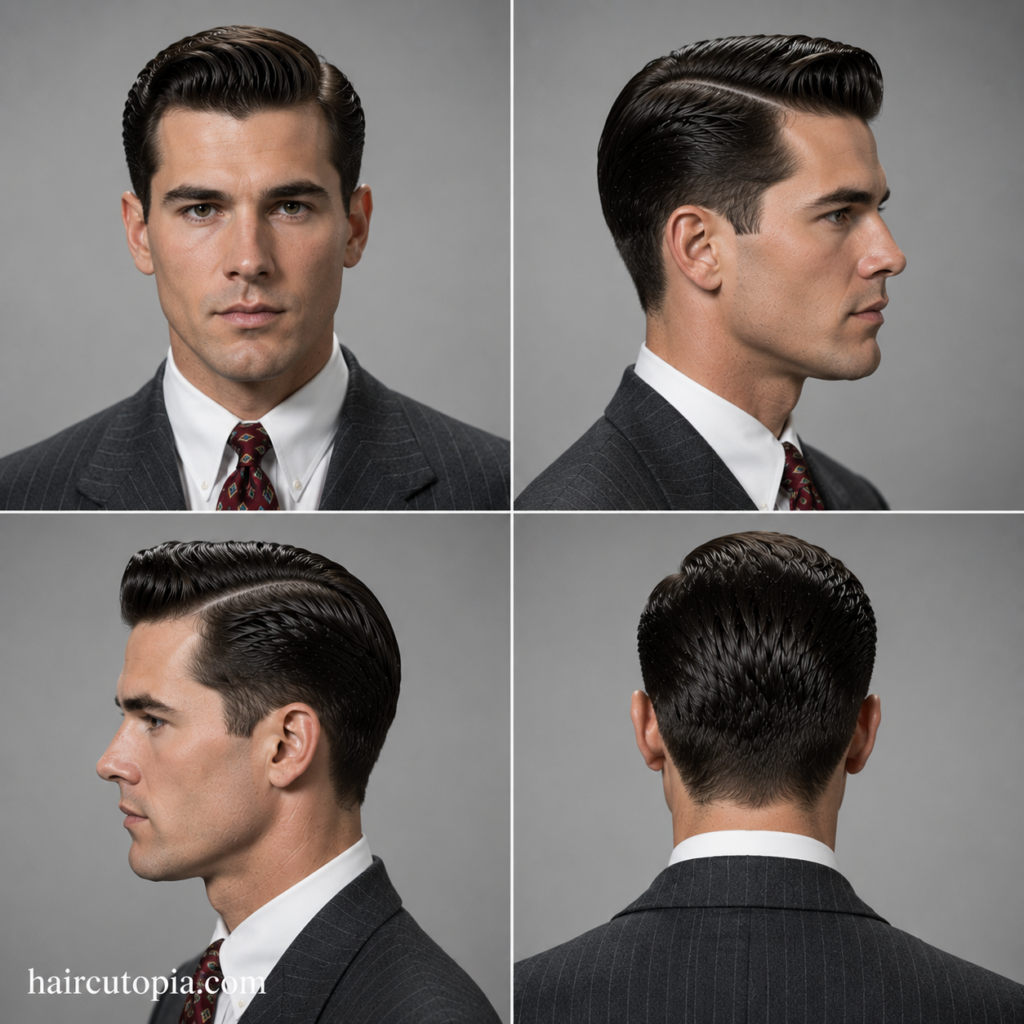
The typical 1940s men’s haircut followed a fairly straightforward shape.
Hair was shorter around the sides and back and longer through the top. That extra length allowed the wearer to comb the hair into a side part, sweep it backward, create a controlled wave, or add some height through the front.
The sides weren’t necessarily shaved extremely close.
Instead, traditional tapering created a gradual transition toward the ears and neckline.
Common features of 1940s men’s hair included:
- Short, tidy sides
- Tapered backs and necklines
- Longer hair on top
- Defined side parts
- Combed and brushed-back styling
- Controlled natural waves
- Moderate front volume
- Smooth finishes
- Pomade and hair tonic
- Military-influenced short cuts
- Crew cuts
- Conservative, polished silhouettes
Hair generally looked intentional.
Even when a man’s natural waves or curls were visible, they were usually guided into an organized shape rather than styled to look tousled.
The Classic 1940s Side Part
The side part is one of the easiest men’s hairstyles to associate with the 1940s.
It’s also one of the most timeless.
Hair was parted clearly on one side and combed across the top. Depending on the wearer’s hair type, the front could remain relatively flat or rise into a small wave.
The sides were combed neatly into position.
A classic 1940s side part typically worked best with:
- A traditional taper
- Moderate length on top
- Additional length near the front
- Enough weight through the sides
- A smooth styling product
Compared with many modern side-part haircuts, the contrast between the top and sides was usually less dramatic.
You didn’t need an exposed scalp or disconnected fade to make the part stand out.
The shape came from combing and grooming.
Side-Parted Wavy Hair
Naturally wavy hair worked particularly well with 1940s men’s styling.
Instead of trying to straighten or flatten every wave, men could use the natural movement to give the front more character.
A side part established the basic structure.
From there, the hair could sweep across and backward while a controlled wave developed near the forehead.
The result looked polished without appearing rigid.
This type of hairstyle is visible in plenty of classic photographs and films from the period and remains one of the most wearable vintage men’s looks today.
Brushed-Back Hair
Not every 1940s hairstyle needed an obvious part.
Men could brush the top away from the forehead and toward the back of the head.
The sides were kept neat, while the longer top created a smooth flow backward.
Thicker hair worked particularly well because it could retain some natural volume.
The goal wasn’t necessarily to plaster the hair completely flat.
A good brushed-back style could still have shape and movement.
What separated it from many contemporary versions was the finish. Modern brushed-back hair often emphasizes dry texture and individual strands, while a 1940s version typically looked smoother and more unified.
Slicked-Back Hair
For an even sleeker appearance, the hair could be slicked backward.
Pomade or another grooming product helped hold the strands in position and provided the glossy finish associated with period men’s grooming.
The style worked well for formal occasions but wasn’t limited to them.
A slicked-back look could complement the suits, collared shirts, and structured clothing common during the decade.
Men with naturally straight hair could create a very smooth silhouette, while wavy hair added subtle texture through the top.
The 1940s Pompadour
The pompadour wasn’t invented in the 1950s.
Men were already wearing elevated front sections during the 1940s, although many versions were more restrained than the dramatic rock-and-roll pompadours that followed.
The basic technique involved lifting the hair at the front and directing it backward.
This created height above the forehead while keeping the sides controlled.
A 1940s pompadour generally needed:
- Extra length at the front
- Moderate top length
- Tapered or neatly cut sides
- A styling product with good control
- Careful combing
As the decade progressed, some men’s hairstyles began showing more front volume.
These late-1940s styles helped establish the foundation for the larger pompadours of the 1950s.
The 1940s Quiff
Although the terminology used to describe hairstyles can shift over time, some 1940s men’s looks featured the kind of lifted and swept-back front we would now recognize as quiff-like.
The front was elevated rather than lying completely flat.
Unlike a large modern quiff, however, the shape generally remained controlled and proportional to the rest of the haircut.
The sides retained enough weight to keep the overall silhouette balanced.
This makes a modest quiff an effective option for someone who wants a 1940s influence without recreating a highly specific historical hairstyle.
Short Back and Sides
The traditional short-back-and-sides haircut provided the foundation for many men’s styles of the decade.
As the name suggests, the sides and back were cut shorter while additional length remained on top.
That top length could then be styled in several ways:
- Side parted
- Brushed backward
- Slicked back
- Waved at the front
- Lifted into a pompadour
The cut was practical without eliminating styling possibilities.
One major difference from many contemporary versions is the transition.
Modern short-back-and-sides haircuts are often paired with a skin fade. A period-inspired version generally benefits from a softer taper and more visible hair around the sides.
The Traditional Taper
The taper was a natural fit for 1940s men’s grooming.
Hair gradually became shorter as it approached the ears and neckline.
This produced a neat finish without the sudden contrast created by a disconnected undercut or high skin fade.
A taper could be conservative enough for work or military-influenced grooming while still supporting a stylish top.
It worked particularly well with:
- Side parts
- Front waves
- Brushed-back styles
- Slicked hair
- Modest pompadours
Traditional tapers remain standard barbershop cuts today, which is why they can reference the 1940s without looking dated.
The Crew Cut
The crew cut offered a much shorter option.
Hair remained short around the sides and back, with slightly greater length through the top.
The style was practical, masculine, and relatively easy to maintain.
Crew cuts had strong associations with military and athletic environments, but their straightforward appearance allowed them to move easily into civilian grooming as well.
A historically inspired crew cut tends to look softer around the sides than many modern faded versions.
The basic silhouette, however, remains familiar.
Military Haircuts in the 1940s
It’s impossible to discuss 1940s men’s hair without considering World War II.
Military service brought practical short grooming into everyday view on an enormous scale.
There wasn’t one universal haircut worn by every serviceman. Grooming varied according to branch, regulations, circumstances, and individual hair.
Still, military life strongly favored manageable hair.
Shorter lengths offered obvious practical advantages and reinforced the broader cultural preference for tidy men’s grooming.
Common characteristics included:
- Short sides
- Clean necklines
- Controlled top length
- Minimal excess bulk
- Straightforward maintenance
The visibility of military grooming also influenced how we remember men’s hair from the decade as a whole.
Civilian Hair vs. Military Hair
Civilian men generally had more freedom with their hair.
A civilian haircut could retain additional top length for waves, pompadours, and more prominent side parts.
The sides could also carry somewhat more weight.
Military cuts prioritized practicality and conformity to grooming requirements.
The difference wasn’t always dramatic, though.
Both civilian and military styles shared the decade’s preference for neatness.
A civilian man with a short taper and side part could still have a silhouette that looked relatively close to military-influenced grooming.
Hollywood Men’s Hair in the 1940s
Hollywood represented the more glamorous side of men’s hair.
Leading men appeared with perfectly arranged side parts, smooth waves, brushed-back tops, and glossy finishes.
The cuts themselves weren’t always unusual.
What made them stand out was the styling.
Every section looked deliberate.
Hair complemented tailored suits and formal clothing rather than competing with them.
Hollywood helped reinforce several characteristics that became strongly associated with sophisticated men’s grooming:
- Deep side parts
- Controlled waves
- Smooth surfaces
- Moderate volume
- Clean silhouettes
- Well-maintained edges
For a modern interpretation of 1940s Hollywood hair, the finishing technique is often more important than choosing an unusual haircut.
The Wet and Glossy Look
One noticeable characteristic in many period photographs is shine.
Men’s hair products often produced a visibly polished finish.
This is quite different from the matte clays and pastes popular in contemporary barbering.
A glossy finish made comb marks more visible and helped emphasize the smooth structure of the hairstyle.
That doesn’t mean every man’s hair looked soaking wet.
The level of shine varied.
But if you’re trying to recreate a convincing 1940s hairstyle today, switching from a dry matte product to something with moderate shine can immediately move the look closer to the period.
Pomade and 1940s Men’s Hair
Pomade was an important tool for maintaining smooth men’s hairstyles.
It helped control flyaways, define parts, and keep hair combed into position.
For side parts and brushed-back styles, this control was particularly useful.
A good pomade also allowed hair to maintain some flexibility rather than becoming completely rigid.
Modern products make recreating the effect relatively easy.
For a vintage-inspired finish, look for a product that provides:
- Medium to strong hold
- Some shine
- Combability
- Smooth control
You don’t necessarily need an extremely greasy finish.
The goal is simply to avoid the dry, separated texture associated with many modern styles.
Hair Tonic
Hair tonic was another familiar part of men’s grooming.
Tonics could be used to help groom and manage the hair while contributing to the polished ritual of getting ready.
The barbering experience itself often involved more than simply cutting hair.
Men visited barbers for haircuts, shaves, grooming, and maintenance.
Products such as tonics became part of that culture.
While modern styling routines have changed, the idea of using a lighter grooming product before combing remains useful for recreating a softer vintage finish.
How Men Styled Their Hair in the 1940s
A typical hairstyle didn’t require a drawer full of products.
The process could be relatively straightforward.
For a traditional side-part style:
- Start with clean or slightly damp hair.
- Establish the natural or preferred side part.
- Apply a small amount of grooming product.
- Comb the sides neatly downward and backward.
- Direct the top across from the part.
- Lift or shape the front if desired.
- Comb everything into a smooth, connected silhouette.
- Make small adjustments rather than deliberately breaking up the texture.
The comb was essential.
Modern men’s styling often involves working product through the hair with the fingers. Finger styling creates separation and texture, which can make a hairstyle look more contemporary.
For a stronger 1940s appearance, the comb should do more of the work.
The Importance of the Comb
A simple comb helped create many of the decade’s defining men’s hairstyles.
It established crisp parts, aligned strands, and shaped waves.
Visible comb lines weren’t necessarily something to avoid.
They could contribute to the polished appearance of the hairstyle.
A comb also made it easier to distribute grooming product evenly.
For a side part, the teeth could guide the hair into a consistent direction from the part toward the opposite side.
For brushed-back styles, combing helped connect the front and crown into one smooth flow.
How Long Was Men’s Hair in the 1940s?
There wasn’t one standard length.
Military cuts could be quite short, while civilian styles often retained considerably more hair through the top.
Generally, men’s hair was short enough to look tidy around the ears and neckline while leaving sufficient top length for grooming.
The front could be longer than the crown to accommodate a wave or pompadour.
Compared with today’s long men’s styles, even the fuller 1940s looks were relatively conservative.
The key was balance.
Hair needed enough length to style without becoming loose or uncontrolled.
Did Men Have Fades in the 1940s?
Men certainly wore hair that transitioned from shorter lengths around the sides and back into longer hair above.
In that broad sense, gradual fading and tapering techniques aren’t new.
However, the high-contrast skin fades seen in contemporary barbering aren’t representative of the typical 1940s silhouette.
Period men’s hair generally retained more weight through the sides.
For a historically inspired look, a traditional taper is usually a better choice than:
- A high skin fade
- A disconnected undercut
- A sharp modern drop fade
- An extreme bald fade
Those modern techniques can still look great, but they change the historical character of the haircut.
1940s Hair for Straight Hair
Straight hair works particularly well for smooth side parts and slicked-back styles.
A styling product can help keep the hair connected and prevent flyaways.
Men with very straight hair may need additional front length to create a noticeable wave or pompadour.
Blow-drying can make this much easier today.
For a more authentic-looking finish, avoid creating excessive airy volume.
The silhouette should remain controlled.
1940s Hair for Wavy Hair
Wavy hair is almost ideal for many 1940s styles.
Natural movement can create the characteristic wave around the front without requiring much manipulation.
A side part helps organize the texture.
Pomade or another smoothing product can then control the wave without completely removing it.
The result should look deliberate rather than stiff.
Wavy hair also works beautifully when brushed backward because the natural bends add depth to an otherwise simple shape.
1940s Hair for Curly Hair
Curly hair could be groomed into shorter controlled shapes or styled with additional length through the top.
The goal didn’t have to be eliminating the curl.
Instead, the overall silhouette could be kept neat while allowing the natural texture to remain visible.
A traditional taper around the sides and back provides structure.
The top can then retain enough length for the curls to form naturally.
Using a grooming product with control can help keep the style cohesive without flattening the texture completely.
1940s Hair for Thick Hair
Thick hair offers plenty of opportunities for vintage styling.
It naturally supports:
- Pompadours
- Front waves
- Brushed-back styles
- Full side parts
The challenge is controlling bulk.
A barber can remove unnecessary weight while preserving the smooth outer silhouette.
Modern aggressive texturizing can sometimes create too much separation for an authentic vintage finish.
The aim is movement without making the ends look overly choppy.
1940s Hair for Thin or Fine Hair
Fine hair can still work well with classic men’s styles.
A clean side part is particularly effective because it doesn’t require enormous volume.
Keeping the sides tidy can make the top appear fuller.
Excessively long hair may become difficult to control, so a moderate top length often works best.
A lighter styling product can also help avoid weighing the hair down.
You don’t need a large pompadour to create a convincing 1940s look.
Neatness and shape matter more than height.
Facial Hair and Men’s Grooming in the 1940s
Clean-shaven faces were a prominent part of mainstream men’s grooming during the decade, particularly within military environments and polished professional settings.
That clean appearance complemented neatly styled hair.
Mustaches certainly existed and could add character to the overall look.
Large contemporary beards, however, aren’t what most people associate with mainstream 1940s grooming.
For someone recreating a highly recognizable period appearance, a clean shave or carefully maintained mustache often pairs naturally with the hairstyle.
Barbershops and Men’s Grooming
Barbershops were central to men’s grooming culture.
A haircut wasn’t necessarily something a man stretched out for months.
Keeping the sides, neckline, and overall shape neat required regular maintenance.
The barber could:
- Shorten the sides and back
- Maintain the taper
- Clean the neckline
- Shape the top
- Refine the side part
- Provide shaving and grooming services
A freshly maintained haircut made daily styling considerably easier.
The same principle applies today.
A traditional 1940s-inspired cut shouldn’t require fighting against the haircut every morning.
Early 1940s Men’s Hair
The early 1940s retained much of the polished grooming culture of the late 1930s.
Side parts, waves, and neatly combed hair remained common.
As World War II intensified, military grooming became increasingly visible.
Shorter, practical cuts became part of everyday visual culture.
Civilian styles still offered more freedom, but the overall preference for conservative grooming remained strong.
Mid-1940s Men’s Hair
The middle of the decade was deeply shaped by wartime life.
Military cuts were everywhere, while civilian men continued wearing traditional tapers, side parts, and brushed-back styles.
Hollywood provided a polished counterpoint.
Movie stars demonstrated how relatively straightforward haircuts could become sophisticated through careful combing, controlled waves, and grooming products.
The contrast between practical military hair and polished Hollywood styling captures much of the decade’s range.
Late 1940s Men’s Hair
The later years of the decade began hinting at the styles that would become more prominent during the 1950s.
Men increasingly experimented with greater front volume.
Pompadour-like shapes became more noticeable while the sides remained traditionally neat.
Side parts and brushed-back styles didn’t disappear.
Instead, familiar cuts gradually became fuller and more expressive.
There wasn’t a sudden switch when 1950 arrived.
Late-1940s men’s hair naturally flowed into the next decade.
1940s Men’s Hair vs. 1930s Men’s Hair
The two decades shared plenty of similarities.
Men in both periods commonly wore:
- Side parts
- Tapered sides
- Smooth finishes
- Controlled waves
- Brushed-back hair
The major difference was context.
Military grooming became dramatically more visible during the 1940s because of World War II.
The decade therefore carried a stronger association with short, practical men’s cuts.
At the same time, the later 1940s began introducing some of the increased volume that would characterize certain postwar styles.
1940s Men’s Hair vs. 1950s Men’s Hair
The difference becomes most obvious when looking at youth-oriented hairstyles.
The 1940s generally favored conservative, polished grooming.
During the 1950s, rock-and-roll and emerging youth culture helped make larger pompadours, greaser styles, and more rebellious hair increasingly visible.
That doesn’t mean the pompadour suddenly appeared in the 1950s.
Its foundations were already present.
The difference was often scale and cultural meaning.
A controlled 1940s pompadour could look sophisticated and traditional. A larger 1950s version might deliberately project youthful attitude.
How to Ask Your Barber for a 1940s Haircut
You don’t necessarily need to walk into a barbershop and ask for a “1940s haircut.”
Describing the shape can be more useful.
Ask for:
- A traditional taper on the sides and back
- Enough weight around the sides
- Moderate length through the top
- Extra length through the front
- A clean neckline
- A shape that can be side parted or brushed back
- No extreme disconnection
If you want a side part, tell your barber where you normally part your hair.
For a pompadour or front wave, mention that you need enough length at the front to create height.
Most importantly, bring a reference if you’re aiming for a particular historical silhouette.
How to Style a Modern 1940s Side Part
Modern tools make recreating the style easier.
Start with damp hair.
Establish the part before the hair dries into another direction.
Apply a modest amount of product and comb the top across and slightly backward.
Keep the sides smooth.
At the front, use the comb to create a subtle lift or wave rather than pushing the hair completely flat.
If necessary, use a blow dryer on a low or moderate setting to establish the shape before applying your finishing product.
The final hairstyle should look polished but not helmet-like.
How to Style a Modern 1940s Pompadour
You’ll need additional length through the front.
Begin with damp hair and direct the top backward.
Use a blow dryer to lift the front while maintaining control through the sides.
Apply styling product and use a comb to shape the hair upward and backward.
Don’t chase maximum height.
For a convincing 1940s interpretation, moderate volume usually looks more appropriate than an exaggerated rockabilly pompadour.
Keep the silhouette smooth and balanced.
How to Make 1940s Men’s Hair Look Authentic
Small details make a big difference.
For a stronger period appearance:
- Choose a traditional taper over a high skin fade.
- Leave enough weight through the sides.
- Use a comb instead of relying entirely on finger styling.
- Choose a product with some shine.
- Keep the outline neat.
- Control natural texture rather than making it deliberately messy.
- Avoid excessive height unless recreating a specific style.
- Maintain the neckline and sideburns regularly.
The goal isn’t necessarily to make your hair look old-fashioned.
It’s to recreate the proportions and grooming philosophy of the period.
How to Modernize 1940s Men’s Hair
You can also take inspiration from the decade without trying to reproduce it exactly.
A modern interpretation might keep the traditional side part but use a lighter product.
You could pair a brushed-back top with a contemporary low taper.
Natural waves can be left slightly looser.
A pompadour can retain the classic shape while using less shine.
The easiest elements to borrow are:
- Side parts
- Classic tapers
- Front waves
- Brushed-back tops
- Moderate pompadour volume
- Clean outlines
These features are subtle enough to work with modern clothing and grooming.
Frequently Asked Questions About 1940s Men’s Hair
What was the most popular men’s hairstyle in the 1940s?
The neatly groomed side part was one of the decade’s most characteristic men’s styles. Brushed-back hair, controlled waves, slicked styles, crew cuts, military-inspired cuts, and modest pompadours were also common.
How did men style their hair in the 1940s?
Men typically used a comb and grooming products such as pomade or hair tonic to create smooth, controlled hairstyles. Side parts, waves, and brushed-back shapes depended heavily on careful combing.
What hair product did men use in the 1940s?
Pomades and hair tonics were among the products associated with men’s grooming during the period. These helped control the hair and contributed to the smooth, often slightly glossy finish visible in period styles.
Did men have long hair in the 1940s?
Mainstream men’s hairstyles were generally short by modern long-hair standards. Civilian men could retain enough length on top for waves and pompadours, but the sides and back were typically kept neat.
Did men wear pompadours in the 1940s?
Yes. Pompadour-style volume existed during the 1940s, although many examples were more restrained than the larger styles associated with 1950s rock-and-roll.
Did men have fades in the 1940s?
Hair could transition gradually from shorter sides into longer sections, but the extreme skin fades common in contemporary barbering aren’t representative of the typical 1940s silhouette. Traditional tapering is a better reference for most period-inspired cuts.
What military haircuts were worn in the 1940s?
Military grooming varied, so there wasn’t one universal haircut. Short, practical, manageable hair was the general theme, with neat sides, backs, and controlled top lengths becoming strongly associated with servicemen.
How often should a 1940s-inspired haircut be maintained?
If you want the sides, neckline, and taper to remain consistently sharp, regular barber visits are useful. The exact schedule depends on hair growth and how polished you want the haircut to look.
Can curly hair work with a 1940s men’s hairstyle?
Yes. Natural curls and waves can be incorporated into a traditional tapered shape. The key is maintaining a controlled overall silhouette rather than trying to eliminate every bit of texture.
What’s the easiest 1940s men’s hairstyle to wear today?
A traditional taper with a side part is probably the easiest. It’s historically appropriate, straightforward to style, and still looks completely natural in a modern setting.
Why 1940s Men’s Hair Still Works Today
The staying power of 1940s men’s hair comes down to simplicity.
Most of the decade’s best-known styles weren’t dependent on extreme cutting techniques. They relied on good proportions, careful grooming, and enough length in the right places.
A tapered side part still works.
So does a crew cut.
Brushed-back hair, controlled waves, and moderate pompadours continue to cycle through men’s fashion because their underlying shapes are versatile.
World War II gave the decade its strong association with practical short grooming, while Hollywood demonstrated how polished those same basic principles could look.
Together, those influences created a distinctive approach to men’s hair: neat without always being severe, stylish without needing to be extravagant.
Modern products and tools make the looks easier to recreate, but the formula hasn’t changed much.
Keep the sides tidy. Leave enough length on top. Use the natural movement of the hair. Comb it into a deliberate shape.
That’s the essence of 1940s men’s hair—and it’s why so much of it still looks good today.