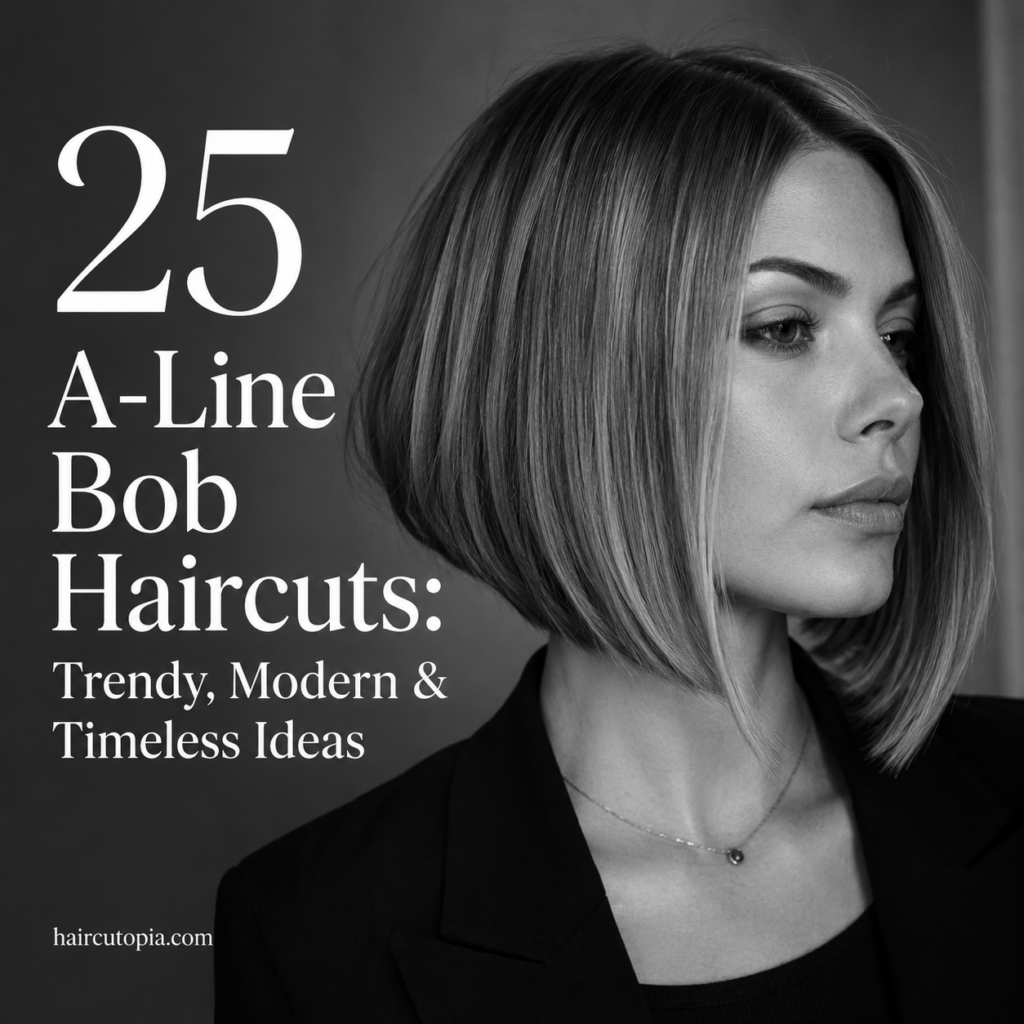
The A-line bob is one of those haircuts that never really disappears. It may get softer, sharper, shorter, or more textured depending on current trends, but the basic shape continues to work year after year.
What makes an A-line bob different is its angled silhouette. The hair is typically shorter in the back and gradually becomes longer toward the front. That simple change in length can create a beautifully structured shape while still leaving plenty of room for customization.
You can wear an A-line bob sleek and polished, tousled and casual, layered for extra movement, or paired with bangs for a completely different look. It also works at several lengths, from dramatic chin-skimming cuts to longer bobs that brush the shoulders.
If you’re thinking about changing your haircut, here are 25 A-line bob haircut ideas ranging from classic and understated to bold and modern.
1. Classic A-Line Bob
The classic A-line bob keeps things simple with a clean, gradual angle from the shorter back to the longer front.
This version is polished without looking overly dramatic, making it a good introduction to the A-line shape if you’ve never tried one before. The front sections can fall around the chin or slightly below it, depending on how much length you want to keep.
A smooth blowout shows off the shape particularly well, although the cut can also be worn with a little natural texture for a more relaxed finish.
Best for
- Straight or slightly wavy hair
- Fine to medium hair
- Anyone wanting a timeless, easy-to-style bob
- Those who prefer a noticeable but not extreme angle
2. Short A-Line Bob
A short A-line bob brings the back of the haircut higher while keeping enough length around the face to create that recognizable angled shape.
The shorter length can make the cut feel light, fresh, and modern. It also exposes more of the neckline, which gives the overall style a crisp appearance.
For a sleek look, straighten the front pieces and tuck one side behind the ear. For something softer, add a little texture through the ends.
3. Long A-Line Bob
Not ready to commit to a short bob? A long A-line bob gives you the same angled effect while preserving more length.
Often called an angled lob, this haircut typically falls somewhere between the collarbone and shoulders in front, with slightly shorter layers toward the back.
It’s a versatile option because you can still curl it, wave it, straighten it, and often pull at least part of it into a ponytail.
A long A-line bob is also a practical transition haircut if you’re moving from longer hair into a shorter style.
4. A-Line Bob With Layers
Layers can completely change the personality of an A-line bob.
Instead of a solid, structured perimeter, strategically placed layers create movement throughout the haircut. They can also prevent thicker hair from feeling too heavy around the ends.
The key is keeping enough weight in the overall shape so the A-line silhouette doesn’t disappear.
Soft layers work especially well if you prefer an effortless style rather than a sharply sculpted bob.
5. Textured A-Line Bob
A textured A-line bob has a slightly undone finish that makes the classic shape feel more casual.
Rather than keeping every strand perfectly smooth, the ends are styled with separation and movement. This can be achieved through subtle layering, point cutting, or styling products that enhance texture.
The result is a bob that looks polished enough for work but relaxed enough for everyday wear.
Try scrunching in a lightweight texture spray and allowing some natural bends to remain instead of straightening everything perfectly.
6. A-Line Bob With Bangs
Adding bangs can dramatically change an A-line bob without altering its signature angled shape.
Straight bangs create a bold, graphic look, while softer fringe can make the haircut feel more relaxed.
Because both the bob and bangs frame the face, small adjustments in length can make a big difference. Your stylist can customize the fringe based on your forehead, face shape, and preferred styling routine.
This combination works particularly well when you want your haircut to make a stronger statement.
7. A-Line Bob With Curtain Bangs
Curtain bangs are a softer alternative to traditional straight-across fringe.
They typically part near the center and gradually become longer toward the sides, allowing them to blend naturally into the front sections of an A-line bob.
The combination creates plenty of face-framing movement without hiding the angled silhouette.
Curtain bangs can also be easier to grow out than shorter fringe because they naturally transition into longer face-framing layers.
8. Blunt A-Line Bob
A blunt A-line bob combines two strong haircut elements: a defined perimeter and an angled shape.
Instead of adding lots of visible layers, the ends remain relatively solid. This gives the haircut a fuller appearance and emphasizes the line running from the shorter back toward the longer front.
The clean shape can look especially striking on straight hair.
A flat iron can create a glassy, precise finish, while a round-brush blowout gives the cut a slightly softer appearance.
9. Stacked A-Line Bob
The stacked A-line bob creates extra shape and volume toward the back of the head.
Shorter graduated layers are built into the back while the front remains longer. From the side, this creates a rounded silhouette with a noticeable forward angle.
Stacking can be particularly helpful for hair that tends to fall flat around the crown.
The amount of graduation can be subtle or dramatic, so it’s worth showing your stylist exactly how much volume you want in the back.
10. Inverted A-Line Bob
The terms “A-line bob” and “inverted bob” are sometimes used interchangeably, but an inverted version often has more noticeable graduation through the back.
The hair becomes progressively longer as it moves toward the face, creating a defined angled profile.
A dramatic inverted bob can have a significant difference between the back and front lengths, while a softer version keeps the transition more subtle.
Either way, the shape naturally draws attention toward the jawline and face.
11. Wavy A-Line Bob
Soft waves give an A-line bob an entirely different feel.
Instead of emphasizing every precise line, waves add movement and create a relaxed silhouette. The angled shape is still visible, but it feels softer and less structured.
You don’t need perfectly uniform curls. In fact, alternating the direction of the waves can make the style look more natural.
Finish by gently separating the waves with your fingers rather than brushing them into one solid shape.
12. Curly A-Line Bob
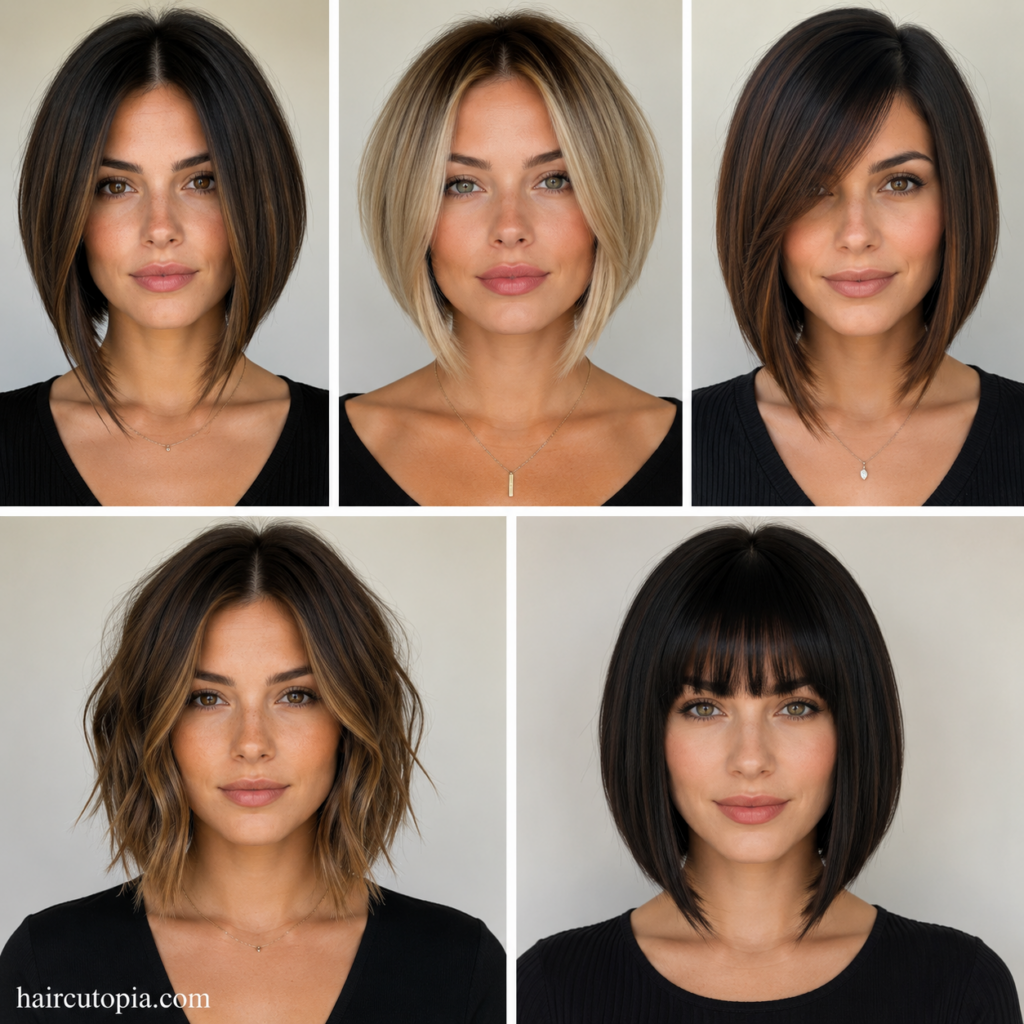
An A-line bob isn’t limited to straight hair.
On curly hair, the angled shape can create a beautiful cascade of curls that becomes gradually longer toward the face. The result can feel playful, dimensional, and full of movement.
Cutting curly hair requires careful consideration of shrinkage, however. The finished dry length may be considerably shorter than the wet length.
Working with a stylist experienced in curly hair can help ensure the final angle works with your natural curl pattern.
13. A-Line Bob for Fine Hair
A well-designed A-line bob can make fine hair appear fuller, especially when the perimeter remains relatively blunt.
Too many layers can sometimes remove density from fine hair, so a simpler shape may work better.
Keeping the back slightly shorter can also create natural lift and prevent longer strands from weighing everything down.
For styling, lightweight volumizing products are usually preferable to heavy creams or oils that can flatten fine hair.
14. A-Line Bob for Thick Hair
Thick hair can create an especially dramatic A-line silhouette, but removing some internal weight may make the haircut easier to manage.
Without enough shaping, a bob on very dense hair can become bulky around the bottom.
Subtle internal layers or carefully placed texture can reduce that heaviness without making the ends look thin.
A longer A-line bob can also work beautifully on thick hair because the additional length helps balance its natural volume.
15. A-Line Bob for Straight Hair
Straight hair naturally highlights the geometry of an A-line haircut.
Because the strands fall smoothly, the gradual change in length from back to front becomes easy to see.
You can keep the cut sharp and minimal or introduce subtle layers if you want a little more movement.
For an especially polished finish, blow-dry the hair with a round brush and lightly smooth the ends with a flat iron.
16. A-Line Bob With Side-Swept Bangs
Side-swept bangs complement the forward movement of an A-line bob.
Rather than creating a strong horizontal line across the forehead, the fringe flows diagonally and blends into the longer side of the haircut.
This can give the style a softer appearance while still providing plenty of face framing.
A deep side part can make the effect even more noticeable and add volume around the crown.
17. Side-Parted A-Line Bob
Sometimes you don’t need bangs or extra layers to update a bob. Changing the part can be enough.
A deep side part creates natural asymmetry and can give one side of the haircut more volume.
It works particularly well with an A-line shape because the longer front pieces naturally sweep around the face.
For a modern finish, wear one side tucked behind the ear while allowing the opposite side to fall forward.
18. Center-Parted A-Line Bob
A center part gives the A-line bob a clean, balanced appearance.
With the front pieces falling evenly on either side of the face, the symmetry highlights the haircut’s structure.
This style looks especially sleek when the hair is straight, but it also works beautifully with loose waves.
If your hair naturally falls in a different direction, you may need a little blow-drying at the roots to encourage the center part to stay in place.
19. Choppy A-Line Bob
For something less polished and more playful, consider a choppy A-line bob.
This variation uses uneven texture and piecey ends to break up the traditional smooth silhouette.
The result has more movement and often requires less precise daily styling. A few imperfect bends can actually make the haircut look better.
A small amount of texturizing paste worked through the ends can help create separation without making the hair stiff.
20. Sleek A-Line Bob
A sleek A-line bob puts the haircut’s shape front and center.
The hair is styled smooth and straight, allowing the clean angle to become the main feature. Depending on the cut, the front sections may end at the chin or extend several inches below it.
A heat protectant is important if you regularly use hot tools to achieve this finish.
You can also ask your stylist for a subtle bevel at the ends so the hair naturally curves inward rather than looking completely flat.
21. Tousled A-Line Bob
Not every bob needs a perfectly finished blowout.
A tousled A-line bob embraces soft bends, natural texture, and slightly messy separation. It’s a great option if you like hairstyles that look put together without appearing overly styled.
Loose waves can be created with a curling iron, flat iron, or heatless styling method.
Once the texture is in place, gently loosen it with your fingers and avoid overworking the hair.
22. A-Line Bob With Face-Framing Layers
Face-framing layers can soften the stronger lines of an A-line bob.
These shorter pieces typically begin somewhere around the cheekbones, jaw, or chin before blending into the longer front sections.
The effect can add movement around the face while preserving the overall angled silhouette.
It’s a particularly useful option if you want more dimension but don’t necessarily want bangs.
23. Dramatic Angled A-Line Bob
If you’re ready for a haircut that gets noticed, increase the angle.
A dramatic A-line bob has a much shorter back and noticeably longer front pieces. Viewed from the side, the diagonal line becomes one of the haircut’s defining features.
This version can look extremely sleek when straightened, although adding waves creates an interesting contrast between a structured cut and relaxed styling.
Keep in mind that a stronger angle usually requires more frequent trims to maintain its intended shape.
24. Soft A-Line Bob
An A-line haircut doesn’t have to feature a sharp, obvious angle.
A soft A-line bob uses only a slight difference between the back and front lengths. From the front, it may initially look like a traditional bob, with the subtle graduation becoming more visible from the side.
This understated version is ideal if you like classic hairstyles and want something that won’t feel dated quickly.
It can also be easier to grow out because there isn’t a huge difference between the shortest and longest sections.
25. Shoulder-Length A-Line Bob
A shoulder-length A-line bob gives you the shape of a bob while keeping enough length for plenty of styling options.
The back may sit slightly above the shoulders while the front sections reach the collarbone.
You can wear it straight, curled, wavy, or tucked behind the ears. Depending on your exact length, you may also be able to pull it into a low ponytail.
This is a great choice if you want a noticeable haircut change without going dramatically short.
What Is an A-Line Bob Haircut?
An A-line bob is a haircut that gradually becomes longer toward the front.
Traditionally, the back is the shortest part of the haircut, while the sections surrounding the face are longer. When viewed from the side, this creates a diagonal line that slopes downward toward the front.
The angle can range from extremely subtle to very dramatic.
Some A-line bobs have a solid perimeter with almost no layering. Others incorporate graduation, stacked layers, texture, or face-framing pieces.
That’s one reason the style is so adaptable. You aren’t limited to one exact version of the haircut.
A-Line Bob vs. Inverted Bob: What’s the Difference?
A-line and inverted bobs are closely related, which is why the terms are often used to describe similar haircuts.
Both generally feature shorter hair in the back and longer hair toward the front.
The main difference often comes down to graduation.
A classic A-line bob can have a relatively simple angled perimeter without significant stacking. An inverted bob typically incorporates more graduation or layering through the back, creating additional roundness and volume.
In practice, hairstylists may use the terms differently. If you have a specific shape in mind, showing reference photos and discussing the desired back, sides, and front lengths is more useful than relying entirely on the haircut’s name.
How to Choose the Right A-Line Bob
With so many variations available, choosing the right version is mostly about finding a balance between your hair texture, desired length, and styling routine.
Consider your natural texture
Straight hair tends to display the angle most clearly.
Wavy hair softens the shape and gives it more movement, while curly hair creates a fuller, more dimensional version of the cut.
Rather than fighting your natural texture every morning, consider choosing an A-line variation that works with it.
Think about how short you want to go
There’s a major difference between a jaw-length bob and a collarbone-length lob.
Before your appointment, think about whether you need to:
- Put your hair into a ponytail
- Tuck it behind your ears
- Wear it up for work or exercise
- Keep enough length for curling or braiding
If you’re uncertain, starting with a longer A-line bob gives you room to go shorter later.
Decide how dramatic you want the angle
A subtle angle creates a classic, understated look.
A steep angle makes the haircut much more noticeable.
If you want something easy to grow out, a softer A-line shape is usually the simpler option. If you’re specifically looking for a bold transformation, a dramatic angled or stacked bob may be more appealing.
Be realistic about styling
A sleek, precision bob can look effortless once it’s finished, but getting it there may require regular blow-drying or straightening depending on your natural texture.
Textured and tousled versions are generally more forgiving.
Tell your stylist how much time you actually want to spend on your hair each morning. That information can influence the best length, layering, and shape for you.
Which Face Shapes Suit an A-Line Bob?
One of the advantages of an A-line bob is how easily its proportions can be adjusted.
Instead of looking for one haircut that’s supposedly perfect for a particular face shape, focus on where the front pieces fall.
Longer sections around the jaw or below it can create a different effect than a shorter chin-length cut. Bangs, layers, volume, and part placement also influence the overall look.
For example:
- A longer front can visually elongate the face.
- Side-swept bangs can introduce diagonal movement.
- Curtain bangs can soften the area around the cheekbones.
- Crown volume can change the haircut’s overall proportions.
- Face-framing layers can make a structured bob appear softer.
A stylist can adjust these elements while keeping the basic A-line silhouette intact.
How to Style an A-Line Bob
The way you style an A-line bob can make the same haircut look completely different from one day to the next.
For a sleek finish
Start with a heat protectant and blow-dry the hair smooth.
Use a round brush if you want the ends to curve slightly inward, or follow with a flat iron for a straighter finish.
A small amount of smoothing serum can help control flyaways, but avoid applying too much near the roots.
For loose waves
Create waves through the mid-lengths while leaving the ends slightly straighter.
This keeps the hairstyle modern and prevents shorter bobs from becoming overly rounded.
Alternate the direction of some waves for a less uniform appearance, then loosen everything with your fingers.
For natural texture
If your hair already has waves or curls, you may not need much heat styling at all.
Apply products designed for your natural texture, gently shape the hair, and allow it to air-dry or use a diffuser.
The goal isn’t necessarily to make every curl identical. Allowing natural variation can give the bob more dimension.
For extra volume
Concentrate on the roots rather than loading the ends with product.
A volumizing mousse, root-lifting spray, or round-brush blowout can add height around the crown.
Changing your part can also temporarily create extra lift.
How to Maintain an A-Line Bob
Because the shape depends on a defined difference between the back and front lengths, regular trims help an A-line bob maintain its silhouette.
As the hair grows, the angle gradually becomes less noticeable.
How frequently you need a trim depends on your haircut. A sharp, short, or heavily stacked bob will usually show growth sooner than a longer, softer version.
Between salon visits:
- Use heat protectant before hot tools.
- Choose styling products suited to your hair texture.
- Avoid weighing down fine hair with excessive product.
- Condition the ends regularly, especially if you frequently heat-style.
- Pay attention to the back of the haircut, where lost shape may become noticeable first.
If you’re intentionally growing the bob out, your stylist can gradually soften the angle during each appointment.
What to Ask Your Stylist For
“A-line bob” can describe several different looks, so being specific at your appointment helps.
Discuss:
- Your preferred overall length
- How short you’re comfortable going in the back
- Where you want the front pieces to fall
- Whether you want a subtle or dramatic angle
- How much layering you prefer
- Whether you want stacking in the back
- Bangs or face-framing pieces
- How you normally style your hair
- How frequently you’re willing to get trims
If possible, bring a few reference photos showing both what you like and what you don’t like.
Two A-line bobs can look completely different depending on the angle, graduation, texture, and length. Clear references make it much easier for you and your stylist to agree on the final shape.
Is an A-Line Bob High Maintenance?
It depends on the version you choose.
A softly angled, shoulder-length bob can be relatively low maintenance because the shape grows out gradually.
A short, dramatically angled or heavily stacked bob usually requires more upkeep. Once the back grows, the original silhouette can change noticeably.
Your natural texture also matters.
Someone with naturally straight hair may find a sleek A-line bob very easy to style, while someone with curly or wavy hair may need more time if they want to wear the same cut completely straight every day.
If low maintenance is your priority, consider a longer A-line bob with subtle layering and a softer angle.
Final Thoughts
The A-line bob has lasted for a reason. Its simple shorter-in-the-back, longer-in-the-front shape provides a foundation that can be customized in dozens of ways.
You can keep it classic with a smooth, subtle angle, make it bold with a dramatically shorter back, add layers for movement, or embrace waves and curls for a softer finish.
If you’re unsure where to start, a longer A-line bob with a gentle angle is one of the easiest versions to try. You can always go shorter or add more graduation at your next appointment.
The best A-line bob isn’t necessarily the trendiest one. It’s the version that works with your natural hair, fits your styling routine, and gives you a shape you’ll actually enjoy wearing every day.
Related Posts
 Professional Butterfly Cut Haircuts: 29 Polished Layered Styles for Work and Everyday Elegance
 Bangs Haircuts: The Complete Guide to Fringe Styles, Lengths & Ideas
 Medium Long Layers Haircuts: 29 Stylish Ideas for Effortless Volume and Movement
 Long Bob Haircuts for Square Faces: 25 Soft and Stylish Lob Ideas to Flatter Strong Features