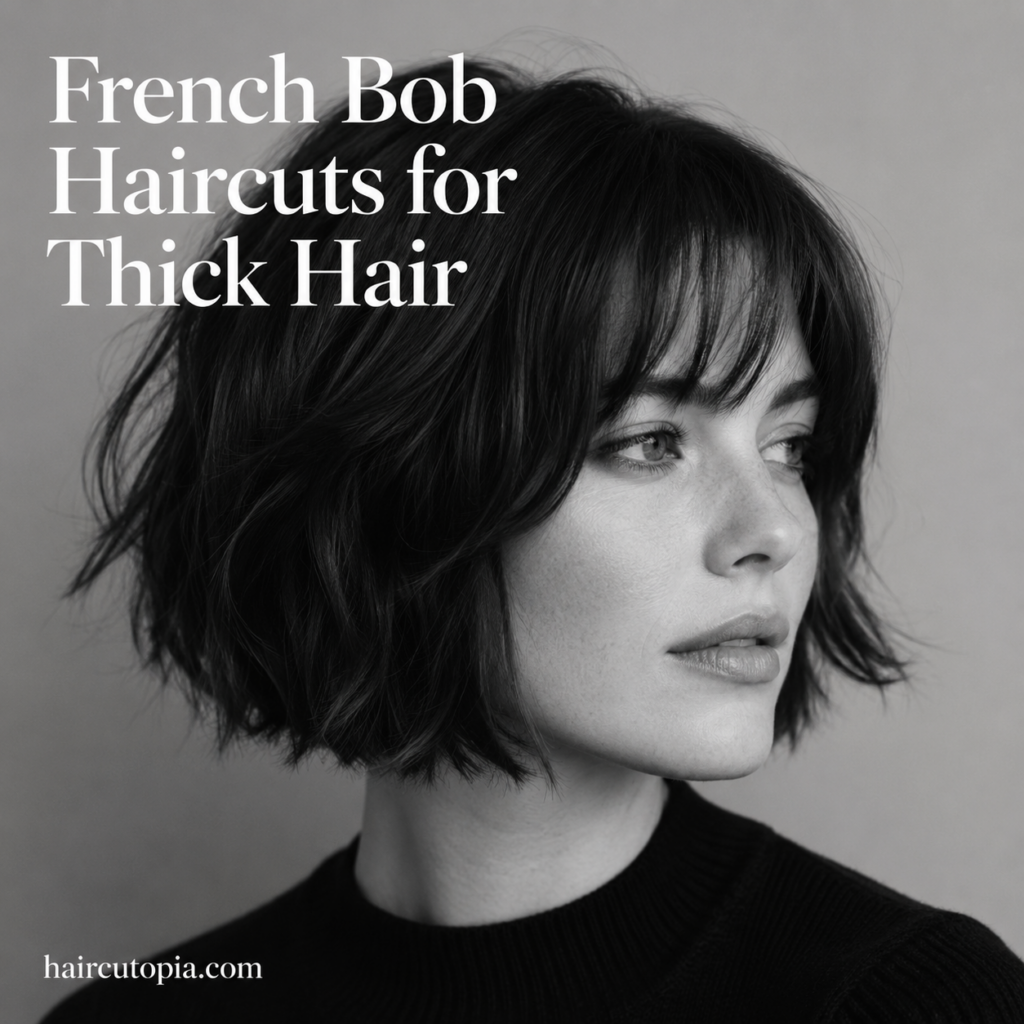
French bob haircuts have that rare ability to look polished without seeming overly styled. Short, slightly undone, and full of personality, the cut can be especially striking on thick hair.
The key is getting the shape right.
Because thick hair naturally has more density and volume, a French bob can look beautifully full and structured. But without thoughtful layering or weight removal, it can also become bulky around the sides and ends. The best versions work with your natural thickness instead of fighting it.
Whether you love a classic jaw-length bob, soft waves, wispy bangs, or something a little more modern, there are plenty of ways to make this iconic haircut work for thicker strands.
Here are 25 French bob haircuts for thick hair worth considering for your next salon visit.
What Is a French Bob?
A French bob is traditionally a short bob that falls somewhere around the jawline, often paired with bangs. Compared with longer, more structured bobs, it usually has a softer and slightly more relaxed finish.
Think less perfectly sculpted and more naturally chic.
Some French bobs are blunt and precise, while others have subtle layers, tousled texture, or loose waves. Bangs aren’t required either. Curtain bangs, wispy fringe, micro bangs, or an open forehead can all work beautifully with the cut.
For thick hair, the stylist may remove some internal weight so the bob keeps its signature shape without becoming too wide or heavy.
Why French Bobs Work So Well With Thick Hair
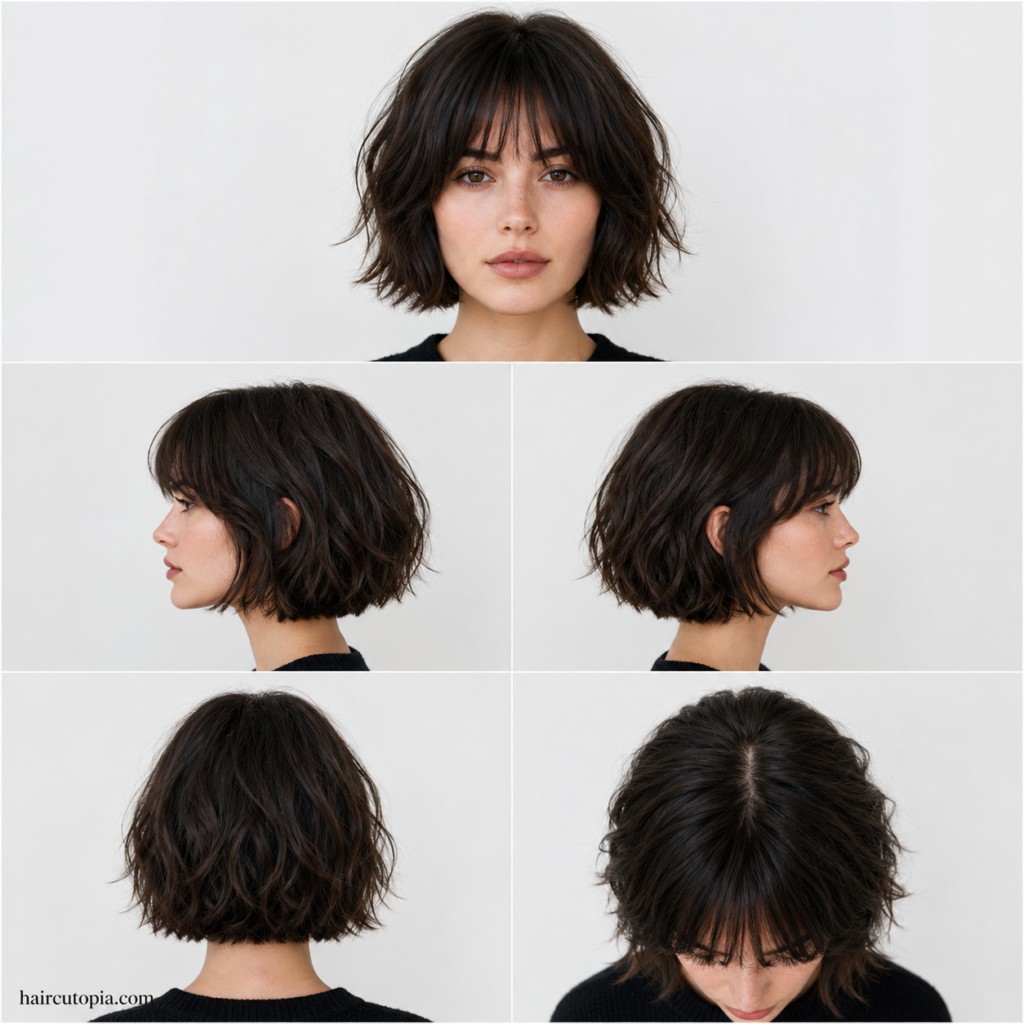
Thick hair already has something many shorter hairstyles try to create: natural fullness.
That density can give a French bob a gorgeous silhouette, especially around the jaw and cheekbones. It can also make textured versions of the haircut look fuller and more effortless.
A few details make a big difference:
- Internal layers can remove bulk without making the haircut look heavily layered.
- Textured ends create movement and prevent a blocky finish.
- Slight graduation can help the hair sit closer to the head.
- Face-framing pieces can soften a strong jaw-length shape.
- The right fringe can balance the volume of thick hair.
Your natural texture matters too. Straight, wavy, and curly thick hair will each create a very different version of the French bob.
1. Classic Jaw-Length French Bob
The classic jaw-length French bob is an ideal starting point if you love clean, timeless hairstyles.
The hair is cut around the jaw with a relatively blunt perimeter, creating a strong silhouette that naturally draws attention to the face. On thick hair, the shape can look especially luxurious because the ends appear naturally full.
Ask your stylist about removing some weight internally if your hair tends to expand at the sides. This preserves the blunt appearance while making the haircut easier to manage.
2. French Bob With Wispy Bangs
Wispy bangs bring softness to the heavier shape of a thick French bob.
Instead of a dense fringe covering the entire forehead, these bangs are lightly textured so small sections of skin remain visible. That little bit of openness can keep thick hair from feeling overwhelming around the face.
This combination works particularly well if you want bangs but aren’t ready for a full, heavy fringe.
3. Wavy French Bob for Thick Hair
Natural waves and French bobs are an easy match.
A jaw-length cut gives thick, wavy hair enough structure to create a recognizable bob while allowing the natural bends and curves to keep it relaxed.
The goal isn’t necessarily to make every wave identical. A slightly imperfect finish is part of the appeal.
Try scrunching a small amount of lightweight styling cream into damp hair and letting your natural texture do most of the work.
4. Blunt French Bob
A blunt French bob creates a bold, graphic shape.
The perimeter is kept relatively even, giving thick hair a dense and substantial appearance at the ends. This can look particularly striking on straight or slightly wavy hair.
The challenge is controlling excess bulk. Your stylist can subtly remove weight from underneath while maintaining the appearance of a strong blunt line from the outside.
5. Layered French Bob for Thick Hair
Layers can completely change how a short bob behaves.
Instead of allowing all your hair to sit at one length, subtle layering creates movement and reduces some of the density through the interior.
The result still looks like a French bob rather than a heavily layered haircut, but it may feel considerably lighter.
This is a particularly useful option for very thick hair that tends to become triangular when cut short.
6. French Bob With Curtain Bangs
Curtain bangs give the traditional French bob a softer, modern update.
The fringe separates around the center and gradually blends into the sides of the haircut. Because the forehead isn’t completely covered, the style can feel more open than a classic full fringe.
Curtain bangs are also versatile. Wear them swept outward for a polished look or let them fall naturally for something more casual.
7. Tousled French Bob
A French bob doesn’t need to look perfectly arranged.
In fact, a slightly tousled finish can make the haircut feel even more effortless.
Thick hair provides plenty of natural body for this style. Subtle layers and textured ends help individual sections move independently instead of forming one solid shape.
A little texture spray can add separation, but avoid using too much product. Thick hair already has volume, so the goal is definition rather than additional fullness.
8. Chin-Length French Bob
If jaw-length feels slightly too short, bring the perimeter down toward the chin.
That small amount of extra length can make a noticeable difference, particularly if your hair tends to puff up after drying.
A chin-length French bob still has the compact proportions associated with the style while giving thick hair a little more weight to help it fall naturally.
9. French Bob With Full Bangs
Full bangs create one of the most recognizable French bob combinations.
The fringe can sit around the brows while the rest of the hair falls near the jaw, framing the eyes and cheekbones.
Because both the bob and bangs can be dense on thick hair, balance is important. Your stylist may lightly texture the fringe so it moves naturally rather than sitting like one heavy section.
10. Textured French Bob
A textured French bob is a great choice if you don’t want your short haircut to look overly precise.
The ends are softened and separated rather than forming a perfectly solid line. On thick hair, this helps break up density and creates a lighter overall appearance.
The texture can be subtle or more noticeable depending on the finish you prefer.
11. French Bob Without Bangs
Bangs aren’t essential to getting the French bob look.
Leaving the forehead open creates a cleaner, simpler shape and puts more emphasis on the jaw-length perimeter.
A center or slightly off-center part works especially well. You can also tuck one side behind your ear for an understated asymmetrical effect.
This version may require less maintenance if you don’t want regular fringe trims.
12. Side-Parted French Bob
Changing the part can dramatically alter a short haircut.
A side part creates natural lift around the crown while allowing the opposite side to sit closer to the face. That subtle imbalance gives a French bob movement without requiring dramatic layers.
For thick hair, a deeper part can create considerable volume, so experiment with placement until you find the right balance.
13. Sleek French Bob for Thick Hair
Prefer something polished?
A sleek French bob emphasizes the clean geometry of the haircut. Smooth strands and carefully shaped ends create a sophisticated silhouette that works particularly well with naturally straight hair.
Thick hair may require some internal weight removal to achieve this flatter finish.
When heat styling, work in sections rather than repeatedly passing a flat iron over large amounts of hair.
14. French Bob With Micro Bangs
Micro bangs add an edgier element to the classic French bob.
The fringe sits noticeably above the eyebrows, leaving more of the forehead exposed. Paired with a jaw-length bob, it creates a distinctive frame around the face.
Because this combination makes a strong visual statement, talk with your stylist about exactly where the bangs should fall before making the cut.
15. Softly Layered French Bob
Not every layered bob needs obvious, choppy pieces.
Soft layers can be almost invisible while still removing enough weight to help thick hair move.
This approach is ideal if you like the solid outline of a traditional French bob but want something that feels lighter when you run your fingers through it.
The layers can also help naturally wavy hair settle into a more balanced shape.
16. Curly French Bob for Thick Hair
Thick curly hair can create a beautiful French bob with plenty of personality.
Instead of forcing curls into a perfectly straight perimeter, the haircut can be shaped around how individual curls naturally spring.
Remember that curls may become noticeably shorter once dry. A stylist experienced with curly hair can account for shrinkage and build the final silhouette around your natural pattern.
A longer starting length may be helpful if you’re unsure how much your curls will bounce up.
17. French Bob With Face-Framing Layers
Face-framing layers soften the transition between bangs, sides, and the main perimeter of the bob.
These shorter sections can sit around the cheekbones or gradually blend toward the jaw.
For thick hair, they also remove a little density from the front, helping prevent the haircut from feeling too heavy around the face.
18. Rounded French Bob
A rounded French bob creates a softer silhouette than a sharply blunt version.
The shape follows the natural curve of the head and gently bends toward the jaw. Thick hair provides enough density to make this rounded outline look full without requiring excessive styling.
Subtle graduation toward the back can help maintain the shape.
19. French Bob With Piecey Bangs
Piecey bangs sit somewhere between a full fringe and wispy bangs.
Instead of forming one continuous line, the fringe separates into defined sections. This creates texture and keeps the forehead partially visible.
It’s an easy way to give a dense French bob a little more visual breathing room.
Use only a tiny amount of styling product on the bangs. Too much can make separated pieces look oily rather than intentionally textured.
20. Jaw-Length Bob With Tucked Sides
Sometimes the styling makes the haircut.
A simple jaw-length French bob takes on a completely different character when one or both sides are tucked behind the ears.
This exposes more of the cheekbones and jawline while reducing the visual volume around the sides of the head.
It’s also an easy styling option on days when you want your hair away from your face without putting it up.
21. French Bob With Flipped Ends
A slight outward flip gives the French bob a playful finish.
Instead of turning inward toward the jaw, selected ends curve gently outward. The movement breaks up the solid shape of thick hair and adds a subtle retro influence.
Keep the flip soft rather than perfectly uniform for a more modern result.
22. Air-Dried French Bob
If your thick hair already has natural texture, consider choosing a cut designed around air-drying.
The stylist can shape the bob according to your natural movement rather than creating something that only looks right after a blowout.
Soft internal layers and carefully placed weight removal are especially useful here.
Apply your preferred leave-in or styling cream while the hair is damp, arrange your part, and allow the shape to develop naturally as it dries.
23. French Bob With Bottleneck Bangs
Bottleneck bangs combine shorter fringe through the center with longer sections toward the sides.
That gradual transition creates a flattering frame around the eyes and cheekbones while blending naturally into a short bob.
For thick hair, the fringe can be lightly thinned or textured to prevent it from becoming overly dense.
It’s a good middle ground between curtain bangs and a traditional full fringe.
24. Slightly Angled French Bob
A subtle angle can give the French bob extra structure.
The back is kept slightly shorter while the front pieces extend a little farther toward the chin. The difference doesn’t need to be dramatic.
On thick hair, this shape can help redistribute volume and create a more elongated silhouette around the face.
It also gives you slightly longer front pieces to tuck behind the ears.
25. Shaggy French Bob
For something less polished, consider a shag-inspired French bob.
Short layers, textured ends, and relaxed fringe give the haircut plenty of movement. Instead of creating one dense shape, the layers encourage thick hair to separate into softer sections.
This style works particularly well with natural waves and loose curls.
It also embraces a little frizz and imperfection, making it a good option if you prefer hairstyles that don’t need to look freshly styled all day.
How to Choose a French Bob for Thick Hair
The photos you bring to your stylist are a starting point, but your own hair will ultimately determine how the cut behaves.
Before choosing a version, consider a few things.
Your Natural Texture
Straight thick hair can create a very defined bob shape, while waves and curls naturally make the perimeter softer.
If you usually wear your hair air-dried, show your stylist how it behaves naturally before the cut begins.
How Much Volume You Want
Some people love the fullness thick hair creates in a short bob. Others want the shape to sit flatter.
Tell your stylist which you prefer.
Techniques such as internal layering, graduation, and selective weight removal can significantly change the final amount of volume.
Your Preferred Maintenance Level
A short bob isn’t necessarily difficult to maintain, but it does require regular reshaping.
Bangs usually increase that maintenance because they grow out more noticeably.
If you’d rather stretch the time between salon appointments, a slightly longer bob without a short fringe may be easier to manage.
Your Face-Framing Preference
A French bob naturally draws attention toward the face.
Decide which features you’d like the haircut to emphasize. Jaw-length ends can highlight the jawline, while bangs bring attention toward the eyes.
Longer curtain or bottleneck bangs create a softer frame around the cheekbones.
What to Ask Your Stylist
Clear communication is particularly important when cutting thick hair short.
Instead of simply requesting a “French bob,” discuss the specific shape you want.
You might ask about:
- The best length for your natural texture
- Whether internal layers would reduce unwanted bulk
- How the haircut will look when air-dried
- Whether your preferred bangs work with your hairline
- How much styling the cut will require
- How the shape will grow out
- How frequently you’ll need trims
Bring a few reference photos rather than only one. Showing examples of both what you like and what you don’t like can make your preferences much clearer.
How to Style a French Bob With Thick Hair
One of the best things about a French bob is that it doesn’t always need elaborate styling.
For a Natural Finish
Apply a small amount of lightweight leave-in product or styling cream to damp hair.
Create your part, gently shape the hair with your fingers, and allow it to air-dry whenever your natural texture cooperates.
For Soft Waves
Create a few loose bends with a curling iron or flat iron rather than curling every section.
Alternate the direction of the waves and leave some ends straighter. This prevents the finished style from looking too uniform.
For a Sleek Finish
Apply heat protectant before blow-drying the hair in sections.
Use a brush to guide the ends into the desired shape. If necessary, follow with a flat iron on areas that need additional smoothing.
For Extra Texture
Use a small amount of texture spray or lightweight styling product on dry hair.
Concentrate on the mid-lengths and ends rather than the roots. Thick hair already has plenty of natural volume, so adding too much product near the scalp can make the style feel unnecessarily heavy.
How Often Should You Trim a French Bob?
Shorter hairstyles tend to show growth more quickly than long hair.
Many people find that a French bob benefits from reshaping approximately every six to eight weeks, although the ideal schedule depends on the cut, your growth rate, and how precise you want the silhouette to remain.
Bangs may need attention sooner.
A highly structured blunt bob will generally show growth faster than a tousled or layered version, which can often transition more naturally as it gets longer.
Is a French Bob High Maintenance on Thick Hair?
It can be, but it doesn’t have to be.
A very sleek, blunt bob with full bangs will usually require more regular styling and trimming than a textured bob designed around your natural hair pattern.
The haircut itself plays a major role.
When thick hair is properly shaped and excess weight is removed in the right places, it can settle into a French bob surprisingly easily. If the cut ignores your natural density, you may end up spending more time trying to control the volume.
That’s why choosing a stylist who is comfortable working with thick hair can make such a difference.
Final Thoughts on French Bob Haircuts for Thick Hair
A French bob and thick hair can be an excellent combination.
Natural density gives the haircut fullness and presence, while thoughtful layering, texturing, and weight removal can keep the shape from becoming bulky.
You can keep things classic with a jaw-length blunt bob and bangs, embrace natural waves with a tousled version, or modernize the look with curtain bangs, subtle layers, or a slightly angled shape.
The most flattering version isn’t necessarily the one that looks perfect in a reference photo. It’s the one designed around your own texture, density, and everyday styling routine.
Find that balance, and the French bob can become one of those rare short haircuts that feels stylish without requiring you to make it look perfect every morning.
Related Posts
 Short Haircuts for Curly Hair: 25 Stylish Ideas, Tips, and Maintenance Guide
 Haircuts for Women with Thin Hair: 25 Flattering Styles That Add Volume and Confidence
 Haircuts for Long Faces and Thick Hair: 25 Flattering Styles That Balance Volume Beautifully
 Haircuts for Women with Long Faces: 25 Flattering Styles That Create Beautiful Balance