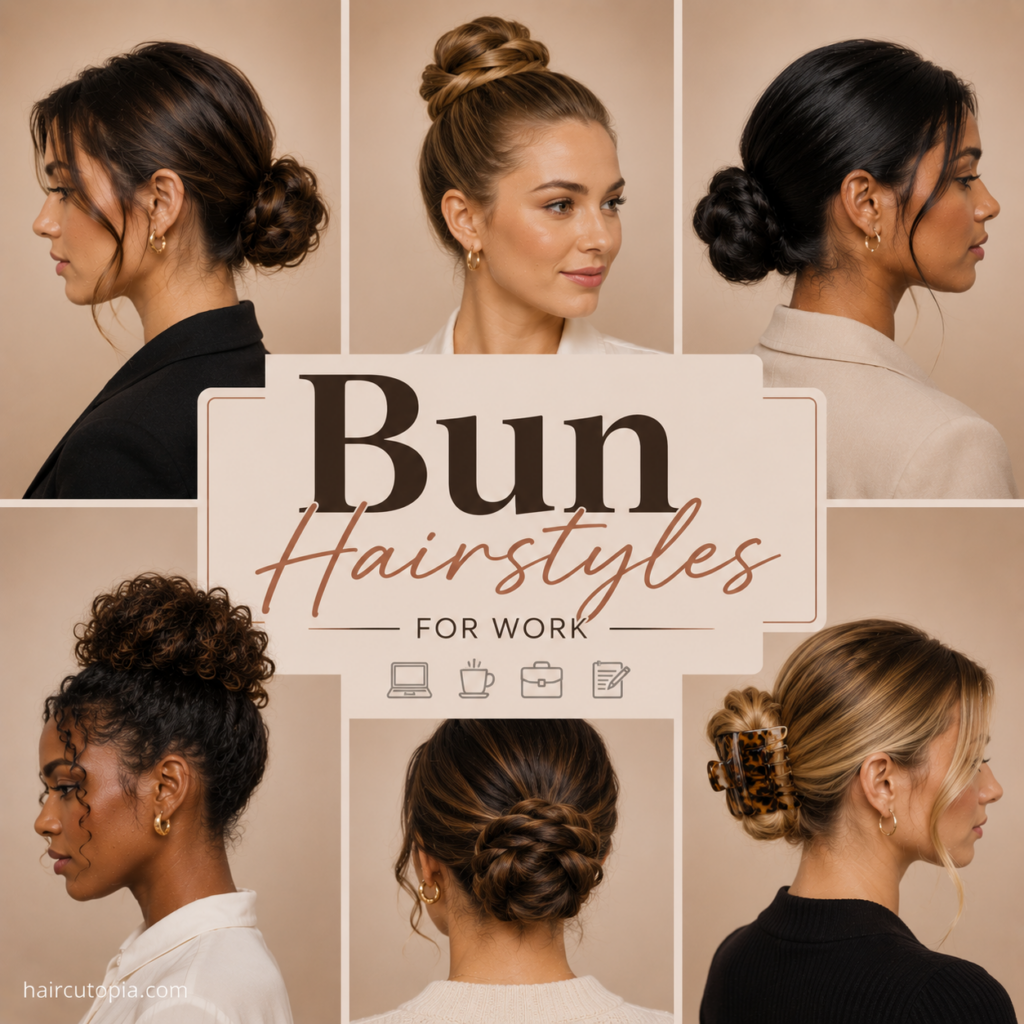
A bun is one of those hairstyles that just makes sense for work. It keeps your hair out of the way, works with everything from casual office clothes to more formal business attire, and doesn’t necessarily require much time in the morning.
The trick is finding a bun that looks intentional without turning your morning routine into a hairstyling session.
Some workplaces call for a sleek, polished finish. Others are relaxed enough for messy buns, claw clips, curls, and more natural texture. And if you’re working from home, your definition of “professional” may simply mean something that looks presentable on a video call and stays comfortable until the end of the day.
From classic low buns to braided, curly, twisted, and quick five-minute styles, here are 25 bun hairstyles for work that balance practicality with polish.
Why Buns Work So Well for the Workplace
A good work hairstyle needs to do more than look nice at 8:30 in the morning.
Ideally, it should stay comfortable and reasonably intact throughout the day.
Buns work particularly well because they can:
- Keep hair away from your face
- Keep long hair contained
- Work with professional and casual outfits
- Transition easily from work to evening plans
- Accommodate different hair textures
- Take only a few minutes to create
- Stay secure without constant adjustment
You can also change the overall feel simply by moving the bun higher or lower.
A sleek low bun tends to look more formal. A loose mid-height bun feels relaxed. A high bun creates a little more energy and can be particularly practical when you want all your hair off your neck.
1. Classic Low Work Bun
The classic low bun is hard to beat for versatility.
Gather your hair at the nape and secure it in a ponytail. Twist the length around itself and wrap it around the base.
Tuck the ends underneath and secure the bun with bobby pins.
You can create this style with a center part, side part, or no visible part at all.
Keep the front smooth for a traditional office look or leave a little natural texture if your workplace is more relaxed.
2. Sleek Center-Part Bun
A clean center part gives a low bun a modern, polished finish.
Part your hair evenly and brush both sides toward the nape.
Secure a low ponytail, twist it into a compact bun, and pin the ends underneath.
A small amount of styling cream can help control obvious flyaways without making the hair look overly stiff.
This is an especially good choice for presentations, interviews, client meetings, and more formal workdays.
3. Side-Part Low Bun
If you prefer a softer front, try a side part.
Create your part first, then gather the hair into a low ponytail.
Twist and pin the bun at the nape.
A subtle side part keeps the style understated, while a deeper one creates a little more shape around the front.
If you have shorter face-framing layers, you can tuck them behind the ears or leave one small section loose.
4. Polished Mid-Height Bun
Moving the bun a few inches higher can make a familiar hairstyle feel completely different.
Gather your hair around the middle of the back of your head rather than directly at the nape.
Create a smooth bun and secure it firmly.
A mid-height placement feels polished but slightly less formal than a very sleek low bun.
It can also be comfortable if you spend much of your workday sitting against a high-backed chair.
5. Simple High Bun for Work
High buns aren’t only for workouts and weekends.
Keep the shape compact and the front relatively neat, and a high bun can work well in many professional settings.
Gather the hair near the crown, twist the ponytail, and wrap it around the base.
Secure the ends underneath.
If your hair is long or thick, avoid pulling the ponytail excessively tight. A secure base plus a few well-placed pins should do the work.
6. Easy Five-Minute Work Bun
Running late?
Gather your hair into a low ponytail, twist the length, wrap it around the base, and add two or three pins.
Smooth the front with your hands and move on.
The key is keeping the shape reasonably neat rather than trying to make every strand perfect.
This is the kind of hairstyle worth practicing until you can create it without thinking.
7. Soft Low Bun
Not every professional bun needs a slick finish.
Gather your hair loosely at the nape, preserving some natural volume around the crown.
Twist the length into a bun and pin it securely.
Keep the looseness controlled rather than pulling random sections out everywhere.
The result feels softer and more relaxed while still looking put together.
8. Work Bun With Face-Framing Pieces
A few front pieces can make a bun feel less severe.
Leave one small section near each temple before pulling your hair back.
Create a low or mid-height bun, then adjust the loose pieces.
If necessary, add a gentle bend so they sit naturally around the face.
Keep the sections relatively subtle for a professional finish.
9. Work Bun With Curtain Bangs
Curtain bangs work naturally with buns because you don’t need to force the shorter front pieces backward.
Style the bangs away from your face and pull the remaining hair into a bun.
A low placement creates a softer, classic look.
A higher bun feels a little more casual and contemporary.
Either way, the bangs provide enough movement around the front that the hairstyle doesn’t feel overly strict.
10. Easy Twisted Work Bun
Twists add detail without adding much time.
Create a low ponytail and divide it into two sections.
Twist both sections, then wrap them around the base in opposite directions.
Secure the ends underneath with pins.
This can look more elaborate than a standard bun while still being easy enough for a weekday morning.
11. Braided Low Bun
If you can create a basic three-strand braid, you can make this style.
Pull your hair into a low ponytail and braid the length.
Secure the end with a small elastic, then wrap the braid around the base.
Pin it into place.
Keep the braid tight for a more structured appearance or loosen it slightly before wrapping if you want a fuller bun.
12. Bun With Side Twists
Side twists can help shorter layers stay contained while adding a little visual interest.
Leave out a section on each side before creating a low bun.
Twist each section toward the back and pin the ends around the bun.
This technique works particularly well with medium or layered hair because the shorter side pieces don’t need to reach the ponytail elastic.
13. Low Curly Work Bun
There’s no need to straighten curly hair just to create a polished work hairstyle.
Gather your curls toward the nape and secure them comfortably.
Instead of twisting everything tightly, arrange individual curly sections around the base.
Pin them where they naturally fall.
You can smooth the perimeter if you prefer a more defined contrast or keep the natural texture visible throughout.
14. High Curly Bun
A high curly bun keeps your hair completely away from your face while showing off the natural texture.
Gather your curls near the crown.
Arrange the length loosely around the base rather than compressing everything into a tight twist.
Secure the shape with pins.
Leave a couple of curls around the front if that suits your usual style, or keep everything pulled back for a cleaner silhouette.
15. Wavy Textured Work Bun
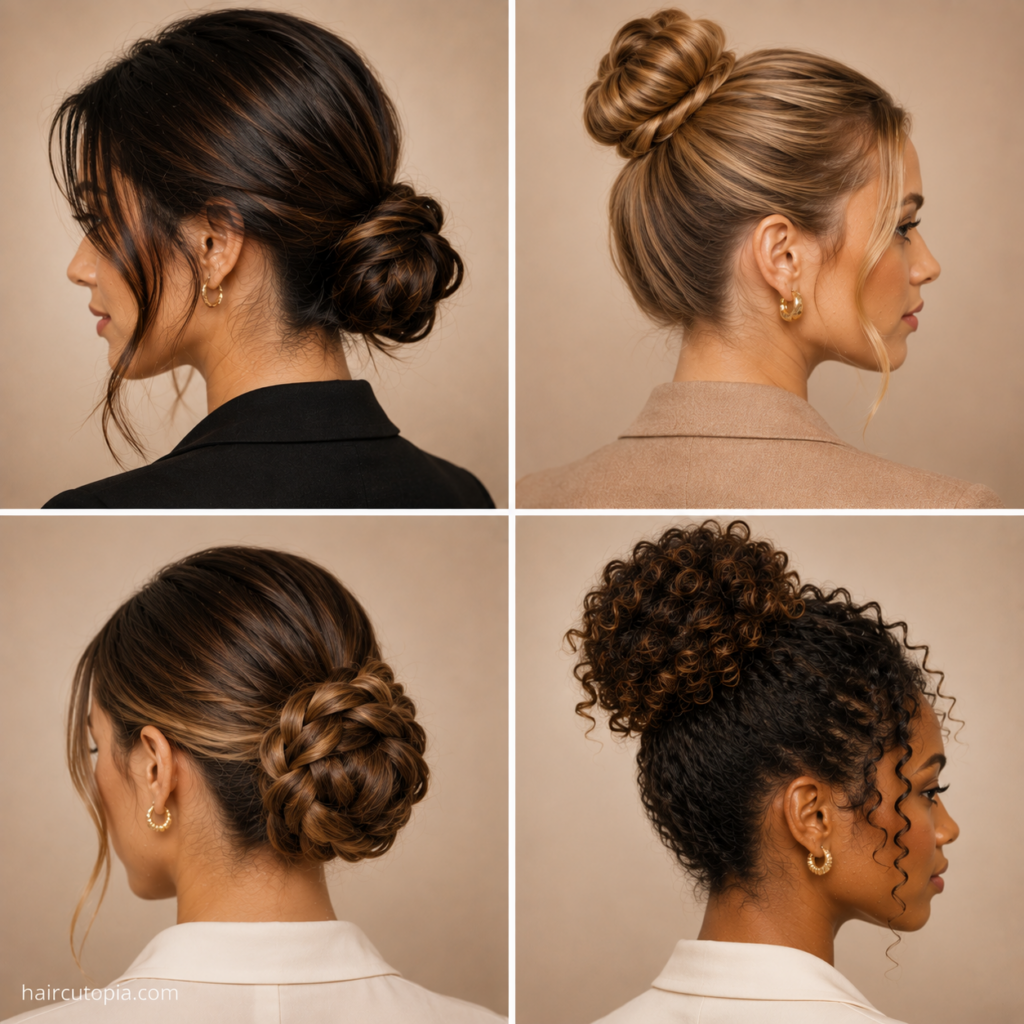
Wavy hair can create a polished bun without needing to be brushed completely smooth.
Gather your hair into a low or mid-height ponytail while preserving some texture.
Twist or pin sections around the base.
Keep the shape secure, but don’t worry about eliminating every wave.
The texture gives the bun dimension and makes a relatively simple hairstyle look more detailed.
16. Claw-Clip Bun for the Office
Claw clips can work in many casual and business-casual workplaces when the finished style looks intentional.
Gather your hair at the back and twist it upward.
Fold the remaining length toward the base and secure it with a simple claw clip.
Neutral, tortoiseshell, metallic, or minimalist clips tend to create a more understated look than oversized novelty styles.
If your workplace has a formal dress code, a traditional pinned bun may be the safer choice.
17. Half-Up Work Bun
If you prefer wearing your hair down, a half-up bun keeps the front controlled without pulling everything back.
Gather the upper section from around your temples and crown.
Create a small bun at the back and leave the remaining hair loose.
Keep the lower section naturally straight, wavy, curly, or coily.
This style tends to work best in more relaxed or creative workplaces.
18. Minimalist Knot Bun
A small knot-shaped bun creates a clean, understated appearance.
Gather your hair low and divide the ponytail into sections.
Fold or tie the hair into a knot-like shape, then tuck the ends underneath.
Pin everything securely.
The finished bun doesn’t need to be large. Its compact shape is part of what makes it look polished.
19. Sleek Ballerina Bun
A ballerina-inspired bun is useful when you want every section completely contained.
Brush your hair back smoothly and secure it at a low or mid-height position.
Twist the ponytail tightly and wrap it close to the base.
Pin the ends underneath.
This style works particularly well on days when you have meetings, presentations, or other situations where you want a very clean silhouette.
20. Low Bun With Tucked-Behind-the-Ears Styling
Sometimes the front of the hairstyle makes the biggest difference.
Create a center or subtle side part and tuck both sides behind your ears.
Gather the remaining hair into a low bun.
This exposes more of the face and creates a simple, streamlined shape.
It also pairs nicely with glasses and understated earrings.
21. Quick Loop Bun
A loop bun is useful when you want something fast.
Begin making a regular ponytail, but on the final pass through the elastic, stop before pulling the hair all the way through.
Leave it folded into a loop.
Tuck or wrap the loose ends around the base and secure them if necessary.
For work, keep the loop relatively compact rather than pulling it apart into a very messy shape.
22. Professional Bun for Shorter Hair
Short and medium-short hair can still create a polished work bun if enough length reaches the nape.
Gather what you can into a small low ponytail.
Twist or fold the length into a compact bun and secure it.
Use bobby pins for shorter sections around the sides and nape.
Don’t worry about creating a large bun. A small, clean shape can look completely professional.
23. Professional Bun for Long Hair
Long hair gives you plenty of material, but keeping the bun comfortable becomes important.
Create a low or mid-height ponytail and twist the length around the base.
Use several pins to distribute the weight.
If the bun becomes too large, twist the ponytail more tightly before wrapping it.
For especially long or thick hair, a lower placement may feel better over an eight-hour workday than a high bun.
24. Professional Bun for Thick Hair
Thick hair usually doesn’t need help creating volume.
Instead, focus on security.
Use a strong elastic and divide the ponytail into two or more sections.
Wrap and pin each section individually around the base.
This distributes the hair more evenly and can be easier than trying to control one very thick twist.
Choose a comfortable placement and avoid relying on excessive tension.
25. Work-to-Dinner Bun
If you’re going somewhere after work, choose a bun that can easily be softened later.
Start the day with a polished low or mid-height bun.
After work, gently loosen the crown and pull out one or two face-framing pieces.
If you have a decorative pin or small accessory, add it to one side of the bun.
A few small changes can take the hairstyle from office-ready to dinner-ready without starting over.
Best Bun Hairstyles for Different Work Environments
Not every workplace has the same definition of professional.
Your hairstyle can reflect the environment while still looking intentional.
Corporate and Formal Offices
Clean, structured styles are easy choices.
Consider:
- Sleek low buns
- Center-part buns
- Side-part buns
- Ballerina buns
- Compact mid-height buns
- Braided low buns
You don’t necessarily need a perfectly slick finish, but keeping the overall shape controlled usually works well.
Business-Casual Offices
You have more room to play with texture.
Soft low buns, curly buns, side twists, braided styles, and understated claw clips can all fit naturally.
Creative Workplaces
Creative environments often allow more individuality.
You might try textured buns, half-up styles, high curly buns, braids, accessories, or more relaxed shapes.
Remote Work
For video calls, the front and upper silhouette matter more than the back of the hairstyle.
A high bun, top knot, half-up bun, or simple low style can all work.
Just remember that a very low bun may disappear completely on camera.
Active Work Environments
If your job involves frequent movement, prioritize security.
A compact braided bun, ballerina bun, or firmly pinned low bun may hold better than a loose style.
Work Bun Hairstyles for Different Hair Lengths
Hair length affects which styles will be easiest to maintain throughout the day.
Shorter Hair
Low placement is usually your friend.
Try a small low bun, pinned twist, half-up bun, or compact loop style.
Use bobby pins for sections that don’t reach the elastic rather than pulling the hair tighter.
Medium Hair
Medium and shoulder-length hair are particularly versatile.
You can wear:
- Sleek low buns
- Messy-but-polished buns
- Mid-height styles
- Braided buns
- Twisted buns
- Claw-clip buns
- Curly buns
Layers may require a few additional pins.
Long Hair
Long hair works with almost every bun style, but weight becomes more important.
Low and mid-height buns are often comfortable for extended wear.
If you prefer a high bun, make sure the base is secure without being painfully tight.
Work Buns for Different Hair Textures
You don’t need to change your natural texture to make a bun appropriate for work.
Straight Hair
Straight hair works especially well with sleek low buns, ballerina styles, center parts, and compact knot buns.
If your hair is very smooth, lightweight texture can help pins grip.
Wavy Hair
Waves add dimension to soft and twisted buns.
Use your fingers when gathering the hair if you want to preserve the texture.
Curly Hair
Curly buns can look both polished and expressive.
Arrange curls around the base rather than tightly twisting them together.
Coily Hair
Coily textures can create full buns, puffs, braided updos, and sculpted styles.
You can smooth the perimeter if desired or let your texture remain visible throughout.
Fine Hair
Fine hair may create a smaller bun, and that’s completely fine.
If you want more fullness, use loose waves, a softer twist, or strategic pinning.
Thick Hair
Thick hair benefits from strong elastics and multiple pins.
Dividing the ponytail into sections can make the bun easier to control and more comfortable.
How to Make a Bun Look More Professional
You don’t have to make your hair completely slick.
Focus on a few areas that create an intentional finish.
Start With a Clear Shape
Choose your placement before you begin.
A bun that sits intentionally at the nape, middle, or crown generally looks more polished than one that ended up somewhere by accident.
Define the Front
Use a center part, side part, or smoothly brushed-back front.
Any of these can work.
Secure Loose Sections
If a large section is falling out, pin it.
A few tiny flyaways usually aren’t a problem.
Keep Accessories Understated
Simple clips, pins, barrettes, and elastics can complement the hairstyle without distracting from it.
Make Comfort Part of the Plan
A professional hairstyle shouldn’t require constant touching or readjusting.
If it’s uncomfortable at 9 a.m., it’s probably going to feel much worse by 3 p.m.
How to Create an Easy Work Bun in Five Minutes
A polished low bun is one of the simplest styles to master.
- Choose a center or side part.
- Gather your hair at the nape.
- Secure it with an elastic.
- Twist the ponytail.
- Wrap the twist around the base.
- Tuck the ends underneath.
- Secure the bun with bobby pins.
- Smooth or adjust the front as needed.
Once you know this basic technique, you can create several variations without learning a completely different hairstyle.
How to Keep a Work Bun Comfortable All Day
The biggest mistake is assuming tighter automatically means better.
It doesn’t.
A bun can be secure without pulling hard against your scalp.
Try these adjustments:
- Move a heavy bun lower.
- Use multiple pins to distribute weight.
- Avoid repeatedly tightening the elastic.
- Pin shorter sections separately.
- Rotate your bun placement from day to day.
- Choose an elastic suited to your hair thickness.
If your scalp starts hurting, take the bun down and restyle it.
Comfort matters when you’re wearing the hairstyle for most of the day.
How to Keep a Work Bun From Falling Apart
Start with a stable base.
If your hair is extremely smooth, a small amount of texture can help.
Once the ponytail is secure, place pins around multiple sides of the bun rather than relying on one or two pins in the same area.
For thick or long hair, divide the ponytail into sections and secure each one individually.
Keep a couple of spare pins nearby if necessary, but a properly supported bun shouldn’t require constant maintenance.
Bun Hairstyles for Work With Glasses
Buns and glasses work particularly well together because the hair can stay away from the sides of the face.
A center-part low bun with the hair tucked behind the ears creates a clean look.
You can also try a side part or leave soft face-framing pieces.
Just make sure the hair around your ears isn’t so tightly pinned that the arms of your glasses become uncomfortable.
Bun Hairstyles for Work From Home
Working from home gives you a little more flexibility.
A messy bun, high bun, claw-clip style, or half-up bun can all work well for video calls.
Think about what the hairstyle looks like from the front.
A little crown volume can help prevent a low bun from making your hair appear completely flat on camera.
And if you only have five minutes before the meeting starts, a clean front matters more than creating a perfect bun nobody can actually see.
Should a Work Bun Be Sleek or Textured?
Either can work.
A sleek bun creates a more traditional, formal appearance.
A textured bun feels softer and more relaxed.
Your workplace, personal style, natural hair texture, and outfit can all influence which one makes more sense.
Professional hair doesn’t have to mean perfectly straight, completely slick, or identical from person to person.
The hairstyle simply needs to feel intentional and appropriate for your environment.
What You Need for Work Bun Hairstyles
A small styling kit can handle most work buns:
- Hair elastics
- Bobby pins
- U-shaped hairpins
- Small clear elastics
- Brush or comb
- Lightweight styling cream or gel
- Optional texturizing product
- Simple claw clip
Keeping a couple of spare pins and an elastic at work can also come in handy.
Frequently Asked Questions About Bun Hairstyles for Work
Are buns professional for work?
Yes. Buns are widely adaptable and can work in formal, business-casual, creative, remote, and active workplaces. The styling and overall finish can be adjusted to suit the environment.
What is the best bun hairstyle for the office?
A classic or sleek low bun is one of the most versatile options. Mid-height buns, braided buns, curly buns, and twisted styles can also work well.
Is a messy bun appropriate for work?
It depends on the workplace and how the bun is styled. A softly textured bun with a secure base can work well in many business-casual and creative environments, while a more formal office may call for a cleaner finish.
How do I make a bun look professional?
Choose a deliberate placement, keep the overall shape secure, style the front intentionally, and control distracting loose sections. You don’t need to eliminate every flyaway.
Is a high bun appropriate for work?
In many workplaces, yes. Keeping the bun neat and relatively compact can make a high style feel more polished.
Can curly hair be worn in a professional bun?
Absolutely. Curly hair can create beautiful low, high, and mid-height buns. You don’t need to straighten natural texture for the hairstyle to look polished.
What’s a quick bun for work?
A classic low twist-and-wrap bun can take only a few minutes once you’re familiar with it. Loop buns and simple claw-clip styles can be even faster.
How can I keep my work bun comfortable all day?
Avoid excessive tension, use multiple pins to distribute the weight, and consider a lower placement if your hair is long or thick. A secure hairstyle shouldn’t hurt.
Final Thoughts
Bun hairstyles for work don’t need to be complicated or overly formal.
A simple low bun can handle an important meeting. A curly or textured bun can showcase your natural hair while keeping it comfortably contained. Braids and twists add detail when you want something different, while a claw clip or quick loop bun can rescue a morning when you’re already running late.
The best work bun is ultimately one that fits your environment, works with your hair, and stays comfortable for the hours you’re actually wearing it.
Keep the shape intentional, secure what needs securing, and don’t worry about making every strand perfectly smooth.
You have work to do. Your hairstyle shouldn’t become another full-time job.