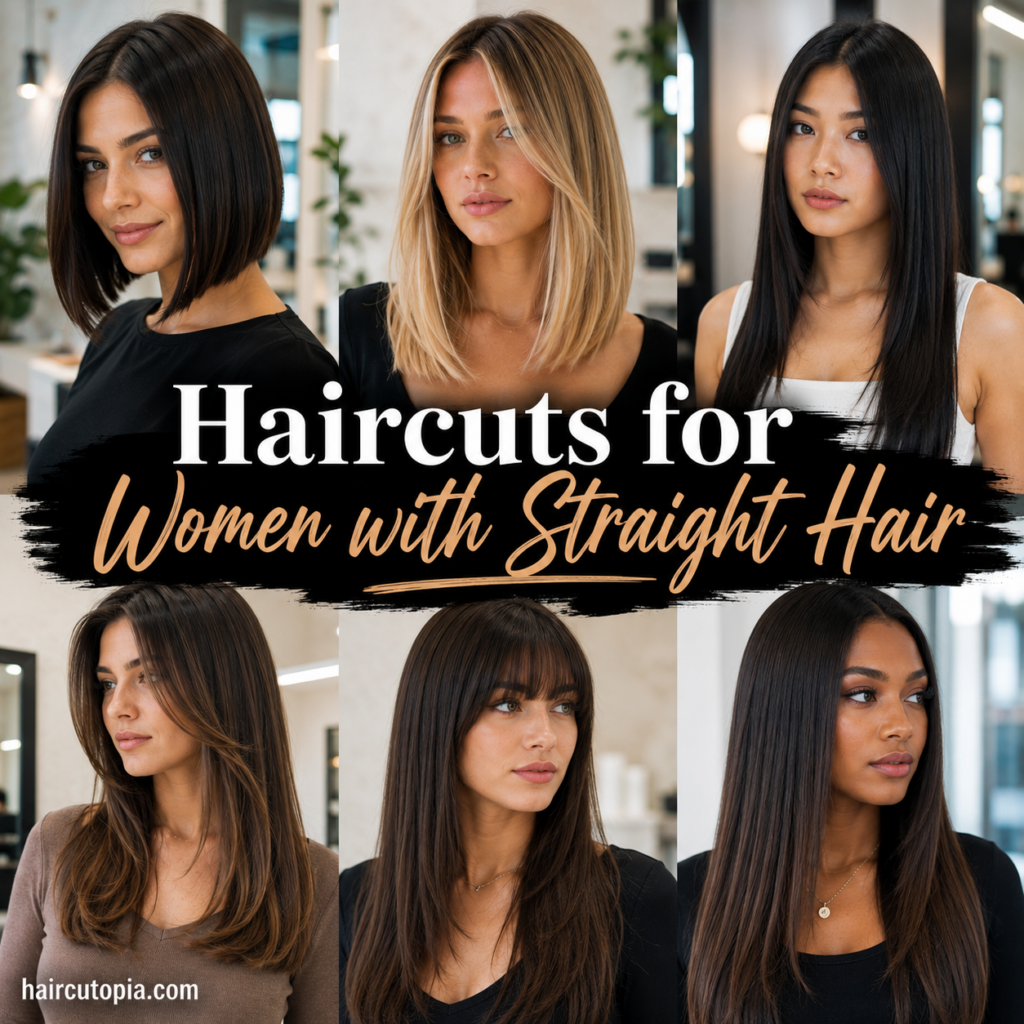
Straight hair has a way of showing everything a haircut is doing. A blunt edge looks noticeably sharp. Layers create visible movement. Bangs can completely change the way the hair frames your face.
That makes straight hair incredibly versatile, but it also means the details of the cut matter.
Fine straight hair may look fuller with a stronger perimeter and fewer layers. Thick straight hair often benefits from removing some weight so it doesn’t feel heavy or bulky. Then there’s length to consider. A pixie behaves very differently from a shoulder-length lob or long layered cut.
Whether you’re ready to go short, want to refresh your current length, or simply need a haircut that makes straight hair easier to manage, there are plenty of options.
Why Straight Hair Works With So Many Women’s Haircuts
One of the biggest advantages of straight hair is how clearly it shows shape.
With curly or wavy hair, some of the haircut’s structure blends into the natural texture. Straight strands tend to reveal the lines and layers more directly.
That makes straight hair particularly well suited to:
- Blunt cuts
- Bobs and lobs
- Face-framing layers
- Pixie cuts
- Curtain bangs
- Butterfly cuts
- Shags
- U-shaped and V-shaped cuts
Straight hair can also be relatively predictable. Once you understand how your hair naturally falls, you can choose a cut that works with that direction instead of requiring constant styling.
Hair density is just as important as texture, though.
Someone with fine straight hair may need a completely different approach from someone whose straight hair is extremely thick.
Best Short Haircuts for Women With Straight Hair
Short hair can emphasize the clean lines of naturally straight strands.
Some cuts are sleek and structured, while others use layers to create texture and movement.
Classic Bob
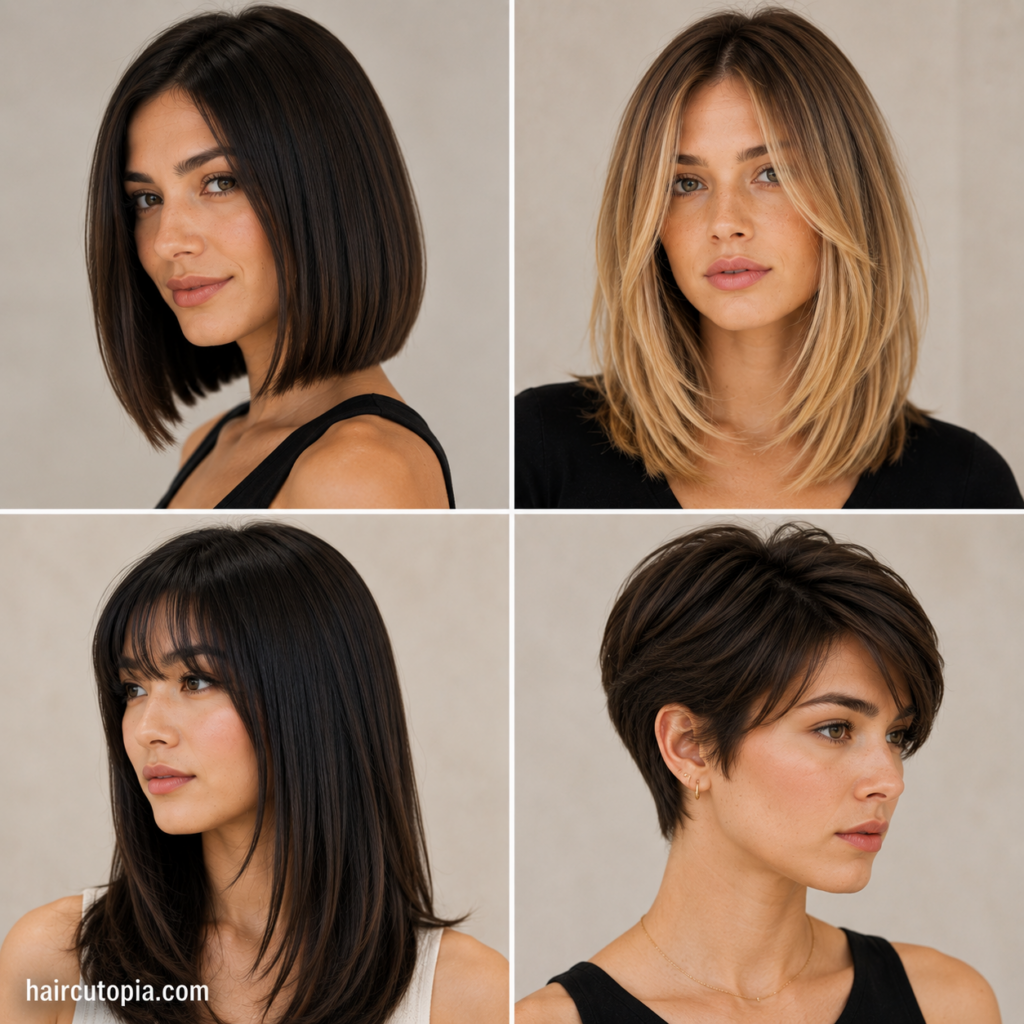
The classic bob remains one of the most versatile haircuts for straight hair.
It can sit anywhere from around the jaw to just above the shoulders, depending on the look you want.
Straight hair naturally highlights the outline of the cut, which makes a bob look especially polished even without complicated styling.
You can wear it with:
- A center part
- A deep side part
- Curtain bangs
- Wispy bangs
- Blunt bangs
- Subtle face-framing pieces
A slightly longer bob is also a good starting point if you’re nervous about cutting long hair short.
Blunt Bob
A blunt bob keeps the ends relatively even instead of adding lots of layers.
This creates a strong perimeter that can make fine straight hair appear denser.
The style can look very sleek when worn straight, but it doesn’t have to be perfectly polished. Adding a little texture through the ends can create a more relaxed finish without changing the actual haircut.
French Bob
The French bob usually falls around the jaw and is often paired with bangs.
Compared with a highly precise blunt bob, it tends to feel softer and a little less structured.
Straight hair works particularly well with this cut because the basic shape remains visible even when the hair isn’t heavily styled.
Textured Bob
If a classic bob feels too polished, adding texture can completely change it.
A textured bob incorporates subtle layers or piecey ends to create movement.
This is especially useful for straight hair that tends to fall flat.
The layers don’t necessarily need to be dramatic. Even small changes through the ends can make the haircut feel lighter.
Pixie Cut
A pixie removes most of the length while leaving enough hair to create shape around the top and front.
Straight hair offers plenty of styling options because the longer sections can be:
- Swept sideways
- Brushed forward
- Styled upward
- Tucked behind the ears
- Separated with texture product
The sides and back can be closely cropped or left slightly longer for a softer appearance.
Long Pixie
A long pixie provides more flexibility than a traditional short crop.
Extra length around the front and top makes it easier to experiment with different parts and styling directions.
It’s also a useful transition between a bob and a shorter pixie if you don’t want to make a dramatic change all at once.
Bixie Cut
The bixie combines elements of a bob and pixie.
It generally keeps more length around the sides and back than a traditional pixie while still feeling noticeably shorter than a bob.
Layers help prevent straight hair from sitting too close to the head and can give the cut a relaxed, piecey appearance.
Best Medium Haircuts for Women With Straight Hair
Medium length gives straight hair plenty of versatility.
There’s enough hair for ponytails and simple updos while still being short enough to avoid some of the weight associated with very long hair.
Long Bob
The long bob, or lob, typically falls somewhere around the shoulders or collarbone.
It’s one of the easiest medium haircuts to adapt to different hair densities.
Fine hair can benefit from a relatively blunt lob, while thicker hair may feel better with subtle internal layers.
Collarbone Cut
A collarbone haircut sits right around the collarbone and provides a comfortable middle ground between short and long hair.
It’s long enough to tie back but short enough to make a noticeable difference if you’re coming from much longer hair.
Face-framing layers can easily be incorporated without sacrificing much overall length.
Shoulder-Length Blunt Cut
Keeping shoulder-length hair mostly one length creates a clean, substantial perimeter.
This can be especially flattering for fine straight hair because fewer layers mean more density remains around the ends.
A center part emphasizes the symmetry, while a side part can create additional volume around the roots.
Medium Layered Cut
Layers introduce movement through medium straight hair.
For fine hair, keeping those layers longer generally prevents the ends from becoming too sparse.
Thick hair can usually support more extensive layering, which helps remove bulk and allows the haircut to move more naturally.
Medium Shag
A medium shag uses shorter layers around the crown and face with longer sections underneath.
The result is more textured and intentionally relaxed than a classic layered cut.
On straight hair, the individual layers remain quite visible, so the amount of layering can significantly change the final look.
Angled Lob
An angled lob is shorter in the back and gradually becomes longer toward the front.
Because straight hair clearly shows the perimeter, even a subtle angle can create a noticeable shape.
This cut can also help remove some weight from the back of thick hair.
Best Long Haircuts for Women With Straight Hair
Long straight hair can look sleek with very little effort, but without shaping it may eventually begin to feel heavy.
Layers and perimeter changes can introduce movement while allowing you to keep most of your length.
Long Layers
Long layers are one of the easiest ways to give straight hair more movement.
Rather than dramatically shortening the hair, the layers gradually transition through the lengths.
Fine hair generally benefits from fewer layers, while thick hair can support more significant weight removal.
Face-Framing Layers
If you don’t want layers throughout your entire head, focus them around the face.
The shortest pieces might begin around the cheekbones, jaw, chin, or collarbone.
This creates movement at the front while leaving most of the length untouched.
Butterfly Haircut
The butterfly haircut combines shorter face-framing layers with longer layers throughout the rest of the hair.
It creates a noticeably layered look without sacrificing the longest sections.
Straight hair makes the different lengths particularly visible, especially when the ends are styled with a slight bend.
U-Shaped Cut
A U-shaped haircut creates a gentle curve along the back.
The center remains slightly longer while the sides gradually become shorter.
It’s a subtle way to add shape without heavily layering the hair.
V-Shaped Cut
A V-shaped cut creates a more dramatic point toward the center of the back.
This style works particularly well on very long hair where there’s enough length for the shape to be noticeable.
It creates more variation through the perimeter than a blunt cut while preserving substantial length.
Long Blunt Cut
There’s nothing wrong with keeping long straight hair simple.
A blunt perimeter creates a strong edge that can make fine hair appear thicker.
If your ends naturally become sparse as your hair grows, periodically trimming them back to a stronger perimeter can make the entire hairstyle look healthier and fuller.
Haircuts for Women With Fine Straight Hair
Fine straight hair often needs more density, not more layers.
Removing too much hair can leave the bottom looking thin and make the overall style appear flatter.
Good options include:
- Blunt bobs
- Long bobs
- Collarbone cuts
- Shoulder-length blunt cuts
- Long cuts with minimal layering
- Light face-framing pieces
- Long pixies
This doesn’t mean fine hair can’t be layered.
The key is keeping enough weight through the perimeter while adding movement strategically.
Lightweight styling products can also help. Heavy oils, creams, and waxes may make fine straight hair look flat surprisingly quickly.
Haircuts for Women With Thick Straight Hair
Thick straight hair comes with the opposite problem: weight.
A completely one-length cut can become bulky, especially at shorter and medium lengths.
Strategic layering can make a significant difference.
Consider:
- Layered bobs
- Angled lobs
- Medium shags
- Butterfly cuts
- Long layers
- U-shaped cuts with internal layers
- Bixies
- Textured pixies
Internal weight removal can also reduce bulk without making the outside of the haircut look heavily layered.
Rather than thinning everything evenly, a stylist can target the areas where your hair naturally becomes heaviest.
Straight Haircuts With Bangs
Bangs work particularly well with straight hair because the strands naturally fall into a defined shape.
Curtain Bangs
Curtain bangs are shorter toward the center and become gradually longer toward the sides.
They blend easily into face-framing layers and work with medium and long hairstyles.
Because they’re longer than traditional bangs, they’re also relatively forgiving during the grow-out process.
Wispy Bangs
Wispy bangs create a lighter fringe across the forehead.
They use less hair than thick blunt bangs, making them a good option if your hair is fine or you simply don’t want a heavy fringe.
Blunt Bangs
Blunt bangs create a strong, structured line across the forehead.
They pair particularly well with sleek bobs and longer straight styles.
The tradeoff is maintenance. You’ll generally need trims more frequently than you would with curtain or side-swept bangs.
Bottleneck Bangs
Bottleneck bangs combine a shorter center with longer pieces around the sides.
They’re fuller than many curtain bangs but softer than a completely blunt fringe.
They work especially well with layered medium and long hair.
Side-Swept Bangs
Side-swept bangs create a softer effect and transition naturally into face-framing layers.
They’re also useful when you’re growing out shorter bangs and want them to become part of the rest of your haircut.
Choosing a Straight Haircut for Your Face Shape
Face shape can provide a useful starting point, but it shouldn’t determine your haircut by itself.
Your features, hair density, forehead, jawline, styling habits, and personal preferences matter just as much.
Round Faces
Cuts that extend below the chin can create longer vertical lines.
Angled lobs, long layers, side parts, and longer face-framing pieces are all worth considering.
A pixie with some height through the top can also work beautifully.
Oval Faces
Oval faces generally suit a broad range of haircuts.
Bobs, pixies, lobs, bangs, shags, and long layered styles can all work depending on your hair density and preferred look.
Square Faces
Soft layers and face-framing pieces can contrast with a defined jawline.
Curtain bangs, textured bobs, medium layers, and long layered cuts can create a softer effect.
A sharp blunt bob can do the opposite and intentionally emphasize angular features.
Heart-Shaped Faces
Haircuts that create some movement around the jaw can complement a wider forehead and narrower chin.
Chin-length bobs, curtain bangs, collarbone cuts, and face-framing layers are good options to explore.
Long or Oblong Faces
Adding width through the sides can balance a longer face.
Bangs, shoulder-length cuts, bobs, and layered styles can all create more horizontal movement.
How to Add Volume to Straight Hair
Straight hair can sometimes sit very close to the scalp, especially when it’s fine or long.
The haircut itself can help.
Choose Layers Carefully
Layers can create movement, but they aren’t automatically the answer to flat hair.
If your hair is fine, too many layers may actually make it look thinner.
Consider Going Slightly Shorter
Long hair carries more weight.
Removing several inches may allow the roots to lift more easily while making the ends appear fuller.
Change Your Part
Hair becomes accustomed to falling in the same direction.
Moving your part to the opposite side—or even shifting it slightly—can create immediate root lift.
Keep Products Lightweight
Heavy products can quickly flatten straight hair.
Start with small amounts and concentrate richer products toward the ends rather than the roots.
How to Style Women’s Straight Hair
A good haircut should do much of the work for you.
For a simple everyday routine:
- Apply heat protectant if you’re using hot tools.
- Blow-dry the roots with some lift instead of pressing them flat.
- Direct face-framing pieces where you want them to sit.
- Smooth the lengths with a brush or your fingers.
- Add a small amount of finishing product if needed.
Naturally straight hair doesn’t necessarily need a flat iron.
In fact, making the hair extremely flat can sometimes hide the movement created by layers.
A slight bend through the ends can make face-framing pieces and layered cuts much more noticeable.
Low-Maintenance Haircuts for Women With Straight Hair
Low maintenance means different things to different people.
A pixie may take only a few minutes to style, but it requires frequent salon visits to maintain its shape. Long hair may require fewer haircuts but take considerably longer to wash and dry.
Some practical options include:
- Blunt bobs
- Long bobs
- Collarbone cuts
- Shoulder-length cuts
- Long hair with minimal layers
- Soft U-shaped cuts
The most important factor is how the haircut behaves when you style it yourself.
If you normally air-dry, tell your stylist. Your haircut should still look good without a professional blowout.
How Often Should Straight Hair Be Trimmed?
The shorter and more precise the haircut, the sooner changes in length become noticeable.
As a general guide:
- Pixies: around every 4–6 weeks
- Short bobs: around every 6–10 weeks
- Medium hair: around every 8–12 weeks
- Long hair: around every 8–12 weeks or as needed
These aren’t strict rules.
A textured haircut may grow out gracefully for months, while precise bangs can begin feeling too long after only a few weeks.
Pay attention to the shape and condition of your hair rather than relying entirely on the calendar.
What to Ask Your Stylist
Reference photos are useful, but explaining your routine is just as important.
Before the haircut, discuss:
- Your hair density
- Whether your strands are fine, medium, or coarse
- Where your hair naturally parts
- Cowlicks around the crown or hairline
- How your hair behaves when air-dried
- Whether you regularly use heat tools
- How much daily styling you’re comfortable doing
- How frequently you’re willing to get trims
- How much length you’re comfortable losing
If you like only one specific element of a reference photo, point that out.
Maybe you love the bangs but not the layers. Or you like the length but want a completely different perimeter.
Those details help your stylist adapt the haircut to you rather than simply trying to recreate someone else’s hair.
Common Mistakes With Women’s Straight Hair
A few common choices can make straight hair more difficult to manage than it needs to be.
Over-Layering Fine Hair
Removing too much weight can leave fine hair looking sparse.
Preserving density through the ends is often more flattering.
Leaving Thick Hair Too Heavy
Thick straight hair may become bulky when it’s kept completely one length.
Strategic layering can create movement without making the haircut look thin.
Ignoring Natural Growth Patterns
Cowlicks matter, especially with bangs and short cuts.
A fringe that fights your natural growth direction every morning can quickly become frustrating.
Using Too Much Product
Straight hair tends to show product buildup easily.
Start with less product and add more only when necessary.
Choosing a Haircut That Only Looks Good Styled
A professional blowout can make almost any haircut look impressive.
The more important question is what happens the next morning.
Choose a cut that works with the amount of styling you’re realistically willing to do.
Finding the Best Haircut for Women’s Straight Hair
The best haircut for straight hair isn’t necessarily the trendiest one. It’s the haircut that makes your natural texture easier to work with while giving you the shape you want.
If your hair is fine, a blunt bob, lob, or lightly layered longer cut can help preserve fullness. If it’s thick, layers and strategic weight removal can create movement and make everyday styling easier.
Length gives you even more choices.
A pixie or bob can emphasize the clean lines of straight hair. Medium cuts offer flexibility without too much weight. Long layers, butterfly cuts, and face-framing pieces can transform longer hair without sacrificing the length you’ve spent years growing.
And sometimes the smallest change makes the biggest difference. Moving your part, adding curtain bangs, trimming thin ends, or introducing a few face-framing pieces can make familiar straight hair feel completely new.
The goal isn’t to fight your natural texture. It’s to choose a haircut that gives it the right shape and lets straight hair do what it already does well.