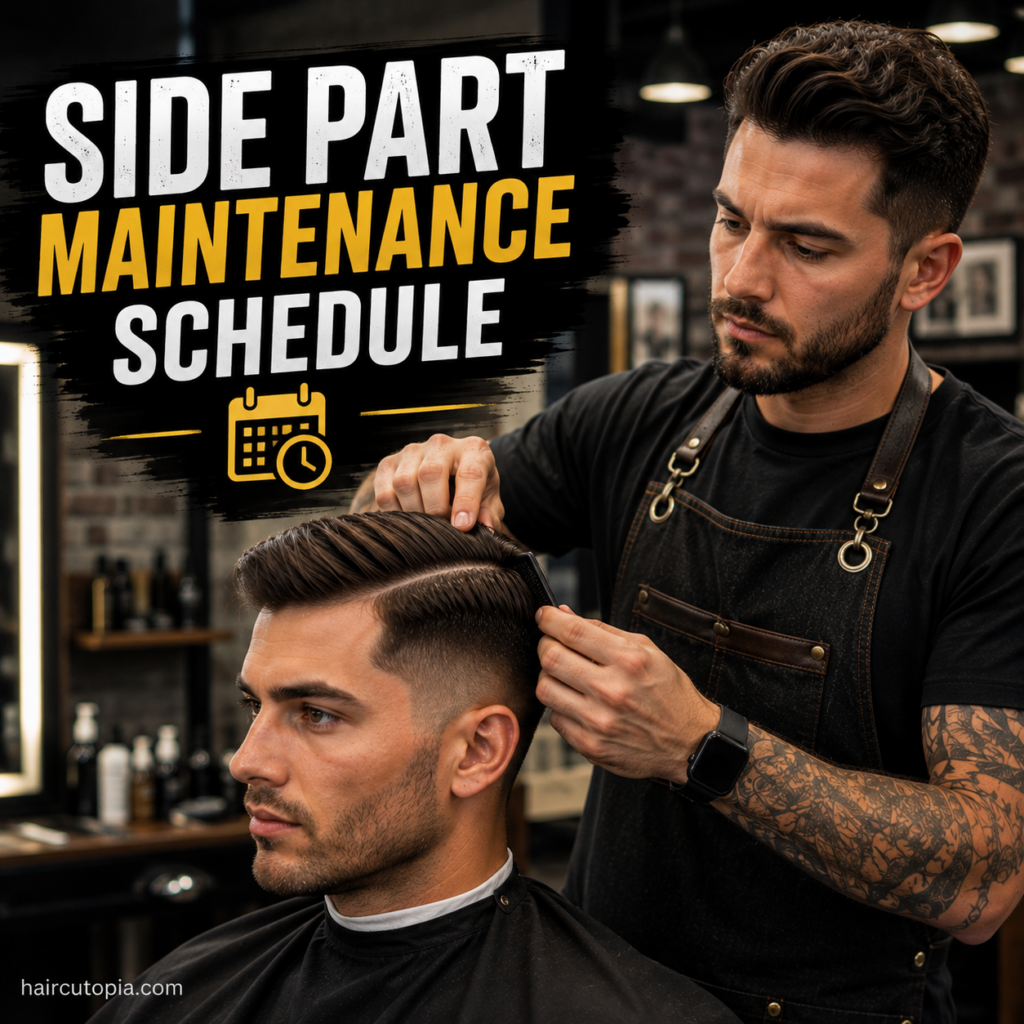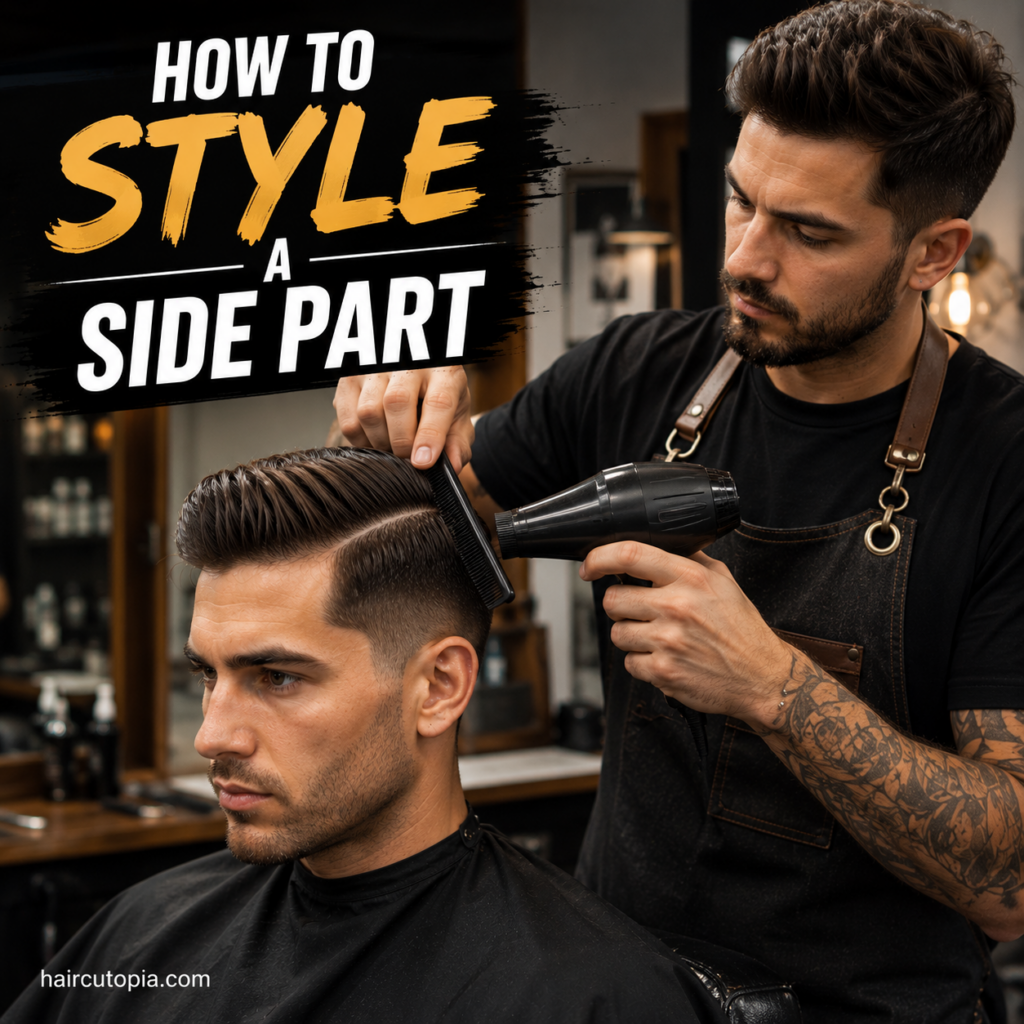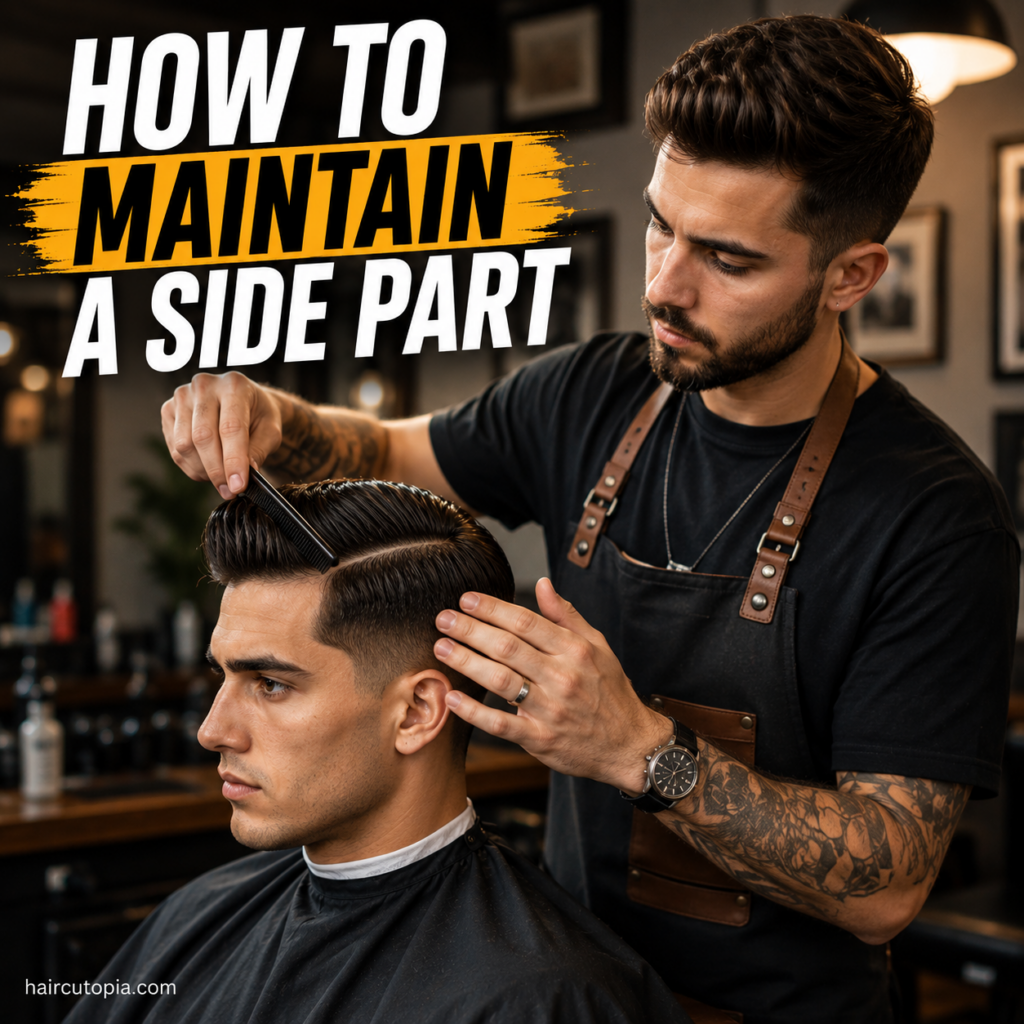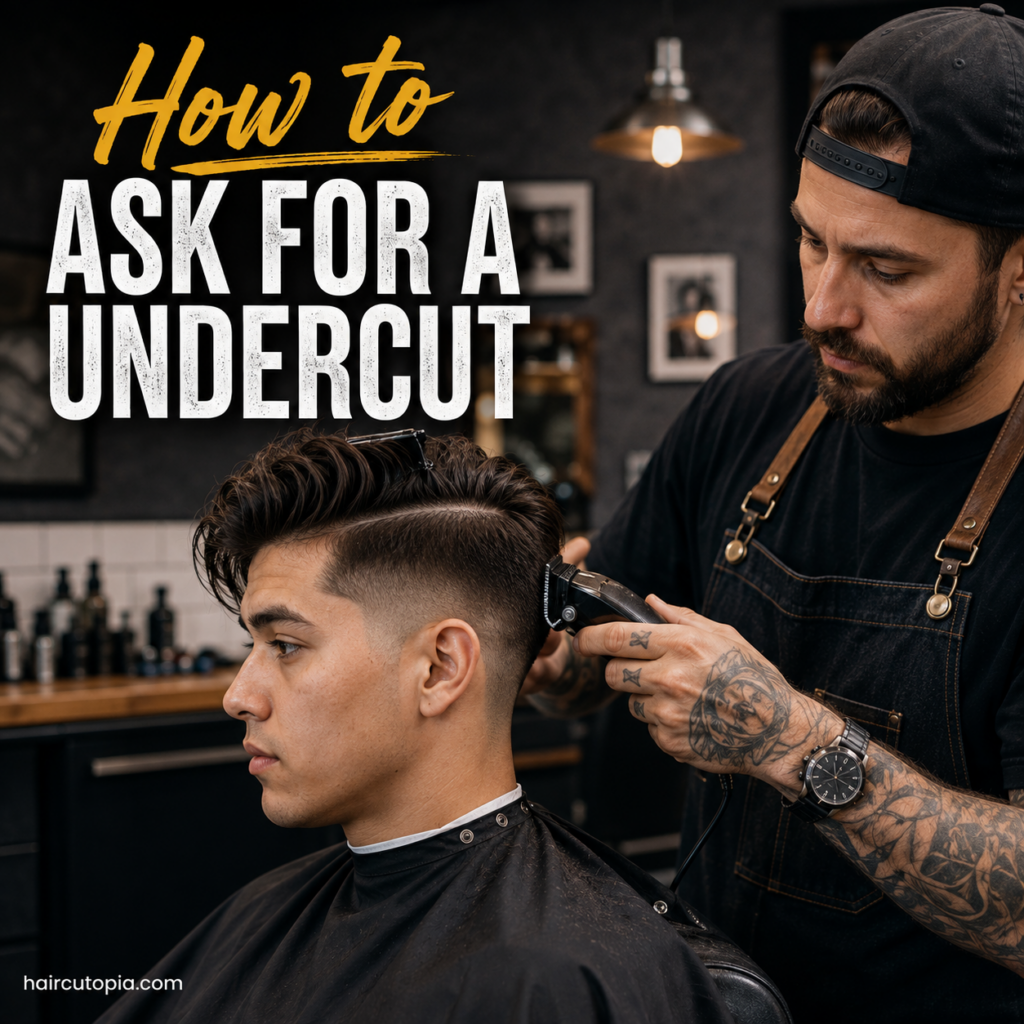
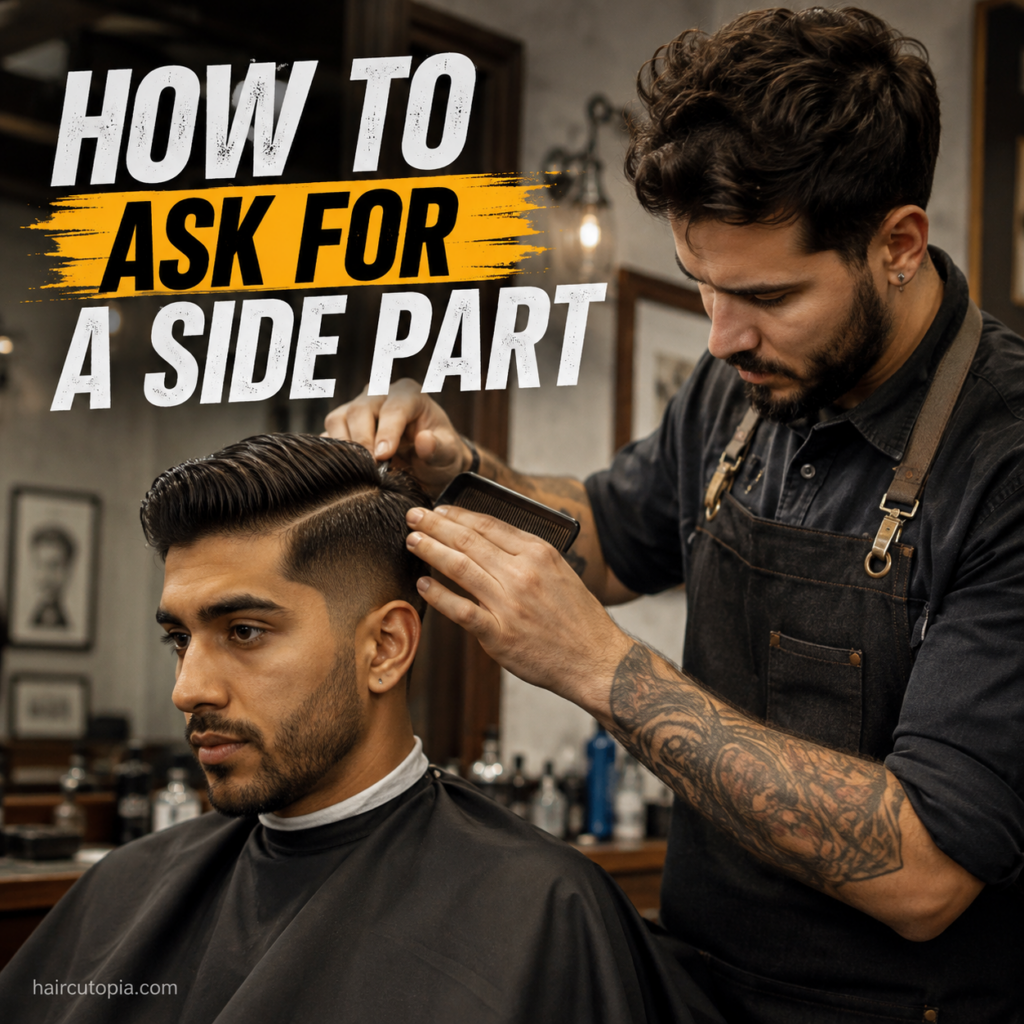
A side part is one of those haircuts that sounds simple until you’re sitting in the barber chair trying to explain exactly what you want. Ask for a “side part,” and your barber still has several decisions to make: How short should the sides be? Should the part look natural or sharply defined? Do you want a fade? How much length should stay on top?
The good news is that you don’t need to know professional barber terminology to get it right. A few clear details—and ideally a reference photo—can make the conversation much easier.
This guide explains how to ask for a side part, what to tell your barber, which variations to consider, and how to maintain the style once you leave the shop.
What Is a Side Part Haircut?
A side part is a hairstyle where the hair is divided along one side of the head and styled in opposite directions. Most of the top is swept across the head, while the smaller section follows the other side of the part.
It’s a classic men’s hairstyle, but there isn’t just one version.
A traditional side part usually keeps some length on the sides and has a softer, more natural finish. Modern versions may combine the part with a taper, fade, undercut, textured top, or even a shaved part line.
That flexibility is one reason the style has remained popular for so long. You can make it clean and professional, relaxed and textured, or much sharper depending on your haircut and styling choices.
How to Ask Your Barber for a Side Part
Instead of simply saying, “I’d like a side part,” describe the haircut in a few pieces.
Tell your barber:
- How much length you want to keep on top
- How short you want the sides and back
- Whether you want a taper, fade, or scissor-cut sides
- Whether you want a natural or defined part
- How you normally style your hair
- Whether you prefer a polished or textured finish
You don’t have to explain everything using barber terminology. In fact, giving your barber practical information about how you want the haircut to look is often more useful than trying to use technical terms you’re unsure about.
For example, you could say:
“I’d like a classic side part with enough length on top to comb over. Keep the sides shorter and tapered, but don’t take them down to the skin. I’d like the part to look natural rather than shaved in.”
That’s much more specific than simply asking for a side part.
Decide How Long You Want the Top
The length on top has a big influence on how your side part will look and behave.
For a traditional side part, you’ll generally need enough hair to comb or sweep across the head without it sticking straight up. Longer hair creates a smoother, more classic shape, while shorter hair tends to produce a tighter and more modern appearance.
If you’re not sure about an exact measurement, show your barber where you’d like the hair to fall.
You might say:
- “Leave enough on top to comb it over.”
- “I want some length and volume in the front.”
- “Keep the top fairly short but long enough to establish the part.”
- “I’d like a longer, looser side part rather than a slick style.”
Your barber can then recommend a length based on your hair texture, density, growth pattern, and head shape.
Choose How Short You Want the Sides
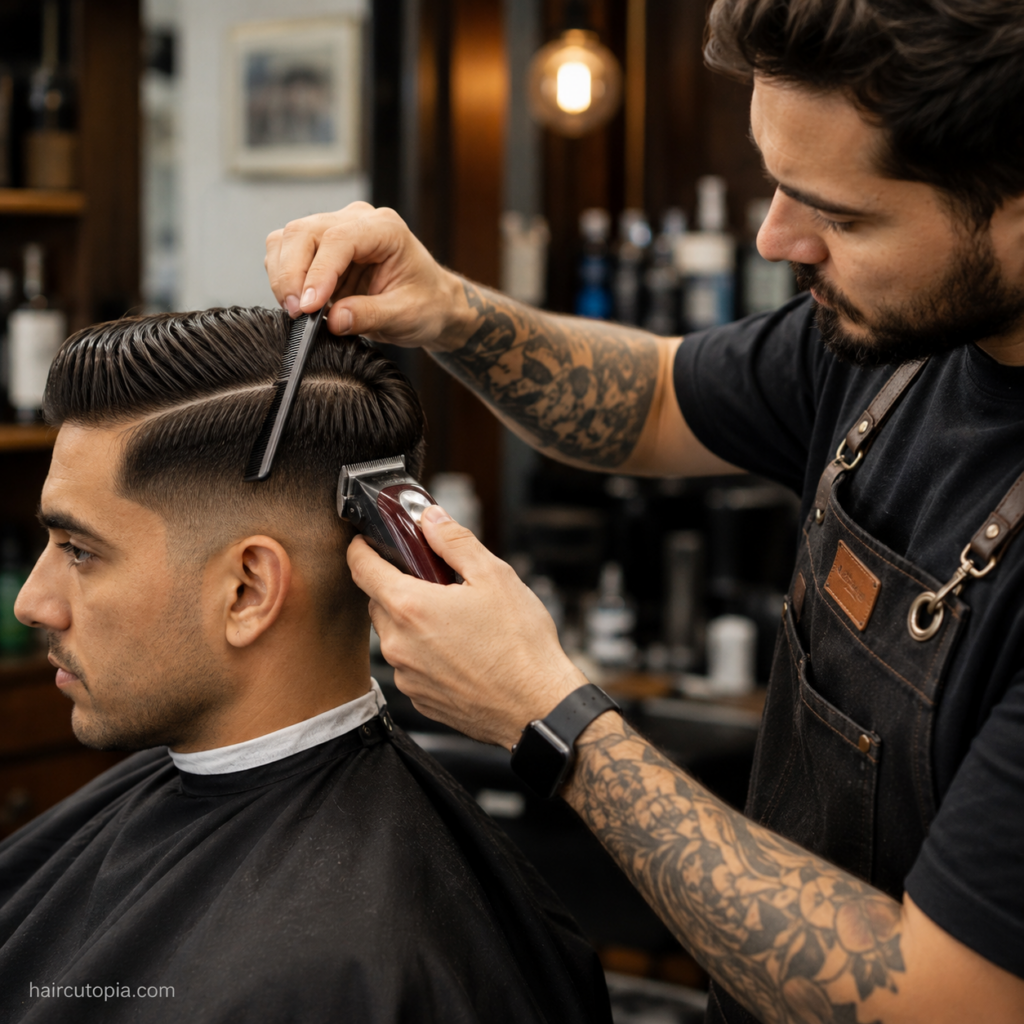
The sides can dramatically change the overall character of the haircut.
Classic Scissor-Cut Sides
For a traditional side part, ask your barber to keep the sides relatively full and shape them with scissors or a longer clipper guard.
This creates a softer transition between the top and sides.
It’s a good choice if you want a conservative, business-friendly haircut or simply don’t like the high-contrast appearance of very short sides.
Tapered Sides
A taper gradually shortens the hair around the sideburns and neckline while leaving more length through the rest of the sides.
This works especially well with a side part because it cleans up the edges without making the haircut look overly aggressive.
Ask for a “classic taper” or “low taper” if you want the haircut to stay relatively subtle.
Faded Sides
For a more modern side part, you can pair the style with a fade.
Common options include:
- Low fade
- Mid fade
- High fade
- Skin fade
- Drop fade
A low fade generally keeps the haircut more understated, while a high or skin fade creates much stronger contrast.
If you’re unsure, tell your barber you want a side part with shorter sides but don’t want too much scalp showing. They can recommend an appropriate fade or taper.
Natural Part vs. Hard Part
One of the most important decisions is whether you want the part to look natural or sharply defined.
Natural Side Part
A natural part follows the direction in which your hair naturally separates.
The barber shapes the haircut around that line, but doesn’t shave the part into your scalp.
This is the most versatile option because you can style the part prominently one day and more casually the next.
Hard Part
A hard part is created by shaving a thin line along the part with clippers or a razor.
The result is much more defined.
Hard parts work particularly well with fades and other modern barbered styles, but they require more maintenance. As your hair grows, the shaved line becomes less crisp and will eventually need to be cleaned up.
If you aren’t sure which one you want, start with a natural part. A hard part can always be added later, while growing one out takes time.
Know Which Side You Want to Part Your Hair
You don’t necessarily need to choose the side yourself.
Hair often has a natural direction determined by its growth pattern, particularly around the crown. Your barber can identify which direction your hair naturally wants to fall.
If you’ve already been styling your hair with the part on a particular side and like how it behaves, tell your barber.
Otherwise, ask:
“Which side does my hair naturally want to part on?”
Working with your natural growth pattern can make everyday styling considerably easier.
Tell Your Barber How You Style Your Hair
Your barber isn’t only cutting your hair for the moment you leave the chair. Ideally, the haircut should work when you’re styling it yourself several days or weeks later.
Tell them what your normal routine looks like.
For example:
- Do you blow-dry your hair?
- Do you usually let it air-dry?
- Do you use pomade, clay, wax, cream, or gel?
- Do you want volume or a flatter finish?
- How much time do you want to spend styling it each morning?
If you’re someone who wants to spend two minutes on your hair, say so. Your barber may approach the cut differently than they would for someone comfortable blow-drying and styling every morning.
Ask for the Right Finish
The same basic side-part haircut can look completely different depending on how it’s styled.
Classic and Polished
For the traditional gentleman’s side part, keep the hair relatively smooth and controlled.
A pomade or styling cream can help create separation and hold while maintaining the recognizable combed shape.
Textured and Modern
If you prefer something less formal, ask your barber to add texture to the top.
Instead of combing every strand neatly into place, you can style the hair loosely to create movement and separation.
Matte clay, paste, or styling cream often works well for this approach.
Voluminous Side Part
A side part doesn’t have to sit flat against your head.
Keeping more length through the front allows you to lift the hair before sweeping it sideways. Blow-drying the hair into position can create significantly more volume than applying product to wet hair and combing it flat.
Tell your barber if volume is important so they don’t remove too much length from the front.
Bring a Reference Photo
A reference photo is one of the easiest ways to prevent misunderstandings.
“Side part” can describe everything from a conservative business haircut to a skin fade with a shaved hard part. Showing your barber a picture immediately establishes the general direction.
Try to find a reference with hair that’s reasonably similar to yours in:
- Texture
- Density
- Length
- Hairline
- Growth pattern
The haircut doesn’t need to be identical. The photo simply gives you and your barber a common visual reference.
You can also explain which specific elements you like.
For example:
“I like the length on top in this photo, but I’d prefer the sides a little longer.”
That gives your barber much more useful information than expecting them to reproduce the entire haircut exactly.
Side Part Haircut Variations to Consider
Once you’ve settled on the basic style, there are several ways to customize it.
Classic Side Part
The classic version keeps enough length on the sides for a smooth transition into the top.
It’s neat, understated, and works especially well if you want a professional hairstyle without extremely short sides.
Side Part With a Low Fade
A low fade introduces a cleaner, more contemporary finish while keeping most of the contrast toward the bottom of the haircut.
It’s a good middle ground between a traditional taper and a dramatic fade.
Side Part With a Mid Fade
A mid fade begins higher on the sides and creates more visible contrast.
This makes the top stand out and gives the haircut a noticeably modern barbershop appearance.
Side Part With a Skin Fade
A skin fade takes the shortest portion of the sides down to bare skin.
Combined with a side part, it creates a sharp, high-contrast haircut. It’s clean and precise but usually requires more frequent barber visits to maintain that freshly faded appearance.
Side Part With a Hard Part
Adding a shaved line emphasizes the separation between the two sections of hair.
This is a strong choice if you like highly defined haircuts and don’t mind maintaining the line.
Textured Side Part
A textured side part keeps the general direction of the classic style but avoids the perfectly combed finish.
It’s especially useful for men who prefer a casual hairstyle or have naturally wavy or textured hair.
What to Ask for Based on Your Hair Type
Your natural hair can influence which version of the side part works best.
Straight Hair
Straight hair typically forms a clean part easily and can work with both polished and textured styles.
Fine straight hair may benefit from extra length and volume on top rather than heavy thinning.
Thick Hair
Thick hair can produce an excellent side part, but removing some excess bulk may make the style easier to control.
Your barber can reduce weight without necessarily making the haircut look thin.
Wavy Hair
Wavy hair can give a side part natural movement and volume.
Instead of fighting the texture, consider asking for a looser, more relaxed side part that allows some of the wave to remain visible.
Curly Hair
A side part can also work with curly hair, although it doesn’t have to resemble the traditional combed version.
The barber can establish the part while preserving curl definition and controlling the overall shape.
What Not to Say to Your Barber
There aren’t many truly “wrong” ways to ask for a haircut, but vague instructions make the outcome harder to predict.
Try not to rely entirely on phrases such as:
- “Just a normal side part.”
- “Short on the sides.”
- “Clean it up.”
- “Make it look good.”
- “You know what I mean.”
Your definition of “short” might be very different from your barber’s.
When possible, clarify what you mean. If you don’t know clipper guard numbers or exact lengths, that’s completely fine. Show your barber with your fingers, use a photo, or explain how much scalp you want visible.
How to Style a Side Part at Home
A good haircut makes styling easier, but you’ll still need to recreate the shape after washing your hair.
A simple routine is:
- Start with clean, damp hair.
- Find your natural part using your fingers or a comb.
- Apply a small amount of styling product.
- Direct the smaller section away from the part.
- Comb or brush the larger section across the top.
- Add volume at the front if desired.
- Adjust the shape with your fingers for a more natural finish.
For extra volume, use a blow dryer while directing the hair upward and across the head. Once the general shape is established, finish with a small amount of product.
Avoid starting with too much product. You can always add more, but removing excess usually means washing your hair again.
Which Products Work Best for a Side Part?
The best product depends on the finish you’re trying to achieve.
Pomade works well for a smooth, classic side part with noticeable control and definition.
Styling cream is useful when you want a softer, more natural result.
Clay and paste tend to work better for textured side parts because they can provide hold without creating an overly shiny finish.
Hair wax can offer flexible control, particularly for thicker hair.
You don’t necessarily need the strongest product available. If the haircut is shaped properly and your hair naturally cooperates with the part, a moderate-hold product may be enough.
How Often Should You Get a Side Part Cut?
A typical side part can usually be maintained with a haircut every three to six weeks.
The ideal schedule depends heavily on the sides.
A longer, classic side part can grow out gracefully and may look good for several weeks. A skin fade or hard part will lose its crisp appearance much sooner and may benefit from more frequent cleanups.
If you don’t want to visit the barber every couple of weeks, mention that before the haircut. Your barber can recommend a version that grows out more naturally.
What If You’re Not Sure What Side Part Suits You?
You don’t have to walk into the barbershop with every detail figured out.
A good approach is to know the general look you want and ask your barber for advice on the specifics.
You can say:
“I want a side part that’s easy to maintain and works with my natural hair. What would you recommend for the sides and length on top?”
That gives the barber room to consider your face shape, hair density, texture, cowlicks, hairline, and growth pattern.
It’s still your haircut, so speak up about anything you definitely do or don’t want.
Quick Barber Checklist
Before your barber starts cutting, make sure you’ve covered these points:
- Top length
- Side and back length
- Taper or fade preference
- Fade height, if applicable
- Natural part or hard part
- Preferred styling direction
- Polished or textured finish
- Amount of volume you want
- How frequently you’re willing to maintain the cut
You don’t need to turn the consultation into a lengthy discussion. Even 30 seconds of clear communication can eliminate a lot of uncertainty.
Final Thoughts
Learning how to ask for a side part is mostly about being specific about the details that matter.
Instead of requesting the style by name and leaving everything else open to interpretation, explain how much length you want on top, how short you’d like the sides, whether you prefer a fade or taper, and whether the part should look natural or sharply defined.
Bring a reference photo whenever possible, especially if you’re visiting a new barber.
And if you don’t know the terminology, don’t worry about it. Describe the result you want in everyday language and let your barber translate that into the right cutting techniques.
A side part can be classic, modern, textured, sharp, subtle, or somewhere in between. Getting the version you actually want starts with a clear conversation before the first cut.