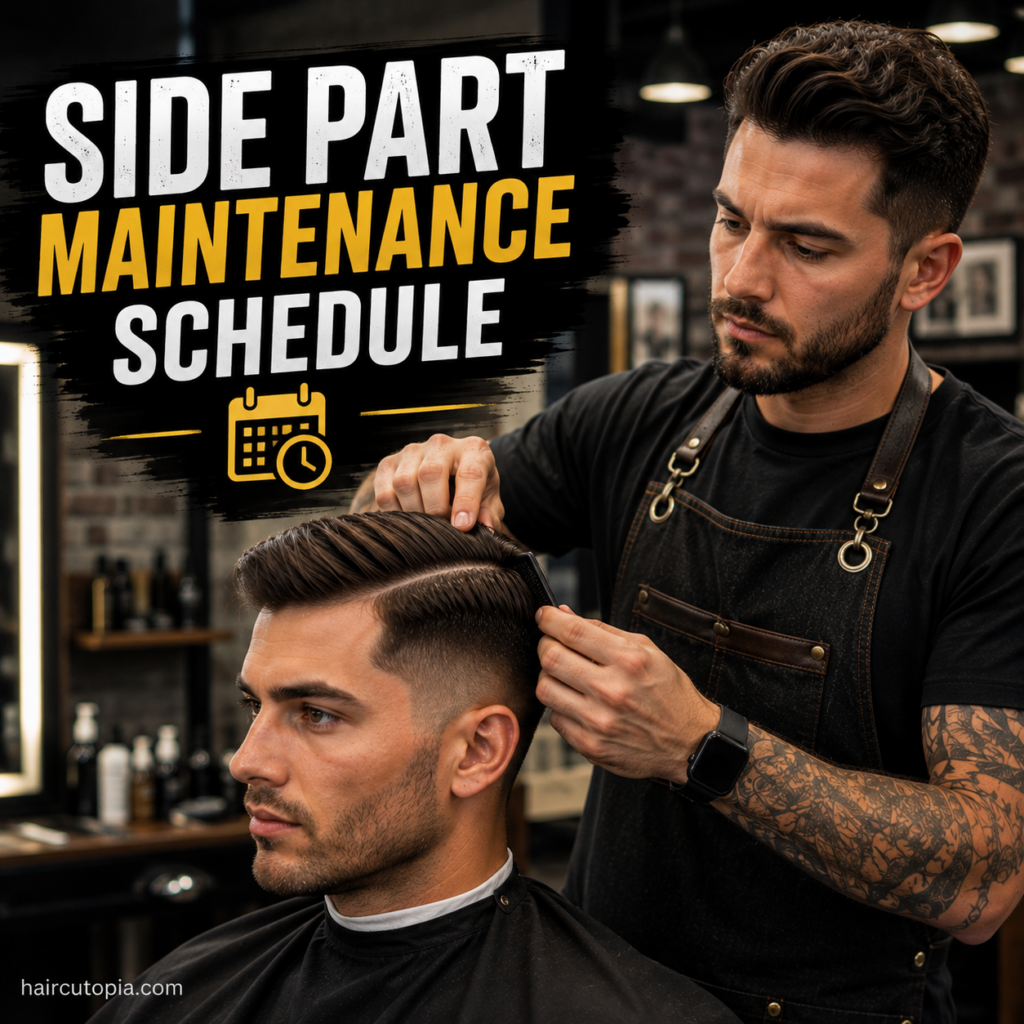
A side part can be surprisingly forgiving as it grows out, but how often you need to maintain it depends on what’s happening around the part.
A classic side part with longer, scissor-cut sides may still look good several weeks after a haircut. Pair the same style with a skin fade or shaved hard part, and the fresh-from-the-barber look disappears much faster.
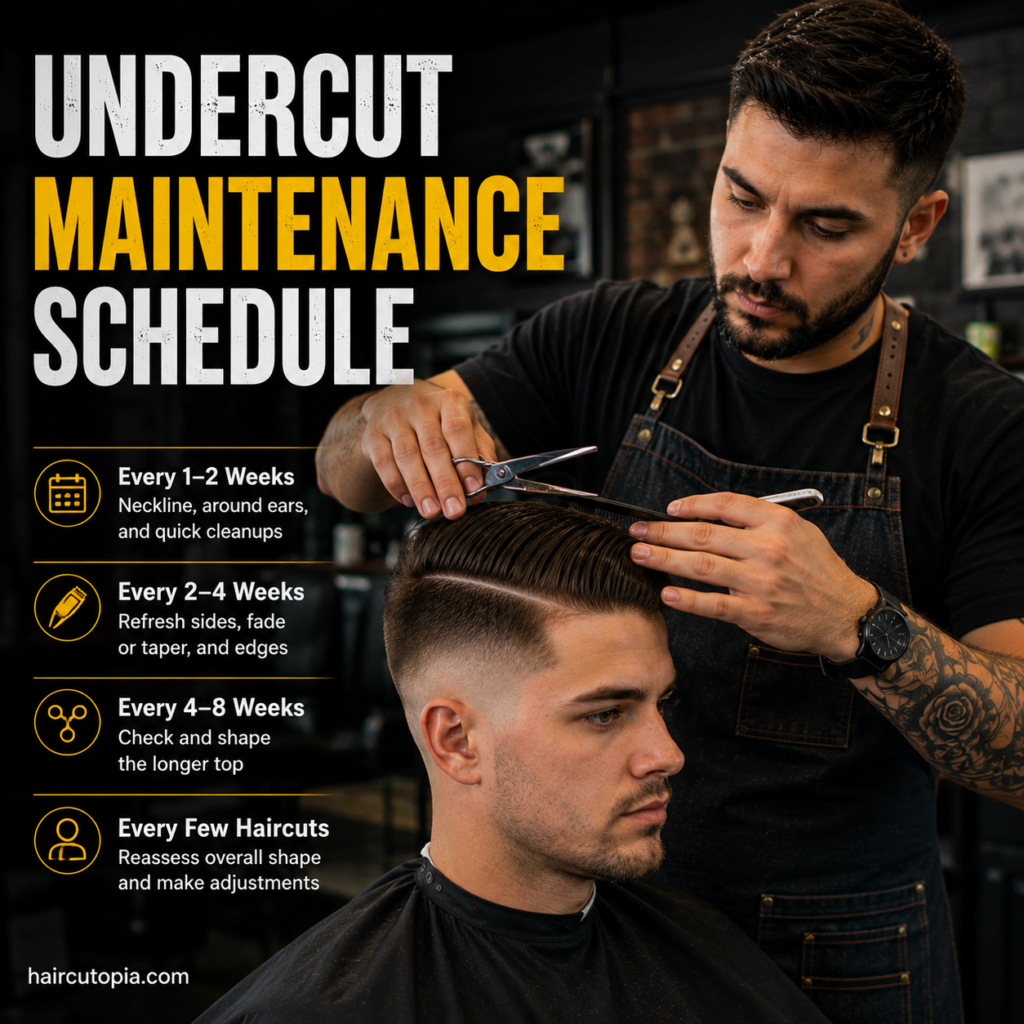
That doesn’t mean you need a complete haircut every time something starts looking untidy. Sometimes a neckline cleanup, fade refresh, or quick trim around the ears is enough.
A practical side part maintenance schedule should match your haircut, hair growth, styling routine, and how polished you like to keep it. Here’s how to figure out a schedule that works without making unnecessary trips to the barbershop.
How Often Should You Maintain a Side Part?
For most side-part haircuts, a full haircut every three to six weeks is a reasonable starting point.
The shorter and more precise the haircut, the more frequently it will generally need attention.
A typical schedule looks something like this:
- Classic side part: every 4–6 weeks
- Side part with longer scissor-cut sides: every 4–6 weeks
- Side part with a taper: every 3–5 weeks
- Side part with a low fade: every 3–4 weeks
- Side part with a mid or high fade: every 2–4 weeks
- Side part with a skin fade: around every 2–3 weeks for a consistently fresh appearance
- Side part with a hard part: touch up when the shaved line begins filling in
These are guidelines rather than deadlines.
Your hair may grow faster or slower, and you may actually prefer how your side part looks after it has grown in for a week or two.
Why Side Parts Have Different Maintenance Schedules
The part itself usually isn’t the highest-maintenance feature.
It’s the surrounding haircut.
A natural part can continue looking perfectly normal as your hair grows. There’s no shaved line that suddenly disappears and no exact boundary that needs to remain perfectly crisp.
Short fades are different.
When hair has been cut extremely close to the scalp, even a small amount of growth changes its appearance. The contrast between the top and sides becomes softer, and the fade gradually loses definition.
The same applies to:
- Hard parts
- Skin fades
- Sharp lineups
- Tapered sideburns
- Clean necklines
- Detailed edge work
The more precision you want to preserve, the shorter your maintenance cycle will usually be.
Week 1: Keep the Fresh Haircut in Shape
The first week after a haircut should require very little maintenance.
Your barber has already established the shape, removed excess weight, cleaned the neckline, and defined the part.
Your main job is simply to style it.
Follow the Established Part
After washing your hair, locate the part your barber created and continue styling along that line.
Starting with damp hair usually makes this easier.
Direct the larger section across the top and the smaller section away from the part.
If you have a natural part, don’t worry about creating a perfectly straight line every morning.
Use Product Sparingly
Freshly cut hair often requires less styling product because there’s less excess length and weight to control.
Start with a small amount.
Depending on the finish you want, you might use:
- Pomade for a classic, polished finish
- Clay for texture and a matte appearance
- Paste for flexible everyday control
- Styling cream for softer, natural movement
Avoid adding product simply because your hair doesn’t immediately sit perfectly. Establishing the shape with a blow dryer can sometimes solve the problem without additional product.
Pay Attention to How the Cut Behaves
The first week is also a good time to evaluate the haircut.
Notice whether:
- The top is easy to style
- The part sits naturally
- The front has enough volume
- The sides feel too short or too long
- Any section sticks out
- The haircut works without excessive product
Remember these details.
They’re useful feedback for your barber at the next appointment.
Week 2: Refresh the Everyday Styling Routine
By the second week, your side part will have grown slightly but should still retain most of its original shape.
For many people, this is actually when the haircut begins looking its most natural.
Continue your normal washing and styling routine.
You may notice that you need slightly more control through the top, particularly if your hair grows quickly.
Rather than immediately increasing the amount of product, try adjusting your blow-drying technique.
Lift the front while drying and direct the hair across the head. Once the basic shape is established, use product to refine it.
Check Short Fades and Hard Parts
If you have a skin fade or hard part, this is often when the haircut begins showing more obvious growth.
The fade won’t necessarily look bad. It simply won’t look as freshly cut.
A shaved hard part may also begin filling in.
If you like an extremely sharp appearance, this may be the point when you start considering a cleanup appointment.
If you prefer a softer, grown-in look, there’s usually no need to do anything yet.
Week 3: Decide Whether You Need a Cleanup
Around the third week, the maintenance requirements of different side-part styles begin separating more noticeably.
A classic side part may still look nearly effortless.
A skin fade may look significantly different from when it was freshly cut.
Check:
- Around the ears
- Sideburns
- Neckline
- Fade transition
- Hard part
- Hairline
- Bulk around the sides
If the top still looks good but the edges are becoming untidy, you may not need a full haircut.
Ask your barber whether a cleanup or fade refresh is available.
This can preserve the overall haircut while allowing you to keep growing the top.
Week 4: Common Full Haircut Point
Four weeks is a common haircut interval for a side part because it works well for many variations.
By this point, you may notice:
- Additional bulk on the sides
- A less defined taper or fade
- Longer hair around the ears
- An untidy neckline
- Extra weight through the top
- Reduced volume
- More effort required to style the part
This doesn’t automatically mean the haircut needs to be redone.
If you have a longer classic side part, week four may still be comfortably within the haircut’s normal lifespan.
For a side part with a fade, however, this is often a good time for a full refresh.
Weeks 5–6: Longer Side Parts May Still Work Well
Classic side parts can often reach five or six weeks before they truly need another haircut.
The longer sides allow new growth to blend into the existing shape more naturally.
You may notice the top becoming heavier.
As hair gains length and weight, it can become more difficult to create volume at the front. You might find yourself using more product or spending longer with the blow dryer.
That’s often a sign that it’s time for a trim.
You don’t necessarily need to remove a lot of length.
Ask your barber to restore the shape and remove excess bulk while preserving enough length for the part.
Maintenance Schedule for a Classic Side Part
A traditional side part is one of the easier versions to maintain.
Because the sides aren’t taken extremely short, new growth doesn’t create an obvious line between “fresh” and “overgrown.”
A practical schedule might be:
Every Day
- Re-establish the part as needed
- Style the hair into position
- Use a small amount of product
- Blow-dry if you want additional volume
Every Few Days
Wash according to your scalp, hair type, and product use.
There’s no need to follow a rigid shampoo schedule if your hair doesn’t require it.
Around Weeks 3–4
Check the neckline, sideburns, and area around the ears.
Get a cleanup if needed.
Around Weeks 4–6
Schedule a full haircut to restore the overall shape.
If you prefer a slightly longer side part, you may be able to stretch the interval further.
Maintenance Schedule for a Side Part With a Taper
A taper keeps the lowest portions around the sideburns and neckline short while leaving more length through the sides.
This makes it a relatively forgiving option.
The taper will gradually soften rather than producing the dramatic grow-out associated with a skin fade.
For many people, a barber visit every three to five weeks provides a good balance.
If the top still looks good, you can also alternate between a small cleanup and a full haircut.
Maintenance Schedule for a Side Part With a Fade
Fades generally need more frequent attention.
Exactly how often depends on the fade height and how short it begins.
Low Fade
A low fade concentrates the shortest section near the bottom of the haircut.
Because more hair remains above it, the grow-out can be relatively subtle.
Consider a refresh around every three to four weeks if you like keeping it defined.
Mid Fade
A mid fade exposes more of the sides and creates stronger contrast with the top.
Growth may become noticeable sooner.
A two-to-four-week maintenance interval is common depending on how sharp you want it.
High Fade
A high fade removes considerably more hair from the sides.
Because the contrast is a major part of the hairstyle, new growth changes the overall appearance relatively quickly.
Plan on approximately two to four weeks if maintaining the faded look is important to you.
Skin Fade
Skin fades show growth particularly quickly because the shortest section begins at bare skin.
Within a week or two, the fade will already look softer.
If you want it to look consistently fresh, you may prefer a cleanup approximately every two to three weeks.
If you don’t mind the softer appearance, you can wait longer.
Maintenance Schedule for a Side Part With a Hard Part
A hard part is created by shaving a defined line into the hair.
That precision comes with additional maintenance.
As the shaved hair grows back, the line gradually becomes less obvious.
How quickly that happens varies from person to person.
Instead of following an exact number of days, use the visibility of the part as your guide.
When the line no longer looks intentional, you have three options:
- Have your barber redefine it
- Let it soften naturally until your next haircut
- Grow it out and transition to a natural part
Avoid repeatedly widening the line.
If you’re touching it up yourself and move slightly outside the original part each time, a narrow hard part can gradually become much wider than intended.
Professional touchups are the safer choice.
Daily Side Part Maintenance
Your barber schedule is only one part of maintaining the hairstyle.
Everyday care determines how the side part looks between appointments.
A simple morning routine can be:
- Lightly dampen your hair if necessary.
- Locate the established part.
- Direct the hair into position.
- Blow-dry for volume or control.
- Apply a small amount of styling product.
- Comb or finger-style the final shape.
This doesn’t need to take long.
Once you become familiar with your natural growth pattern, a basic side part can often be styled within a few minutes.
Weekly Side Part Maintenance
Once or twice a week, take a closer look at how the haircut is growing.
You don’t need to measure anything.
Simply check whether the hairstyle still feels balanced.
Look at the sides and back in a mirror and pay attention to:
- Hair growing over the ears
- Uneven sideburns
- Neckline growth
- Increased bulk
- Flyaways
- Fade definition
- Hard-part definition
This gives you a better indication of when you actually need another appointment than blindly following a calendar.
When Should You Get a Cleanup Instead of a Full Haircut?
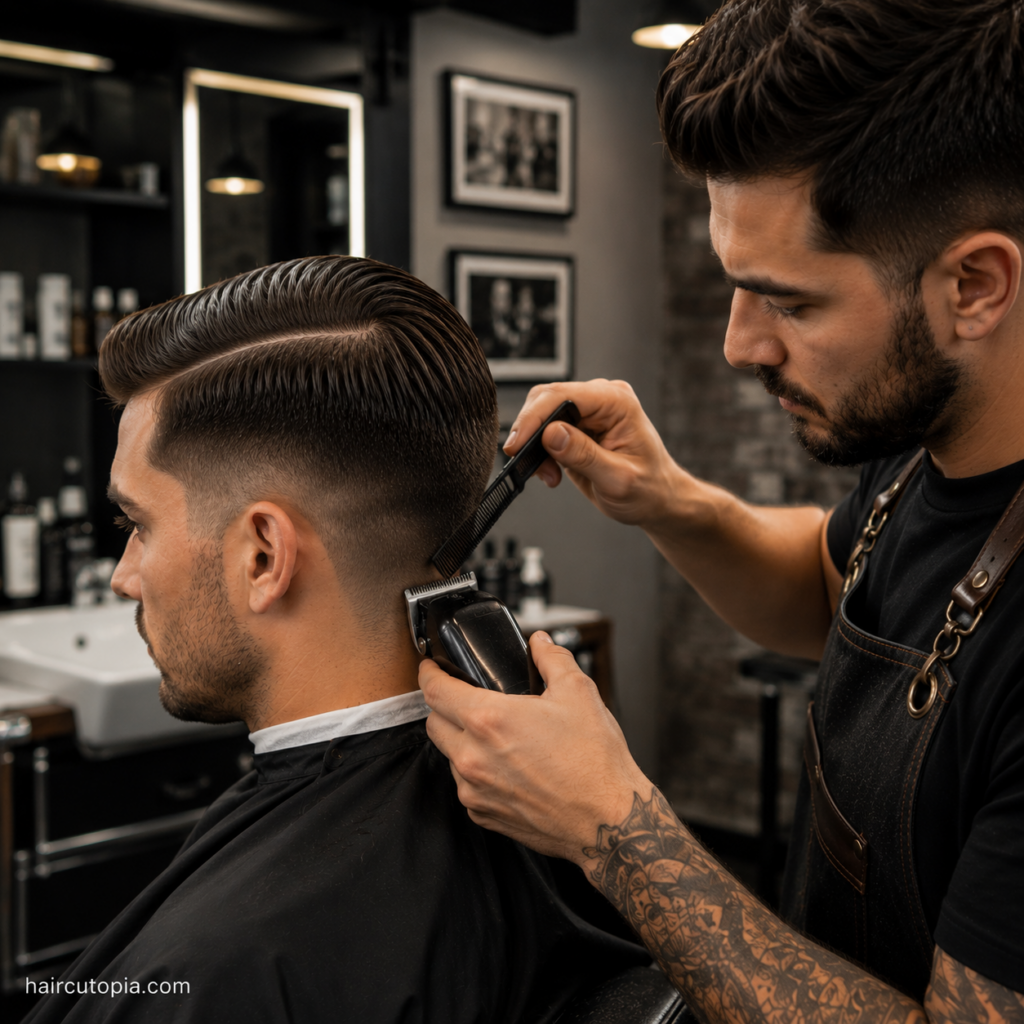
A cleanup can be useful when the edges have grown out but the overall haircut still works.
For example, you might still like the top length at week three while the neckline and sides have started looking untidy.
A cleanup may focus on:
- Neckline
- Sideburns
- Hair around the ears
- Taper
- Fade
- Hairline
- Hard part
The exact services vary by barbershop, so ask your barber what they offer.
Cleanups can also be useful when you’re deliberately growing the top longer.
Instead of cutting everything every few weeks, you can maintain the perimeter while allowing the top to gain length.
Signs Your Side Part Needs a Full Haircut
Don’t judge the haircut only by the calendar.
How it behaves is often a better indicator.
Consider scheduling a haircut when:
- The sides are becoming bulky
- Hair is growing noticeably over the ears
- The neckline looks untidy
- The top has become difficult to control
- The front no longer holds volume
- You’re using substantially more product
- The part doesn’t sit as naturally
- The haircut has lost its overall shape
One of the biggest clues is styling time.
If a side part that normally takes three minutes suddenly takes ten minutes every morning, excess length or weight may be working against you.
Can You Maintain a Side Part at Home?
Most everyday maintenance can easily be handled at home.
Styling, washing, conditioning, and managing product buildup are all part of normal upkeep.
You can also carefully remove obvious stray hairs if you’re comfortable doing so.
Be more cautious with clipper work.
Trying to recreate a fade or hard part without experience can quickly change the haircut’s shape.
A small mistake around a hard part is especially noticeable because widening the shaved line isn’t easily reversible.
For precision work, it’s usually better to let your barber handle it.
How Hair Type Changes Your Maintenance Schedule
Not everyone needs the same haircut frequency.
Straight Hair
Straight hair often makes growth around the sides and ears easy to see.
If your haircut relies on sharp lines, you may notice new growth fairly quickly.
Thick Hair
Thick hair can develop bulk as it grows.
Even when the length doesn’t look excessive, the haircut may become harder to style because there’s simply more weight.
Removing bulk periodically can restore the original shape.
Wavy Hair
Wavy hair can disguise some growth because the texture naturally creates movement.
Longer, relaxed side parts may grow out particularly well.
Curly Hair
Curly hair can expand outward as it gains length, so shape may matter more than an exact haircut interval.
Pay attention to the silhouette rather than measuring growth.
Fine Hair
Fine hair may become flatter as the top gets longer.
If you notice that you’re losing volume despite proper blow-drying, a trim may help restore movement.
How to Make a Side Part Last Longer Between Haircuts
If frequent barber visits aren’t appealing, choose a version of the side part that grows out gracefully.
Consider:
- A natural part instead of a hard part
- A taper instead of a skin fade
- Slightly longer sides
- A low fade instead of a high fade
- A textured finish instead of extremely sharp styling
Tell your barber that you want the haircut to look good as it grows.
That’s useful information.
They may be able to adjust the transition between the top and sides so the haircut maintains its shape longer.
Sample Low-Maintenance Side Part Schedule
If convenience is your priority, your schedule could look like this:
Week 1
Normal styling. No barber maintenance needed.
Week 2
Continue normal styling and monitor the edges.
Week 3
Check the neckline and sideburns. Cleanup only if necessary.
Week 4
Evaluate the overall shape.
Weeks 5–6
Schedule a full haircut when the top becomes heavy or the sides lose their shape.
This type of schedule works best with a natural part and longer or tapered sides.
Sample High-Maintenance Side Part Schedule
A skin fade with a hard part requires more attention.
Week 1
Style normally and enjoy the freshly cut shape.
Week 2
Evaluate fade and hard-part definition.
Week 2–3
Schedule a cleanup if you want to maintain a consistently sharp appearance.
Week 3–4
Consider a full haircut depending on top growth and overall shape.
You don’t have to maintain it this aggressively.
The haircut simply becomes softer as it grows.
Tell Your Barber How Often You Want to Return
One of the easiest ways to build a practical maintenance schedule is to discuss it before the haircut.
Tell your barber how frequently you realistically want appointments.
For example:
“I’d like this to grow out well for about five weeks.”
That can influence how the haircut is designed.
If you’re willing to return every two weeks, a skin fade and hard part may be perfectly practical.
If you want to go six weeks between visits, a natural side part with a taper or longer sides will generally be easier to live with.
Your maintenance preference should be part of choosing the haircut, not something you think about only afterward.
Final Thoughts
There’s no single side part maintenance schedule that works for everyone.
For a classic side part, a full haircut roughly every four to six weeks is a useful starting point. Tapers may need attention around every three to five weeks, while sharper fades often benefit from shorter intervals if you want to preserve their definition.
Skin fades and hard parts usually require the most upkeep because even a small amount of new growth changes their appearance.
But you don’t have to schedule a haircut simply because a certain number of weeks have passed.
Watch how your hair behaves.
When the sides become bulky, the neckline looks untidy, the fade loses more definition than you like, or the top becomes noticeably harder to style, it’s probably time for a cleanup or haircut.
The best maintenance schedule is ultimately the one that keeps your side part looking the way you like it without turning barber appointments into a chore.