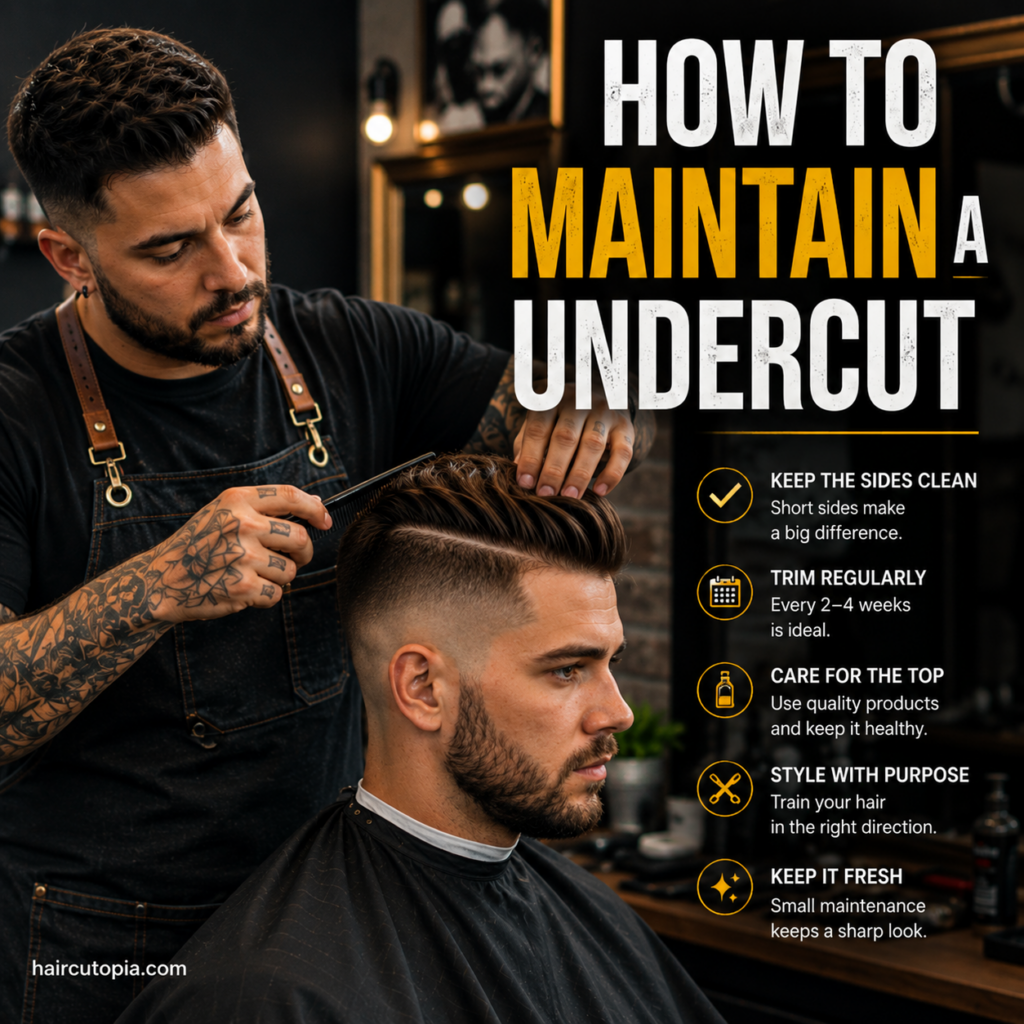
An undercut can still look good several weeks after a haircut, but it won’t look exactly the same as it did when you left the barber’s chair. That’s simply the nature of a style built around contrast.
The short sides begin filling in, the neckline becomes less defined, and the longer hair on top gets heavier. If you have a fade incorporated into your undercut, that crisp transition can disappear even sooner.
So, how often should you actually get an undercut trimmed?
For most people, a good undercut maintenance schedule falls somewhere between every 2 and 4 weeks. Very short or skin-faded versions may need attention every 1 to 2 weeks, while softer, longer undercuts can often stretch to 4 to 6 weeks.
You don’t necessarily need a complete haircut every time, either. Strategic cleanups can keep an undercut looking sharp while allowing you to preserve or grow the length on top.
Here’s how to build a maintenance schedule that works for your haircut, hair type, and tolerance for a little grow-out.
Quick Undercut Maintenance Schedule
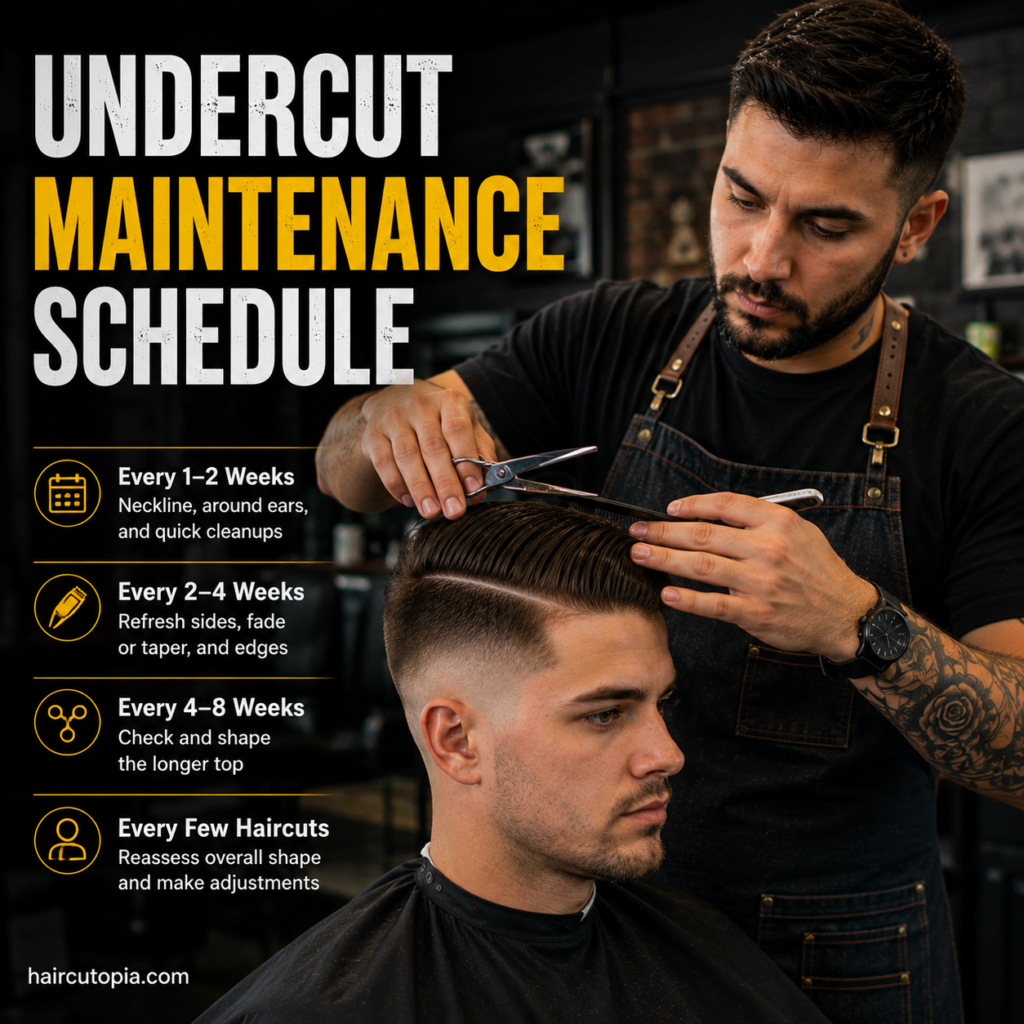
If you’re looking for a simple starting point, use this schedule:
- Every few days: Style the top and wash as needed based on your hair and product use.
- Every 1 to 2 weeks: Check the neckline, sideburns, around the ears, and very short faded areas.
- Every 2 to 4 weeks: Refresh the sides and back for most undercuts.
- Every 4 to 8 weeks: Evaluate the top for shaping, excess weight, split ends, or loss of structure.
- Every few haircuts: Reassess the overall shape with your barber and make adjustments as needed.
This isn’t a rigid calendar.
Some people are perfectly happy with an undercut after five weeks of growth. Others notice their fade looking overgrown after ten days.
Your ideal schedule depends largely on how short you wear the sides and how polished you want the haircut to look.
How Fast Does an Undercut Lose Its Shape?
Hair doesn’t suddenly become overgrown on a particular day.
Instead, the haircut gradually changes.
The earliest signs tend to appear around areas where the hair is shortest. A skin fade begins showing growth. A clean neckline becomes fuzzy. Hair starts appearing around the ears.
Later, the sides gain enough length to change the overall silhouette of the haircut.
Eventually, the longer top can also become heavier and more difficult to style.
Because an undercut intentionally creates a difference between the top and sides, changes in that contrast can be particularly noticeable.
How Often Should You Trim an Undercut?
A 2-to-4-week barber schedule works well for many undercuts, but there’s no single interval that applies to everyone.
Here’s a more useful breakdown.
Every 1 to 2 Weeks
Consider this schedule if you have:
- A skin undercut
- A very short fade
- A zero or extremely short clipper length
- A sharply lined neckline
- A haircut you want to keep consistently barber-fresh
You may not need the top cut at all during these appointments.
A quick cleanup of the sides, back, edges, and neckline may be enough.
Every 2 to 3 Weeks
This is a practical schedule for many short undercuts.
It’s particularly useful if the sides are cut with short clipper guards and you want to maintain a strong contrast with the top.
At this point, your barber may:
- Reclipper the sides
- Refresh a fade or taper
- Clean the neckline
- Tidy around the ears
- Reshape the sideburns
- Leave most of the top alone
Every 3 to 4 Weeks
If you don’t mind a little growth, this is often a comfortable middle ground.
The undercut will no longer look freshly cut toward the end of the cycle, but it should still retain much of its basic shape.
People with slightly longer sides may find this schedule particularly manageable.
Every 4 to 6 Weeks
Longer, softer undercuts can sometimes go this long between full barber appointments.
Expect noticeably more growth around the sides and back.
This schedule works better if you don’t need the haircut to maintain a highly precise fade or dramatic short-to-long contrast at all times.
Your Side Length Determines a Lot
One of the easiest ways to estimate your maintenance schedule is to look at how short the sides are.
The shorter the starting length, the sooner growth becomes visually obvious.
Skin or Nearly Skin
Expect the highest maintenance.
Even a small amount of growth changes the appearance because you’re going from virtually no visible hair to visible stubble.
If keeping the skin-short appearance matters to you, you may want a cleanup every week or two.
#1 to #2 Guard
These lengths still create substantial contrast but generally give you a little more breathing room than skin.
A visit every 2 to 3 weeks can keep things looking sharp.
#3 to #4 Guard
Slightly longer clipper lengths tend to grow out more softly.
You may find that every 3 to 4 weeks is sufficient.
Longer Scissor-Cut Sides
A softer undercut with longer sides can often stretch beyond four weeks, particularly if the edges and neckline grow cleanly.
These are general guidelines rather than rules. Hair density, texture, growth direction, and personal preference all affect how quickly the haircut appears overgrown.
Fade vs. Classic Undercut Maintenance
Not every undercut has a fade.
That distinction matters when planning appointments.
Classic Disconnected Undercut
A traditional disconnected undercut often keeps the sides at a relatively consistent short length with an obvious separation from the longer top.
Because there’s no intricate gradient to preserve, maintenance can be relatively straightforward.
Your barber can shorten the sides while protecting the longer section.
Undercut With a Fade
Adding a fade usually increases maintenance.
The smooth transition between different lengths is most visible immediately after the haircut. As the shortest sections grow, the fade becomes softer.
If maintaining that crisp gradient is important, expect more frequent barber visits.
Undercut With a Taper
A taper focuses shorter lengths around areas such as the sideburns and neckline rather than fading a large portion of the head.
This can grow out more subtly and may be a good option if you want an undercut that doesn’t require constant cleanup.
Weekly Undercut Maintenance
You don’t need to visit the barber every week to maintain your haircut.
Most weekly maintenance happens at home.
Check the Sides
Look for areas beginning to stick outward.
Thick or straight hair can become especially noticeable as short sides grow.
A little styling product may temporarily control them, but don’t keep adding more product to compensate for an obviously overgrown haircut.
Check Around Your Ears
Small hairs around the ears can make a haircut look untidy surprisingly quickly.
If you’re comfortable performing minor cleanup yourself, this area can sometimes be maintained at home.
Avoid cutting into the main structure of the haircut.
Check Your Neckline
The neckline is easy to forget because you rarely see it without a second mirror.
Unfortunately, it’s also one of the first areas other people may notice when it becomes overgrown.
Evaluate the Top
Ask yourself whether the longer hair is still styling normally.
If your usual technique suddenly requires significantly more product or effort, excess length or weight may be part of the problem.
What Should Be Done at a 2-Week Cleanup?
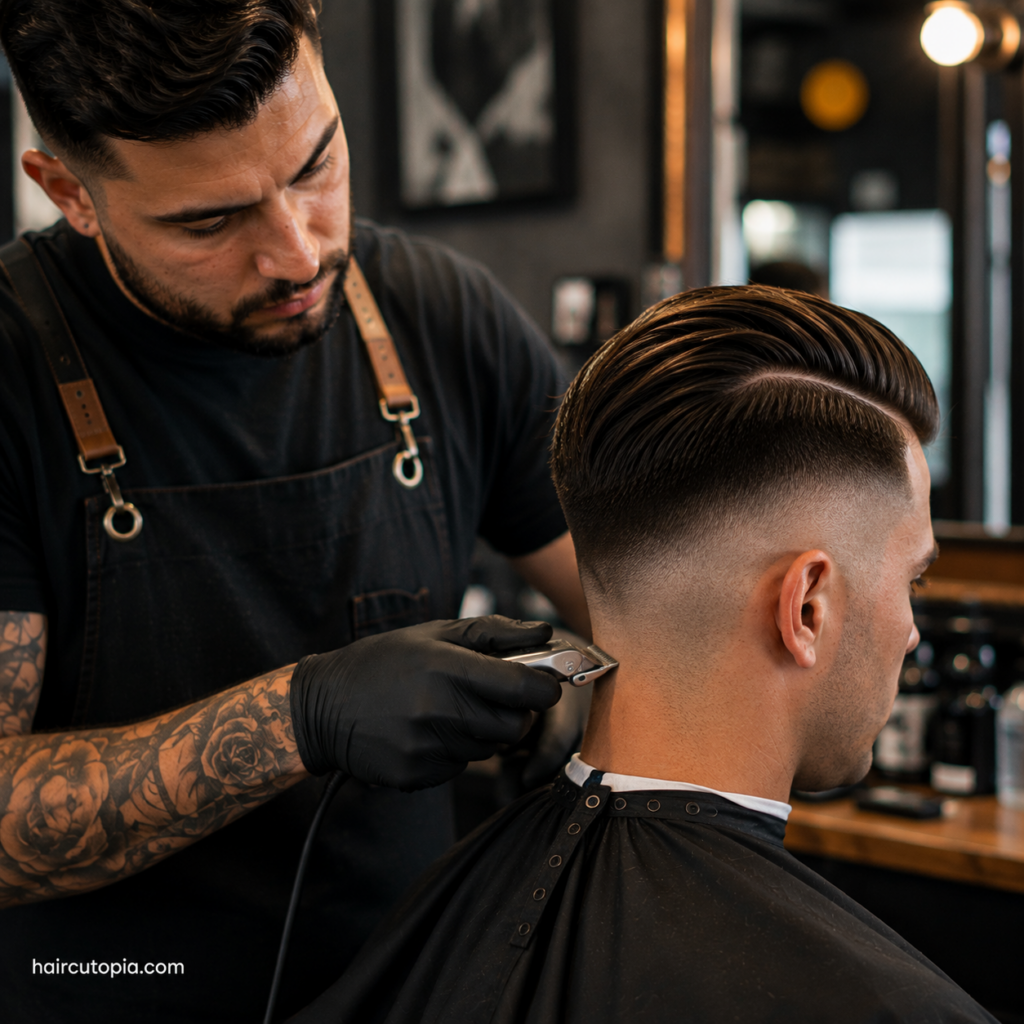
A two-week appointment doesn’t necessarily need to become another full haircut.
Think of it as a reset.
Depending on your undercut, the barber might:
- Refresh the shortest sections.
- Restore the fade or taper.
- Clean around the ears.
- Reshape the sideburns.
- Clean the neckline.
- Leave the longer top untouched.
This approach is particularly useful if you’re intentionally growing the top.
Tell your barber exactly that.
You can say:
“Just refresh the sides and back today. I’m growing the top, so I’d like to keep the length.”
What Should Be Done at a 4-Week Appointment?
Around four weeks is a good time to evaluate the entire haircut rather than automatically repeating the previous cut.
The sides probably need attention, but the top may also benefit from minor shaping.
Ask whether there is:
- Too much weight
- Uneven growth
- Loss of texture
- Excess length around the front
- Bulky areas near the transition
- Dry or damaged ends
You don’t necessarily need to shorten the top significantly.
A barber can often reshape or remove strategic weight while preserving most of the length.
When Should You Trim the Top?
The top of an undercut usually doesn’t need to follow the same schedule as the sides.
That’s important.
If you’re trying to build enough length for a slick back, quiff, pompadour, or longer side-swept style, trimming the top every two weeks would work against you.
Instead, evaluate it every several haircuts.
The top may need attention when:
- It becomes difficult to style
- The front falls differently
- It feels excessively heavy
- Your volume collapses quickly
- The shape looks uneven
- The ends feel dry or damaged
Tell your barber your long-term goal before they begin cutting.
Undercut Maintenance Schedule for Growing the Top
Growing the top while maintaining short sides is a common strategy.
Your schedule might look something like this:
Weeks 1–2
Style normally and allow the top to grow.
If the sides are extremely short, consider a quick cleanup.
Weeks 3–4
Refresh the sides and back.
Keep the top largely untouched unless it needs very minor shaping.
Weeks 5–8
Continue maintaining the short areas while allowing length to accumulate on top.
Your barber may lightly reshape the top if it becomes unbalanced.
After Several Months
Reassess the haircut.
As the top gets longer, the proportions of the undercut change. You may want the sides adjusted slightly to complement the additional length.
This approach lets you maintain a clean haircut without repeatedly sacrificing your progress on top.
Undercut Maintenance Schedule for a Slick Back
A slicked-back undercut depends heavily on having enough length.
The sides may need trimming every 2 to 4 weeks, while the top can often be left considerably longer between substantial cuts.
Rather than shortening it automatically, ask your barber to check:
- Overall shape
- Weight distribution
- Damaged ends
- How easily the hair moves backward
If the hair begins separating strangely or refuses to stay back, it may need reshaping rather than simply stronger pomade.
Undercut Maintenance Schedule for a Quiff
A quiff depends on volume through the front.
Too little length makes it difficult to create height, but excessive weight can cause the style to collapse.
Keep the sides on your preferred 2-to-4-week schedule and evaluate the top periodically.
The front may need to remain longer while other areas are lightly reshaped to preserve the silhouette.
Tell your barber you wear the hair as a quiff so they understand why certain lengths matter.
Undercut Maintenance Schedule for Thick Hair
Thick hair can make an undercut look especially full as it grows.
The sides may begin sticking outward relatively quickly, even when they aren’t particularly long.
You may prefer shorter maintenance intervals simply to control the silhouette.
The top can also become heavy.
Rather than automatically shortening it, your barber may be able to remove some internal weight or add appropriate texture.
Undercut Maintenance Schedule for Fine Hair
Fine hair doesn’t necessarily need more frequent cutting.
In fact, excessive thinning or texturizing can make the longer section appear less full.
Focus on preserving a flattering shape.
A slightly softer undercut may also grow out more naturally than an extremely dramatic skin-to-long contrast.
Ask your barber to be conservative with weight removal if fullness is important to you.
Undercut Maintenance Schedule for Curly or Wavy Hair
Texture can disguise some growth, particularly through the longer section.
That may allow you to stretch appointments slightly.
However, the sides can still become bulky as they grow.
Pay attention to the overall shape rather than judging the haircut only by length.
With curly hair, remember that the top can look substantially shorter once dry. Make sure your barber knows how you normally wear your curls before removing length.
Should You Maintain an Undercut at Home?
Some maintenance can be done at home, but know where to draw the line.
Simple cleanup is much easier than recreating a professional fade.
At-home maintenance may be reasonable if:
- Your sides are one consistent clipper length
- You understand the original sectioning
- You’re only removing obvious growth
- You’re comfortable using clippers
- You can clearly see the area you’re cutting
Be especially careful around the boundary between the long top and short sides.
Moving the clippers too high can remove hair you’ve spent months growing.
If you’re uncertain, leave the structural work to your barber.
How to Make an Undercut Last Longer Between Haircuts
You can’t stop your hair from growing, but you can keep the haircut looking better during the process.
A few habits help:
- Keep the neckline and edges tidy.
- Style the longer top rather than allowing it to sit randomly.
- Wash out excessive product buildup.
- Use conditioner when the longer hair needs it.
- Blow-dry the top into its intended shape.
- Avoid overloading overgrown sides with styling product.
- Schedule a small cleanup instead of waiting for a complete haircut when necessary.
A haircut with slightly longer sides will also naturally require less frequent maintenance than a skin-short version.
If you dislike frequent barber visits, mention that during your consultation. Your barber can design the undercut with grow-out in mind.
Signs Your Undercut Needs a Trim
The calendar is useful, but your hair is a better indicator.
It’s probably time for a cleanup when:
- Hair begins growing noticeably over the ears
- The sides stick outward
- The neckline looks fuzzy
- Your fade has lost most of its definition
- The sideburns become uneven
- The contrast between top and sides disappears
- The top becomes difficult to style
- You need considerably more product than usual
- The overall silhouette looks rounder or heavier
You don’t need to wait until all of these happen.
For some people, the first sign is enough to schedule an appointment.
What to Tell Your Barber at a Maintenance Appointment
Be specific about what you want to preserve.
If you like your current length on top, say so before the haircut begins.
For example:
“I want to maintain the undercut and take the sides back to about a #2. Please clean up the neckline and around the ears, but keep most of the length on top.”
If the top has become heavy, add:
“The top is getting harder to style, so I’d like some of the weight removed without making it noticeably shorter.”
That gives your barber much more useful information than simply asking for “the same thing as last time.”
How to Adjust Your Maintenance Schedule
Your first schedule doesn’t have to be permanent.
Experiment.
If you’re getting your undercut trimmed every two weeks but still think it looks good at the appointment, try waiting three weeks.
If you’re waiting four weeks but dislike how it looks after week two, move your appointments closer together.
You may even find that your schedule changes depending on the season, your hairstyle, or how short you decide to wear the sides.
The goal isn’t to visit the barber as frequently as possible.
It’s to find the point where the haircut still looks good without creating unnecessary maintenance.
Sample Low-Maintenance Undercut Schedule
If you want fewer barber visits, consider keeping the sides slightly longer.
A simple routine could be:
- Weeks 1–2: Normal styling and hair care
- Week 3: Check edges, neckline, and overall shape
- Week 4: Barber cleanup or full maintenance cut
- Weeks 5–7: Normal styling after the refresh
- Week 8: Reassess the top and complete haircut shape
Your exact timing may vary, but the principle is simple: avoid extremely short details that need constant refreshing.
Sample High-Maintenance Undercut Schedule
If you prefer a consistently sharp skin fade or very short undercut, the schedule will be more demanding.
For example:
- Week 1: Fresh haircut
- Week 2: Fade, neckline, and edge cleanup
- Week 3: Normal styling
- Week 4: Full haircut and shape evaluation
- Week 5: Normal styling
- Week 6: Fade and edge cleanup
- Week 8: Full haircut
Not everyone needs this level of maintenance.
It’s mainly for people who want the haircut to remain close to freshly cut most of the time.
How Much Maintenance Does an Undercut Really Require?
An undercut can be either relatively low-maintenance or surprisingly demanding.
The haircut itself isn’t the deciding factor. The version you choose is.
A skin-faded undercut with sharply defined edges requires regular attention.
A softer undercut with longer sides and a natural neckline can tolerate considerably more growth.
If convenience matters, tell your barber before choosing the shortest possible version.
A slightly longer cut may give you essentially the same overall style with much easier upkeep.
Final Thoughts
For most people, an undercut maintenance schedule of roughly every 2 to 4 weeks offers a good balance between keeping the haircut sharp and avoiding constant barber visits.
If you wear the sides extremely short or incorporate a skin fade, you may prefer a cleanup every 1 to 2 weeks. Longer and softer undercuts can often stretch to 4 weeks or beyond.
Remember that the top and sides don’t have to be cut on the same schedule. You can refresh the short areas while preserving the longer hair, especially if you’re growing it for a slick back, quiff, or other longer style.
Use the calendar as a starting point, not a rule. Once you know when your own undercut begins losing the shape you like, you’ve found the maintenance schedule that actually matters.