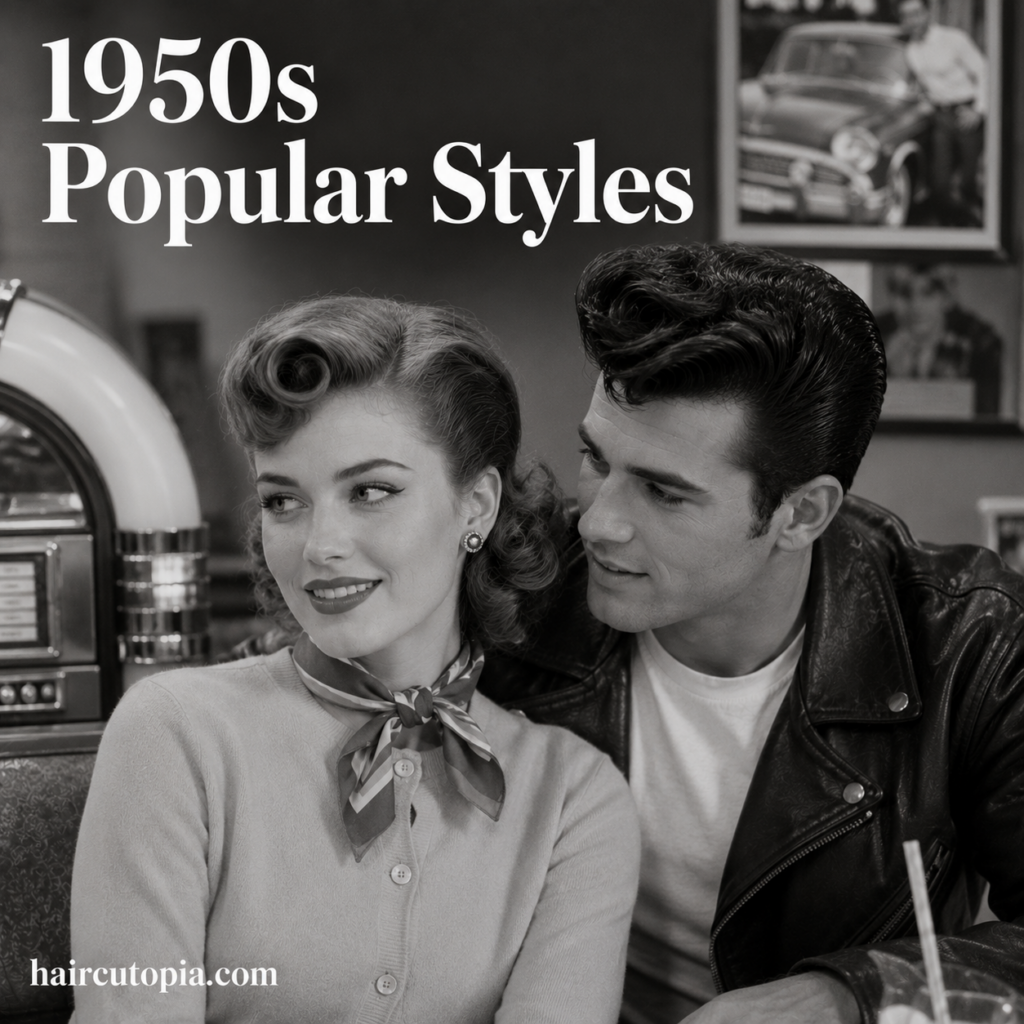
The 1950s produced some of the most recognizable hair looks of the 20th century.
Short curls, polished waves, ponytails, pixies, pompadours, crew cuts, and slicked-back styles all belonged to the same decade. Some were elegant and conservative. Others became symbols of teenagers, Hollywood glamour, or the emerging rock-and-roll scene.
That’s part of what makes 1950s hair so interesting. There wasn’t one single look everyone followed.
Women could choose carefully sculpted curls or a surprisingly short pixie. Men might wear a neat crew cut to school or work while younger trendsetters experimented with towering pompadours and glossy ducktails.
Many of these styles remain familiar today, even if the modern versions are softer and less structured.
Let’s look at the popular styles of the 1950s, how people wore them, and what made certain looks become lasting symbols of the era.
What Hair Styles Were Popular in the 1950s?
Hair in the 1950s generally had a finished appearance.
Women often relied on rollers, pin curls, brushing, and careful shaping to create curls and waves. Men used combs and styling products to keep their hair smooth or build volume through the front.
Some of the decade’s most popular looks included:
- Short curled hairstyles
- Hollywood waves
- Poodle curls
- Pixie cuts
- Pageboys
- Ponytails
- Curled-under bobs
- Bouffant-inspired styles
- Crew cuts
- Side parts
- Ivy League styles
- Pompadours
- Quiffs
- Ducktails
- Slick backs
Popularity also changed depending on age, lifestyle, and where you were in the decade.
The polished looks of the early 1950s gradually shared space with more youthful and expressive styles as rock and roll and teenage culture grew.
Popular 1950s Styles for Women
Women’s hair could be glamorous, practical, playful, or sophisticated.
Shorter lengths were especially important, but medium and long hair remained common and offered plenty of styling possibilities.
1. Short Sculpted Curls
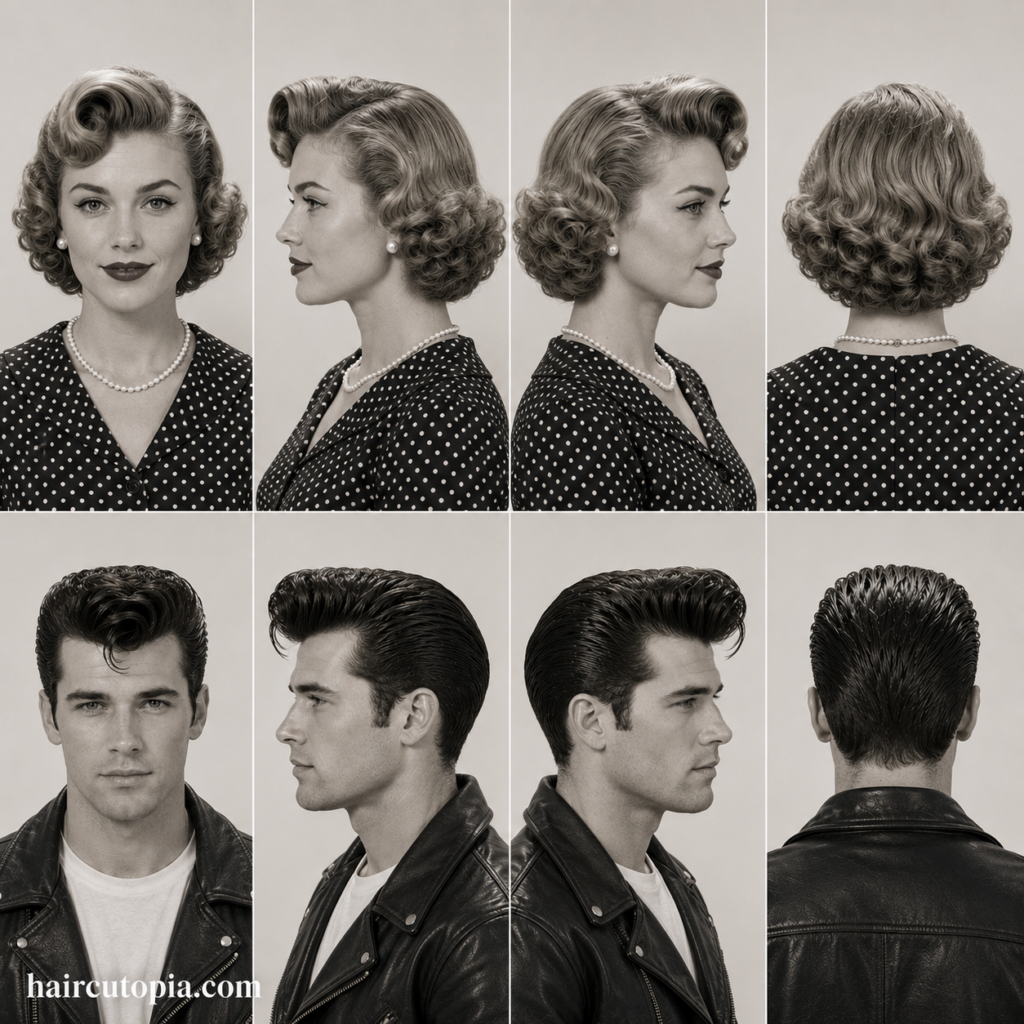
Short curls are one of the easiest hairstyles to associate with the 1950s.
Hair was usually set in rollers or pin curls and then brushed into a controlled shape around the head.
The finished curls might be soft and flowing or much more defined.
This style worked particularly well with shorter hair because the curls created fullness without requiring much length.
It could also be adjusted for different occasions. A softer brush-out worked for everyday wear, while more carefully arranged curls created a glamorous evening look.
2. Hollywood Waves
Hollywood helped turn polished waves into an enduring symbol of mid-century glamour.
Hair was curled and then brushed until individual curls blended into larger, smoother waves.
A deep side part could create additional drama around the face.
Marilyn Monroe became one of the most famous examples of the decade’s glamorous short curls and waves.
The appeal of this look has lasted remarkably well.
Modern red-carpet waves still borrow heavily from the same idea: defined movement, polished texture, and a carefully shaped silhouette.
3. The Poodle Style
The poodle look was one of the more distinctive curly styles of the early 1950s.
Instead of brushing curls into long waves, smaller curls remained visible and were often concentrated around the top or front of the head.
Lucille Ball became closely associated with highly recognizable curly hairstyles during the era.
The poodle style could be playful, glamorous, or theatrical depending on how dramatically the curls were arranged.
4. The Pixie
Very short women’s hair became a fashionable statement.
The pixie was cropped closely around the ears and neckline, with short pieces or a delicate fringe framing the forehead.
Audrey Hepburn helped demonstrate how sophisticated a very short hairstyle could look.
The pixie stood apart from the decade’s fuller curled hairstyles.
Instead of relying on volume, it emphasized facial features, particularly the eyes and cheekbones.
That simplicity is one reason the style remains popular today.
5. The Pageboy
The pageboy offered a smoother alternative to tightly curled hair.
Typically worn somewhere between chin and shoulder length, the hair curved inward around the ends to create a rounded silhouette.
It could be paired with:
- Short bangs
- A side part
- A smooth crown
- Softly curved ends
The pageboy looked polished without requiring curls throughout the entire hairstyle.
Modern versions sometimes incorporate layers and additional texture while retaining the recognizable curved shape.
6. The Curled Bob
Bobs were already well established by the 1950s, but the decade gave them a softer appearance.
Instead of the sharply geometric lines associated with some later bob styles, 1950s versions frequently incorporated curls, waves, or rounded ends.
A chin-length bob could be set with rollers and brushed into a smooth shape.
The result was elegant but practical enough for everyday wear.
7. The Ponytail
The ponytail became one of the defining youthful styles of the decade.
It was particularly popular among teenagers and younger women.
Hair was gathered toward the back of the head and could be worn relatively high, with the lengths often curled for extra bounce.
A ponytail might also be paired with:
- Short bangs
- A ribbon
- A scarf
- Curled front pieces
- A headband
Compared with elaborate roller-set hairstyles, the ponytail felt relaxed and youthful.
It also fit naturally into the growing teenage fashion culture of the era.
8. Curled-Under Hair
One of the simplest popular looks involved curling the ends inward.
Hair could remain relatively smooth through the top and middle before turning toward the neck.
This technique worked especially well with shoulder-length styles, bobs, and pageboys.
The effect was neat, feminine, and understated.
It also created the rounded silhouette seen frequently in 1950s fashion photography and advertisements.
9. Flipped Ends
The opposite approach became increasingly visible later in the decade.
Instead of curling toward the neck, the ends flipped outward.
The look could be subtle or more pronounced depending on the length and styling.
Flipped ends would become even more recognizable during the early 1960s, making the style an interesting bridge between the two eras.
10. The Bouffant
As the 1950s progressed, women’s hair started moving upward.
The bouffant emphasized volume around the crown.
Rollers provided lift, while backcombing could create additional structure underneath the visible surface of the hair.
The top layer was then smoothed over the teased foundation.
Late-1950s bouffants were an early indication of what was coming next. During the 1960s, high-volume hairstyles would become considerably more dramatic.
11. Elegant Chignons
Women with longer hair could arrange it into a chignon for a sophisticated appearance.
Hair was gathered around the nape and shaped into a smooth bun or roll.
The front could be kept sleek or styled with waves.
This made the chignon especially useful for formal events because it provided an elegant silhouette without requiring the hair to be cut short.
12. Rolled Updos
More elaborate updos used curls, rolls, and pinned sections to create sculpted shapes.
There wasn’t one universal 1950s updo.
Instead, hair could be arranged differently depending on its length, the occasion, and the desired level of glamour.
The common thread was control.
Even complicated hairstyles were generally designed to look polished rather than deliberately messy.
Popular 1950s Styles for Men
Men’s hair during the 1950s had two distinct personalities.
Traditional styles remained neat and conservative.
At the same time, rock and roll helped popularize longer, more dramatic hairstyles among younger men.
13. The Crew Cut
The crew cut was one of the most practical men’s styles of the decade.
Hair was clipped short around the sides and back with slightly more length left through the top.
It was easy to maintain and required little daily styling.
The crew cut became associated with:
- Athletes
- College students
- Military-inspired grooming
- Clean-cut fashion
Its simplicity helped it remain a standard barbershop haircut long after the 1950s ended.
14. The Classic Side Part
The side part was another everyday staple.
Hair was neatly divided and combed to one side, usually with enough styling product to maintain a controlled finish.
The sides and back remained relatively short.
Unlike more dramatic rock-and-roll hairstyles, the side part worked in virtually any environment.
It was appropriate for school, business, formal events, and everyday life.
15. The Ivy League Style
The Ivy League offered a slightly longer version of the clean-cut aesthetic.
Hair remained short around the sides and back but had enough length on top to create a small side part or sweep through the front.
The style was tidy without appearing as closely cropped as a crew cut.
It’s also one of the easiest 1950s men’s styles to wear today because the proportions remain common in modern barbering.
16. The Pompadour
Few men’s hairstyles are more strongly associated with the 1950s.
The pompadour featured substantial length at the front, which was brushed upward and backward to create height above the forehead.
The sides remained much flatter.
Elvis Presley became one of the most recognizable hairstyle influences of the decade, helping connect voluminous men’s hair with rock-and-roll culture.
A pompadour could range from relatively restrained to dramatically tall.
Either way, it required considerably more styling than a crew cut or simple side part.
17. The Ducktail
The ducktail became another classic rebellious style.
Hair along both sides of the head was combed backward until the sections met along the center of the back.
That seam created the tail-like shape that gave the hairstyle its name.
The front was often styled upward into a quiff or pompadour.
The ducktail required length, careful combing, and plenty of hold.
It became closely connected with the greaser aesthetic that remains visually associated with the decade.
18. The Slick Back
The slick back provided a simpler approach to longer men’s hair.
Hair was combed directly away from the forehead and held in place with styling product.
The sides could also be directed backward for a streamlined silhouette.
Traditional pomades produced the glossy finish commonly seen in photographs from the era.
Today’s slick backs often use lighter products and more natural texture, but the basic styling direction remains unchanged.
19. The Quiff
The quiff combined additional front length with shorter, controlled sides.
Hair above the forehead was lifted upward and slightly backward.
Compared with a full pompadour, the quiff could be smaller and less structured.
That made it adaptable.
A neat quiff could look relatively conservative, while a larger version had much more of a rock-and-roll personality.
Modern textured quiffs continue to use the same basic proportions.
20. The Greaser Look
The greaser look wasn’t one single haircut.
It was an overall approach to styling.
Hair was typically glossy, shaped, and deliberately noticeable.
Greaser-inspired hair could include:
- Pompadours
- Ducktails
- Slick backs
- Quiffs
- Sculpted front waves
The style became part of a broader youth image involving leather jackets, denim, T-shirts, motorcycles, cars, and rock-and-roll culture.
It remains one of the most instantly recognizable visual representations of the 1950s.
21. The Elephant Trunk
The elephant trunk offered an even more distinctive variation.
Hair through the sides was slicked backward, while longer sections at the front were shaped so that part of the hair curved or dropped toward the forehead.
The result created a noticeable feature at the front.
It wasn’t as universally popular as a side part or crew cut, but it became part of the more adventurous men’s styling associated with the decade.
Popular Teenage Styles of the 1950s
Teenagers played an increasingly important role in fashion during the 1950s.
For the first time, youth culture was becoming a major consumer force with its own music, clothing, magazines, and recognizable style.
Hair naturally became part of that identity.
For teenage girls, popular choices included:
- Ponytails
- Short curls
- Bangs
- Headbands
- Scarves
- Shoulder-length styles
- Curled ends
Teenage boys could choose between traditional short hair and more rebellious styles such as:
- Pompadours
- Quiffs
- Ducktails
- Slick backs
The difference could communicate quite a bit.
A crew cut projected a very different image from a glossy pompadour.
Hair was becoming a visible way for young people to express personality.
Popular Hollywood Styles of the 1950s
Hollywood was one of the decade’s most powerful style influences.
People encountered movie stars not only on the screen but also in magazines, advertisements, newspapers, and promotional photographs.
Marilyn Monroe’s short blonde curls became synonymous with glamorous 1950s beauty.
Audrey Hepburn made very short hair look sophisticated.
Grace Kelly represented a polished, elegant approach to hair, while Elizabeth Taylor appeared with richly styled curls and waves.
Men had their own screen influences.
James Dean became an enduring image of youthful cool, while Elvis Presley’s musical and screen appearances helped make voluminous men’s styling famous around the world.
These celebrities didn’t necessarily invent the hairstyles they wore.
Their visibility helped make those styles desirable.
Popular Rock-and-Roll Hair Styles
Rock and roll changed the cultural meaning of men’s hair.
Before the genre exploded in popularity, men’s grooming was largely associated with neatness and conformity.
Rock-and-roll performers offered another possibility.
Hair could be part of the performance.
Pompadours became higher. Front sections became more dramatic. Glossy styling products emphasized every carefully combed wave.
The look was particularly appealing to teenagers because it felt separate from conventional adult fashion.
Music and hair became connected in a way that would continue through virtually every major youth movement that followed.
Popular Casual Women’s Styles
It’s easy to focus entirely on glamorous photographs when discussing 1950s hair.
Everyday hair could be much simpler.
A woman might wear a ponytail, scarf, smooth pageboy, short curled style, or basic roller-set waves.
The difference was that even casual hair often retained some structure.
Ends were curled.
The front was shaped.
A scarf or headband might finish the look.
The overall effect was still intentional without necessarily requiring elaborate styling every day.
Popular Formal Styles
Formal hair generally involved more control and detail.
Women could wear:
- Chignons
- Rolled updos
- Sculpted curls
- Smooth waves
- Pinned curls
- Elegant short sets
Men usually kept their existing haircut but styled it particularly neatly.
A side part might receive additional shine and definition, while longer hair could be carefully slicked into position.
The goal was refinement rather than a completely different haircut.
Popular Hair Accessories
Accessories were an easy way to change the appearance of a hairstyle.
Some of the most recognizable included:
- Scarves
- Ribbons
- Headbands
- Barrettes
- Decorative combs
- Hairpins
- Flowers
- Small clips
Scarves were especially useful because they could be both decorative and practical.
A scarf might be tied around a ponytail or wrapped around the head to protect styled hair.
Ribbons and headbands were particularly compatible with youthful looks.
Popular Hair Colors of the 1950s
Color became increasingly visible as part of the overall hairstyle.
Hollywood helped reinforce several recognizable beauty images.
Blonde hair became strongly associated with glamour through stars such as Marilyn Monroe.
Brunette hair offered a polished, dramatic alternative.
Red hair became particularly memorable through celebrities such as Lucille Ball.
At the same time, commercial hair coloring was becoming increasingly accessible.
That helped shift hair color toward something people could intentionally change as part of their appearance rather than simply accept as a fixed feature.
How People Created Popular 1950s Styles
The finished hairstyles might look effortless in old photographs, but many required considerable preparation.
Women’s hair frequently began with a wet or damp set.
A typical process might involve:
- Washing and preparing the hair.
- Dividing it into sections.
- Setting the hair with rollers or pin curls.
- Allowing it to dry completely.
- Removing the rollers or pins.
- Brushing the curls together.
- Shaping the hair into the desired silhouette.
- Securing sections with pins if necessary.
- Applying finishing product.
The brush-out was especially important.
Fresh curls were often much tighter than the final hairstyle. Brushing transformed them into smooth waves and larger shapes.
Men generally relied more heavily on combing and styling products.
Pomade could provide enough control to sculpt a pompadour, slick back the sides, or create the center seam of a ducktail.
Early 1950s Popular Styles
The beginning of the decade still carried noticeable influence from the 1940s.
Women’s styles often featured:
- Short curls
- Poodle-inspired curls
- Structured waves
- Rounded silhouettes
- Carefully set hair
Men generally favored:
- Short cuts
- Crew cuts
- Side parts
- Neat combed styles
Hair tended to remain controlled and relatively compact.
Mid-1950s Popular Styles
By the middle of the decade, youth culture was becoming increasingly visible.
Women’s styles included:
- Pixies
- Curled bobs
- Ponytails
- Hollywood waves
- Pageboys
Men’s fashion expanded to include:
- Pompadours
- Quiffs
- Ducktails
- Slick backs
Rock and roll was helping hair become more expressive.
Late 1950s Popular Styles
Toward the end of the decade, women’s hair began increasing in size.
Bouffant-inspired volume appeared around the crown.
Flipped ends became more visible.
Backcombing helped create larger silhouettes.
These styles pointed toward the dramatically bigger hairstyles of the early 1960s.
Men’s styles continued to range from conservative short cuts to rock-and-roll-inspired looks, although youth fashion was becoming increasingly influential.
1950s Popular Styles That Still Work Today
Many 1950s styles have survived surprisingly well.
Some barely need modification.
Popular looks that still appear today include:
- Pixie cuts
- Curled bobs
- Vintage waves
- Ponytails
- Side parts
- Crew cuts
- Ivy League cuts
- Pompadours
- Quiffs
- Slick backs
- Flipped ends
What has changed most is the finish.
Modern hair usually looks softer and more touchable.
A modern pompadour may have visible texture rather than a glossy, perfectly combed surface. Vintage waves may be loosened to create more movement.
The underlying shapes, however, are often remarkably similar.
How to Wear a 1950s Style Without Looking Like a Costume
Vintage inspiration doesn’t have to mean complete historical recreation.
The easiest approach is to borrow one defining feature.
For example:
- Add a scarf to a curled ponytail.
- Give a modern bob softly curved ends.
- Brush curls into loose vintage waves.
- Add subtle crown volume.
- Style short hair with a vintage-inspired fringe.
- Turn a modern men’s cut into a loose quiff.
- Add height to the front for a subtle pompadour.
- Use a little extra shine with a classic side part.
Keeping the rest of the look contemporary prevents the hairstyle from feeling overly theatrical.
You can always increase the vintage styling if you’re dressing for a themed event or want a more historically recognizable result.
Frequently Asked Questions About 1950s Popular Styles
What was the most popular women’s hairstyle in the 1950s?
There wasn’t one universal style. Short curls, waves, pixies, pageboys, ponytails, and curled bobs were all popular at different points during the decade.
What was the most popular men’s hairstyle in the 1950s?
Crew cuts and side parts were common everyday choices. Pompadours, quiffs, ducktails, and slick backs became particularly recognizable through rock-and-roll and youth culture.
What styles did teenagers wear in the 1950s?
Teenage girls frequently wore ponytails, curls, bangs, scarves, and headbands. Teenage boys could wear crew cuts or experiment with pompadours, quiffs, ducktails, and slicked styles.
What was the greaser hairstyle?
Greaser hair generally featured longer, heavily styled men’s hair with a glossy finish. Pompadours, ducktails, quiffs, and slick backs were commonly associated with the look.
Were ponytails popular in the 1950s?
Yes. Ponytails became especially associated with teenage girls and younger women. They were often curled and paired with ribbons, scarves, headbands, or bangs.
Did women wear short hair in the 1950s?
Yes. Short hair was extremely fashionable. Pixies, short curled styles, bobs, and Italian-inspired cuts were among the popular options.
Were bangs popular in the 1950s?
Yes. Bangs appeared with short hair, ponytails, pageboys, and other styles. They could be short and neat or softly curled depending on the overall look.
Why were pompadours popular in the 1950s?
Rock-and-roll culture and highly visible performers helped turn voluminous men’s hair into a symbol of youth and rebellion. The pompadour’s dramatic height made it especially recognizable.
Final Thoughts
The popular styles of the 1950s tell a story about a decade that was changing faster than its polished appearance might suggest.
Traditional grooming remained everywhere. Crew cuts, side parts, carefully curled hair, and elegant waves reflected the importance of looking neat and put together.
But another influence was emerging.
Teenagers were developing their own fashion culture. Rock and roll made men’s hair bigger and bolder. Hollywood celebrities brought glamorous hairstyles into homes through movies and magazines. Women experimented with shorter cuts while gradually building more volume toward the crown.
By the end of the decade, hair was already pointing toward the 1960s.
That’s why 1950s popular styles offer so much variety today.
You can choose something understated, like a side part or curled-under bob, or go fully vintage with sculpted curls, a glossy ducktail, or a towering pompadour.
Either way, the shapes remain unmistakable — and more than 70 years later, many of them still look surprisingly at home in a modern salon or barbershop.