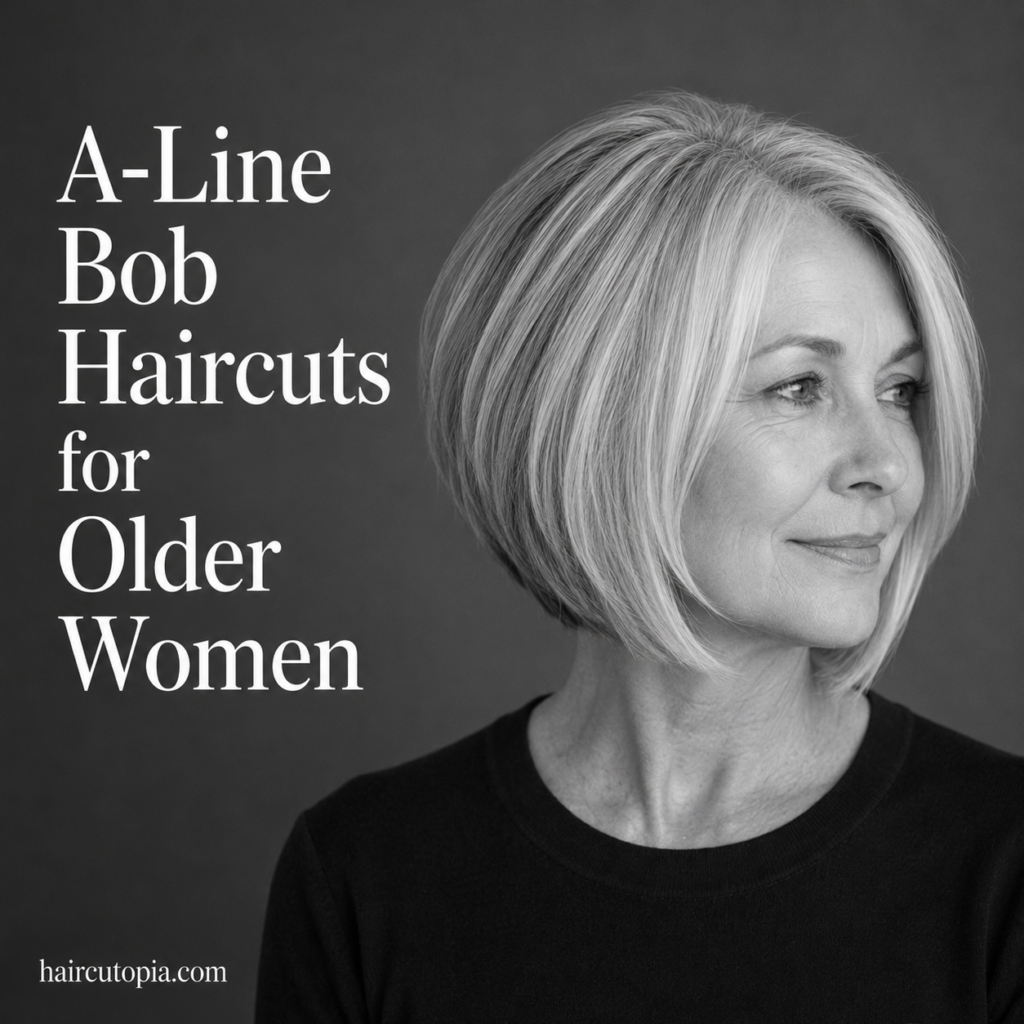
A great haircut doesn’t need to be complicated. Sometimes, the most flattering styles are the ones built around a strong, simple shape—and that’s exactly what makes the A-line bob such an enduring choice.
A-line bob haircuts for older women combine a shorter back with gradually longer pieces toward the front. That angled silhouette can give the hair more shape, create movement around the face, and make everyday styling considerably easier. It also works with far more hair textures than its sleek appearance might suggest.
Fine hair can benefit from a fuller-looking perimeter. Thick hair can be shaped to remove excess weight. Gray and silver hair can look especially striking when paired with a precise bob, while waves and curls give the classic cut a softer personality.
And there’s plenty of room for customization. Your A-line bob can be chin-length or shoulder-skimming, blunt or layered, sleek or tousled, subtle or dramatically angled.
Here are 27 beautiful ideas to consider, plus practical advice for choosing a version that works with your hair rather than against it.
What Is an A-Line Bob?
An A-line bob is shorter at the back and gradually gets longer as it approaches the front of the face.
Look at the haircut from the side and you’ll notice that the bottom edge slopes downward toward the front. That’s what creates the recognizable “A-line” effect.
The angle doesn’t have to be dramatic. In fact, a gentle transition often creates the softest and most wearable version.
An A-line bob can also include:
- Graduation through the back
- Subtle or pronounced layers
- Blunt ends
- Face-framing pieces
- Bangs
- Natural texture
- Stacked layers for additional volume
This flexibility is why two A-line bobs can look completely different while still sharing the same basic shape.
Why A-Line Bobs Work So Well for Older Women
Hair texture and density can change over time. Some women notice less density, while others find that their hair becomes coarser, drier, or more naturally textured.
A well-cut bob can accommodate those changes.
Depending on how it’s customized, an A-line bob can:
- Make fine hair appear fuller
- Add shape around the crown
- Remove weight from dense hair
- Frame the cheekbones and jaw
- Showcase gray, silver, or white hair
- Reduce daily styling time
- Add movement without sacrificing too much length
- Create a polished shape even with minimal styling
There’s also no requirement that an older woman’s haircut needs to be especially short. Longer A-line bobs can work just as beautifully and offer more flexibility for pulling the hair back.
27 A-Line Bob Haircuts for Older Women
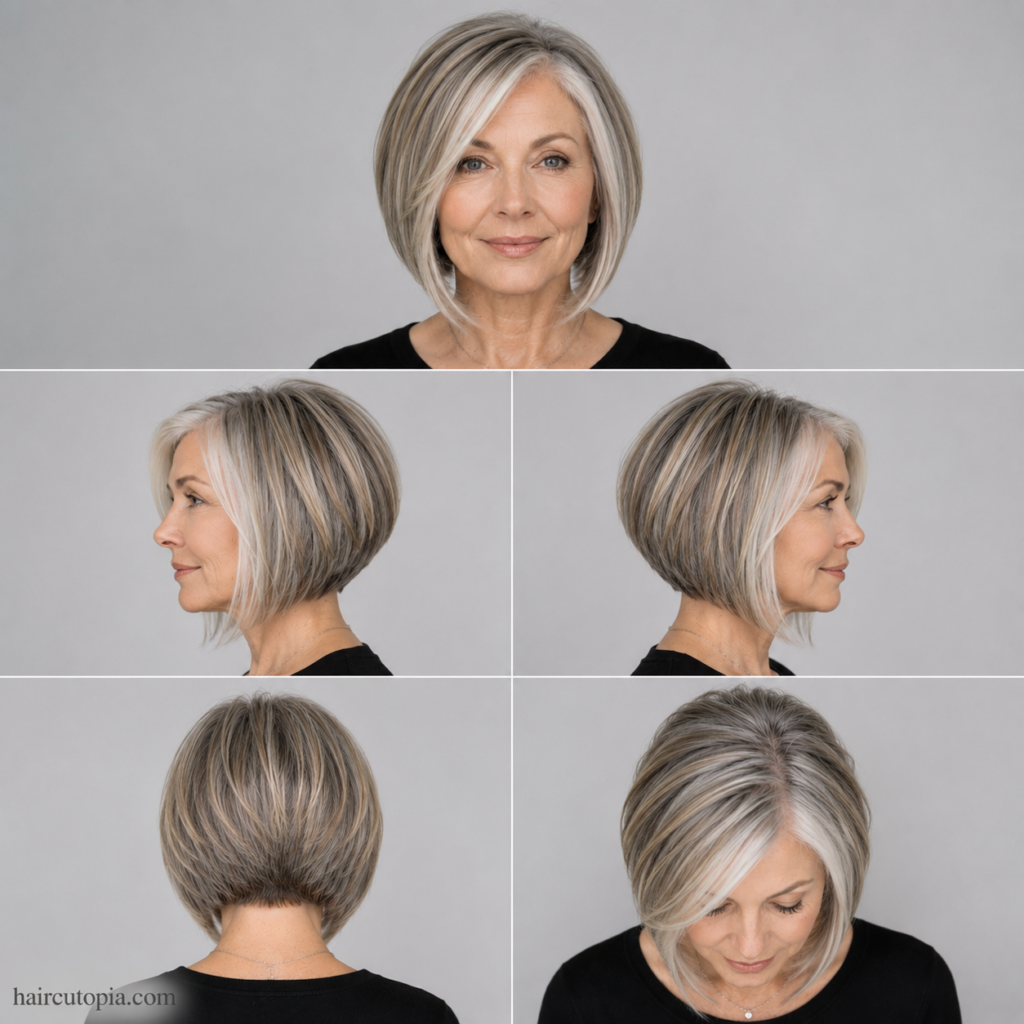
1. Classic A-Line Bob
The classic version keeps things simple: shorter through the back with a gradual increase in length toward the face.
A moderate angle feels polished without becoming overly dramatic. It’s an excellent choice if you want a noticeable change that still feels timeless.
2. Chin-Length A-Line Bob
A chin-length bob creates a crisp, defined silhouette.
Keeping the front pieces around or slightly below the chin provides natural face framing while maintaining the convenience of short hair.
3. Long A-Line Bob
If you’re hesitant about losing too much length, consider an A-line lob.
The back can sit near the shoulders while the front falls slightly lower. You still get that angled shape but retain more options for ponytails, clips, and half-up hairstyles.
4. Softly Layered A-Line Bob
Layers don’t need to be obvious.
A few strategically placed layers can introduce movement while keeping the outer shape full. This approach works particularly well if you prefer a softer finish rather than a highly structured bob.
5. Blunt A-Line Bob
A strong, blunt perimeter can make the ends look noticeably denser.
For fine or thinning hair, that visual fullness can be more beneficial than adding lots of layers.
6. Stacked A-Line Bob
Stacked layers through the back create additional volume and a rounded shape around the crown.
The longer front maintains the signature A-line silhouette, giving you volume without losing the face-framing effect.
7. Graduated A-Line Bob
Graduation creates a smoother transition from shorter layers at the back into longer lengths.
It can add lift without producing the more pronounced stacked appearance of a traditional stacked bob.
8. A-Line Bob With Side-Swept Bangs
Side-swept bangs blend naturally into an angled haircut.
They’re especially useful if you want softness around the forehead without committing to a full fringe.
9. A-Line Bob With Curtain Bangs
Long curtain bangs create movement around the eyes and cheekbones.
Keep them soft and slightly longer so they transition naturally into the front of the bob.
10. A-Line Bob With Wispy Bangs
Wispy bangs offer a lighter alternative to traditional fringe.
They work particularly well with softly layered bobs and can be easier to grow out when you’re ready for another change.
11. Side-Parted A-Line Bob
A side part can instantly change the balance of a bob.
Moving the part away from the center often creates extra root lift on one side, which can be helpful for hair that tends to fall flat.
12. Center-Parted A-Line Bob
A center part gives the haircut a clean, contemporary feel.
It’s particularly striking with a sleek finish because the symmetry emphasizes the angled shape.
13. A-Line Bob for Fine Hair
Fine hair usually benefits from preserving as much density around the perimeter as possible.
Instead of heavy layering, consider a blunt or lightly graduated cut. A small amount of lift around the crown can provide volume without thinning out the ends.
14. Voluminous A-Line Bob
If volume is your main goal, ask your stylist to create a shape that naturally supports lift through the back and crown.
A round-brush blowout can enhance the effect, but the haircut itself should do most of the work.
15. A-Line Bob for Thick Hair
Thick hair can become bulky in a short bob if the weight isn’t properly distributed.
Internal layering can remove excess density while leaving the exterior silhouette looking full and polished.
16. Sleek Straight A-Line Bob
Straight styling puts the haircut’s geometry on full display.
A smooth finish works beautifully with a subtle angle or a more dramatic transition from back to front.
17. Wavy A-Line Bob
Soft waves give an A-line bob a relaxed personality.
They also help disguise minor grow-out between salon visits, making this a practical option if you don’t want a precision style that needs constant upkeep.
18. Curly A-Line Bob
Curly hair can absolutely work with an A-line silhouette.
The key is accounting for shrinkage. The haircut needs to be shaped around how your curls naturally sit when dry rather than relying solely on the wet length.
19. Tousled A-Line Bob
A tousled finish is perfect if you prefer hairstyles that don’t look overly styled.
Use a small amount of lightweight texture product and allow individual pieces to fall naturally instead of trying to make every strand perfect.
20. Natural Gray A-Line Bob
There’s something particularly striking about natural gray hair paired with a strong haircut.
The different shades of silver, charcoal, and white can create natural dimension that becomes even more noticeable within an angled shape.
21. Silver A-Line Bob
Bright silver hair gives the classic bob a contemporary edge.
Whether the color is natural or professionally enhanced, a clean silhouette helps showcase the brightness and dimension.
22. White A-Line Bob
White hair can look beautiful in a smooth, softly graduated bob.
A little movement keeps the haircut from appearing too rigid, while a defined perimeter creates a polished finish.
23. Salt-and-Pepper A-Line Bob
Salt-and-pepper hair already has natural contrast.
Layering can reveal more of that dimensional color, particularly around the crown and longer face-framing sections.
24. Highlighted A-Line Bob
Strategic highlights can emphasize the movement within an angled haircut.
Face-framing highlights are especially effective because they draw attention toward the longer front pieces.
25. Face-Framing A-Line Bob
If you love the look of longer pieces around the face, exaggerate that part of the silhouette slightly.
The front can extend below the chin while the back remains noticeably shorter.
26. Asymmetrical A-Line Bob
An asymmetrical variation makes one side intentionally longer.
The difference can be subtle or dramatic depending on how adventurous you’d like the finished haircut to feel.
27. Low-Maintenance A-Line Lob
For maximum flexibility, keep the haircut longer and the angle relatively gentle.
A shoulder-length A-line lob grows out gracefully and can usually still be tied back, making it one of the easiest versions to live with day to day.
Best A-Line Bob Lengths for Older Women
The ideal length isn’t determined by age. It’s about proportions, hair texture, lifestyle, and how much maintenance you’re comfortable with.
Jaw-Length Bob
A jaw-length A-line bob creates a defined, structured shape.
It’s one of the shortest options and can emphasize both the jawline and neck.
Chin-Length Bob
Chin length is a versatile middle ground.
It provides enough length for face framing while still delivering the ease of a short haircut.
Neck-Length Bob
Extending the front below the chin softens the overall silhouette and makes the angle more visible from the side.
It’s also slightly more forgiving as it grows.
Shoulder-Length A-Line Lob
A longer bob is ideal if you want flexibility.
You can wear it down, tuck it behind the ears, pull it into a low ponytail, or create half-up styles while still enjoying the angled shape.
Best A-Line Bobs for Fine or Thinning Hair
When hair becomes finer, it’s tempting to add layers in an attempt to create volume.
That isn’t always the best solution.
Too many layers can remove valuable density from the ends. Instead, a stronger perimeter can make fine hair look fuller.
Consider:
- Blunt ends
- Minimal layering
- Gentle graduation
- A chin- or neck-length cut
- Light crown volume
- Lightweight styling products
A slightly shorter back can also create natural lift without relying entirely on styling products.
Best A-Line Bobs for Thick Hair
Thick hair presents the opposite challenge.
The goal is often to remove enough weight that the bob moves naturally without making the ends look thin.
Internal layering can help tremendously.
Your stylist may remove bulk underneath while keeping the visible outer layer relatively intact. This preserves the strong A-line silhouette while making the haircut easier to style.
A-Line Bob Ideas for Gray and Silver Hair
Gray hair isn’t one single texture or color.
It can include white, silver, charcoal, and darker strands, sometimes all on the same head. An A-line bob can make those variations more noticeable by creating movement and exposing different sections of hair.
If your gray hair tends to be coarse or dry, prioritize moisture and heat protection rather than trying to force it into an ultra-sleek finish every day.
A slightly textured bob can look equally polished while working with the hair’s natural character.
Choosing an A-Line Bob for Your Face Shape
Face shape can be a useful guide, but it doesn’t need to become a strict rulebook.
Think more about where you’d like the haircut to create length, width, or softness.
Round Face
Longer front sections that extend below the chin can create stronger vertical lines.
A slightly off-center part can also add visual asymmetry.
Oval Face
Most bob lengths work well with oval proportions, giving you plenty of freedom to choose based on texture and maintenance.
Square Face
Soft waves, subtle layers, or longer front sections can provide contrast against a defined jawline.
Heart-Shaped Face
A chin-length or slightly longer bob can create fullness around the lower portion of the face.
Curtain bangs are another flattering option.
Long Face
Consider keeping some fullness through the sides rather than adding excessive height at the crown.
Bangs can also visually shorten the face.
Should Older Women Wear Bangs With an A-Line Bob?
If you like bangs, yes.
Age isn’t the deciding factor. Hair texture, growth patterns, forehead shape, and how much styling you’re willing to do are far more important.
Curtain Bangs
Soft, versatile, and relatively easy to grow out.
Side-Swept Bangs
Blend naturally into longer front sections and work well with side parts.
Wispy Bangs
Provide softness without creating a heavy line across the forehead.
Full Fringe
Creates a stronger statement but usually requires more frequent trimming.
If you have cowlicks around the hairline, discuss them with your stylist before choosing fringe.
How to Style an A-Line Bob at Home
One of the best things about a properly cut bob is that styling doesn’t need to become an hour-long project.
Smooth and Polished
- Apply heat protectant to damp hair.
- Add a lightweight smoothing or volumizing product.
- Rough-dry until the hair is mostly dry.
- Use a round brush to finish individual sections.
- Direct the ends slightly inward.
- Finish with a small amount of lightweight serum.
Soft and Wavy
- Apply heat protectant to dry hair.
- Curl medium sections loosely.
- Alternate the direction of the curls.
- Leave the very ends slightly straighter.
- Let the hair cool.
- Gently loosen the waves with your fingers.
Naturally Textured
Apply your preferred curl or texture product while the hair is damp.
Scrunch gently, then air-dry or use a diffuser. Try not to continually touch the hair as it dries, since that can encourage frizz.
Products That Work Well With an A-Line Bob
You don’t need every styling product on the shelf.
A practical routine may include:
- Heat protectant
- Volumizing mousse
- Root-lifting spray
- Lightweight smoothing cream
- Curl cream for textured hair
- Texture spray
- Dry shampoo
- Shine serum
- Flexible-hold hairspray
Choose products according to your actual hair texture.
Fine hair can easily become weighed down by heavy creams and oils, while coarse or gray hair may appreciate additional moisture.
How Often Should You Trim an A-Line Bob?
The more precise the haircut, the sooner you’ll notice when it grows out.
As a general guideline:
- Short precision bob: every 5–7 weeks
- Layered A-line bob: every 6–8 weeks
- Longer A-line bob: every 8–10 weeks
If the back begins feeling bulky or the angled silhouette disappears, that’s usually a good indication that you’re ready for another trim.
How to Ask Your Stylist for an A-Line Bob
A photo is helpful, but you should also explain what you like about the haircut you’re showing.
Talk about:
- Where you want the back to fall
- Your preferred front length
- How noticeable you want the angle
- Whether you want layers
- How much crown volume you prefer
- Whether you’d like bangs
- Your natural texture
- How you normally style your hair
- How often you’re willing to return for trims
Also tell your stylist if being able to pull your hair back is important. That can significantly influence the minimum length.
A-Line Bob vs. Stacked Bob
These two cuts overlap, but they’re not identical.
| Feature | A-Line Bob | Stacked Bob |
|---|---|---|
| Main characteristic | Angled toward the front | Layered, rounded back |
| Front | Usually longer | Can be longer or similar |
| Back | Shorter | Short with stacked layers |
| Crown volume | Customizable | Usually prominent |
| Layers | Optional | Essential |
| Overall effect | Angled and elongated | Rounded and voluminous |
You don’t necessarily have to choose between them.
A stylist can combine a longer A-line front with gentle stacking through the back.
Common A-Line Bob Mistakes to Avoid
A few choices can make a bob harder to manage than necessary.
Over-Layering Fine Hair
Too many layers may leave already-fine ends looking sparse.
Ignoring Natural Texture
A haircut that only works after a full blowout may become frustrating if you usually air-dry.
Choosing an Angle That’s Too Extreme
A dramatic A-line can look fantastic, but it may require more frequent trims to maintain its shape.
Going Too Short Too Quickly
If you’ve had long hair for years, a longer bob can make the transition less intimidating.
Using Too Much Product
Shorter hair often needs less product than you expect. Start small and add more only if necessary.
Is an A-Line Bob Low Maintenance?
It certainly can be.
The easiest versions tend to have a moderate angle, enough length to work with your natural texture, and relatively simple layering.
A very short precision bob with a dramatic angle usually requires more frequent trims.
If easy maintenance is your priority, consider:
- A neck- or shoulder-length bob
- A subtle angle
- Soft layering
- Your natural texture
- Longer bangs or no bangs
- A cut that can air-dry well
A good stylist should design the haircut around what you’ll realistically do at home.
Frequently Asked Questions
Are A-line bobs flattering for older women?
Yes. Because the length, angle, layers, bangs, and volume can all be customized, an A-line bob can complement many face shapes and hair textures.
Is an A-line bob good for thinning hair?
It can be. A strong perimeter and minimal layering may make fine or thinning hair appear fuller. Your stylist can also use subtle graduation to create additional lift.
What is the best A-line bob for gray hair?
There isn’t one best version. Sleek bobs showcase the color contrast within gray hair, while layered or textured versions can emphasize its natural dimension.
Can an older woman with curly hair wear an A-line bob?
Absolutely. The stylist simply needs to account for curl pattern, shrinkage, density, and how the hair behaves when dry.
Can I wear an A-line bob with glasses?
Yes. The front length and bangs can be adjusted to complement your frames rather than compete with them.
Does an A-line bob need bangs?
No. Bangs are completely optional. A bob without bangs creates a clean silhouette, while curtain, side-swept, or wispy bangs add softness.
What’s the lowest-maintenance A-line bob?
A longer bob with a moderate angle and minimal layering is generally easier to maintain because it grows out more gradually and offers more styling flexibility.
Can an A-line bob make hair look thicker?
A blunt or lightly graduated A-line bob can create the appearance of greater density by maintaining a stronger line through the ends.
Final Thoughts
A-line bob haircuts for older women offer something that’s increasingly valuable in a hairstyle: flexibility.
You can keep the cut sleek and sophisticated or embrace natural waves and curls. You can choose a short, defined shape or retain more length with an A-line lob. Fine hair can benefit from a stronger perimeter, while thick hair can be shaped internally to create easier movement.
And if you’re embracing gray, silver, salt-and-pepper, or white hair, the angled silhouette can beautifully showcase the natural variations in your color.
Rather than choosing an A-line bob based on age, think about your hair as it is today. Consider its texture, density, growth patterns, and how much time you actually want to spend styling it.
That’s ultimately what makes a haircut work.
The right A-line bob won’t simply look good when you leave the salon. It should still look and feel good when you’re styling it yourself weeks later.
Related Posts
 A-Line Bob Haircuts for Women Over 50: 27 Flattering Styles for a Fresh, Modern Look
 Long Textured Bob Haircuts: 35 Beautiful Styles for Effortless Movement and Volume
 Medium Textured Bob Haircuts: 35 Stylish Ideas for Effortless Volume and Movement
 Short Butterfly Cut Haircuts: 27 Chic Ideas That Add Volume Without Losing Length