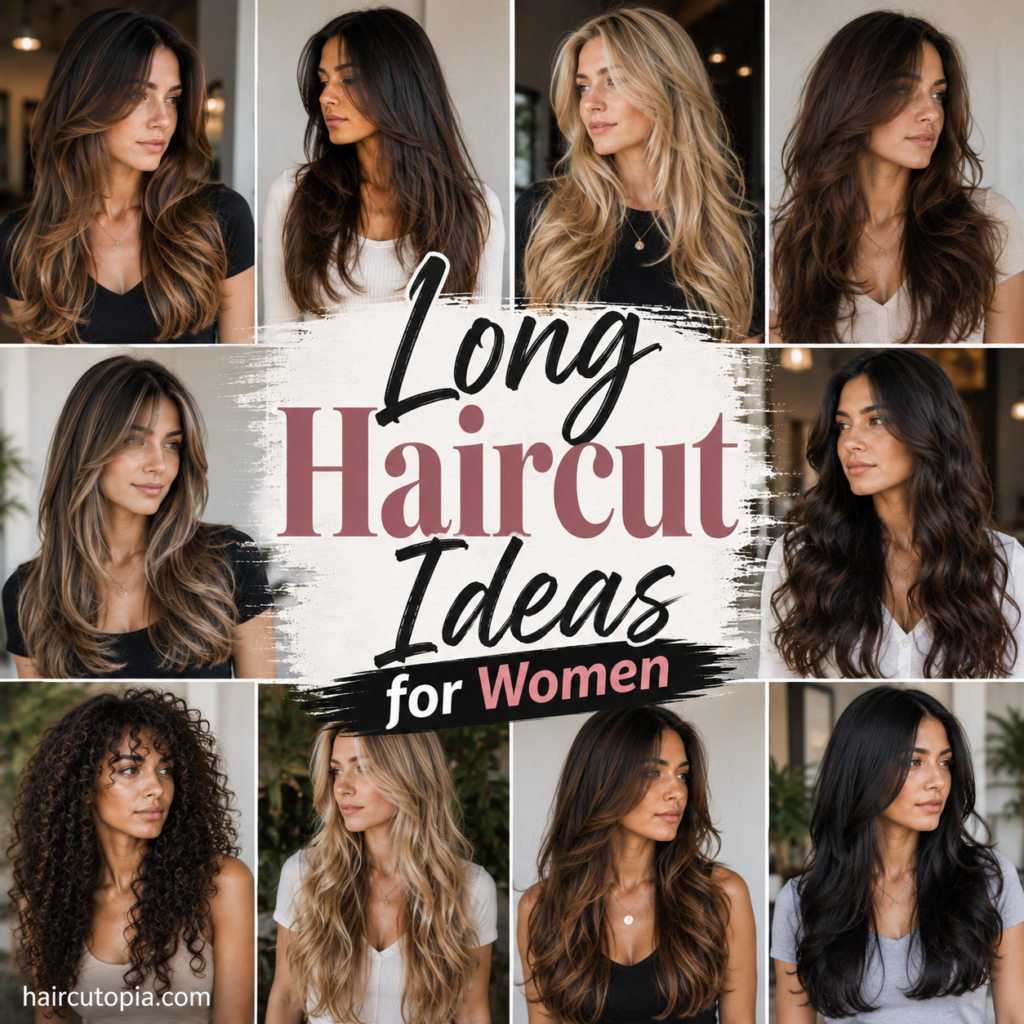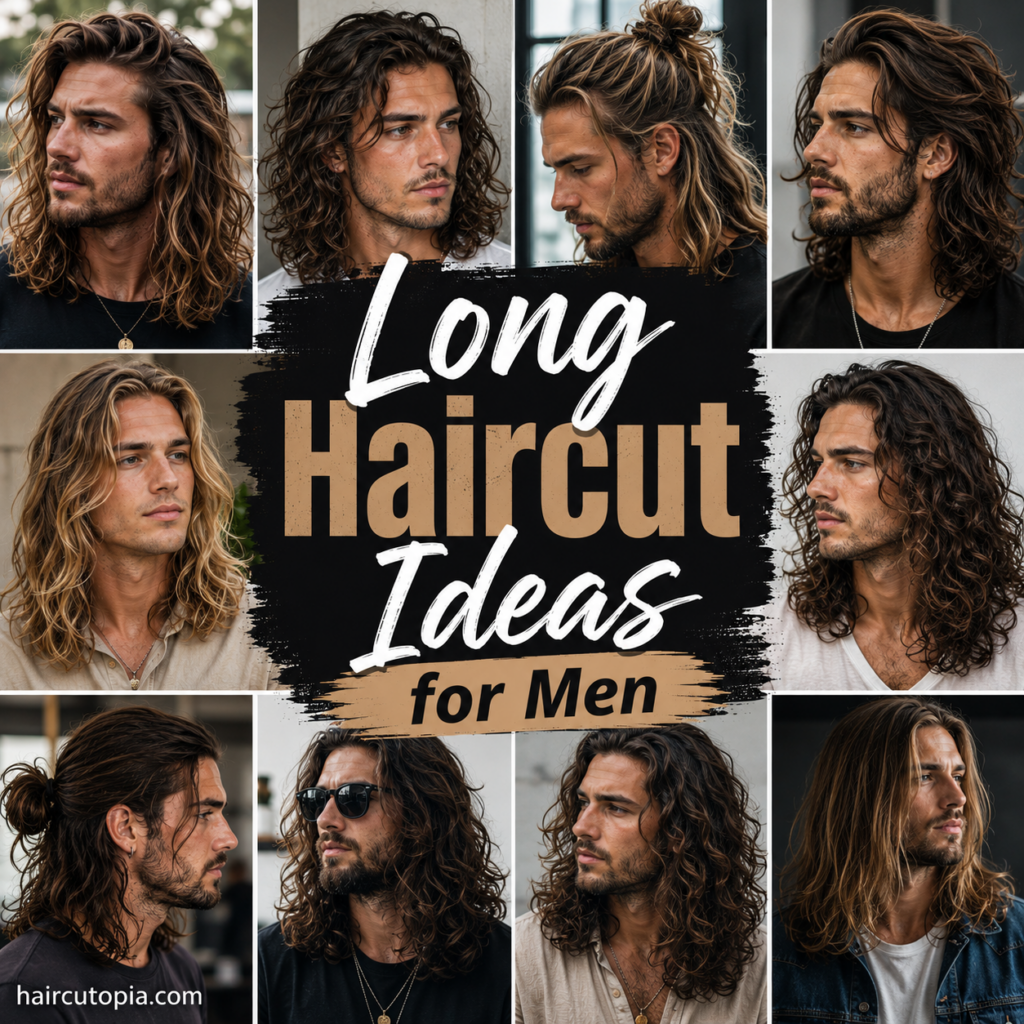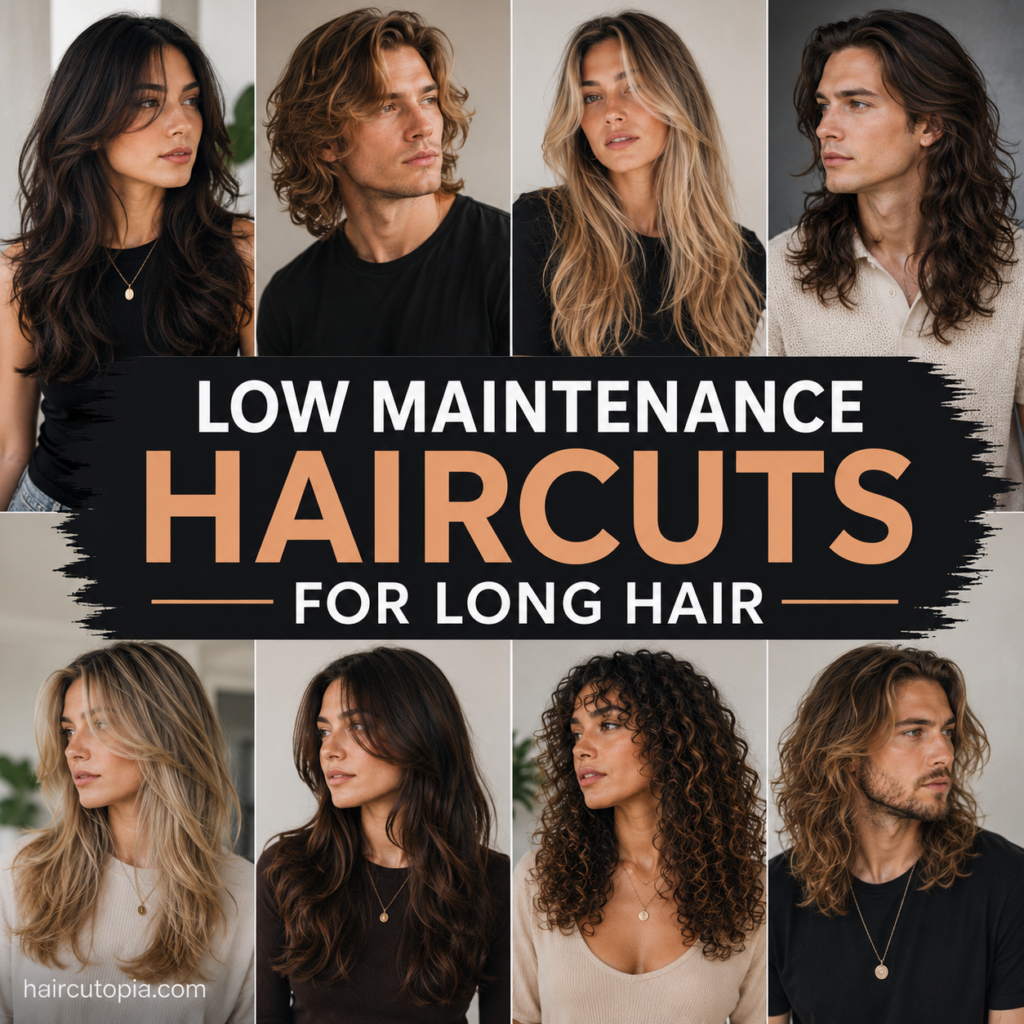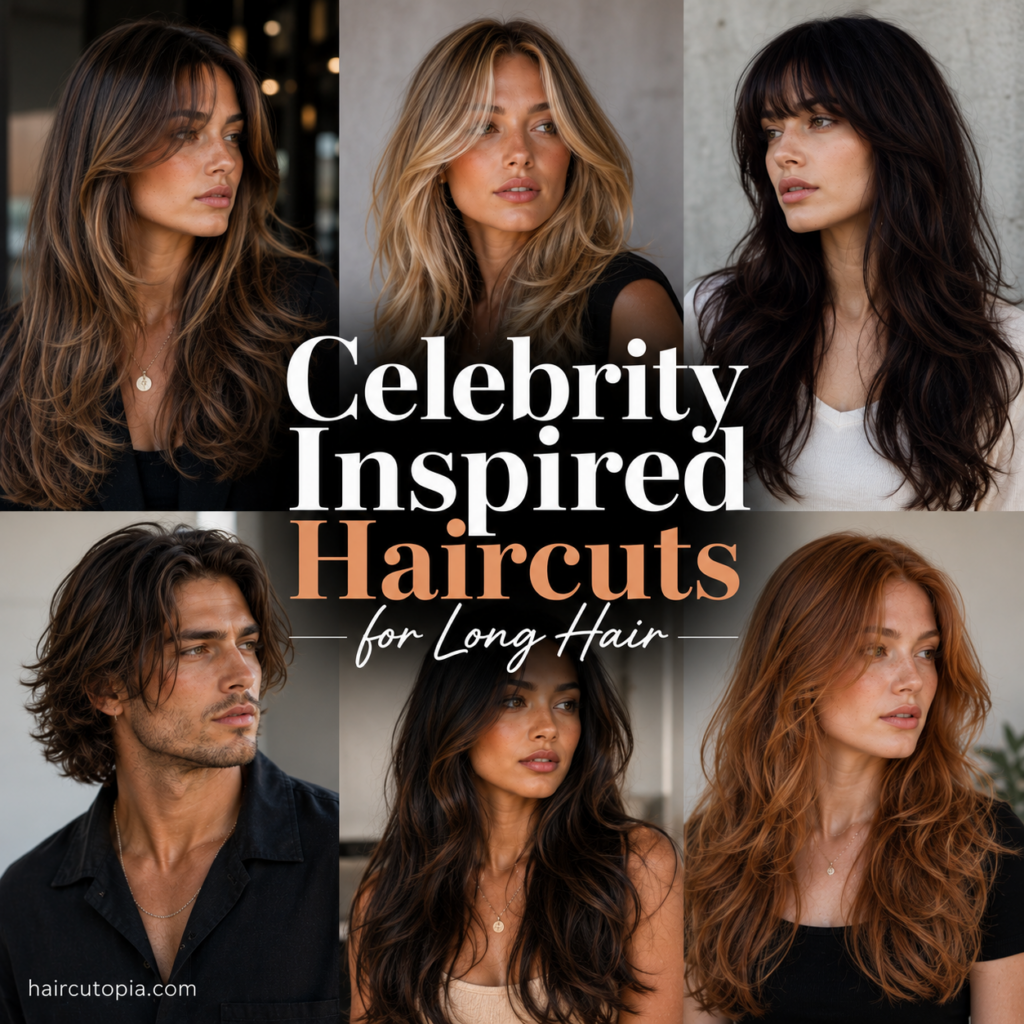
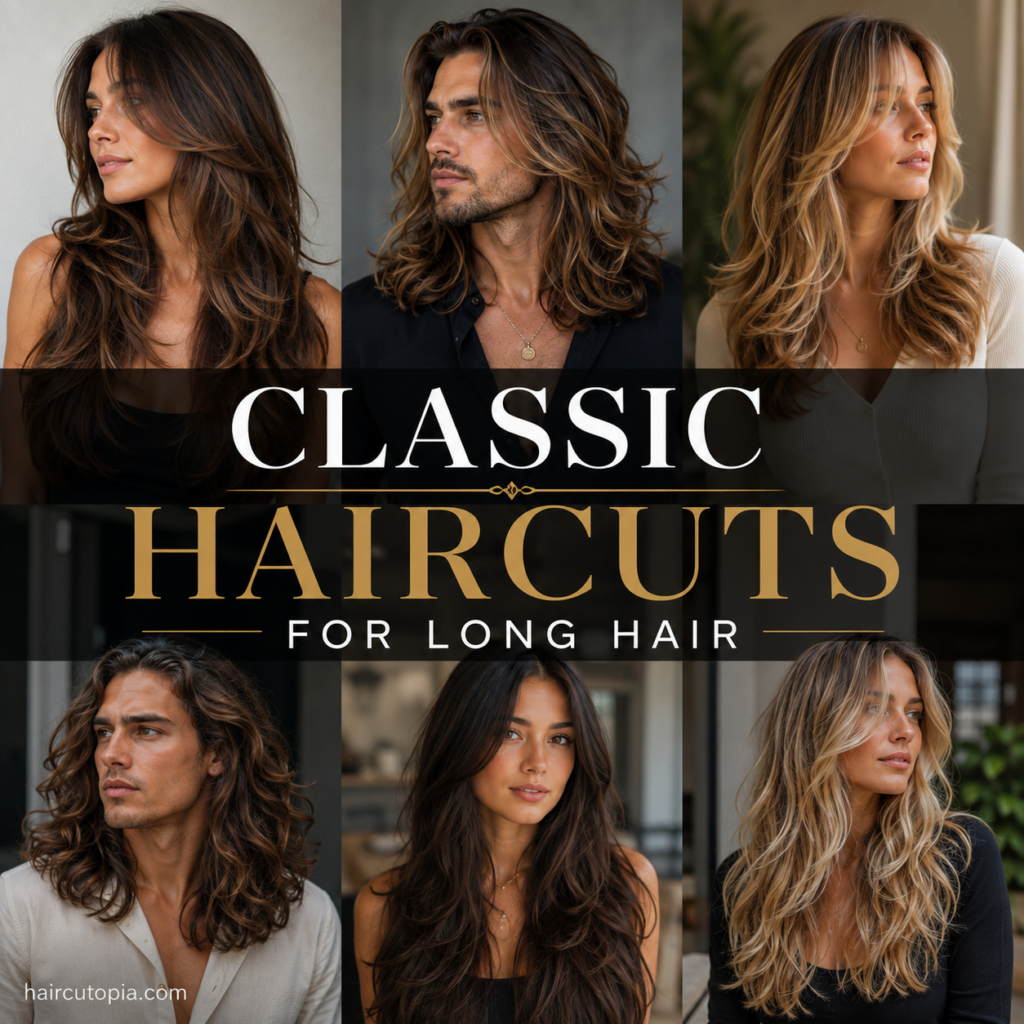
Long hair doesn’t need an elaborate haircut to make an impact. Sometimes the most flattering styles are built around a simple shape, healthy-looking ends, and just enough layering to keep everything moving.
That’s where classic long haircuts shine.
Long layers, face-framing pieces, U-shaped cuts, feathered styles, shags, and simple one-length hair have been around in one form or another for decades. The details change with trends, but the foundation remains familiar.
Today’s versions tend to feel softer and more natural. Layers can be subtle instead of heavily sculpted. Curls and waves are allowed to move. Bangs can blend into the rest of the haircut rather than sitting separately from it.
If you want to keep your length while giving your hair more shape, these classic haircuts for long hair offer plenty of inspiration.
What Is Considered Long Hair?
Long hair generally extends beyond the shoulders, although the exact definition depends on who you ask.
Hair reaching the upper back is clearly in long-hair territory, while waist-length and longer styles offer even more room for layering and shaping.
The advantage of having more length is versatility.
Long hair can be:
- Layered
- Worn one length
- Curled or waved
- Braided
- Pulled into ponytails
- Styled into buns and updos
- Slicked back
- Parted in different ways
- Combined with almost any type of bangs
The haircut determines how all that length falls when it’s worn down.
Why Classic Haircuts Work So Well With Long Hair
Long hair tends to change more slowly than short hair as it grows.
A few extra inches can completely transform a pixie or bob. On very long hair, the difference is usually less dramatic.
That makes classic shapes particularly practical.
A well-designed long haircut can grow while maintaining much of its original structure. It can also be updated without sacrificing significant length.
Classic long haircuts tend to emphasize:
- Movement
- Balanced proportions
- Healthy-looking ends
- Natural texture
- Face framing
- Versatile styling
- Gradual transitions between lengths
The goal isn’t necessarily to make long hair complicated. It’s to give all that length a shape.
1. Classic Long Layers
Long layers are one of the most enduring haircuts for long hair.
Instead of cutting everything to the same length, shorter sections are introduced throughout the haircut. These layers create movement while preserving most of the overall length.
The difference between a subtle layered cut and a dramatic one comes down to where the shortest layers begin.
Longer layers create gentle movement. Shorter layers around the crown and face produce more volume and separation.
Who can wear long layers?
Long layers can work with:
- Straight hair
- Wavy hair
- Curly hair
- Thick hair
- Medium-density hair
- Some finer hair types
The key is adjusting the amount of layering to the hair’s density.
Fine hair may benefit from fewer layers so the ends retain fullness, while thick hair can often accommodate more weight removal.
2. Face-Framing Layers
Face-framing layers concentrate shorter pieces around the front of the haircut.
They might begin around the cheekbones, jawline, chin, collarbone, or even lower.
This makes them incredibly customizable.
Face-framing layers can change the appearance of long hair without removing much length from the back.
They also work naturally with center parts, side parts, curtain bangs, waves, and blowouts.
3. The U-Shaped Cut
A U-shaped haircut creates a gently curved perimeter when viewed from behind.
The center remains longest while the sides gradually become slightly shorter.
The result is softer than a completely blunt line but less dramatic than a V-shaped cut.
A U shape can work particularly well when you want to maintain a substantial amount of hair around the perimeter while adding a little movement.
It can be worn with or without layers.
4. The V-Shaped Cut
A V-shaped haircut creates a more pronounced point through the center of the back.
The sides gradually become shorter as they move toward the front.
This shape can make very long hair look more dynamic, particularly from behind.
It is often paired with layers so the transition feels natural rather than overly geometric.
The V shape tends to be most visible when the hair is worn straight or gently waved.
5. The One-Length Long Cut
Not every long haircut needs layers.
A one-length cut maintains a strong perimeter and keeps most of the hair at approximately the same length.
This simple approach can make the ends appear thicker, which is especially appealing for finer hair.
The haircut also creates a clean canvas for styling.
Straight hair emphasizes the strong outline, while waves and curls soften it.
6. Long Hair With Subtle Layers
If you like the fullness of a one-length haircut but want more movement, subtle layers offer a compromise.
The shortest sections remain relatively long, preventing an obvious layered appearance.
You may barely notice the layers when the hair is straight.
Add waves or a blowout, however, and the additional movement becomes much more apparent.
This is a good option if you’re nervous about removing too much hair.
7. Long Hair With Rounded Layers
Rounded layers create a soft, flowing silhouette rather than a sharply disconnected one.
The layers are designed to blend smoothly into one another, producing movement through the lengths and ends.
This technique can work particularly well with thick hair because it creates shape without making the haircut look overly choppy.
Styled with a blowout, rounded layers can produce plenty of movement.
Worn naturally, they create a softer effect.
8. The Butterfly Haircut
The butterfly haircut may have a contemporary name, but many of its defining characteristics come from classic layered hairstyles.
Shorter, face-framing sections are combined with longer layers underneath.
The contrast creates movement while allowing the overall length to remain intact.
When styled with volume, the shorter layers can almost create the appearance of a shorter haircut sitting over longer hair.
Why the butterfly cut works on long hair
It gives long hair more shape without requiring a major loss of length.
It’s particularly effective if you enjoy:
- Voluminous blowouts
- Face-framing layers
- Large waves
- Bouncy styling
- Noticeable movement
The cut can still be worn more casually without a full blowout.
9. The Classic Shag
Few haircuts embrace layers as enthusiastically as the shag.
A long shag typically combines shorter layers around the crown with progressively longer sections through the rest of the hair.
Bangs are common but not essential.
The haircut is designed to encourage movement and texture rather than create a perfectly smooth silhouette.
Modernizing a long shag
Today’s shags can be considerably softer than their retro predecessors.
Instead of dramatic separation between every layer, a stylist can blend the lengths while preserving the loose, textured character of the haircut.
Natural waves and curls work particularly well with this approach.
10. The Soft Shag
A soft shag keeps the general movement of a traditional shag while reducing the contrast between layers.
The crown isn’t cut quite as short, and the perimeter retains more weight.
This makes the haircut easier to transition into if you’ve been wearing long, relatively uniform hair.
It can also be easier to grow out because the differences between lengths aren’t as dramatic.
11. Long Feathered Hair
Feathered layers have repeatedly returned to hairstyling.
The technique creates sections that move outward and away from the face, producing a light, flowing effect.
Modern feathering usually feels softer than the heavily styled versions associated with previous decades.
Long layers around the face can be blown outward for a dramatic finish or allowed to fall naturally for something more understated.
12. Long Hair With Curtain Bangs
Curtain bangs pair naturally with long hair.
They are typically shorter toward the center of the forehead and gradually become longer toward the sides.
This allows them to blend into face-framing layers.
Curtain bangs can be worn:
- Center-parted
- Slightly off-center
- Swept outward
- Blended into waves
- Tucked away as they grow
Because longer versions transition relatively easily into the rest of the haircut, they’re often less of a commitment than a short blunt fringe.
13. Long Hair With Blunt Bangs
Blunt bangs create a much stronger contrast with long hair.
A defined fringe across the forehead can make even a simple one-length haircut feel completely different.
The density of the bangs matters.
A thick fringe creates a bold statement, while removing some weight can produce a softer result without turning the bangs into a wispy style.
14. Long Hair With Wispy Bangs
Wispy bangs use less hair to create a light fringe across the forehead.
They pair well with long layers because the overall effect remains soft and fluid.
Unlike a dense blunt fringe, wispy bangs allow more of the forehead to remain visible.
They’re also easy to combine with face-framing pieces around the temples and cheekbones.
15. Long Hair With Side-Swept Bangs
Side-swept bangs have been a staple of long hairstyles for decades.
The fringe is cut long enough to move across the forehead and gradually blend into the surrounding hair.
Longer versions offer plenty of flexibility.
You can style them prominently across the forehead, blend them into waves, or tuck them away when you want a different look.
16. Long Hair With a Center Part
Few hairstyles are simpler than long hair divided through the center.
That simplicity is part of its appeal.
A center part creates symmetry and places more attention on the shape of the haircut surrounding the face.
It works particularly well with:
- Face-framing layers
- Curtain bangs
- Straight hair
- Loose waves
- Long curls
- One-length cuts
The part itself doesn’t determine the haircut, but it can completely change how the shape is perceived.
17. Long Hair With a Side Part
A side part introduces asymmetry and often creates more volume on one side.
It can be subtle or deep depending on the look you want.
Long layers naturally complement a side part because the hair has enough movement to sweep across the top without looking rigid.
A side part can also change which face-framing pieces become most prominent.
18. Classic Long Straight Hair
Long straight hair doesn’t necessarily need dramatic layers.
A clean perimeter, carefully maintained ends, and subtle shaping around the face may be enough.
This minimalist approach places more emphasis on the condition of the hair.
Because there isn’t a highly textured haircut creating visual movement, split or uneven ends can become more noticeable.
Regular maintenance helps preserve the clean silhouette.
19. Long Wavy Hair
Waves already provide natural movement, so the haircut should support them rather than compete with them.
Long layers can prevent wavy hair from becoming overly heavy, especially when the density is high.
The ideal amount of layering depends on how loose or defined the wave pattern is.
Some people need only a little shaping around the front. Others benefit from layers throughout the length.
20. Long Curly Hair
Long curls can create incredible volume and movement, but all that length also adds weight.
Strategic layering can help distribute the volume and allow curls at different heights to form more freely.
The haircut should account for shrinkage.
A curl that appears relatively long when stretched can spring considerably shorter when dry.
For that reason, cutting techniques and final length need to be adapted to the individual curl pattern.
21. Long Coily Hair
Long coily hair offers enormous versatility and can be shaped in many ways.
Rounded cuts create a balanced silhouette, while layers can help distribute volume and encourage definition throughout the hair.
Shrinkage is particularly important when determining length and shape.
A stylist familiar with tightly coiled textures can account for how the hair behaves when dry, stretched, and styled.
The goal is to create a shape that works with the texture rather than relying on how the hair looks in only one state.
22. Long Curly Layers
Layering curly hair can create a completely different silhouette without dramatically shortening the overall length.
Shorter curls through the upper sections can add volume around the crown, while longer curls preserve the length underneath.
This prevents all of the visual weight from accumulating toward the bottom.
The result can feel lighter and more balanced while still clearly reading as long hair.
23. The Long Curly Shag
The long curly shag combines natural texture with more pronounced layering.
Curls form at different lengths throughout the haircut, producing volume around the crown and movement through the perimeter.
A curly fringe can be added for an even stronger shag shape.
Because shrinkage varies from curl to curl, this haircut benefits from careful customization.
24. Long Hair With Tapered Ends
Tapering the ends removes some weight toward the bottom of the haircut.
This can create a softer finish than a completely blunt perimeter.
It’s especially useful for very dense hair that feels heavy through the lower lengths.
However, too much thinning can make the ends look sparse, so the amount of weight removal should be matched to the hair’s density.
25. The Long Scissor Cut
Classic long men’s hair often relies on scissor work rather than dramatic clipper transitions.
The hair is shaped while preserving length through the top, sides, and back.
It can then be:
- Parted
- Brushed backward
- Tucked behind the ears
- Worn naturally
- Styled with waves or curls
The result has a softer silhouette than most faded or undercut styles.
26. The Long Bro Flow
The bro flow lets longer hair naturally move backward and away from the face.
Rather than creating a rigid style with heavy product, the haircut works with the hair’s existing movement.
Wavy hair is especially well suited to the look.
Straight hair can achieve a similar shape with the right layering, while curly hair creates a fuller interpretation.
27. Long Slicked-Back Hair
Slicked-back long hair creates a clean, controlled silhouette while preserving the length.
Traditional versions can be very smooth and polished.
For a modern interpretation, use less product and allow some natural movement through the lengths.
The contrast between an open face and longer hair through the back creates a distinctive shape.
28. Long Layered Hair for Men
Long layers aren’t limited to women’s hairstyles.
For men growing their hair beyond the shoulders, layering can prevent the cut from becoming heavy or triangular.
Long, subtle layers maintain the overall length while allowing waves and curls to move more naturally.
Face-framing sections can also help connect shorter growth around the temples with the longer hair.
Classic vs. Modern Long Haircuts
Many hairstyles considered modern are actually new interpretations of familiar shapes.
The difference often comes down to the details.
Classic long haircuts tend to favor:
- Gradual layering
- Balanced proportions
- Full-looking ends
- Natural movement
- Blended face framing
- Versatile styling
Modern interpretations may use:
- More dramatic face-framing layers
- Shorter crown layers
- Heavier texture
- Stronger fringe shapes
- Disconnected sections
- More visible contrast between lengths
There’s no reason you can’t combine both.
A timeless U-shaped perimeter with dramatic face-framing layers, for example, can feel current without requiring an entirely trend-driven haircut.
How to Choose the Right Classic Haircut for Long Hair
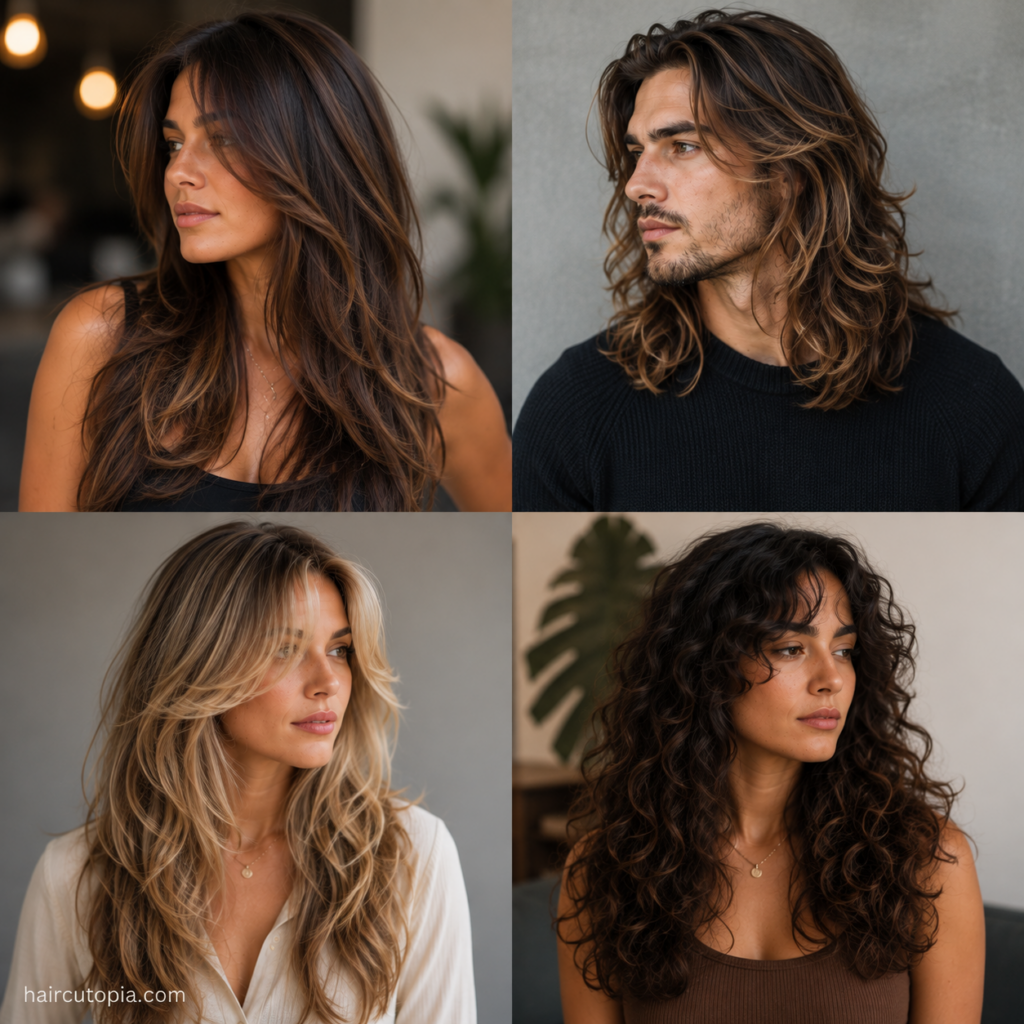
The right haircut depends less on the trend you’re following and more on how your hair actually behaves.
Texture and density are particularly important with long hair.
Fine hair
Fine hair can benefit from maintaining weight around the perimeter.
Too many short layers may make the lower sections appear thinner.
Consider:
- One-length cuts
- U-shaped cuts
- Subtle long layers
- Light face framing
Thick hair
Thick hair can become heavy when worn long.
Strategic layering can remove bulk and create movement without sacrificing the overall length.
Long layers, shags, rounded layers, and face-framing sections can all work well.
Straight hair
Straight hair clearly displays the structure of a haircut.
Blunt perimeters, U shapes, V shapes, and carefully blended layers tend to be especially visible.
Wavy hair
Waves often benefit from enough layering to prevent the length from pulling the texture flat.
The goal is to encourage movement without creating unwanted bulk.
Curly and coily hair
Curl pattern, shrinkage, and density should guide the haircut.
Rather than relying solely on a photo of someone else’s curls, work with a stylist who can adapt the shape to how your own texture behaves.
How to Choose Long Hair for Your Face Shape
You don’t need a particular face shape to wear long hair.
What matters more is how the haircut frames the face.
Small adjustments can change the proportions considerably.
For example:
- Cheekbone-length layers emphasize the middle of the face.
- Chin-length layers bring attention toward the jaw.
- Curtain bangs highlight the eyes and cheekbones.
- Crown layers can add height.
- A center part creates symmetry.
- A side part adds asymmetry and volume.
Instead of asking whether your face shape can “pull off” a haircut, consider which elements you want to emphasize.
How to Ask Your Stylist for a Long Haircut
Saying “keep it long” doesn’t give your stylist much information.
Be specific about what you want to preserve and what you’re willing to change.
Discuss:
- Where you want the final perimeter to fall.
- How much length you’re comfortable removing.
- Where you want the shortest layer to begin.
- Whether you want face-framing pieces.
- Whether you want bangs.
- How you normally style your hair.
- Whether you frequently wear ponytails or updos.
- How much maintenance you’re comfortable with.
Reference photos can help communicate the overall shape.
Try to find examples with hair texture and density similar to yours whenever possible.
How to Make a Classic Long Haircut Look Modern
You don’t have to cut off half your hair to make it feel different.
Long hair can change dramatically with relatively small adjustments.
Add face-framing layers
Shorter pieces around the face can transform an otherwise simple long haircut.
Try curtain bangs
Curtain bangs provide a noticeable change while blending naturally into longer layers.
Change your part
Moving from a center part to a side part—or vice versa—can alter the balance of the entire hairstyle.
Embrace your natural texture
Instead of styling every section into uniform waves or straightening natural movement, allow some variation.
Change the perimeter
Moving from a blunt edge to a U or V shape can create a different silhouette without sacrificing much length.
Introduce subtle layers
If you’ve worn one-length hair for years, even a few long layers can make the haircut feel noticeably lighter.
Styling Products for Long Hair
Long hair doesn’t necessarily need more products. It usually needs products chosen for the right purpose.
Lightweight styling cream
Useful for smoothing flyaways and adding soft definition.
Mousse
Can create volume without adding excessive weight.
Curl cream
Helps define curls and waves while controlling frizz.
Texture spray
Adds separation and movement to layered or wavy styles.
Hair oil or serum
A small amount can add shine and help smooth dry-looking ends.
Heat protectant
If you regularly use blow-dryers, curling irons, or straighteners, heat protection is particularly important for preserving longer lengths.
Maintaining Long Hair
Long hair can be forgiving when it comes to haircut frequency, but the condition of the ends matters.
Damaged ends can eventually split farther up the hair shaft, making it harder to maintain healthy-looking length.
Between salon visits:
- Condition according to your hair’s needs.
- Detangle gently.
- Limit unnecessary heat.
- Use heat protection before hot tools.
- Avoid excessively tight hairstyles.
- Trim damaged ends when necessary.
- Protect longer hair from excessive friction while sleeping.
Maintenance doesn’t need to be complicated.
Consistency matters more than having an enormous collection of products.
How Often Should Long Hair Be Trimmed?
There isn’t a universal trimming schedule.
Someone maintaining a precise fringe or heavily layered shape may need appointments more frequently than someone growing a simple one-length cut.
Pay attention to the condition and behavior of your hair.
It may be time for a trim when:
- The ends look noticeably thin or uneven.
- Split ends become visible.
- Layers stop sitting correctly.
- Face-framing pieces lose their shape.
- Detangling becomes more difficult.
- The haircut feels heavy or shapeless.
If your goal is maximum length, tell your stylist. Maintenance trims can focus on preserving length rather than automatically removing several inches.
Are Classic Long Haircuts Still Trending?
Yes—and many current long-hair trends prove the point.
Butterfly layers, curtain bangs, shags, face-framing pieces, voluminous blowouts, center parts, and side parts all borrow heavily from styles that have appeared before.
What changes is the combination.
A haircut that once relied on a highly polished blowout might now be worn with natural waves. Dramatic feathering can become softer face framing. A traditional shag can be adapted for curls.
Classic haircuts survive because they aren’t limited to one styling method.
You can keep the foundation and change everything around it.
Final Thoughts on Classic Haircuts for Long Hair
Keeping your hair long doesn’t mean keeping it exactly the same.
Long layers can introduce movement. Face-framing pieces can completely change the front of the haircut. A U-shaped or V-shaped perimeter can reshape the back, while bangs can transform the overall look without sacrificing your length.
Straight, wavy, curly, and coily hair can all benefit from a cut designed around their natural behavior.
That’s ultimately what makes classic haircuts so useful. They give you a reliable foundation without locking you into one look.
Keep the parts that work. Change the details when you’re ready for something new.