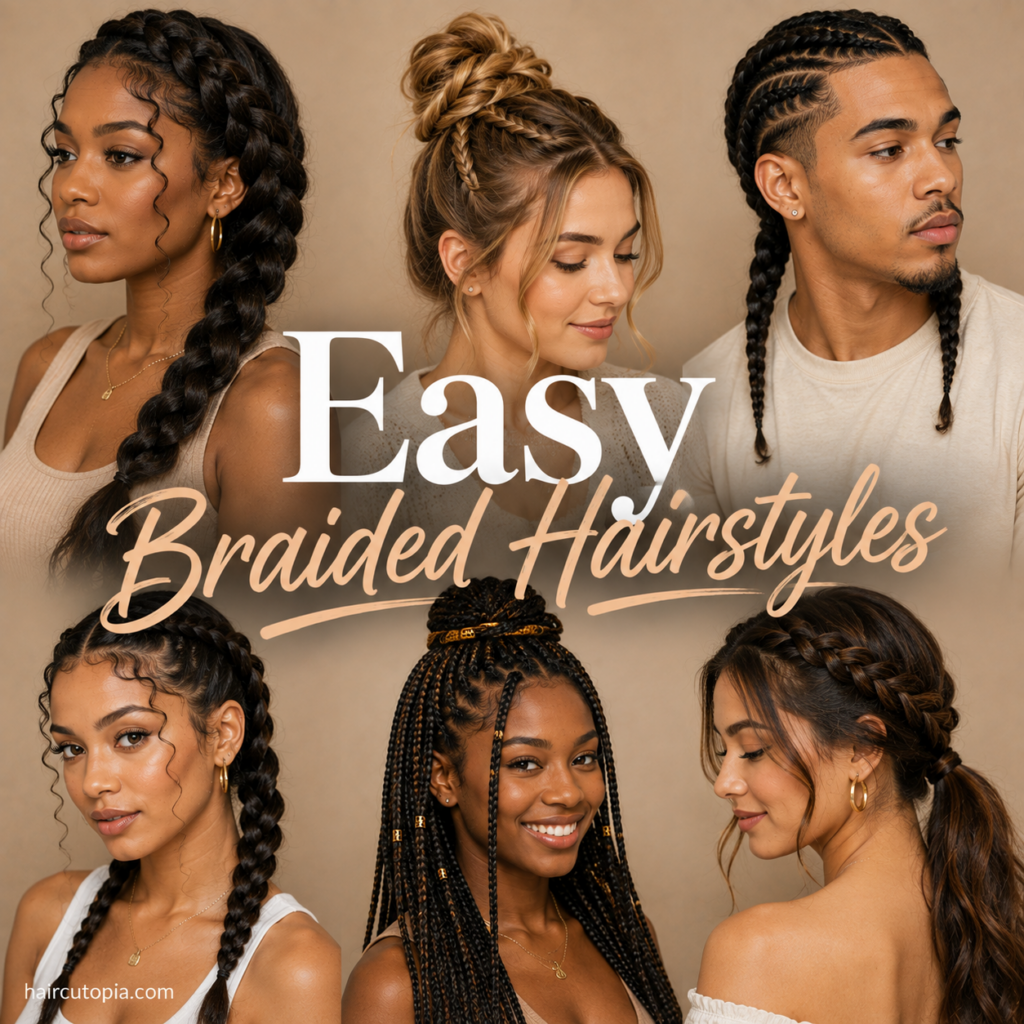
Braided hairstyles can look complicated even when they’re surprisingly easy to create.
That’s part of their appeal. A basic three-strand braid can turn an ordinary ponytail into something more interesting, while two small braids around your face can change your whole look in a few minutes. You don’t necessarily need advanced braiding skills, a pile of styling tools, or an hour in front of the mirror.
The trick is choosing the right style.
If you’re new to braiding, start with hairstyles that use techniques you already know and build from there. Once you’re comfortable separating sections and keeping consistent tension, styles like French braids, Dutch braids, and braided crowns become much easier.
Whether you’re getting ready for work, school, a night out, or simply trying to keep your hair out of your face, these easy braided hairstyles are practical enough for real life.
What Makes a Braided Hairstyle Easy?
An easy braid shouldn’t require professional-level precision.
You might need a little practice, especially if you’re working behind your own head, but the basic technique should be something you can repeat without starting over five times.
Beginner-friendly braided hairstyles usually have a few things in common:
- They use only a few sections of hair
- They don’t require complicated parting
- They can look good slightly messy
- They use basic braiding techniques
- They don’t require many tools
- They can usually be finished fairly quickly
And that’s worth remembering: your braid doesn’t have to look perfectly symmetrical to look good.
Sometimes a slightly loose or imperfect braid actually makes the hairstyle better.
Easy Braided Hairstyles to Try
Some of these styles take only a couple of minutes. Others require a little more practice but become surprisingly quick once you’ve learned the technique.
Start with whichever feels most comfortable.
1. Classic Three-Strand Braid
If you’re learning how to braid, this is the place to begin.
Divide your hair into three sections. Cross one outer section over the middle, then repeat with the section from the opposite side. Continue alternating until you reach the ends.
That’s it.
A classic braid works particularly well on medium and long hair and can be worn straight down the back or pulled over one shoulder.
If the braid looks too tight or narrow, gently pull on the outer edges after securing it to make it appear fuller.
2. Easy Side Braid
A side braid uses the same basic three-strand technique but is often easier because you can actually see what you’re doing.
Gather your hair over one shoulder and divide it into three sections. Braid downward and secure the end.
For a softer look, loosen the braid slightly and pull out a couple of face-framing pieces.
This style works especially well when you don’t want everything to look overly polished.
3. Braided Ponytail
Already know how to make a ponytail and a basic braid?
Combine them.
Secure your hair into a high, medium, or low ponytail. Divide the ponytail into three sections and braid to the ends.
A high braided ponytail feels sporty and energetic, while a low version tends to look more understated.
You can also wrap a small piece of hair around the ponytail elastic before braiding for a cleaner finish.
4. Low Braided Ponytail
This is one of the simplest options for days when you want your hair completely out of the way.
Gather everything at the nape of your neck, secure it with an elastic, and braid the ponytail.
Because the braid starts below the elastic, you don’t have to worry about maintaining tension against your scalp.
It’s a good beginner hairstyle and works well when you need something practical and quick.
5. Two Basic Braids
Two braids are simple, classic, and useful when you want to keep your hair controlled.
Part your hair down the middle and divide it into two sections.
Create a standard three-strand braid on each side.
You can keep them neat or loosen the sections for a fuller, more relaxed appearance.
This style also works well for sleeping when you want to keep longer hair contained overnight.
6. Mini Face-Framing Braids
You don’t have to braid your whole head.
Take a small section near each side of your face and create a tiny three-strand braid.
Leave the rest of your hair loose.
These little braids work with straight, wavy, and curly hair and can add detail without dramatically changing your hairstyle.
They’re also useful for shorter hair that isn’t long enough for a full braid.
7. Single Accent Braid
Even easier than two face-framing braids? Just make one.
Choose a small section near your temple or part and braid it toward the ends.
Let it blend naturally into the rest of your hair.
A single accent braid is a good option when you have only a couple of minutes but want your hairstyle to look more intentional.
8. Half-Up Braided Hairstyle
This style gives you the detail of braids while keeping most of your hair loose.
Take a section from each side of your head and braid both pieces.
Bring the braids toward the back and secure them together.
You can use:
- A small elastic
- Bobby pins
- A decorative clip
- A barrette
The remaining hair can stay straight, wavy, or curly.
9. Braided Half-Up Ponytail
Instead of connecting two small braids at the back, gather them with a little more hair into a half-up ponytail.
This gives the hairstyle more structure while still keeping plenty of hair loose.
It’s particularly useful if the front sections of your hair tend to fall into your face.
You can keep the ponytail simple or braid that section as well.
10. Easy French Braid
French braiding can look intimidating at first, but the basic idea isn’t too complicated.
Start with three sections near the top of your head.
Begin a normal braid, but each time you cross an outer section toward the middle, add a little more loose hair to it.
Continue until all of the hair has been incorporated, then finish with a regular three-strand braid.
Your first attempt may not be perfect. That’s normal.
Once your hands learn the movement, French braiding becomes much faster.
11. Two French Braids
If one large French braid feels awkward, dividing the hair into two sections can sometimes make the technique easier to control.
Create a middle part.
Clip one side out of the way while you French braid the other, then repeat.
Two French braids are practical for workouts, outdoor activities, busy days, and anytime you want your hair securely out of the way.
12. Easy Dutch Braid
A Dutch braid is basically the reverse of a French braid.
Instead of crossing the outer strands over the middle section, you cross them underneath.
That small change makes the braid sit on top of the hair rather than blending into it.
Once you understand French braiding, learning a Dutch braid is usually much easier.
After finishing, gently pull the outer loops if you want the braid to look wider.
13. Double Dutch Braids
Two Dutch braids create a defined, balanced hairstyle.
Part your hair down the center and work on one side at a time.
Because the braids sit above the surface of the hair, the pattern is more noticeable than with French braids.
Don’t worry if your part isn’t perfectly straight. Unless you’re going for an extremely polished finish, minor imperfections usually aren’t noticeable once the style is complete.
14. Loose Side French Braid
A French braid doesn’t have to be tight against the scalp.
Direct the braid toward one shoulder and keep your tension slightly relaxed.
Once you’ve finished, gently pull apart some of the outer sections.
The result is softer than a traditional French braid and works particularly well with naturally wavy or textured hair.
15. Easy Fishtail Braid
Fishtail braids look intricate but use only two main sections.
Divide your ponytail into two pieces.
Take a small strand from the outside of one section and cross it over to join the opposite side. Then repeat from the other side.
Continue alternating.
Using smaller pieces creates a more detailed pattern, while larger sections make the braid quicker to complete.
If you’re learning, start with a low ponytail so the hair stays together while you practice.
16. Side Fishtail Braid
A side fishtail is often easier than trying to create one behind your head.
Bring your hair over one shoulder and secure it loosely if necessary.
Create the fishtail braid where you can see your hands.
Once you’re finished, you can remove the upper elastic if you used one to help get started.
Gently loosen the braid for a fuller appearance.
17. Bubble Braid
Here’s the secret: a bubble braid isn’t technically a braid.
But it creates a similar segmented look and is incredibly easy.
Make a ponytail and place another small elastic a few inches below the first. Gently pull the hair between the elastics outward to create a rounded “bubble.”
Continue down the ponytail.
This is one of the easiest alternatives if traditional braiding isn’t your thing.
18. Bubble Pigtails
Use the same technique on two ponytails.
Part your hair down the middle, secure each side, and add elastics at even intervals.
Pull each section outward slightly to create the bubble shape.
The result is playful and requires no actual braiding skill.
19. Braided Headband
Your own hair can double as a headband.
Take a section from behind one ear and create a small braid. Bring it across the top of your head and pin it behind the opposite ear.
Leave the rest of your hair loose.
This works best when you have enough length for the braid to comfortably reach across your head.
20. Easy Crown Braid
A full crown braid can be complicated, but there’s an easier shortcut.
Create two low braids, one on each side of your head.
Bring each braid upward and across the head, then pin them into place.
Tuck the ends underneath the opposite braid.
From the front, it creates the appearance of a more complicated braided crown without requiring you to continuously braid around your head.
21. Braided Low Bun
Start with a low ponytail and braid it normally.
Then wrap the braid around the base of the ponytail to create a bun.
Secure it with bobby pins.
This is one of those hairstyles that looks more complicated than it actually is.
Keep everything smooth for a polished finish or loosen a few pieces around the face for something more relaxed.
22. Braided High Bun
The same technique works higher on the head.
Create a high ponytail, braid the length, and wrap the braid around the base.
Secure it with pins.
This can be especially useful when you want long hair completely off your neck.
If your hair is very thick or heavy, a lower placement may feel more comfortable.
23. Half-Up Braided Bun
You don’t need to put all your hair into the bun.
Gather only the top portion, create a braid, and wrap it into a small bun.
Leave the rest of your hair loose.
The contrast between the braided bun and loose hair creates more texture without adding much extra work.
24. Two Braids Into One
This simple technique creates the illusion of a more complicated braid.
Create two smaller braids on either side of your head.
Bring them together at the back, then incorporate them into one larger braid.
Because multiple braid patterns are visible, the finished hairstyle looks more detailed than a basic three-strand braid.
25. Braided Pigtails With Loose Ends
You don’t always have to braid all the way down.
Create two braids but stop several inches before the ends.
Secure each braid and leave the remaining hair loose.
This works particularly well with wavy or curly hair because the loose ends add another texture to the style.
26. Half-Braided Ponytail
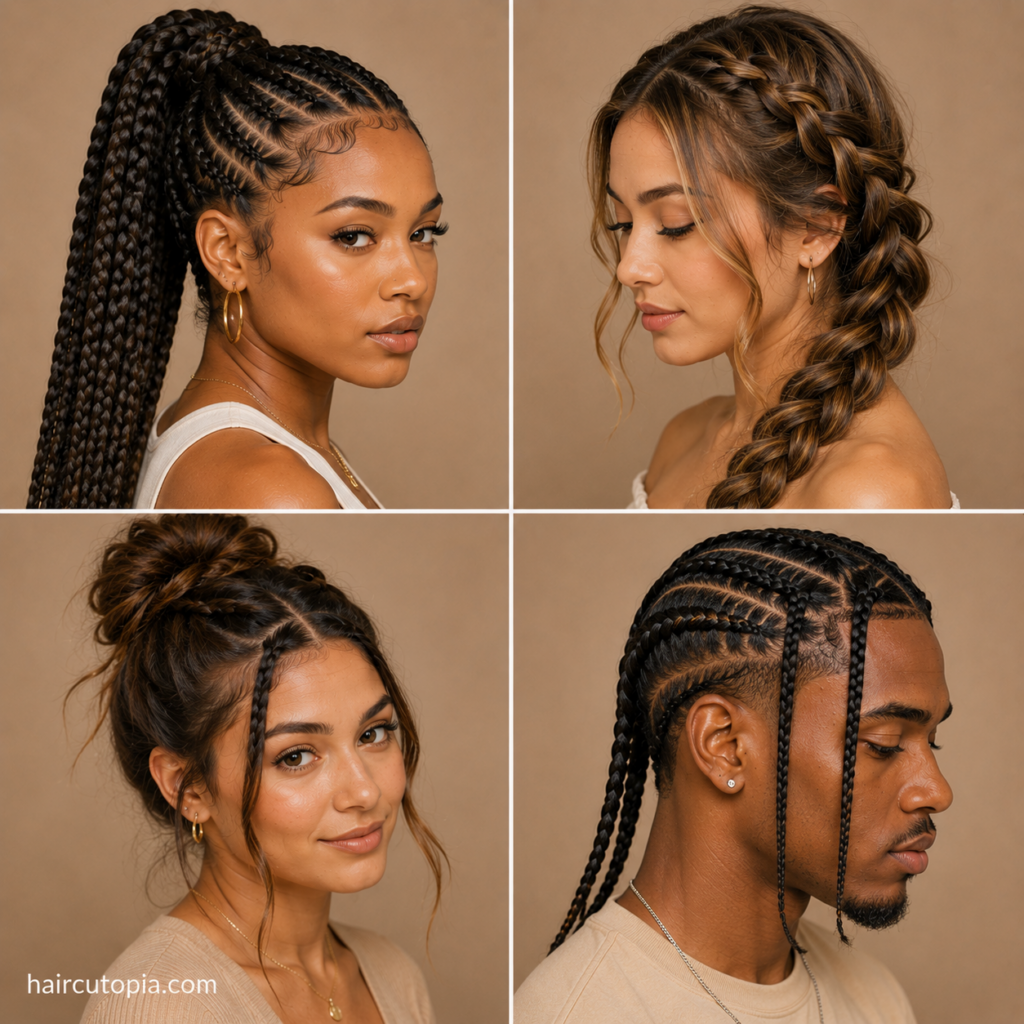
Start a standard braid in a ponytail but stop halfway down.
Secure it and leave the rest of the ponytail loose.
It’s a small variation, but it creates a noticeably different shape from a fully braided ponytail.
You can also curl or wave the loose ends if you want more contrast.
Easy Braided Hairstyles for Short Hair
Short hair can absolutely be braided. You just have to work with smaller sections.
Instead of trying to create one large braid, focus on details around the front and sides.
Good options include:
- Mini face-framing braids
- Single accent braids
- Braided bangs
- Small side cornrows
- Half-up braids
- Tiny French braids near the hairline
Bobby pins can help secure sections that aren’t long enough to stay inside the braid.
A little texture can also make short strands easier to control.
Easy Braided Hairstyles for Medium Hair
Medium hair gives you significantly more options.
It’s usually long enough for traditional braids but short enough that styling doesn’t take forever.
Try:
- Side braids
- French braids
- Dutch braids
- Half-up braids
- Braided ponytails
- Low braided buns
- Fishtail braids
Medium length is also ideal for learning new techniques because there’s enough hair to practice with without having a huge amount of length to manage.
Easy Braided Hairstyles for Long Hair
Long hair gives you the most flexibility.
You can create larger braids, wrap them into buns, make crowns, or combine several braiding techniques.
The downside is that long hair can tangle while you’re working.
Before starting, gently detangle your hair and divide sections cleanly. This makes it much easier to keep the strands separated as you braid.
How to Make Braiding Your Own Hair Easier
Knowing the braid pattern is only half the battle.
Actually doing it on your own head can be the tricky part.
A few simple habits can make a noticeable difference.
Start With Detangled Hair
Trying to separate tangled sections halfway through a braid gets frustrating quickly.
Brush or gently detangle your hair before you start.
Your fingers should be able to move through the sections without constantly getting caught.
Don’t Chase Perfection
If you’re learning French or Dutch braids, don’t restart every time one section looks slightly uneven.
Finish the braid.
You’ll often discover that the small mistake you noticed while working isn’t obvious at all once the hairstyle is complete.
Use a Mirror Strategically
Watching every movement in a mirror can sometimes make braiding harder because everything appears reversed.
Use the mirror to check your placement, but try learning the movement by feel.
Eventually, your hands will know what to do without you having to watch them constantly.
Keep Elastics Nearby
There’s nothing worse than finishing a braid and realizing your hair tie is across the room.
Keep a couple of small elastics around your wrist or within easy reach before you begin.
Practice the Technique Where You Can See It
If you’re learning fishtail braids, practice with a side ponytail.
If you’re learning a standard three-strand braid, bring your hair over one shoulder.
Once the hand movements become familiar, working behind your head becomes much easier.
How to Make Simple Braids Look Better
You don’t necessarily need a more complicated technique.
Sometimes a few finishing touches are all it takes.
Loosen the Braid
Gently tugging the outer loops can make a braid appear wider and fuller.
Start at the bottom and work upward rather than pulling aggressively on one section.
Leave a Few Pieces Loose
A couple of face-framing strands can soften an otherwise structured hairstyle.
This works particularly well with side braids, low buns, and crown braids.
Hide the Elastic
Take a small piece of hair and wrap it around the elastic.
Secure it underneath with a bobby pin.
It’s a tiny detail, but it can make a basic ponytail or braid look more finished.
Add a Simple Accessory
Try adding:
- A ribbon
- A bow
- A decorative clip
- A scrunchie
- Small hair cuffs
- A headband
One accessory can give a very basic braid more personality.
Which Braid Is Easiest for Beginners?
The classic three-strand braid is generally the best starting point.
Once you understand how to keep three sections separated and maintain consistent tension, many other styles become easier.
A good progression is:
- Three-strand braid
- Side braid
- Braided ponytail
- Fishtail braid
- French braid
- Dutch braid
Don’t feel like you need to master everything at once.
Practice one technique until the movement feels natural, then move on.
How Long Do Easy Braided Hairstyles Take?
It depends on the style and how comfortable you are with the technique.
A basic side braid or braided ponytail can take only a few minutes. French and Dutch braids may take longer while you’re learning but become much faster with practice.
More important than speed is consistency.
Once your hands know where each section goes, you’ll stop thinking through every movement individually.
That’s when braiding becomes genuinely quick.
Simple Braids Don’t Have to Look Basic
The easiest braided hairstyles often work because they don’t try too hard.
A loose side braid, two small face-framing braids, or a basic braided ponytail can look just as intentional as something much more complicated.
Start with techniques you’re comfortable with and build from there.
Learn a basic three-strand braid first. Experiment with ponytails and half-up styles. Then try French, Dutch, or fishtail braiding once you’re ready for something new.
Most importantly, don’t worry about making every section perfect.
Braids have texture by nature, and sometimes a little imperfection is exactly what makes them look good.