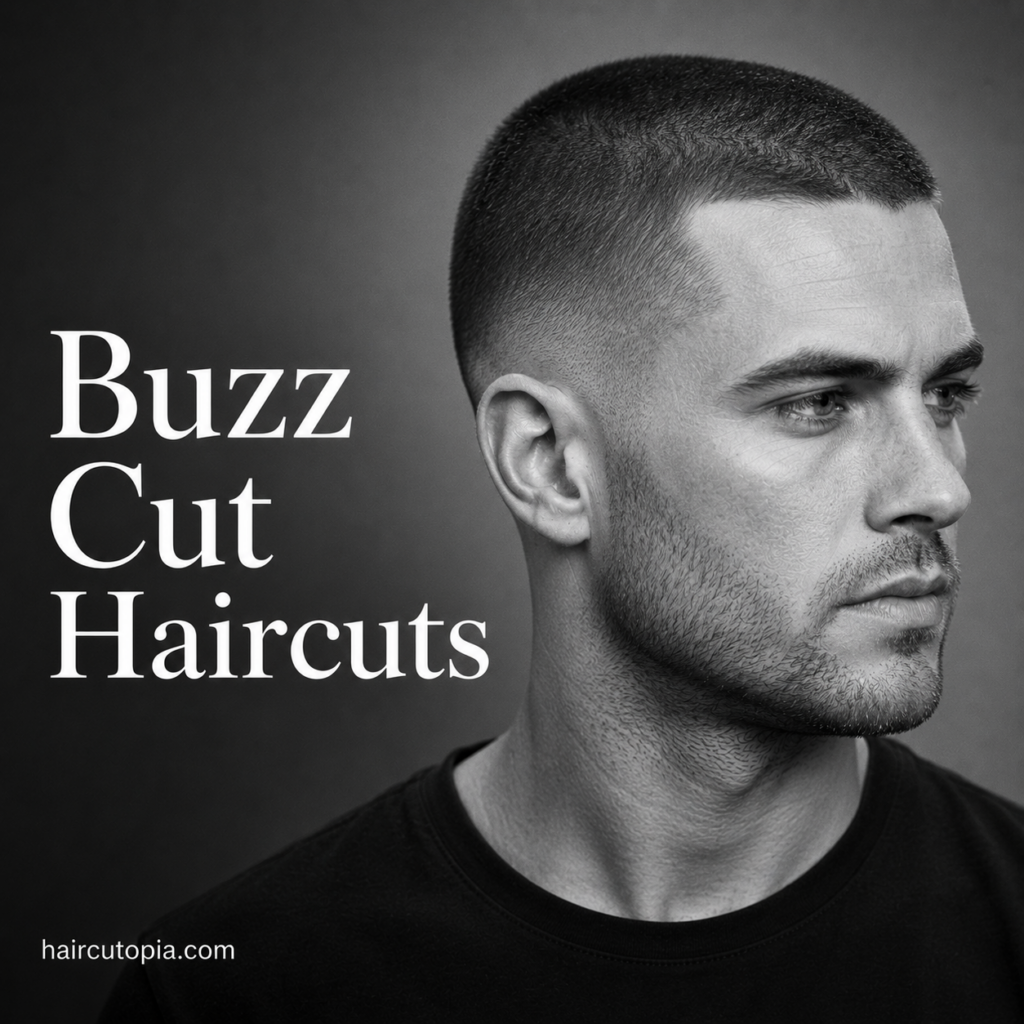
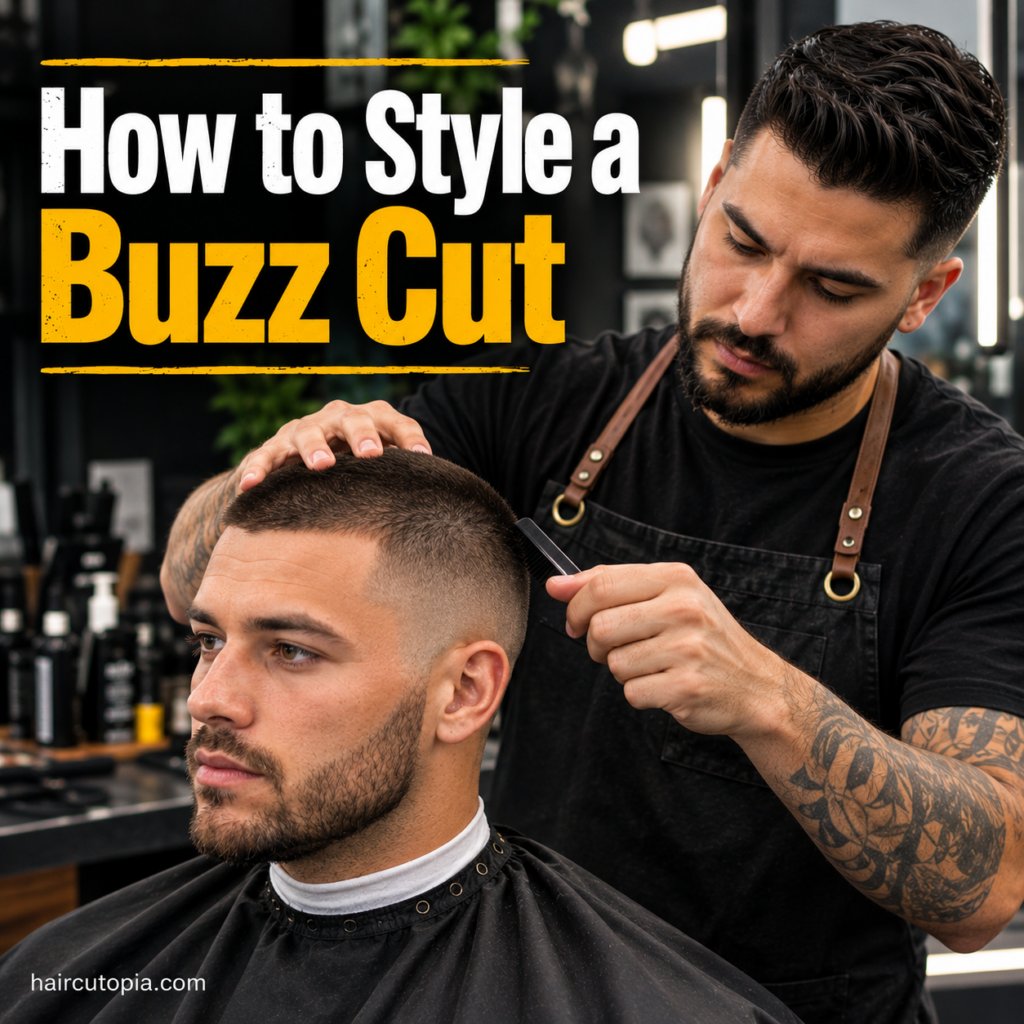
A buzz cut doesn’t exactly look like a hairstyle that needs much styling. That’s part of its appeal. You can get out of bed, run a hand over your hair, and be ready to go.
But “buzz cut” covers a much wider range of lengths than many people realize.
A very short #1 buzz cut may need almost no styling, while a #4, #5, or longer buzz cut can have enough hair to show texture, change direction, or develop a slightly messy appearance. Add a fade, lineup, beard, or textured top, and there are plenty of ways to change the overall look.
The trick is knowing when to leave your buzz cut alone and when a little styling actually makes it look better.
Here’s how to style a buzz cut without making one of the easiest men’s haircuts unnecessarily complicated.
Does a Buzz Cut Need Styling?
A traditional short buzz cut usually requires little to no daily styling.
If your hair is clipped extremely close to the scalp, there simply isn’t enough length for pomade, clay, or styling cream to do much.
As the hair gets longer, however, styling becomes more useful.
Your routine will largely depend on your buzz cut length:
- #0–#1: Usually no styling product needed
- #2–#3: Minimal styling, although texture can sometimes be enhanced
- #4–#5: Enough length to control direction and texture
- #6–#8: More styling possibilities, particularly with thick, wavy, curly, or textured hair
These aren’t strict rules. Hair texture and density make a difference, so two people with the same guard length may have very different styling needs.
Start With a Clean Buzz Cut
Good styling starts with clean hair and a comfortable scalp.
Even though a buzz cut is short, oil, sweat, dead skin, and styling products can still accumulate. This can make the hair look greasy or flatten whatever natural texture you have.
Wash according to the needs of your hair and scalp rather than following an arbitrary schedule.
If you exercise frequently or have an oily scalp, you may prefer washing more often. If your scalp tends to be dry, frequent shampooing may not be necessary.
After washing, gently towel-dry your hair instead of aggressively rubbing your scalp.
For many short buzz cuts, that may be your entire styling routine.
How to Style a Very Short Buzz Cut
With a #0, #1, or similarly short cut, styling is mostly about grooming rather than shaping the hair.
There isn’t enough length to create much movement, so focus on keeping the haircut and scalp looking clean.
That means paying attention to:
- An even overall length
- Clean edges around the ears
- A tidy neckline
- A well-maintained fade or taper
- Your hairline
- Scalp condition
- Facial hair, if you have it
At this length, the precision of the haircut itself creates the style.
Adding a heavy wax or pomade generally won’t make a #1 buzz cut look significantly better. It may simply make the scalp feel oily.
How to Style a Longer Buzz Cut
Once you reach roughly a #4 guard and above, the hair starts having enough length to behave more like a conventional short hairstyle.
You may notice certain sections sticking up, lying flat, or moving in different directions.
This is where a small amount of styling product can help.
Use Your Natural Growth Pattern
Before trying to force your hair in a particular direction, look at how it naturally grows.
Some people have hair that naturally moves forward. Others have strong cowlicks or a crown that creates visible directional patterns.
Working with those patterns is usually easier than fighting them.
After washing:
- Towel-dry the hair.
- Use your fingers or a small brush to move it in its natural direction.
- Apply a tiny amount of styling product if needed.
- Work the product evenly through the hair.
- Make final adjustments with your fingertips.
The key word is tiny.
A buzz cut doesn’t provide much hair for product to spread through, so it’s easy to use too much.
Best Styling Products for a Buzz Cut
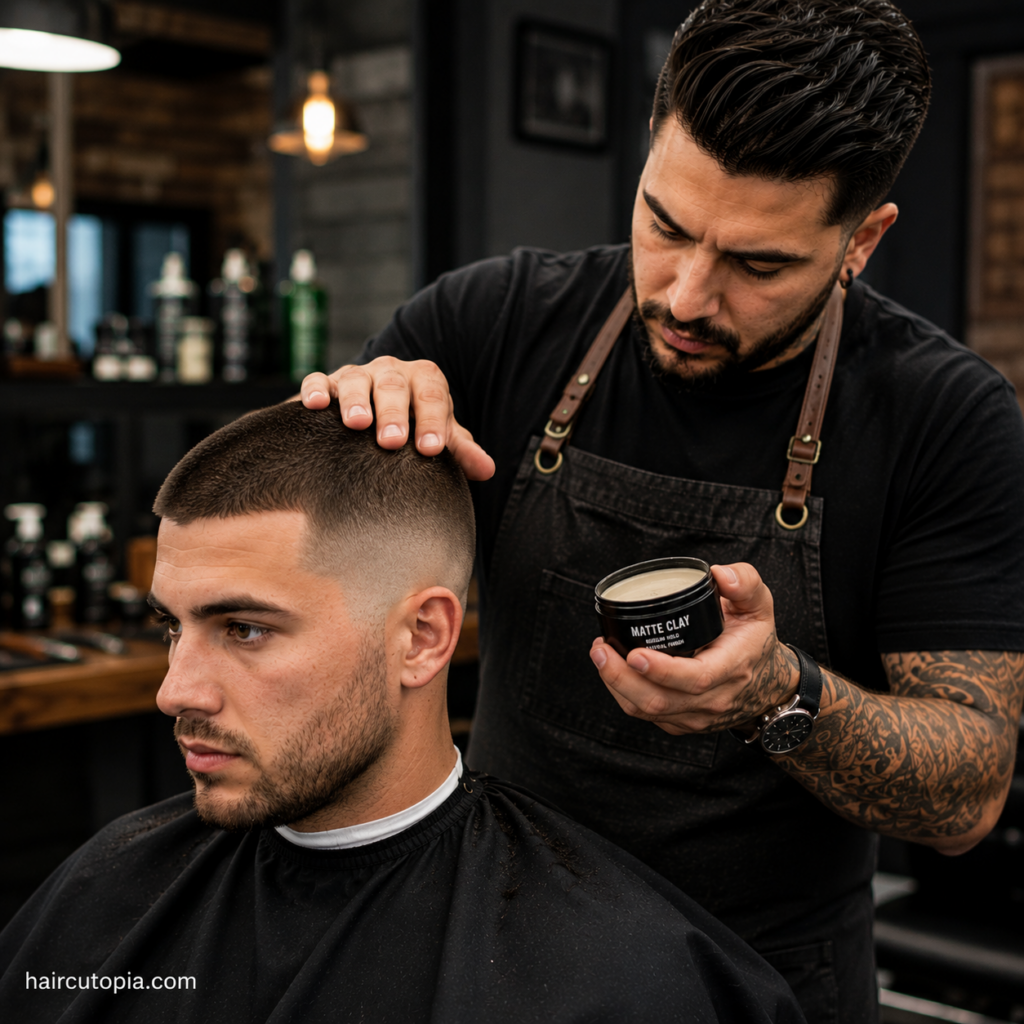
You don’t need a cabinet full of products.
Choose one based on the finish you’re trying to achieve and the amount of hair you actually have.
Matte Clay
A matte clay can work well on longer buzz cuts when you want more texture and definition without noticeable shine.
It can be particularly useful for thick hair that needs a little control.
Start with a very small amount, warm it between your hands, and distribute it lightly.
Styling Cream
Styling cream generally provides softer control than a clay or wax.
It can be useful if you have enough length for your hair to become slightly unruly but don’t want a stiff or heavily styled appearance.
Creams can also work well for hair that naturally has some wave or curl.
Lightweight Paste
A light styling paste offers another middle ground.
It can add subtle definition and control without making a buzz cut look overly styled.
Again, use less than you think you’ll need.
Pomade
Pomade can add control and shine, but it isn’t usually necessary for extremely short buzz cuts.
If you’re wearing a longer buzz cut and intentionally want a slightly slicker finish, a small amount may work.
Heavy application can quickly make short hair look greasy, so restraint matters.
How Much Product Should You Use?
Probably less than you would use with almost any longer hairstyle.
Start with an amount around the size of a small pea or even less, depending on your hair length.
Rub it thoroughly between your palms and fingers before touching your hair. This helps distribute the product instead of depositing a concentrated patch in one area.
Then work it through the hair gradually.
You can always add more.
Removing too much product usually means washing your hair and starting over.
How to Add Texture to a Buzz Cut
Texture becomes increasingly visible as a buzz cut gets longer.
If you have a #4 or longer cut, try using your fingertips instead of flattening everything with a comb.
Apply a very small amount of matte product, then lightly pinch or move sections of hair to emphasize the natural texture.
Don’t try to create perfectly separated spikes.
The goal is usually a subtle, slightly lived-in finish rather than making each individual section stand upright.
Naturally curly, coily, or wavy hair may show texture even at shorter lengths and may require little additional styling.
How to Style a Buzz Cut With a Fade
A fade does much of the styling work for you.
Because the sides gradually transition into the longer hair above, the haircut already has structure and contrast.
For a short buzz cut with a fade, concentrate on keeping the top clean and letting the fade provide the shape.
If the top is longer, you can add subtle texture with a matte product.
The overall appearance will also depend on your fade height.
Low Fade Buzz Cut
A low fade keeps more hair along the sides and creates a relatively subtle transition.
It works well if you want the buzz cut to look clean without creating dramatic contrast.
Styling the top naturally usually complements this softer transition.
Mid Fade Buzz Cut
A mid fade creates more visible separation between the top and sides.
Because the fade itself becomes a stronger visual feature, you often don’t need much product on top.
High Fade Buzz Cut
A high fade removes more hair from the sides and puts greater emphasis on the top.
If the top has enough length, adding a little texture can strengthen that contrast.
Skin Fade Buzz Cut
A skin fade blends down to bare or nearly bare skin.
This creates enough contrast that the haircut can look highly styled even when you haven’t used any product at all.
Keeping the fade fresh becomes more important than styling the top every morning.
Style Your Hairline
The hairline is especially visible with a buzz cut.
You generally have two approaches.
Natural Hairline
A natural hairline follows your existing growth pattern without creating an aggressively sharp edge.
This can give a buzz cut a softer, more relaxed appearance.
There’s essentially nothing to style. Just keep the surrounding hair clean and let the natural shape show.
Lineup
A lineup creates sharper edges around the front hairline and temples.
This can make a buzz cut look more structured and polished, particularly when combined with a fade.
The downside is maintenance.
As the hair grows, the sharp edge begins to soften. You’ll need periodic touch-ups if you want to maintain that freshly lined appearance.
Be careful about repeatedly moving the line farther into your natural hairline when doing touch-ups yourself.
Use Your Beard to Balance a Buzz Cut
If you have facial hair, it becomes a major part of the overall style when your head hair is extremely short.
A buzz cut paired with a beard can create contrast and help frame the face.
You don’t necessarily need a large beard. A short beard, stubble, mustache, or goatee can all change how the haircut reads.
For a polished appearance, consider how the sideburns connect with the beard.
A barber can fade the sideburn area into your facial hair, creating a gradual transition from the buzz cut into the beard.
For a simpler look, keep both the haircut and facial hair relatively uniform.
Can You Brush a Buzz Cut?
Yes, assuming there’s enough hair to brush.
A soft brush can help longer buzz cuts lie consistently and can remove loose hairs after a haircut.
Brushing can be particularly useful for:
- Longer buzz cuts
- Thick hair
- Waves
- Hair that grows strongly in one direction
- Distributing a small amount of styling product
For extremely short hair, brushing isn’t usually necessary for styling.
Avoid aggressively brushing an irritated or sensitive scalp.
Can You Blow-Dry a Buzz Cut?
You can, but most buzz cuts don’t need it.
Longer versions may benefit from a quick blow-dry if you’re trying to create more volume or direct the hair in a particular way.
Use a comfortable temperature rather than holding very hot air directly against the scalp.
For a basic buzz cut, towel-drying or air-drying is normally more than enough.
Styling Buzz Cuts for Different Hair Types
Your natural hair texture can make a significant difference in how a buzz cut looks.
Straight Hair
Straight hair tends to show the shape and consistency of the haircut clearly.
At longer buzz cut lengths, you may notice individual sections beginning to stick up or change direction.
A small amount of matte clay, cream, or paste can help control them.
Wavy Hair
Wavy hair can develop visible texture surprisingly quickly as it grows.
Rather than flattening the wave, try using a lightweight product to enhance the natural movement.
Curly Hair
A longer buzz cut can allow short curls to become visible across the top.
A lightweight moisturizing styling product may help define the natural texture without weighing it down.
Coily Hair
Coily hair can create strong visual texture even at relatively short lengths.
Depending on the style, brushing may also be used to encourage a more consistent pattern. Keep the hair and scalp appropriately moisturized for your individual needs rather than relying heavily on hold products.
Fine or Thinning Hair
Heavy, shiny products can cause fine hair to clump together, which may make more of the scalp visible.
If you use anything, a lightweight matte product is often the more natural-looking option.
You may also find that no styling product looks better.
Style the Buzz Cut Around Your Overall Look
A buzz cut puts more attention on your face because there’s less hair competing for attention.
That makes other grooming choices more noticeable.
You can change the character of the haircut through:
- Facial hair
- Eyewear
- Fade height
- Hairline shape
- Overall buzz length
- Clothing style
- Accessories
For example, a uniform #4 buzz cut with a natural hairline has a very different feel from a #2 buzz cut with a high skin fade, sharp lineup, and faded beard.
Both are buzz cuts. The surrounding details create the personality of the style.
How to Style a Buzz Cut for Work
For a professional environment, simplicity usually works best.
Keep the haircut evenly trimmed and the edges tidy. If you use styling product, choose a small amount that doesn’t leave the hair looking greasy or heavily coated.
A natural taper or clean low fade can provide definition without drawing too much attention.
If your workplace has specific grooming requirements, follow those rather than assuming every variation of a buzz cut will be treated the same way.
How to Style a Buzz Cut for a More Casual Look
If you have some length on top, a casual buzz cut can benefit from slightly more texture.
Rather than brushing everything perfectly into place, use your fingertips and a small amount of matte product.
You can also let a fade grow in slightly for a softer appearance rather than maintaining a fresh skin fade every week.
Buzz cuts don’t have to look military-sharp to look intentional.
Keep Your Scalp Looking Good
With longer hairstyles, the scalp mostly stays hidden.
A buzz cut changes that.
Dryness, flakes, redness, and sun exposure can become much more noticeable, particularly with very short cuts.
Basic scalp care can therefore have a bigger effect on the appearance of your haircut than styling products.
Pay attention to:
- Appropriate shampooing
- Dry or flaky skin
- Product buildup
- Sun exposure
- Irritation after clipping
If you’re outdoors with an extremely short buzz cut, remember that your scalp has much less hair covering it. A hat or appropriate sunscreen can help protect exposed skin.
Persistent scalp problems should be discussed with a dermatologist rather than treated as a styling issue.
Common Buzz Cut Styling Mistakes
Using Too Much Product
This is probably the easiest mistake to make.
Short hair requires very little product. Too much can leave the hair shiny, sticky, or greasy.
Start small.
Trying to Style Hair That’s Too Short
A #1 buzz cut isn’t going to behave like a textured crop.
Instead of forcing a style onto extremely short hair, focus on the haircut’s shape, edges, fade, and scalp.
Ignoring the Grow-Out
The haircut itself is a major part of styling a buzz cut.
Once the sides and edges become noticeably overgrown, styling product isn’t going to restore the original shape.
Sometimes the best styling product is simply another haircut.
Fighting Your Natural Hair Pattern
Cowlicks and crowns can become especially obvious as a buzz cut grows.
Work with your natural direction whenever possible instead of applying increasingly heavy products to force the hair somewhere it doesn’t naturally want to go.
Forgetting About Facial Hair
A beard or mustache becomes visually prominent when the hair on your head is extremely short.
Even basic beard maintenance can make the entire haircut look more intentional.
A Simple Daily Buzz Cut Styling Routine
For most people, styling a buzz cut can stay refreshingly simple:
- Wash or rinse your hair as needed.
- Gently dry your hair and scalp.
- Check for areas sticking up or lying unevenly.
- Brush or use your fingers if the hair is long enough.
- Apply a tiny amount of product only if necessary.
- Make sure your beard or facial hair looks tidy.
- Get on with your day.
That’s really all a buzz cut needs.
If your morning routine is becoming as complicated as it was with longer hair, you’re probably doing more than necessary.
Final Thoughts on Styling a Buzz Cut
The best way to style a buzz cut is usually to let the haircut do most of the work.
Very short buzz cuts need almost no product. Their appearance comes from consistent length, clean edges, a well-executed fade or taper, and a healthy-looking scalp.
Longer buzz cuts give you more options. You can add texture, control the direction of the hair, enhance waves or curls, or use a small amount of matte product for definition.
Just don’t lose sight of why the buzz cut is so popular in the first place.
It’s simple.
Keep the haircut fresh, work with your natural texture, use styling products sparingly, and focus on the details that actually make a difference.