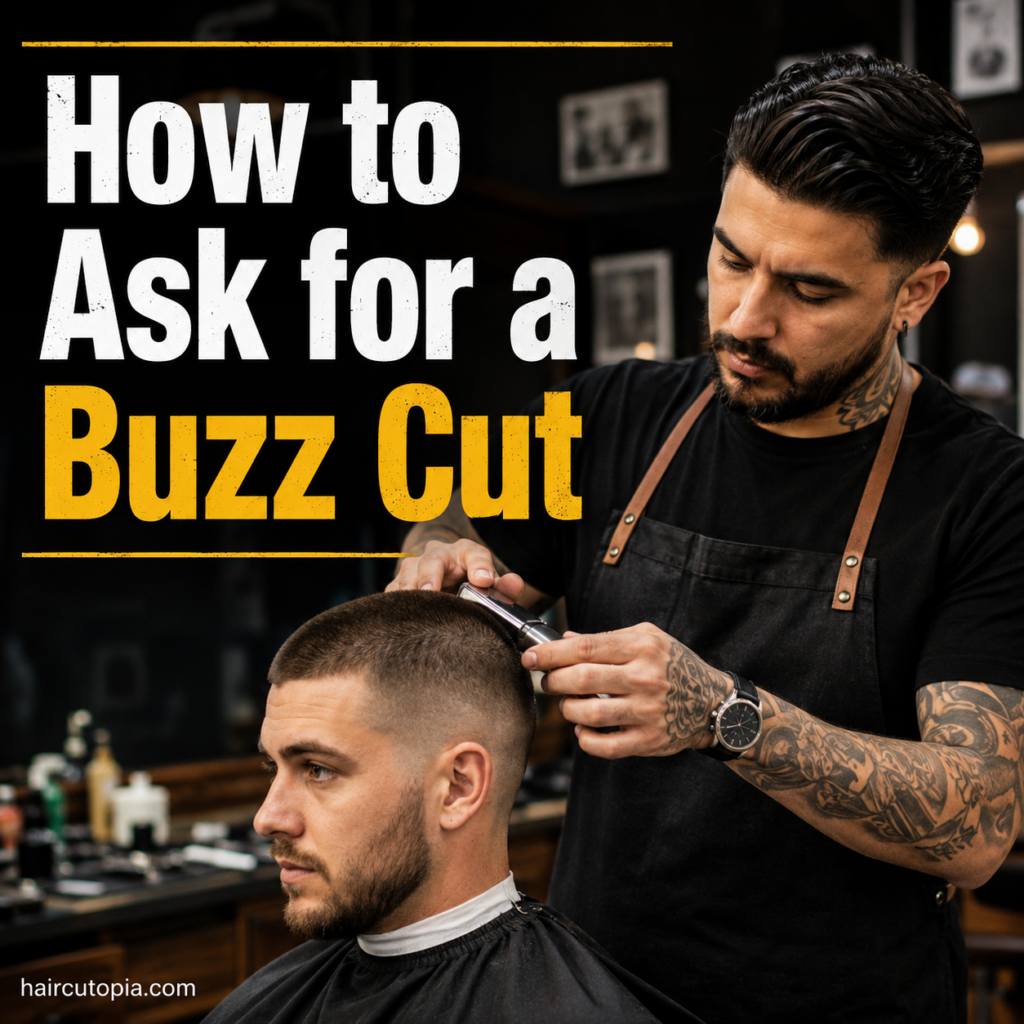
A buzz cut sounds like one of the simplest haircuts you can order. After all, the hair is short, the clippers do most of the work, and there usually isn’t much styling involved.
But asking for “a buzz cut” alone leaves quite a bit open to interpretation.
Buzz cuts can be extremely short or leave enough length to show texture. They can be the same length all over, paired with a fade, tapered around the edges, or finished with a sharp lineup. The difference between a haircut you love and one that feels much shorter than expected often comes down to a few details you give your barber before the clippers turn on.
If you’re not sure what to say, here’s how to ask for a buzz cut and communicate exactly what you want.
What to Tell Your Barber When Asking for a Buzz Cut
The easiest way to order a buzz cut is to describe four things:
- How short you want the top.
- How you want the sides and back cut.
- Whether you want a fade or taper.
- How you want the hairline and edges finished.
You don’t need to know professional barber terminology. A clear description and a reference photo can usually communicate more than trying to use technical terms you’re unsure about.
For example, you might say:
“I’d like a buzz cut with a #3 on top, a low fade on the sides and back, and a natural-looking hairline.”
That’s much more specific than simply saying, “Give me a buzz cut.”
Know How Short You Want Your Buzz Cut
Length is usually the most important decision.
Barbers commonly use clipper guard numbers to describe how much hair will remain after cutting. Lower guard numbers leave the hair shorter, while higher numbers leave more length.
Common buzz cut lengths include:
- #1 guard — approximately 1/8 inch
- #2 guard — approximately 1/4 inch
- #3 guard — approximately 3/8 inch
- #4 guard — approximately 1/2 inch
- #5 guard — approximately 5/8 inch
- #6 guard — approximately 3/4 inch
- #7 guard — approximately 7/8 inch
- #8 guard — approximately 1 inch
Keep in mind that the finished appearance can vary depending on your hair texture, density, growth pattern, and the clipper system being used.
What If You Don’t Know Your Guard Number?
You don’t have to guess.
Tell your barber roughly how much hair you want left and show a reference photo if possible. You can also ask the barber what guard would create the look you’re after.
If you’re nervous about going too short, say so.
Something as simple as “I’d rather start a little longer because I’m not sure how short I want to go” gives your barber useful information. Hair can always be taken shorter during the appointment.
Decide Between an Even Buzz Cut and a Fade
Not every buzz cut has to be one uniform length.
An even buzz cut keeps approximately the same length across the top, sides, and back. It’s straightforward, low-maintenance, and gives the haircut a very consistent appearance.
A faded buzz cut keeps some length on top while gradually shortening the sides and back.
That small change can dramatically affect the overall look.
Asking for an Even Buzz Cut
If you want the classic uniform appearance, you could say:
“I’d like a #3 buzz cut, the same length all over.”
You can then tell your barber whether you’d like the neckline and sideburns tapered or kept simple.
Asking for a Buzz Cut With a Fade
For more contrast, ask for your preferred length on top followed by the type of fade you want.
For example:
“I’d like a #3 on top with a mid fade on the sides and back.”
The fade creates a gradual transition from shorter hair around the sides and back into the longer hair above.
Choose Your Fade Height
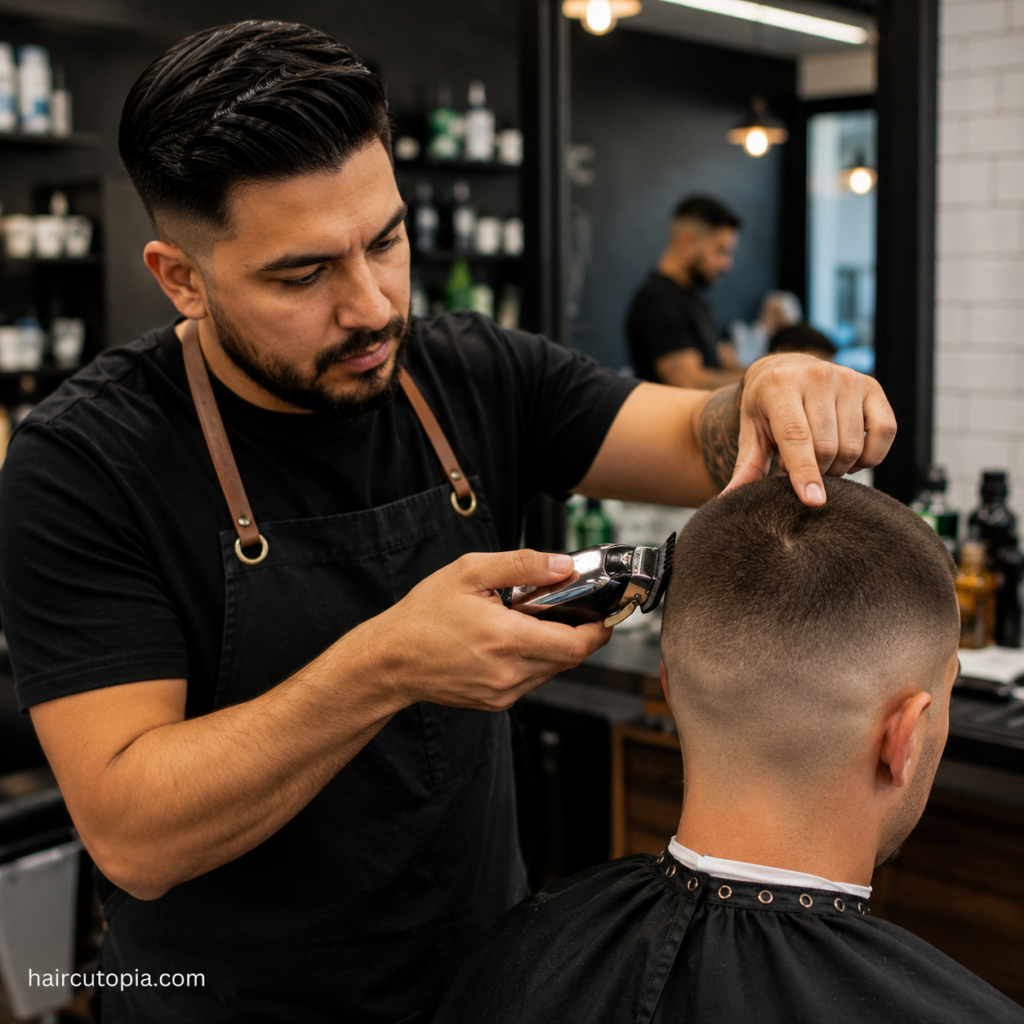
If you’re combining your buzz cut with a fade, you’ll also need to decide roughly where the fade should begin.
Low Fade
A low fade starts relatively close to the ears and neckline.
Because more length remains higher on the sides, the transition tends to look subtle. It’s a good choice if you want a clean buzz cut without creating too much contrast.
Mid Fade
A mid fade begins higher along the sides of the head.
It creates a more noticeable transition and sits somewhere between the subtle appearance of a low fade and the stronger contrast of a high fade.
High Fade
A high fade begins farther up the sides of the head.
This removes more hair from the sides and emphasizes the hair remaining on top. It generally creates a sharper, more dramatic buzz cut.
Skin Fade
A skin fade, sometimes called a bald fade, gradually blends the hair down to bare or nearly bare skin.
You can combine a skin fade with different fade heights, so you might ask for a low skin fade, mid skin fade, or high skin fade.
If you don’t want the sides shaved all the way down, make that clear before the haircut begins.
Buzz Cut vs. Buzz Cut With a Taper
A taper is another option if you don’t want a full fade.
Instead of significantly shortening the entire sides and back, a taper concentrates the transition around areas such as the sideburns and neckline.
This keeps more overall length while cleaning up the edges.
You could ask for:
“A #3 buzz cut with a taper around the sideburns and neckline.”
A tapered buzz cut can work well when you want something neat and understated rather than a strong faded effect.
Decide How You Want Your Hairline
The front hairline can change the character of a buzz cut more than you might expect.
With longer hairstyles, the natural hairline is often partially hidden. A buzz cut exposes it, making the barber’s finishing work more noticeable.
Natural Hairline
Ask your barber to keep your natural hairline if you prefer a softer appearance or don’t want the front edge pushed back.
You can simply say:
“Keep the front hairline natural.”
Lineup
A lineup, sometimes called an edge-up, creates cleaner and more defined edges around the hairline.
The barber may sharpen the temples and front edge to create a more structured shape.
If that’s the look you want, ask for a lineup with your buzz cut.
Bring a Reference Photo
One of the easiest ways to avoid confusion is to show your barber a picture.
Buzz cut terminology can describe several variations, and two people may imagine completely different haircuts after hearing the same words.
Choose a photo showing:
- The approximate top length you want
- The sides and back
- The fade or taper height
- The front hairline
- A similar hair texture, if possible
Try to find more than just a front-facing photo. A side view is especially helpful when discussing fades.
You don’t have to find someone with your exact face shape or hair type. The image is simply there to give your barber a visual target.
Consider Your Hair Texture
The same clipper guard can look different depending on the hair it’s cutting.
Thick, straight hair may appear fuller at a particular length, while fine hair can expose more of the scalp. Curly and coily hair can also look visually different at the same measured length because of curl pattern and shrinkage.
This is another reason a photo can be more useful than relying entirely on guard numbers.
If you’re uncertain, ask your barber how the reference haircut would translate to your own hair.
Consider Your Hairline and Head Shape
Buzz cuts expose areas that longer hairstyles often disguise.
Your natural hairline, crown, temples, scalp, and head shape will all become more visible as the hair gets shorter.
That doesn’t mean you need a particular head shape to wear a buzz cut. It simply means the exact length and fade placement can influence how the haircut frames your features.
An experienced barber may suggest keeping slightly more length in certain areas or adjusting the fade height to better suit your hair growth and proportions.
Should You Ask for a #1, #2, #3, or #4 Buzz Cut?
If you’re deciding between common guard lengths, think about how much scalp visibility and texture you want.
#1 Buzz Cut
A #1 is extremely short and leaves approximately 1/8 inch of hair.
The scalp and natural contours of the head will generally be more noticeable at this length.
#2 Buzz Cut
A #2 leaves approximately 1/4 inch.
It’s still very short but provides more coverage than a #1. It’s a popular option for people who want a close buzz without going nearly bald.
#3 Buzz Cut
A #3 leaves approximately 3/8 inch.
At this length, there’s usually enough hair to show more texture while maintaining the unmistakably short appearance of a buzz cut.
#4 Buzz Cut
A #4 leaves approximately 1/2 inch.
This is a good starting point if you’re trying a buzz cut for the first time and aren’t comfortable going extremely short. It provides noticeably more coverage and can always be shortened if needed.
What to Say If It’s Your First Buzz Cut
Tell your barber.
Knowing that it’s your first time going this short can help them understand why you may be uncertain about guard numbers or how the haircut will look.
You could say:
“This is my first buzz cut. I want it short, but I don’t want to go extremely short. What length would you recommend?”
You can also ask the barber to begin with a longer guard.
For example, if you’re choosing between a #3 and #4, starting with the #4 lets you see how that length looks before deciding whether to remove more.
Buzz Cut Examples You Can Ask For
Here are a few straightforward ways to describe common variations.
Classic Even Buzz Cut
“I’d like a #3 buzz cut, the same length all over, with the edges cleaned up.”
Buzz Cut With a Low Fade
“I’d like a #3 on top with a low fade on the sides and back.”
Buzz Cut With a Mid Skin Fade
“I’d like a #2 on top with a mid skin fade and a clean lineup.”
Longer Buzz Cut
“I’d like a #4 on top. Keep it short and clean, but I don’t want much scalp showing.”
Buzz Cut With a Taper
“I’d like a #3 all over with a taper around the sideburns and neckline.”
You don’t need to memorize these phrases. Use them as a framework and adjust the details to match the haircut you actually want.
Questions to Ask Your Barber Before Going Short
If you’re unsure about any part of the haircut, ask before the cutting starts.
Useful questions include:
- What guard would you recommend for this reference photo?
- How much scalp will show at this length?
- Would a low, mid, or high fade work better with this cut?
- Can we start longer and go shorter if needed?
- Would you recommend a taper instead of a full fade?
- How often would I need to get this cleaned up?
A short conversation at the beginning of the appointment can prevent a much longer period of waiting for a haircut you didn’t want to grow back.
Common Mistakes When Asking for a Buzz Cut
Saying Only “Give Me a Buzz Cut”
This doesn’t tell the barber enough.
At minimum, discuss your preferred length and whether you want the sides the same length, faded, or tapered.
Guessing a Guard Number
If you don’t know what a #1 or #2 actually looks like, don’t choose one simply because it sounds right.
Ask the barber or look at examples first.
Going Too Short Immediately
If you’re uncertain, starting slightly longer gives you options.
The barber can take another pass with a shorter guard. They can’t put the hair back once it’s been cut.
Forgetting About the Hairline
Tell your barber whether you prefer a natural hairline or a sharper lineup.
Using a Reference Photo Without Explaining What You Like
Point out the specific elements you want from the picture.
Maybe you like the fade but want the top longer. Maybe you like the overall length but don’t want such a sharp lineup.
A reference image should start the conversation rather than replace it.
How Often Does a Buzz Cut Need a Haircut?
Buzz cuts are easy to style, but maintaining a consistently sharp appearance can require fairly frequent trims.
Many people refresh a buzz cut every two to four weeks. Very short cuts and skin fades may begin looking grown out sooner because even a small amount of new growth changes the contrast.
If you don’t mind a softer, grown-in appearance, you can wait longer between appointments.
Your maintenance schedule ultimately depends on:
- Your hair growth rate
- Your chosen guard length
- Whether you have a fade
- How sharp you like the edges
- How much grow-out you’re comfortable with
How to Ask for a Buzz Cut With Confidence
You don’t need to speak like a barber to get a good buzz cut.
Focus on communicating the details that actually affect the finished haircut: length on top, treatment of the sides and back, fade or taper preference, and how you’d like the hairline finished.
If you know the guard number, great. If you don’t, describe the length you’re comfortable with and show your barber a photo.
A simple request such as “I’d like a #3 on top with a low fade, but please keep the front hairline natural” gives your barber a much clearer picture than simply asking for a buzz cut.
And if you’re still deciding between lengths, start longer. Going shorter takes another few minutes. Growing it back takes considerably longer.