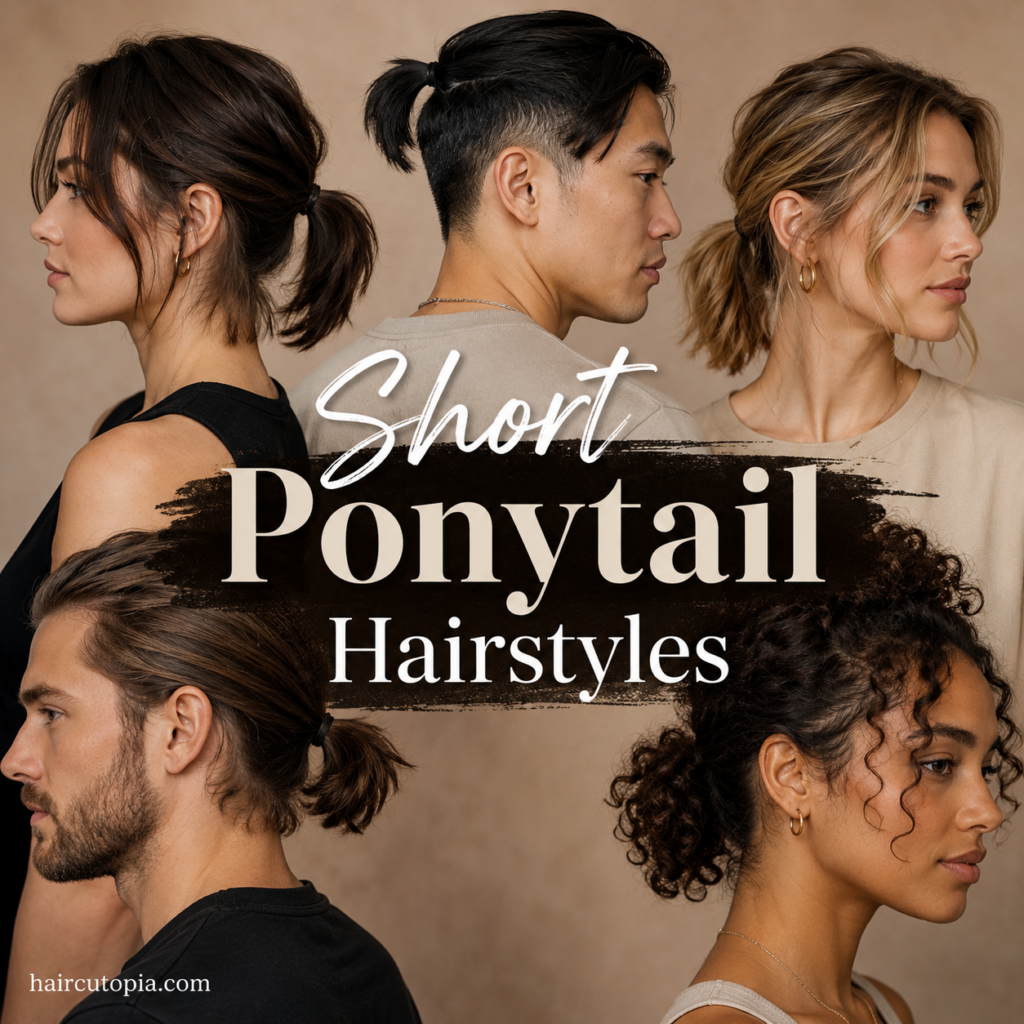
A ponytail sounds like the simplest hairstyle in the world—until you’re working with short hair.
Then suddenly you’re negotiating with layers at the nape, pieces that won’t reach the elastic, and that one section near your ear that seems determined to escape no matter how many bobby pins you use.
The good news is that short ponytail hairstyles don’t need to look like compromised versions of long-hair styles. Bobs, lobs, layered cuts, curly hair, and even some shorter cuts can create ponytails with their own shape and personality.
A tiny low pony can look sleek and minimalist. A textured ponytail can feel casual and effortless. Add braids, twists, accessories, or face-framing pieces, and a basic ponytail becomes something completely different.
Here are 20 ways to make a ponytail work beautifully with shorter hair.
Can You Put Short Hair in a Ponytail?
Usually, yes—but exactly how short you can go depends on the cut.
Hair around chin length may only allow a very small low ponytail, especially if there are layers around the front. Once your hair reaches the shoulders or approaches lob length, you’ll have considerably more options.
You don’t necessarily need every strand to reach the elastic.
Shorter pieces can be:
- Pinned back
- Twisted toward the ponytail
- Braided into the sides
- Left loose intentionally
- Styled as face-framing pieces
- Secured with decorative clips
Instead of fighting your haircut, let those shorter sections become part of the hairstyle.
1. Classic Short Low Ponytail
The low ponytail is the natural starting point for short hair.
Gather your hair at the nape and secure it with a small elastic.
Don’t worry if the ponytail itself is short. That compact shape is part of the look.
For a casual finish, loosen the crown slightly and allow a few pieces to fall naturally around your face.
For something more polished, smooth the hair toward the elastic and tuck shorter side pieces behind your ears.
Best for:
- Bobs and lobs
- Everyday wear
- Work
- Straight or wavy hair
- Growing-out hairstyles
2. Sleek Short Ponytail
Short hair can create an especially sharp-looking sleek ponytail because there isn’t a lot of excess length competing with the clean silhouette.
Create a center or side part.
Apply a small amount of smoothing product, then brush the hair toward the nape.
Secure it tightly enough to stay neat without pulling uncomfortably at the hairline.
If short pieces escape around the nape, use bobby pins or a little styling product to keep them controlled.
The result is simple, modern, and surprisingly versatile.
3. Messy Short Ponytail
Not every piece needs to stay perfectly contained.
A messy ponytail actually benefits from short layers.
Gather your hair loosely at the back and secure it without flattening all the volume around the crown.
Gently pull a few sections loose.
If shorter layers naturally fall around your face, let them.
The key is making the texture look intentional rather than spending 15 minutes trying to manufacture a hairstyle that supposedly took 30 seconds.
4. Short Ponytail With Face-Framing Pieces
Before putting your hair up, separate a small section on either side of your face.
Create your ponytail as usual.
Then style those pieces independently.
Depending on your haircut, you can:
- Leave them straight
- Add a soft bend
- Curl them away from the face
- Follow your natural wave
- Tuck one side behind your ear
This is particularly effective with layered bobs and lobs because those shorter front sections are already designed to frame the face.
5. Short Wavy Ponytail
Natural waves give a short ponytail texture without requiring much styling.
Gather your hair low at the nape and secure it loosely.
Instead of brushing everything smooth first, preserve some of the natural movement through the crown and sides.
If your hair is naturally straight, you can add a few loose bends before creating the ponytail.
You don’t need to curl every strand. A little texture goes a long way when the ponytail is short.
6. Short Curly Ponytail
Curly hair can create plenty of volume even when there isn’t much length.
Gather the curls low or toward the middle of the back of your head, depending on what your length allows.
Avoid brushing through the curls beforehand if you want to preserve their definition.
Leave a few curls around the hairline and temples.
A short curly ponytail can look fuller than a straight ponytail of exactly the same length because the curl pattern creates additional width and dimension.
7. Short High Ponytail
A high ponytail is trickier with short hair, but it’s possible with the right length and a few pins.
Gather as much hair as possible toward the crown and secure it.
The sections around the nape may not reach.
Instead of repeatedly trying to force them into the elastic, twist them upward and pin them underneath the ponytail.
You can also use several visible decorative pins if you want that detail to become part of the hairstyle.
This technique works particularly well with shoulder-length hair and longer bobs.
8. Short Half-Up Ponytail
If your hair isn’t long enough for a full ponytail, don’t force it.
A half-up ponytail may work perfectly.
Gather the top and side sections toward the back of your head and secure them with a small elastic.
Leave the lower section down.
This keeps hair away from your face while showing off the length and texture you do have.
It also works across straight, wavy, and curly hair.
9. Short Ponytail With a Side Part
Changing your part is one of the easiest ways to make the same ponytail look different.
Create a defined side part before gathering your hair.
Sweep both sections toward a low ponytail at the nape.
You can smooth the heavier side for a polished finish or allow it to fall naturally for something softer.
A deep side part can give even a very small ponytail a more deliberate shape.
10. Short Ponytail With a Middle Part
For a cleaner, more symmetrical look, try a center part.
Part your hair before pulling it back.
Smooth both sides toward the nape and secure a low ponytail.
This works particularly well with straight hair and blunt or minimally layered bobs.
You can tuck both sides behind the ears for an even more streamlined appearance.
11. Braided Side Ponytail for Short Hair
You don’t need enough length to braid the actual ponytail.
Instead, braid one side of your hair before gathering it.
Create a small French or Dutch braid beginning near the front and direct it toward the back.
When you reach the point where you’re placing the ponytail, secure the braid together with the rest of the hair.
This has another practical benefit: the braid can capture shorter layers that might otherwise fall out.
12. Double-Braid Short Ponytail
Why stop at one braid?
Create a small braid on each side of the head.
Direct both toward the back and gather them into a low ponytail with the remaining hair.
Keep the braids tight for a cleaner appearance or gently loosen them for more texture.
This style can make a very simple ponytail look much more detailed while helping control shorter front layers.
13. Twisted Short Ponytail
If braiding isn’t your thing, use twists.
Take a small section from each side of your head and twist both toward the back.
Combine the twists with the remaining hair and secure everything into a ponytail.
You can keep the twists neat or gently pull them apart for a softer finish.
This is one of the easiest ways to dress up a short ponytail without adding much time to your routine.
14. Short Bubble Ponytail
You don’t need waist-length hair to experiment with a bubble ponytail.
Create a ponytail and add another small elastic an inch or two below the first.
If you have enough length, add one more.
Gently pull the hair between the elastics outward to create small rounded sections.
With short hair, the bubbles will naturally be smaller—and that’s exactly what makes the style interesting.
15. Short Ponytail With Wrapped Elastic
One tiny detail can make a basic ponytail look considerably more polished.
After creating your ponytail, take a small piece from underneath.
Wrap it around the elastic and secure the end underneath with a bobby pin.
If your ponytail is too short to spare a full section, you can create the same effect with a decorative ponytail cuff.
This works particularly well for work, dinner, and occasions where you want something simple but finished.
16. Short Ponytail With Bangs
Bangs and short ponytails naturally work together.
Straight-across bangs can create a strong contrast with a sleek low ponytail.
Curtain bangs complement textured and wavy ponytails.
Longer side-swept bangs can either remain loose or be pinned back.
You don’t need to incorporate every front section into the ponytail. Letting your bangs remain visible often makes the hairstyle look more balanced.
17. Short Ponytail With Bobby Pin Detail
When short layers won’t reach the elastic, turn the solution into part of the hairstyle.
Gather the longest sections into a ponytail.
Then secure shorter pieces with visible bobby pins.
Instead of placing them randomly, arrange them intentionally.
You might use:
- Two parallel pins
- Three stacked pins
- Crossed pins
- Metallic pins
- Pearl pins
- Minimal decorative barrettes
What started as a practical fix becomes an accessory.
18. Short Ponytail With a Scrunchie
A scrunchie adds volume around the base, which can make a small ponytail feel more substantial.
Create a low or mid-height ponytail and secure it with a scrunchie.
Choose the size carefully.
A huge scrunchie can overwhelm a very short ponytail, while a small or medium version usually keeps the proportions balanced.
Velvet, satin, linen, and neutral fabrics can make the style feel more intentional.
19. Short Ponytail for Work
For a work-ready version, keep things simple.
Create a center or side part and gather the hair into a low ponytail.
Smooth obvious flyaways and secure shorter sections around the nape if necessary.
You can wrap a small piece of hair around the elastic or use a simple ponytail cuff for a cleaner finish.
If your workplace is more relaxed, a softly textured ponytail can work just as well.
Professional doesn’t have to mean completely slick.
20. Short Ponytail for a Special Occasion
A short ponytail can absolutely work for dinner, a wedding, a party, or another special event.
Start by adding waves or curls.
Create volume around the crown and gather the hair into a low ponytail.
Leave a couple of face-framing pieces free.
Then add one finishing detail, such as:
- A decorative barrette
- Pearl pins
- A velvet bow
- A metallic cuff
- A small braid
- A jeweled elastic
You don’t need to disguise the fact that the ponytail is short.
A compact ponytail with good texture and intentional styling can look just as finished as a longer one.
Short Ponytail Hairstyles for Different Hair Lengths
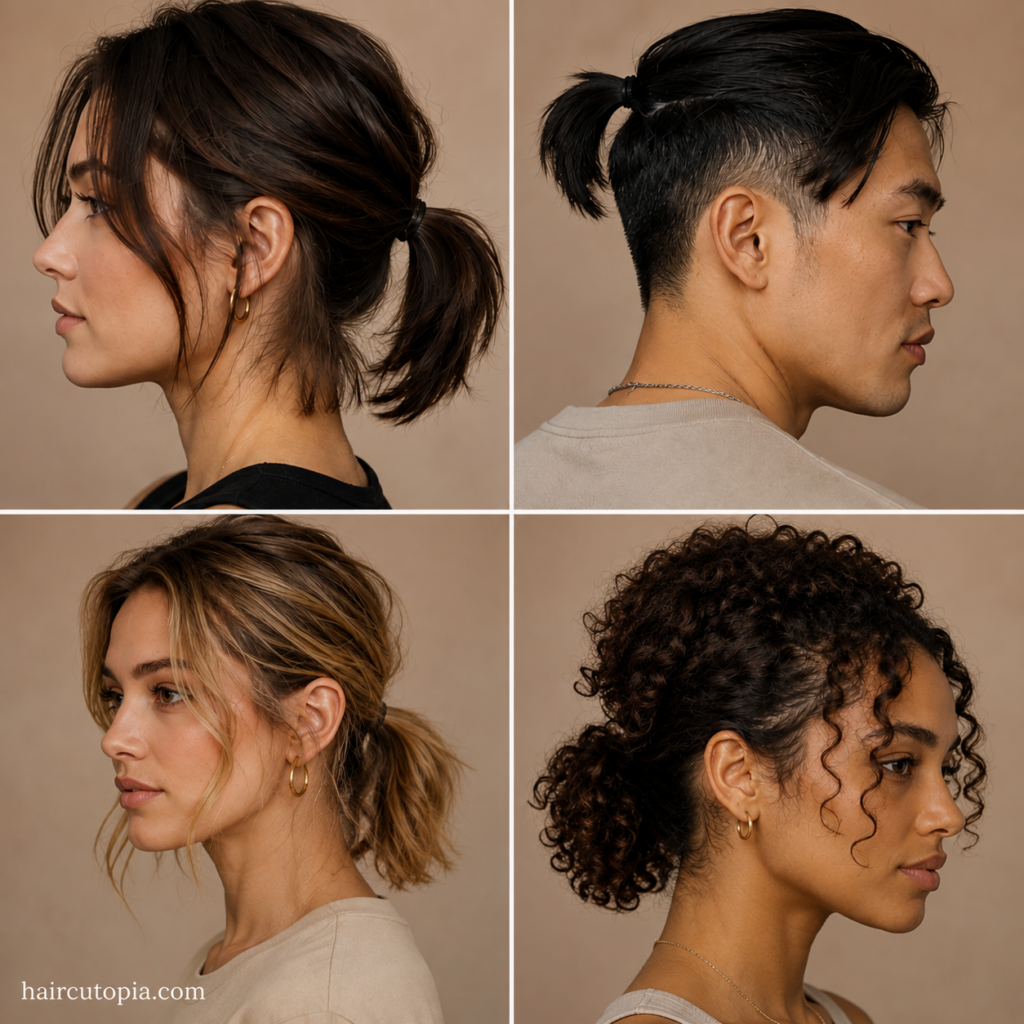
“Short hair” covers everything from hair around the jaw to cuts that nearly reach the shoulders.
A difference of just a few inches can dramatically change your ponytail options.
Ponytails for Chin-Length Hair
Chin-length hair may not completely reach a traditional ponytail.
Start low at the nape.
Gather whatever length reaches comfortably and pin shorter pieces separately.
Half-up ponytails, twisted styles, and small braided sections are often easier than trying to force everything into one elastic.
Ponytails for Bob Haircuts
Many bobs can create a small low ponytail.
Blunt bobs tend to produce compact, clean ponytails, while layered bobs naturally create more loose pieces.
Try working with those pieces rather than hiding every one.
Face-framing layers can remain out, while shorter sections at the back can be secured with pins.
Ponytails for Lob Haircuts
The long bob gives you considerably more flexibility.
Depending on your exact length, you may be able to wear:
- Low ponytails
- Mid-height ponytails
- Half-up ponytails
- Small high ponytails
- Braided ponytails
- Bubble ponytails
- Twisted styles
Lobs are also long enough for more of the nape to reach the elastic, reducing the number of pins you’ll need.
Ponytails for Short Layered Hair
Layers can make ponytails more interesting, but they can also make them harder to secure.
Use smaller sections.
Braiding or twisting the sides can capture short layers before they reach the ponytail.
You can also leave selected pieces loose around the face.
Trying to force every layer into the elastic often creates more frustration than it’s worth.
Short Ponytail Hairstyles for Different Hair Types
Texture changes the shape of a short ponytail considerably.
The best approach is usually to work with what your hair already wants to do.
Short Ponytails for Fine Hair
Fine hair can create a small ponytail, especially when it’s both short and straight.
A little texture can help.
Try adding waves or using a small amount of texturizing spray before putting the hair up.
Gently loosen the crown after securing the ponytail to prevent everything from looking overly flat.
You can also use a small scrunchie or ponytail cuff to add visual weight around the base.
Short Ponytails for Thick Hair
Thick short hair can create a surprisingly substantial ponytail.
The challenge is getting shorter layers to stay put.
Use a strong elastic and secure sections individually where needed.
Braided sides, twists, and bobby pins can help keep the hairstyle controlled without requiring excessive amounts of styling product.
Short Ponytails for Curly Hair
Curls can make a short ponytail look full even when there’s very little actual length.
Preserve the curl pattern by avoiding unnecessary brushing.
Gather the hair gently and adjust individual curls afterward.
You can also leave curls around the temples and hairline for a softer shape.
Short Ponytails for Straight Hair
Straight hair emphasizes the shape and length of the cut.
Sleek low ponytails, center parts, side parts, and wrapped elastics all work particularly well.
If your hair is extremely smooth and slips out of the elastic, a little texture spray can provide extra grip.
Short Ponytails for Wavy Hair
Waves naturally add movement to a short ponytail.
Avoid brushing everything completely smooth before styling.
Instead, gather the hair while preserving some texture around the crown and through the ponytail.
A few face-framing pieces can reinforce the relaxed look.
How to Make a Short Ponytail Look Fuller
A short ponytail isn’t going to suddenly become waist-length, but you can make it appear more substantial.
Add texture before putting it up
Waves and curls create width.
Even a few loose bends through the hair can make the ponytail look fuller.
Loosen the crown
After securing the ponytail, gently pull upward on small sections around the crown.
This creates volume without affecting the security of the elastic.
Don’t overtighten the length
Pulling every strand completely flat can make fine hair appear even smaller.
Keep the base secure while allowing some natural volume elsewhere.
Choose accessories proportionally
A small scrunchie, ribbon, or cuff can add visual interest around the ponytail base.
Avoid accessories so large that the actual ponytail disappears behind them.
Embrace the compact shape
Sometimes the best approach is not trying to make a short ponytail look bigger at all.
A tiny, sleek ponytail can look intentionally minimalist.
The short length is part of the hairstyle—not something you need to hide.
How to Keep Short Hair in a Ponytail
The main challenge with short hair isn’t usually the ponytail itself.
It’s everything that can’t quite reach it.
Start with the right placement
The lower the ponytail, the easier it is for short pieces to reach.
If your hair constantly falls out of a high ponytail, move the elastic closer to the nape.
Use bobby pins strategically
Pin shorter sections in the direction they’re naturally traveling.
For pieces around the nape, slide pins upward toward the ponytail.
Twist short sections
Instead of pinning a loose section directly back, twist it first.
The twist can capture several shorter layers at once.
Try small braids
Braiding the sides is another way to contain shorter pieces before combining them with the ponytail.
Add a little grip
Silky hair may benefit from a small amount of texture spray, mousse, or dry shampoo.
You don’t need much.
The goal is simply to prevent everything from sliding apart.
How to Make a Short Ponytail Look More Polished
You don’t need to add complicated styling.
Focus on a few small details.
Check your part and make sure it looks intentional.
Smooth flyaways that distract from the shape.
If you’re leaving pieces around your face, style them rather than letting them fall randomly.
You can also hide the elastic with hair, a ribbon, scrunchie, or ponytail cuff.
And check the back.
Short hairstyles can look completely different from behind, especially when several layers are being held together with pins.
Accessories That Work With Short Ponytails
Accessories are especially useful when you’re working with limited length.
They can add interest while helping control shorter pieces.
Try:
- Small scrunchies
- Ribbons
- Ponytail cuffs
- Decorative elastics
- Bobby pins
- Pearl pins
- Barrettes
- Bows
- Small clips
Keep the proportions in mind.
A very large accessory can overpower a tiny ponytail, while smaller pieces tend to complement the hairstyle.
Frequently Asked Questions About Short Ponytail Hairstyles
How short can hair be for a ponytail?
It depends on the haircut and placement. Some chin-length hair can form a small low ponytail, while shorter pieces may need pins. Shoulder-length hair generally provides many more ponytail options.
How do you put short hair into a ponytail without pieces falling out?
Position the ponytail lower, then secure shorter sections with bobby pins, twists, braids, or styling product. You don’t necessarily need every strand inside the elastic.
Can you do a high ponytail with short hair?
Yes, if enough of your hair reaches the crown. Shorter pieces around the nape can be twisted or pinned upward underneath the ponytail.
How do you make a short ponytail look good?
Work with the shape rather than trying to hide the length. Add texture, create a defined part, leave intentional face-framing pieces, or use a small accessory to make the hairstyle feel finished.
What ponytail works best for a bob?
A low ponytail is usually the easiest option for a bob. Half-up ponytails, twisted ponytails, and braided-side styles also work well when some sections aren’t long enough to reach the back.
How do you make a short ponytail look thicker?
Adding waves or curls can create more width. Texturizing products, gentle crown volume, and a small scrunchie or ponytail cuff can also make the hairstyle appear fuller.
Can layered short hair go into a ponytail?
Yes. Some layers may fall out naturally, particularly around the face and nape. You can leave selected pieces loose or secure them separately with pins, twists, or braids.
Are short ponytails suitable for formal occasions?
Absolutely. A sleek ponytail, softly curled low pony, or textured style with a decorative accessory can work for dinners, parties, weddings, and other special occasions.
Final Thoughts on Short Ponytail Hairstyles
Short hair doesn’t disqualify you from ponytails.
It just changes the way you create them.
Sometimes that means placing the ponytail lower. Sometimes it means pinning the nape, braiding the sides, or intentionally leaving a few layers around your face.
And sometimes it means embracing a tiny ponytail instead of wishing it were longer.
That’s part of what makes short ponytail hairstyles interesting. The cut remains visible. The layers become part of the styling, and small changes—a side part, a braid, a ribbon, a few waves—can noticeably change the finished look.
So if a few pieces refuse to reach the elastic, don’t immediately declare the hairstyle a failure.
Give them a bobby pin and a job.