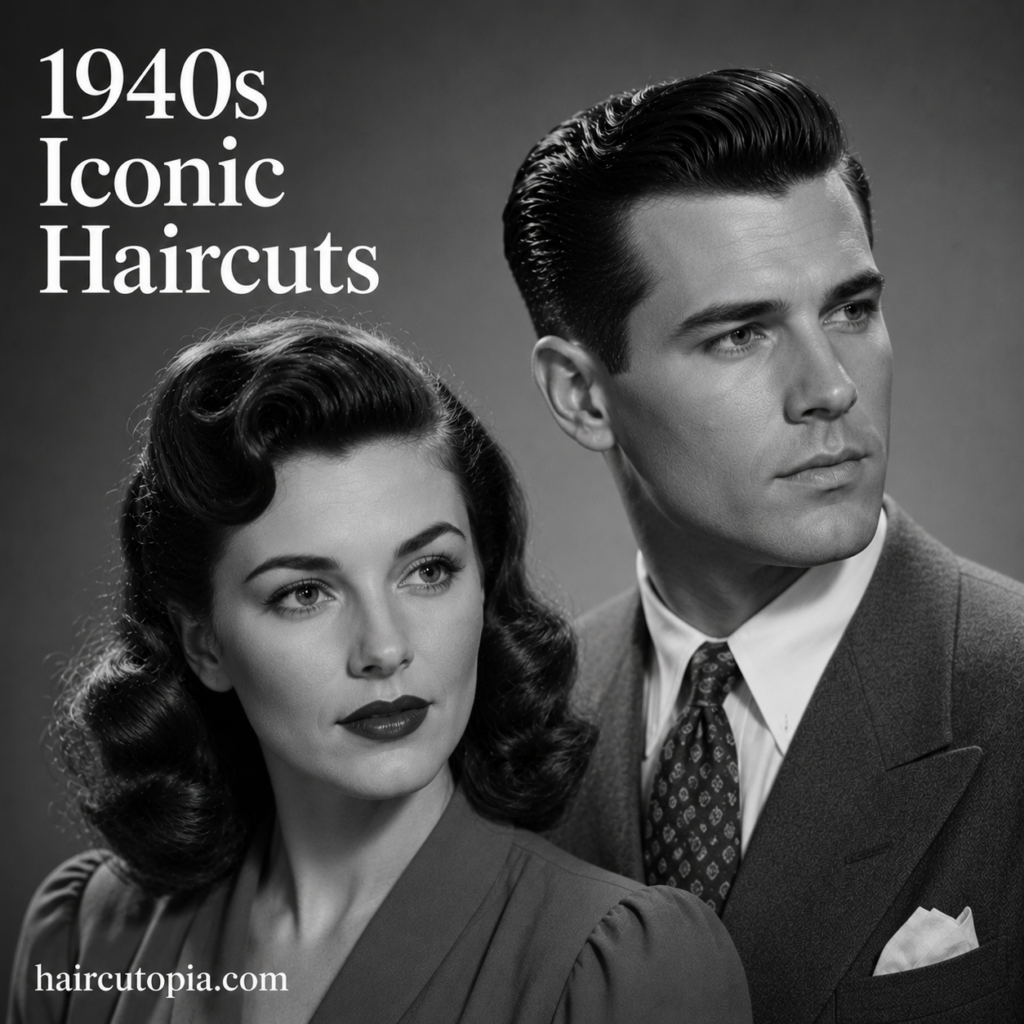
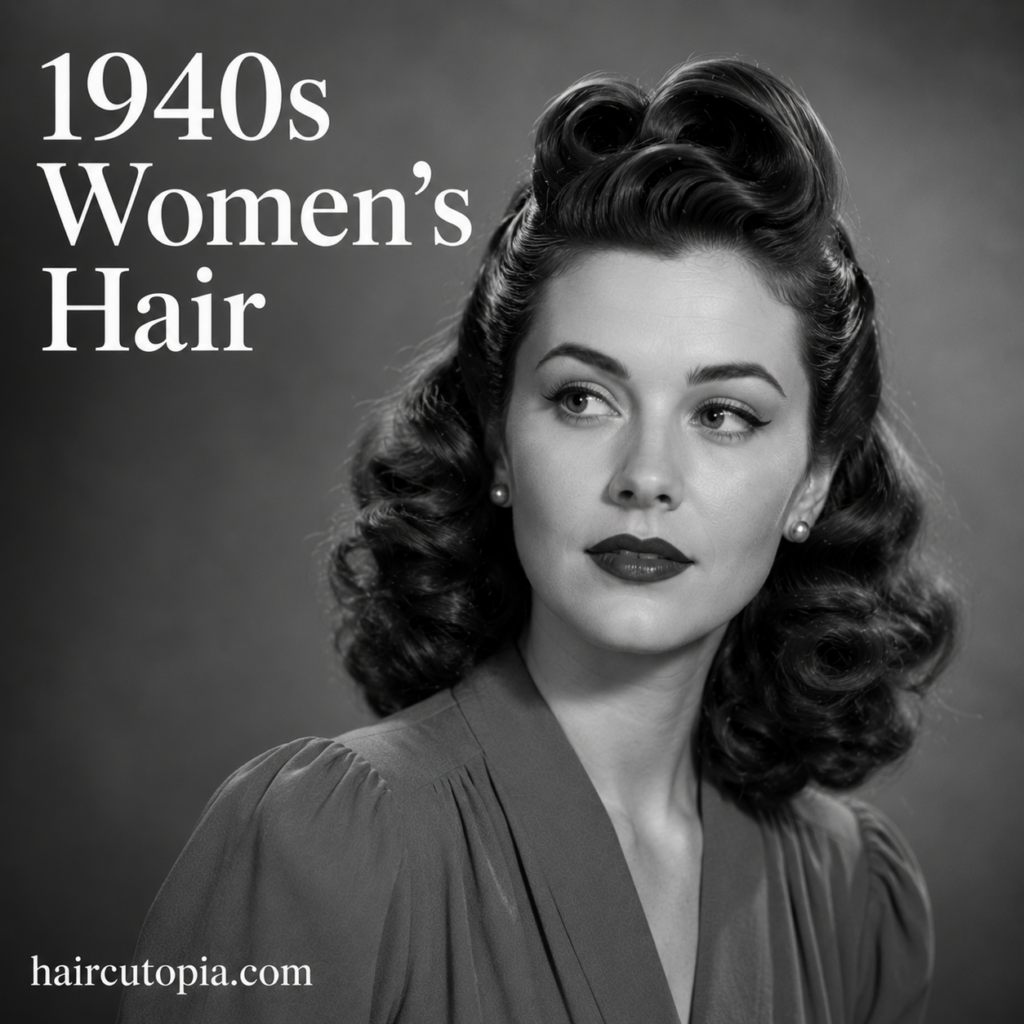
1940s women’s hair had a look all its own. Victory rolls rose above the forehead, polished waves framed the face, curls gathered around the shoulders, and scarves or snoods turned practical hair into part of an outfit.
It was glamorous, but it wasn’t all about glamour.
World War II changed daily life dramatically. As more women took on factory and industrial work, keeping hair controlled became a practical concern. Loose lengths could get in the way, so women rolled, pinned, wrapped, and covered their hair.
At the same time, Hollywood continued to influence beauty. Movie stars appeared with glossy waves, deep side parts, sculpted curls, and carefully arranged silhouettes.
Those two worlds—wartime practicality and screen-ready glamour—helped define women’s hair throughout the 1940s.
What Did Women’s Hair Look Like in the 1940s?
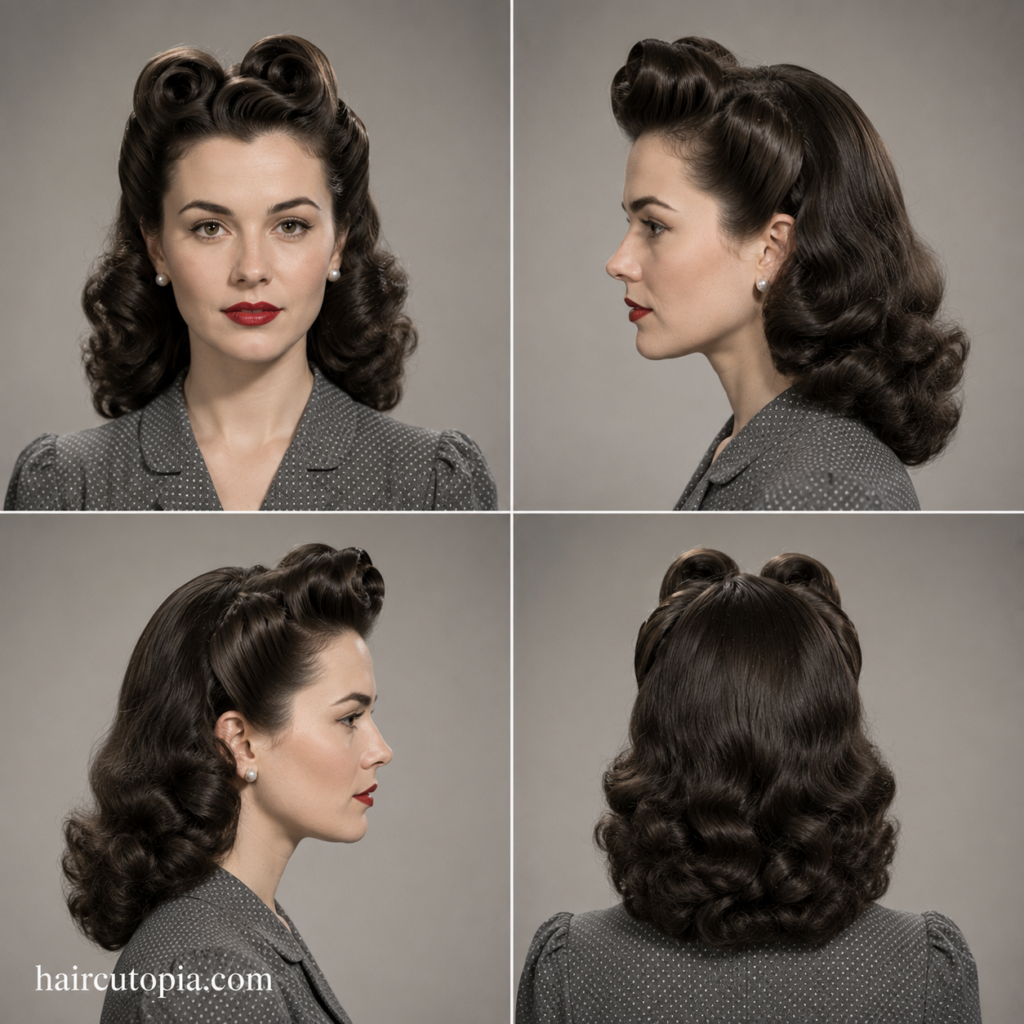
Women’s hair during the 1940s was usually styled rather than simply left to fall naturally.
Curls formed the foundation of many looks. Hair could be set overnight, released, and then brushed into waves, rolls, or rounded shapes.
Medium lengths were especially useful because they provided enough hair for styling without being excessively difficult to secure.
Common characteristics of 1940s women’s hair included:
- Victory rolls
- Pin curls
- Brushed-out waves
- Deep side parts
- Rolled bangs
- Shoulder-length hair
- Curled-under ends
- Women’s pompadours
- Pageboy shapes
- Curled bobs
- Snoods
- Hair scarves
- Turbans
- Hair pinned away from the face
- Polished Hollywood waves
The finished hair generally looked deliberate.
Even soft styles usually had a defined shape. Compared with today’s preference for intentionally undone waves and loose texture, 1940s hair tended to appear smoother and more controlled.
Victory Rolls
Few hairstyles represent 1940s women’s hair as clearly as victory rolls.
Sections near the front of the head were rolled into large cylindrical shapes and secured with pins.
The familiar double-roll version created volume on both sides of the upper head, but women weren’t limited to one arrangement.
Victory rolls could be:
- Symmetrical
- Asymmetrical
- Worn as a single roll
- Combined with loose curls
- Paired with an updo
- Worn with a snood
- Combined with a scarf
The remaining hair could be curled around the shoulders or secured at the back.
Victory rolls also kept the front sections away from the face, making the basic idea compatible with the decade’s preference for controlled hair.
Today, they’re among the strongest visual shortcuts for creating a recognizable 1940s-inspired look.
Pin Curls
Pin curls were one of the most important techniques behind women’s hairstyles of the era.
They weren’t necessarily the finished hairstyle.
Instead, they acted as a foundation.
Small sections of damp hair were wound into curls and secured against the head with pins. After the hair dried, the pins were removed.
At that point, the real styling began.
The resulting curls could be:
- Left relatively defined
- Brushed into waves
- Shaped into rolls
- Directed around the face
- Used to create volume
- Incorporated into an updo
The direction and placement of each pin curl affected how the hair behaved after the set was released.
That meant the setting pattern could be planned around the desired final hairstyle.
The 1940s Brush-Out
The brush-out was one of the secrets behind the smooth appearance of vintage hair.
If you curl modern hair and leave every curl separated, the result can look very different from a 1940s style.
Women often brushed through their set.
At first, that might make the hair look larger or less organized. Continued brushing and shaping helped the individual curls begin falling together.
Eventually, they formed larger waves and smooth curves.
This is how a head full of small set curls could become a polished hairstyle with flowing movement.
The technique is still essential for anyone trying to recreate convincing vintage waves today.
Hollywood Waves
Hollywood showed the glamorous side of 1940s women’s hair.
Smooth, flowing waves could frame the face and continue through the lengths.
A deep side part often created an asymmetrical silhouette, with one side carrying more volume.
Unlike loose modern beach waves, these curls weren’t intended to look accidental.
They flowed together.
The result was elegant and polished without necessarily requiring elaborate rolls or an updo.
Hollywood-inspired waves remain highly wearable today and regularly appear in bridal, formal, and red-carpet hairstyling.
Deep Side Parts
The part itself could dramatically change a hairstyle.
A deep side part moved volume toward one side of the head and created a natural starting point for waves.
The fuller side could sweep upward and away from the forehead before flowing into curls.
The opposite side might remain smoother and sit closer to the head.
This asymmetry gave relatively simple hairstyles a more glamorous shape.
It’s also one of the easiest elements of 1940s women’s hair to recreate.
You don’t need a vintage haircut or complicated set. Moving the part and adding smooth waves can provide a subtle reference to the era.
Rolled Bangs
Bangs didn’t always hang freely across the forehead.
A front section could instead be curled into a structured roll.
The roll might sit directly above the forehead or be positioned slightly toward one side.
This worked especially well when the rest of the hair was covered or pinned.
Rolled bangs could be paired with:
- Hair scarves
- Snoods
- Turbans
- Updos
- Loose curls
- Other rolls
The visible front section gave women room to personalize practical hairstyles.
A single rolled bang can still create a strong vintage effect without requiring the complexity of full victory rolls.
Women’s Pompadour Styles
Pompadour-inspired hair added height above the forehead.
Front sections were lifted upward and directed away from the face.
The shape could be smooth and rounded or combined with curls and rolls.
Women’s pompadours weren’t identical to men’s versions, but both relied on the same basic idea of creating elevation through the front.
This style also suited the decade’s tendency to keep hair away from the face.
It could look sophisticated on its own or become part of a more elaborate arrangement.
Shoulder-Length Curls
Not every woman wore an elaborate hairstyle every day.
Shoulder-length curls offered a versatile alternative.
The hair could be set, brushed, and arranged so that the curls concentrated around the lower half.
A side part added shape around the face.
This type of hairstyle could look polished without requiring large rolls.
It also worked well with the medium hair lengths common during the era.
For a modern interpretation, shoulder-length curls are among the easiest vintage styles to wear without making the overall look feel theatrical.
The Middy Haircut
The middy is particularly important when discussing authentic 1940s women’s hair.
Unlike a hairstyle such as victory rolls, the middy was an underlying haircut.
Its carefully planned lengths were intended to work with curled sets.
When the hair was curled and brushed, those different lengths helped form the rounded silhouettes associated with the period.
The haircut could support:
- Waves
- Pin-curl sets
- Victory rolls
- Curled ends
- Updos
- Rounded brush-outs
An authentic middy can look quite different when worn straight.
That’s because its proportions make the most sense when the hair is styled.
For women who regularly recreated period looks, the haircut and set worked together.
Longer Middy Styles
Not every vintage-inspired cut needed to be particularly short.
Longer variations of structured cuts allowed women to maintain additional length while still benefiting from a shape designed for curling.
Extra length also offered more possibilities for updos, rolls, and snoods.
This flexibility is useful today.
Someone interested in vintage styling doesn’t necessarily need an exact historical cut. A stylist can adapt the general principles to create a more modern haircut that still works well with 1940s sets.
The 1940s Pageboy
The pageboy provided a smoother alternative to heavily rolled hair.
Hair typically fell around the shoulders or somewhat shorter and curved inward at the bottom.
The ends created a rounded silhouette.
The top could remain relatively smooth, often with a side part.
Compared with victory rolls, the pageboy was understated.
Yet its deliberate shape still fit the polished aesthetic of the decade.
Modern versions of the pageboy may be more geometric, while a 1940s interpretation tends to feel softer and more rounded.
Curled Bob Hairstyles
Women with shorter hair could still take full advantage of the decade’s styling techniques.
A bob could be curled around the ends, shaped into waves, or given additional volume around the sides.
A deep side part worked particularly well.
Instead of the deliberately tousled texture often seen in modern bobs, a 1940s bob usually benefited from a smooth, controlled finish.
The ends might turn inward toward the jaw or form defined curls around the lower edge.
This made shorter hair look polished while retaining plenty of personality.
Hair Rolled Under at the Ends
Curled-under ends were another characteristic detail.
Rather than allowing hair to flip outward or hang straight, the lower sections could be directed inward.
This created a rounded outline.
The technique worked particularly well on:
- Pageboy cuts
- Medium-length hair
- Shoulder-length styles
- Shorter bobs
It’s a relatively subtle detail, but it can dramatically change the period feel of a hairstyle.
Even a modern shoulder-length cut can take on a vintage character when the ends are smoothly curled underneath.
Updos and Pinned Hair
Women had many reasons to wear their hair up.
Sometimes it was practical. Sometimes it was decorative. Often, it was both.
Hair could be rolled and pinned around the back while the front remained styled.
Unlike a modern intentionally loose updo, the overall appearance generally emphasized structure.
Pins were essential.
They allowed women to manipulate sections into shapes that might appear much shorter than the actual hair underneath.
This versatility meant longer hair didn’t always need to be cut to create a compact silhouette.
Snood Hairstyles
The snood became one of the most recognizable ways to contain longer hair.
The back sections were placed inside a netted or fabric covering while the front remained visible.
That front section could still feature:
- Victory rolls
- Pin curls
- Rolled bangs
- Pompadour volume
- Soft waves
This gave women a practical way to manage longer hair while retaining decorative styling around the face.
Snoods could also be fashionable accessories in their own right.
Different materials and designs allowed them to complement clothing rather than functioning purely as hair restraints.
Hair Scarves
The hair scarf is inseparable from the visual culture of wartime women’s hair.
As women worked around machinery, keeping loose hair contained became a safety issue.
Scarves provided an accessible solution.
Hair could be pinned or tucked underneath while curls or rolls remained visible at the front.
The result was practical but far from plain.
Different tying techniques could change the look considerably.
A scarf might cover most of the head, wrap around an updo, or leave more of the hair exposed.
The combination of a scarf and rolled front section remains one of the most recognizable 1940s-inspired looks today.
Turban Hairstyles
Turbans offered another way to cover and secure the hair.
Fabric could wrap around most of the head, making the style particularly practical.
But the covering itself became part of the fashion.
Folds, knots, and wrapping techniques created visual interest.
A curl or roll might remain visible near the forehead.
Like the snood and scarf, the turban shows how wartime circumstances influenced beauty without eliminating creativity.
Women adapted practical solutions into distinctive styles.
Flowers and Decorative Accessories
Not every hair accessory served a practical purpose.
Flowers, decorative combs, ribbons, and clips could add personality to curled and pinned hairstyles.
A flower placed near one side of the head worked particularly well with an asymmetrical style.
Decorative pieces could also transform a relatively simple set into something suitable for an evening or special occasion.
Accessories commonly associated with 1940s women’s hair included:
- Flowers
- Combs
- Clips
- Hairpins
- Ribbons
- Scarves
- Snoods
- Hairnets
- Turbans
Even when the accessory wasn’t highly visible, pins and combs often played an important structural role.
Women’s Work Hairstyles During World War II
World War II had a direct effect on women’s hair.
As women entered factories and other industrial workplaces in greater numbers, loose hair could become hazardous around machinery.
Hair needed to stay controlled.
Common approaches included:
- Pinning hair up
- Wearing a scarf
- Using a snood
- Wearing a hairnet
- Wrapping hair in a turban
- Rolling front sections away from the face
What makes this period so visually distinctive is that practicality didn’t eliminate personal style.
Women could secure most of their hair while leaving carefully arranged rolls or curls visible.
Functional hair became fashionable hair.
Rosie the Riveter-Inspired Hair
The image of a woman with her hair wrapped in a scarf or bandana has become one of the most familiar visual symbols of American women working during World War II.
Modern “Rosie the Riveter” hairstyles often combine a tied scarf with rolled or curled front sections.
The look captures several important features of wartime hair:
- Hair secured away from machinery
- Visible styling around the front
- Practical accessories
- Rolled or curled sections
- An overall sense of neatness
Modern recreations sometimes exaggerate the vintage styling, but the underlying idea reflects genuine workplace concerns of the era.
Women’s Everyday Hair
Daily hair didn’t always resemble a movie premiere.
Simpler curled and pinned styles could be worn for ordinary routines.
Once the hair had been set, a woman could adapt it in different ways.
A relatively straightforward everyday look might involve a side part, controlled waves, and curls around the ends.
Hair could then be pinned or covered when necessary.
This adaptability mattered because setting the hair took time.
Being able to transform one set into several different arrangements made the effort more worthwhile.
Evening and Formal Hair
Formal styling allowed for more glamour.
Smooth waves could frame the face, while curls were carefully arranged around the shoulders or pinned into elegant shapes.
Decorative accessories could be added.
Hollywood provided obvious inspiration.
A deep side part paired with glossy waves created a sophisticated look without requiring an elaborate updo.
Other women might choose rolls, sculpted curls, or pinned arrangements.
The common thread was polish.
Even softer formal styles generally looked carefully finished.
How Women Curled Their Hair in the 1940s
Curling wasn’t necessarily a quick morning routine.
Hair could be set while damp and allowed to dry over time.
Pin curls were especially important.
A simplified process might involve:
- Starting with damp hair.
- Dividing it into planned sections.
- Winding each section into a curl.
- Pinning the curl against the head.
- Allowing the set to dry completely.
- Removing the pins.
- Brushing through the curls.
- Shaping the hair into waves or rolls.
- Securing sections where necessary.
- Finishing the overall silhouette.
The exact pattern depended on the desired hairstyle.
A skilled set could make the final styling much easier because the hair already wanted to move in the intended directions.
Rollers and Hair Setting
Rollers offered another way to create curls and volume.
The principle was similar: damp hair was shaped and allowed to dry in a predetermined form.
Roller size influenced the finished result.
Larger sections could produce broader waves and volume, while smaller sections created tighter curls.
After the set, brushing was again important.
The finished 1940s look often depended less on having perfect individual curls and more on shaping those curls into a cohesive silhouette.
How Long Was Women’s Hair in the 1940s?
There wasn’t one standard length.
Women wore short, medium, and longer hair.
However, medium and shoulder-length hair offered considerable versatility.
It could be curled and worn down, rolled into elaborate shapes, pinned up, or tucked into a snood.
Longer hair could also be styled successfully, particularly when pinned or contained.
Shorter bobs worked well with waves and curls.
The finished appearance can sometimes make judging actual length difficult because rolling and pinning could hide a significant amount of hair.
1940s Hair for Straight Hair
Straight hair provided a smooth foundation but usually needed to be set if curls or waves were desired.
Pin curls or rollers could create the necessary movement.
Once released, the hair could be brushed into a softer pattern.
Straight hair also worked well for pageboy-inspired shapes and curled-under ends.
Modern heat tools make the process faster, but setting can still produce a particularly convincing vintage finish.
1940s Hair for Wavy Hair
Naturally wavy hair has an advantage when recreating many 1940s styles.
The existing movement can support brushed waves and curled silhouettes.
A set can make the wave pattern more consistent.
Instead of fighting natural texture, the goal is usually to guide it into the desired shape.
Deep side parts work especially well because they allow the waves to flow asymmetrically around the face.
1940s Hair for Curly Hair
Curly hair can provide an excellent foundation for vintage styling.
The curls can be shaped, pinned, and arranged rather than completely removed.
Depending on the desired result, sections may be reset to create a more uniform curl pattern.
The finished hairstyle can retain plenty of natural volume while still reflecting the controlled silhouettes associated with the era.
For rolled styles, curl can also provide useful body and grip.
1940s Hair for Thick Hair
Thick hair offers plenty of volume for rolls and waves.
Victory rolls can look especially full.
The challenge is controlling the amount of hair in each section.
Dividing the hair carefully helps prevent rolls from becoming too bulky.
Long, thick hair may also benefit from pinned or snood styles because these allow much of the length to be contained.
The goal is to use the density strategically rather than trying to force all of it into one feature.
1940s Hair for Fine Hair
Fine hair can work beautifully with 1940s styles.
Setting the hair can create additional body.
Smaller pin-curl sections may help build volume, while careful brushing can combine those curls into a fuller-looking shape.
A moderate roll is often easier to manage than an oversized one.
Fine hair can also work particularly well with smooth Hollywood-inspired waves and shorter curled bobs.
The key is choosing proportions that suit the natural density of the hair.
Early 1940s Women’s Hair
The early 1940s carried forward some of the polished waves and curls of the late 1930s.
As wartime conditions became increasingly important, practical styling gained greater visibility.
Hair was rolled, pinned, and covered when necessary.
Medium lengths remained versatile.
Women could maintain fashionable curls while adapting their hair for changing work and daily routines.
The result was a balance between established glamour and growing practicality.
Mid-1940s Women’s Hair
The middle of the decade contains many of the looks now most strongly associated with 1940s women’s hair.
Victory rolls, rolled bangs, scarves, snoods, pin curls, and structured waves became defining visual references.
Work hairstyles reflected wartime realities.
Hollywood simultaneously continued presenting polished, glamorous alternatives.
Those influences weren’t completely separate.
Women could combine practical and decorative elements, wearing a scarf with carefully styled front rolls or turning the same curled set into a more glamorous arrangement later.
Late 1940s Women’s Hair
After World War II, women’s hair gradually began moving toward the styles of the 1950s.
The change didn’t happen overnight.
Curls and waves remained important, but some silhouettes became softer.
Postwar fashion brought different influences, and hair continued evolving alongside clothing.
Late-1940s styles therefore occupy an interesting middle ground.
They retain the polished curl patterns of the wartime years while beginning to hint at the shorter and more sculpted looks that would become prominent during the following decade.
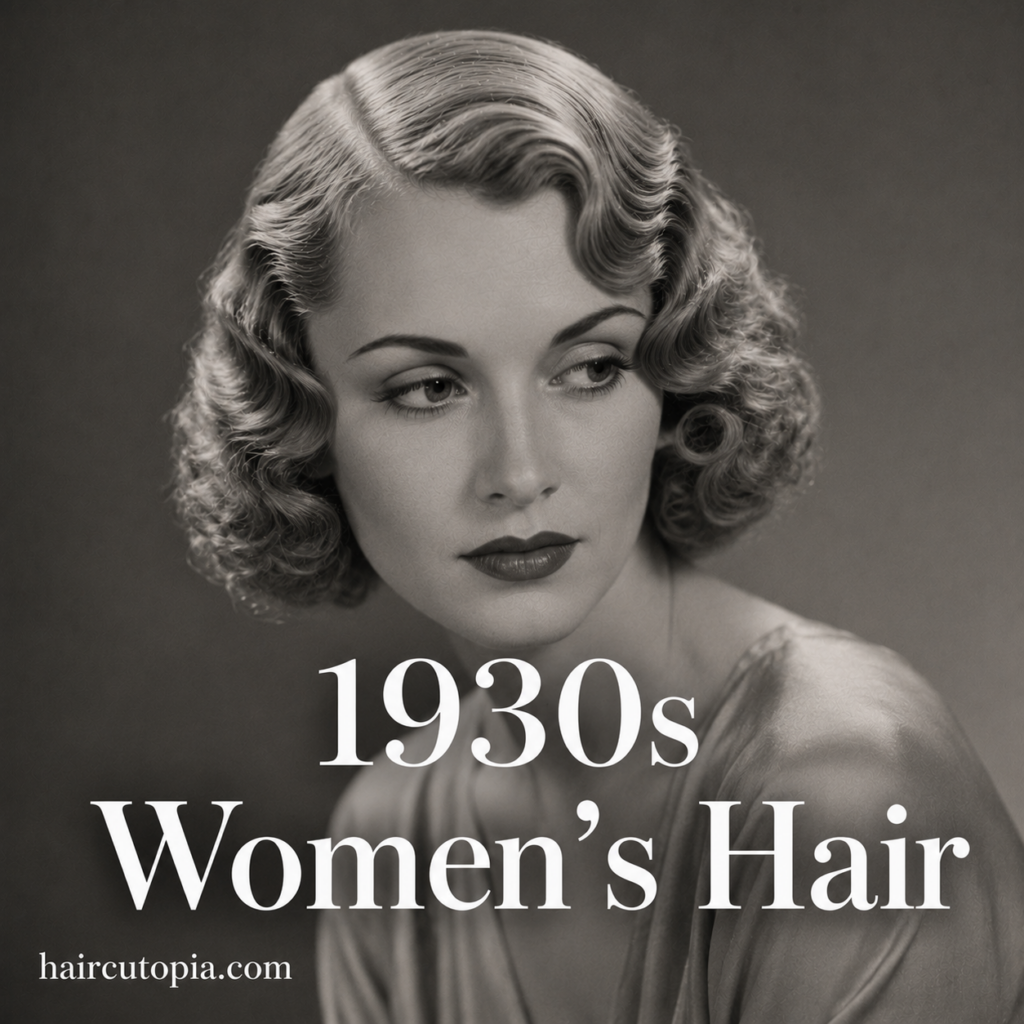
1940s Women’s Hair vs. 1930s Women’s Hair
There was plenty of continuity between the two decades.
The 1930s had already established a strong preference for polished waves, curls, and Hollywood-inspired glamour.
Women’s hair during that period could sit relatively close to the head, with carefully shaped waves providing movement.
The 1940s often introduced more visible volume.
Rolls became especially recognizable, and wartime accessories such as scarves and snoods gained greater importance.
The face was frequently opened up by lifting or pinning the front sections away from it.
Both decades valued polished styling, but the 1940s developed a particularly distinctive combination of structure and practicality.
1940s Women’s Hair vs. 1950s Women’s Hair
The transition into the 1950s introduced a wider range of sculpted short styles and postwar beauty trends.
The 1940s remained strongly associated with medium-length curls, rolls, waves, and wartime hair accessories.
By the 1950s, shorter cuts became increasingly prominent alongside carefully shaped curls and more varied silhouettes.
There was considerable overlap, especially around 1948–1952.
Hair trends don’t reset when a decade ends.
Instead, the later 1940s gradually provided the foundation for what followed.
How to Recreate 1940s Women’s Hair Today
You don’t need historically accurate tools to achieve a vintage-inspired result.
Modern curling irons, heated rollers, blow dryers, and styling products can make the process considerably faster.
For a simple 1940s-inspired look:
- Create a deep side part.
- Curl the hair in consistent sections.
- Allow the curls to cool completely.
- Brush through them gently.
- Continue shaping until the curls begin forming larger waves.
- Smooth the surface.
- Pin any sections that need additional control.
- Finish without separating the waves too much.
For a stronger period look, add a rolled front section or victory rolls.
A scarf or snood can take the vintage reference even further.
How to Make 1940s Women’s Hair Look Authentic
The difference often comes down to finishing.
Modern hair tends to emphasize separated texture.
1940s hair generally looks more connected.
For a stronger vintage effect:
- Brush curls together instead of separating them.
- Keep the surface relatively smooth.
- Use structured rather than messy volume.
- Curl the ends deliberately.
- Try a deep side part.
- Keep front sections away from the face.
- Use rolls strategically.
- Choose period-inspired accessories.
- Avoid making every section look intentionally undone.
You don’t need every one of these elements.
Often, two or three are enough to establish the era.
How to Modernize 1940s Women’s Hair
A vintage influence doesn’t have to look like a historical recreation.
The easiest approach is to choose one defining detail.
You could wear loose contemporary waves with a deeper side part.
A modern bob can be styled with curled-under ends.
Shoulder-length hair can be brushed into smooth Hollywood waves.
A single front roll can add vintage character without becoming a complete victory-roll hairstyle.
Some of the easiest 1940s elements to modernize include:
- Deep side parts
- Polished waves
- Curled-under ends
- Hair scarves
- Rounded bobs
- Smooth shoulder-length curls
- Single front rolls
This approach allows the historical influence to come through without making the hairstyle feel like a costume.
Frequently Asked Questions About 1940s Women’s Hair
What was the most popular women’s hairstyle in the 1940s?
There wasn’t one universal hairstyle, but victory rolls are among the most recognizable. Pin curls, brushed waves, rolled bangs, shoulder-length curls, pageboy styles, snoods, and scarf hairstyles were also strongly associated with the decade.
Why did women curl their hair in the 1940s?
Curls provided the foundation for many fashionable hairstyles. They could be worn visibly or brushed and shaped into waves, rolls, and rounded silhouettes.
Why did women wear victory rolls?
Rolled hairstyles created decorative volume while keeping front sections controlled and away from the face. Victory rolls became strongly associated with wartime-era women’s fashion.
Why did women wear scarves in their hair during the 1940s?
Scarves helped contain loose hair and were particularly useful for women working around machinery. They also became fashionable accessories and could be combined with visible curls or rolls.
What was a snood used for?
A snood contained the hair at the back of the head while allowing the front to remain styled. It offered a practical way to manage longer hair while maintaining a fashionable appearance.
What was the middy haircut?
The middy was a structured women’s haircut designed to work with curled sets and vintage brush-outs. Its planned lengths helped create the rounded shapes associated with period styling.
Did women have short hair in the 1940s?
Yes. Women wore shorter cuts and curled bobs as well as medium and longer hair. Short hair could be styled with waves, side parts, curls, and rolled sections.
Did women wear long hair down in the 1940s?
Longer hair could be worn down, but it was also frequently curled, pinned, rolled, or contained. Medium-length hair was especially versatile for the popular styles of the decade.
How did women sleep in pin curls?
Pin curls could be secured relatively flat against the head, allowing a set to remain in place while drying. Women could protect the set while sleeping and release it once the hair was fully dry.
Can you create 1940s hair without pin curls?
Yes. Modern curling irons, rollers, and other heat tools can recreate many of the necessary curl patterns. The brush-out and final shaping are often more important to the finished vintage appearance than the exact tool used.
What is the easiest 1940s women’s hairstyle to wear today?
Smooth side-parted waves are one of the easiest options. They reference the decade while still fitting naturally with contemporary fashion.
Why 1940s Women’s Hair Is Still Iconic
1940s women’s hair tells a bigger story than curls and victory rolls.
It shows how beauty adapted to circumstances.
Women needed practical ways to control their hair during a period when daily routines and working lives were changing dramatically. Scarves, snoods, rolls, and pinned styles helped meet those needs.
But practicality didn’t erase creativity.
Women turned functional solutions into fashion. A protective scarf could frame carefully styled curls. A snood could be paired with sculpted rolls. A basic pin-curl set could become an everyday hairstyle one day and polished Hollywood waves the next.
That versatility is a major reason the decade remains so influential.
Victory rolls are still instantly recognizable. Hollywood waves remain a formal-hair favorite. Vintage scarves continue to return to fashion, while curled bobs and deep side parts can look completely contemporary with only minor adjustments.
The tools may be different now, but the defining ideas remain surprisingly useful: create shape, work with the hair’s movement, keep the finish intentional, and don’t be afraid of a little glamour.
That’s what made 1940s women’s hair memorable in the first place.