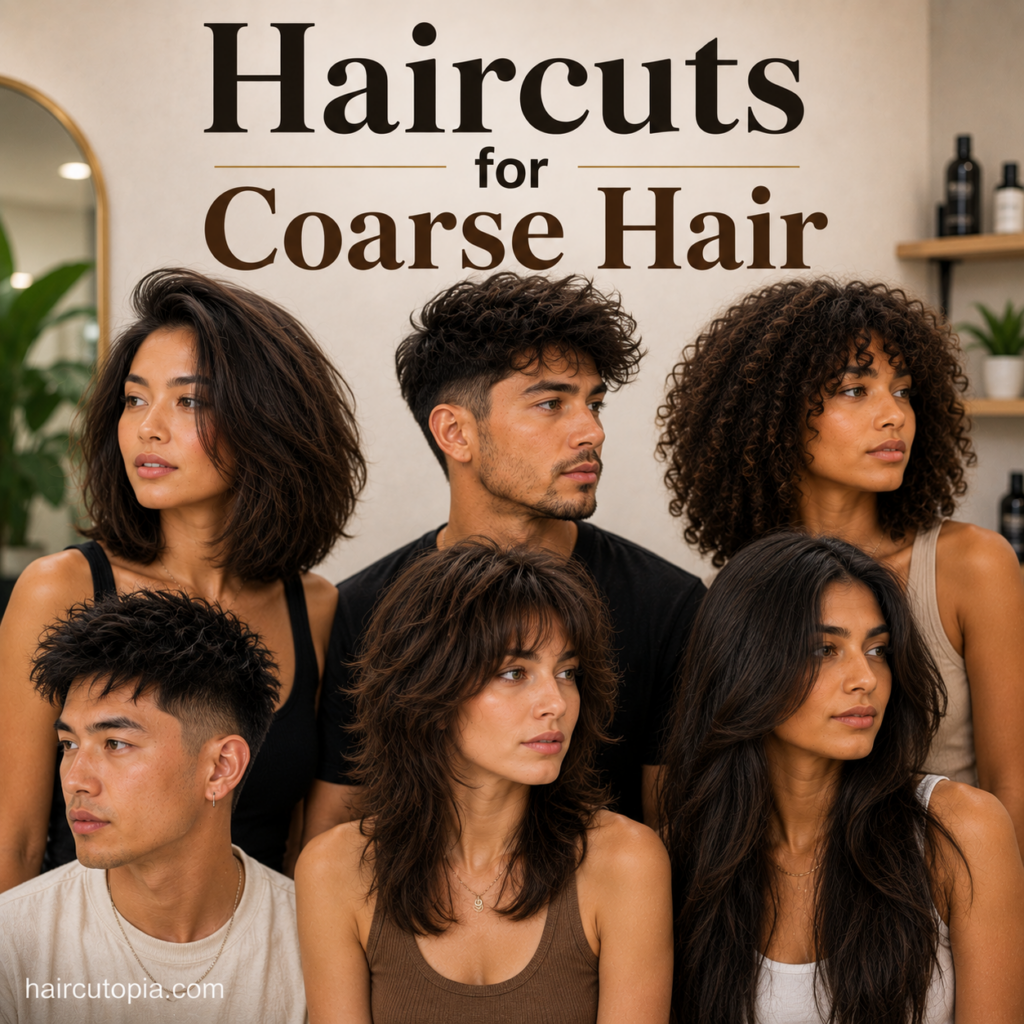
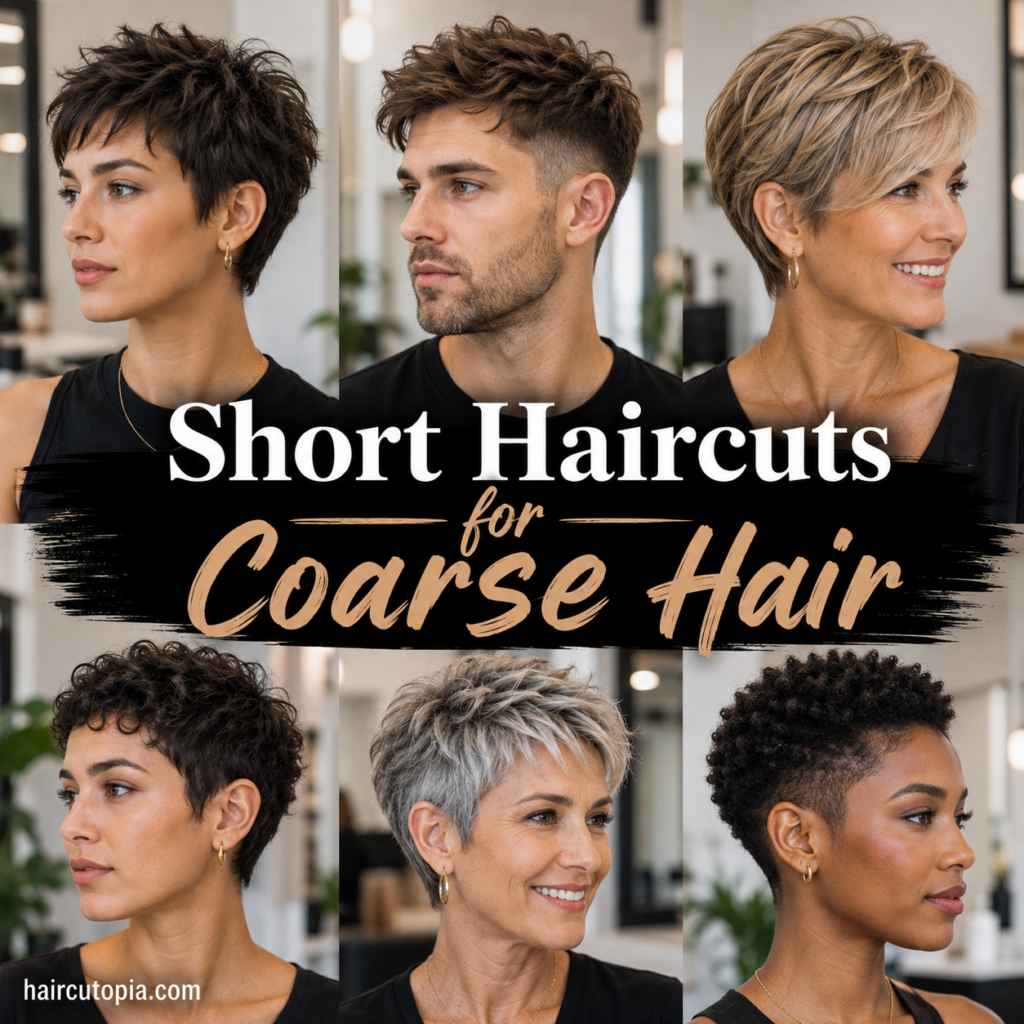
Coarse hair has personality. The individual strands are thicker, the hair can hold a shape incredibly well, and there’s often enough natural body to create styles that would require a lot more work on finer hair.
Of course, that same thickness can also make a short haircut feel bulky if the shape isn’t right.
That’s why choosing short haircuts for coarse hair isn’t simply about finding a style you like. The cut needs to account for how your hair naturally falls, how much density you have, and whether your texture is straight, wavy, or curly.
Get those things right and coarse hair can be fantastic at shorter lengths. Pixies can look full and textured, bobs can have beautiful structure, and layered crops can remove weight without sacrificing the natural character of the hair.
What Does Coarse Hair Actually Mean?
“Coarse” describes the thickness of the individual hair strands, not necessarily how much hair you have.
A single coarse strand generally has a larger diameter than a fine or medium strand.
That distinction matters because coarse hair and thick hair aren’t exactly the same thing.
You can have:
- Coarse strands with high hair density
- Coarse strands with lower density
- Fine strands with very high density
- Medium strands with almost any density
People often use “coarse” and “thick” interchangeably, but your stylist may approach them differently.
Coarse hair can also be straight, wavy, curly, or coily. The best short haircut depends on all of these characteristics rather than strand thickness alone.
Why Short Hair Can Work So Well for Coarse Hair
Long coarse hair can carry a lot of weight.
Going shorter removes some of that weight and can make washing, drying, and everyday styling considerably easier.
A good short haircut can also take advantage of coarse hair’s natural body.
Benefits may include:
- Faster drying
- Less overall weight
- Easier detangling
- More visible shape
- Natural volume
- Better-defined texture
- Less product needed for some styles
The challenge is avoiding unwanted bulk.
If dense, coarse hair is cut to the wrong length without enough shaping, it may expand outward instead of falling neatly into place. Strategic layering and weight removal can make a big difference.
Best Short Haircuts for Coarse Hair
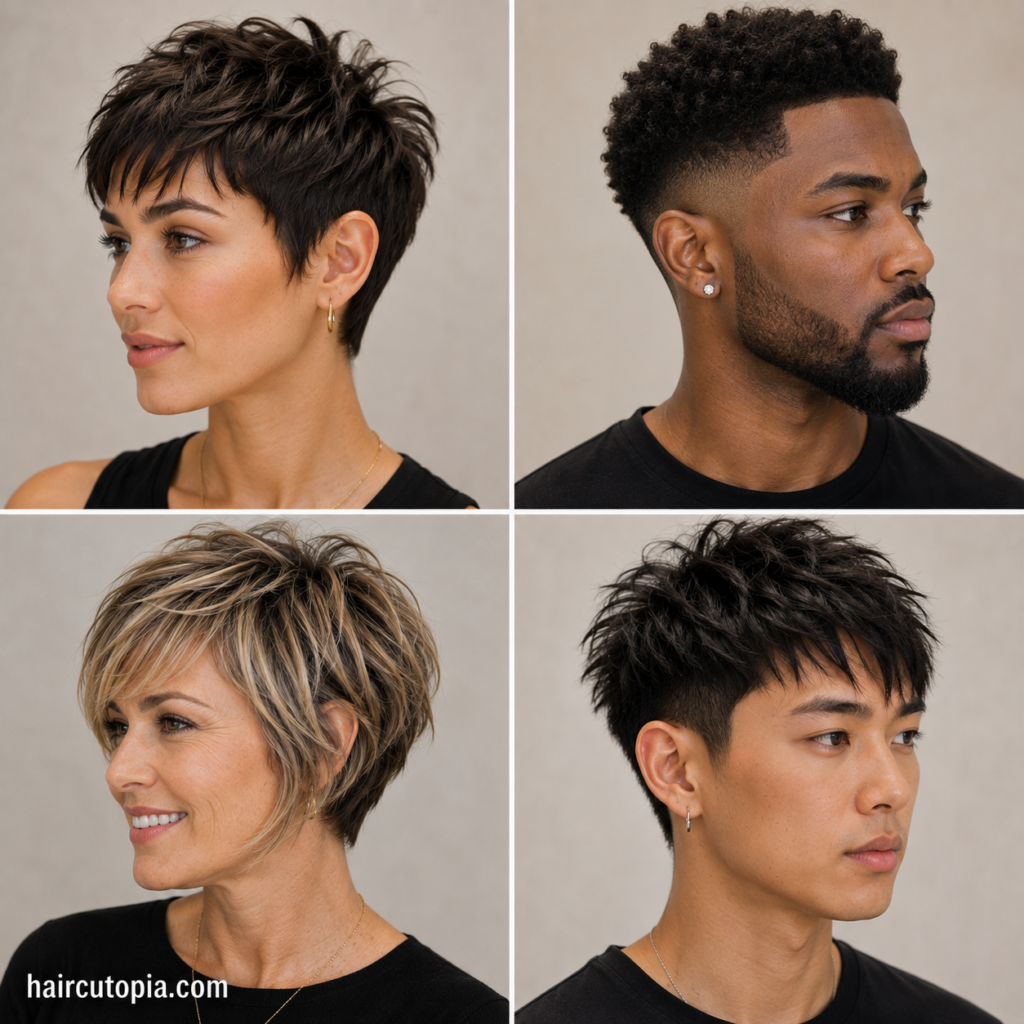
Coarse hair can support everything from structured bobs to heavily textured crops.
The right choice depends on your density, natural texture, and how much styling you’re comfortable doing.
Textured Pixie Cut
A textured pixie takes advantage of the natural body coarse hair already has.
Instead of trying to make every strand lie perfectly flat, the cut uses short layers to create separation and movement.
The sides and back can be kept relatively close while leaving more length through the top.
That extra length gives you room to style the hair forward, sideways, or slightly upward.
If your coarse hair tends to stick out when cut extremely short, leaving strategic sections slightly longer can help the hair settle more naturally.
Long Pixie
A long pixie is a good option if you want short hair without going dramatically cropped.
The top, front, and sides retain more length than a traditional pixie, allowing the natural texture to remain visible.
Coarse hair provides enough body to keep the cut from looking flat.
It can also be styled in several ways:
- Side-swept
- Tucked behind the ears
- Textured and piecey
- Brushed away from the face
- Worn with a longer fringe
A long pixie can also make the transition from a bob to a shorter cut feel less drastic.
Bixie Cut
The bixie sits somewhere between a bob and a pixie.
It typically keeps more length around the sides and back while incorporating shorter layers throughout.
That combination works particularly well for coarse hair because the layers can remove weight without requiring an extremely short haircut.
The result can be polished or intentionally tousled depending on your natural texture.
Layered Bob
A layered bob is one of the most adaptable short haircuts for coarse hair.
Layers can remove some of the density that makes a one-length bob feel heavy.
The placement matters, though.
Too many short layers may create additional volume in areas where you don’t want it. Longer or internal layers often work better when the goal is reducing bulk rather than creating more lift.
Graduated Bob
A graduated bob is shorter in the back and gradually becomes longer toward the front.
The back is shaped with stacked or graduated layers, which can help control dense hair around the neckline.
The amount of graduation can be subtle or dramatic.
A softer graduation generally creates a more natural silhouette, while stronger stacking produces a rounder, more structured shape.
Angled Bob
An angled bob also becomes longer toward the front, but the emphasis is usually on the visible perimeter rather than stacked layers.
This can be particularly flattering for coarse straight or slightly wavy hair because the hair’s natural body helps maintain the shape.
Internal weight removal can prevent the sides from becoming overly bulky.
French Bob
A French bob typically sits around the jaw and may be paired with bangs.
Coarse hair can give this haircut a naturally substantial shape.
Rather than trying to make the ends perfectly sleek, allowing some natural movement can create a softer, more relaxed appearance.
The exact length should take your texture into account. Hair that expands or bends when dry may need to be cut slightly differently than coarse hair that remains very straight.
Short Shag
A short shag is ideal if you want to lean into texture rather than control every strand.
The haircut uses layers throughout the crown, sides, and ends to create movement.
Coarse hair can support those layers beautifully because the individual strands have enough structure to hold the shape.
This style can work especially well with naturally wavy coarse hair.
Cropped Shag
A cropped shag takes the same layered idea even shorter.
The result sits somewhere between a shag and a heavily textured pixie.
It’s intentionally imperfect, which can make it forgiving for coarse hair that doesn’t naturally lie flat.
A little styling cream or lightweight texture product can help define individual sections without making the hair feel stiff.
Undercut Pixie
An undercut pixie removes significant weight from the sides or back while leaving more length on top.
For extremely dense coarse hair, this can dramatically reduce bulk.
The contrast can be subtle, with the undercut mostly hidden, or much more visible.
Keep in mind that undercuts require maintenance. As the short sections grow, the shape can change quickly.
Short Haircuts for Coarse Straight Hair
Coarse straight hair often has plenty of natural structure.
The strands may hold clean lines beautifully, but they can also stick outward when cut too short.
Useful options include:
- Angled bobs
- Layered bobs
- Long pixies
- Bixies
- Graduated bobs
- Textured crops
Length becomes particularly important around the sides.
If your hair tends to stick straight out near the ears, leaving those areas slightly longer may actually make the haircut easier to manage.
Short Haircuts for Coarse Wavy Hair
Coarse wavy hair already has movement, so the haircut should help that texture form naturally.
Layering can remove excess weight and prevent waves from becoming stretched or triangular.
Good options include:
- Short shags
- Layered bobs
- Bixies
- Long pixies
- Textured crops
- Jaw-length layered cuts
Avoid assuming that every section needs to be heavily thinned.
Too much thinning can disrupt the wave pattern and create unwanted frizz or uneven pieces.
Short Haircuts for Coarse Curly Hair
Coarse curly hair can create incredible shape at shorter lengths.
The key is accounting for shrinkage and curl pattern before choosing the final length.
Options include:
- Curly pixies
- Rounded crops
- Layered curly bobs
- Tapered cuts
- Curly shags
- Longer pixies with textured tops
A stylist experienced with curly hair can determine where the curls naturally sit once they’re dry.
Cutting entirely based on wet length can produce a much shorter result than expected after the curls spring back.
Short Haircuts for Dense, Coarse Hair
If your hair is both coarse and dense, bulk management becomes particularly important.
You have thick individual strands and a lot of them.
Strategic weight removal can make a short haircut significantly easier to manage.
Consider:
- Internal layers
- Graduated shapes
- Undercuts
- Longer pixies
- Layered bobs
- Shags
The goal isn’t necessarily to make the hair “thin.”
It’s to distribute the weight so the haircut has a balanced shape.
Short Coarse Hair With Bangs
Bangs can work beautifully with coarse hair, but they need to account for natural growth patterns and strand thickness.
Curtain Bangs
Curtain bangs are longer and generally easier to blend into a short layered cut.
They can work particularly well with bobs, shags, and bixies.
Side-Swept Bangs
Side-swept bangs allow coarse hair to maintain some length while creating movement across the forehead.
They’re especially useful with pixies and shorter layered cuts.
Textured Bangs
Rather than creating a perfectly solid line, textured bangs introduce some separation.
This can keep a coarse fringe from looking too heavy.
Blunt Bangs
Coarse hair can create striking blunt bangs because the strands naturally provide substantial density.
However, a very heavy fringe may require more styling and frequent trimming.
Your stylist can adjust how much hair is included in the bangs to keep them manageable.
Choosing a Short Coarse Haircut for Your Face Shape
Face shape can help you think about proportions, but it shouldn’t become a rigid set of rules.
Hair density, natural texture, growth patterns, and personal style are equally important.
Round Faces
Cuts with some height or movement through the top can create more vertical emphasis.
Long pixies, angled bobs, side-swept bangs, and textured crops are worth considering.
Oval Faces
Oval faces can generally accommodate many short hairstyles.
Pixies, bixies, bobs, shags, and cropped cuts can all work depending on your texture and density.
Square Faces
Soft layers can contrast with a defined jawline.
Textured bobs, long pixies, short shags, and side-swept styles can create movement around the face.
If you prefer a stronger look, a structured blunt or angled bob can emphasize those angular features instead.
Heart-Shaped Faces
Styles that retain some fullness around the jaw can create balance.
Chin-length bobs, bixies, longer pixies, and side-swept bangs are all options.
Long or Oblong Faces
Short cuts with some width through the sides can help balance a longer face.
Bobs, bangs, textured crops, and layered styles can all create more horizontal movement.
How to Remove Bulk From Short Coarse Hair
Removing bulk doesn’t necessarily mean thinning the entire haircut.
In fact, indiscriminate thinning can sometimes make coarse hair more difficult to manage.
Use Strategic Layers
Layers can remove weight from specific areas while preserving the overall shape.
Longer internal layers are often useful when you want less bulk without an obviously layered appearance.
Consider an Undercut
For extremely dense hair, removing weight underneath can dramatically change how the rest of the haircut sits.
A hidden undercut can provide the benefit without becoming a visible part of the hairstyle.
Be Careful With Thinning Shears
Thinning shears can be useful in the right hands, but removing too much hair may create shorter strands that push outward or contribute to frizz.
Ask your stylist how they plan to remove weight and why.
Work With Your Natural Texture
A haircut that allows coarse hair to bend, wave, or curl naturally may require less aggressive weight removal than one designed to sit perfectly flat.
How to Style Short Coarse Hair
Coarse hair often needs less help creating volume and more help controlling shape.
A simple routine may be enough:
- Start with damp, towel-dried hair.
- Apply a moisturizing or smoothing leave-in product if needed.
- Add heat protectant before blow-drying.
- Dry the hair in the direction you want it to sit.
- Use a small amount of styling cream, paste, or finishing product.
- Define individual pieces rather than coating the entire head.
The right product depends on your texture.
Straight coarse hair may benefit from smoothing products, while wavy or curly coarse hair may respond better to products designed to define natural texture.
Avoid automatically applying large amounts simply because your strands are thick.
Start small. You can always add more.
How to Keep Short Coarse Hair From Looking Puffy
Puffiness usually comes from a combination of haircut shape, dryness, humidity, and styling.
A few things can help.
Maintain Enough Length
Cutting coarse hair extremely short can sometimes make it stand outward.
Leaving enough length for gravity to influence the hair may actually make it easier to control.
Keep the Hair Conditioned
Coarse strands can sometimes feel dry, particularly through the ends.
Regular conditioning can help the hair feel smoother and more manageable.
Avoid Over-Thinning
Removing too much internal weight can leave shorter strands without enough length to lie down.
Strategic shaping is usually more useful than thinning everything.
Direct the Hair While Drying
Blow-drying the hair in the direction you want it to sit can create a smoother shape before styling products are even added.
Low-Maintenance Short Haircuts for Coarse Hair
Short doesn’t always mean low maintenance.
A very short undercut might require frequent appointments, while a longer textured bob could grow out comfortably for months.
Lower-maintenance options often include:
- Long pixies
- Bixies
- Layered bobs
- Short shags
- Softly graduated bobs
Cuts that embrace your natural texture generally require less daily effort than styles that force coarse hair into a completely different shape.
How Often Should Short Coarse Hair Be Trimmed?
The ideal schedule depends more on the haircut than the strand thickness.
As a general guide:
- Short pixies: around every 4–6 weeks
- Undercuts: around every 3–6 weeks
- Bixies: around every 5–8 weeks
- Short bobs: around every 6–10 weeks
- Shags: around every 8–12 weeks
If you like the way your haircut grows out, you may be able to wait longer.
Highly structured cuts usually show growth sooner than textured styles.
What to Ask Your Stylist
A good consultation is especially important with coarse hair because density and texture can dramatically change how a short haircut behaves.
Talk about:
- Your strand thickness
- Your overall hair density
- Whether your hair is straight, wavy, curly, or coily
- Areas that become especially bulky
- Cowlicks and growth patterns
- How your hair behaves when air-dried
- Whether it expands in humidity
- How much styling you’re willing to do
- How often you’re comfortable getting trims
If you’ve had a short haircut before, tell your stylist what worked and what didn’t.
Something as specific as “the hair above my ears stuck straight out when it was cut this short” can be extremely useful information.
Common Mistakes With Short Coarse Hair
Coarse hair isn’t inherently difficult, but the wrong approach can make it feel that way.
Removing Too Much Weight
More thinning isn’t always better.
Removing too much internal density can create flyaways, puffiness, or pieces that stick outward.
Cutting Without Considering Dry Texture
Wavy and curly coarse hair can look considerably different when dry.
Shrinkage and natural movement need to be considered before determining the final length.
Going Extremely Short in Problem Areas
If certain sections naturally stick outward, cutting them shorter may make the problem worse.
Sometimes those areas need additional length, not less.
Fighting Natural Volume
Coarse hair often has body that people with finer hair spend considerable time trying to create.
Instead of flattening everything, consider a haircut that uses that volume as part of the shape.
Choosing a High-Maintenance Cut Without Realizing It
A dramatic undercut or precise pixie may look effortless, but keeping the shape sharp can mean frequent salon visits.
Think about maintenance before committing.
Finding the Right Short Haircut for Coarse Hair
Coarse hair can be an excellent match for short hairstyles because the strands naturally have enough substance to create shape and texture.
The key is controlling weight without removing so much that the hair becomes difficult to manage.
If your coarse hair is straight, structured bobs, bixies, and longer pixies can take advantage of its natural body. Wavy coarse hair often works beautifully with layered bobs and shags, while curly coarse hair can create striking rounded crops, tapered cuts, and textured pixies.
Density matters too.
If you have a lot of coarse hair, strategic internal layering or an undercut can reduce bulk. If your density is lower, preserving more weight may create a fuller appearance.
Most importantly, work with what your hair naturally wants to do. Coarse hair already has body, texture, and presence. A good short haircut doesn’t need to eliminate those qualities—it just gives them a shape that feels intentional and much easier to manage.