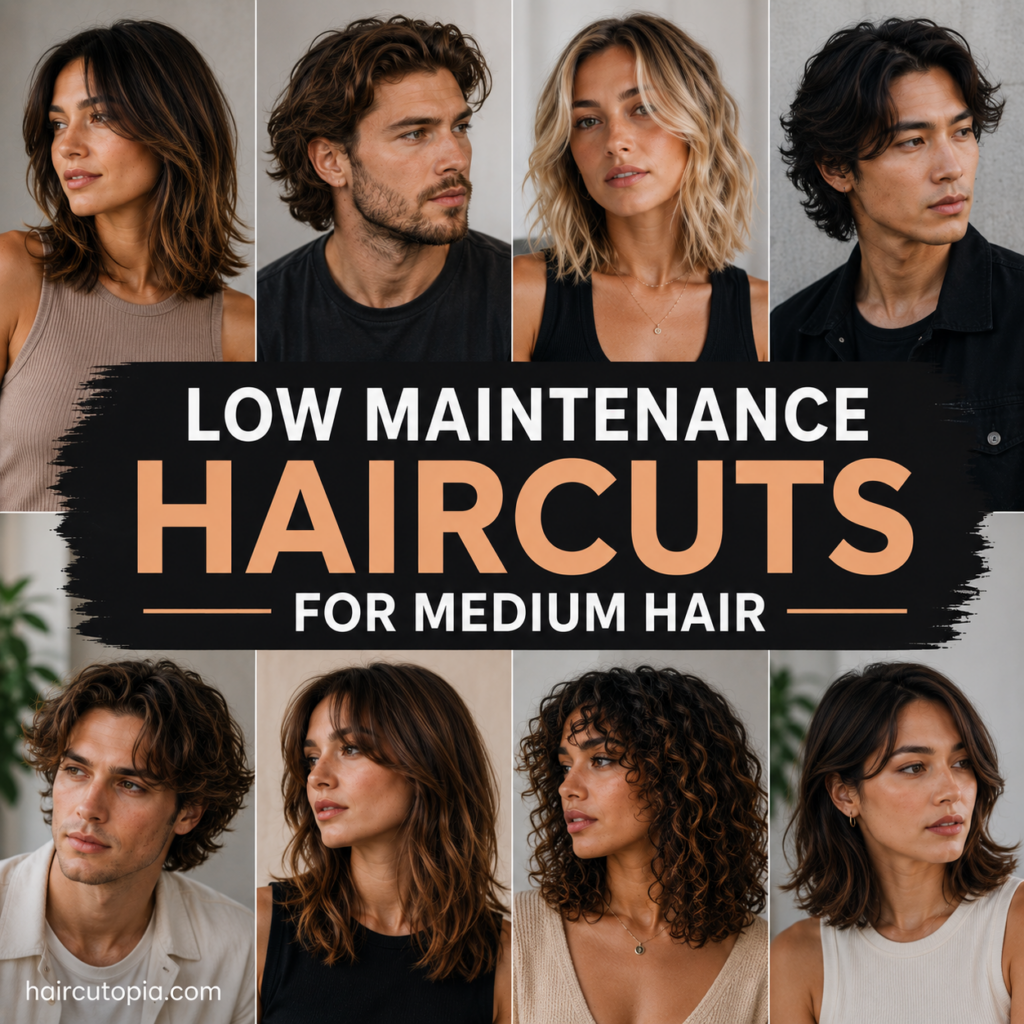
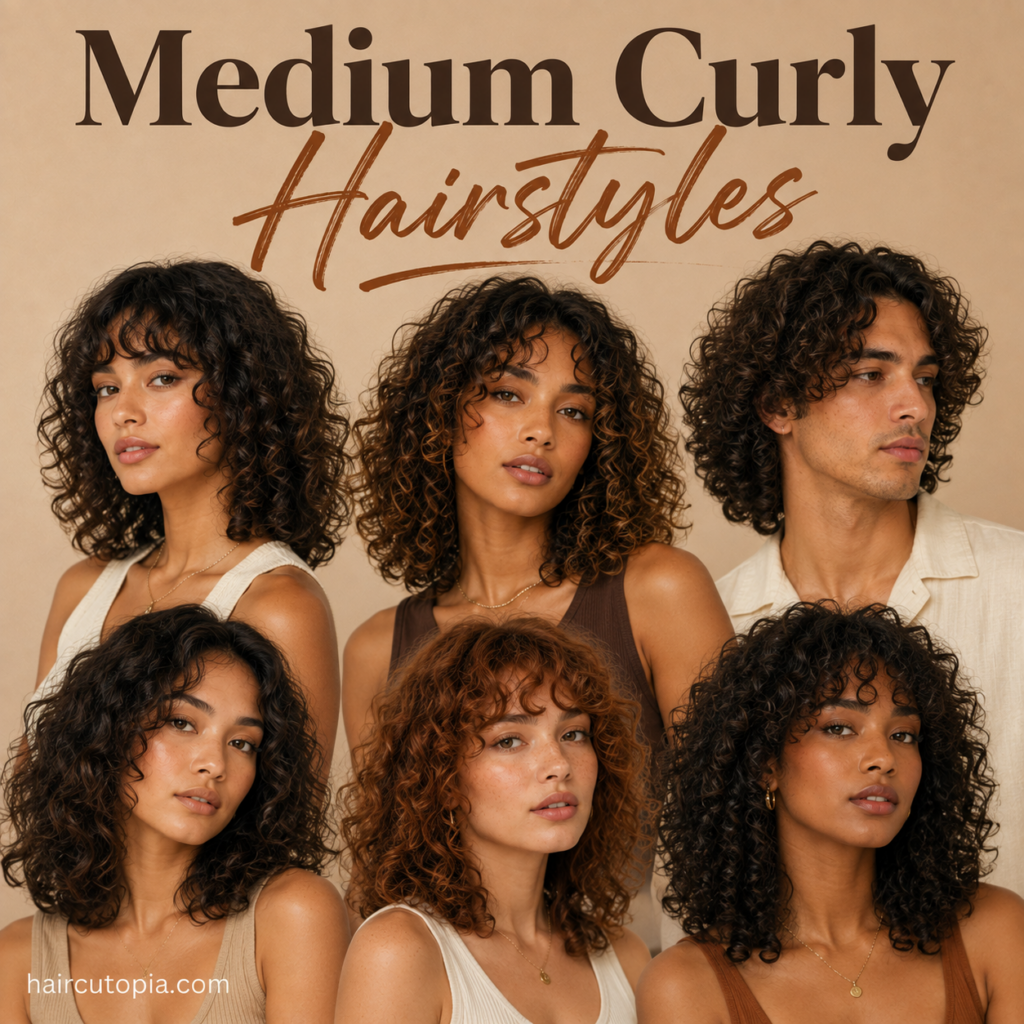
Medium curly hair sits in a pretty useful sweet spot. It’s long enough to show off your curl pattern and give you plenty of styling options, but it doesn’t come with quite as much weight or maintenance as very long curls.
Depending on your texture, medium length can mean anything from curls that skim the shoulders to a cut that falls a few inches below them. The important part isn’t hitting an exact measurement. It’s finding a length and shape that allow your curls to move naturally.
Layers can create lift. Bangs can completely change the personality of the cut. A blunt perimeter can make curls look fuller, while a shag can take things in a much more relaxed direction.
If you’re thinking about changing your haircut without going dramatically short, these medium curly hairstyles offer plenty of inspiration.
Why Medium-Length Hair Works So Well With Curls
One of the biggest advantages of medium curly hair is balance.
There is enough length for curls to develop their natural shape, but usually not so much that the weight pulls all the volume toward the ends.
That can make medium cuts particularly useful for anyone trying to bring back some bounce.
The length also leaves room to experiment. You can wear your curls completely down one day, create a half-up style the next, or pull most of the hair back when you don’t feel like dealing with it.
A well-designed medium curly haircut can help:
- Give curls more movement
- Create or reduce volume where needed
- Frame the face
- Remove excess weight from dense hair
- Make styling more manageable
- Preserve enough length for updos and ponytails
The key is shape. With curly hair, a relatively small change in layering or length can make a surprisingly big difference.
1. Medium Layered Curly Hair
Layers are one of the most popular ways to shape medium curly hair, and for good reason.
When curls are all cut to roughly the same length, they can sometimes become heavy around the bottom. Adding carefully placed layers redistributes some of that weight and gives individual curls more room to move.
Shorter layers around the crown can encourage volume, while longer layers preserve length around the perimeter.
The amount of layering should depend on your density and curl pattern.
Dense curls may benefit from more strategic weight removal. Finer or lower-density hair generally needs a lighter touch so the ends don’t start looking thin.
2. Shoulder-Length Curly Hair
A shoulder-length cut is a classic choice when you want versatility without keeping your hair particularly long.
Depending on shrinkage, the curls may sit directly on the shoulders or bounce slightly above them once dry.
This length works with loose waves, spirals, tighter curls, and coils. It can also be adapted with layers, bangs, or face-framing pieces.
Another advantage is practicality.
You still have enough hair for a ponytail or loose updo, but washing and drying usually takes less time than it does with longer curls.
3. Medium Curly Shag
If perfectly arranged curls aren’t really your thing, the curly shag might be.
This cut relies heavily on layers to create movement and an intentionally relaxed shape. Volume is often concentrated around the crown, with curls becoming longer toward the bottom.
The result feels slightly undone in the best way.
A medium curly shag often includes:
- Crown layers
- Face-framing pieces
- Textured ends
- Curly bangs or fringe
- Plenty of natural movement
Because the style isn’t supposed to look overly precise, it can also be forgiving when your curls decide to behave differently from one day to the next.
4. Medium Curly Hair With Bangs
Bangs and curls can work beautifully together.
Rather than straightening the fringe, letting it follow your natural texture creates a much more cohesive look.
Curly bangs can be full and eyebrow-skimming, light and wispy, or longer around the sides for a softer transition into the rest of the haircut.
The main thing to consider is shrinkage.
Curly hair can appear significantly shorter once dry, so bangs that look fairly long when wet may end up sitting much higher on the forehead.
It’s usually better to start conservatively and shorten them gradually.
5. Medium Curly Hair With Curtain Bangs
Curtain bangs are a softer alternative to a full fringe.
They’re generally shorter around the center of the face and gradually become longer toward the sides. On curly hair, the transition doesn’t need to be perfectly symmetrical.
In fact, a little variation often looks more natural.
Longer curly curtain bangs can blend into cheekbone or jaw-length layers, creating movement around the face without committing to traditional short bangs.
They’re also relatively easy to grow out because they gradually become face-framing layers.
6. Medium Curly Bob
A longer curly bob — sometimes called a curly lob — sits somewhere between a traditional bob and shoulder-length hair.
It’s a useful option if you like the structure of a bob but aren’t ready to lose too much length.
Depending on your curl pattern, the cut may sit near the collarbone when stretched and bounce toward the shoulders once dry.
Subtle layers can keep the shape from becoming bottom-heavy, while a more blunt perimeter can emphasize fullness.
This cut can look polished with defined curls or much more casual when styled with a softer, tousled finish.
7. Rounded Medium Curly Cut
Some hairstyles try to minimize volume. A rounded curly cut does the opposite.
The goal is to create a balanced silhouette that allows the natural fullness of the hair to become part of the style.
The sides remain relatively full while strategic shaping prevents the cut from becoming bulky in the wrong areas.
This works especially well with dense curls and coils.
Rather than thinning the hair aggressively, a stylist can shape the exterior and selectively remove weight where necessary.
The finished result feels full but intentional.
8. Medium Curly Hair With Face-Framing Layers
You don’t need dramatic layers throughout your entire haircut to make a noticeable change.
Adding shorter curls around the face can create movement while preserving most of your length.
Face-framing layers may begin around the cheekbones, jaw, or chin depending on your curl pattern and the effect you want.
Higher layers draw more attention toward the eyes and cheekbones. Longer pieces create a subtler transition.
This is also a good option if you’re hesitant about getting bangs.
You get some of the framing effect without having to manage a shorter fringe.
9. Middle-Parted Medium Curls
A middle part creates a balanced shape that works particularly well with medium-length curls.
The hair falls relatively evenly on both sides of the face, allowing the curl pattern itself to provide most of the movement.
It can work with layered cuts, shags, curly lobs, and more uniform lengths.
If your natural part isn’t perfectly centered, don’t worry about forcing it.
Curls often look better when they’re allowed to separate where they naturally want to. A slightly imperfect middle part can actually keep the style from looking too rigid.
10. Side-Parted Medium Curly Hair
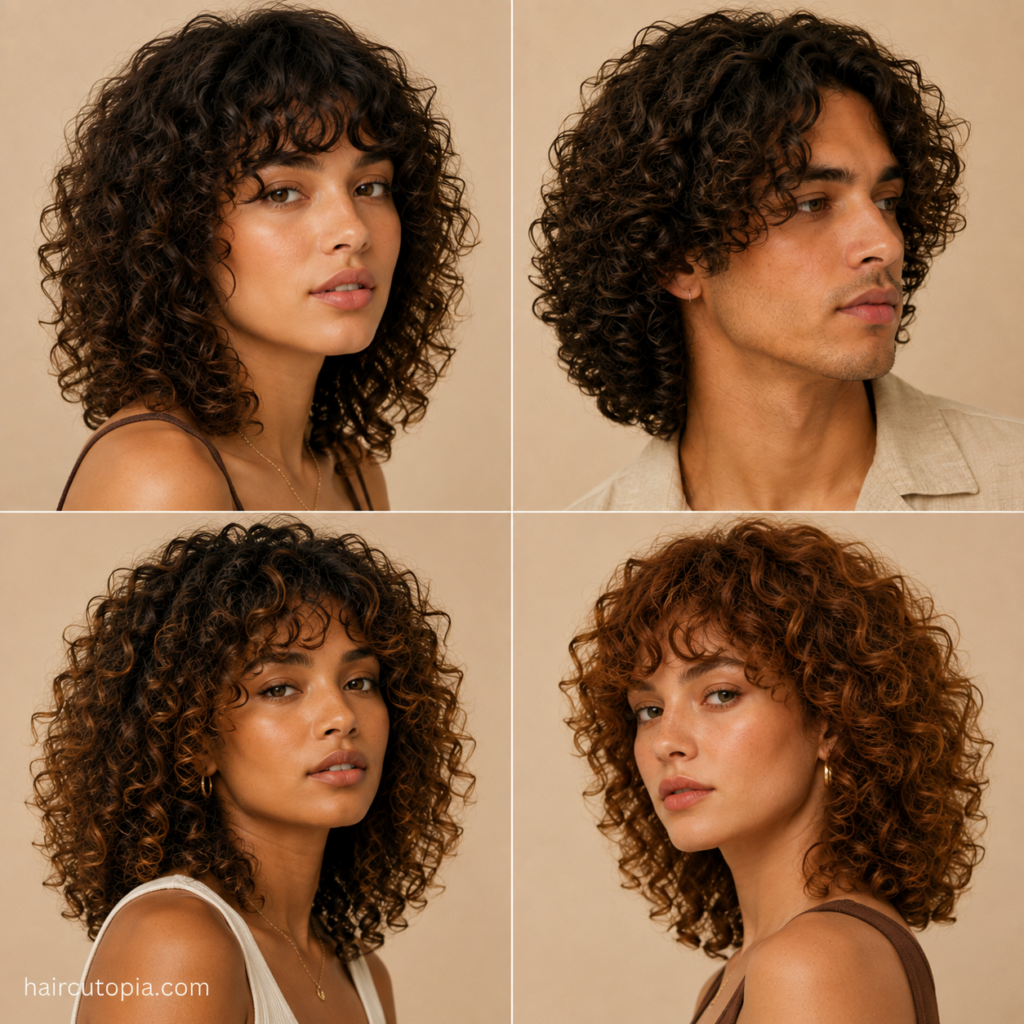
Changing your part is one of the easiest ways to alter the shape of curly hair without cutting anything.
A side part shifts more hair toward one side, instantly creating additional volume.
The deeper the part, the stronger the effect.
This can be especially useful if your roots tend to sit flat. Moving the hair away from the direction in which it normally falls often gives the roots a temporary lift.
A softer side part creates a more subtle asymmetry while still adding movement around the face.
11. Voluminous Medium Curls
If you’ve got volume, you don’t necessarily need to tame it.
A medium-length haircut can be shaped specifically to emphasize big, full curls.
Layers around the crown prevent the top from falling flat, while maintaining enough length through the sides keeps the silhouette balanced.
Product choice matters here.
Heavy creams and oils can pull curls downward, especially if your strands are fine. Lightweight mousse, foam, or gel may provide definition while preserving more lift.
For even more volume, diffuse the hair and gently lift the roots once everything is completely dry.
12. Defined Medium-Length Curls
For a more polished finish, medium curls can be styled with stronger definition.
The goal is to encourage curls to group together rather than separating into smaller pieces.
Start with wet or very damp hair. Apply your styling products evenly, then use techniques such as scrunching, finger coiling, or brush styling where needed.
After that, leave the hair alone while it dries.
It can be tempting to keep adjusting curls, but touching them repeatedly during the drying process often creates frizz.
If you use a gel that forms a firm cast, gently scrunch the curls once they’re completely dry to soften the finish.
13. Tousled Medium Curly Hair
Defined curls aren’t the only option.
A tousled style has more separation, movement, and deliberate imperfection. It’s particularly well suited to layered cuts and curly shags.
Instead of trying to make every curl identical, allow different sections to form naturally.
A lightweight styling product can provide enough hold to keep the overall shape while still allowing the hair to move.
Once dry, gently separate a few curl clumps with your fingers.
Don’t overdo it. There’s a fine line between tousled and “I fought with my hairbrush this morning.”
14. Medium Curly Hair With Long Layers
Long layers offer a subtle way to reshape curls without dramatically changing the overall length.
Instead of creating obvious shorter sections around the crown, the layers gradually blend throughout the haircut.
This can remove some weight while maintaining a fuller perimeter.
Long layers are particularly useful if you want movement but prefer a softer silhouette than you’d get from a shag or heavily layered cut.
They can also make the grow-out process relatively easy because there aren’t large differences between the shortest and longest sections.
15. Medium Curly Wolf Cut
The wolf cut combines elements of a shag with a slightly more dramatic layered shape.
There’s usually more volume near the crown and less weight toward the ends, giving the haircut a deliberately textured appearance.
On curly hair, the natural texture does much of the styling work.
A medium curly wolf cut can include bangs, but they aren’t mandatory. Longer face-framing curls can create a similar effect if you prefer to keep hair off your forehead.
This style works particularly well if you like volume and don’t mind a haircut that looks a little different every day.
16. Medium Curly Hair With Highlights
Color can change the way curls appear even when the haircut stays exactly the same.
Strategically placed highlights create contrast between individual curls, making texture and movement more noticeable.
Depending on the effect you want, highlights can be subtle and blended or much more pronounced.
Face-framing highlights can brighten the area around the face, while scattered highlights throughout the hair emphasize dimension.
Keep in mind that lightening hair involves chemical processing. Curly hair that’s already dry or fragile may need additional conditioning and a gentler approach to coloring.
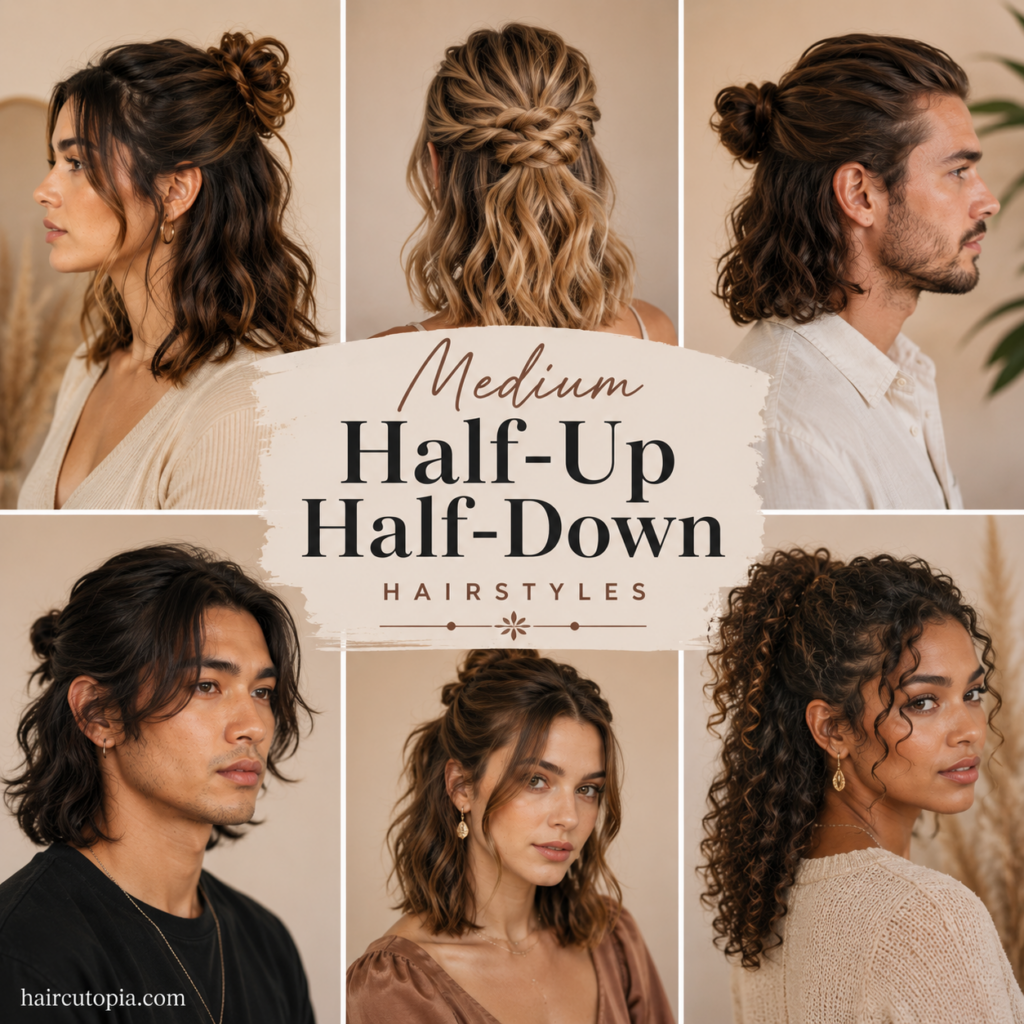
17. Half-Up Medium Curly Hairstyle
One reason medium-length curls are so versatile is that you can actually put some of the hair up.
A half-up style pulls the front and upper sections away from the face while leaving the rest of the curls loose.
You can secure the hair with:
- A small claw clip
- Hair tie
- Barrette
- Pins
- Scrunchie
Keep it neat for a polished look or loosen a few curls around the face for something more relaxed.
It’s also a practical option for second- or third-day curls when the front needs refreshing but the lengths still look good.
18. Medium Curly Ponytail
A ponytail might be simple, but curly texture gives it plenty of character.
At medium length, you may not have enough hair for a very long ponytail, but that can actually make the style look fuller and bouncier.
A high ponytail creates more visible volume, while a low ponytail gives the hair a softer, understated shape.
You can also leave a few curls loose around the face rather than pulling everything tightly backward.
For a more relaxed finish, avoid brushing all the natural texture out of the roots.
How to Choose the Best Medium Curly Hairstyle
Reference photos are helpful, but they should be treated as inspiration rather than exact instructions.
Two people can have hair that looks similar in a picture but behaves completely differently in real life.
Before choosing a cut, consider your curl pattern, density, shrinkage, and everyday routine.
Consider Your Natural Curl Pattern
Loose curls may become significantly springier when weight is removed.
Tighter curls and coils can experience substantial shrinkage, making the dry haircut appear considerably shorter than the stretched length.
Look at where your hair naturally sits when it’s completely dry.
That’s usually more useful than judging length while it’s wet.
Pay Attention to Density
Hair density influences how a haircut should be layered.
Very dense curly hair can become bulky if all the weight sits at one length. Strategic layers can create movement and redistribute that volume.
Lower-density hair needs a different approach. Removing too much can make the ends appear sparse.
The goal isn’t simply to “add layers.” It’s to put them where your particular hair needs them.
Think About Your Preferred Volume
Some people want their curls as big as possible. Others would prefer to keep the silhouette more controlled.
Tell your stylist where you like volume.
If you want height, shorter crown layers may help. If you prefer less width through the sides, the haircut can be shaped accordingly.
Consider Your Styling Routine
Be realistic about how you normally style your hair.
If you air-dry almost every day, choose a haircut that works with your natural curl formation.
If you’re comfortable diffusing, finger coiling, or using multiple styling products, you may be happy with a cut that requires a little more attention.
A hairstyle isn’t particularly convenient if it only looks the way you want after 45 minutes of styling.
How to Style Medium Curly Hair
You don’t need an enormous collection of products to get good results.
A consistent routine and products suited to your particular hair are usually more important.
1. Start With Wet or Damp Hair
Water helps curls group together.
Applying styling products while the hair is still wet or damp can make distribution easier and reduce unwanted frizz.
2. Add Moisture if Needed
Apply a leave-in conditioner or lightweight curl cream if your hair needs additional moisture.
Fine curls may only need a small amount, while coarse or very dry hair may benefit from something richer.
3. Apply Hold
Use mousse, foam, gel, or another styling product depending on the finish you prefer.
A stronger hold can improve definition and longevity. Lighter products generally allow more movement and volume.
4. Encourage the Curl Pattern
Scrunch the hair upward toward the scalp or use finger coiling on sections that need additional encouragement.
You don’t have to manually shape every curl.
Sometimes the best approach is simply distributing the product and letting your natural pattern take over.
5. Air-Dry or Diffuse
Air-drying requires minimal effort, while diffusing can speed things up and increase volume.
If you diffuse, avoid blasting the curls around with very strong airflow.
Gentler airflow helps preserve curl groups and reduce frizz.
6. Finish After the Hair Is Dry
Wait until your curls are completely dry before separating them or fluffing the roots.
Once dry, gently lift the hair at the scalp with your fingertips or a pick if you want additional volume.
How to Refresh Medium Curls Between Washes
You don’t necessarily need to wash and completely restyle curly hair every morning.
Sometimes a refresh is enough.
Lightly mist flattened sections with water and reshape them with your fingers. If necessary, add a tiny amount of styling product.
Focus on the areas that actually need attention rather than soaking your entire head.
For some curl patterns, simply shaking out the roots and reshaping a few pieces around the face is enough.
Experiment to see what your hair responds to. Curly hair has a habit of making its own rules.
How to Maintain Medium Curly Hair
Maintaining healthy-looking curls is largely about preserving moisture while minimizing unnecessary damage and friction.
Your exact routine will depend on your scalp and hair, but a few habits can make medium curls easier to manage.
Consider:
- Detangling gently when the hair has plenty of slip
- Conditioning regularly
- Limiting excessive heat
- Avoiding overly heavy product buildup
- Sleeping on a satin or silk pillowcase
- Protecting curls overnight when helpful
- Refreshing with water instead of repeatedly adding product
- Trimming the hair when the shape starts becoming uneven
There isn’t a universal schedule for washing or trimming curly hair.
Pay attention to your own hair rather than feeling like you need to follow someone else’s routine exactly.
What to Ask Your Stylist Before Getting a Medium Curly Cut
A consultation is especially useful with curly hair because the same haircut can behave very differently across textures.
Bring a few reference photos, but explain what you actually like about each one.
Maybe it’s the volume rather than the length. Maybe you like the bangs but not the layers. Maybe it’s simply the overall silhouette.
Tell your stylist:
- How much your hair normally shrinks
- Where you tend to get unwanted bulk
- Whether you prefer volume or control
- How you usually style your curls
- Whether you air-dry or diffuse
- How often you straighten your hair
- How much time you want to spend styling
- Whether you normally wear your hair up
That information can be more valuable than showing up with a single photo and asking for the exact haircut.
Frequently Asked Questions About Medium Curly Hair
What length is considered medium for curly hair?
Medium curly hair generally falls somewhere around the shoulders to a few inches below them, although curl shrinkage makes exact measurements difficult. It’s better to judge the finished dry length than the stretched or wet length.
Are layers good for medium curly hair?
Layers can be excellent for medium curls because they redistribute weight and create movement. However, the amount and placement of layering should depend on your curl pattern and density.
What haircut makes medium curls look fuller?
Rounded cuts, strategic layering, and shorter crown layers can all help create the appearance of fuller curls. People with lower-density hair may benefit from maintaining more weight around the perimeter instead of adding too many layers.
Should medium curly hair be cut wet or dry?
Both methods can work. Dry cutting allows a stylist to see how individual curls naturally sit, while wet cutting provides more control over the overall structure. Some stylists combine both techniques.
Experience with curly hair is generally more important than choosing one method exclusively.
How can I add volume to medium curly hair?
Using lightweight products, avoiding excessive product at the roots, adding appropriate layers, changing your part, and diffusing can all increase volume. Once the hair is completely dry, gently lifting the roots can create additional fullness.
Are bangs difficult to maintain with medium curly hair?
Not necessarily, but curly bangs may need more frequent refreshing because they’re exposed to touching, humidity, and movement around the forehead. Longer curtain-style bangs generally require less upkeep than a short curly fringe.
How often should medium curly hair be trimmed?
There isn’t one schedule that works for everyone. Get a trim when the haircut begins losing its shape, the ends become noticeably damaged, or the curls aren’t sitting the way they normally do. More structured cuts generally require more frequent maintenance.
Final Thoughts on Medium Curly Hairstyles
Medium-length curls give you room to experiment without committing to either extremely short or very long hair.
You can keep things simple with shoulder-length curls and long layers, add movement with a shag or wolf cut, frame your face with bangs, or embrace as much natural volume as your hair can produce.
The best medium curly hairstyle is ultimately the one that works when you’re styling your own hair at home.
Start with your natural texture, think about how much maintenance you’re comfortable with, and choose a shape that makes your curls easier to work with rather than harder.
When the cut works with the way your hair naturally moves, you spend less time fighting it — and a lot more time actually enjoying your curls.