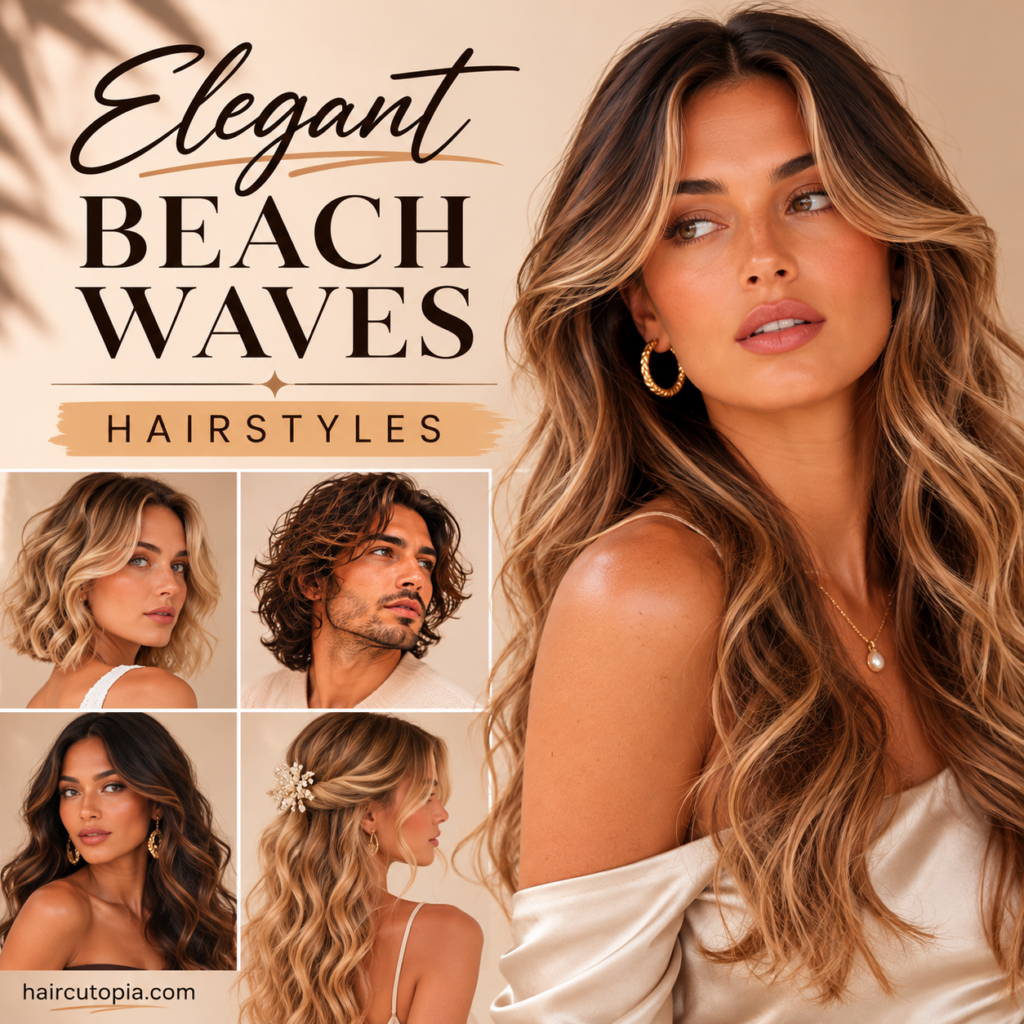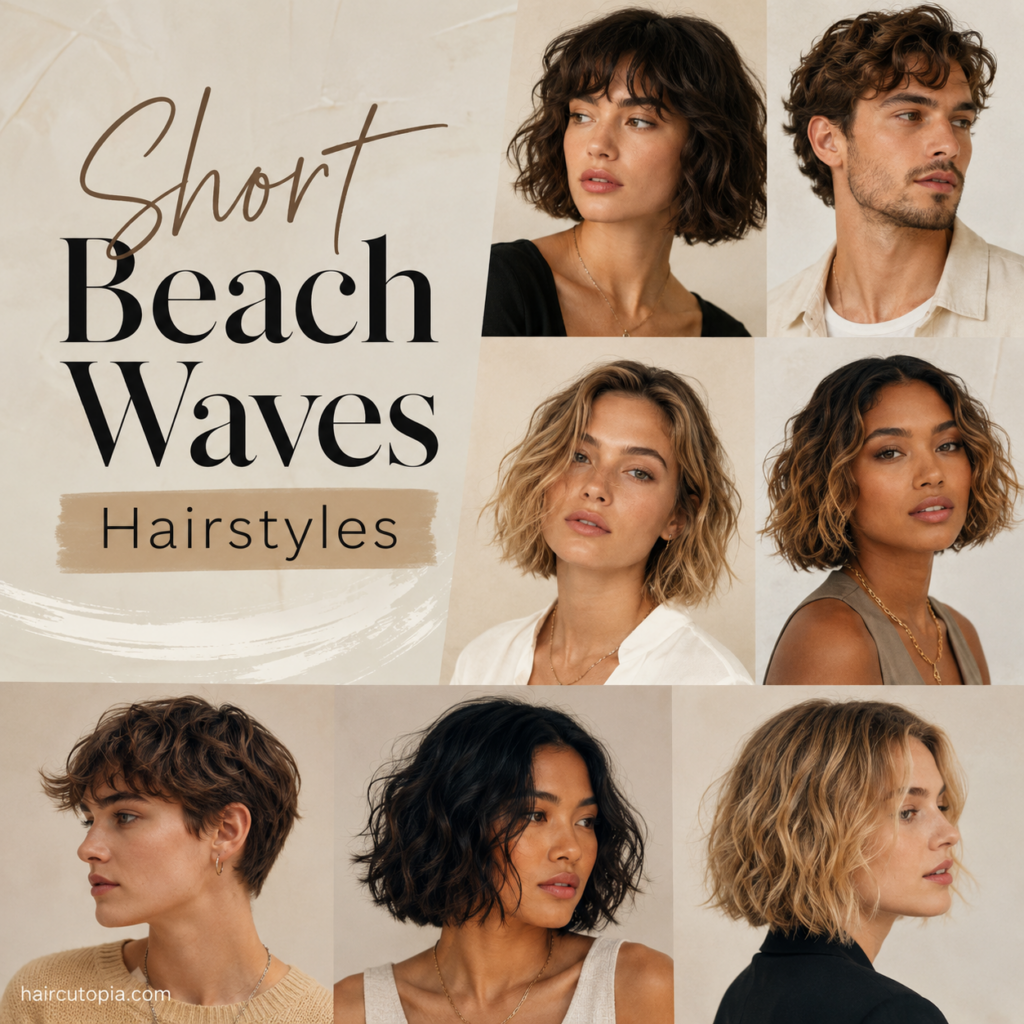
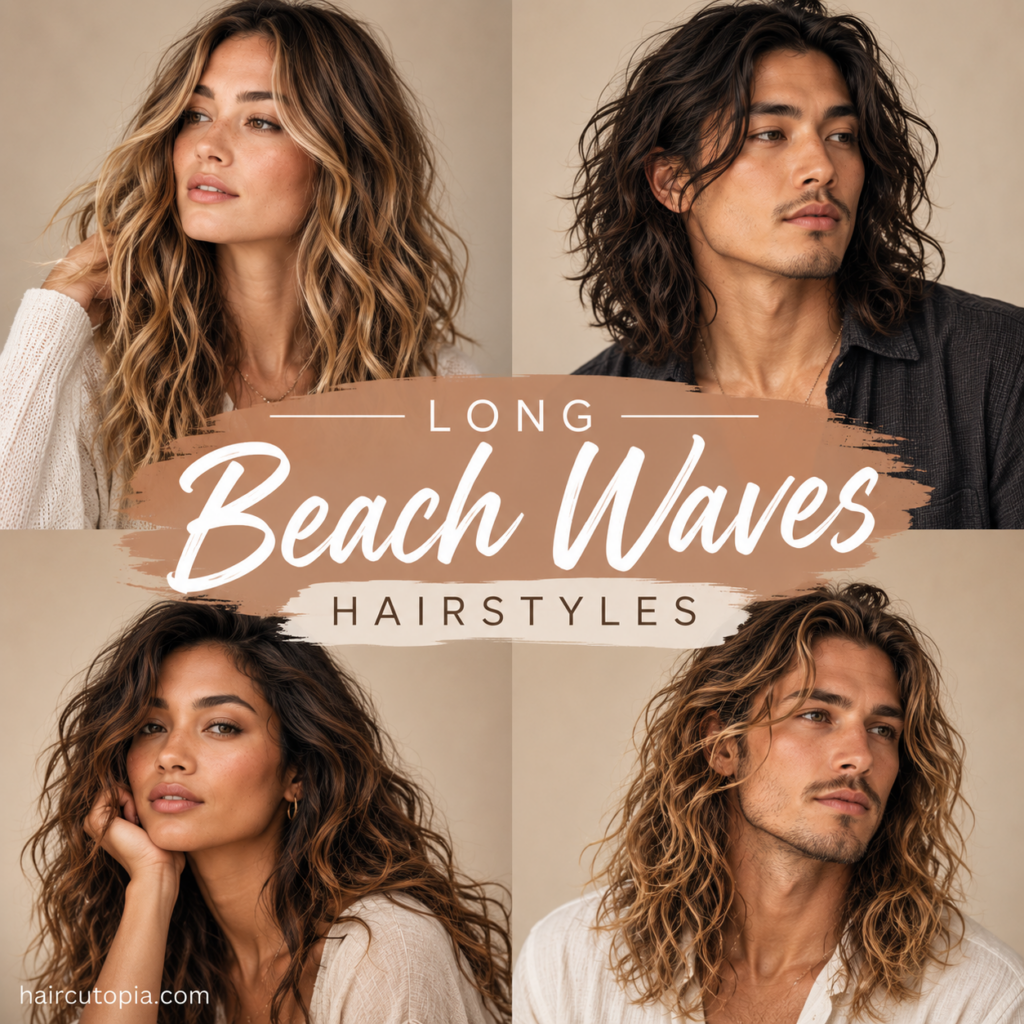
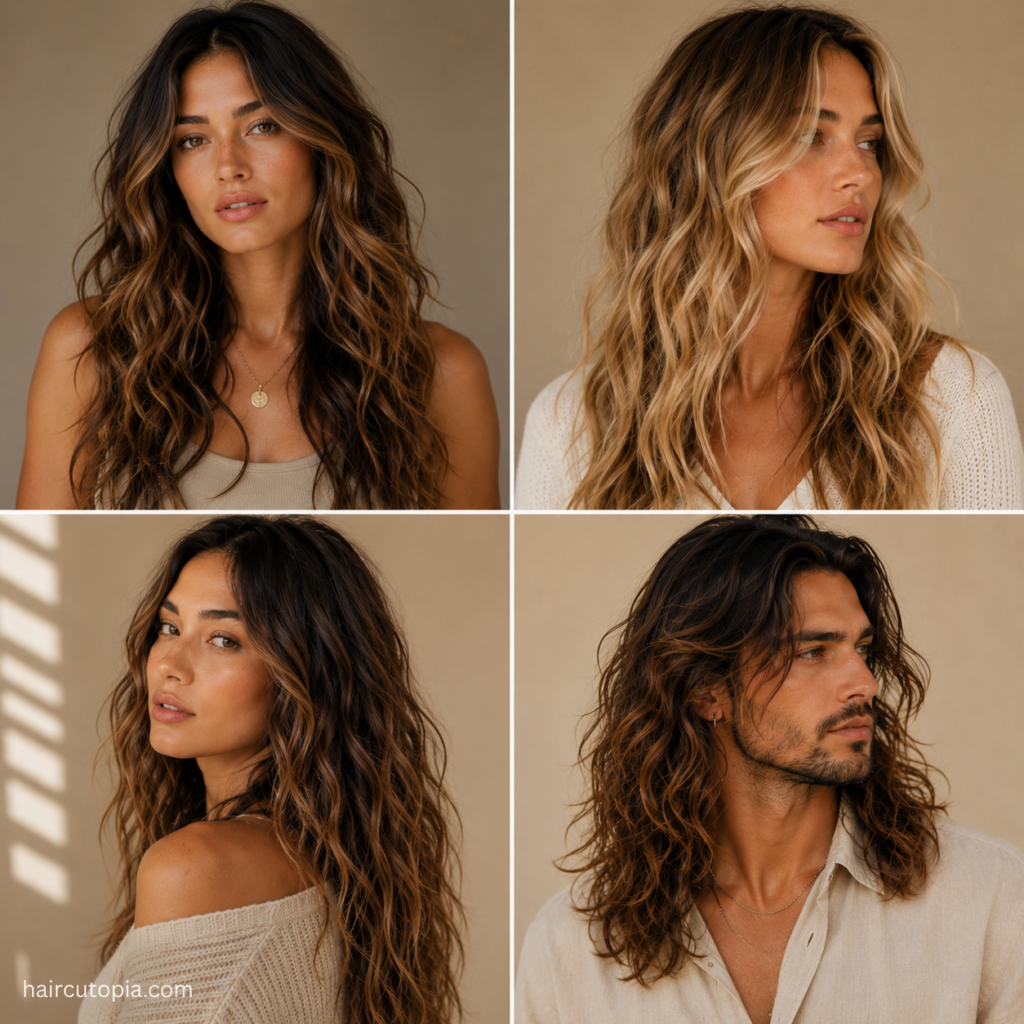
Long beach waves have that rare combination of looking styled without looking overly done. They’re soft, loose, a little imperfect, and especially flattering when you have enough length for the waves to move naturally.
You can wear them with long layers, curtain bangs, a center part, dimensional highlights, or a simple one-length cut. The waves themselves can be barely noticeable or full and voluminous. That’s part of what makes this hairstyle so versatile.
And no, beach waves aren’t only a summer hairstyle. The “beachy” part is really about relaxed texture rather than an actual trip to the coast.
Whether your hair reaches below your shoulders or well past your chest, these long beach waves hairstyles offer plenty of ways to add movement without turning your hair into a head full of perfectly structured curls.
Why Beach Waves Work So Well on Long Hair
Long hair gives waves room to develop.
Instead of creating a single bend, you can build several soft curves through the length of the hair. That movement can make an otherwise simple long haircut look much more dimensional.
Beach waves can also:
- Bring long layers to life
- Add body to fine hair
- Break up the heaviness of thick hair
- Showcase highlights and balayage
- Add movement to one-length cuts
- Blend grown-out bangs into longer layers
- Make second-day hair easier to refresh
The key is keeping enough softness that the hair still moves.
1. Classic Long Beach Waves
Classic beach waves fall somewhere between straight hair and traditional curls.
The roots stay relatively smooth, while loose bends develop through the middle and lower lengths. The ends are usually softer or slightly straighter.
Alternating the direction of your waves prevents them from joining together into one large curl.
It’s simple, wearable, and works with almost any long haircut.
2. Long Tousled Beach Waves
Tousled waves take the classic version and make it a little less polished.
The wave pattern doesn’t need to be consistent. Some sections can have a stronger bend, while others remain relatively loose.
After styling, use your fingers to gently separate the hair.
This works particularly well with long layers because the different lengths naturally create movement.
A little texture spray can help, but don’t use so much that your hair becomes stiff or gritty.
3. Long Beach Waves With a Center Part
A center part creates a clean contrast against relaxed waves.
Keep the roots fairly smooth and begin the more noticeable texture around cheekbone or jaw level. Style the front pieces slightly away from your face.
This combination can make long hair feel lighter because the waves break up the length visually.
It’s especially flattering with face-framing layers.
4. Long Beach Waves With a Side Part
Switching to a side part can instantly make long waves appear fuller.
The heavier side gains natural volume while the opposite side sits closer to the head. You can leave both sides loose or tuck one side behind your ear.
A soft side part works for everyday styling, while a deeper part can create a more glamorous finish.
5. Beach Waves With Long Layers
Long layers and beach waves are practically made for each other.
The waves emphasize the different lengths, giving the haircut more visible movement and preventing the bottom from looking too heavy.
You don’t need to curl every layer individually.
Instead, create loose waves throughout the hair and allow the haircut itself to determine where the texture falls.
For heavily layered hair, fewer styled sections may actually look better.
6. Beach Waves With Face-Framing Layers
Face-framing layers can disappear into straight hair, especially when the rest of your hair is very long.
Adding waves makes those shorter pieces stand out.
Direct the front layers away from your face with a soft bend. Continue with less uniform waves throughout the remaining lengths.
The front pieces should blend into the rest of the hairstyle rather than looking like separate curls.
7. Long Beach Waves With Curtain Bangs
Curtain bangs flow naturally into long beach waves.
Style the bangs outward and away from the center of your face, keeping the bend soft. From there, allow them to transition into your face-framing layers and longer waves.
This is especially effective if your curtain bangs have grown out a little.
Rather than fighting the extra length, the waves help blend everything together.
8. Long Beach Waves With Wispy Bangs
Wispy bangs create a softer contrast against long, textured hair.
Instead of curling the fringe to match the rest of your waves, keep it relatively natural. A slight bend or gentle separation is usually enough.
This keeps the front from looking too busy.
The combination works particularly well if your long haircut already has light layering around the face.
9. Loose, Barely-There Beach Waves
Not every beach wave needs to be dramatic.
Barely-there waves create subtle bends that make long hair appear naturally textured rather than obviously curled.
Use larger sections and keep the movement soft.
This style is particularly useful if you want to maintain the visual length of your hair. Tighter waves can make long hair appear significantly shorter, while loose bends preserve more of its length.
10. Voluminous Long Beach Waves
If subtle isn’t what you’re after, beach waves can also go big.
Start by creating volume around the roots, then build broad waves through the lengths.
Once the hair has cooled, separate the waves carefully to create fullness without turning them fluffy.
Long layers can make this style even more dramatic because they allow the hair to expand at different points rather than creating all the volume at the bottom.
11. Messy Long Beach Waves
Messy beach waves are supposed to look slightly unpredictable.
Use different-sized sections. Alternate directions. Leave a few pieces relatively straight.
You don’t want every wave beginning and ending in exactly the same place.
Once everything has cooled, gently shake out the lengths with your fingers.
The result should feel intentionally undone rather than unfinished.
12. Long Beach Waves With Straight Ends
Leaving the ends straighter is one of the easiest ways to make long beach waves feel more modern.
Create your bends through the middle of the hair, but stop before reaching the final inch or two.
This prevents the ends from turning into ringlets and gives the hairstyle a more relaxed shape.
It’s particularly effective on one-length or lightly layered long hair.
13. Long Beach Waves With Balayage
Beach waves can make balayage much more noticeable.
As the hair bends, lighter and darker sections catch the light differently. That movement emphasizes the gradual color transitions throughout the lengths.
The effect can work with:
- Blonde balayage
- Caramel balayage
- Brunette dimensional color
- Copper tones
- Face-framing highlights
- Subtle sun-kissed highlights
Even relatively subtle color variation can become more visible once waves are added.
14. Long Beach Waves With Highlights
Traditional highlights also pair beautifully with waves.
Rather than appearing as relatively straight ribbons of color, highlights move in and out of view as the hair curves.
For an especially dimensional look, keep your waves loose enough that the different tones remain visible.
You don’t necessarily need dramatic highlights. Fine babylights can create a softer version of the same effect.
15. Beach Waves on Long Brunette Hair
Beach waves aren’t dependent on lighter hair color.
On long brunette hair, waves can help create depth by allowing light to hit different sections of the hair.
This can be especially noticeable on rich brown shades that might otherwise appear more uniform when worn completely straight.
If you have subtle caramel, chocolate, chestnut, or warm brown dimension, loose waves can help bring those tones forward.
16. Beach Waves on Long Blonde Hair
Long blonde hair naturally shows plenty of dimension when waved.
Different blonde tones can become more visible as the hair bends, particularly if you have highlights, lowlights, or darker roots.
Loose waves can create a relaxed finish, while larger, smoother waves can make the hairstyle feel more polished.
Leaving the ends slightly straighter can keep the overall look modern.
17. Beach Waves on Long Red Hair
Copper, auburn, and red hair can look especially dimensional with waves because the color changes noticeably depending on how the light hits it.
Keep the waves relatively broad if you want the color itself to remain the focus.
Long layers can add even more movement without requiring tighter curls.
18. Naturally Wavy Long Hair
If your hair already has a natural wave pattern, you may be closer to beach waves than you think.
Instead of creating an entirely new texture, focus on defining what you already have.
Apply an appropriate lightweight styling product to damp hair, gently scrunch, and allow it to air-dry or use a diffuser.
Once your hair is completely dry, separate any sections that have clumped together too much.
Natural variation is part of the look, so don’t worry about making both sides perfectly symmetrical.
19. Long Beach Waves With a Deep Side Part
A deep side part gives relaxed waves a more dramatic shape.
The heavier side naturally creates volume around the crown and face, while the lighter side can be tucked behind the ear.
This simple change can make everyday waves feel much more evening-ready.
It works especially well with long face-framing layers because those pieces can sweep across the forehead before blending into the rest of the hair.
20. Polished Long Beach Waves
Beach waves don’t always have to look messy.
For a more polished version, use smoother, broader sections and keep the wave pattern slightly more consistent.
Control flyaways without eliminating all movement.
This version works well for:
- Weddings
- Date nights
- Work events
- Parties
- Holiday gatherings
- Formal dinners
- Photos
You still want softness. Once the hair becomes rigid, it starts moving away from the beach-wave aesthetic.
21. Long Beach Waves With Extra Texture
If your hair tends to look very smooth after curling, adding texture can create a more lived-in finish.
Separate individual waves rather than allowing them to merge together. A lightweight texturizing product can help create definition.
Concentrate the product primarily through the middle and lower lengths instead of coating your roots.
This can also help long, fine hair appear fuller.
22. Soft S-Waves on Long Hair
S-waves create smooth bends that move back and forth through the hair rather than forming traditional spirals.
They’re ideal if you want beach-inspired movement without obvious curls.
A flat iron can work particularly well for this technique because you can change the direction of the bend as you move down each section.
Keep the pattern loose for a more natural finish.
23. Long Beach Waves With a Half-Up Style
Beach waves make an excellent base for half-up hairstyles.
Pull the upper sections away from your face while leaving the remaining waves loose.
You can keep the half-up portion simple or create:
- A small ponytail
- A loose twist
- A small bun
- A clipped-back style
- Soft pinned sections
Allow a few face-framing pieces to remain loose if you want a more relaxed finish.
24. Beach Waves With One Side Tucked Back
Sometimes the smallest change makes the biggest difference.
Create your waves as usual, then tuck one side behind your ear.
That’s it.
The asymmetry gives the hairstyle more shape while showing off your face, earrings, or neckline.
It’s also an easy way to make everyday waves feel slightly more intentional.
25. Long Beach Waves With a Half-Up Bun
For a more casual option, gather some of the hair around your crown into a small, loose bun.
Leave the rest of your waves flowing underneath.
Avoid pulling everything too tightly. A slightly relaxed shape works better with the texture of the waves.
This can also be useful for second-day hair when the roots need a little help but the lengths still look good.
26. Second-Day Long Beach Waves
Long beach waves often look even better the following day.
The curls loosen, the sections blend together, and the hairstyle develops a more lived-in texture.
Instead of starting over, refresh only the pieces that have flattened.
You can also add a little volume around the roots if needed.
This approach saves time and avoids repeatedly applying heat to your entire head of hair.
27. Long Beach Waves With a Relaxed Ponytail
Beach waves don’t have to stay completely down.
A loose ponytail allows the texture to remain visible while getting your hair away from your face.
Keep the ponytail relatively relaxed and gently pull out a few face-framing pieces.
The existing waves will give the ponytail more movement and volume than completely straight hair.
28. Long Beach Waves With a Loose Braid
Loose waves can also serve as the foundation for a casual braid.
Because the hair already has texture, the braid often appears fuller and less rigid.
Try a simple side braid or loose three-strand braid and allow a few shorter layers to fall naturally.
You don’t need to make every piece stay perfectly in place.
How to Create Beach Waves on Long Hair
Long hair gives you plenty of styling options, but it can also take more time. Working in organized sections makes the process much easier.
Using a Curling Iron or Wand
A curling iron or wand gives you control over the size and placement of your waves.
- Start with completely dry hair.
- Apply heat protectant according to the product directions.
- Divide your hair into manageable sections.
- Take a section and wrap primarily through the middle lengths.
- Leave the ends slightly straighter.
- Alternate the direction of neighboring sections.
- Direct the front pieces away from your face.
- Continue until you’ve styled the sections you want waved.
- Let your hair cool completely.
- Separate the waves gently with your fingers.
- Finish lightly if you need additional texture or hold.
You don’t necessarily have to curl every strand. Leaving a few sections less defined can make the finished style look more natural.
Creating Long Beach Waves With a Flat Iron
A flat iron can create soft bends rather than traditional curls.
Clamp a section gently and rotate the iron as you move down the hair. Change direction farther down the section if you want a more obvious S-wave.
Avoid holding the tool in one spot for too long.
The goal is a smooth bend rather than a sharp crease.
Heatless Beach Waves for Long Hair
Long hair gives you several heatless styling options.
You can loosely braid or twist slightly damp hair and allow it to dry completely before taking it down.
For looser waves, create fewer and larger sections. More sections generally produce smaller, more noticeable waves.
Once your hair is dry, undo everything carefully and separate the texture with your fingers.
The result will vary depending on your natural hair type, but a little unpredictability works well for this style.
How to Keep Long Beach Waves From Looking Too Curly
One of the most common problems with beach waves is accidentally creating traditional curls.
If that happens frequently, try:
- Using larger sections
- Leaving the ends straighter
- Starting the waves below the roots
- Alternating wave directions
- Loosening the hair after it cools
- Leaving selected sections less curled
- Creating bends instead of spirals
Remember that waves usually relax as you wear them.
If your hair holds curls extremely well, creating them slightly stronger at first may work. If your hair tends to hold curl easily and you want an immediately relaxed look, start with broader bends.
Best Styling Products for Long Beach Waves
Long hair can become weighed down by too much product, so start small.
Texture Spray
Texture spray can help separate waves and create a lived-in finish.
Focus primarily on the lengths.
Sea Salt Spray
Sea salt spray can enhance natural texture, particularly on already wavy hair. Some formulas can feel drying, so choose one suited to your hair and avoid assuming more product will create better waves.
Volumizing Mousse
Mousse can help create lift if long hair tends to lie flat around the roots.
Wave-Enhancing Products
Naturally wavy hair may benefit from lightweight products designed to encourage definition and reduce unwanted frizz.
Flexible-Hold Hairspray
A flexible formula can help waves last without making long hair feel stiff.
Heat Protectant
If you’re using hot styling tools, apply a heat protectant appropriate for your hair and follow its directions.
Long Beach Waves for Fine Hair
Long, fine hair can lose volume because the length pulls it downward.
Beach waves can help create the appearance of additional body.
Try concentrating volume around the roots while using medium-sized sections throughout the lengths. Avoid heavy styling creams or oils before waving your hair.
A slightly more textured finish can also make fine hair appear fuller than very smooth waves.
Long Beach Waves for Thick Hair
Thick long hair has plenty of natural volume, so definition may be more important than adding additional fullness.
Divide your hair into sections so the waves extend beyond the outermost layer.
Keeping the roots smoother can prevent the hairstyle from becoming excessively wide.
Long layers can also help distribute the volume and make individual waves more visible.
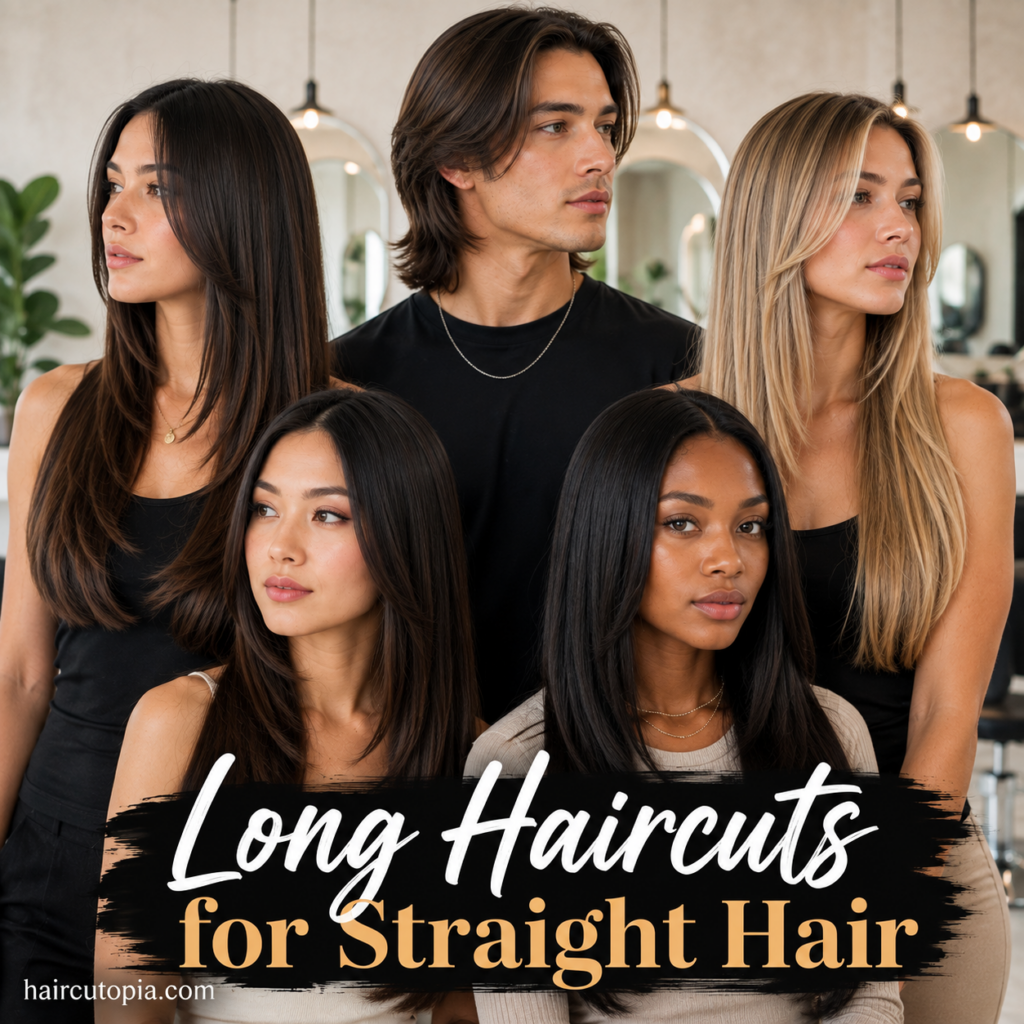
Long Beach Waves for Straight Hair
Naturally straight hair may need a little extra help holding loose waves.
Make sure your hair is completely dry before using hot tools, and allow each wave to cool before separating it.
You may also want to create slightly stronger waves initially, knowing that they’ll relax over time.
Lightweight hold is usually preferable to saturating the hair with hairspray.
How to Make Long Beach Waves Last Longer
Long hair has extra weight, which can gradually pull waves downward.
To help them last:
- Start with completely dry hair when heat styling.
- Avoid applying heavy products beforehand.
- Work in manageable sections.
- Allow the waves to cool before separating them.
- Avoid constantly running your fingers through your hair.
- Use lightweight hold when necessary.
- Refresh individual sections rather than restyling everything the next day.
Your natural texture will determine how much hold you actually need.
Common Mistakes When Styling Long Beach Waves
Beach waves are intentionally relaxed, but a few styling habits can make the process harder than necessary.
Making Every Wave Identical
Perfectly uniform sections often create a more formal curled hairstyle.
Mix things up slightly.
Curling From Root to Tip
Beach waves generally look more relaxed when the roots and ends aren’t equally curled.
Using Sections That Are Too Small
Tiny sections can produce tighter curls instead of broad waves.
Adding Too Much Product
Long hair already has weight. Heavy products can make the waves disappear faster.
Brushing the Waves Immediately
Give your hair time to cool before loosening it.
Overthinking the Imperfections
A section that isn’t perfectly curled may actually improve the finished hairstyle.
Beach waves benefit from variation.
Choosing Beach Waves for Your Long Haircut
Your haircut can guide the way you style your waves.
For long layers, use the waves to emphasize movement between different lengths.
For one-length hair, create loose bends to break up the solid shape.
For face-framing layers, direct the front sections away from your face.
For curtain bangs, keep the fringe soft and flowing into the longer waves.
For fine hair, prioritize texture and root volume.
For thick hair, keep the roots controlled while creating definition through the lengths.
The goal isn’t to force your hair into one specific wave pattern. It’s to find a version that complements the cut you already have.
Are Long Beach Waves Still in Style?
Beach waves have been around long enough that they’re better thought of as a styling category than a single trend.
What changes is how they’re worn.
Some versions are big and voluminous. Others are barely noticeable. Modern beach waves often feature straighter ends, softer roots, face-framing layers, and less uniformity than the highly curled styles associated with earlier trends.
Because the technique can adapt to different haircuts and personal styles, it doesn’t depend on one specific look staying fashionable.
Final Thoughts on Long Beach Waves Hairstyles
Long hair gives you plenty of room to make beach waves your own.
You can keep them soft and subtle, add volume, emphasize your layers, show off dimensional color, or use the waves as a starting point for half-up styles, ponytails, and braids.
The most important part is resisting the urge to make everything identical.
Beach waves look their best when there’s movement and variation. Leave a few ends straighter. Change the direction of some waves. Let your natural texture show through.
The result should feel relaxed, wearable, and just imperfect enough to look effortless.