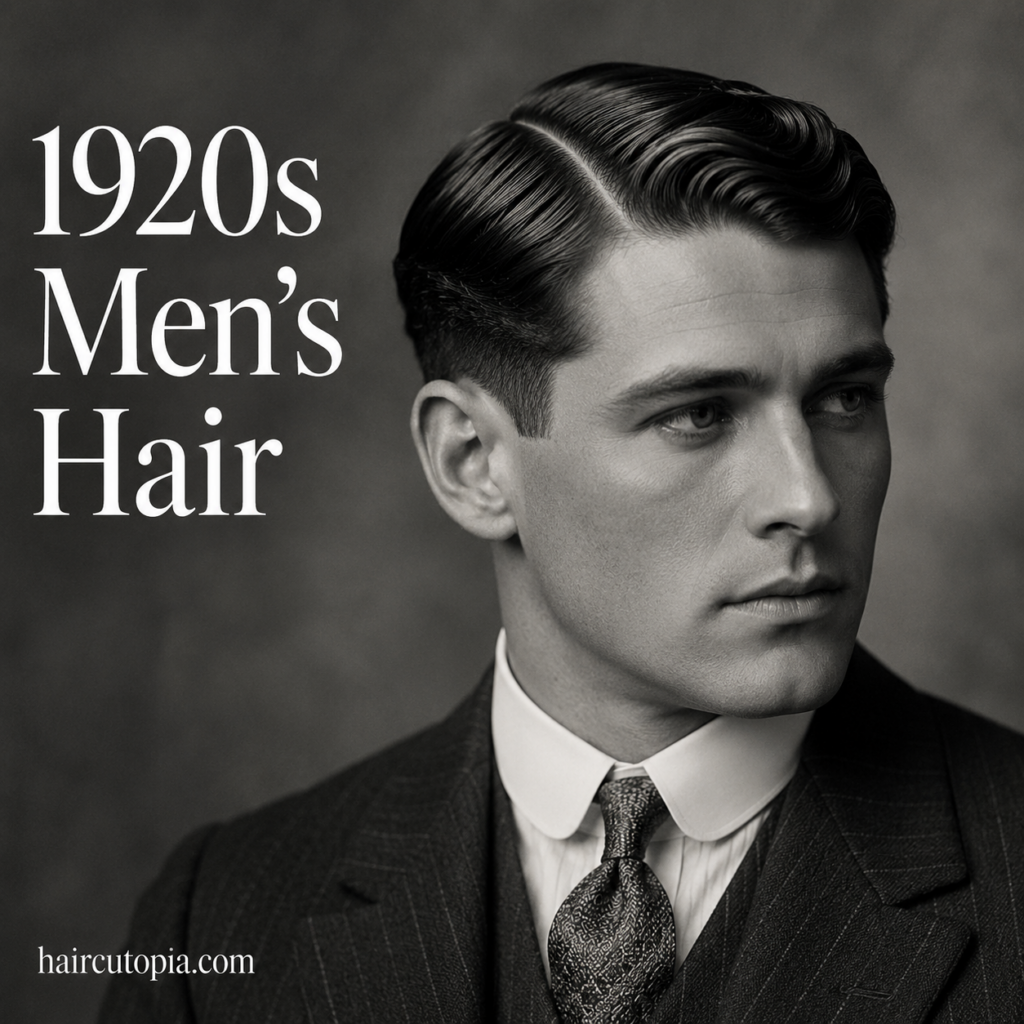
Men’s hair in the 1920s was all about looking polished.
While women’s hair was undergoing the dramatic bob revolution, men’s styles evolved more quietly. Hair was generally kept short around the sides and back, with enough length left on top to create a clean side part, slick the hair backward, or shape natural waves into place.
The finished look was neat, controlled, and often noticeably shiny.
That combination created some of the most enduring men’s hairstyles of the 20th century. Classic tapers, side parts, slick backs, and short-back-and-sides cuts are still worn today, even if modern versions tend to use different products and more relaxed texture.
Whether you’re researching authentic 1920s men’s hair or looking for a modern haircut with Roaring Twenties character, here’s what defined the era.
What Did Men’s Hair Look Like in the 1920s?
Most fashionable men’s hairstyles of the 1920s shared a similar foundation.
Hair was shorter around the ears, sides, and neckline. The top remained longer so it could be combed neatly into position.
Unlike many contemporary styles, intentionally messy hair wasn’t usually the goal.
Everything looked deliberate.
A typical 1920s men’s style might include:
- Short, neatly tapered sides
- A clean neckline
- Longer hair on top
- A defined side or center part
- Hair combed away from the face
- Controlled natural waves
- A smooth or glossy finish
There was still plenty of variation within that framework.
Hair type, age, profession, personal taste, and grooming habits all affected the finished look.
The Classic 1920s Side Part
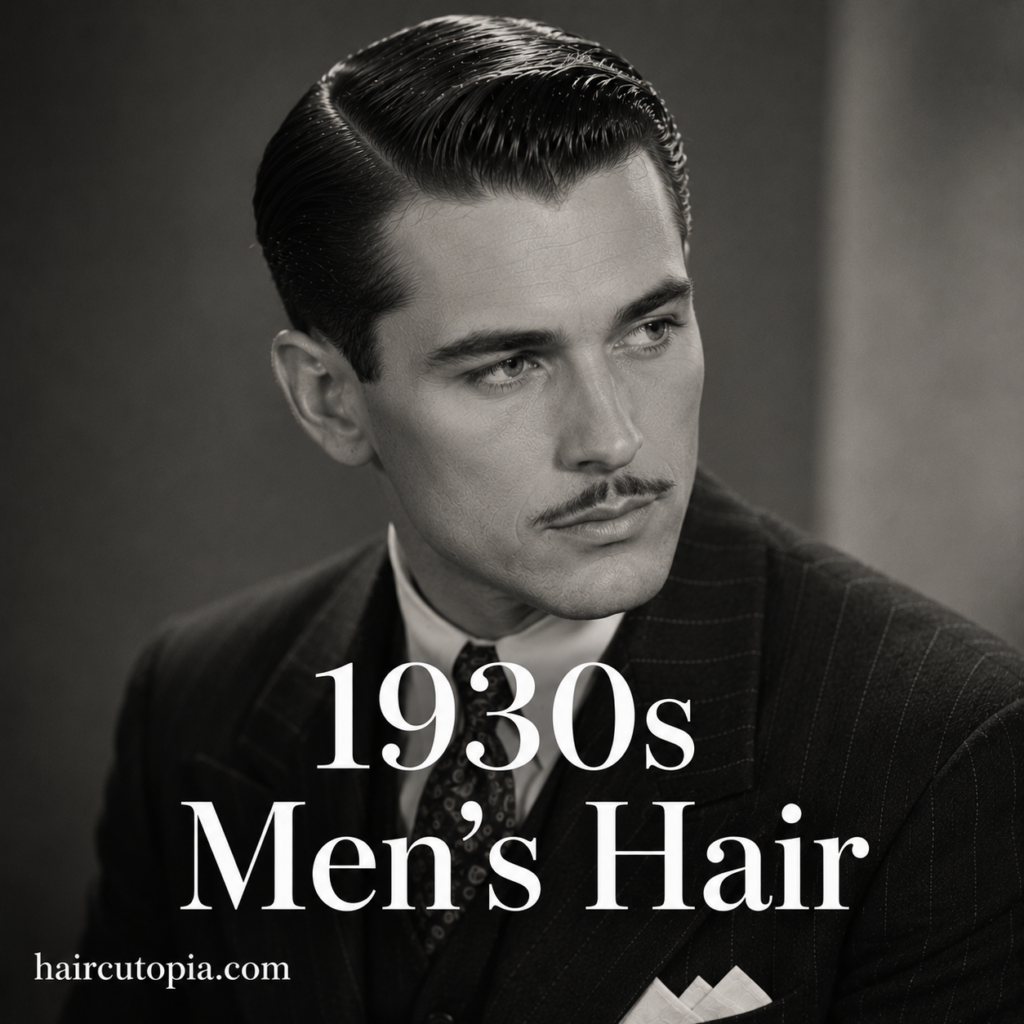
The side part is probably the most recognizable men’s hairstyle associated with the decade.
Hair was divided clearly on one side and combed across the top, often with a slight backward direction.
The sides remained controlled and close to the head.
Styling products helped maintain the shape while adding the smooth finish fashionable at the time.
Why the Side Part Worked So Well
The style was adaptable.
It looked appropriate with formal clothing but wasn’t limited to special occasions.
A side part could also work with straight, wavy, thick, or moderately fine hair.
The exact placement of the part changed the effect.
A deeper side part created a stronger, more dramatic sweep across the top, while a less extreme part produced a balanced everyday style.
The basic formula remains popular a century later.
Slicked-Back 1920s Hair
Not every man divided his hair into a strong side part.
Hair could also be combed backward from the forehead.
The slick-back style emphasized a smooth surface and clean silhouette.
Enough length was needed through the top to direct the hair backward without short pieces constantly falling forward.
The sides were kept neat and could also be combed slightly backward.
Compared with some modern slick backs, the transition between the top and sides generally looked more blended.
There wasn’t necessarily an extreme fade or disconnected undercut.
Instead, the entire haircut flowed together.
Short Back and Sides
The short-back-and-sides structure provided the foundation for many men’s hairstyles.
As the name suggests, the sides and back were cut shorter while the top retained additional length.
This wasn’t one rigid haircut.
Different proportions could create different looks.
A man could wear the top:
- Side-parted
- Slicked backward
- Combed diagonally
- Gently waved
- Center-parted
The shorter perimeter kept the haircut looking tidy while the longer top provided flexibility.
It’s a simple idea, but it became one of the foundations of modern barbering.
The Classic Taper
A traditional taper is particularly useful for understanding authentic-looking 1920s men’s hair.
Hair gradually becomes shorter as it approaches the ears and neckline.
There’s no sudden jump between very long and extremely short sections.
Instead, the transition is blended.
This creates a clean shape while preserving a relatively natural appearance.
1920s Taper vs. Modern Fade
A modern fade can become extremely short around the sides and may transition all the way down to bare skin.
That dramatic contrast wasn’t the defining appearance of 1920s men’s hair.
A historically inspired cut usually looks better with a softer taper.
The sides can still be short, but the graduation should feel smooth rather than extreme.
If you’re recreating the look today, asking your barber for a traditional taper rather than a high skin fade will generally produce a more convincing period-inspired silhouette.
Slick Side-Parted Hair
Combining the side part with a slick finish created one of the decade’s sharpest looks.
The part provided structure.
Product provided control.
Hair on the larger side of the part could sweep across and backward, while the smaller section stayed close to the head.
The result worked particularly well with straight or slightly wavy hair.
It’s also one of the easiest 1920s men’s hairstyles to adapt for modern wear because the overall shape remains familiar.
Wavy Men’s Hair in the 1920s
Not all 1920s men’s hair was perfectly straight.
Natural waves could be incorporated into the style rather than completely flattened.
The difference was how that texture was handled.
Instead of encouraging a loose or tousled appearance, waves were generally directed into a controlled shape.
A man might comb wavy hair backward or toward the side, allowing the natural bends to remain visible through the top.
This could create a softer, more dimensional appearance while still looking polished.
Men with naturally wavy hair can recreate this look today without forcing their hair completely straight.
Center-Parted Men’s Hair
Although side parts are more strongly associated with the period, center parts also appeared.
The top needed enough length to divide through the middle and fall or sweep toward either side.
Straight and wavy hair could both work.
Compared with a sharp side part, the center part created a more symmetrical appearance.
Interestingly, this is another historical look that feels surprisingly familiar today.
Modern curtain hairstyles use a similar basic structure, although contemporary versions are usually looser, longer, and more textured.
Combed-Back Waves
For men with longer or naturally textured hair on top, combed-back waves provided another option.
Rather than creating a perfectly flat slick back, the hair retained visible movement.
The front could rise slightly before flowing backward.
This gave the hairstyle more shape while maintaining the polished character expected of men’s grooming.
The key difference from modern textured styling was control.
Individual pieces weren’t intentionally separated or made messy.
The waves worked together as part of one organized shape.
The 1920s Businessman’s Haircut
Professional men’s grooming tended to favor conservative, tidy styles.
A traditional taper with a side part fit naturally into this environment.
The sides were neat, the neckline clean, and the top controlled.
Nothing needed to be particularly dramatic.
That understated quality is exactly why the style has survived.
A modern professional haircut featuring a classic taper and neatly combed top can look remarkably similar to men’s styles worn generations ago.
Formal Men’s Hairstyles
For formal occasions, additional attention could be given to smoothness and shine.
Hair might be combed more precisely and held firmly in place with grooming product.
A deep side part or sleek backward direction paired naturally with formal clothing.
The goal wasn’t necessarily to create a completely different hairstyle for the evening.
Instead, the everyday style could simply become sharper and more polished.
This is still a useful approach when recreating 1920s hair for weddings, themed events, or formal occasions today.
Hair Length for 1920s Men’s Styles
Men’s hair was generally short by modern long-hair standards, but the top wasn’t always extremely short.
Some length was necessary for styling.
If the top is clipped too close, it becomes difficult to create the smooth sweeps and defined parts associated with the era.
A period-inspired cut typically benefits from:
- Shorter hair around the ears
- A tapered neckline
- Moderate length through the top
- Extra length toward the front
- Enough hair to comb backward or sideways
Exact measurements aren’t necessary because hair type changes how length behaves.
Curly or wavy hair may require different proportions than straight hair.
The important thing is maintaining a clear difference between the neat perimeter and the styleable top.
What Hair Products Did Men Use in the 1920s?
Products played an important role in men’s grooming.
The glossy, controlled appearance associated with the decade required something to keep hair in position.
Men used various grooming preparations, including hair oils, tonics, brilliantine, and pomade-like products.
These could add shine, smooth flyaways, and make hair easier to comb.
The finished appearance often looked noticeably glossier than many popular men’s styles today.
Brilliantine
Brilliantine was associated with adding gloss and smoothness to the hair.
It helped create the polished appearance fashionable during the period.
The term covered grooming preparations available in different forms, but shine was a major part of the appeal.
Hair Tonics
Hair tonics were another familiar part of men’s grooming.
They could be worked through the hair before combing and were often associated with both grooming and scalp care.
Barbershops also helped make tonics part of the traditional men’s grooming experience.
Pomades and Oils
Oil- and pomade-style products offered additional control.
They helped hair stay neatly combed and could create the sleek surface associated with side parts and slick backs.
Modern products make recreating this effect much easier.
Water-based pomades, creams, and gels can provide varying degrees of shine and hold without requiring historically accurate grooming formulas.
How Men Combed Their Hair in the 1920s
The comb was essential.
Many styles relied on visible comb lines and carefully directed hair.
A typical routine was relatively straightforward:
- Start with slightly damp or prepared hair.
- Apply a small amount of grooming product.
- Establish the part.
- Comb the top toward the side or backward.
- Smooth the sides close to the head.
- Refine the front and hairline.
- Add additional product only where necessary.
For wavy hair, the comb could guide the overall direction while allowing some natural movement to remain.
The finished result was controlled without necessarily being completely flat.
Barbering in the 1920s
Barbershops played an important role in men’s grooming.
A haircut wasn’t simply about shortening the hair.
Barbers shaped the neckline, cleaned around the ears, tapered the sides, and maintained the proportions needed for polished styling.
Regular visits helped keep the haircut sharp.
The barbershop could also provide shaving and other grooming services, making it an important part of men’s personal care.
Many of the techniques associated with traditional barbering today have roots stretching through this period and earlier.
What About Facial Hair?
The clean-shaven face became strongly associated with fashionable younger men during the 1920s.
Improved shaving products and safety razors made regular shaving increasingly practical.
That doesn’t mean facial hair disappeared.
Mustaches remained an option, particularly among older or more traditionally styled men.
When worn, they were often kept relatively neat and controlled rather than deliberately rugged.
The clean-shaven look, however, paired particularly well with the sharply groomed hairstyles fashionable during the decade.
Hairlines and Necklines
Small details helped make 1920s men’s hair look polished.
Hair around the ears needed to be controlled.
The neckline needed to be tidy.
Sideburns were generally kept relatively restrained compared with some later decades.
These details mattered because the hairstyles themselves were fairly simple.
When a haircut relies on clean proportions rather than dramatic texture or extreme length, finishing becomes especially noticeable.
A well-shaped neckline and smooth taper could make the entire haircut look sharper.
How 1920s Men’s Hair Changed During the Decade
There wasn’t a sudden switch from one men’s hairstyle to another when the calendar reached 1920.
Many grooming traditions carried over from earlier years and continued evolving gradually.
Throughout the decade, short and neatly controlled hair remained dominant.
The influence of film, advertising, photography, and popular culture also gave fashionable men more visible grooming references.
By the later 1920s, the sleek, well-combed image we now associate with the era had become firmly established.
Still, there was never one haircut worn by every man.
Personal preference, hair texture, age, occupation, and social environment all mattered.
Hollywood’s Influence on Men’s Hair
Cinema helped turn actors into international style references.
Audiences could see fashionable men on screen and in publicity photographs, making hairstyles increasingly visible beyond local communities.
Smooth side parts, glossy finishes, and carefully groomed silhouettes fit naturally with the polished image of leading men.
Celebrity influence on hair certainly didn’t begin with social media.
The medium was different, but the basic behavior was familiar: people saw attractive public figures wearing a particular look and wanted something similar.
How to Get a 1920s Men’s Haircut Today
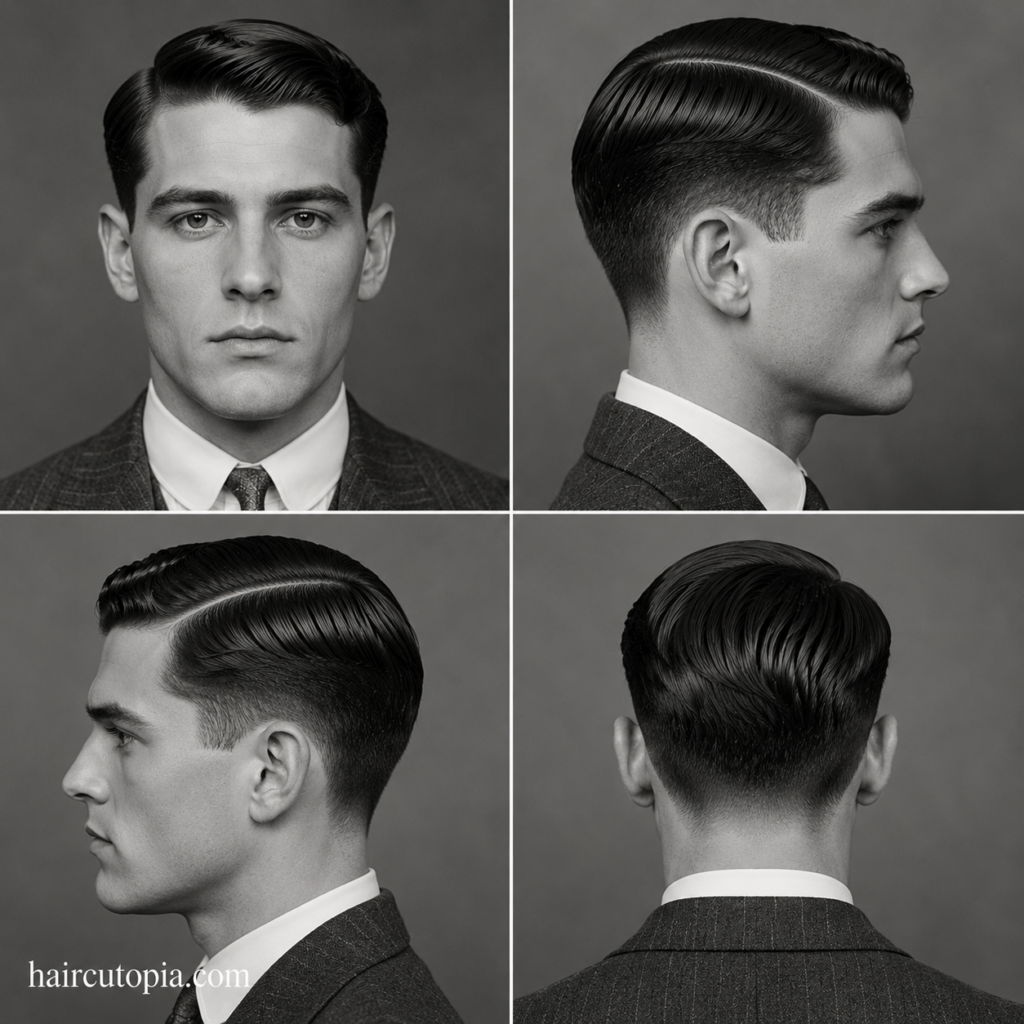
A 1920s-inspired men’s haircut doesn’t require an exact historical recreation.
Start with the proportions.
Ask for a classic taper or traditional short back and sides while keeping enough length through the top for combing.
Avoid going excessively short if you want an authentic-looking silhouette.
Tell your barber how you intend to style the top as well.
If you’re planning a side part, the cut should support that direction.
If you want a slick back, additional front length may be helpful.
Bringing a visual reference is always useful.
How to Style 1920s Men’s Hair Today
The styling process can be kept simple.
For a Classic Side Part
Start with damp hair and create a clean part using a comb.
Apply a pomade or grooming cream with some shine.
Comb the larger section across and slightly backward, then smooth the smaller side close to the head.
Finish by refining the front.
For a Slick Back
Apply product evenly through damp hair.
Comb the top backward from the forehead.
Direct the sides slightly backward as well so the entire style flows together.
Avoid creating too much height if you’re aiming for a stronger 1920s appearance.
For Wavy Hair
Use a moderate amount of product that provides control without completely eliminating natural movement.
Establish the part and comb the hair into its general direction.
Then allow the waves to settle naturally rather than repeatedly flattening them.
Modern vs. Authentic 1920s Men’s Hair
A modern interpretation doesn’t have to look like a costume.
Small changes can make the style more contemporary.
For example, you can use a matte cream rather than a high-shine pomade.
You can leave more natural texture through the top.
You can also choose a slightly tighter taper.
For a more authentic-looking result, emphasize:
- Softer tapering instead of an extreme fade
- A clearly defined part
- A neatly combed top
- Controlled sides
- Moderate rather than exaggerated volume
- A smooth or glossy finish
The haircut itself can remain almost identical while the styling determines whether it looks historical or modern.
Which 1920s Men’s Hairstyles Are Still Popular?
Quite a few.
The classic side part remains a standard men’s hairstyle.
So does the slick back.
Traditional tapers continue to be offered in barbershops everywhere, and short-back-and-sides cuts remain fundamental to men’s grooming.
Modern descendants of 1920s styles include:
- Classic side parts
- Slick backs
- Low tapers
- Business cuts
- Short back and sides
- Comb backs
- Side-swept styles
- Center-parted styles
The biggest differences tend to involve texture and finishing.
Today’s hair is often worn more naturally, while 1920s styling generally favored a smoother and more controlled result.
Frequently Asked Questions About 1920s Men’s Hair
What was the most popular men’s hairstyle in the 1920s?
The neatly groomed side part was one of the decade’s most recognizable men’s styles. Hair was typically shorter around the sides and back with enough length on top to comb across and backward.
Did men slick their hair back in the 1920s?
Yes. Slicked-back styles were worn, particularly when the top had enough length to comb smoothly away from the forehead.
Did men use pomade in the 1920s?
Men used a variety of grooming products, including pomade-like preparations, oils, brilliantine, and hair tonics. These helped create the smooth, shiny finish associated with the era.
Did men have fades in the 1920s?
Hair could be tapered progressively shorter around the sides and neckline, but the dramatic skin fades common in modern barbering weren’t the defining look. A softer traditional taper creates a more authentic 1920s-inspired appearance.
How long was men’s hair in the 1920s?
The sides and back were generally kept fairly short, while the top retained enough length to be parted, slicked back, or combed into controlled waves.
Did men wear center parts in the 1920s?
Yes, although side parts are more strongly associated with the decade. Longer top sections could be divided through the center and directed toward either side.
Did men have facial hair in the 1920s?
Some did, particularly mustaches, but clean-shaven faces became strongly associated with fashionable men’s grooming during the period.
Can you wear a 1920s men’s hairstyle today?
Absolutely. Classic tapers, side parts, slick backs, and short-back-and-sides cuts remain common. Changing the amount of shine and texture can make the same basic haircut look either vintage or contemporary.
Why 1920s Men’s Hair Still Works Today
1920s men’s hair has lasted because the underlying ideas are simple.
Keep the sides and back neat. Leave enough length on top to style. Create a deliberate shape. Maintain the haircut.
There’s nothing especially complicated about it.
The difference was in the finish.
Men of the era generally favored controlled hair, visible grooming, and a polished surface. Modern styles often loosen those rules by adding texture, matte products, fades, and more volume.
But underneath those updates, the connection is easy to see.
The classic taper, side part, slick back, and short-back-and-sides haircut didn’t vanish with the Roaring Twenties.
They became part of the vocabulary of men’s hair.