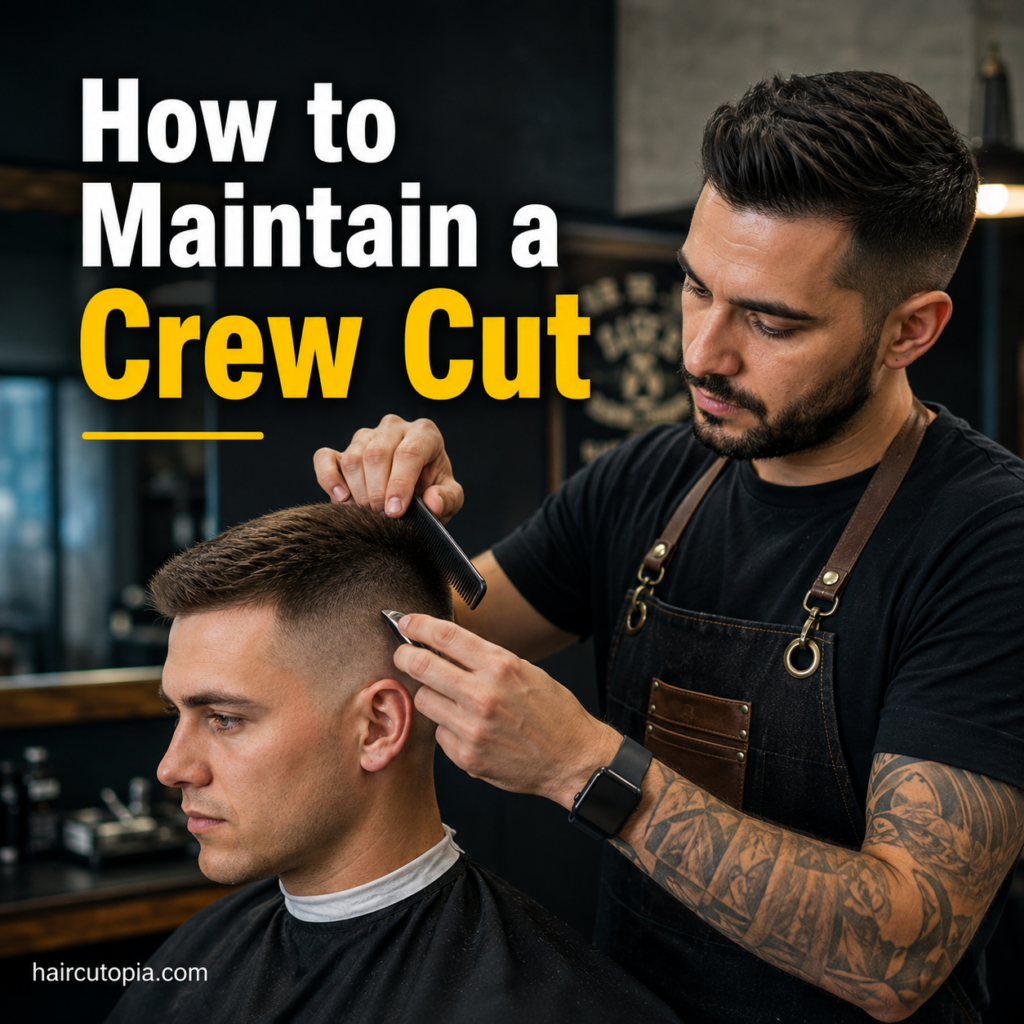
A crew cut doesn’t require much daily work, but timing matters if you want to keep that freshly cut shape.
The tricky part is that different parts of the haircut don’t grow out at the same visual pace. Your hair is growing everywhere, of course, but you’ll usually notice it first around the fade, sideburns, ears, and neckline. Meanwhile, the top may still look perfectly fine.
That’s why a good crew cut maintenance schedule isn’t simply “get a haircut every two weeks.” Your ideal routine depends on how short you wear it, whether you have a fade or taper, how quickly your hair grows, and how sharp you like your haircut to look.
For most people, a full trim every two to four weeks works well. Between appointments, a few quick grooming habits can keep things under control.
Here’s a practical crew cut maintenance schedule you can adjust to your haircut and lifestyle.
Crew Cut Maintenance Schedule at a Glance
If you want a simple starting point, use this schedule:
- Daily: Shape the top as needed and keep styling product light.
- Every few days: Wash according to your hair and scalp needs.
- Weekly: Check the neckline, sideburns, and hair around the ears.
- Every 1–2 weeks: Consider an edge or fade cleanup if you prefer a consistently fresh appearance.
- Every 2–4 weeks: Get a full crew cut to restore the shape and proportions.
- Every 4–5 weeks: Usually the outer limit for maintaining the same recognizable crew cut, although longer tapered styles may still look good.
You don’t have to follow this exactly. Think of it as a baseline that you can adjust once you see how your particular haircut grows.
Daily Crew Cut Maintenance
Daily maintenance should take very little time.
That’s part of the appeal of getting a crew cut in the first place.
Morning Styling
Very short crew cuts may require nothing at all.
If you have more length on top, lightly dampen your hair or style it dry. Use your fingers to put the top into position, adding a small amount of product if needed.
Depending on the style, you can:
- Push the front slightly upward
- Brush the hair forward
- Add texture with your fingertips
- Angle the front subtly to one side
- Leave the hair completely natural
You generally don’t need to spend more than a couple of minutes on it.
Check for Flattened Hair
Sleeping can leave short hair sticking in unexpected directions.
Usually, a little water fixes the problem.
Wet your hands, run them through the affected section, and reshape it. You don’t necessarily need to completely wet or wash your hair every morning.
Don’t Keep Adding Product
If yesterday’s product is still making your hair feel heavy or greasy, adding another layer isn’t going to help.
Wash or rinse the buildup away when necessary and start again with a small amount.
Short hair tends to show product buildup quickly.
Every Few Days: Wash and Scalp Care
There’s no universal shampoo schedule that works for everyone.
Some people prefer frequent washing because they exercise daily or have an oily scalp. Others find that shampooing less often keeps their hair and scalp more comfortable.
The important thing is to respond to your own hair.
Wash when your scalp or hair feels oily, dirty, sweaty, or loaded with styling product.
Shampoo the Scalp
With a crew cut, you don’t need a handful of shampoo.
Use a small amount and massage it gently through the scalp with your fingertips.
Rinse thoroughly.
Condition When Needed
You can still use conditioner with short hair.
It’s especially useful if the top is longer, coarse, curly, or prone to dryness.
If your hair is extremely short or naturally oily, you may not need conditioner every time you wash.
Watch for Scalp Dryness
A crew cut exposes more of your scalp, particularly when paired with a skin or high fade.
That means dryness, flaking, irritation, and redness may be more noticeable.
If your scalp regularly feels uncomfortable, don’t assume more shampoo is the answer. Overwashing or using harsh products can sometimes make dryness worse.
Weekly: Inspect the Shape of Your Crew Cut
Once a week, take a quick look at how the haircut is growing.
You aren’t necessarily looking for a reason to cut it. You’re checking which areas are beginning to lose their original shape.
Pay attention to:
- Sideburns
- Hair around the ears
- Neckline
- Fade transition
- Temples
- Crown
- Length at the front
- Bulk along the upper sides
Good lighting and a second mirror can help you see the back.
Weekly: Clean Up Obvious Stray Hairs
If you use a trimmer at home, weekly edge maintenance can extend the clean appearance of a crew cut.
The safest approach is to remove only obvious growth outside the established haircut.
Around the Ears
Stray hairs around the ears become noticeable relatively quickly.
Use a small trimmer carefully around the outer edge without cutting upward into the fade.
Sideburns
Sideburns can lose their shape as they grow.
Follow the existing outline rather than creating a completely new one.
Check both sides as you work so you don’t accidentally make one side significantly shorter.
Neckline
The neckline is one of the easiest places to spot new growth and one of the hardest areas to trim accurately on yourself.
If you’re cleaning it at home, remove obvious hairs beneath the existing neckline.
Avoid continually moving the neckline higher.
Every 1–2 Weeks: Fade and Edge Cleanup
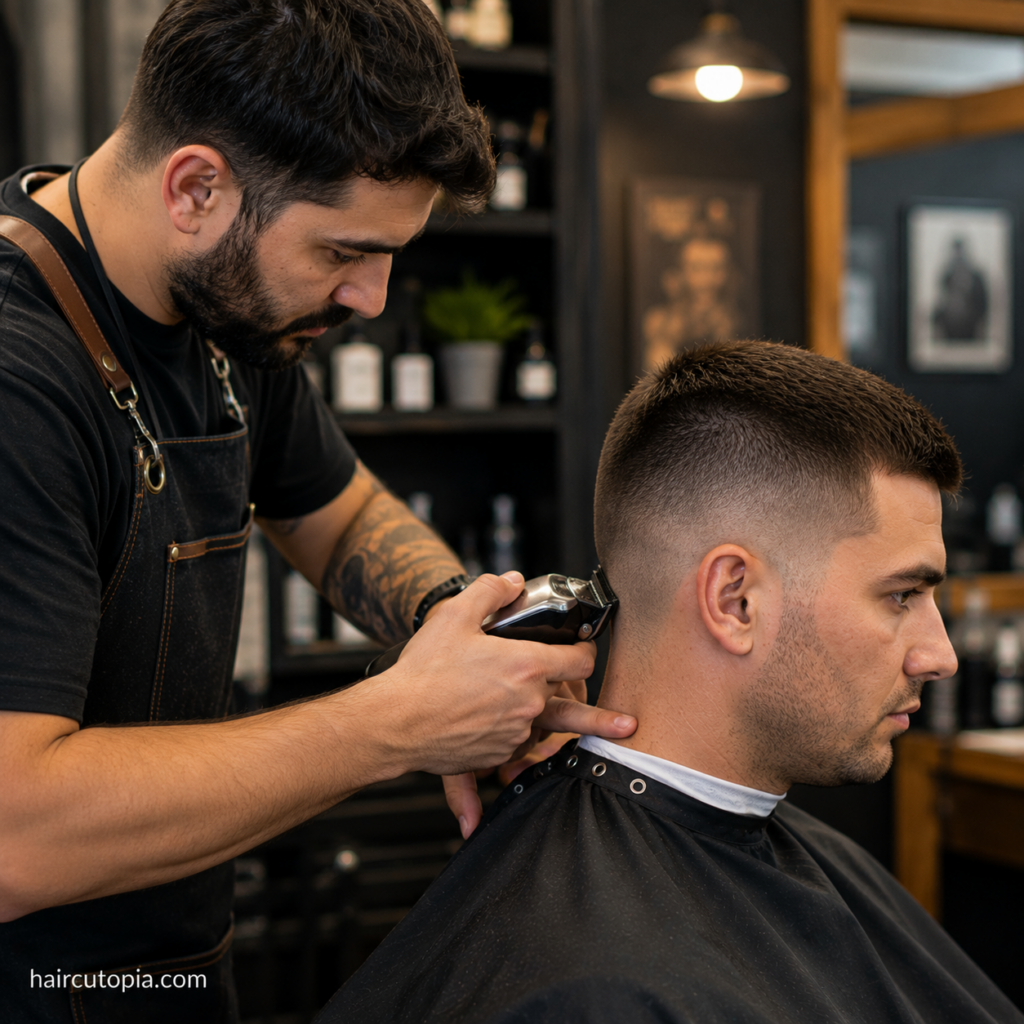
This step is optional.
If you like your crew cut looking extremely fresh at all times, a quick cleanup around the sides and neckline can bridge the gap between full haircuts.
This is particularly useful for:
- Skin fades
- High fades
- Sharp lineups
- Very short sideburns
- Defined necklines
Some barbers offer shorter cleanup appointments specifically for this purpose.
If your crew cut has a traditional taper instead of a dramatic fade, you may not need an intermediate cleanup at all.
Every 2 Weeks: Who Needs a Full Haircut?
Two-week appointments aren’t necessary for everyone.
They’re most useful when the haircut depends on very short sides and crisp contrast.
Consider a full haircut approximately every two weeks if you have:
- A skin fade
- A high fade
- An extremely short crew cut
- A sharp lineup
- Fast-growing hair
- A job or personal style where you prefer an consistently fresh-cut appearance
At the two-week point, the haircut probably hasn’t completely lost its shape. You’re maintaining it before that happens.
Every 3 Weeks: The Sweet Spot for Many Crew Cuts
For many people, three weeks is a practical balance.
The haircut has grown enough to justify a barber visit, but it usually hasn’t changed dramatically.
A three-week schedule often works well for:
- Low fades
- Mid fades
- Classic crew cuts
- Short textured crew cuts
- Moderate tapers
If you aren’t sure where to start, try getting your next haircut three weeks after your current one.
Then adjust.
If it still looks great, try waiting another week next time. If it looked overdue several days earlier, shorten the interval.
Every 4 Weeks: A Practical Monthly Schedule
A monthly crew cut works well if you don’t need the haircut to look freshly faded every day.
By four weeks, most crew cuts will show noticeable growth, but many will still look perfectly presentable.
Monthly appointments are particularly practical for:
- Classic crew cuts
- Longer crew cuts
- Tapered sides
- Low fades
- Naturally textured hair
- People who don’t mind some growth
Choosing a haircut that grows out well can make a monthly schedule much easier.
Tell your barber that you’d prefer a crew cut that remains presentable for around four weeks. They can potentially adjust the fade, taper, and proportions with that goal in mind.
Can You Wait 5–6 Weeks Between Crew Cuts?
You can, but at that point you’re generally allowing the haircut to grow rather than strictly maintaining the original crew cut.
That isn’t necessarily a problem.
A longer crew cut with tapered sides may still look good after five weeks or more.
The difference is that you’ll probably notice:
- Fuller sides
- A less defined taper or fade
- More hair around the ears
- A softer neckline
- Additional bulk near the crown
- More length through the front
If you like the grown-out version, there’s no reason you have to cut it sooner.
If your goal is to maintain consistent proportions, however, you’ll probably want a full haircut before this point.
Maintenance Schedule for a Crew Cut With a Skin Fade
Skin fades are the most demanding crew cut variation from a maintenance standpoint.
The fade starts at bare or nearly bare skin, so new growth changes the appearance quickly.
A practical schedule might be:
- Daily: Style the top as needed.
- Weekly: Check the edges and neckline.
- Every 1–2 weeks: Fade or edge cleanup.
- Every 2–3 weeks: Full haircut.
You don’t have to maintain a skin fade this aggressively, but the fade will look softer as it grows.
If frequent barber appointments become inconvenient, consider switching to a low fade or taper.
Maintenance Schedule for a Crew Cut With a Low Fade
Low fades are somewhat easier to maintain.
Because the shortest portion stays lower on the head, new growth tends to be less dramatic.
A typical routine might be:
- Daily: Minimal styling
- Weekly: Edge check
- Every 2 weeks: Optional neckline cleanup
- Every 3–4 weeks: Full haircut
This makes a low-fade crew cut a good compromise between a modern appearance and manageable upkeep.
Maintenance Schedule for a Classic Tapered Crew Cut
A classic taper is usually the easiest version to maintain over longer periods.
Instead of exposing large areas of skin, the hair gradually becomes shorter around the sideburns and neckline.
As it grows, the transition remains relatively natural.
A typical schedule is:
- Daily: Style only if needed
- Weekly: Check neckline and ears
- Every 2–3 weeks: Optional edge cleanup
- Every 3–5 weeks: Full haircut
If your main priority is reducing barber visits, this is one of the better crew cut variations to consider.
Maintenance Schedule for a Longer Crew Cut
Longer crew cuts are forgiving on the sides if they’re paired with a taper, but the top eventually becomes the maintenance issue.
As the top grows, it may:
- Fall forward
- Lose texture
- Become bulky
- Stick up around the crown
- Require more styling product
- Stop holding its intended shape
You may be able to wait four weeks or longer between appointments, but pay attention to how the top behaves rather than relying only on the calendar.
Adjust Your Schedule for Your Hair Type
Hair texture can change how quickly a crew cut appears to grow out.
Thick Hair
Thick hair often becomes bulky before it looks especially long.
You may notice the upper sides expanding outward or the top becoming harder to control.
Regular debulking and texturizing can help.
Fine Hair
Fine hair may not develop the same bulk, but sharp edges and fades still soften as the hair grows.
A lightweight styling routine can help maintain texture between appointments.
Wavy Hair
Wavy hair often handles additional length well.
The grown-out texture can look intentional, potentially allowing you to extend the time between haircuts.
Curly Hair
Curly hair tends to become fuller as it grows.
Rather than measuring maintenance entirely by length, look at the overall silhouette. When the sides begin expanding beyond the shape you want, it’s time for a trim.
Signs You Need a Crew Cut Ahead of Schedule
Your calendar should be a guide, not a rule.
If your haircut stops behaving the way you want, get it cut.
Common signs include:
- The sides are sticking outward
- Your fade has almost disappeared
- The neckline looks noticeably overgrown
- Hair is covering or curling around your ears
- The top requires much more product than usual
- Your crown is difficult to control
- The transition between the top and sides looks heavy
- The front has become longer than you prefer
You may simply have faster-growing hair than the average schedule assumes.
Signs You Can Wait Longer
You don’t need a haircut just because three weeks have passed.
If the shape still looks balanced and you’re happy with it, keep going.
You may be able to extend your schedule if:
- Your taper is growing out evenly
- The sides aren’t becoming bulky
- The neckline still looks clean
- The top remains easy to style
- You prefer a slightly longer appearance
Finding your ideal schedule may take two or three haircut cycles.
At-Home Crew Cut Maintenance Between Barber Visits
A little home maintenance can extend the life of the haircut, but know where to stop.
Relatively simple tasks include:
- Cleaning stray neckline hairs
- Trimming obvious hair around the ears
- Maintaining sideburn edges
- Styling the top
- Keeping clippers and trimmers clean
More advanced tasks include:
- Recreating a skin fade
- Blending multiple clipper guards
- Reshaping the entire neckline
- Cutting the top evenly
- Blending the top into the sides
If you’re not experienced with clippers, leave those jobs for your barber.
One aggressive attempt to “clean up” a fade can easily turn into an unexpected full haircut.
Keep Your Grooming Tools Clean
If you’re using clippers or trimmers every week or two, basic tool maintenance should be part of your schedule.
After using them:
- Turn the tool off.
- Remove the guard.
- Brush away loose hair.
- Clean or disinfect the blades according to the manufacturer’s instructions.
- Oil the blades when recommended.
- Store the tool somewhere clean and dry.
Clean, properly maintained blades generally cut more consistently and are less likely to pull at your hair.
How to Build Your Own Crew Cut Maintenance Schedule
Instead of automatically booking appointments every two weeks, figure out when your haircut actually starts bothering you.
After your next fresh crew cut, take note of how it looks at:
- Week 1
- Week 2
- Week 3
- Week 4
At some point, you’ll notice the haircut crossing from “grown in” to “I need a haircut.”
That’s your maintenance interval.
If it happens around day 18, a three-week appointment makes sense. If your crew cut still looks good after four weeks, there’s little reason to force yourself into a two-week schedule.
Choosing the Right Crew Cut for Your Maintenance Preference
The easiest way to reduce crew cut maintenance is to think about upkeep before getting the haircut.
If you enjoy frequent barber visits and want maximum contrast, a skin fade can work beautifully.
If you’d rather get your hair cut approximately once a month, choose something more forgiving.
In general:
- Skin fade: highest maintenance
- High fade: high maintenance
- Mid fade: moderate maintenance
- Low fade: moderate to lower maintenance
- Classic taper: lower maintenance
- Longer tapered crew cut: typically the easiest to grow out
Tell your barber how often you realistically plan to return.
That’s useful information when deciding how short to take the sides.
A Crew Cut Schedule You Can Actually Maintain
The best crew cut maintenance schedule isn’t necessarily the one that keeps your haircut looking freshly cut every single day.
It’s the one that fits your routine.
For most people, a full haircut every two to four weeks is enough. Skin fades may need attention sooner, while longer tapered crew cuts can often stretch beyond a month.
Between appointments, keep things simple. Style the top when needed, wash according to your hair and scalp, check the neckline and ears once a week, and clean up only the areas you’re comfortable trimming yourself.
Once you’ve watched your crew cut grow through a few cycles, you’ll know exactly when it starts looking overdue.
At that point, you won’t need a generic schedule. You’ll have your own.