The quiff is one of those hairstyles that can look classic, modern, polished, or slightly messy depending on how it’s cut and styled. That versatility is a big reason it has stuck around for decades.
The problem is that simply walking into a barbershop and saying, “I want a quiff,” leaves quite a bit open to interpretation.
A barber still needs to know how much length you want on top, how short the sides should be, whether you prefer a fade or taper, and how dramatic you want the front to look.
If you know how to describe those details, getting the quiff you actually pictured becomes much easier.
What Is a Quiff Haircut?
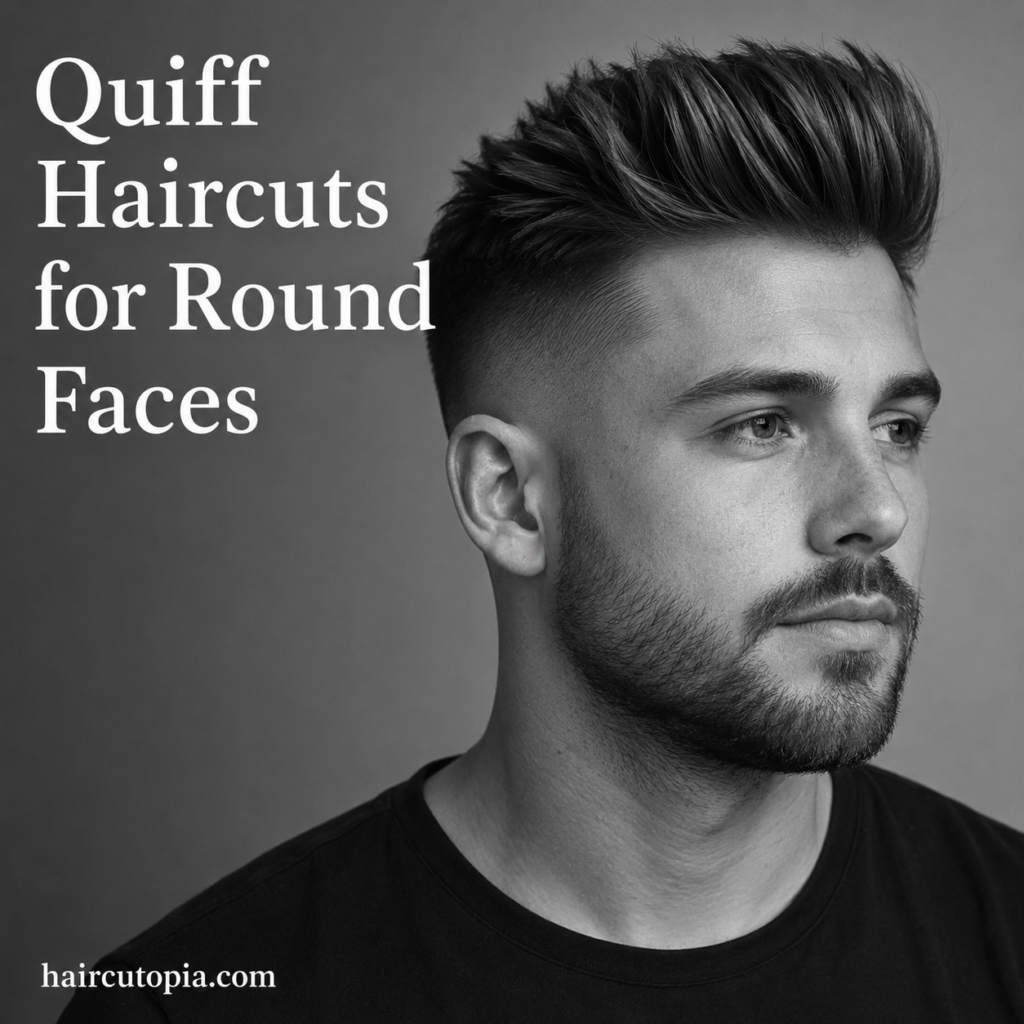
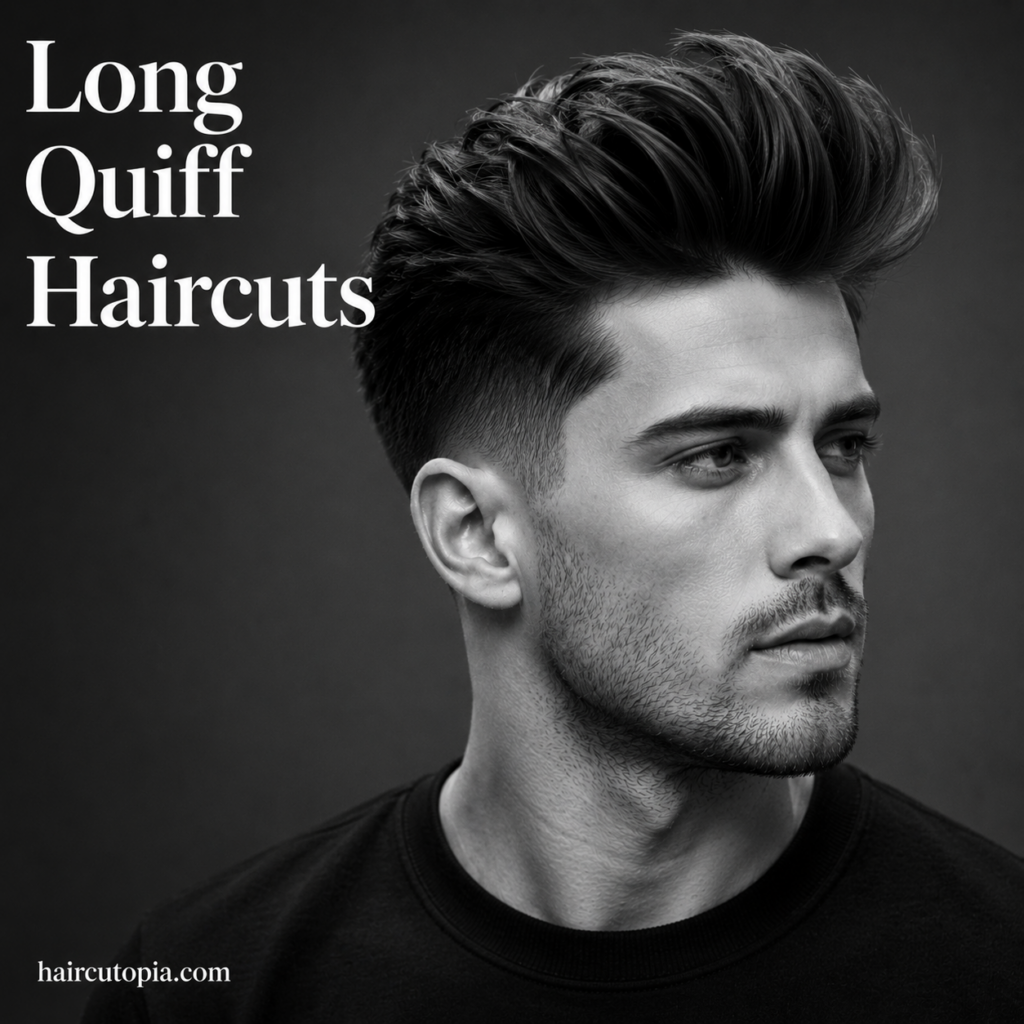
A quiff is a men’s hairstyle that keeps enough length at the front of the hair to create height and volume. The front is typically styled upward and slightly backward, while the sides and back are kept shorter.
Unlike a pompadour, which usually has a smoother and more sculpted shape, a quiff can be looser and more textured.
Some quiffs are neat enough for the office. Others have a deliberately messy finish. Modern versions are often paired with fades, tapers, or short textured sides.
The defining feature is the front.
If your hair doesn’t have enough length there, creating a noticeable quiff will be difficult regardless of the styling product you use.
What to Tell Your Barber When Asking for a Quiff
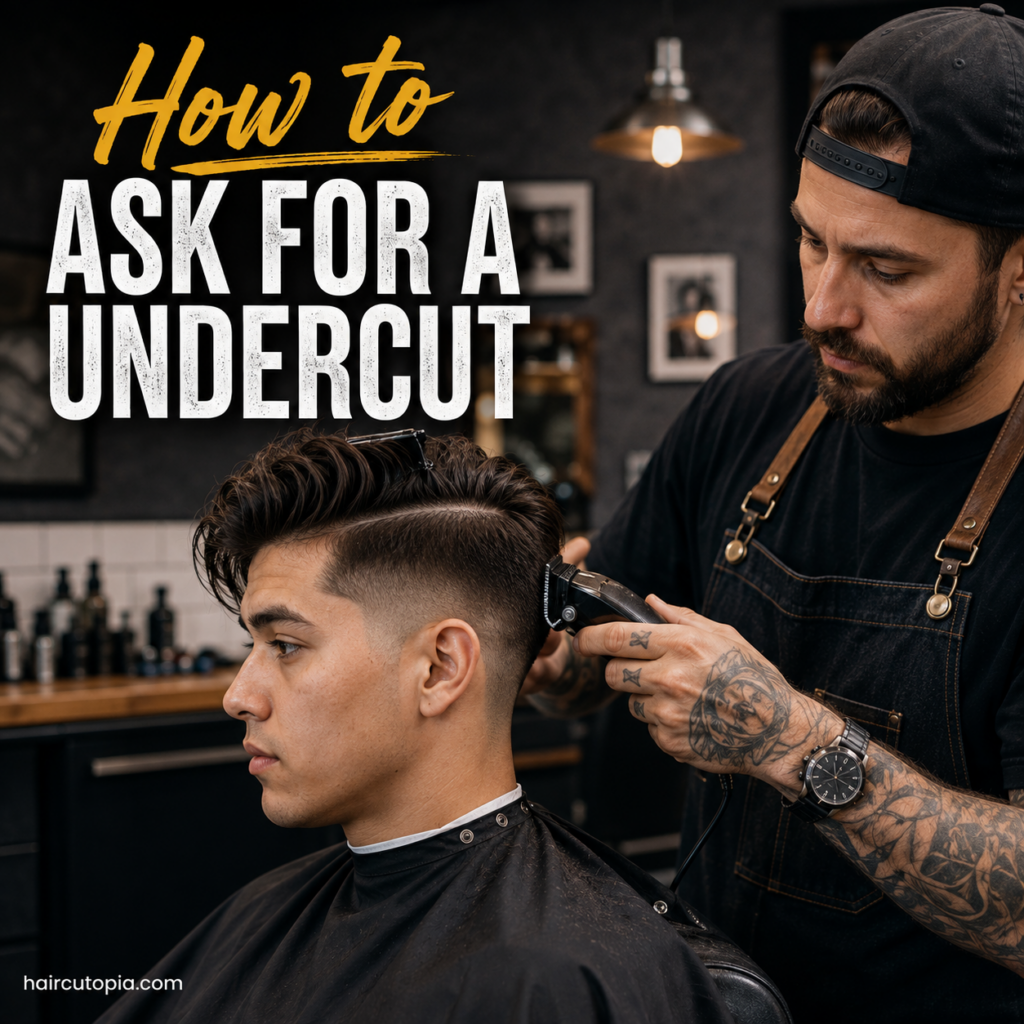
Instead of only asking for a quiff, describe the haircut in sections.
A straightforward request might sound something like this:
“I’d like a textured quiff with enough length in front to style up and back. Keep the sides shorter with a low taper, but don’t take too much length off the top.”
That gives your barber considerably more information than the word “quiff” alone.
You can then fine-tune the haircut based on the look you want.
Explain How Much Length You Want on Top
The top needs enough length to create volume.
For many quiff styles, roughly 3 to 5 inches on top gives the barber plenty to work with, although the ideal length depends on your hair type and the size of the quiff.
The front is usually one of the longest areas.
If you want a subtle quiff, you don’t necessarily need dramatic length. If you want a larger, more noticeable shape, keeping additional length toward the front will help.
Tell your barber whether you want to:
- Keep most of your existing length
- Remove some bulk without making the top much shorter
- Add texture throughout the top
- Keep extra length toward the fringe
- Create a short, controlled quiff
- Grow toward a larger quiff over several haircuts
If you’re currently growing your hair, mention that before the barber starts cutting. They can clean up the shape without removing the length you’re trying to build.
Decide How Short You Want the Sides
The sides have a major effect on how dramatic the quiff appears.
Short sides create more contrast and make the volume on top stand out. Longer sides create a softer, more traditional appearance.
Common options include:
- Low fade
- Mid fade
- High fade
- Low taper
- Classic taper
- Scissor-cut sides
- Short sides with no skin exposure
A low taper is a good option if you want the haircut to remain versatile and relatively natural.
A mid or high fade creates stronger contrast and gives the quiff a more contemporary appearance.
If you’re unsure, tell your barber how much scalp you are comfortable showing rather than guessing a clipper guard or fade height.
Tell Your Barber How You Style Your Hair
This is an easy detail to overlook.
Tell your barber how you normally style your hair and how much time you’re willing to spend on it each morning.
If you regularly use a blow dryer and styling product, your barber can leave enough length and weight to create a more substantial quiff.
If you prefer something you can style quickly with your hands, a shorter textured quiff may be more practical.
Your haircut should work with your actual routine, not just look good immediately after the barber styles it.
How Long Should Your Hair Be for a Quiff?
You generally need at least a few inches of hair on top to create a recognizable quiff.
Around 3 inches at the front can be enough for a shorter version. Four or more inches gives you considerably more styling flexibility.
There isn’t one required measurement, though.
Hair texture, density, growth direction, and the amount of volume you want all affect how much length you need.
Straight hair may require product and blow-drying to maintain volume, while naturally wavy hair can often produce texture and movement with less effort.
If your hair isn’t long enough yet, ask your barber to shape it while preserving the front.
Choosing the Right Type of Quiff
“Quiff” describes a family of hairstyles rather than one exact haircut. Knowing which variation you like will make the conversation with your barber much easier.
Classic Quiff
The classic quiff usually keeps more length through the sides than modern faded versions.
The transition between the top and sides is relatively soft, creating a balanced and polished shape.
Ask for:
- Medium length on top
- Extra length at the front
- Scissor-cut or gently tapered sides
- A natural transition between the top and sides
- Moderate volume rather than extreme height
This version works particularly well if you want something professional that doesn’t rely on a dramatic fade.
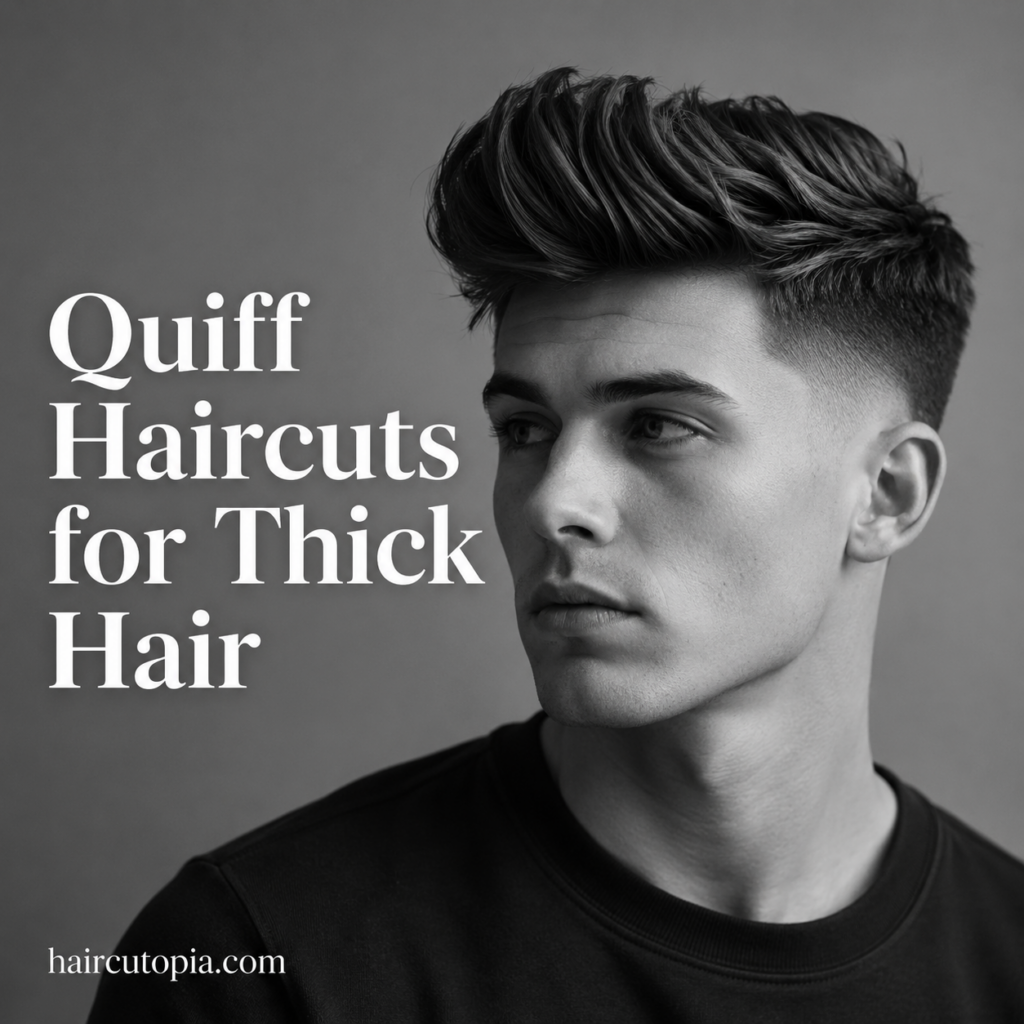
Textured Quiff
A textured quiff has more separation and movement through the top.
Instead of forming one perfectly smooth shape, individual sections of hair remain visible.
Ask your barber to keep enough length in front while adding texture through the top. Make it clear that you want movement rather than a slick, uniform finish.
Textured quiffs often pair well with matte styling products.
Quiff With a Fade
Pairing a quiff with a fade creates a much stronger difference between the top and sides.
You’ll need to specify the fade height.
A low fade keeps most of the contrast toward the bottom of the haircut. A mid fade is more noticeable, while a high fade produces a much sharper separation between the sides and the longer top.
You can also tell your barber whether you want the fade taken down to skin.
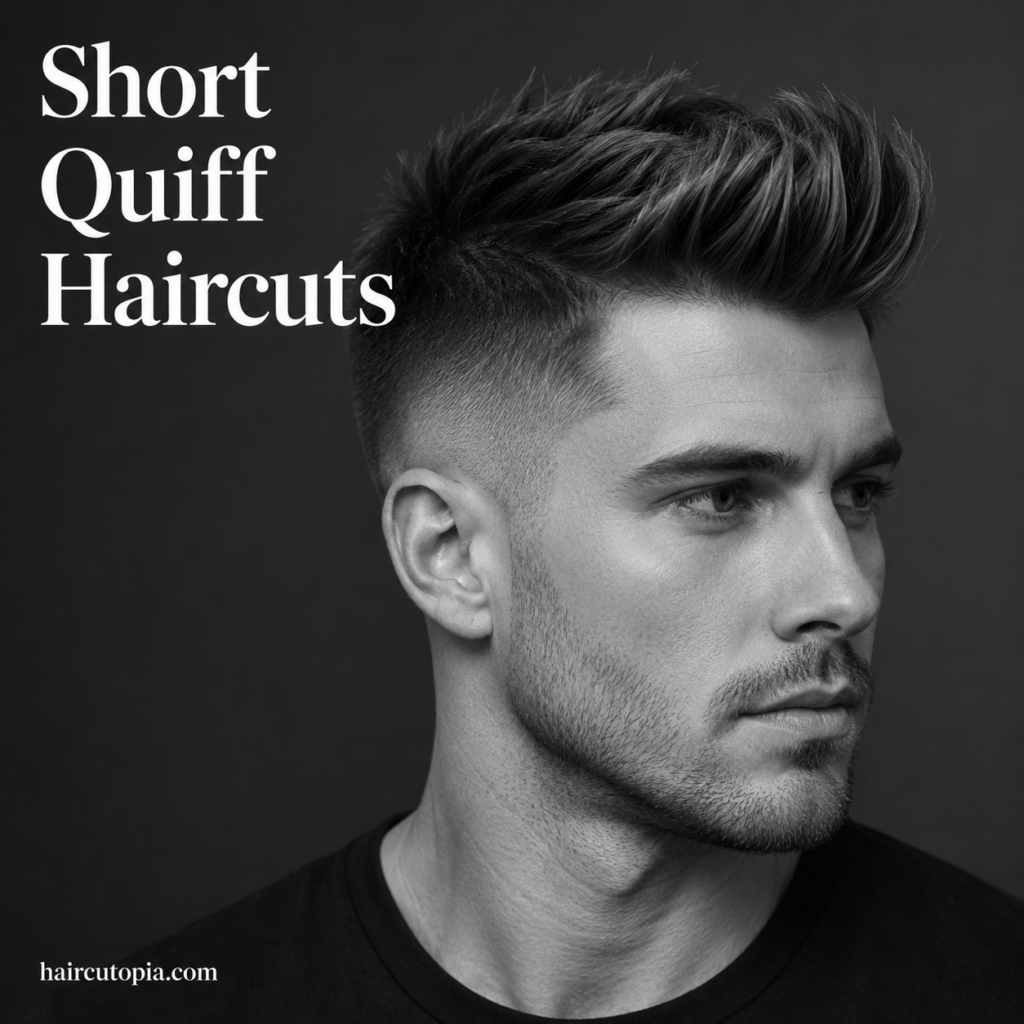
Short Quiff
You don’t need extremely long hair to wear a quiff.
A short quiff keeps the front long enough to lift while maintaining a cleaner, lower-maintenance shape.
Ask for a textured top with slightly more length at the front and shorter sides.
This is a useful option if you like the general shape of a quiff but don’t want to spend much time styling it.
Messy Quiff
A messy quiff is intentionally less structured.
The front still has height, but the hair isn’t combed into a perfectly defined shape. Texture and separation are part of the look.
Tell your barber you want a loose, textured finish rather than a slick quiff.
The haircut still needs structure underneath. “Messy” doesn’t mean the hair is simply left unshaped.
Quiff vs. Pompadour: What Should You Ask For?
Quiffs and pompadours are often confused because both hairstyles feature volume at the front.
The main difference is usually the overall shape and styling.
A pompadour tends to have:
- More uniform volume
- A smoother finish
- Hair directed strongly backward
- A more sculpted silhouette
A quiff typically has:
- More emphasis on the front
- Greater texture and separation
- A looser shape
- More flexibility in how the hair is styled
There is plenty of overlap between the two.
If you’re unsure which one you want, showing your barber a reference photo is often more useful than worrying about the exact hairstyle name.
Should You Bring a Reference Photo?
Yes.
A reference photo is one of the easiest ways to communicate what you want.
Terms such as “short,” “textured,” and even “low fade” can mean slightly different things to different people. A photo gives your barber a visual starting point.
Ideally, choose a picture showing:
- The front of the haircut
- The side profile
- The fade or taper
- The amount of volume on top
- Hair with a texture reasonably similar to yours
You don’t necessarily need to find someone with exactly the same hair.
Just remember that your barber may need to adapt the haircut to your density, growth pattern, face shape, or natural texture.
What If You Don’t Know Clipper Guard Numbers?
You don’t need to.
Knowing whether you want a #1, #2, or #3 guard can be helpful, but it isn’t a requirement for getting a good haircut.
Instead, describe what you want visually.
For example:
- “I want the sides short, but I don’t want to see much scalp.”
- “I’d like it tapered around the ears and neckline.”
- “I want noticeable contrast between the top and sides.”
- “I’d like the fade kept fairly low.”
- “Don’t take the sides down to skin.”
Those descriptions give your barber useful information without requiring you to speak in clipper measurements.
How to Ask for Texture
Texture can completely change the character of a quiff.
If you want a modern, separated appearance, tell your barber that you plan to wear the top textured rather than slicked.
You can ask for texture and movement through the top while preserving enough weight to create volume.
Avoid assuming that “more texture” is always better. Removing too much weight can make certain hair types harder to control.
Your barber can decide how aggressively to texturize the hair based on its thickness and density.
How to Ask for a Natural-Looking Quiff
Not everyone wants a towering quiff with a skin fade.
For something understated, ask for a softer taper on the sides and moderate length on top. Keep enough length around the sides that the haircut doesn’t have an extreme disconnected appearance.
You can say:
“I want a natural quiff with some volume in front, but nothing too high. Keep the sides tapered and blended rather than extremely short.”
This gives you the basic quiff silhouette without making the haircut overly dramatic.
What to Ask About Before Leaving the Barber
Once the haircut is finished, pay attention to how your barber styles it.
This is your chance to learn how to recreate the look at home.
Ask:
- Which direction should I blow-dry my hair?
- What type of product works best for my hair?
- How much product should I use?
- Should I apply it to damp or dry hair?
- How often should I get the haircut cleaned up?
A great haircut isn’t particularly useful if you can never make it look the same again.
How to Style a Quiff at Home
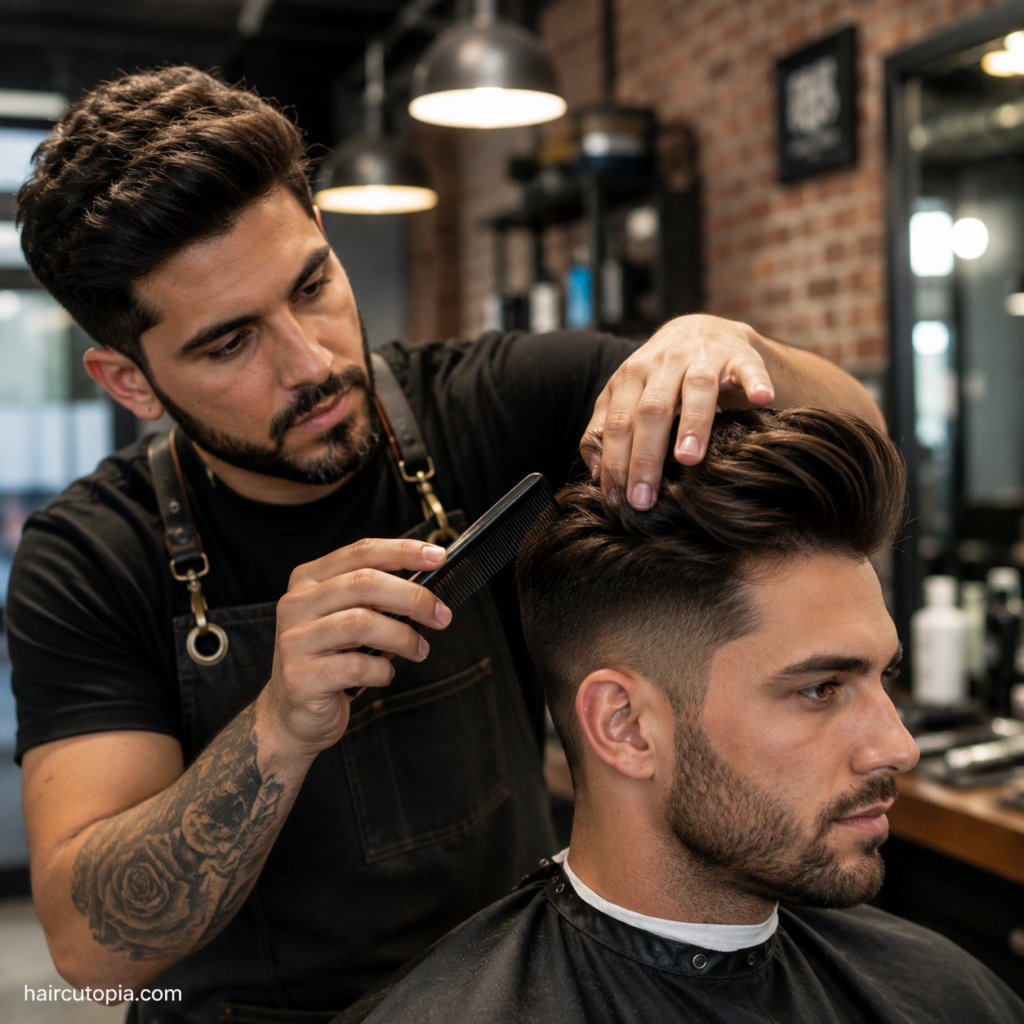
The exact routine depends on your hair, but most quiffs benefit from creating volume before applying a finishing product.
1. Start With Slightly Damp Hair
Towel-dry your hair after washing it.
You generally don’t want it soaking wet when you begin styling.
2. Apply a Pre-Styling Product if Needed
A lightweight mousse, styling cream, or volumizing product can help create structure before blow-drying.
You don’t necessarily need this step for every hair type.
3. Blow-Dry the Front Upward
The blow dryer does much of the work when creating a larger quiff.
Direct the front upward and slightly backward while using your fingers, brush, or comb to create the shape.
Don’t focus only on the fringe. Creating volume throughout the top helps the hairstyle look balanced.
4. Apply Your Finishing Product
Once the basic shape is established, use a small amount of styling product to add hold and definition.
Depending on the finish you want, you might choose:
- Matte clay for texture and stronger control
- Paste for flexible hold
- Pomade for a smoother or shinier finish
- Styling cream for lighter, more natural control
Start with less product than you think you need. You can always add more.
5. Shape the Front
Use your fingers for a textured finish or a comb for something cleaner.
Lift the front while directing it slightly backward.
The goal is to create volume without making the hairstyle look stiff or overloaded with product.
Common Mistakes When Asking for a Quiff
A few communication mistakes can make it harder for your barber to understand the haircut you’re imagining.
Only Saying “Give Me a Quiff”
That’s a starting point, not a complete haircut request.
Specify the top length, side length, fade or taper, texture, and general finish.
Cutting the Front Too Short
The front creates the characteristic shape of the quiff.
If you’re trying to grow a larger quiff, tell your barber before the haircut begins so they know to preserve that length.
Asking for a Fade Without Specifying the Height
A low fade and high fade can make the same quiff look like two very different haircuts.
Tell your barber how high you want the fade and whether you want it taken down to skin.
Choosing a Style That Doesn’t Match Your Routine
A large, polished quiff may require blow-drying and product every morning.
If you don’t want that level of maintenance, say so.
Your barber can create a shorter or more textured version that’s easier to manage.
How Often Should You Get a Quiff Trimmed?
Most quiff haircuts look their sharpest with regular maintenance.
If you have a tight fade, you may want the sides cleaned up every 2 to 3 weeks.
A softer taper or longer-sided quiff can usually go longer between appointments. Around 3 to 6 weeks is common depending on your hair growth and how polished you want the haircut to remain.
You may also be able to clean up the sides while continuing to grow the top.
Tell your barber if you’re working toward a longer style so they don’t automatically remove too much length at every appointment.
The Simplest Way to Ask for a Quiff
If you don’t want to memorize barber terminology, focus on five things:
- How much length you want on top
- How much length you want at the front
- How short you want the sides
- Whether you want a fade, taper, or longer sides
- Whether you want the finished style neat, textured, or messy
Then show your barber a reference photo.
For example:
“I’d like a textured quiff with about 3 to 4 inches on top and a little extra length in front. Keep the sides shorter with a low taper, and leave enough length so the overall look stays natural. I usually style it with a blow dryer and matte product.”
That’s specific enough to start a useful conversation while still allowing your barber to adapt the haircut to your hair.
Final Thoughts
Asking for a quiff doesn’t require knowing every barbering term or clipper guard number.
What matters is communicating the shape you want.
Describe the length on top, how much volume you want at the front, what should happen on the sides, and how you plan to style your hair at home. A good reference photo can fill in the remaining details.
Most importantly, treat the haircut as a conversation rather than a single instruction. Your barber can tell you whether the exact quiff you’re considering will work with your current length and hair type—and suggest adjustments that make it easier to style once you’re out of the chair.