A pompadour can look incredibly sharp after a fresh haircut, but keeping that shape is a little different from maintaining a shorter, simpler style. You have length and volume on top to manage, while the sides may need regular attention—especially if your pompadour is paired with a fade.
The good news is that you don’t need a full haircut every week.
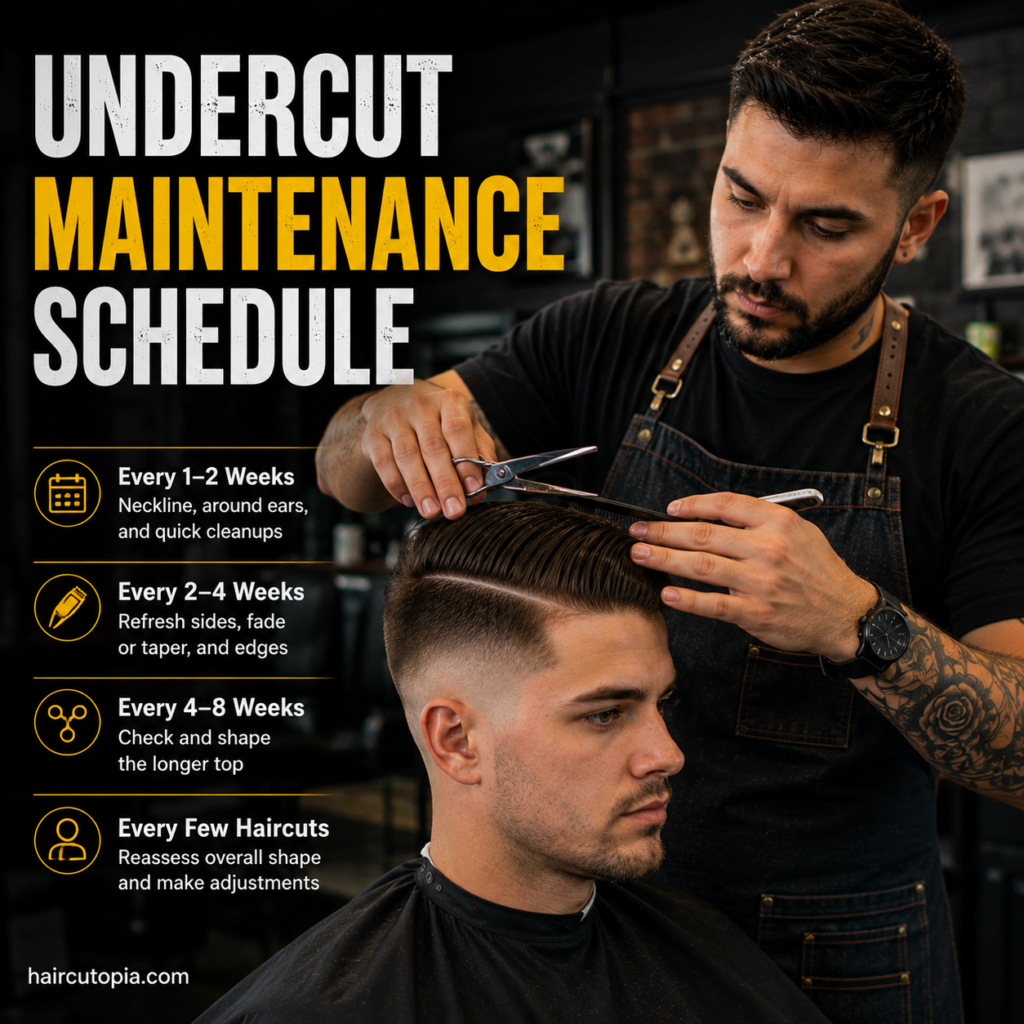
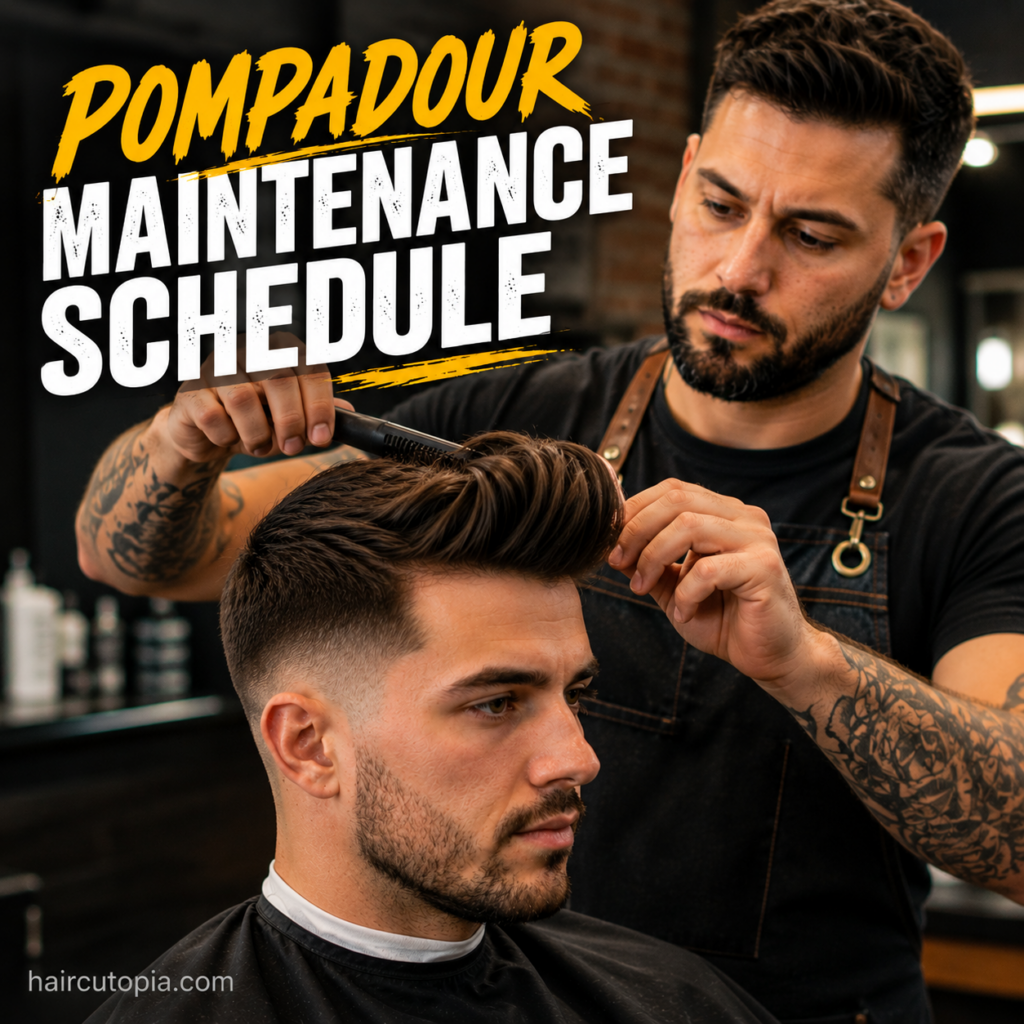
A practical pompadour maintenance schedule combines daily styling, regular washing based on your hair and scalp, occasional product cleanup, and barber visits before the haircut becomes difficult to control.
How often you need each step depends on your hair type, how quickly your hair grows, and whether you’re wearing a classic pompadour, taper, or tight fade.
Here’s a realistic schedule you can adjust to your own hair.
Quick Pompadour Maintenance Schedule
If you want a simple starting point, use this schedule:
- Daily: Restyle as needed and reshape the front
- Every few days or as needed: Shampoo based on oil, sweat, and product buildup
- Regularly: Condition according to your hair’s needs
- Weekly: Check for buildup and clean styling tools
- Every 2–3 weeks: Refresh very short or skin fades
- Every 3–5 weeks: Maintain most tapered or faded pompadours
- Every 4–6 weeks: Reshape longer classic pompadours
- As needed: Remove excess weight from the top while preserving front length
These aren’t strict deadlines.
Someone with fast-growing hair and a skin fade may want to see a barber much sooner than someone wearing a longer, traditional pompadour.
Daily Pompadour Maintenance
Most pompadour maintenance happens during styling.
You don’t necessarily need to shampoo and completely rebuild the hairstyle every morning. If your hair and scalp feel clean enough, a quick refresh may be all that’s necessary.
Morning Styling
After sleeping, the pompadour will usually be flattened or pushed out of shape.
That’s normal.
To reset it:
- Lightly dampen your hair if necessary.
- Loosen any leftover product with your fingers.
- Direct the hair upward and backward with a blow dryer.
- Give the front additional lift.
- Make sure the hair is dry.
- Apply a small amount of styling product if needed.
- Shape the pompadour with your fingers, brush, or comb.
You may be able to reuse some of yesterday’s styling product rather than adding another full application.
If your hair feels heavily coated, however, it’s probably better to wash it instead of continuing to layer on more product.
Evening Maintenance
You don’t need to preserve the pompadour’s exact shape while you sleep.
If you’ve used a lot of product or your scalp feels sweaty or uncomfortable, you may prefer to wash your hair.
Otherwise, you can simply leave it alone and restyle it the following morning.
The important thing is avoiding endless layers of product without periodically cleaning your hair.
How Often Should You Wash a Pompadour?
There’s no universal shampoo schedule for a pompadour.
Your scalp, hair texture, activity level, styling products, and personal preference all matter.
Someone with an oily scalp who exercises daily may wash more frequently than someone with dry or curly hair.
Instead of following a rigid schedule, watch for signs that your hair needs washing:
- Oily roots
- Visible styling residue
- Heavy or waxy hair
- Scalp discomfort
- Sweat buildup
- Difficulty restyling
- Hair that stays flat despite blow-drying
If the hair still feels manageable and your scalp feels comfortable, you may not need to shampoo simply because another day has passed.
Condition According to Your Hair Type
The longer top of a pompadour can benefit from conditioning, particularly if you regularly blow-dry your hair.
Conditioner helps keep the hair manageable and can reduce the dry, rough feeling that makes longer sections difficult to control.
Focus primarily on the lengths of your hair rather than automatically applying a large amount directly to the scalp.
Fine hair may need a lighter conditioner, while coarse, curly, or dry hair may benefit from more moisture.
The goal is balance.
Hair that’s extremely dry can be difficult to shape, but hair weighed down by heavy conditioning products can also struggle to maintain volume.
Weekly Pompadour Maintenance
Once a week, take a little extra time to look beyond the morning styling routine.
This doesn’t need to become an elaborate grooming ritual.
Check for Product Buildup
Pomade, clay, wax, paste, pre-stylers, and hairspray can accumulate over time.
Run your fingers through clean, dry hair.
If it still feels coated or unusually heavy after regular shampooing, you may have product buildup.
An occasional deeper wash or clarifying shampoo may help remove stubborn residue. Because clarifying products can be more cleansing than everyday shampoo, they generally don’t need to be used constantly.
Clean Your Comb and Brushes
Your styling tools collect more than hair.
Brushes and combs can accumulate:
- Styling product
- Natural oils
- Loose hair
- Dust
- Skin debris
Remove trapped hair and clean your tools according to their materials.
A clean brush or comb is much nicer to put back into freshly washed hair than one coated in several weeks of old pomade.
Check Your Overall Shape
Take a look at your hairstyle from more than just the front.
Use a second mirror or your phone to check the sides and back.
Look for:
- Bulging around the sides
- An overgrown neckline
- A fade losing definition
- Excess weight around the crown
- Uneven growth
- A top that’s becoming difficult to control
Catching these changes early helps you decide whether you need a full haircut or simply a cleanup.
Every 2–3 Weeks: Maintain Tight Fades
If your pompadour is paired with a skin fade, bald fade, or another very short fade, the sides may look grown out long before the top needs cutting.
Around the two- to three-week point, you may notice that the contrast is less defined.
This doesn’t mean you need to remove length from the pompadour itself.
You can ask your barber to refresh the fade while leaving most of the top alone.
This is particularly useful if you’re intentionally growing the top longer.
What to Ask Your Barber
Try something simple:
“Can we refresh the fade but keep the length on top? I’m maintaining the pompadour.”
That tells your barber that the goal is cleanup rather than a complete reset.
Every 3–5 Weeks: Maintain a Tapered Pompadour
A pompadour paired with a taper usually grows out more gracefully than one with a skin fade.
The sides remain longer, so a little growth doesn’t immediately destroy the contrast.
For many people, a barber visit somewhere around every three to five weeks is a reasonable starting point.
At the appointment, your barber can:
- Clean up the taper
- Refine the neckline
- Manage the sideburns
- Remove excess bulk
- Reshape the top
- Preserve length through the front
You may not need every one of these services at every appointment.
Tell your barber what has become difficult to manage since your previous cut.
Every 4–6 Weeks: Maintain a Classic Pompadour
A traditional pompadour usually carries considerably more length through the sides than modern faded versions.
That means it can tolerate growth better.
A haircut approximately every four to six weeks may work well, although some people can comfortably go longer.
The goal isn’t necessarily to make the sides short.
Instead, your barber maintains the proportions so the sides continue flowing into the top without becoming bulky.
This is also an opportunity to remove excess weight through the top while keeping enough length for the signature pompadour shape.
When Should the Top of a Pompadour Be Trimmed?
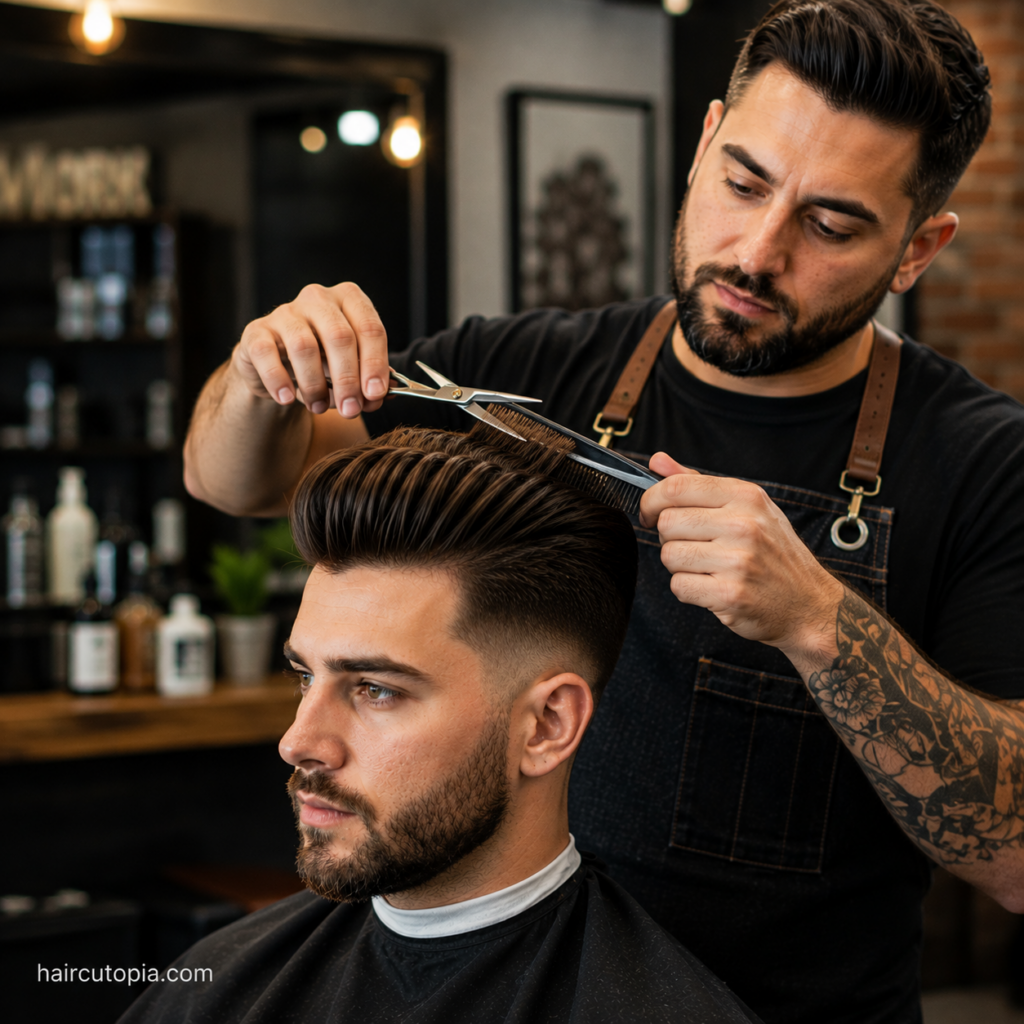
Don’t assume the top needs significant length removed every time you visit the barber.
The front is especially important.
A pompadour needs sufficient length to rise upward before flowing backward. If the front is cut too short at every appointment, you’ll constantly struggle to build height.
Instead, trim the top when:
- It feels excessively heavy
- Styling takes noticeably longer
- The front continually falls forward
- The crown becomes difficult to blend into the shape
- The hairstyle loses its balance
- The ends need cleaning up
- You no longer want the current length
Sometimes your barber only needs to remove bulk rather than dramatically shorten the hair.
Don’t Confuse Length With Weight
This distinction is important for pompadour maintenance.
Hair can become difficult to style because it’s too heavy without necessarily being too long.
For example, thick hair may accumulate enough bulk that the pompadour begins collapsing under its own weight.
Your barber may be able to strategically reduce that bulk while preserving much of the visible length.
That’s different from simply cutting several inches off.
If you like the length but dislike how heavy the style has become, say exactly that.
Maintenance Schedule for a Pompadour Fade
If you wear a modern pompadour with faded sides, your schedule might look like this:
Week 1
Your haircut is fresh.
Focus on learning how the barber styled it and recreating the same shape at home.
Pay attention to the amount of product and blow-drying technique used.
Week 2
The fade will begin showing some growth.
For many people, it will still look clean enough.
Continue your normal styling routine.
Week 3
A skin or very short fade may now look noticeably softer.
This is a good time for a fade refresh if you like keeping the sides extremely sharp.
Week 4
Many faded pompadours are ready for more substantial maintenance.
The barber can clean up the sides and assess whether the top needs reshaping.
Then the cycle begins again.
Maintenance Schedule for a Classic Pompadour
A classic pompadour follows a slower rhythm.
Weeks 1–2
The haircut should retain most of its intended proportions.
Maintain the style through regular blow-drying and product use.
Weeks 3–4
You may notice additional weight through the sides and top.
This isn’t necessarily a problem. Some classic pompadours actually become easier to style with a little extra length.
Weeks 5–6
The sides may begin losing their shape and the top can become heavier.
This is a common time to schedule a trim.
Ask your barber to restore the proportions without unnecessarily shortening the front.
How Hair Growth Rate Changes Your Schedule
Hair doesn’t grow according to your barber appointment calendar.
Some people notice their haircut changing significantly within a couple of weeks. Others can go much longer before the style feels overgrown.
Instead of obsessing over an exact number of days, learn the signs your own hair gives you.
Your maintenance schedule should become shorter if:
- Your hair grows quickly
- You wear a skin fade
- You prefer extremely sharp edges
- Your sides become bulky quickly
- Your job or personal style calls for a consistently polished haircut
You may be able to extend appointments if:
- You wear longer sides
- Your haircut grows out evenly
- You prefer a relaxed finish
- Your hair remains easy to style
- You don’t mind softer edges
The best schedule is the one that keeps the haircut manageable without sending you to the barbershop unnecessarily.
Seasonal Pompadour Maintenance
Your styling routine may need small adjustments throughout the year.
Hot and Humid Weather
Heat and humidity can make some pompadours lose shape faster.
You may need:
- Lighter product
- Stronger finishing hold
- More attention to blow-drying
- More frequent washing after sweating
- Slightly shorter or less bulky sides
Avoid simply piling on more heavy product.
That can make the hair feel even less manageable.
Cold and Dry Weather
Dry air can leave some hair feeling rough or brittle.
You may find that conditioning becomes more important, particularly if you’re regularly using a blow dryer.
A slightly more flexible or moisturizing styling product may also feel better than a very dry clay.
When to Replace Your Styling Products
Hair products don’t need to be replaced according to your haircut schedule, but they shouldn’t live in the bathroom forever.
Check the packaging for the manufacturer’s recommended period after opening or expiration information.
Replace a product if you notice unexpected changes in:
- Smell
- Texture
- Consistency
- Color
- Performance
Keep containers properly closed and store products according to their instructions.
When Your Current Routine Stops Working
Sometimes a pompadour becomes difficult to style even though you’re doing exactly what worked a month ago.
That doesn’t necessarily mean you need a new product.
Your hair may simply have changed length or weight.
Before buying something stronger, consider:
- Is the top much longer?
- Have the sides become bulky?
- Is there product buildup?
- Are you applying too much product?
- Are you fully drying the hair?
- Has the weather changed?
- Does the haircut need reshaping?
A trim may solve a problem that another jar of pomade won’t.
Signs You’re Over-Maintaining Your Pompadour
Maintenance can go too far.
If you’re constantly trimming the hairstyle, you may never allow enough length to develop through the front.
Similarly, excessive product, aggressive washing, or unnecessary heat can make your routine more complicated than it needs to be.
You probably don’t need to:
- Shampoo solely because you styled your hair that day
- Apply several finishing products at once
- Get the top shortened every time the fade is refreshed
- Use maximum dryer heat every morning
- Completely restyle the hair every few hours
- Keep adding product whenever the front drops slightly
A pompadour requires attention, but it shouldn’t become a full-time project.
A Simple Long-Term Pompadour Maintenance Plan
For an easy routine, think about maintenance in four layers.
Daily
Style and reshape the pompadour.
Use the blow dryer for volume and add only as much product as necessary.
As Needed During the Week
Wash and condition based on your scalp, hair type, activity level, and product buildup.
Refresh the style with water and blow-drying when a complete wash isn’t necessary.
Weekly
Check your styling tools, product buildup, and overall haircut shape.
Clean your brushes and combs.
Every Few Weeks
Visit your barber based on the type of pompadour you’re wearing.
A tight fade may need attention around two to three weeks, while a classic pompadour can often go four to six weeks or longer depending on growth.
What to Tell Your Barber at Maintenance Appointments
You don’t need to explain the entire haircut again every time, particularly if you’re visiting the same barber.
Tell them what changed since the last appointment.
Useful comments include:
- “The sides started feeling bulky after three weeks.”
- “Keep the front at about this length.”
- “I’d like the fade refreshed without taking much off the top.”
- “The top feels heavy, but I don’t want it much shorter.”
- “The last length was easy to style.”
- “I’d like the same shape as last time.”
If your pompadour looked especially good on a particular day, take a photo.
That gives you and your barber a useful reference at future appointments.
Final Thoughts
A good pompadour maintenance schedule isn’t based on one rigid rule.
The haircut on the sides largely determines how often you’ll need professional maintenance. Tight fades may need refreshing every two to three weeks, tapered versions often fall somewhere around three to five weeks, and longer classic pompadours may comfortably go four to six weeks between trims.
At home, maintenance is mostly about keeping the hair manageable.
Wash according to your scalp and product use, condition when your hair needs moisture, keep your styling tools clean, and use blow-drying to restore the shape instead of relying on increasingly heavy layers of product.
Most importantly, don’t cut the top simply because the sides need attention.
Preserving the right length and controlling excess weight will make your pompadour easier to style—and keep you from starting the growing process over every few weeks.