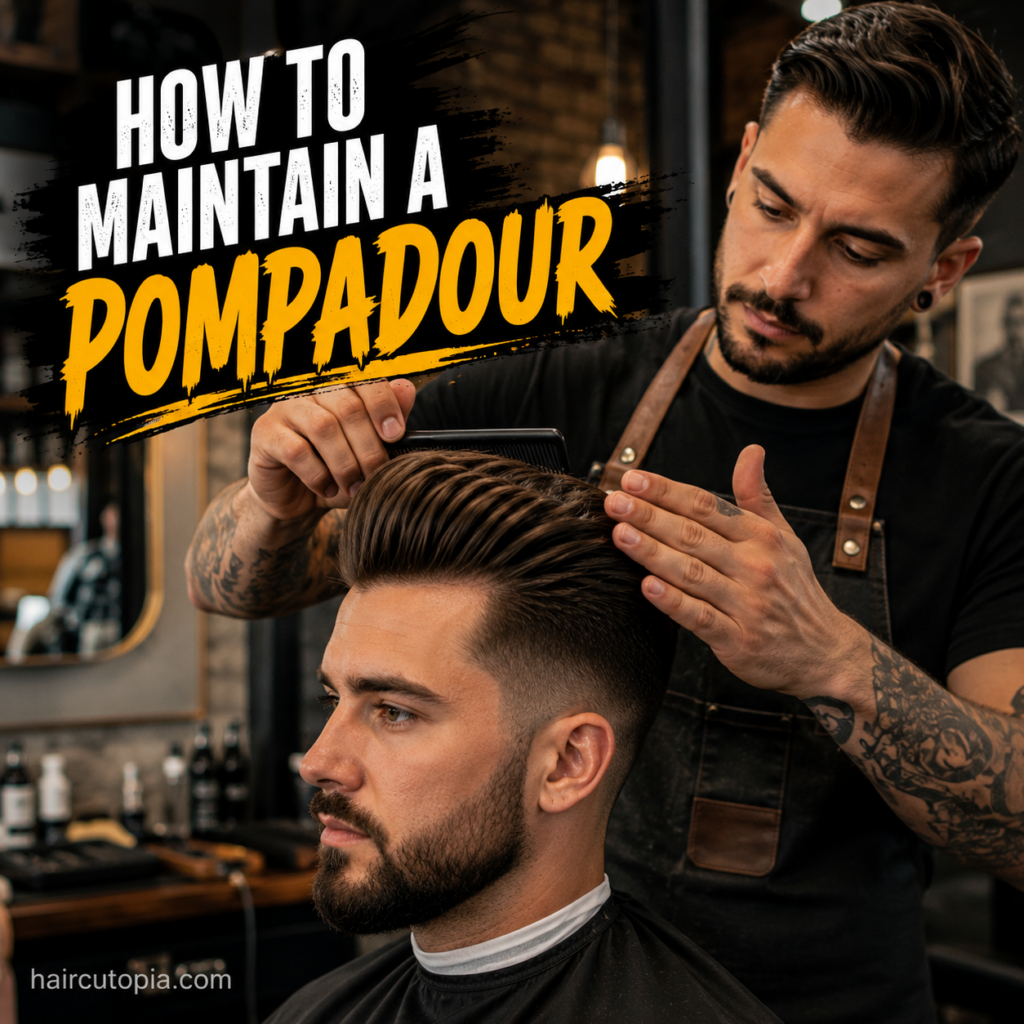
A fresh pompadour can look almost effortless when you leave the barbershop. The front has height, the sides are clean, and every strand seems to fall exactly where it should.
Then you wake up the next morning and have to recreate it yourself.
Maintaining a pompadour isn’t especially difficult once you understand what the style needs. The key is keeping enough length in the right places, controlling the shape as your hair grows, and using a styling routine that creates volume without loading your hair with product.
Whether you wear a classic pompadour with fuller sides or a modern version paired with a fade, this guide covers how to maintain the haircut between barber visits, style it at home, and keep it looking intentional as it grows.
What Does a Pompadour Need to Stay in Shape?
A pompadour depends on proportion.
The hair toward the front needs enough length to rise before sweeping backward. The rest of the top supports that shape, while the sides provide either a smooth transition or deliberate contrast.
As your hair grows, those proportions gradually change.
The sides may become bulky. The top can get heavy. A tight fade begins losing definition. Eventually, the front may become harder to control even though you technically have more hair to work with.
Good pompadour maintenance comes down to four things:
- Regular trims
- Proper washing and conditioning
- Consistent blow-drying
- Using the right amount of styling product
You don’t necessarily need to spend a long time on your hair every morning. A good haircut and a repeatable routine make most of the difference.
How Often Should You Get a Pompadour Trimmed?
Most pompadours benefit from a haircut approximately every three to six weeks, but the right schedule depends on the variation you’re wearing.
A tight fade requires more frequent maintenance than a traditional pompadour with longer sides.
Pompadour With a Skin or Short Fade
If your pompadour is paired with a skin fade or very short clipper fade, you may want a cleanup every two to three weeks.
The top might not need much attention that frequently. It’s usually the sides that make the haircut start looking grown out.
Some people alternate between full haircuts and quick fade cleanups.
Pompadour With a Taper
A tapered pompadour usually grows out more naturally.
Around three to five weeks between haircuts works well for many people, depending on hair growth and how polished you want the style to remain.
Classic Pompadour
Traditional pompadours generally keep more length through the sides and back, so the haircut can be more forgiving as it grows.
A full trim every four to six weeks may be enough.
Rather than following the calendar exactly, pay attention to the shape. If the sides are beginning to puff outward or the top is becoming difficult to style, it’s probably time for a cleanup.
Don’t Cut Too Much Length From the Front
The front is the centerpiece of a pompadour.
It needs enough length to create height and curve backward. Cutting it too short can make the hairstyle collapse into something closer to a short quiff.
When you return to your barber, explain that you’re maintaining a pompadour rather than starting over with a completely new haircut.
You can say:
“Keep the length through the front. I mainly want to clean up the shape and remove some excess weight.”
Your barber can then adjust the rest of the haircut without unnecessarily removing the length you’ve been growing.
Keep the Sides Under Control
The sides often show growth before the top becomes a problem.
This is especially noticeable with modern pompadours because the contrast between a longer top and shorter sides is part of the style.
If you wear a fade, maintaining that fade will keep the entire haircut looking fresher.
With a classic pompadour, the goal is different. You generally want to prevent the sides from becoming bulky without taking them so short that the haircut loses its traditional shape.
Your barber may use scissors, clippers, or a combination of both depending on the style.
Wash Your Pompadour Without Overdoing It
Pompadours often require styling products, so washing is important. That doesn’t necessarily mean aggressively shampooing your hair every morning.
How frequently you should shampoo depends on your scalp, hair type, activity level, and the products you use.
If your hair feels greasy, coated, itchy, or difficult to style because of product buildup, it’s probably time to wash it.
On the other hand, excessively frequent washing may leave some hair types feeling dry or harder to control.
Use Shampoo When You Need to Remove Buildup
Styling waxes, pomades, clays, and pastes can accumulate over time.
Use a shampoo appropriate for your hair and scalp to remove excess oil and styling residue.
If you use heavier products regularly, an occasional clarifying shampoo can help with stubborn buildup. Clarifying formulas can be more cleansing than everyday shampoos, so they generally don’t need to be used every day.
Don’t Forget Conditioner
Conditioner can make longer hair on top easier to manage, particularly if your hair tends to feel dry or rough.
Apply it mainly through the lengths rather than concentrating it directly on the scalp.
Healthy, manageable hair is easier to shape than hair that is excessively dry or tangled.
Learn to Blow-Dry Your Pompadour
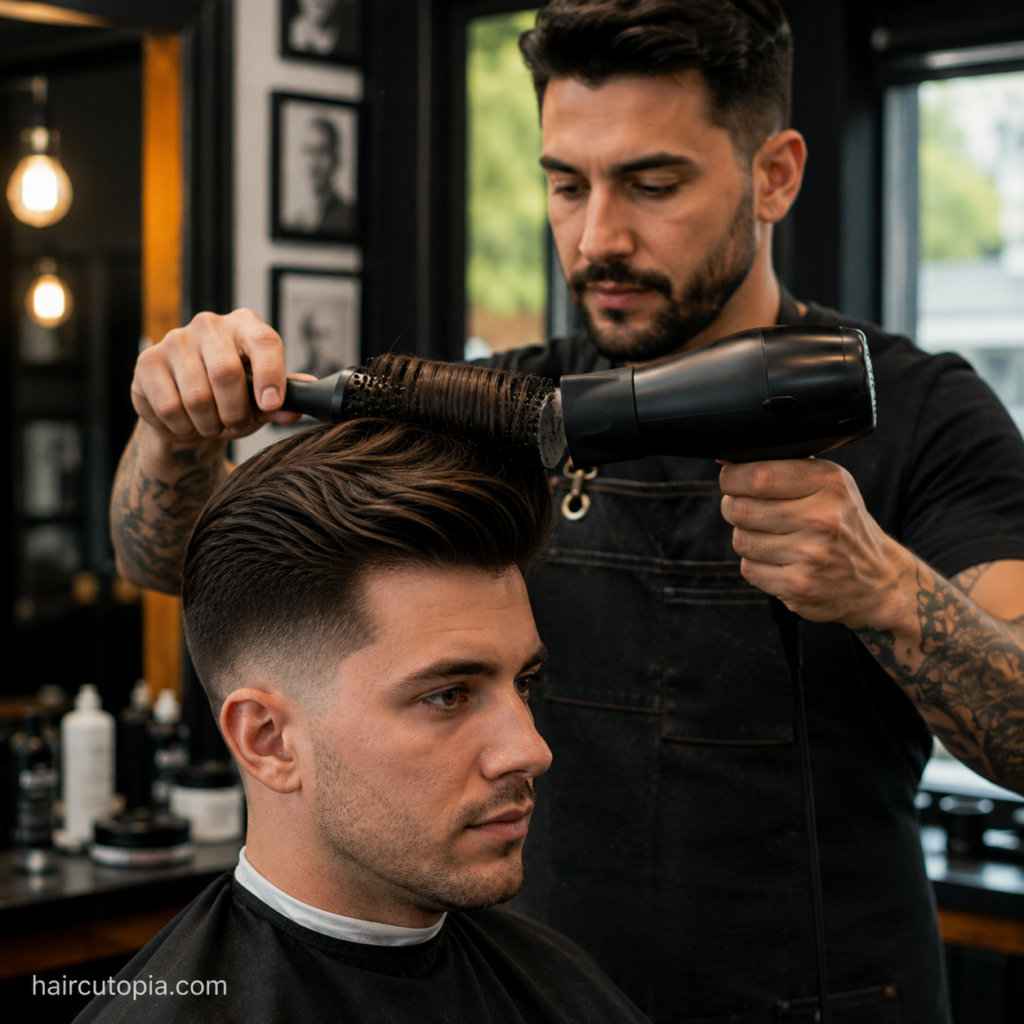
If there’s one styling skill worth learning for a pompadour, it’s blow-drying.
Trying to create all the volume with pomade alone usually results in using far more product than necessary.
A blow dryer creates the basic structure first. Styling product then helps refine and hold that structure.
How to Blow-Dry a Pompadour
A simple routine looks like this:
- Start with damp, towel-dried hair.
- Apply a small amount of pre-styling product if you use one.
- Begin drying the sides in the direction you want them to sit.
- Direct the hair on top backward while lifting it away from the scalp.
- Focus extra attention on the front.
- Lift the front upward before directing it backward.
- Continue until your hair is mostly or completely dry.
- Shape the pompadour with your fingers, brush, or comb.
The goal is to establish the silhouette before applying your finishing product.
If your hair already has the basic pompadour shape after blow-drying, you’ll need much less product to finish it.
Use a Brush or Comb to Build Volume
Your choice of tool affects the finish.
A comb can create a cleaner, more structured pompadour. Your fingers create more separation and a casual texture.
A vented or round brush can also help lift the hair while blow-drying.
For a traditional polished pompadour, you might use a comb to refine the final shape.
For a modern textured pompadour, your fingers may be all you need once you’ve established volume with the blow dryer.
Choose the Right Styling Product
There’s no single best product for every pompadour.
The right choice depends on your hair type and the finish you’re trying to achieve.
Pomade
Pomade is closely associated with classic pompadour styling.
It works well when you want:
- A smooth finish
- Defined shape
- Controlled movement
- Medium to strong hold
- Some degree of shine
Water-based pomades are generally easier to wash out, while traditional oil-based formulas can provide a different feel and longer-lasting restylability.
Hair Clay
Clay works particularly well for modern pompadours.
It’s a good option if you prefer:
- Lower shine
- Stronger texture
- A more natural appearance
- Good control
- A thicker-looking finish
Clay can work especially well for shorter or more textured versions of the hairstyle.
Paste
Styling paste sits somewhere between highly polished pomade and dry-textured clay.
It can be useful when you want flexible control without making the hairstyle look overly styled.
Styling Cream
Creams generally provide softer control.
They can work for loose pompadours or hair that already has plenty of natural volume and doesn’t require a heavy hold.
Start With Less Product
One of the easiest ways to ruin a pompadour is to use too much product.
Heavy product can pull the hair downward, reducing the volume you worked to create with the blow dryer.
Start with a small amount.
Warm the product between your palms, distribute it through your hair, and see how the style responds. You can always add a little more.
Pay particular attention to distributing the product rather than depositing most of it at the front.
Work it through the hair evenly, then shape the pompadour.
How to Maintain Pompadour Volume Throughout the Day
A pompadour naturally loses some volume as the day goes on.
Heat, humidity, hats, physical activity, and touching your hair can all affect the shape.
You can improve staying power by building the volume during blow-drying rather than relying exclusively on finishing products.
For longer-lasting volume:
- Start with damp rather than soaking-wet hair
- Blow-dry the roots upward
- Avoid excessive heavy product
- Make sure the hair is fully dry before finishing
- Use a light hairspray if additional hold is needed
- Avoid constantly running your hands through the style
If your pompadour repeatedly collapses within an hour or two, the problem may be your styling technique rather than a lack of product.
How to Maintain a Pompadour Overnight
Don’t expect your pompadour to survive a full night’s sleep in perfect condition.
Fortunately, it doesn’t need to.
Instead of trying to preserve the exact shape overnight, focus on keeping your hair manageable.
In the morning, lightly dampening the hair can make it easier to reset. You don’t necessarily need to completely soak or shampoo it every time you style.
For some hair types, a little water followed by a quick blow-dry is enough to reactivate the shape.
If you’ve used a significant amount of product the previous day, you may prefer to wash it out before restyling.
What to Do When Your Pompadour Starts Growing Out
A slightly overgrown pompadour isn’t necessarily a bad thing.
More length can actually give you additional styling possibilities. The problem occurs when the weight and proportions become difficult to manage.
Signs that your pompadour may need a trim include:
- The sides are beginning to bulge outward
- The fade has lost its shape
- The top feels excessively heavy
- The front keeps falling forward
- Blow-drying takes noticeably longer
- You need increasingly more product
- The hairstyle no longer holds its intended silhouette
You may not need much hair removed.
Sometimes cleaning up the sides and strategically reducing weight through the top is enough to restore the shape.
Avoid Trimming the Pompadour Yourself
It’s tempting to fix a stray section or overgrown sideburn at home.
Small grooming touch-ups are one thing, but reshaping a pompadour yourself can become difficult quickly.
The hairstyle relies on carefully distributed length and weight. Removing too much from one area can affect how another section sits.
This is particularly important around the transition between the sides and longer top.
If you want to maintain a fade between appointments, you can ask your barber whether they offer quick cleanup appointments instead of attempting to rebuild the blend yourself.
Adjust Your Routine for Your Hair Type
Different hair types require slightly different approaches.
Fine Hair
Fine hair may struggle with volume if you use heavy products.
Focus on blow-drying and consider lightweight products that provide hold without weighing the hair down.
Applying too much pomade can make fine hair separate and expose more of the scalp.
Thick Hair
Thick hair usually has plenty of natural volume but may become difficult to control as it grows.
Regular trims can prevent excessive bulk.
You may also need a stronger product, but don’t assume more product is always better. Proper blow-drying still does much of the work.
Wavy Hair
Wavy hair can give a pompadour natural texture and movement.
You don’t have to eliminate every wave. Working with your natural pattern can create a softer, more relaxed version of the hairstyle.
Curly Hair
Curly pompadours can develop significant natural volume.
Moisture and curl definition may be just as important as hold, so avoid automatically choosing the strongest, driest styling product available.
Your barber can also shape the haircut to encourage the curls to sit in the right direction.
Protect Your Hair From Excessive Heat
A blow dryer is extremely useful for maintaining a pompadour, but you don’t need maximum heat every morning.
Use enough heat to shape the hair effectively without holding the dryer extremely close to one area for a prolonged period.
A heat-protectant product can also be useful if you frequently use heated styling tools.
The goal isn’t to avoid blow-drying. It’s to use heat sensibly.
How to Refresh a Pompadour Without Washing It
Not every styling session requires a complete shampoo and reset.
If your hair isn’t particularly oily or coated with product, you may be able to refresh it quickly.
Try this:
- Lightly dampen the areas that have lost their shape.
- Use your fingers or comb to loosen the previous style.
- Blow-dry the top upward and backward again.
- Reshape the front.
- Add a tiny amount of product only if necessary.
This can be especially useful the day after a full wash and style.
Keep Your Haircut Consistent With the Style You Want
Maintenance becomes much easier when your barber knows what you’re trying to preserve.
If you liked your previous haircut, tell them.
You can even take photos of your hair on the day it looks best. At your next appointment, those photos provide a reference for the length, shape, and fade you want to maintain.
Try to be specific about what worked.
For example:
- “I liked the amount of length we left in front last time.”
- “Let’s keep the fade at the same height.”
- “The top got a little too heavy after three weeks.”
- “I’d like to keep more weight through the sides.”
- “I want the same shape but slightly more texture.”
Those details help your barber refine the haircut over time.
Common Pompadour Maintenance Mistakes
A few habits can make the hairstyle harder to maintain than it needs to be.
Using Too Much Styling Product
More product doesn’t automatically mean more hold.
Too much can flatten the hairstyle, create buildup, and make the hair difficult to restyle.
Skipping the Blow Dryer
Trying to create a large pompadour using only your hands and pomade makes styling much harder.
Build the shape with airflow first.
Letting the Sides Grow Too Long
Even when the top still looks good, bulky sides can change the entire silhouette.
A quick cleanup may be all you need.
Removing Too Much Length During Every Haircut
You don’t need to rebuild the pompadour from scratch at every appointment.
If you’re happy with the length on top, ask your barber to preserve it and focus on maintaining the shape.
Fighting Your Natural Texture
A pompadour doesn’t have to be perfectly smooth.
Waves, curls, and natural separation can give the hairstyle character. Sometimes working with your hair is much easier than trying to force it into a completely different texture.
A Simple Pompadour Maintenance Routine
If you want to keep things straightforward, use this as a starting routine:
- Wash and condition your hair as needed for your hair and scalp.
- Towel-dry until the hair is damp.
- Apply a lightweight pre-styler if needed.
- Blow-dry the top upward and backward.
- Give the front additional lift.
- Apply a small amount of your preferred styling product.
- Shape with your fingers for texture or a comb for a polished finish.
- Refresh with water and a quick blow-dry between washes when appropriate.
- Schedule regular barber visits before the haircut completely loses its shape.
Once you’ve done this a few times, styling a pompadour becomes much more intuitive.
Final Thoughts
Maintaining a pompadour is mostly about preserving its shape and learning how to recreate the volume your barber gave you.
Keep enough length through the front, prevent the sides from becoming overly bulky, and schedule trims based on how quickly your particular haircut loses its proportions. At home, focus on blow-drying before reaching for more styling product.
The routine doesn’t have to be complicated.
Once you know how your hair responds to heat, moisture, and your preferred product, you’ll spend less time fighting with it and more time simply putting the style back into place.
A good pompadour should look deliberate without requiring half your morning to maintain it.