Knowing how to talk to your barber can make the difference between leaving the shop with exactly what you wanted and spending the next few weeks wondering where the conversation went wrong.
You don’t need to know professional barber terminology. You don’t need to memorize clipper guard numbers either. What matters is being able to explain the result you want clearly enough that your barber can translate it into a haircut.
That means talking about length, shape, styling, maintenance, and the things you definitely don’t want. A few good reference photos help too.
Here’s how to communicate with your barber before and during a haircut—even if you have no idea what your hairstyle is technically called.
Start With the Overall Haircut You Want
Before getting into details, give your barber the big picture.
If you know the name of the haircut, that’s a useful starting point:
- Crew cut
- Buzz cut
- Textured crop
- Side part
- Pompadour
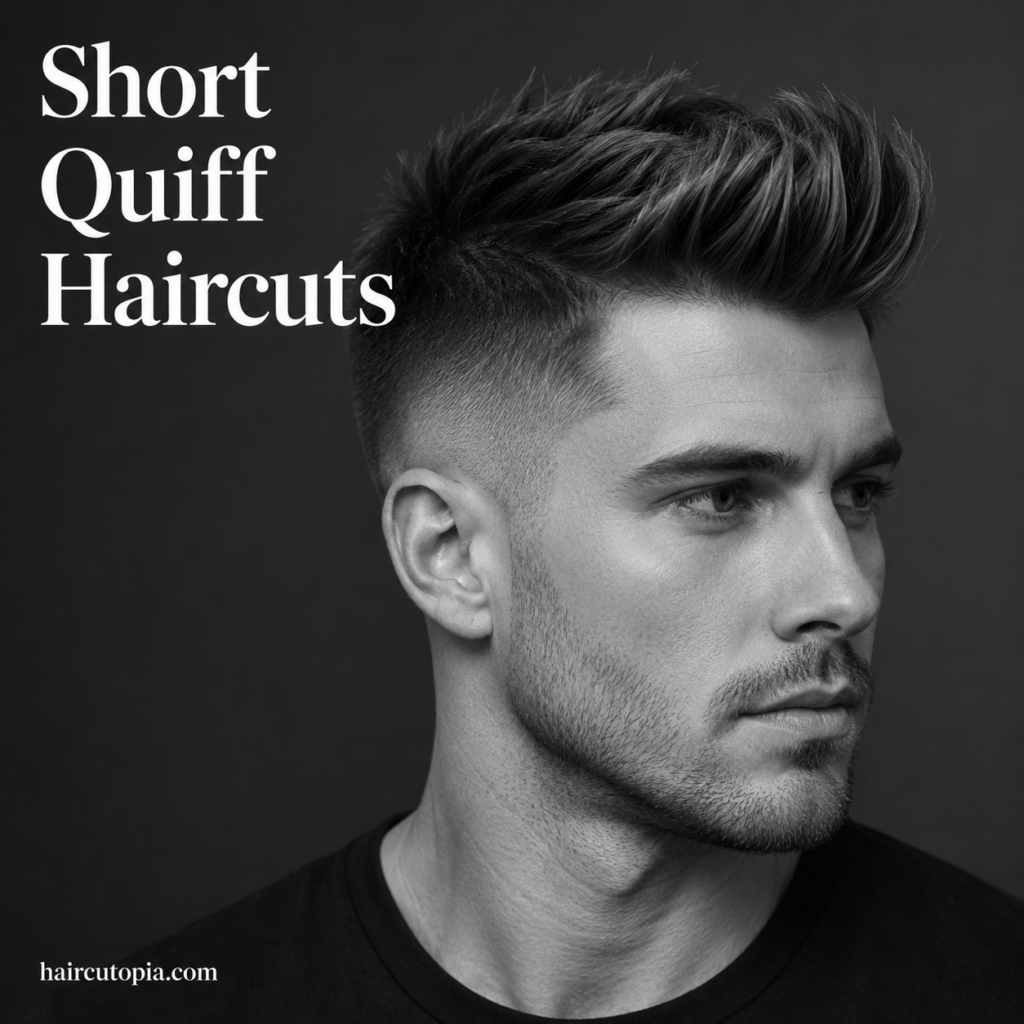
- Quiff
- Slick back
- Low fade
- Taper
- Undercut
But don’t assume the haircut name tells your barber everything.
A “textured crop” can be cut several ways. So can a crew cut, taper, or fade. Haircut terminology isn’t always used exactly the same way from one shop or barber to another.
Follow the name with a simple description of what you’re picturing.
For example:
“I want a textured crop, but I’d like to keep some length on top and have the sides tapered rather than taken down to skin.”
Now your barber has something specific to work with.
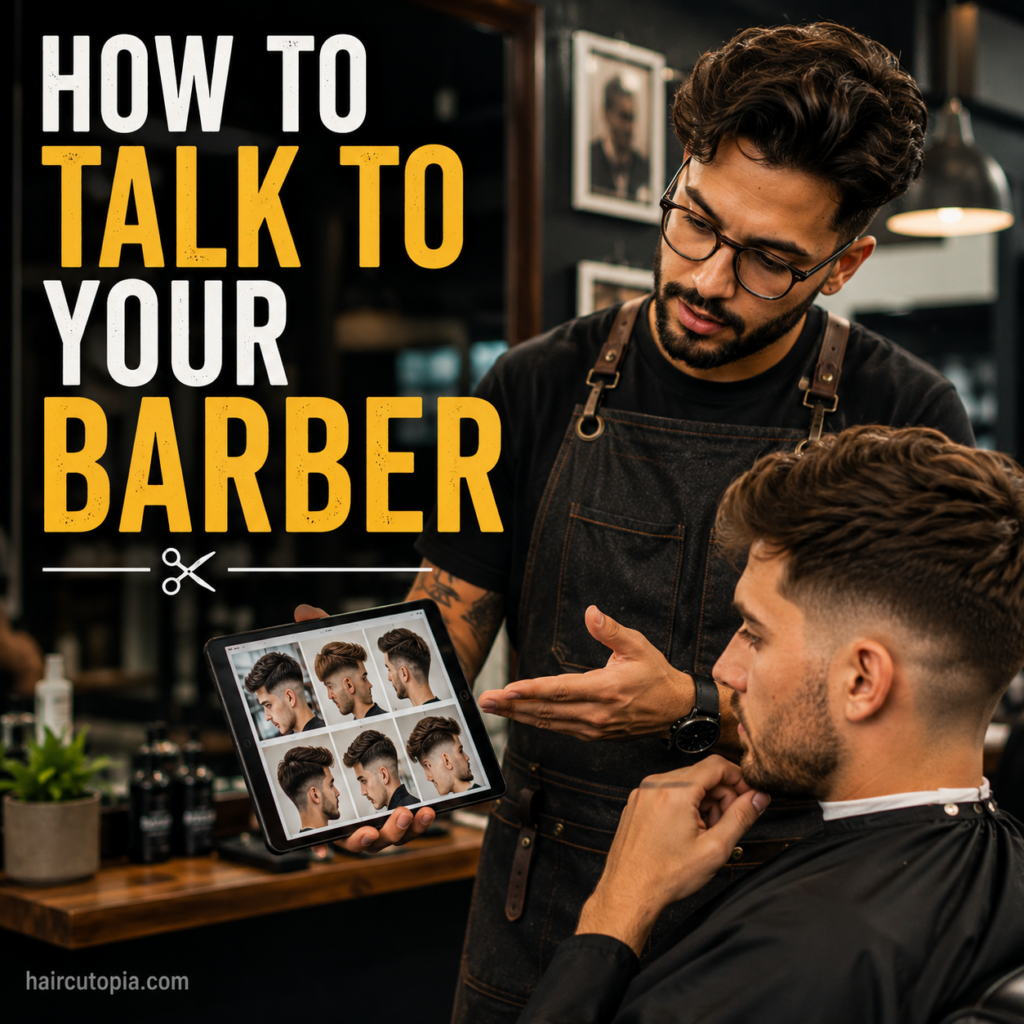
Show Your Barber a Reference Photo
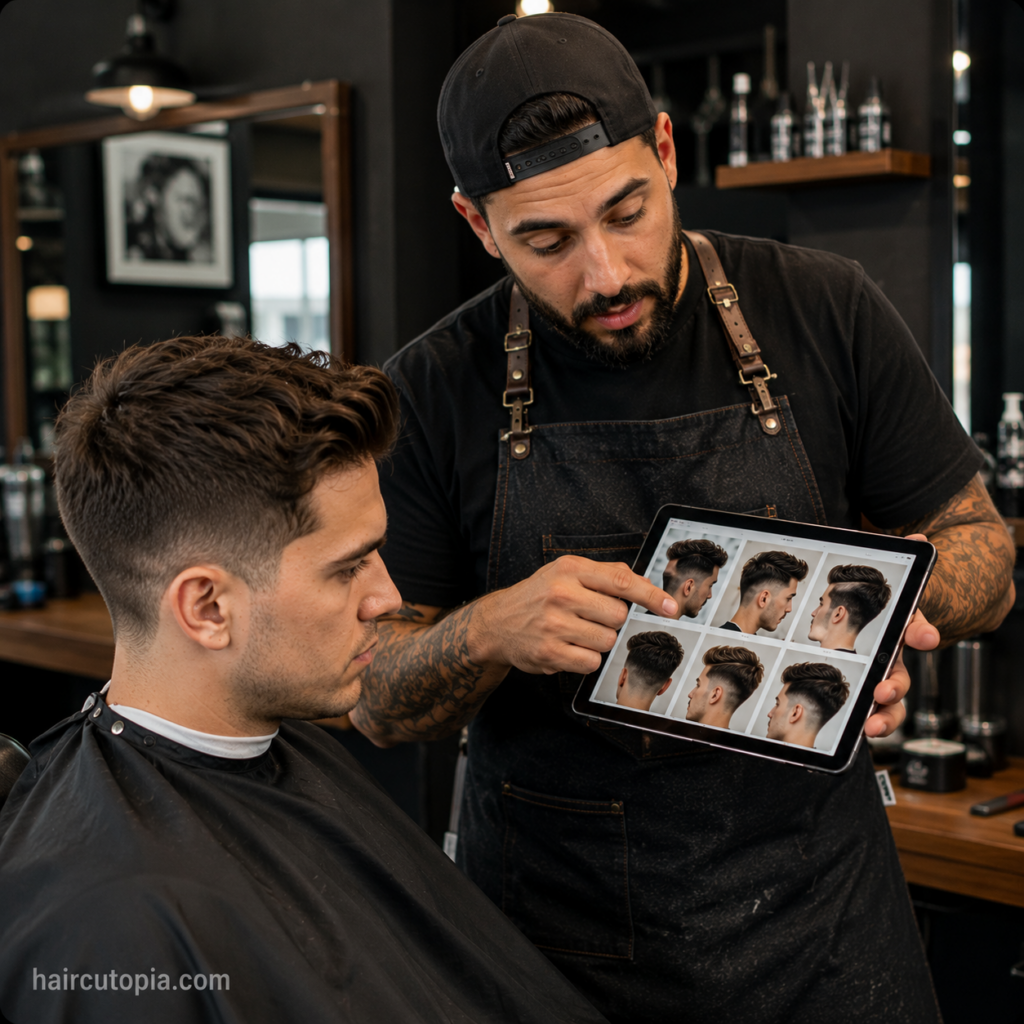
One of the easiest ways to explain a haircut is to show it.
A good reference photo communicates shape, proportions, texture, and length much faster than trying to describe everything verbally.
Instead of finding any photo of a haircut you like, look for someone whose hair is reasonably similar to yours.
Pay attention to:
- Hair texture
- Hair density
- Hairline
- Approximate length
- Curl or wave pattern
- Overall hairstyle
Your barber can still adapt a reference from someone with different hair, but similar starting points make the photo more useful.
Bring Multiple Angles When Possible
One front-facing photo doesn’t show what happens around the sides and back.
If you’re planning a substantial haircut change, try to find:
- Front view
- Side view
- Back view
These don’t necessarily need to be photographs of the same person if you’re combining elements from different cuts.
You might like the top from one haircut but prefer the fade from another.
Tell your barber that.
Explain What You Like About the Photo
Don’t simply hand over your phone and say, “This.”
Point out what you’re actually trying to replicate.
For example:
“I like the length and texture on top, but I don’t want the sides quite that short.”
Or:
“I want the fade about this height, but I’d rather keep more length around the front.”
This matters because your barber may notice details in the photo that you weren’t even thinking about.
Being specific about what caught your attention removes that ambiguity.
Tell Your Barber How Long It’s Been Since Your Last Haircut
This is surprisingly useful information.
If you liked your previous haircut and simply want it restored, tell your barber how long ago you had it cut.
You could say:
“I had this cut about four weeks ago, and I basically want the same thing again.”
If your barber knows approximately how much your hair has grown since then, they have another reference point for estimating how much length to remove.
This is especially helpful when you’re seeing the same barber regularly.
Explain How Much Length You Want to Keep
“Just take a little off” is one of those phrases that sounds clear until two people realize they have very different definitions of “a little.”
Whenever possible, be more specific.
You might say:
- “Take about half an inch off the top.”
- “I want to keep enough length to push it back.”
- “I want the front to still reach about here.”
- “Clean up the ends, but I’m growing it longer.”
- “I want it short enough that I don’t have to blow-dry it.”
You don’t need perfect measurements.
Your goal is to give your barber a sense of how you want the hair to behave after it’s cut.
Show the Length With Your Fingers
If you’re unsure about inches, physically showing the amount you want removed can work well.
Indicate the approximate length with your fingers and ask:
“About this much?”
That gives your barber a chance to confirm before cutting.
How to Talk About the Sides
The sides have a huge effect on the overall appearance of a haircut.
Instead of simply saying “short on the sides,” explain how short you’re comfortable going.
Ask yourself:
- Do I want to see scalp?
- Do I want the sides faded?
- How high should the fade go?
- Do I want some natural fullness?
- Should the sides connect gradually with the top?
- Do I want a traditional scissor-cut appearance?
These details are much more useful than “short back and sides.”
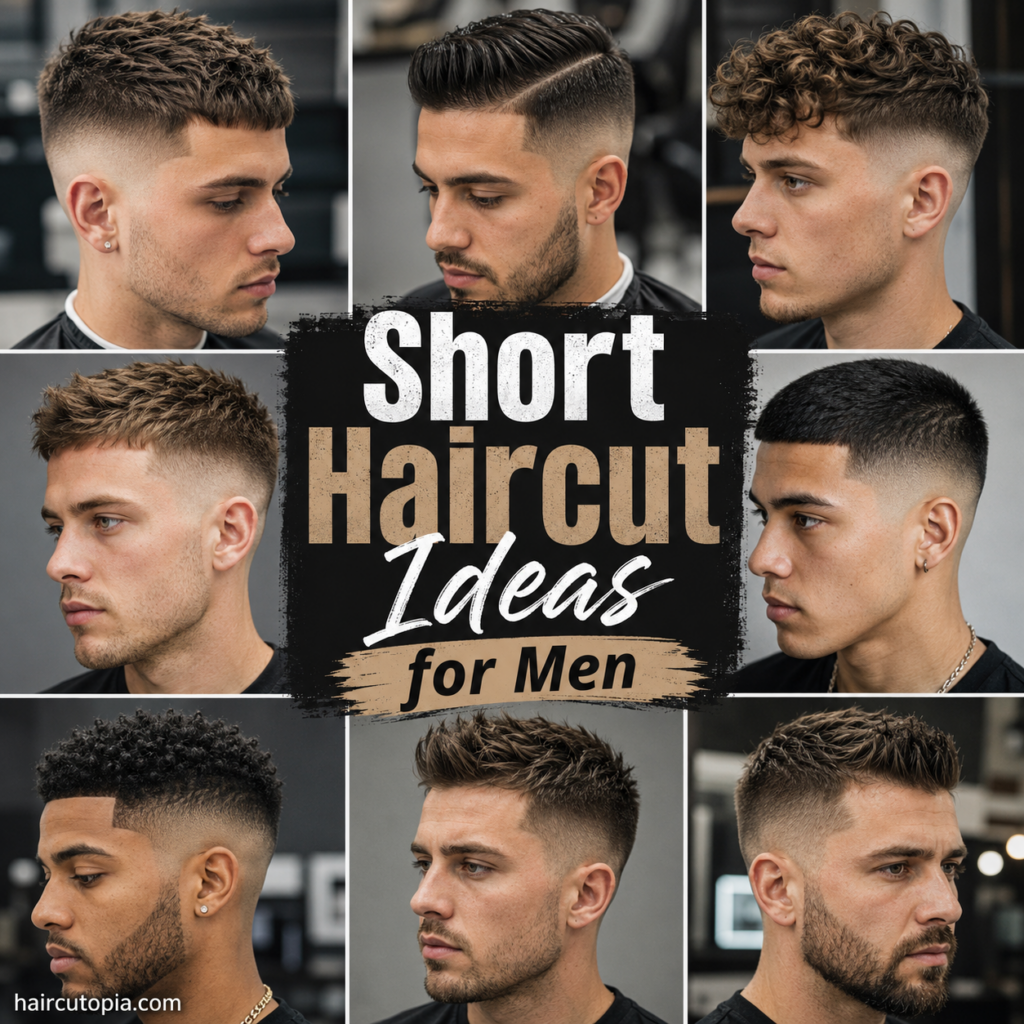
Know the Difference Between a Fade and a Taper
You don’t need to understand every barbering technique, but knowing this distinction can help.
Fade
A fade gradually transitions the hair from very short to longer as it moves up the sides and back.
Depending on the style, you might ask for:
- Low fade
- Mid fade
- High fade
- Skin fade
The height describes roughly where the transition occurs, while a skin fade indicates that the shortest section goes down to bare or nearly bare skin.
Taper
A taper is generally more subtle.
Instead of dramatically fading much of the sides and back, the shortest transitions are usually concentrated around areas such as the sideburns and neckline.
If you want your haircut cleaned up without removing as much hair from the sides, a taper may be closer to what you’re looking for.
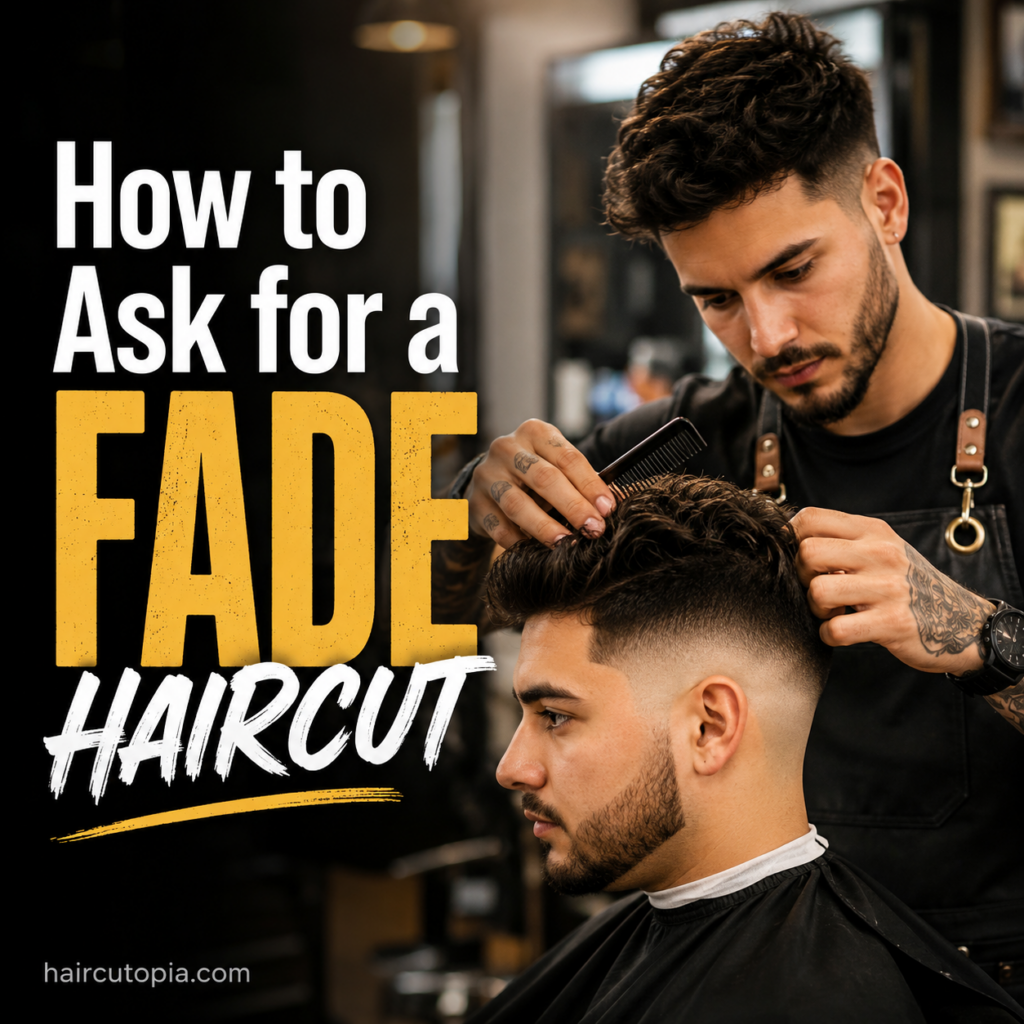
How to Ask for a Fade
Saying “give me a fade” still leaves several decisions unanswered.
A clearer request would be something like:
“I’d like a low fade, but don’t take it down to skin. Keep some weight around the upper sides.”
Or:
“I want a mid skin fade with the top left long enough to style forward.”
That tells your barber both the fade height and how you want it to relate to the rest of the haircut.
If You Don’t Know Which Fade You Want
Ask.
You can simply say:
“I want the sides faded, but I’m not sure whether a low or mid fade would work better with my head shape and the length on top.”
A barber can evaluate the proportions in person and recommend an option.
You aren’t expected to arrive knowing every technical detail.
Do You Need to Know Clipper Guard Numbers?
Not necessarily.
Guard numbers can be helpful when you already know exactly what you like, but they aren’t required to communicate a good haircut.
If you know that you normally get a #2 on the sides, tell your barber.
If you don’t, describe the result instead:
“I want it short, but I don’t want to see much scalp.”
That may actually be more useful than guessing a guard number.
What If You’re Unsure About Going Shorter?
Ask your barber to start slightly longer.
You can always remove more hair.
Putting it back is considerably more difficult.
If you’re deciding between two lengths, you can say:
“Can we start a little longer and see how it looks?”
That’s a completely reasonable request.
Explain What You Want on Top
Don’t spend the entire consultation discussing the fade and forget about the top.
Think about how you want to wear your hair.
Do you normally:
- Push it forward?
- Brush it back?
- Part it to one side?
- Wear it messy and textured?
- Create volume?
- Let curls fall naturally?
- Wear a fringe?
Tell your barber.
How you style your hair affects how it should be cut.
A top intended to be slicked back may need different length and weight distribution than hair that’s styled forward into a textured fringe.
Tell Your Barber How You Style Your Hair at Home
Your barber sees you for part of an hour. You’re the one who has to deal with the haircut every morning afterward.
Explain your normal routine.
For example:
“I usually towel-dry it, use a little matte paste, and push it to the side.”
Or:
“I don’t really style my hair. I want something that looks decent after I shower and let it dry.”
That second sentence is extremely valuable.
If you don’t use a blow dryer and have no intention of starting, your barber shouldn’t be designing a haircut that only achieves its intended shape after 15 minutes of blow-drying.
Be Honest About How Much Maintenance You Want
A great-looking haircut can still be the wrong haircut if it requires more maintenance than you’re willing to give it.
Tell your barber how often you realistically plan to return.
If you prefer haircuts every six weeks, say so.
Your barber may recommend a softer taper or another cut that grows out more naturally instead of an extremely tight skin fade that changes noticeably after a couple of weeks.
Daily maintenance matters too.
If you want something simple, phrases like these help:
- “I want this to be low-maintenance.”
- “I don’t want to use much product.”
- “I don’t blow-dry my hair.”
- “I’d like something that grows out well.”
- “I don’t want to come back every two weeks.”
You’re giving your barber useful design constraints, not being difficult.
Mention Your Cowlicks and Problem Areas
You probably know which parts of your hair cause trouble.
Maybe the crown sticks up when it’s too short. Maybe the front flips in an odd direction. Maybe one side becomes bulky faster than the other.
Mention it before the cutting starts.
For example:
“My crown sticks straight up if it’s cut too short, so I’d like to leave some length there.”
Your barber may already notice the growth pattern during the consultation, but pointing out how it behaves at home provides additional information they can’t necessarily see while your hair is sitting perfectly in the chair.
Tell Your Barber About Previous Haircuts You Didn’t Like
Bad haircut experiences can actually provide useful information.
You don’t need to criticize another barber. Just explain what didn’t work.
For example:
- “Last time the fade went too high.”
- “The top was too short to style.”
- “The sides were left too bulky.”
- “I didn’t like seeing that much scalp.”
- “The crown stuck up after a week.”
- “The front was thinned out too much.”
- “The neckline grew out awkwardly.”
Knowing what you dislike helps your barber avoid repeating it.
Tell Your Barber What You Don’t Want
Sometimes defining the boundaries is easier than describing the perfect haircut.
If something is important to you, say it before the cut.
You might say:
- “Don’t take the fade above this point.”
- “I don’t want the sides down to skin.”
- “Please don’t thin out the top too much.”
- “I want to keep the front longer.”
- “No hard part.”
- “Don’t square the hairline too aggressively.”
- “I’m growing the top, so I only want it cleaned up.”
Clear boundaries make everyone’s job easier.
How to Talk About Your Neckline
The neckline is easy to forget because you rarely see it yourself.
Common finishes include tapered, rounded, and squared necklines.
A tapered neckline gradually transitions into the skin and often grows out softly.
Rounded and squared necklines create more defined shapes, although those edges can become more noticeable as the hair grows.
If you have a preference, mention it.
If you don’t, ask your barber what would work best with the haircut and your natural neckline.
Ask Questions During the Consultation
A haircut consultation isn’t supposed to be a one-way conversation.
If your barber recommends something you don’t understand, ask what they mean.
Useful questions include:
- “How short will that be?”
- “Will I see scalp?”
- “How will this grow out?”
- “Will I need to blow-dry this?”
- “What product would you use?”
- “Would a lower fade work?”
- “Can we leave more length there?”
- “How often would this need to be cut?”
A good consultation should leave both you and your barber with the same general picture of the finished haircut.
Speak Up Before It’s Too Late
If you’re watching the haircut and something doesn’t seem right, don’t wait until your barber removes the cape to mention it.
Ask.
If the fade appears to be moving higher than you expected, you can say:
“Are we keeping the fade around this height?”
If you’re worried about the top:
“Can we leave the front a little longer?”
You don’t need to micromanage every snip of the scissors. But if something genuinely concerns you, speaking up early gives the barber more options.
Don’t Micromanage the Technique
Clear communication doesn’t mean directing every movement your barber makes.
Once you’ve agreed on the result, let the barber use their professional judgment about how to achieve it.
Two barbers may use different combinations of:
- Clippers
- Scissors
- Guards
- Shears
- Combs
- Razors
- Texturizing techniques
The exact process matters less than the finished haircut.
Focus your communication on the result unless there’s a specific technique you know causes problems with your hair.
Don’t Say “Do Whatever You Want” Unless You Mean It
Some clients genuinely enjoy giving their barber complete creative freedom.
If that’s you, great.
But don’t say “whatever you think” when you actually have strong preferences.
Instead, give the barber some boundaries:
“I’m open to your recommendation. I want something shorter and easier to style, but I don’t want a skin fade and I’d like to keep some length on top.”
Now the barber has creative freedom within a range you’re comfortable with.
What to Say If You Want the Same Haircut as Last Time
If you’re returning to the same barber and liked your previous haircut, this can be easy.
Say:
“I really liked what we did last time. I’d like basically the same cut.”
Your barber may have notes or remember the haircut, but don’t assume they’ll recall every detail—especially if they see a large number of clients.
Mention anything you’d like changed this time.
For example:
“Same as last time, but let’s leave the top slightly longer.”
Taking a photo of a haircut you really like can also give you a reliable reference for future appointments.
What to Say If You’re Growing Your Hair Out
This is one situation where you should be very clear before the haircut begins.
Start with:
“I’m growing my hair out.”
Then explain your goal.
If you want to grow the top longer, you might only need the sides and neckline cleaned up.
If you’re growing everything longer, your barber may focus on balancing the shape and removing excess bulk rather than shortening the entire haircut.
You can say:
“I want to keep as much length as possible. I’m mainly here to clean it up and keep the shape looking intentional while it grows.”
That makes your priorities clear.
What to Say When You Have No Idea What Haircut You Want
You can still have a productive barber consultation without knowing the name of a single haircut.
Start with your needs.
For example:
“I want something shorter and easy to maintain. I don’t use much product, and I’d prefer something that can go four or five weeks between haircuts. What would you recommend?”
You can also mention what you’re willing to change:
- How short you’re comfortable going
- Whether you want your forehead exposed
- Whether you like fades
- How much styling you’ll do
- Whether you’re growing or shortening the top
- How professional, casual, classic, or modern you want the result to feel
Your barber can use those preferences along with your hair texture, density, face shape, and growth patterns to suggest options.
A Simple Script for Talking to Your Barber
If barber consultations make you uncomfortable, you don’t need to prepare a speech.
Use this basic order:
- Explain the overall haircut or look you want.
- Show one or more reference photos.
- Say what you like about those photos.
- Explain how short you want the sides.
- Explain how much length you want to keep on top.
- Mention how you normally style your hair.
- Point out cowlicks or problem areas.
- Mention anything you definitely don’t want.
- Ask your barber for their recommendation.
A conversation might sound like this:
“I’d like to keep the top fairly long and textured so I can push it back or wear it messy. I like the sides in this photo, but I don’t want them down to skin. Maybe a low taper instead. My crown sticks up if it gets too short, so I’d like to keep some length there. I normally use a little matte paste and don’t spend much time styling it. What do you think would work?”
That’s plenty of information for a useful consultation.
Common Mistakes When Talking to Your Barber
Even a skilled barber can’t read your mind.
Try to avoid these common communication mistakes:
- Saying only “short on the sides, longer on top.”
- Using a clipper guard number you’re unsure about.
- Showing a photo without explaining what you like about it.
- Saying “just a trim” without defining how much should come off.
- Forgetting to mention that you’re growing your hair.
- Agreeing to a skin fade when you don’t actually want visible scalp.
- Staying silent about a cowlick or difficult crown.
- Saying “whatever you want” despite having strong preferences.
- Waiting until the haircut is finished to raise a concern.
- Expecting your hair to behave exactly like someone else’s reference photo.
You don’t need to avoid every possible misunderstanding. A short conversation at the beginning solves most of them.
Frequently Asked Questions
What should I tell my barber when getting a haircut?
Explain the overall style you want, how short you want the sides, how much length you’d like to keep on top, and how you normally style your hair. Reference photos can make the conversation much easier.
Is it okay to show your barber a picture?
Yes. Reference photos are one of the most useful ways to communicate a haircut. Explain which parts of the photo you like so your barber knows what you’re trying to replicate.
What should I say if I don’t know haircut terminology?
Describe the result instead. Tell your barber whether you want the sides very short or fuller, how you style the top, whether you want visible scalp, and how much daily maintenance you’re comfortable with.
Should I tell my barber how much to cut off?
Yes, especially if keeping length is important to you. You can give an approximate measurement, demonstrate the amount with your fingers, or explain what you still need to be able to do with the hair after it’s cut.
Is it rude to correct your barber during a haircut?
No. If you have a genuine concern, politely asking about it is better than waiting until the haircut is finished. You don’t need to supervise every detail, but clear communication during the cut can prevent misunderstandings.
What if I don’t like my haircut at the end?
Explain specifically what isn’t working and ask whether it can be adjusted. Saying “the sides still feel too bulky” or “I’d like a little more texture on top” gives your barber something actionable to work with.
Final Thoughts
Learning how to talk to your barber isn’t about memorizing barber terminology. It’s about communicating what you want in a way that’s difficult to misunderstand.
Bring reference photos. Explain which parts you like. Talk about length, the sides, the top, your styling routine, and how much maintenance you’re willing to handle. Mention your cowlicks and previous haircut problems. And if there’s something you absolutely don’t want, say so before the cutting starts.
You can also ask for advice. Your barber sees your hair, growth pattern, density, and head shape in person, so their recommendations can help turn a general idea into a haircut that actually works for you.
The goal isn’t to tell your barber how to cut hair.
It’s simply to make sure you’re both picturing roughly the same haircut before the first cut is made.