
How often should you get a haircut? For some people, two weeks feels overdue. Others can go two months and still be perfectly happy with their hair.
There isn’t one haircut schedule that works for everyone. How frequently you should visit the barber depends on your haircut, hair length, growth rate, texture, and how polished you like your style to look.
A skin fade, for example, changes noticeably as soon as the sides begin growing back. A medium-length scissor cut usually has much more room to grow before it loses its shape.
If you’re trying to figure out when to schedule your next appointment, here’s how to find a haircut routine that makes sense for your hair and lifestyle.
How Often Should You Get a Haircut?
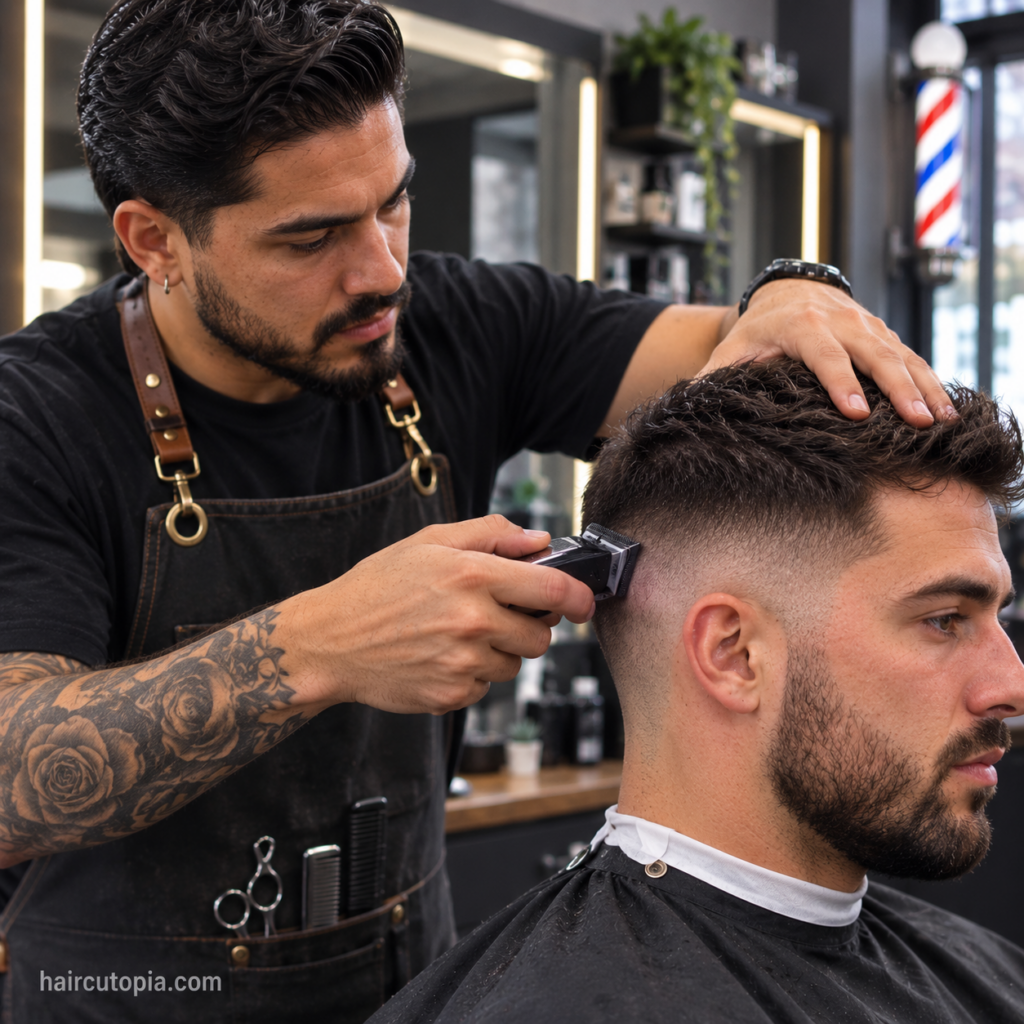
For many men’s hairstyles, getting a haircut roughly every 3 to 6 weeks is a practical starting point.
That’s a guideline, not a rule.
Very short and highly detailed haircuts may need attention every 1 to 3 weeks if you want them looking consistently sharp. Longer hairstyles can often go 6 to 12 weeks or more between full cuts.
A general schedule might look like this:
- Skin fade: about every 1–3 weeks
- Short fade: about every 2–4 weeks
- Buzz cut: about every 2–4 weeks
- Crew cut: about every 3–5 weeks
- Short classic haircut: about every 3–6 weeks
- Medium-length haircut: about every 6–10 weeks
- Longer hairstyle: about every 8–12 weeks or as needed
- Growing your hair out: occasional maintenance trims rather than frequent full cuts
These ranges aren’t deadlines. Hair growth and personal preference vary enough that two people with the same haircut may follow completely different schedules.
Why Some Haircuts Need More Frequent Maintenance
The shorter and more precise a haircut is, the faster new growth becomes noticeable.
Imagine a skin fade that starts at nearly zero length. Even a small amount of growth changes the appearance of that transition.
With longer hair, the same amount of new growth is much less obvious.
Precision also matters. A crisp lineup, sharp neckline, or carefully blended fade depends on clean edges and controlled transitions. As the hair grows, those details gradually soften.
That doesn’t necessarily mean the haircut looks bad. It just stops looking freshly cut.
How Often Should You Get a Fade?
Fades are among the most maintenance-sensitive men’s haircuts because their appearance depends heavily on the transition between different lengths.
Skin Fade
If you want a skin fade to look consistently fresh, you may want a cleanup every 1 to 2 weeks.
That doesn’t mean everyone with a skin fade needs weekly barber visits.
If you don’t mind seeing some growth around the sides, you may comfortably stretch appointments to 2 or 3 weeks.
The biggest difference is usually around the shortest portion of the fade. Once that area grows in, the dramatic skin-to-hair contrast becomes softer.
Low Fade
A low fade can be somewhat forgiving because the shortest portion stays closer to the ears and neckline.
For many people, approximately every 2 to 4 weeks works well.
If the upper sides retain more length, the haircut may continue looking balanced even after the lowest section starts growing out.
Mid Fade
A mid fade usually creates more visible contrast across the sides of the head.
Around 2 to 4 weeks between cuts is common for maintaining its shape, although you can certainly go longer if you prefer a less freshly faded appearance.
High Fade
Because a high fade removes more hair from the sides, regrowth can noticeably change the haircut’s silhouette.
If maintaining strong contrast is important to you, appointments every 2 to 3 weeks may make sense.
Again, there’s no requirement to cut it that frequently. It’s mostly about how sharp you want the fade to remain.
How Often Should You Get a Taper?
Tapers generally grow out more naturally than skin fades.
Rather than taking a large portion of the sides extremely short, a traditional taper concentrates the shortest transition around areas such as the sideburns and neckline.
That often makes the grow-out less obvious.
Depending on the hairstyle, you may be comfortable waiting around 3 to 6 weeks between full haircuts.
You can also get a quick cleanup around the neckline and sideburns without changing much of the rest of the haircut.
How Often Should You Get a Buzz Cut?
Buzz cuts are simple, but they’re surprisingly sensitive to growth.
When all of your hair is very short, even a small amount of additional length can noticeably change the overall appearance.
If you like your buzz cut extremely clean and consistent, you might cut it every 1 to 3 weeks.
If you’re comfortable letting it grow a little, every 3 to 4 weeks may be enough.
The specific clipper length matters too. An extremely short buzz generally shows regrowth sooner than one done with a longer guard.
How Often Should You Get a Crew Cut?
A crew cut usually gives you more flexibility than a buzz cut because there’s additional length on top.
Around every 3 to 5 weeks is a reasonable range for many people.
The sides will often be the first area that starts looking overgrown, particularly if your crew cut includes a fade or tight taper.
You may occasionally be able to clean up the sides while leaving most of the top alone.
How Often Should You Get a Medium-Length Haircut?
Medium-length hairstyles typically don’t require the same frequent barber visits as short fades.
Around every 6 to 10 weeks may work well, depending on the style.
With medium hair, the goal isn’t necessarily to keep every section at exactly the same length. It’s often more important to maintain:
- Overall shape
- Layers
- Movement
- Weight distribution
- Clean ends
- Manageable volume
If the original haircut was shaped well, a little additional length may actually complement the style rather than immediately making it look overgrown.
How Often Should You Cut Long Hair?
Longer hairstyles can often go 8 to 12 weeks or longer between trims.
At this length, appointments are less about restoring a freshly cut appearance and more about maintaining the overall shape and condition of the hair.
You might want a trim when:
- The ends become difficult to manage.
- Layers lose their shape.
- The hair becomes excessively bulky.
- Your hairstyle stops sitting the way you want.
- You simply want to adjust the length.
You don’t have to remove a large amount of hair at every appointment. A maintenance trim can preserve most of the length while cleaning up the overall shape.
How Fast Does Hair Grow?
Scalp hair commonly grows roughly half an inch per month on average, although individual growth rates vary.
That average helps explain why short hairstyles seem to change so quickly.
Half an inch of additional hair may barely register when your hair is several inches long. Add that same growth to a nearly shaved fade, and the difference can be obvious.
Hair growth isn’t perfectly uniform either.
Genetics, age, individual hair cycles, and other factors can affect how quickly your hair appears to grow. Even different areas of your scalp may not seem to grow at exactly the same pace.
Instead of scheduling haircuts based entirely on an average growth rate, pay attention to how your own haircut changes over time.
Your Hair Texture Can Affect Your Haircut Schedule
Hair texture influences how noticeable growth becomes and how a haircut maintains its shape.
Straight Hair
Straight hair can make precise lines and differences in length relatively easy to see.
As a short haircut grows, areas around the ears, neckline, and sides may begin looking untidy sooner than the top.
Longer straight hairstyles may have considerably more flexibility.
Wavy Hair
Wavy hair often handles some additional length well because natural movement can disguise small changes in the haircut.
However, added length can also create extra volume in areas where you don’t want it.
Your ideal schedule depends heavily on the shape of the cut.
Curly Hair
Curly hair can sometimes appear to grow more slowly because the strands coil rather than falling completely straight.
The actual hair is still getting longer, but the visible change in length can be different.
For curly hairstyles, maintaining the overall silhouette and controlling unwanted bulk may be more important than following a strict number of weeks between cuts.
Coily Hair
With tightly coiled hair, haircut frequency can vary dramatically depending on the style.
A sharply defined fade and lineup may need frequent maintenance if you want crisp edges, while a longer natural style may follow a much less frequent trimming schedule.
Focus on maintaining the shape you want rather than cutting simply because a certain number of weeks have passed.
Does Thick Hair Need More Frequent Haircuts?
Not necessarily, but thick or high-density hair can become bulky as it grows.
You may notice extra weight:
- Above the ears
- Around the sides
- At the back of the head
- Near the crown
If your haircut starts looking wider rather than simply longer, it may be time for a trim.
A barber can remove some of that excess weight while preserving length in areas where you want to keep it.
What About Fine or Thinning Hair?
Fine or lower-density hair doesn’t automatically need to be cut more or less frequently.
The important factor is how the haircut maintains its shape.
Some shorter styles can create a fuller, more structured appearance. As those styles grow out, they may lose that shape.
Rather than following a rigid haircut schedule, watch how the hair sits and styles from week to week.
Your Hairline and Neckline Matter Too
Sometimes the haircut itself still looks fine, but the edges don’t.
Hair around the neckline, sideburns, ears, and hairline can make a haircut appear overdue even when the overall length is still manageable.
That’s where a cleanup can help.
Instead of getting a complete haircut every time, you might occasionally ask your barber for:
- Neckline cleanup
- Sideburn cleanup
- Edge or lineup maintenance
- Light taper cleanup
- Beard blending
This can extend the life of a haircut without removing unnecessary length from the top.
How Often Should You Get a Haircut When Growing Your Hair Out?
Growing your hair doesn’t mean you have to stop getting haircuts completely.
It does mean you probably shouldn’t keep asking your barber to cut it back to the same shape every few weeks.
When growing your hair longer, appointments can be used strategically to maintain shape while preserving progress.
Tell your barber that you’re growing your hair out before the haircut begins.
They may focus on:
- Cleaning up awkward areas
- Balancing uneven sections
- Removing excess bulk
- Maintaining layers
- Tidying the neckline
- Preserving as much length as possible
You may be able to go 8 to 12 weeks or longer between maintenance cuts, depending on your hairstyle and goals.
Should You Get a Haircut Before a Special Event?
If you have a wedding, job interview, professional photo session, vacation, or other important event coming up, avoid experimenting at the very last minute.
For a haircut you already know and trust, getting it a few days before the event can give the cut a little time to settle while still looking fresh.
If you’re making a significant change, consider doing it earlier.
That gives you time to get comfortable styling the new haircut and make adjustments if something isn’t quite what you expected.
Signs It’s Time for a Haircut
You don’t need to count the days since your last barber visit.
Your hair will usually tell you when it’s ready.
Common signs include:
- The sides are beginning to puff out.
- Hair is growing noticeably over or around your ears.
- Your neckline looks untidy.
- Your fade has lost most of its definition.
- Your usual styling routine isn’t working as well.
- The top no longer holds its intended shape.
- Your hair feels excessively bulky or heavy.
- Layers aren’t sitting correctly anymore.
- You need significantly more product to control your hair.
- You simply don’t like how your haircut looks when you check the mirror.
If you’re noticing several of these at once, it’s probably time.
How to Make Your Haircut Last Longer
You can’t stop your hair from growing, but you can make the transition between appointments easier.
Choose a Haircut That Grows Out Well
If you don’t want to visit the barber every couple of weeks, mention that during your consultation.
A lower taper, longer fade, or softer scissor-cut transition may grow out more naturally than an extremely tight skin fade.
Learn How to Style the Grow-Out
The way you style your hair during week one doesn’t necessarily need to be the way you style it during week five.
As the hair gets longer, you may need to adjust:
- Product amount
- Blow-drying technique
- Parting
- Direction
- Texture
Sometimes a haircut that feels awkward simply needs to be styled differently at its new length.
Keep the Edges Clean
A neckline or sideburn cleanup can make the entire haircut appear fresher.
Just be cautious about attempting complicated fade or hairline work yourself. It’s easy to take an edge too high or create a line that’s difficult for your barber to correct without shortening more hair.
Use the Right Hair Products
The product that worked immediately after your haircut may feel different once you’ve added several weeks of growth.
Depending on your hair, you may benefit from switching between lighter creams, pastes, clays, pomades, or other styling products as the length changes.
Is Getting a Haircut Every Week Too Often?
If you like an extremely polished fade, lineup, or buzz cut, there’s nothing unusual about getting frequent cleanups.
But you don’t need weekly haircuts simply because someone else gets them.
Ask yourself whether you’re actually unhappy with your hair after seven days.
If it still looks good, styles easily, and feels manageable, there’s little reason to cut it purely because a week has passed.
Is Waiting Two Months Too Long?
For some haircuts, yes. For others, not at all.
A skin fade will look dramatically different after two months. A medium-length layered haircut may simply look longer.
The question isn’t whether eight weeks is objectively too long. It’s whether the haircut still works at eight weeks.
If you deliberately prefer the grown-out version, there’s no problem with keeping it.
Should You Always Book Your Next Haircut Before Leaving?
Pre-booking can be convenient if you already know your ideal schedule.
If you’ve learned that your haircut starts bothering you around week four, booking your next appointment four weeks out removes the guesswork.
For a new haircut, however, it can be useful to watch how it grows.
Take note of when you think:
“This still looks great.”
Then notice when that changes to:
“Okay, I need a haircut.”
That gives you a personalized maintenance interval for future appointments.
How to Find Your Ideal Haircut Schedule
Instead of following someone else’s routine, try a simple experiment.
- Note the date of your next haircut.
- Take a photo when the haircut is fresh.
- Check how it looks after two weeks.
- Check again after three or four weeks.
- Pay attention to when styling becomes noticeably harder.
- Schedule your next cut when you feel the hairstyle has lost its shape.
- Use that interval as the starting point for future appointments.
After a couple of haircut cycles, you’ll probably know exactly when your hair starts feeling overdue.
Frequently Asked Questions
How often should a man get a haircut?
For many short men’s hairstyles, roughly every 3 to 6 weeks is a practical starting point. Very short fades and buzz cuts may require more frequent maintenance, while medium and long hairstyles can often go considerably longer.
How often should I get a haircut to maintain a fade?
If you want a fade to stay consistently sharp, you may prefer appointments every 1 to 3 weeks. Lower or softer fades can often be stretched longer than very tight skin fades.
How often should I get a haircut if I’m growing my hair?
You can usually space appointments farther apart when growing your hair. Instead of removing significant length, maintenance cuts can focus on shape, excess bulk, and uneven areas.
Does cutting your hair more often make it grow faster?
No. Cutting the ends of your hair doesn’t change the growth occurring at the scalp. Regular trims can help maintain a hairstyle and remove unwanted length, but they don’t increase the biological rate of hair growth.
How do I know when I need a haircut?
Look at how your hair behaves rather than relying entirely on the calendar. If the sides are becoming bulky, the neckline is untidy, your fade has disappeared, or your hair is becoming difficult to style, it may be time for another cut.
Final Thoughts
So, how often should you get a haircut?
For many people, somewhere around every 3 to 6 weeks works well, but your ideal schedule could easily fall outside that range.
A skin fade may need attention after a couple of weeks if you want it consistently sharp. A classic taper can usually grow longer. Medium and long hairstyles may go several months between significant cuts while still looking good.
The best schedule is ultimately the one that matches your haircut, hair growth, budget, lifestyle, and preferred level of maintenance.
Instead of worrying about whether you’re “supposed” to get a haircut every two, four, or six weeks, pay attention to when your hairstyle stops working the way you want it to.
That’s usually the best sign that it’s time to head back to the barber.

Related Posts
 Taper Fade Maintenance Schedule: How Often Should You Get a Touch-Up?
 Short Haircuts for Square Faces: 25 Flattering Styles That Soften Strong Features
 A-Line Bob Haircuts for Square Faces: 25 Flattering Styles to Soften Strong Features
 Bangs Haircuts for Square Faces: 25 Flattering Fringe Styles to Soften Strong Features