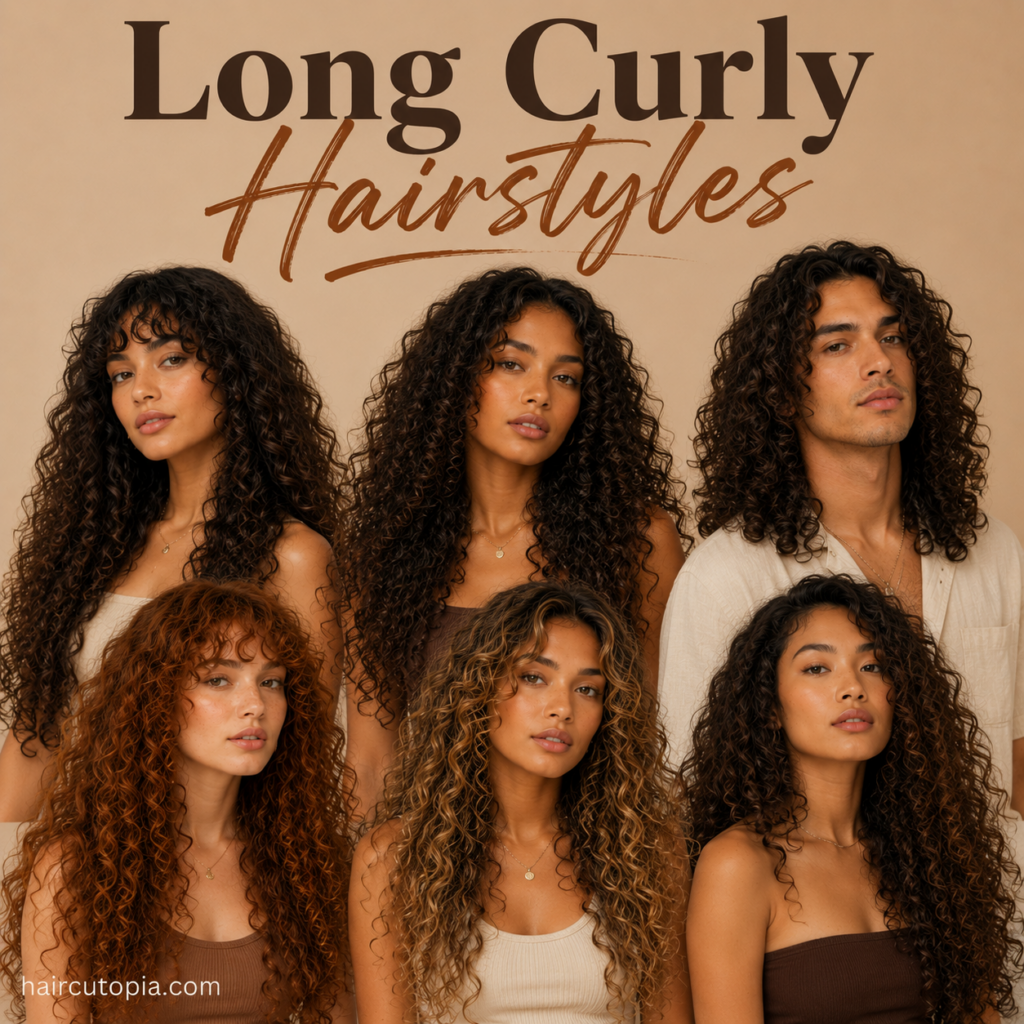
Long curly hair can be dramatic, soft, effortless, polished — and occasionally all of those things before lunchtime.
That’s part of its appeal.
With enough length, curls have room to develop their full pattern, whether you’re working with loose spirals, springy ringlets, or tighter coils. You also have far more styling flexibility than you might expect. Long curls can be layered, shaped around the face, paired with bangs, pulled into a high ponytail, swept to one side, or simply left alone to do their thing.
The challenge is finding a haircut that gives all that hair some shape. Too much weight can stretch curls and flatten the roots, while overly aggressive layering can create more volume than you wanted.
If you’re growing your curls out or looking for a change without sacrificing length, these long curly hairstyles offer plenty of ideas.
Why Long Hair Works So Well With Curls
Length gives curly hair room to show off its texture.
Individual curls can form more completely, and different curl patterns throughout the hair become part of the overall look. Long hair also provides enough weight to soften excessive volume if that’s something you’d rather control.
Then there’s versatility.
With long curls, you can switch between wearing your hair completely down and creating ponytails, buns, braids, half-up styles, and other looks without changing the haircut itself.
A good long curly haircut can:
- Preserve length while improving shape
- Create movement through dense curls
- Add volume around the crown
- Frame the face
- Reduce unwanted bulk
- Make styling easier
- Give curls more definition
The goal isn’t simply to grow your hair as long as possible. Shape matters just as much as length.
1. Long Layered Curly Hair
Layers are one of the easiest ways to give long curly hair more movement.
Without them, the weight of long hair can pull curls downward, especially around the crown. The result may be lots of curl toward the ends but relatively little volume near the roots.
Strategic layering changes that balance.
Shorter layers can remove some weight and allow curls higher on the head to spring up, while longer layers preserve the overall length.
The key word is strategic.
You don’t necessarily need layers everywhere. Their placement should depend on your curl pattern, density, and how much volume you actually want.
2. Long Curly Hair With Face-Framing Layers
Face-framing layers offer a noticeable change without sacrificing much overall length.
These shorter curls can begin around the cheekbones, jaw, chin, or even lower depending on the effect you want.
Higher layers bring more attention toward the eyes and cheekbones. Longer pieces create a softer transition into the rest of the hair.
This is particularly useful when very long curls feel like they’re pulling your features downward.
A few shorter pieces around the front can completely change the balance of the haircut while leaving the back long.
3. Long Curly Hair With Bangs
Long curls and bangs make a surprisingly natural combination.
Instead of separating the fringe from the rest of the hairstyle, curly bangs allow the texture to continue right across the forehead.
They can be:
- Full and rounded
- Light and wispy
- Short and defined
- Long and tousled
- Blended into face-framing layers
Shrinkage is especially important here.
Curly bangs that look long while wet can become considerably shorter after drying. Starting slightly longer gives you room to see where the curls naturally settle before taking off more length.
4. Long Curly Hair With Curtain Bangs
If a full fringe feels like too much commitment, curtain bangs are a softer alternative.
They’re typically shorter toward the center and become progressively longer toward the sides, blending into the rest of the haircut.
On curly hair, they don’t need to form a perfectly symmetrical curtain.
A little irregularity can actually make the style look more natural.
Long curly curtain bangs can frame the cheekbones and jaw while remaining long enough to pin back when you want them out of the way.
They’re also easier to grow out than a short fringe.
5. Long Curly Shag
A curly shag takes layering in a much more noticeable direction.
Instead of maintaining most of the weight toward the bottom, the haircut creates volume higher on the head with progressively longer layers underneath.
The finished shape is textured, relaxed, and intentionally a little wild.
A long curly shag often features:
- Shorter crown layers
- Face-framing curls
- Lots of movement
- Textured ends
- Optional curly bangs
This style works particularly well if you like volume and don’t expect every curl to sit perfectly in place.
In fact, a little unpredictability makes a shag look better.
6. Long Curly Wolf Cut
The wolf cut shares some characteristics with a shag but usually has an even stronger contrast between the volume on top and the length below.
On long curly hair, that creates a dramatic silhouette without sacrificing the longest sections.
The natural curl pattern adds even more texture, so you don’t need to manufacture movement with extensive heat styling.
A curly wolf cut can be bold, but it can also be adapted.
Longer layers create a softer version, while shorter crown layers produce a more dramatic shape.
7. Long Curly Hair With Long Layers
Not everyone wants an obviously layered haircut.
Long layers provide movement while keeping the overall silhouette relatively full.
Because the differences between the shortest and longest sections are smaller, the layers blend naturally into the hair.
This is a good choice if your curls become heavy but you don’t want a shaggy or highly textured appearance.
Long layers can also make growing your hair easier because the shape tends to transition smoothly as the length increases.
8. Long Curly Hair With a Middle Part
A middle part creates balance and lets the curls fall relatively evenly around both sides of the face.
It’s simple, but with long curly hair, simple doesn’t mean boring.
The curl pattern provides plenty of movement on its own.
A middle part works particularly well with face-framing layers because shorter curls can fall naturally around the cheekbones and jaw.
Don’t worry if the part isn’t perfectly straight.
Curly hair tends to create its own separation, and a slightly imperfect part often looks softer.
9. Long Curly Hair With a Deep Side Part
Want instant volume without cutting anything?
Move your part.
A deep side part shifts more hair toward one side of the head, creating asymmetry and extra height near the roots.
It’s an easy way to make a familiar hairstyle feel different.
You can keep the curls loose or tuck one side behind the ear for additional contrast.
This works especially well for special occasions because it can make long curls look more dramatic with almost no additional styling.
10. Long Voluminous Curls
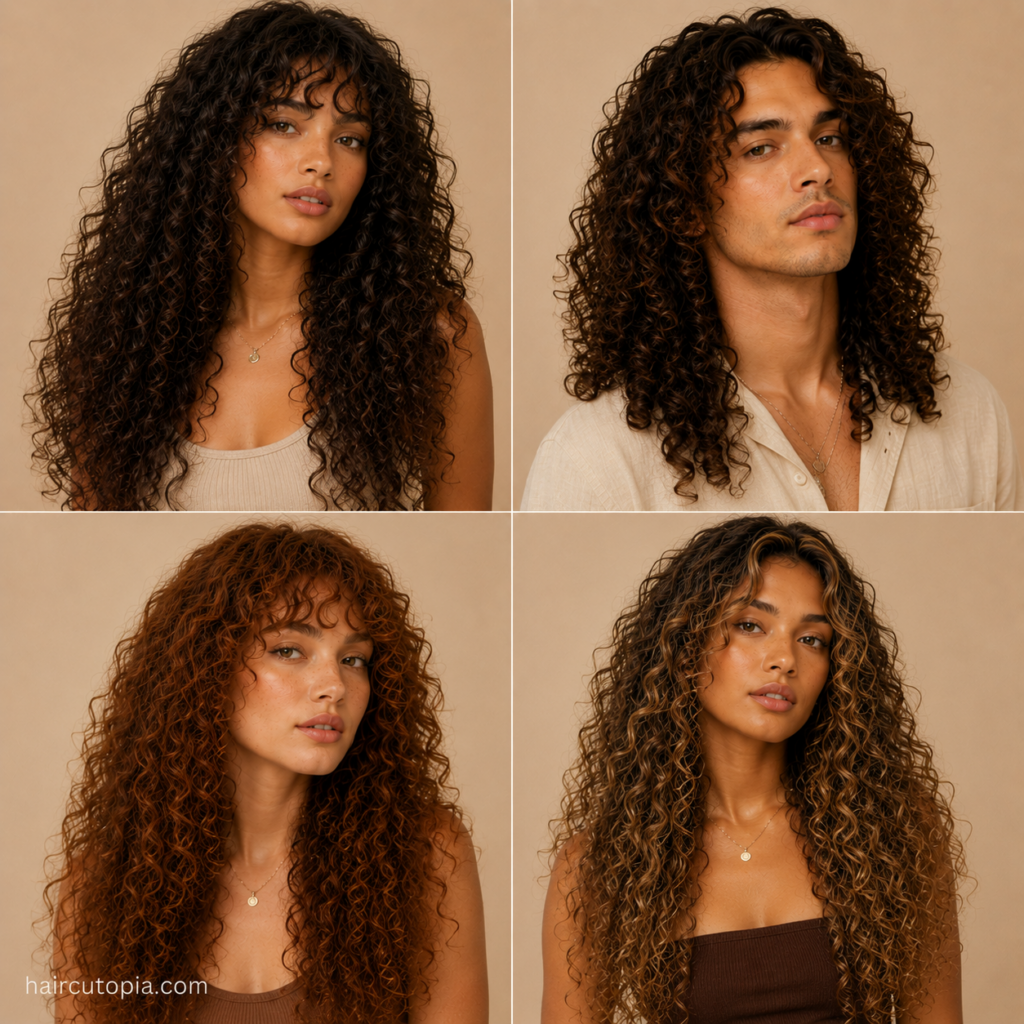
Sometimes the goal isn’t controlling volume. It’s creating more of it.
Long, voluminous curls make natural texture the main feature of the hairstyle.
The haircut needs to support that shape. Layers around the crown can prevent the roots from becoming too flat, while enough fullness through the sides and ends keeps everything balanced.
Product choice also matters.
If volume is your priority, avoid loading the roots with heavy creams or oils. Lightweight mousse, foam, or gel can provide hold without pulling the curls downward.
Once the hair is completely dry, gently lifting the roots can make the finished style even fuller.
11. Long Defined Curls
Defined curls create a more polished appearance while still showing off natural texture.
The goal is to encourage individual strands to form larger curl groups rather than separating into frizz.
Styling usually works best when the hair is wet or very damp.
Apply products evenly, then encourage the curls using your preferred method. That might include:
- Scrunching
- Finger coiling
- Brush styling
- Raking and smoothing
- Simply letting the natural curl pattern form
After styling, try not to keep touching the hair.
Let the curls dry completely before separating or fluffing them.
12. Long Tousled Curls
Not every curl needs perfect definition.
Tousled curls have a softer, more relaxed finish with natural separation and movement.
This style works particularly well with long layers and shags because the haircut already provides texture.
Use enough styling product to maintain the overall shape without making every curl rigid.
Once the hair is dry, gently separate a few curl groups with your fingers.
The idea is controlled imperfection.
You want “effortlessly curly,” not “I discovered a ceiling fan halfway through styling.”
13. Long Curly Hair With Highlights
Highlights can make curl patterns more noticeable by adding contrast between individual sections.
Instead of seeing one solid mass of hair, the eye picks up lighter and darker curls throughout the length.
There are several ways to approach it.
Subtle highlights can create natural-looking dimension, while brighter face-framing pieces draw attention toward the front.
Balayage can also work beautifully on long curls because the color can be positioned to follow the movement of the hair.
Remember that lightening involves chemical processing. If your curls are already dry or fragile, discuss a conservative approach with your colorist and pay extra attention to conditioning afterward.
14. Long Curly Hair With a Half-Up Style
Long curls are ideal for half-up hairstyles.
Pulling the upper portion of the hair away from the face keeps things practical while still leaving plenty of texture visible through the lengths.
You can secure the hair with:
- A claw clip
- Scrunchie
- Barrette
- Small hair tie
- Decorative pins
For a softer look, leave a few curls loose around the face.
This is also useful on days when the front of your hair isn’t cooperating but the rest of your curls still look great.
No one needs to know.
15. High Ponytail With Long Curls
A high ponytail concentrates all that curly volume toward the back and top of the head.
The result can look polished or casual depending on how tightly you style the roots.
For a sleek finish, smooth the front before securing the ponytail. For something more relaxed, preserve some texture at the roots and pull out a few face-framing curls.
Avoid making the ponytail unnecessarily tight.
Constant tension can be uncomfortable and may put additional stress on the hairline.
A softer hold usually looks more natural anyway.
16. Low Curly Ponytail
A low ponytail creates a completely different mood.
Instead of emphasizing height and volume at the crown, it gathers the curls around the nape while allowing the lengths to remain the focus.
A middle part gives the style a more balanced appearance, while a side part makes it feel softer and more asymmetrical.
You can also wrap a small section of hair around the elastic to conceal it.
It’s simple, quick, and useful when you want your hair contained without putting it into a full updo.
17. Long Curly Hair Swept to One Side
Sweeping long curls over one shoulder creates instant drama.
This works particularly well when the hair has layers because the different lengths become more visible once they’re gathered toward one side.
You can create the look with a deep side part or simply move most of your hair across one shoulder.
Use pins discreetly at the back if you need help keeping everything in place.
It’s an easy option for events because the hair remains mostly down while still looking intentionally styled.
18. Long Curly Hair With Natural Shape
Sometimes the best hairstyle is simply a really good haircut.
You don’t need bangs, dramatic layers, highlights, or complicated styling to make long curls interesting.
A naturally shaped cut focuses on creating a balanced silhouette based on the way your curls already grow.
That may involve subtle layers, selective weight removal, or slight adjustments around the perimeter.
The goal is for the haircut to look good even when you haven’t spent half the morning styling it.
For everyday wear, that’s difficult to beat.
How to Choose the Best Long Curly Hairstyle
A hairstyle that looks perfect in a reference photo may behave completely differently on your hair.
That’s especially true with curls.
Instead of focusing only on the finished picture, consider the characteristics that determine how your own haircut will fall.
Consider Your Curl Pattern
Loose curls may stretch significantly as hair gets longer because of the added weight.
Tighter curls and coils can maintain more volume but may also experience substantial shrinkage.
Look at how your curls behave when they’re completely dry rather than judging their length while wet or stretched.
Think About Hair Density
Density plays a major role in how long curly hair should be layered.
Very dense hair may benefit from strategic weight removal to prevent excessive bulk.
Lower-density hair often needs to preserve more fullness around the ends.
Aggressively thinning curly hair isn’t always the answer. The goal should be thoughtful shaping rather than simply removing as much hair as possible.
Decide How Much Volume You Want
There’s no universally correct amount of volume.
If you want big curls, shorter layers around the crown can help create lift.
If you’d rather keep the shape elongated, longer layers allow more weight to remain.
Tell your stylist where you like volume and where you don’t.
That information can be more useful than simply asking for “layers.”
Consider Your Everyday Routine
Think about what happens after you leave the salon.
Do you usually air-dry?
Do you diffuse?
Are you willing to finger-coil individual sections?
Do you regularly put your hair into a ponytail?
A haircut should work with your actual routine, not the imaginary version where you wake up every morning excited to spend an hour styling your hair.
How to Style Long Curly Hair
Long curls can require more product and drying time than shorter styles, but the basic routine doesn’t need to be complicated.
1. Start With Wet or Damp Hair
Water helps curls group together and gives styling products something to distribute through.
For stronger definition, many people find that styling on very wet hair works best.
2. Apply Leave-In Conditioner if Needed
A leave-in can provide additional moisture and slip.
Concentrate it through areas that tend to become dry rather than automatically applying a heavy layer everywhere.
Fine curls may need very little.
3. Add Your Styling Product
Choose a curl cream, mousse, foam, gel, or combination based on the result you want.
Creams can add softness and moisture.
Mousse and foam are useful for lightweight volume.
Gel generally provides stronger hold and can help curls maintain definition for longer.
4. Encourage Curl Formation
Scrunch upward from the ends or use your preferred curl-defining technique.
If certain sections don’t curl as consistently as others, finger coiling can help reshape them.
There’s no need to individually style every curl unless you actually enjoy doing that.
5. Air-Dry or Diffuse
Air-drying requires less effort but can take a while with long, dense curls.
A diffuser speeds up drying and can increase volume.
Use moderate heat and gentler airflow rather than blasting the hair around.
6. Finish Only When Dry
This part requires patience.
Wait until the hair is completely dry before fluffing, separating curls, or breaking a gel cast.
Handling curls too early can create unnecessary frizz.
Once dry, gently lift the roots and separate a few curls if you want more volume.
How to Keep Long Curly Hair From Feeling Heavy
Length adds weight, and eventually that weight can start stretching the curl pattern.
If your curls are becoming flat around the crown while remaining curly at the bottom, your haircut may need reshaping.
Layers can remove some of that weight without sacrificing the overall length.
Product buildup can also contribute.
Using several heavy creams, oils, and styling products at once may make long curls feel even heavier. Periodic cleansing and a simpler styling routine may bring back some bounce.
Sometimes the answer isn’t another product.
It’s less product.
How to Refresh Long Curls Between Washes
Completely washing and restyling long curly hair every morning isn’t realistic for most people.
Fortunately, you usually don’t need to.
Focus on the areas that actually need refreshing.
Lightly mist flattened or frizzy sections with water, then reshape them with your fingers. Add a small amount of styling product only if necessary.
You can also change the style entirely.
Second- or third-day curls often work perfectly for:
- Half-up hairstyles
- Ponytails
- Loose buns
- Side-swept styles
- Braided looks
Sometimes working with slightly lived-in curls is easier than trying to recreate wash day.
How to Maintain Healthy-Looking Long Curls
Long hair has been around for a while.
The ends have experienced years of washing, drying, friction, styling, weather, and everything else you’ve put your hair through.
That makes gentle maintenance particularly important.
Helpful habits include:
- Detangling carefully with plenty of slip
- Conditioning according to your hair’s needs
- Limiting excessive high-heat styling
- Avoiding unnecessarily tight hairstyles
- Protecting the hair from excessive friction overnight
- Using a satin or silk pillowcase if it works for you
- Removing damaged ends when necessary
- Avoiding excessive product buildup
- Handling wet hair gently
There isn’t one perfect wash schedule for curly hair.
Wash according to what your scalp and hair actually need rather than forcing yourself to follow a specific number of days.
What to Ask Your Stylist Before Cutting Long Curly Hair
If you’ve spent years growing your curls, getting a haircut can feel like a fairly major event.
Clear communication helps.
Bring reference photos, but explain exactly what you like about them.
Tell your stylist:
- How much length you want to preserve
- How much your curls shrink
- Where your hair tends to become bulky
- Whether your roots become flat
- How much volume you prefer
- How you normally style your hair
- Whether you regularly wear ponytails or updos
- Whether you straighten your hair
- How much maintenance you’re comfortable with
If keeping your length is the priority, say so clearly.
“Just a trim” can mean surprisingly different things to different people.
Frequently Asked Questions About Long Curly Hair
Do layers look good on long curly hair?
Yes. Layers can reduce weight, add movement, and help prevent long curls from becoming flat around the crown. The amount of layering should be customized to your curl pattern and density.
What is the best haircut for long curly hair?
There isn’t one best haircut for everyone. Long layers, face-framing layers, shags, wolf cuts, and softly shaped cuts can all work well. The right choice depends on your curl pattern, density, desired volume, and maintenance preferences.
How do I make long curly hair look more voluminous?
Appropriate layering, lightweight styling products, diffusing, changing your part, and lifting the roots after drying can all help. Avoid applying excessive heavy products near the scalp.
How can I keep long curls defined?
Style the hair while wet or damp, distribute your products evenly, encourage curl clumps, and avoid touching the hair excessively while it dries. A gel or other hold product can help maintain definition.
How do I prevent long curly hair from getting frizzy?
Keeping the hair adequately conditioned, minimizing friction, styling while the hair contains enough moisture, and leaving curls alone while they dry can help reduce frizz.
Some frizz is completely normal, though. Curly hair doesn’t need to look perfectly smooth to look good.
Are bangs a good idea with long curly hair?
Curly bangs can complement long hair beautifully, especially when blended into face-framing layers. Remember that curls shrink as they dry, so bangs should be cut with the finished dry length in mind.
How often should long curly hair be trimmed?
There isn’t a universal schedule. Consider a trim when the ends become noticeably damaged, tangling increases, or the haircut begins losing its shape.
If you’re growing your hair, maintaining healthy ends may be more useful than trimming according to an arbitrary calendar.
Final Thoughts on Long Curly Hairstyles
Long curly hair gives you an enormous amount of freedom.
You can emphasize natural volume with layers, add personality with bangs, create a dramatic shag or wolf cut, or keep the shape simple and let your curl pattern take center stage.
And when you want a change without getting anywhere near the scissors, you’ve still got ponytails, half-up styles, side-swept curls, buns, and plenty of other options.
The most flattering long curly hairstyles have one thing in common: they work with the hair rather than constantly trying to force it into something else.
Find the right shape, use enough product to support your curls without weighing them down, and don’t worry about making every curl look identical.
A little unpredictability is part of having curly hair — and often part of what makes it look so good.