Choosing a haircut sounds simple until you’re actually sitting in the barber’s chair and someone asks, “So, what are we doing today?”
There are plenty of great haircuts to choose from, but the cut that looks best on someone else isn’t automatically the best one for you. Your face shape, hair texture, density, growth pattern, lifestyle, and willingness to style your hair all play a part.
The good news is that you don’t need to know every haircut by name. You just need to understand what works with your hair and how to communicate what you want.
This guide walks through the most important things to consider when choosing a haircut, whether you’re looking for a small change or an entirely new style.
Start With Your Natural Hair
Before thinking about fades, textured crops, pompadours, or slick backs, take a good look at what your hair naturally wants to do.
Hair can be:
- Straight
- Wavy
- Curly
- Coily
- Fine
- Medium
- Coarse
- Thin or low-density
- Thick or high-density
You may fall somewhere between several of these categories. That’s normal.
Your natural texture affects how a haircut sits once you leave the barber shop. A cut that looks effortless on thick, wavy hair might require quite a bit of styling on fine, straight hair.
Instead of constantly fighting your natural texture, it usually makes sense to choose a haircut that works with it.
Consider Your Hair Density
Texture and density aren’t the same thing.
You can have fine individual strands but a lot of hair overall. You can also have coarse hair with relatively low density.
If you have thick, dense hair, removing some bulk can make the haircut easier to control. Layering, texturizing, tapering, and carefully removing weight can all help.
With thinner or lower-density hair, excessive layering or aggressive thinning can sometimes make the hair appear even less full. Shorter, structured styles may create a stronger overall shape.
A barber can help determine which approach makes sense once they see how your hair behaves in person.
Pay Attention to Your Growth Pattern
Cowlicks, crowns, whorls, and unusual growth directions aren’t necessarily problems. They’re simply part of your hair.
A strong cowlick near the front, for example, may make certain fringe styles difficult while naturally adding lift to another hairstyle.
Your crown matters too. Cutting it too short can cause the hair to stick up, while leaving too much length may make it difficult to control.
This is one reason an experienced barber looks at your hair before immediately reaching for the clippers.
Consider Your Face Shape
Face shape can be useful when narrowing down haircut options, but it shouldn’t be treated as a strict set of rules.
Most faces don’t fit perfectly into one category anyway.
Common face shapes include:
- Oval
- Round
- Square
- Oblong or rectangular
- Diamond
- Heart
- Triangle
The basic idea is to use the haircut to create balance.
Oval Face
Oval faces are relatively balanced, which makes them compatible with a wide range of hairstyles.
You can usually experiment with:
- Side parts
- Quiffs
- Crew cuts
- Textured crops
- Pompadours
- Tapers
- Fades
If you want to emphasize the natural proportions of an oval face, keeping some structure around the sides can work well.
Round Face
Round faces tend to have softer angles and similar proportions in width and length.
Haircuts that add height or stronger lines can create more definition. Options may include:
- Quiffs
- Pompadours
- Side parts
- High fades with length on top
- Textured styles with vertical volume
Keeping the sides tighter while leaving more height on top can visually lengthen the face.
Square Face
A square face typically has a strong jawline and fairly balanced proportions.
Both short and medium-length haircuts can work particularly well. Popular choices include:
- Crew cuts
- Buzz cuts
- Side parts
- Textured crops
- Tapers
- Short fades
You can either emphasize the angular structure with a sharp haircut or soften it slightly with more texture.
Oblong or Rectangular Face
Oblong faces are noticeably longer than they are wide.
Adding too much height on top can exaggerate that length. Instead, consider styles that maintain some fullness around the sides.
Possible options include:
- Classic side parts
- Medium-length textured styles
- Scissor cuts
- Low tapers
- Fringes
A very high skin fade paired with a tall pompadour may make the face appear even longer.
Diamond Face
Diamond-shaped faces tend to be wider around the cheekbones and narrower around the forehead and jaw.
Styles with some volume and texture can help create balance.
Consider:
- Textured fringes
- Medium-length styles
- Side-swept hair
- Layered cuts
- Low or classic tapers
Leaving a little more fullness around the sides may work better than taking everything extremely tight.
Heart-Shaped Face
Heart-shaped faces are generally wider through the forehead and narrower toward the chin.
Medium-length styles, textured fringes, and cuts that avoid excessive height can help balance the proportions.
A little fullness around the sides can also work well.
Triangle Face
Triangle-shaped faces tend to have a wider jaw and narrower forehead.
Adding volume higher on the head can help create visual balance.
Textured styles, longer tops, and cuts that don’t remove too much hair around the temples are worth considering.
Think About Head Shape Too
Face shape gets most of the attention, but head shape matters when choosing a haircut—especially very short styles.
A buzz cut or high skin fade exposes much more of the head than a medium-length scissor cut. Any natural contours become more noticeable.
That doesn’t mean you need a perfectly shaped head to wear short hair. It simply means that the shorter you go, the more your natural head shape becomes part of the overall look.
A low or mid fade can sometimes provide a better transition if you don’t want the sides taken extremely high.
Decide How Short You Actually Want to Go
“Short” means different things to different people.
One person might consider a #4 clipper guard short. Someone else might think anything longer than a skin fade is too long.
Instead of relying only on words like short, medium, or long, think about specific areas.
Ask yourself:
- Do I want my scalp visible on the sides?
- Do I want hair covering my forehead?
- Do I want enough length to style the top?
- Should my ears be completely exposed?
- Do I want the neckline tapered or sharply defined?
- Am I comfortable with the haircut growing out noticeably within a few weeks?
These details make it much easier to choose a haircut and explain it to your barber.
Choose the Right Fade or Taper
Fades are popular, but the height and intensity of the fade can dramatically change the appearance of the same haircut.
Low Fade
A low fade begins closer to the ears and neckline.
Because more hair remains around the upper sides of the head, it generally creates a softer transition. It can work well with classic styles, curls, textured tops, and longer hairstyles.
Mid Fade
A mid fade sits higher and creates more contrast between the sides and top.
It’s a versatile middle ground if you want a noticeable fade without taking the sides extremely high.
High Fade
A high fade removes significantly more hair from the sides and creates strong contrast with the top.
It can pair well with crops, curls, pompadours, and other styles where you want the top to stand out.
Skin Fade
A skin fade transitions all the way down to bare or nearly bare skin.
It’s clean and sharp, but that crisp appearance requires relatively frequent maintenance.
Taper
A taper is usually more subtle.
Instead of fading a large portion of the sides, the barber gradually shortens the hair primarily around the sideburns and neckline.
Tapers are useful if you want a cleaner finish while keeping more natural fullness around the sides.
Be Realistic About Styling
One of the biggest mistakes people make when choosing a haircut is picking the finished look without considering what it takes to create that look every morning.
Some hairstyles really are close to wash-and-go. Others may require:
- Wetting or washing the hair.
- Applying a pre-styling product.
- Blow-drying the hair into shape.
- Applying pomade, clay, paste, cream, or another styling product.
- Making small adjustments throughout the day.
If that sounds like too much work, don’t choose a haircut that depends on that routine.
A simpler cut that looks good with two minutes of effort is often better than an elaborate style you never actually style.
Ask Yourself How Much Time You’ll Spend on Your Hair
Be realistic.
If your answer is “about 30 seconds,” tell your barber.
If you’re happy spending 10 or 15 minutes blow-drying and styling every morning, you’ll have more options.
Neither approach is better. The right haircut is the one that fits your routine.
Think About Your Lifestyle
Your haircut should work beyond the barber chair.
Someone who works outdoors may have different needs than someone working in an office. The same applies if you wear helmets, hats, headsets, or other equipment regularly.
Consider:
- Your workplace and dress expectations
- How often you exercise
- Whether you frequently wear hats
- How much time you have in the morning
- Whether you want a polished or relaxed appearance
- How often you’re willing to visit the barber
A hairstyle that technically suits your face and hair can still be the wrong haircut if it doesn’t fit your day-to-day life.
Consider How Often You Want Haircuts
Maintenance is easy to overlook when you’re looking at a freshly cut hairstyle.
Very sharp cuts generally need more frequent upkeep.
Skin fades, lineups, and extremely clean tapers can begin losing their freshly cut appearance fairly quickly as the hair grows.
Longer and more natural styles often have more flexibility between appointments.
As a general guideline:
- Very short fades and highly detailed cuts may look best with frequent cleanup.
- Classic short haircuts often tolerate a few weeks of growth.
- Medium-length cuts may allow longer intervals if they’re shaped well.
- Longer hairstyles usually rely more on occasional reshaping than constant trimming.
Your hair’s growth rate also matters, so there isn’t one perfect haircut schedule for everyone.
Use Reference Photos the Right Way
Showing your barber a picture is one of the easiest ways to communicate what you want.
But reference photos work best as inspiration rather than a guarantee.
The person in the photo may have completely different:
- Hair density
- Texture
- Growth patterns
- Hairline
- Head shape
- Face shape
Instead of simply saying, “I want this,” explain what you like about the haircut.
For example:
“I like how tight the sides are, but I want to keep my top a little longer.”
Or:
“I like the texture on top, but I don’t want the fade quite that high.”
That gives your barber room to adapt the style to you.
Bring More Than One Photo
If you’re making a significant change, two or three reference photos can be even more helpful.
Try to find:
- A front view
- A side view
- A back view
Photos of people with hair similar to yours are especially useful.
Learn a Few Basic Barber Terms
You don’t need to speak fluent barber terminology, but understanding a few basic terms can prevent misunderstandings.
Guard Numbers
Clipper guards control how much length remains when the hair is cut with clippers.
Lower numbers generally mean shorter hair. However, you don’t need to memorize every guard length.
If you’re uncertain, ask the barber to show you approximately how much hair will remain before committing.
Scissor Cut
A scissor cut uses scissors for most or all of the haircut rather than relying heavily on clippers.
It’s often used when keeping more length, softness, movement, or natural texture.
Texturizing
Texturizing changes how the hair moves and sits by selectively removing weight or creating separation.
It can help thick hair feel less bulky and make certain styles look more natural.
However, the appropriate amount depends heavily on your hair type.
Lineup
A lineup creates clean, defined edges around areas such as the forehead, temples, and sideburns.
It can give a haircut a particularly sharp finish, although it may require more frequent maintenance as the hair grows.
Neckline
The back of the haircut may be finished in different ways, including tapered, rounded, or squared.
A tapered neckline tends to grow out more gradually, while sharply defined edges may lose their crisp appearance sooner.
Tell Your Barber What You Don’t Want
Sometimes this is even more useful than explaining what you do want.
If you’ve had bad experiences with previous haircuts, mention them before the cut starts.
For example:
- “I don’t like seeing too much scalp.”
- “Please don’t take the fade too high.”
- “My crown sticks up when it’s cut too short.”
- “I want enough length to push the front back.”
- “I don’t want a hard part.”
- “I don’t want the sides completely disconnected from the top.”
These details give your barber boundaries to work within.
Ask Your Barber for a Recommendation
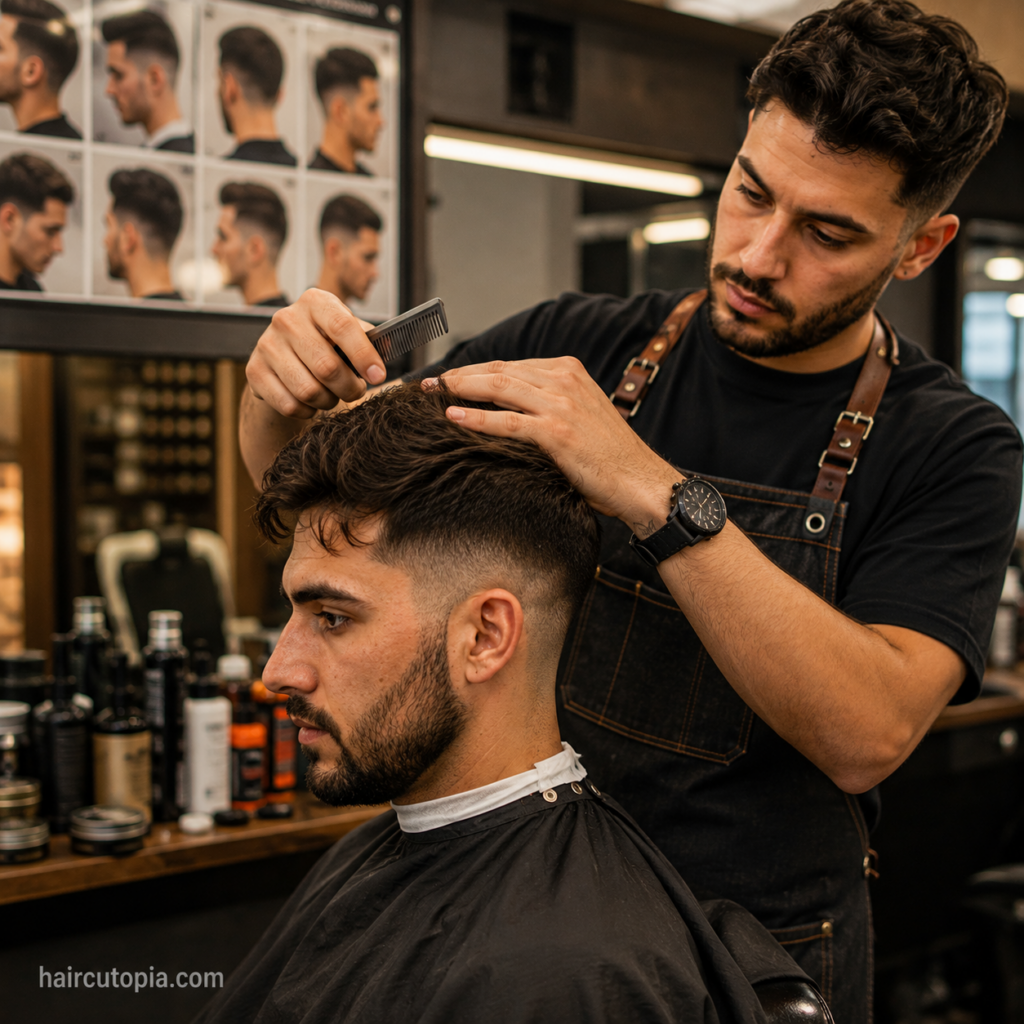
You don’t have to walk into the shop knowing exactly what haircut you want.
A good barber can evaluate your hair in person and suggest options based on its texture, density, growth pattern, and your preferred maintenance level.
You can make the conversation easier by explaining your priorities.
For example:
“I want something low-maintenance that looks good without much product. I’d like the sides shorter, but I don’t want a skin fade.”
That’s much more useful than simply saying, “Do whatever you think looks good.”
Your barber can then recommend a specific variation while still working within your preferences.
Should You Follow Haircut Trends?
Trends can be a great source of inspiration, but you don’t need to chase every popular haircut.
Some trends work particularly well because they can be adapted to different hair types. Others depend heavily on a specific texture, length, or styling routine.
Before choosing a trending haircut, ask yourself:
- Does it work with my natural hair?
- Will I actually style it?
- How will it look after a few weeks of growth?
- Does it fit my everyday style?
- Am I choosing it because I genuinely like it?
If the answers make sense, try it.
Hair grows back. A haircut is one of the easier ways to experiment with your appearance without making a permanent change.
What If You’re Not Sure About a Big Change?
You don’t always need to make the full transformation in one appointment.
If you’ve had the same hairstyle for years, start with a more moderate version of the haircut you’re considering.
You might:
- Lower the fade.
- Keep extra length on top.
- Try a taper before a skin fade.
- Add texture without dramatically shortening the hair.
- Gradually grow the top before switching styles.
Once you know what you like, you can make bigger adjustments at the next appointment.
This approach is especially useful if you’re unsure how a dramatically shorter haircut will look or feel.
How to Explain the Haircut You Want
Before your next barber appointment, keep the conversation simple.
Tell your barber:
- How short you want the sides.
- Whether you want a taper, fade, or more traditional scissor-cut sides.
- Approximately how much length you want to keep on top.
- How you normally style your hair.
- Any problem areas, such as cowlicks or a difficult crown.
- How much daily styling you’re willing to do.
- What you liked or disliked about your previous haircut.
Then show your reference photos.
You don’t need to dictate every clipper guard and cutting technique. Give the barber a clear picture of the result you want and let them determine the best way to achieve it.
Common Mistakes When Choosing a Haircut
A little preparation can prevent a disappointing cut.
Try to avoid:
- Choosing a haircut based only on a celebrity or model photo.
- Ignoring your natural hair texture.
- Asking for an extremely short cut when you’re unsure about the length.
- Choosing a high-maintenance style when you dislike styling your hair.
- Assuming every fade looks the same.
- Forgetting about your cowlicks and growth patterns.
- Giving vague instructions such as “just clean it up.”
- Staying silent when you’re unsure about what the barber is doing.
It’s completely reasonable to ask questions during the consultation.
How Do You Know If a Haircut Is Right for You?
The right haircut should do more than look good immediately after the appointment.
Ideally, it should:
- Complement your natural hair.
- Fit your face and head proportions.
- Work with your normal routine.
- Be manageable at home.
- Grow out reasonably well.
- Match how frequently you want haircuts.
- Make you feel comfortable wearing it every day.
You may need to experiment before finding your favorite style.
Even small adjustments—changing the fade height, leaving another half-inch on top, adding texture, or changing the neckline—can completely change how a haircut feels.
Final Thoughts
Choosing the right haircut isn’t about finding one universal style that’s supposedly perfect for your face shape.
It’s about finding the best combination of shape, length, texture, maintenance, and personal preference.
Start with your natural hair. Consider your face and head shape, decide how much styling and maintenance you’re willing to handle, and bring useful reference photos to your barber. Most importantly, communicate what you like and what you don’t.
Once you find a haircut that works, you can fine-tune it over future appointments. Sometimes the difference between a decent haircut and your ideal haircut is just a few small adjustments.