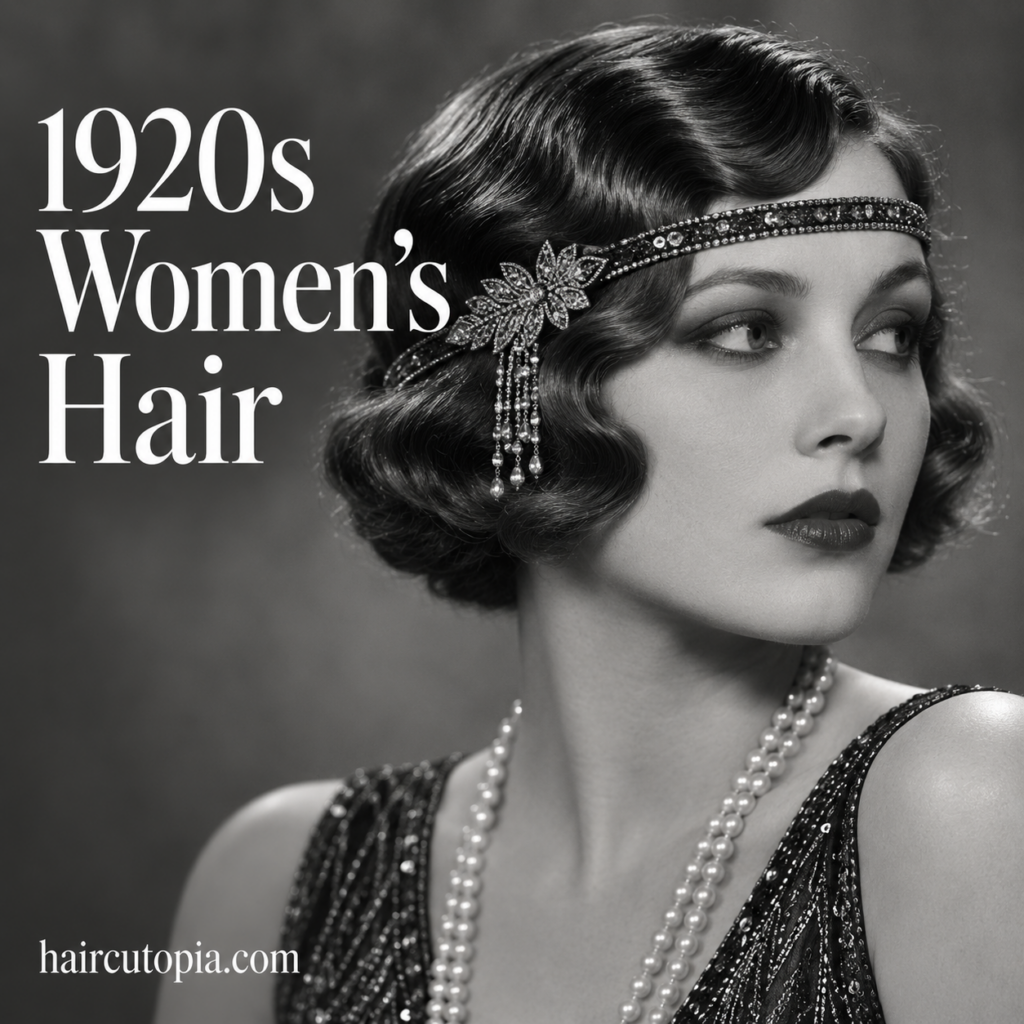
Few periods changed women’s hair as visibly as the 1920s.
At the beginning of the decade, long hair was still familiar and widely worn. But a very different silhouette was gaining attention: the bob. Hair moved upward from the shoulders, necklines became visible, and increasingly short cuts gave women new ways to frame the face.
Then came the styling.
Finger waves created sculpted S-shaped curves. Marcel waves added smooth, polished movement. Short crops pushed beyond the traditional bob, while women who kept their hair long could pin, roll, and tuck it into compact styles that still captured the fashionable look of the decade.
Add cloche hats, decorative headbands, and carefully placed curls, and it’s easy to see why 1920s women’s hair remains so recognizable today.
Here’s a closer look at the haircuts, hairstyles, styling methods, and details that defined women’s hair during the Roaring Twenties.
What Did Women’s Hair Look Like in the 1920s?
There wasn’t one hairstyle worn by every woman.
The decade included everything from long hair arranged at the nape to extremely short crops.
What changed most noticeably was the fashionable silhouette.
Hair increasingly became shorter, flatter, and more closely shaped around the head. Even women who kept their length often arranged it compactly rather than leaving it loose.
Common characteristics included:
- Bobbed hair
- Ear- to jaw-length cuts
- Short tapered crops
- Finger waves
- Marcel waves
- Deep side parts
- Straight or shaped bangs
- Small curls around the face
- Low buns and rolls
- Faux bobs
- Decorative headbands
- Close-fitting hairstyles designed for cloche hats
The overall appearance tended to be intentional and controlled.
Even waves and curls were carefully arranged rather than deliberately tousled.
The Bob Revolution
The bob became the defining women’s haircut of the 1920s.
Cutting long hair to around the ears, cheeks, or jaw may not sound radical now. At the time, however, short hair on women carried much greater visual impact.
The bob changed the entire silhouette.
The neck became more visible. Hair framed the face rather than flowing down the back. Hats could sit closely around the head without accommodating a large mass of pinned hair.
And once women began experimenting with shorter lengths, the possibilities multiplied.
The bob wasn’t one haircut. It became a family of cuts.
The Classic 1920s Bob
The classic bob generally created a compact shape around the face.
Length varied.
Some versions reached the jaw, while others stopped around the cheeks or ears.
The ends could remain relatively blunt or be shaped to curve around the face.
What made the cut particularly versatile was how differently it could be styled.
The same bob could be:
- Worn straight
- Finger-waved
- Marcel-waved
- Curled at the ends
- Paired with bangs
- Deeply side-parted
- Decorated with a headband
That versatility helped the bob become much more than a passing novelty.
The Blunt Bob
The blunt bob emphasized clean lines.
Hair was cut to create a strong perimeter rather than a heavily layered shape.
When worn straight, the effect could look strikingly geometric.
A blunt fringe made the silhouette even stronger.
This combination—short length, solid ends, and full bangs—is one of the easiest 1920s looks to recognize.
It’s also one of the styles that translates most naturally into modern hair.
Contemporary blunt bobs may use different finishing techniques, but the underlying shape remains remarkably similar.
The Shingle Bob
The shingle offered a more dramatically shaped version of short hair.
Instead of maintaining the same length around the entire head, hair became progressively shorter toward the back and nape.
From the front, longer side sections could still suggest a bob.
From behind, the neckline was much more exposed.
The contrast made the shingle distinctive.
It also required more precise haircutting than simply removing length from long hair.
A shingle could be styled smooth or combined with waves through the longer sections.
The Eton Crop
The Eton crop took women’s short hair even further.
Rather than stopping at bob length, the hair was cropped close to the head.
The result was sleek, compact, and noticeably androgynous compared with traditional women’s hairstyles of earlier generations.
Small waves could be added around the temples or forehead, but the haircut itself remained very short.
The Eton crop is one of the clearest examples of just how adventurous women’s hair became during the decade.
Modern pixie cuts and close crops owe something to the same idea: short hair can emphasize the face rather than hiding it.
Ear-Length Bobs
Some women wore bobs that ended around the ears rather than extending to the jaw.
This produced a particularly compact shape.
The ears might be exposed completely or partially covered depending on the cut.
The shorter length also worked naturally with waves because there was less hair to shape around the head.
For a modern comparison, some micro bobs and short French bobs create a similar proportion.
Jaw-Length Bobs
A jaw-length bob provided a slightly softer transition into short hair.
There was enough length to frame the lower face while still exposing much of the neck.
This version worked particularly well with waves.
It could also be worn straight, making it one of the more versatile cuts associated with the decade.
For someone recreating 1920s women’s hair today without wanting an extremely short haircut, a jaw-length bob is one of the easiest starting points.
Bobs With Bangs
Bangs added another layer of personality to short hair.
Full, straight bangs created a strong geometric frame.
Shorter fringes could make the haircut feel even bolder.
Other women wore the front longer and incorporated it into a side part or wave.
The important point is that bobbed hair wasn’t automatically paired with one specific fringe.
There were many ways to shape the front.
That variety is one reason photographs from the period show considerably more diversity than the stereotypical single “flapper bob” often used to represent the entire decade.
Finger Waves
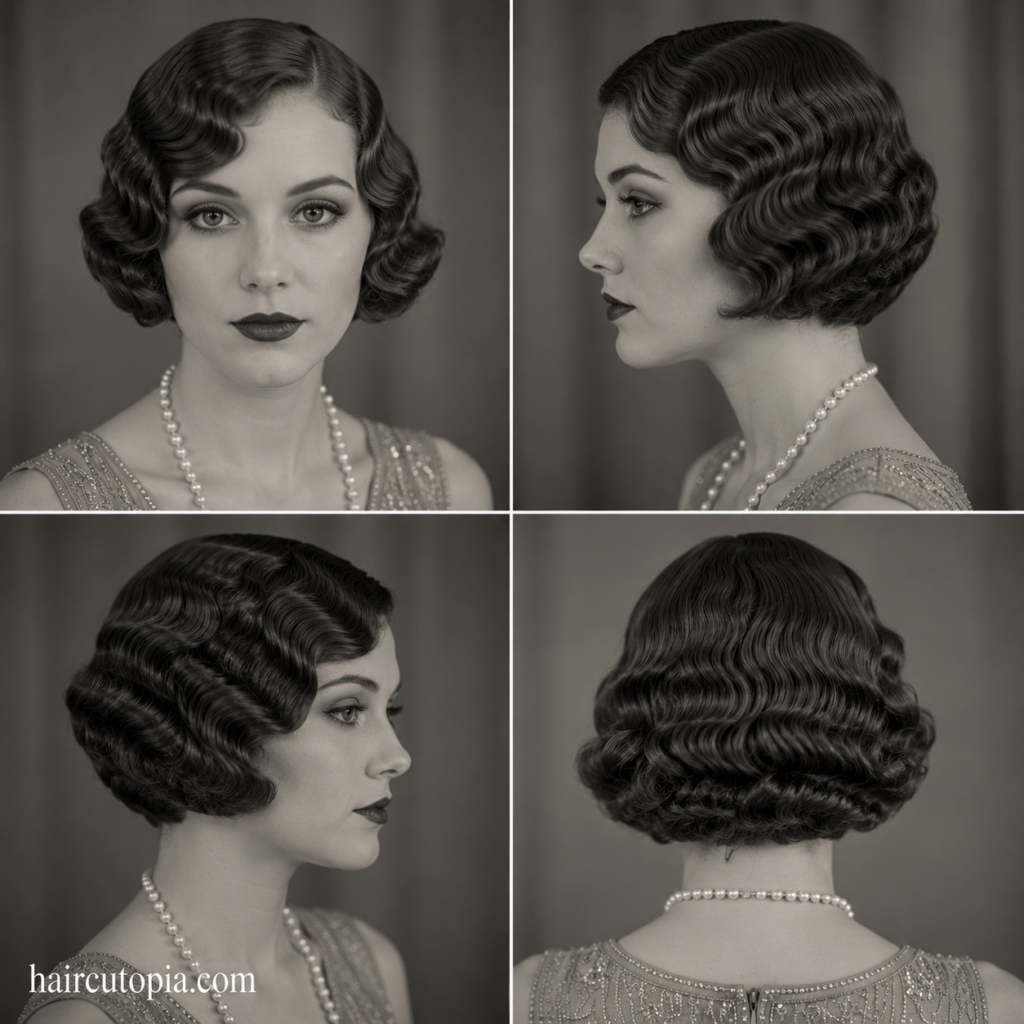
Finger waves are among the most recognizable 1920s women’s hairstyles.
The technique created smooth S-shaped waves that sat relatively close to the head.
Rather than producing loose curls, finger waving sculpted the hair into a repeating pattern.
The waves could be especially dramatic around the forehead and temples.
A deep side part often strengthened the effect.
What Made Finger Waves Different?
Finger waves weren’t simply curled hair.
The hair was shaped into alternating ridges and curves.
Traditionally, this involved manipulating damp hair with the fingers and a comb, working through one section at a time.
The result looked controlled and almost architectural.
Short hair made the pattern particularly visible, which is one reason finger waves became so closely associated with the bob.
Marcel Waves
Marcel waves created another polished form of texture.
The technique predated the 1920s but remained highly relevant during the decade.
Unlike traditional finger waving, Marcel waving involved heated irons.
The resulting waves could appear smooth, regular, and highly structured.
They worked on different hair lengths and could be incorporated into both short and longer styles.
Finger waves and Marcel waves are sometimes treated as interchangeable in modern discussions, but historically they refer to different styling techniques.
Visually, both contributed to the sculpted wave patterns strongly associated with the era.
Deep Side Parts
A deep side part could transform even a relatively simple haircut.
By moving the part noticeably away from the center, more hair swept across one side of the forehead.
This created asymmetry and gave waves a natural direction.
Finger waves paired especially well with deep side parts.
One side could feature a broad sweeping curve while the other remained tighter and closer to the head.
The technique remains useful today when creating vintage-inspired styles.
Even without elaborate waves, moving the part deeper can immediately give a short bob a more dramatic appearance.
Center Parts
Side parts may be strongly associated with 1920s styling, but center parts weren’t absent.
A center part created a more symmetrical frame around the face.
It could work with smooth bobs, curled sides, or longer hair arranged toward the back.
The finished appearance was different from the dramatic sweep of a deep side part but still fit the decade’s preference for deliberate structure.
Kiss Curls and Spit Curls
Small curls placed around the face added detail to otherwise compact hairstyles.
These curls might sit on the forehead, near the temples, or along the cheeks.
They were carefully shaped rather than left to form randomly.
Because much of the surrounding hair was smooth and close to the head, a single curl could become a noticeable decorative feature.
Today, similar details sometimes appear in vintage hairstyling, runway looks, and editorial hair.
Flapper Hair
The flapper became one of the enduring cultural images of the 1920s.
But “flapper hair” wasn’t one specific haircut.
Instead, the look drew from several fashionable elements of the decade.
A flapper-inspired hairstyle might feature:
- A short bob
- A shingle cut
- Finger waves
- Marcel waves
- A deep side part
- Kiss curls
- A decorative headband
- A jeweled hair ornament
Some women associated with flapper fashion also retained longer hair and styled it to appear shorter.
The recognizable effect came from the overall combination rather than a single mandatory haircut.
Did All Women Cut Their Hair Short?
No.
The popularity of the bob can make it seem as though every woman suddenly cut off her long hair during the 1920s.
That wasn’t the case.
Many women continued wearing long hair for personal, cultural, practical, or stylistic reasons.
What changed was how long hair could be arranged.
Instead of wearing it loose, women could roll, pin, curl, or tuck it into shapes that reflected the compact silhouettes fashionable at the time.
Long hair and 1920s style were completely compatible.
The Faux Bob
The faux bob was a clever solution for women who wanted the appearance of short hair without actually cutting it.
Long hair could be curled or waved before the ends were tucked underneath.
Pins secured the hidden length.
From the front and sides, the hair could then resemble a genuine bob.
This approach offered flexibility.
A woman could participate in the short-hair fashion for a particular occasion and return to her full length afterward.
The faux bob remains useful today for vintage events, weddings, theatrical styling, and anyone curious about how short hair might look.
Low Buns
Long-haired women could also gather their hair into a low bun.
The bun typically sat around the nape rather than high on the head.
Keeping the style low helped maintain the streamlined silhouette of the decade.
The front sections could remain smooth or incorporate waves.
This combination allowed a woman to preserve her length while still creating a fashionable appearance from the front.
Rolled and Pinned Styles
Another option was rolling long hair inward and pinning it securely.
The roll could extend across the back of the head or concentrate near the nape.
This reduced the visible length and kept the overall hairstyle compact.
The front could then be styled separately with waves or curls.
From certain angles, a carefully constructed roll could even resemble shorter hair.
1920s Hair Accessories
Accessories played an important role in women’s hair.
A simple hairstyle could become dramatically more glamorous with the addition of the right headpiece.
Popular decorative elements included:
- Headbands
- Beads
- Rhinestones
- Feathers
- Combs
- Decorative pins
- Floral ornaments
- Brooch-like embellishments
Some were subtle.
Others were designed to attract attention.
The 1920s Headband
The decorative headband is particularly associated with flapper imagery.
It could be worn across the forehead or positioned slightly higher.
Some bands were relatively simple, while evening versions could include jewels, beads, feathers, or elaborate decorative pieces.
Headbands worked naturally with short hair because the accessory remained clearly visible.
They also helped transform relatively simple waves or bobs into formal evening styles.
Cloche Hats and Women’s Hair
You can’t fully understand 1920s women’s hair without considering the cloche hat.
The cloche fit closely around the head and often sat low toward the eyebrows.
Large, voluminous hairstyles weren’t particularly practical underneath.
Short bobs and compact waves fit naturally.
Long hair could be pinned low and close to the head.
Small curls or sections of hair might remain visible around the cheeks or nape.
Fashion and hairstyling influenced each other, and the cloche is a perfect example of that relationship.
What Hair Products Did Women Use?
Creating polished waves and controlled styles required help from grooming products.
Various setting preparations, lotions, oils, brilliantine-type products, and hair tonics were available during the period.
Products could help:
- Control flyaways
- Add shine
- Hold waves
- Smooth the surface
- Make hair easier to shape
The exact products and routines varied.
Modern styling products offer much easier ways to reproduce the general appearance.
Gel, mousse, setting lotion, pomade, and hairspray can all be useful depending on the style.
How Women Styled Finger Waves
Traditional finger waving required patience.
Hair was dampened and prepared with a setting product.
A comb and the fingers were then used together to shape the hair into ridges.
The general process involved:
- Starting with damp hair.
- Applying a setting product.
- Creating the desired part.
- Combing a section into one direction.
- Holding the hair in place with the fingers.
- Redirecting the next section to create an S-shaped curve.
- Repeating the pattern around the head.
- Allowing the hair to set.
Modern tools and clips can simplify parts of the process, but traditional-looking finger waves still require careful shaping.
Hair Texture and 1920s Styles
The iconic images of the decade often emphasize smooth, sculpted hair, but women naturally had every kind of hair texture.
Straight hair could be cut into geometric bobs or shaped with waves.
Naturally wavy hair already had movement that could be directed and controlled.
Curly hair could be shaped into short silhouettes while retaining more texture.
The key to a convincing modern interpretation isn’t necessarily changing your natural texture completely.
It’s often more effective to borrow the decade’s silhouette, parting, length, or decorative details.
How to Get a 1920s-Inspired Women’s Haircut Today
You don’t need an exact historical reproduction.
Several modern cuts provide an excellent foundation.
Consider asking for:
- A jaw-length blunt bob
- An ear-length bob
- A short French bob
- A micro bob
- A tapered bob
- A close crop
- A bob with full bangs
If you want something that works beyond vintage styling, tell your stylist you want the haircut to look contemporary when worn naturally but suitable for 1920s-inspired styling when polished.
Reference photos are useful.
Names such as “shingle” may not be interpreted identically by every modern stylist, while an image communicates the shape immediately.
How to Recreate 1920s Women’s Hair With Long Hair
You don’t have to cut your hair.
A faux bob is the obvious solution.
Start by creating waves or curls, then gather the longer sections and tuck them underneath.
Secure everything with pins.
Keep the visible shape around the cheeks and jaw relatively compact.
Another option is a low rolled style.
Wave the front and sides, then gather the remaining length into a roll or bun near the nape.
Adding a decorative headband can strengthen the 1920s influence without changing your haircut at all.
How to Make 1920s Women’s Hair Look Modern
Historical inspiration doesn’t have to become a costume.
The easiest approach is choosing one or two elements rather than recreating everything at once.
For example:
- Wear a modern bob with a deep side part.
- Add one sculpted wave near the forehead.
- Keep natural texture through a short crop.
- Pair a blunt bob with softer contemporary bangs.
- Use a decorative accessory with an otherwise simple hairstyle.
- Create loose waves inspired by Marcel styling rather than exact replicas.
- Wear a modern pixie with a sleek finish.
The underlying reference remains visible without overwhelming the look.
Which 1920s Women’s Hairstyles Are Still Popular?
The bob is easily the biggest survivor.
It has never stopped evolving.
Today’s versions include blunt bobs, French bobs, micro bobs, layered bobs, curly bobs, and countless other variations.
Short crops also became permanent fixtures in women’s hair.
Finger waves are less common as an everyday style, but they regularly return for formal occasions, red carpets, fashion editorials, and vintage-inspired looks.
Deep side parts, sleek finishes, and decorative hair accessories continue to cycle through fashion as well.
The 1920s didn’t simply give us a collection of old hairstyles.
It helped establish ideas that modern hairstyling continues to reinterpret.
Frequently Asked Questions About 1920s Women’s Hair
What was the most popular women’s hairstyle in the 1920s?
The bob became the defining women’s hairstyle and haircut of the decade. It appeared in many variations, including blunt bobs, shingled styles, short bobs, waved bobs, and versions with bangs.
Did all women have bobs in the 1920s?
No. Many women kept their hair long and styled it into low buns, rolls, pinned arrangements, or faux bobs.
What are 1920s finger waves?
Finger waves are sculpted S-shaped waves traditionally formed in damp hair using the fingers and a comb. They became strongly associated with fashionable short hairstyles during the period.
What is the difference between finger waves and Marcel waves?
Finger waves are traditionally shaped using the fingers and a comb on damp hair. Marcel waves historically involved heated waving irons. Both can create the smooth, structured wave patterns associated with the era.
What was a shingle haircut?
A shingle was a short women’s cut that became progressively shorter toward the back and nape while often retaining more length around the sides.
What was an Eton crop?
The Eton crop was an extremely short women’s haircut that sat close to the head. It created a sleek, boyish silhouette and became one of the decade’s boldest short-hair looks.
How did women with long hair style it in the 1920s?
Long hair could be arranged into low buns, rolls, pinned styles, waves, and faux bobs. These techniques allowed women to create the fashionable compact silhouette without cutting their hair.
What hair accessories were popular in the 1920s?
Decorative headbands, jeweled ornaments, feathers, combs, pins, beads, and other embellishments were used, particularly for evening and flapper-inspired styles.
Can I create a 1920s hairstyle without cutting my hair?
Yes. A faux bob, low roll, or pinned hairstyle can create a convincing 1920s-inspired silhouette while preserving long hair.
Are 1920s women’s hairstyles still fashionable?
Many are. Bobs and short crops remain mainstream, while finger waves, sleek side parts, and vintage accessories continue to appear in formal and editorial styling.
Why 1920s Women’s Hair Still Matters
The lasting importance of 1920s women’s hair goes beyond finger waves and glamorous photographs.
The decade helped redefine what women’s hair could look like.
The bob challenged the expectation that femininity required long hair. Shingles and Eton crops went even shorter. At the same time, women who preferred long hair developed creative ways to participate in changing fashion without sacrificing their length.
Styling became equally distinctive.
Sculpted waves, dramatic parts, decorative curls, headbands, and compact shapes gave the decade a visual language that remains instantly recognizable.
Many of those ideas eventually became ordinary.
Women wearing jaw-length bobs no longer cause a stir. Neither do pixie cuts, cropped hair, or sharply tapered styles.
That’s part of the legacy of 1920s women’s hair.
What once looked daring eventually became timeless.