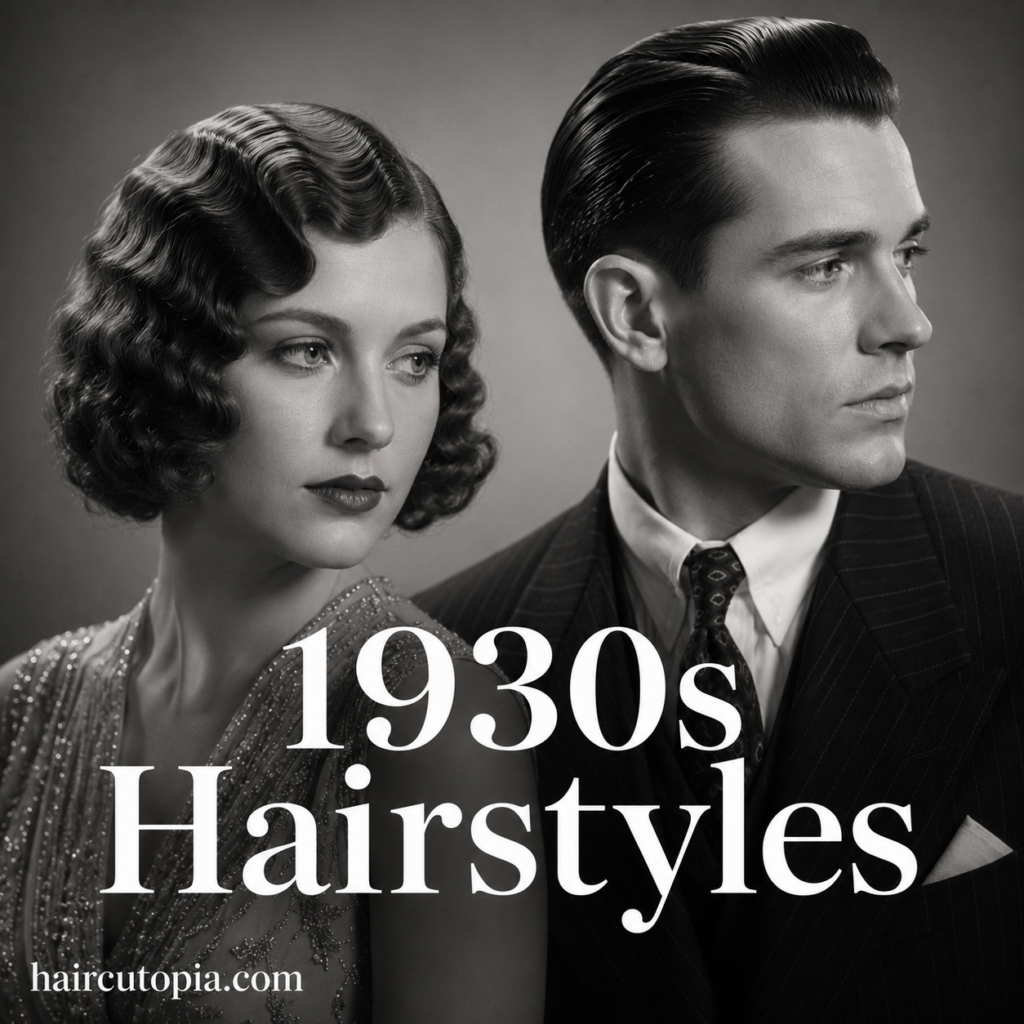
The 1930s brought a softer, more polished approach to hair. The dramatically short bobs of the 1920s didn’t disappear overnight, but hairstyles gradually became longer, more sculpted, and increasingly glamorous as the decade progressed.
For women, waves and curls defined much of the era. Finger waves framed the face, pin curls created carefully controlled movement, and longer styles began appearing around the shoulders by the end of the decade. Men’s hairstyles followed a cleaner formula: neat side parts, slicked-back tops, tapered sides, and plenty of shine.
Hollywood helped turn these looks into recognizable symbols of 1930s style. Movie stars appeared on screen with perfectly arranged hair, and photographs in magazines gave people another source of inspiration. Yet everyday hairstyles also needed to be practical, especially during the economic hardship of the Great Depression.
The result was a decade full of contrasts. Hair could be glamorous without being excessively complicated, structured without looking harsh, and elegant while still being adaptable to everyday life.
Here’s a closer look at the 1930s hairstyles that defined the era and why so many of their styling ideas are still recognizable today.
What Were Hairstyles Like in the 1930s?
The defining feature of 1930s hair was control.
Whether hair was short, medium, waved, curled, or slicked back, the finished style usually looked deliberate. Stray pieces and deliberately messy texture weren’t generally the goal.
Women’s hairstyles increasingly moved away from the sharp geometric shapes associated with the previous decade. Hair became softer around the face, with waves and curls creating rounded silhouettes.
Men typically wore shorter hair around the sides and back while keeping enough length on top to comb into a defined shape.
Some of the most recognizable features of 1930s hairstyles included:
- Deep side parts
- Finger waves
- Marcel-style waves
- Pin curls
- Sculpted curls around the face
- Smooth crowns
- Softly curled ends
- Short and medium-length bobs
- Shoulder-length waves later in the decade
- Slick side parts for men
- Neatly tapered sides and backs
- Glossy, controlled finishes
While these characteristics provide a general picture of the decade, hair fashion changed noticeably between the early and late 1930s.
How Hairstyles Changed During the 1930s
Looking at the entire decade as one fashion period can be misleading.
Early-1930s hairstyles still carried a strong 1920s influence. By 1939, women’s hair had generally become longer, fuller, and closer to the glamorous styles associated with the early 1940s.
Early 1930s Hairstyles
During the early years of the decade, shorter hairstyles remained common.
Women often wore hair around jaw or nape length, styling it close to the head with waves and small curls. Deep side parts helped create an asymmetrical appearance.
Typical early-1930s features included:
- Short bobs
- Finger waves
- Close-fitting silhouettes
- Small curls near the ears
- Deep side parts
- Smooth, controlled styling
Men’s hairstyles were already centered around short sides and longer, combed top sections.
Mid-1930s Hairstyles
By the middle of the decade, women’s hair began gaining noticeable length.
Waves became softer and curls could appear fuller around the sides and back. Hair extending toward the shoulders provided more opportunities for different arrangements.
The silhouette was gradually becoming less compact.
Late 1930s Hairstyles
Late-1930s hair often looked noticeably fuller and more romantic.
Women’s styles could reach the shoulders, with larger curls and waves replacing some of the tightly sculpted shapes seen earlier.
These hairstyles created a bridge into the 1940s, when rolls, curls, and greater volume would become even more prominent.
Men’s hairstyles changed less dramatically, with classic side parts and slicked-back styles remaining popular throughout the decade.
Popular 1930s Hairstyles for Women
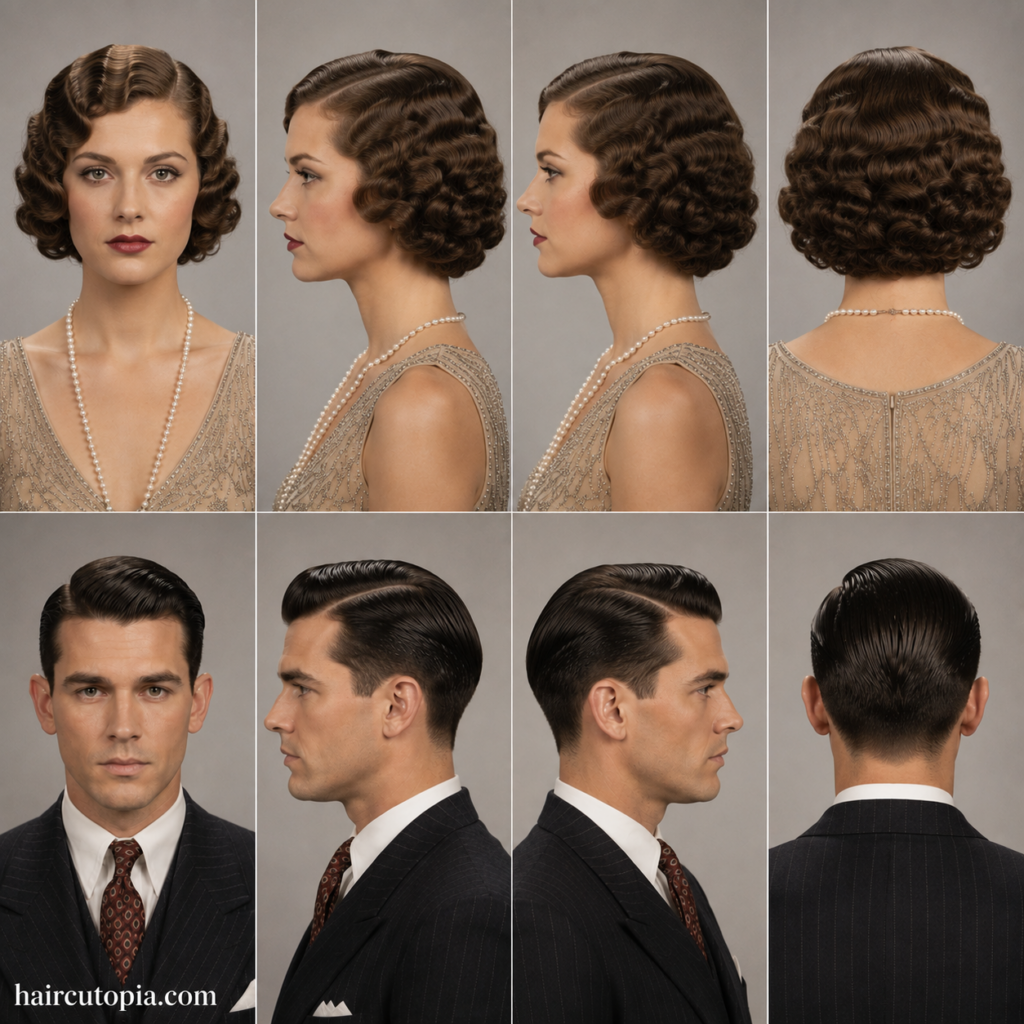
Women’s hairstyling during the 1930s relied heavily on waves, curls, and careful placement.
A relatively simple haircut could produce several completely different looks depending on how it was set.
1. Finger Waves
Finger waves are among the hairstyles most closely associated with the 1930s.
The hair was shaped into smooth S-patterns that followed the contours of the head. Rather than producing loose beachy texture, the technique created clearly defined ridges.
Finger waves were particularly effective on short hair because the waves could remain close to the scalp.
They were often combined with:
- Deep side parts
- Short bobs
- Small curls near the ears
- Sculpted ends
- Smooth necklines
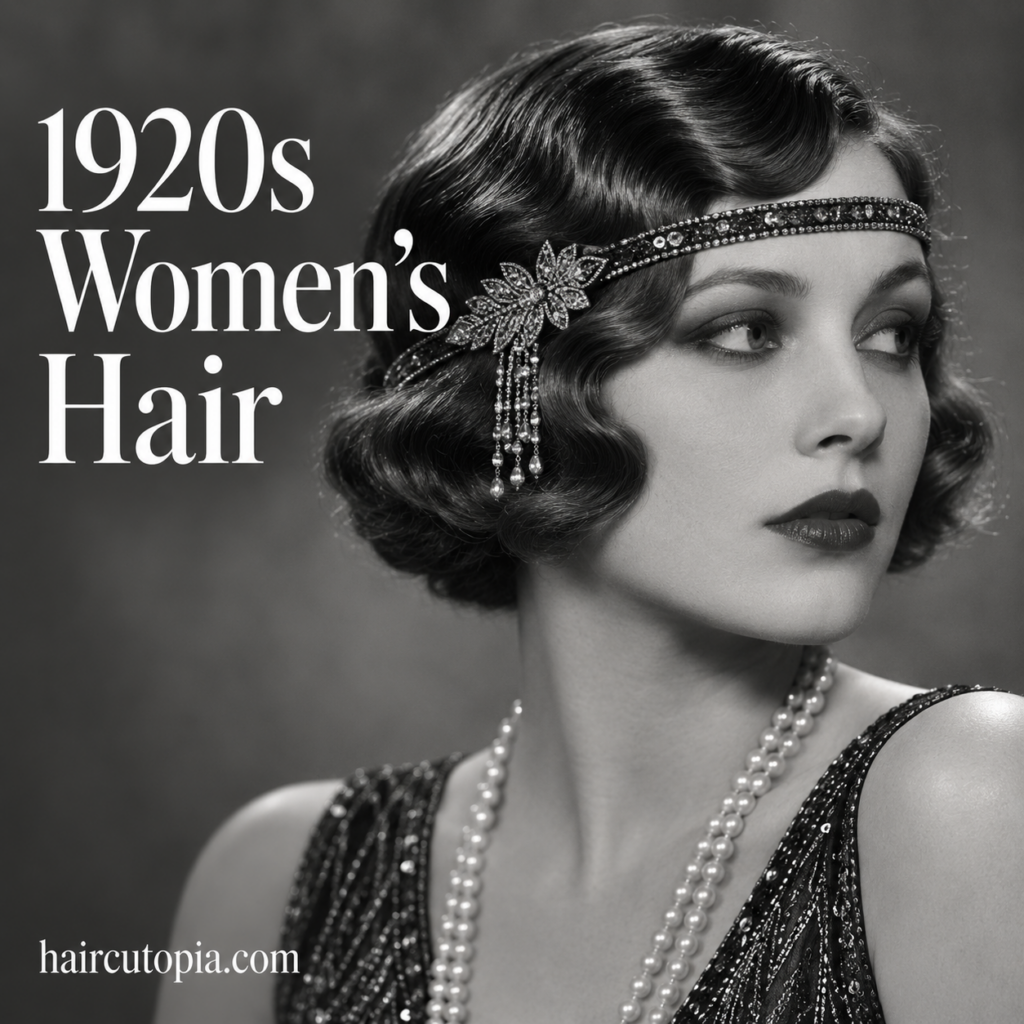
Although strongly associated with the 1920s as well, finger waves remained an important part of early-1930s hairstyling.
2. Side-Parted Waves
The deep side part became a signature detail of the era.
Hair was divided noticeably away from the center, allowing the heavier section to sweep across the forehead before transitioning into waves.
The asymmetry created an elegant frame around the face.
This approach worked with both short and longer hairstyles, which helped it remain fashionable as hair lengths changed.
3. The Waved Bob
The bob continued into the 1930s but usually looked softer than many versions from the previous decade.
Instead of emphasizing an extremely straight perimeter, the hair could be shaped into waves and curls.
The ends might curve inward toward the jaw or form small curls around the neckline.
A waved bob offered the practicality of short hair while still creating the polished appearance fashionable at the time.
4. Marcel Waves
Marcel-style waves produced smooth, repeating curves through the hair.
The technique originated before the 1930s, but the visual effect remained closely connected with glamorous hairstyling during the period.
Compared with softer natural waves, Marcel-style waves looked deliberately sculpted.
They worked particularly well for formal and evening hairstyles.
5. Pin Curl Hairstyles
Pin curls were enormously useful because they weren’t limited to one finished hairstyle.
Small sections of hair could be wound into curls and secured against the scalp while the hair set. Once dry, those curls could be released and arranged in numerous ways.
Depending on placement and brushing, pin curls could create:
- Small defined curls
- Soft waves
- Curled ends
- Face-framing movement
- Fuller sides
- Structured evening styles
This versatility made setting techniques an important part of home hairstyling.
6. Side-Swept Curls
A deep side part combined beautifully with curls.
One side could remain relatively controlled while the heavier section swept across the forehead and transitioned into curls around the cheek or jaw.
The result had the glamorous asymmetry frequently seen in 1930s portraits.
7. Curled-Under Ends
Not every fashionable hairstyle required waves throughout the entire head.
Hair could remain relatively smooth through the crown and lengths before curving inward at the ends.
This produced a neat rounded outline and worked particularly well as hairstyles became longer.
8. Soft Curly Bob
For a more romantic variation on the bob, curls could replace tightly structured finger waves.
The crown was often kept relatively smooth while curls concentrated around the sides and bottom.
This softened the outline of short hair and helped move the bob away from its sharper 1920s appearance.
9. Nape-Length Waves
As short bobs grew out, hair reaching the nape became increasingly useful for styling.
The additional length allowed waves to continue farther down the head and gave curls more room around the neckline.
It was a natural transitional style between the short bob and the longer hair seen later in the decade.
10. Shoulder-Length Waves
By the later 1930s, shoulder-length hair was becoming increasingly fashionable.
Longer hair allowed larger, flowing waves rather than only tight patterns against the scalp.
This produced a more romantic silhouette and foreshadowed many 1940s hairstyles.
11. Brushed-Out Curls
Curls didn’t always remain individually defined.
After setting, hair could be carefully brushed so individual curls blended into a smooth wave pattern.
The technique created a polished surface while preserving movement and volume.
Modern versions of vintage Hollywood waves still use a similar idea.
12. Sculpted Face-Framing Curls
Small curls were frequently positioned strategically around the face.
They might sit near the temples, ears, cheeks, or neckline rather than covering the entire head.
This gave hairstylists considerable control over the overall silhouette.
13. Center-Parted Waves
Although side parts were particularly characteristic of the decade, center parts were also worn.
A center part produced greater symmetry and could be combined with waves or curls on both sides.
The result often looked softer and less dramatic than a deep side-parted style.
14. Longer Curled Hairstyles
Toward the end of the decade, longer hair offered increasingly elaborate styling possibilities.
Hair could remain smooth near the crown before transitioning into larger curls through the lower sections.
These styles marked an important shift away from the very short hairstyles that had dominated women’s fashion roughly a decade earlier.
Popular 1930s Hairstyles for Men
Men’s hairstyles generally emphasized neatness, structure, and shine.
Most styles kept the sides and back shorter while leaving enough length through the top to comb into place.
15. Classic Side Part
Few men’s hairstyles represent the period as clearly as the side part.
Hair was divided cleanly on one side and combed across the top.
The sides remained neat, while styling product helped maintain the smooth finish.
This simple formula could be adapted to different hair lengths and textures.
16. Slicked-Back Hair
Rather than directing hair toward the side, some men combed the longer top backward.
Product helped keep the hair close to the head and created the characteristic shine associated with vintage grooming.
Unlike many modern slick-back styles paired with very tight fades, traditional versions generally had softer transitions through the sides.
17. Side-Swept Hair
A side sweep offered slightly more movement than a completely slick side part.
Hair traveled diagonally across the top while remaining carefully controlled.
This worked especially well for men with naturally straight or gently wavy hair.
18. Wavy Side Part
Natural waves could be incorporated into a polished hairstyle rather than completely flattened.
The side part established the direction, while the top retained some visible texture.
The result looked refined but slightly softer than a heavily pomaded style.
19. Pomaded Comb-Over
Combing the hair cleanly across the top from a side part was a standard grooming technique.
Pomade helped hold the shape and created a sleek finish.
The overall appearance was intentional and orderly rather than voluminous or deliberately tousled.
20. Formal Slick-Back
For evening wear and formal occasions, hair could be styled especially smooth.
The top was combed away from the face and controlled closely with product.
This complemented the tailored suits and formal clothing associated with fashionable men’s evening wear.
21. Short and Neatly Combed Hair
Not everyone needed an elaborate hairstyle.
Shorter hair could simply be combed neatly with a subtle side part.
The important elements were a clean outline and controlled finish.
This made the style practical for everyday grooming.
How Hollywood Influenced 1930s Hairstyles
Hollywood had an enormous influence on beauty during the decade.
Movies gave audiences something earlier generations hadn’t experienced on the same scale: repeated close-up views of famous performers and their appearance.
Hairstyles could be seen on screen, in publicity photographs, in advertisements, and throughout fan magazines.
Jean Harlow became strongly associated with platinum-blonde glamour and carefully styled waves.
Marlene Dietrich presented another influential image of sophisticated 1930s beauty, often wearing sculpted waves and polished styles.
Greta Garbo also helped popularize the elegant, softly waved appearance seen throughout the decade.
For men’s grooming, stars such as Clark Gable and Cary Grant helped establish the enduring image of the neatly groomed Hollywood leading man.
The connection between celebrities and hairstyle trends certainly existed before the 1930s, but cinema gave famous hairstyles extraordinary visibility.
How the Great Depression Affected Hairstyles
Hollywood glamour existed alongside the economic hardship of the Great Depression.
For many households, frequent salon visits weren’t realistic. Hairstyles that could be maintained, reset, or rearranged at home therefore had practical value.
Women could use wet-setting techniques to create waves and curls without needing an entirely new haircut.
A single haircut could potentially be styled several ways by:
- Changing the part
- Repositioning curls
- Creating finger waves
- Using pin curls
- Brushing curls into waves
- Curling only the ends
- Changing the amount of volume
This adaptability made styling particularly important.
Men’s grooming could similarly rely on a straightforward haircut combined with combing and product to maintain a polished appearance.
How Women Created 1930s Waves and Curls
Many authentic-looking 1930s hairstyles depended more on setting techniques than complicated haircuts.
Finger Waving
Finger waves were generally formed while the hair was damp.
A comb and fingers were used to manipulate the hair into alternating ridges, creating the recognizable S-shaped pattern.
Once set and dried, the waves retained their sculpted form.
Pin Curling
Pin curls involved winding small sections into circular curls and securing them close to the scalp.
The direction and position of each curl mattered because the set determined how the finished hair would fall.
Once released, curls could be left relatively defined or brushed into softer waves.
Heated Waving
Heated tools were also used to create structured waves.
These methods required care and skill, especially because historical styling equipment lacked many of the temperature-control and safety features found on modern tools.
Brushing and Shaping
Setting the curls wasn’t necessarily the final step.
Hair could be brushed repeatedly until separate curls blended into the desired shape.
The stylist then manipulated the resulting waves into a smooth, cohesive silhouette.
What Hair Products Were Used in the 1930s?
Styling products helped create the controlled appearance fashionable during the period.
Products varied by purpose, but commonly used categories included:
- Brilliantine
- Pomade
- Hair oils
- Hair tonics
- Setting lotions
- Shampoos
- Wave-setting products
Men often used products that provided both control and visible shine.
Women relied heavily on products that helped curls and waves retain their shape after setting.
Modern products can recreate the same visual effect without requiring historically accurate formulas. Mousse, gel, pomade, setting spray, curl cream, and hairspray can all be useful depending on the hairstyle.
1930s Hairstyles for Different Hair Lengths
One reason the decade provides so much inspiration is the variety of lengths that appeared as fashion evolved.
Short Hair
Short hair works especially well for:
- Finger waves
- Waved bobs
- Sculpted curls
- Close-fitting styles
- Deep side parts
The shorter length makes it easier to create the compact silhouette associated with the early 1930s.
Medium Hair
Medium-length hair offers considerably more versatility.
It can support:
- Larger waves
- Curled-under ends
- Brushed curls
- Side-swept styles
- Face-framing curls
This length works particularly well for mid- to late-1930s inspiration.
Long Hair
Very long loose hair wasn’t the defining everyday fashion image of the decade, but longer hair could still be arranged into period-inspired shapes.
The key is controlling the silhouette through setting, curling, pinning, or arranging the lengths rather than simply leaving the hair completely loose.
1930s Hairstyles for Different Hair Textures
Historical beauty images often emphasize a narrow range of carefully styled finishes, but modern interpretations don’t need to erase natural texture.
Straight Hair
Straight hair provides an excellent base for sculpted waves and smooth side parts.
Setting techniques can introduce curls or waves where needed.
Wavy Hair
Naturally wavy hair can make softer 1930s-inspired styles relatively easy to achieve.
A strong part and strategic styling can emphasize existing movement.
Curly Hair
Curly hair can be shaped into vintage silhouettes by controlling the placement and overall outline rather than trying to eliminate the natural curl pattern.
Defined curls around the face can work particularly well.
Coily Hair
Coily textures can also take inspiration from the decade through sculpted shapes, finger-wave techniques suited to the hair, sleek sections, controlled curls, and period-inspired silhouettes.
A modern historical interpretation doesn’t need to reproduce one exact texture to communicate the aesthetic of the era.
1920s vs. 1930s Hairstyles
The transition between these decades was gradual, but the overall direction of fashion changed considerably.
1920s Hairstyles
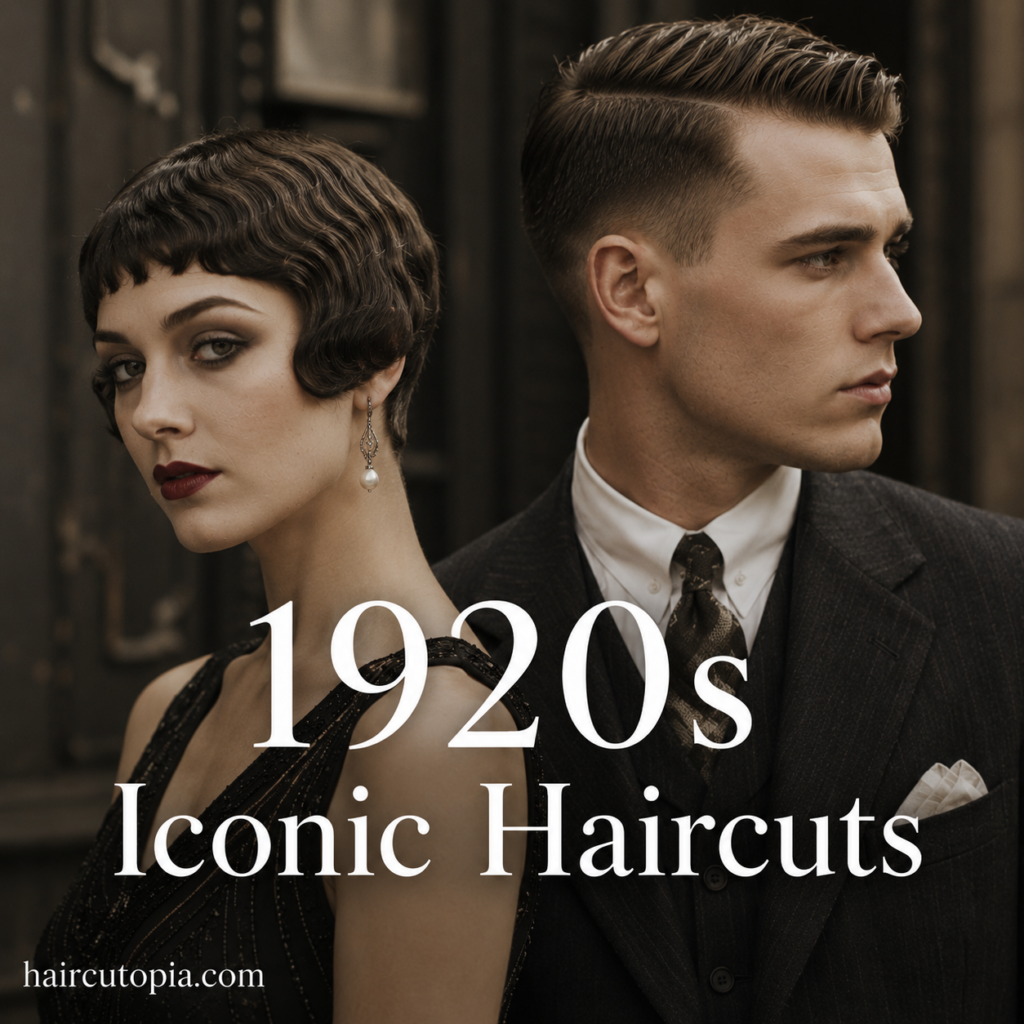
Women’s hair in the 1920s is strongly associated with:
- Very short bobs
- Shingle cuts
- Eton crops
- Geometric shapes
- Close-fitting styles
- Finger waves
The fashionable silhouette often emphasized shortness itself.
1930s Hairstyles
The 1930s increasingly favored:
- Longer bobs
- Softer waves
- More curls
- Greater movement
- Shoulder-length hair
- Romantic silhouettes
Finger waves remained fashionable, particularly early in the decade, but they became part of a broader range of styling options.
1930s vs. 1940s Hairstyles
By comparing the late 1930s with the early 1940s, the transition becomes much easier to see.
Hair was already getting longer during the late 1930s.
The 1940s continued that development but generally introduced more volume, larger curls, rolls, and increasingly structured arrangements.
Women’s 1940s hairstyles became particularly recognizable for:
- Victory rolls
- Larger curls
- Rolled front sections
- Fuller silhouettes
- Shoulder-length shapes
Men’s hairstyles changed less dramatically between the decades, although wartime practicality would influence grooming choices.
How to Recreate a 1930s Hairstyle Today
You can approach a 1930s hairstyle in two ways: historically inspired or historically accurate.
For everyday wear, an inspired version is usually easier.
For Short Hair
Try:
- Create a deep side part.
- Apply a lightweight styling product.
- Form waves through the front and sides.
- Keep the silhouette relatively close to the head.
- Shape the ends into small curls if the length allows.
You don’t necessarily need perfectly defined finger waves. Softer S-waves can suggest the period while looking contemporary.
For Medium or Longer Hair
Start with a side part and create curls throughout the lengths.
Allow the curls to cool or set completely before gently brushing them together.
Instead of separating every curl, encourage them to form larger continuous waves.
For Men’s Hair
A period-inspired men’s style usually begins with enough length on top to establish a strong direction.
Comb the hair into a side part or backward, then use pomade or another styling product to maintain the shape.
For a more authentic appearance, choose a product with some shine rather than an extremely dry matte finish.
How to Make 1930s Hairstyles Look Modern
You don’t have to recreate every historical detail.
In fact, borrowing one or two recognizable elements often produces a more wearable result.
Consider:
- A modern bob with a deep side part
- Loose Hollywood waves instead of tight finger waves
- Natural curls arranged into a vintage silhouette
- A traditional men’s side part with lighter product
- A scissor taper rather than an extremely tight fade
- Softly brushed waves on shoulder-length hair
- A single sculpted wave near the forehead
The goal is to capture the visual language of the decade rather than create a costume.
Are 1930s Hairstyles Still Popular?
Many of them are, although they’re rarely labeled as 1930s hairstyles in everyday life.
Hollywood waves remain extremely popular for weddings, formal events, and red-carpet styling.
The deep side part regularly returns to fashion.
Finger waves continue appearing in editorial styling and contemporary interpretations, while classic men’s side parts have never truly disappeared.
Even the modern bob shares obvious similarities with hairstyles worn nearly a century ago.
What changes most is texture and finish.
Contemporary hair tends to allow more movement, softness, and individuality. The 1930s generally favored stronger control and more deliberate placement.
Frequently Asked Questions About 1930s Hairstyles
What was the most popular hairstyle in the 1930s?
There wasn’t a single hairstyle worn throughout the entire decade. Finger waves, waved bobs, side-parted curls, and increasingly longer waved styles were all fashionable for women.
Men commonly wore neatly tapered hair with a defined side part or slicked-back top.
Were finger waves popular in the 1930s?
Yes. Finger waves were particularly prominent during the early 1930s, carrying over from their popularity during the previous decade.
They were especially suited to shorter hairstyles.
Did women have long hair in the 1930s?
Women’s fashionable hairstyles generally became longer as the decade progressed.
Short hair remained common early in the decade, while medium and shoulder-length styles became increasingly visible later.
How did women curl their hair in the 1930s?
Pin curls, finger waves, wet-setting techniques, and heated waving methods could all be used.
Hair was frequently set and then brushed or arranged into the desired finished shape.
Why were 1930s hairstyles so shiny?
Hair products such as brilliantine, oils, pomades, and setting products helped create smooth, controlled finishes.
Modern preferences often favor matte or natural-looking texture, but visible shine complemented the polished aesthetic of the period.
What hairstyles did men wear in the 1930s?
Side parts, slick-backs, side sweeps, and neatly combed styles were common.
The sides and back were generally kept shorter while enough length remained on top for styling.
What is the difference between 1920s and 1930s hairstyles?
Women’s hairstyles generally became softer and longer during the 1930s.
The extremely short geometric shapes associated with the 1920s gradually gave way to longer bobs, curls, flowing waves, and more romantic silhouettes.
What is the difference between 1930s haircuts and 1930s hairstyles?
A haircut refers primarily to the underlying length, shape, and structure of the hair. A hairstyle describes how that haircut is arranged or finished.
For example, someone might have a short bob haircut and style it with finger waves, pin curls, or a deep side part.
This distinction is particularly important when discussing the 1930s because setting and styling techniques played such a large role in creating the finished appearance.
Can 1930s hairstyles work with modern haircuts?
Yes.
A modern bob, shoulder-length cut, pixie, taper, or medium-length men’s haircut can often be styled with 1930s-inspired elements without changing the underlying cut.
What hairstyle best represents the 1930s?
For women, sculpted side-parted waves are probably the most immediately recognizable representation of the decade.
For men, a polished side part with neatly tapered sides captures the classic 1930s grooming aesthetic particularly well.
The Lasting Influence of 1930s Hairstyles
The 1930s transformed hair fashion without completely abandoning the decade that came before it.
Early styles retained the short lengths and sculpted waves of the 1920s. As the decade continued, women’s hair gradually became longer, softer, and fuller. By the late 1930s, larger waves and curls were already pointing toward the styles that would become fashionable during the 1940s.
Men’s hairstyles were more consistent. Side parts, slicked-back tops, neat tapers, and carefully controlled finishes created a classic grooming formula that remains recognizable today.
Perhaps the decade’s biggest contribution was its approach to styling itself.
A haircut wasn’t necessarily the finished look. The part, curl pattern, wave placement, brushing technique, and styling product could completely transform the hair.
That idea still feels surprisingly modern.
From Hollywood waves and side-swept curls to slick side parts and polished men’s styles, 1930s hairstyles continue to influence the way vintage glamour is interpreted today.