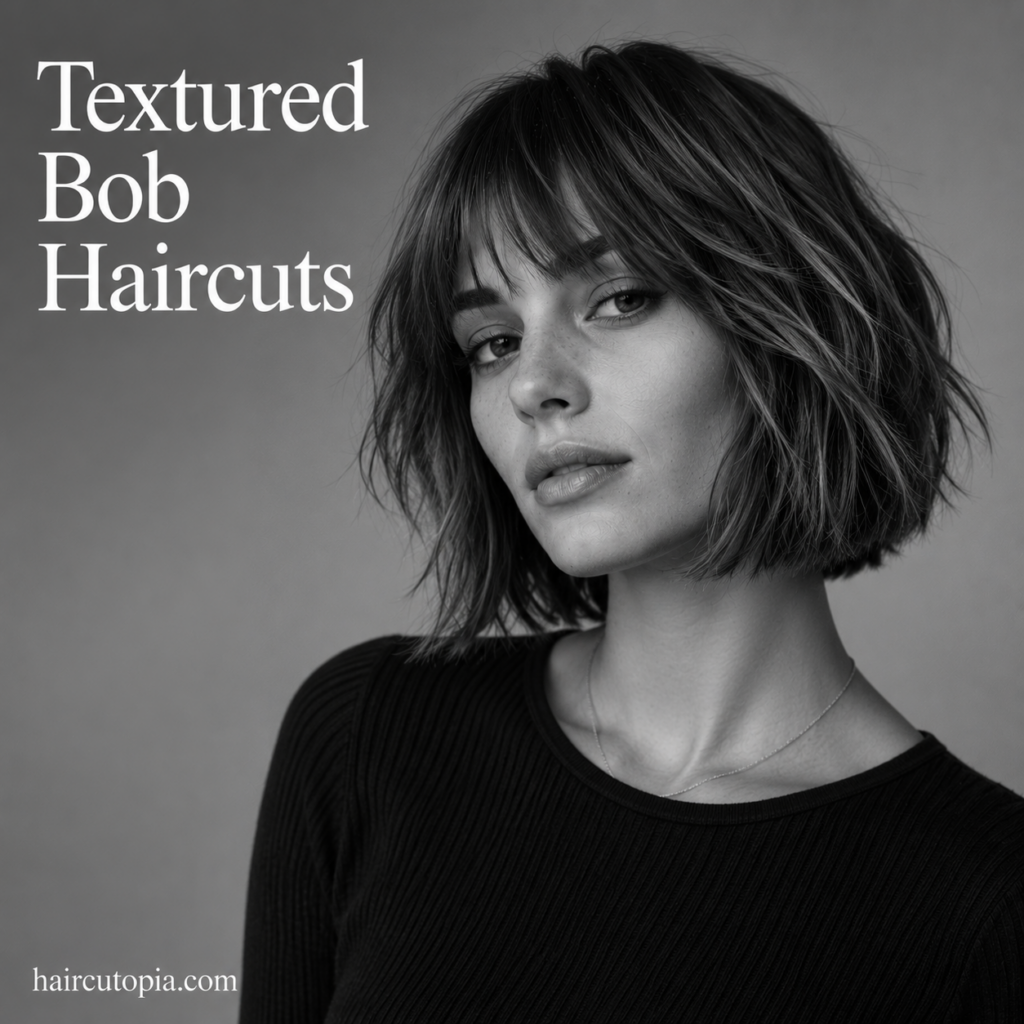
A textured bob takes the familiar shape of a bob and makes it feel a little less perfect—in a good way.
Instead of relying on a completely smooth surface or sharply defined ends, the haircut uses movement, separation, and strategically placed layers to create a softer finish. Some textured bobs look tousled and casual. Others are polished but still have enough variation through the ends to keep the haircut from feeling heavy.
That’s what makes the style so versatile.
You can wear a textured bob straight and piecey, naturally wavy, curly, softly tousled, or with more volume through the crown. The texture can come from the haircut itself, your natural hair pattern, styling, or a combination of all three.
The amount of texture matters too.
A subtle textured bob might have only light movement through the ends. A heavily textured version can include visible layers, choppy sections, and considerably more separation.
If you’re considering a textured bob, here’s how to choose the right length, amount of layering, styling approach, and overall shape for your hair.
What Is a Textured Bob Haircut?
A textured bob is a variation of the classic bob haircut designed to create movement, separation, and dimension rather than one completely uniform shape.
The overall length usually falls somewhere between the jaw and shoulders, although shorter versions are possible.
Texture may be created through:
- Layers
- Point cutting
- Piecey ends
- Internal weight removal
- Graduation
- Face-framing sections
- Natural waves or curls
- Tousled styling
Not every textured bob uses all of these techniques.
The goal is simply to prevent the haircut from looking too solid or heavy.
A textured bob can still have a recognizable perimeter. The difference is that the ends and interior usually contain more movement than you’d see in a classic one-length bob.
What Does a Textured Bob Look Like?
There’s no single textured bob shape.
Some have subtle layers that become noticeable only when the hair moves.
Others have obvious choppy sections.
A typical textured bob may feature:
- Softly separated ends
- Movement around the sides
- Light layering
- Face-framing pieces
- Volume through the crown
- A slightly tousled finish
The texture doesn’t necessarily need to look messy.
A sleek bob can still be textured if the ends and internal structure contain movement.
Why Choose a Textured Bob?
Among shorter women’s haircuts, a textured bob offers substantial movement while keeping the recognizable shape and proportions of a bob.
It can be particularly useful when a solid bob feels too heavy.
You might consider one if you:
- Want short hair with movement
- Prefer a relaxed finish
- Have natural waves
- Want to reduce some bulk
- Like piecey styling
- Want more volume through the crown
- Prefer softer ends
- Want a bob that doesn’t look overly precise
- Like layered hairstyles but still want a strong overall shape
Textured bobs can also be adjusted considerably.
The texture can be concentrated around the ends, distributed throughout the haircut, or placed strategically around the face.
Popular Types of Textured Bob Haircuts
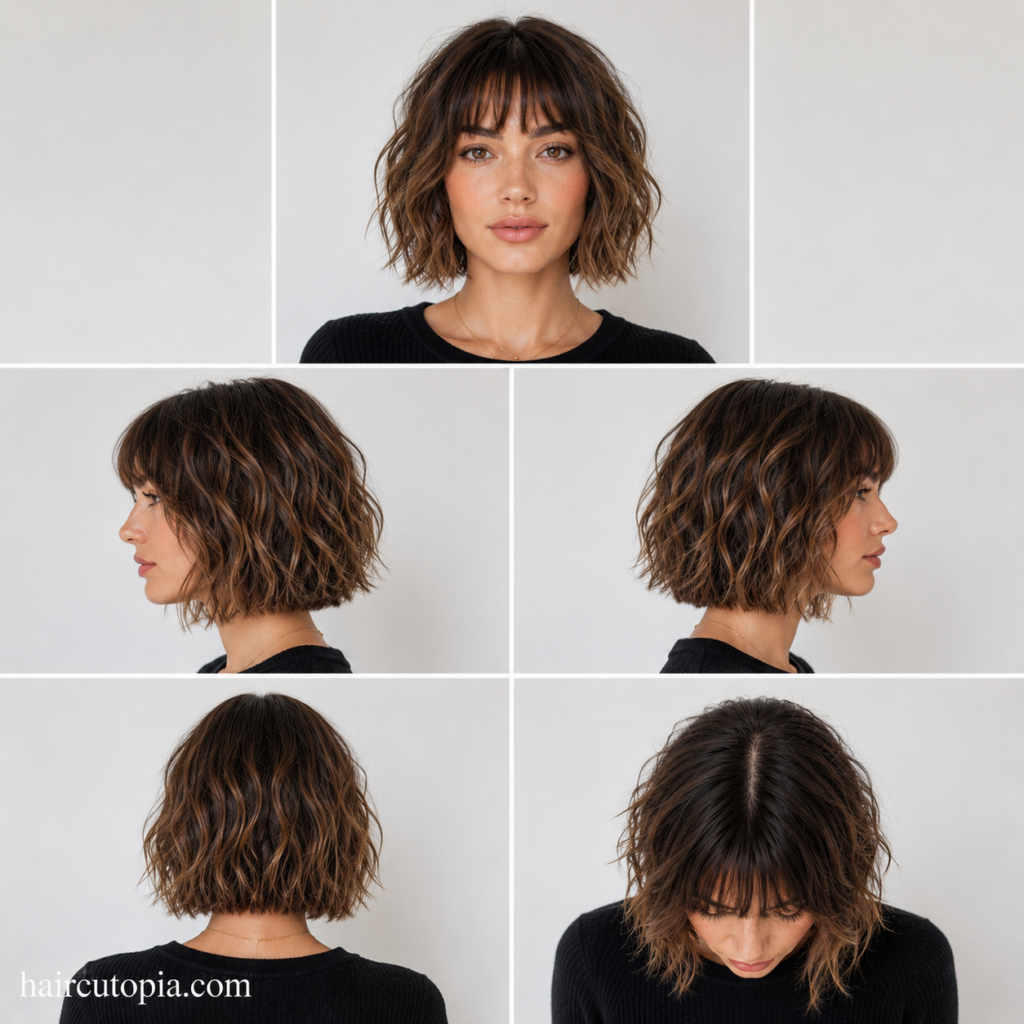
Small changes to length and layering can create very different versions of the textured bob.
Short Textured Bob
A short textured bob applies movement and separation to the compact proportions of a short bob, generally falling somewhere between the ears and jaw.
Because there isn’t much length weighing the hair down, shorter layers can create noticeable volume and movement.
This version can work well with straight, wavy, and curly textures.
The ends may be soft and piecey rather than forming a heavy line.
Chin-Length Textured Bob
A chin-length textured bob keeps the classic compact bob shape while introducing movement.
The perimeter sits around the chin, but layering or texturizing prevents it from looking completely solid.
This length works particularly well with:
- Loose waves
- Piecey straight styling
- Subtle layers
- Face framing
- Tousled finishes
It can feel polished or relaxed depending on how it’s styled.
Jaw-Length Textured Bob
A jaw-length textured bob creates a shorter, more defined silhouette.
The haircut may include volume around the sides or slightly shorter layers through the back.
Because the length sits close to the jaw, texture helps soften what might otherwise be a very strong perimeter.
Neck-Length Textured Bob
A neck-length bob falls slightly lower while still remaining clearly short.
This provides more room for layers to move.
The back can be lightly graduated or kept relatively even depending on the desired silhouette.
A neck-length textured bob can be especially useful if you want short hair without going all the way to chin length.
Shoulder-Length Textured Bob
Once a bob approaches the shoulders, it starts moving into long-bob territory.
This length gives you more styling versatility.
You can wear it:
- Straight
- Wavy
- Curled
- Half-up
- Tied back
- Tousled
The additional length also provides more space for subtle layers without making the haircut appear excessively short.
Textured Lob
A textured lob extends the bob toward the shoulders or collarbone while maintaining movement through the lengths and ends.
It usually falls somewhere around the shoulders or collarbone.
This version is a good option if you like the idea of a textured bob but aren’t ready for shorter hair.
The extra length makes waves and bends particularly noticeable.
Soft Textured Bob
Not every textured bob needs obvious choppiness.
A soft textured bob uses subtle techniques to create movement while maintaining a relatively smooth silhouette.
The ends may have slight separation, and the interior may contain gentle layering.
This is a good choice if you want:
- A polished bob
- Natural movement
- Minimal choppiness
- Soft ends
- Easy styling
From a distance, it may look relatively classic.
The texture becomes more noticeable as the hair moves.
Choppy Textured Bob
A choppy bob makes the texture more obvious.
Different lengths and piecey sections create visible separation throughout the haircut.
This style often works well with:
- Straight hair
- Natural waves
- Shag-inspired styling
- Messier finishes
- Texturizing products
Choppy doesn’t have to mean uneven.
The haircut should still have an intentional overall shape.
The variation in length simply becomes a more noticeable design element.
Tousled Textured Bob
A tousled bob focuses heavily on styling.
The haircut provides enough layering or movement to allow the hair to separate naturally.
Loose bends and irregular waves create the finished look.
The goal isn’t perfectly uniform curls.
In fact, alternating the direction of the waves can make the texture look more natural.
A tousled bob can work particularly well if you want a hairstyle that feels relaxed rather than overly polished.
Piecey Textured Bob
A piecey bob emphasizes individual sections.
The ends separate into smaller groups rather than blending into one continuous surface.
This effect can come from:
- Point cutting
- Light layering
- Texture spray
- Styling cream
- Wax or paste used sparingly
Piecey texture is particularly visible on straight or slightly wavy hair.
The key is moderation.
Too much heavy product can make the sections look greasy rather than intentionally separated.
Textured Bob With Layers
Layers are one of the most common ways to create texture in a bob, helping control movement, volume, and weight within the haircut.
They can be subtle or dramatic.
Light layers maintain more density around the perimeter.
Shorter layers create more movement and volume.
The right amount depends on:
- Hair density
- Natural texture
- Desired volume
- Bob length
- Styling routine
You don’t necessarily need layers everywhere.
Strategic layering can create texture without dramatically changing the overall bob shape.
Textured Bob With Subtle Layers
Subtle layers are ideal if you want movement but still like a fuller perimeter.
The shortest pieces remain relatively close to the overall length.
This allows the ends to move without making the haircut appear heavily layered.
Subtle layering can be particularly useful for:
- Fine hair
- Straight hair
- Soft waves
- Sleeker styling
It provides enough movement to distinguish the haircut from a blunt bob without removing too much density.
Textured Bob With Choppy Layers
Choppy layers create stronger separation.
Instead of blending almost invisibly, some shorter sections remain noticeable.
This can give the bob a more casual, modern appearance.
Choppy layers work particularly well with tousled styling because the different lengths naturally create irregular movement.
They can also add lift to hair that tends to sit flat.
Textured Bob With Face-Framing Layers
Face-framing layers can soften the front of a textured bob while adding another area of movement around the cheekbones, jaw, or chin.
Depending on the overall length, the shortest pieces may begin around the:
- Cheekbones
- Jaw
- Chin
On a shorter bob, face framing needs to be planned carefully because there isn’t much length available for a gradual transition.
Longer textured bobs provide more room.
The front layers can connect naturally with the rest of the haircut while creating extra movement around the face.
Textured Bob With Bangs
Bangs can make a textured bob feel more distinctive, with different fringe styles emphasizing either its softer or more structured qualities.
Different fringe styles create completely different effects.
A textured bob can work with:
- Wispy bangs
- Curtain bangs
- Choppy bangs
- Blunt bangs
- Side-swept bangs
- Micro bangs
- Curly bangs
Wispy and choppy fringe naturally complement a textured finish.
Blunt bangs create more contrast.
You can keep the fringe structured while allowing the rest of the bob to remain loose and piecey.
Textured Bob With Curtain Bangs
Curtain bangs work naturally with a textured bob because both emphasize movement.
The fringe opens through the center or slightly off-center and becomes longer toward the sides.
Those outer sections can then blend into the bob’s layers.
Longer curtain bangs create a softer transition.
Shorter versions make the fringe more noticeable.
This combination works especially well with loose waves and tousled styling.
Textured Bob for Fine Hair
Fine hair can benefit from texture, but the amount of layering matters.
Removing too much density can make the ends appear thinner.
A fine-haired textured bob often works best with:
- A relatively full perimeter
- Subtle layers
- Light end texture
- Limited thinning
- Lightweight styling products
Shorter lengths can also help fine hair feel less weighed down.
A chin or jaw-length bob may naturally create more lift than longer hair.
Texture should create movement without sacrificing the density you want to preserve.
Textured Bob for Thick Hair
Thick hair can support more substantial layering.
Removing some internal weight can prevent a bob from becoming overly wide or heavy through the bottom.
Texture can help distribute volume throughout the haircut.
Depending on the desired shape, your stylist may use:
- Internal layers
- Graduation
- Point cutting
- Longer surface layers
- Strategic weight removal
The goal isn’t necessarily to make thick hair look thin.
It’s to give the density somewhere to move.
Textured Bob for Thin or Low-Density Hair
Low-density hair needs a slightly different approach.
Too many layers can expose gaps through the perimeter.
A softly textured bob may be more effective than a heavily choppy one.
Consider maintaining:
- A strong baseline
- Minimal internal layering
- Soft face framing
- Light movement through the ends
Styling can create additional texture without requiring the haircut itself to contain numerous layers.
Loose bends and lightweight volumizing products can make a simple bob appear much more dimensional.
Textured Bob for Straight Hair
Straight hair makes cutting details easy to see.
A textured bob can prevent straight hair from appearing too rigid.
Depending on how much movement you want, the haircut may include:
- Piecey ends
- Subtle layers
- Choppy sections
- Face framing
- Graduation
You can wear it completely straight and allow the cutting details to create the texture.
Or add bends and waves for a more tousled effect.
Straight hair is particularly good at showcasing piecey ends.
Textured Bob for Wavy Hair
Natural waves and textured bobs are a natural combination.
The haircut gives the waves room to move, while the waves make the layers more visible.
A good textured bob can enhance an existing wave pattern without requiring every section to be curled.
Depending on density, removing some weight may allow the waves to become more defined.
However, too many short layers can create more volume than you want.
The placement should match your preferred silhouette.
Textured Bob for Curly Hair
Curly hair creates texture naturally.
The haircut’s job is to shape and distribute that texture.
A curly textured bob may use layers to prevent too much weight from accumulating around the bottom.
Shorter sections can also create lift through the upper portions of the haircut.
The exact result depends on:
- Curl pattern
- Density
- Shrinkage
- Bob length
- Desired volume
The haircut should be evaluated in its natural dry state whenever possible.
A curl can sit significantly higher once dry than it appears when stretched.
Textured Bob for Coily Hair
Coily textures can create highly dimensional bob shapes.
Layering can distribute volume and help establish the overall silhouette.
A textured coily bob might be:
- Rounded
- Tapered
- Full
- Layered
- Asymmetrical
The perimeter doesn’t need to form a straight line.
Instead, the overall shape should feel balanced while allowing the coils to create natural separation.
Shrinkage should be considered carefully when deciding the finished length.
Textured Bob for Different Face Shapes
A textured bob can be adjusted through length, volume, parting, bangs, and face framing.
That flexibility is more useful than rigid face-shape rules.
Textured Bob for Oval Faces
Oval faces can experiment with almost any bob length.
A jaw-length cut creates a compact shape, while longer versions provide more movement around the shoulders.
Choose the length according to your hair texture and styling preferences.
Textured Bob for Round Faces
Longer textured bobs can create more vertical movement.
Short versions can place more volume around the cheeks and jaw.
Neither is automatically better.
Think about where you want the haircut to feel fullest.
Textured Bob for Square Faces
Soft waves and textured ends can create contrast with a defined jaw.
A jaw-length bob can also intentionally emphasize strong lines.
The decision comes down to whether you prefer softness or structure.
Textured Bob for Heart-Shaped Faces
Chin and neck-length bobs can create fullness around the lower face.
Curtain bangs or face framing can add movement around the forehead and cheekbones.
Textured Bob for Long Faces
Chin, jaw, and shoulder-length bobs can create horizontal movement.
Bangs can add another element across the forehead.
Volume through the sides can make the haircut feel fuller overall.
Textured Bob With a Middle Part
A middle part creates relatively even volume on both sides.
This works especially well with:
- Loose waves
- Curtain bangs
- Chin-length bobs
- Textured lobs
The symmetry of the part can balance the irregularity of tousled texture.
It also makes face-framing pieces more noticeable.
Textured Bob With a Side Part
A side part creates more asymmetry and can shift volume toward one side.
This can make a textured bob feel fuller through the crown.
It works particularly well with:
- Side-swept bangs
- Loose waves
- Piecey styling
- Naturally uneven curl patterns
You don’t need an extreme side part.
Even moving the part slightly away from the center can change how the haircut falls.
Textured Bob With Volume at the Crown
Adding shorter layers through the upper sections can create more lift around the crown.
This is useful if your hair tends to sit flat.
However, crown layers should be chosen carefully.
Very short layers can significantly change the silhouette and move the haircut toward shag or bixie territory.
If you want to maintain a classic bob shape, keep the crown texture relatively subtle.
Textured Bob With a Strong Perimeter
Texture doesn’t mean the bottom has to disappear.
You can maintain a relatively strong perimeter while adding movement inside the haircut.
This approach works especially well for fine or lower-density hair.
The baseline preserves fullness.
The interior texture prevents the haircut from feeling too rigid.
It’s a useful middle ground between a blunt bob and a heavily layered bob.
Textured Bob vs. Blunt Bob
A blunt bob emphasizes a strong, clean perimeter with minimal visible layering, while a textured bob emphasizes movement and separation.
Blunt bobs generally look:
- Fuller through the ends
- Cleaner
- More structured
- More uniform
Textured bobs generally look:
- Softer
- More dimensional
- More piecey
- More relaxed
There can be overlap.
A bob may maintain a blunt-looking perimeter while containing subtle internal texture.
Think of blunt and textured as points on a spectrum rather than completely separate categories.
Textured Bob vs. Layered Bob
These styles are closely related.
Most textured bobs contain some layering, but not every layered bob is heavily textured.
A layered bob focuses on different lengths within the haircut.
A textured bob focuses on the visual result: movement, separation, and dimension.
A layered bob can still be smooth and polished.
A textured bob may rely on only subtle layering combined with styling to create a more piecey appearance.
Textured Bob vs. Choppy Bob
A choppy bob is generally a more pronounced form of textured bob.
The different lengths are intentionally visible.
A softer textured bob may contain layers that blend almost seamlessly.
Choose a choppy bob if you want the texture itself to become a major feature.
Choose softer texture if you want movement without an obviously fragmented shape.
Textured Bob vs. Shaggy Bob
A shaggy bob usually contains more aggressive layering, particularly around the crown.
It may also feature:
- Shorter upper layers
- Fringe
- Stronger texture
- More volume
- Feathered or choppy ends
A textured bob can be much subtler.
It may maintain a classic bob silhouette with only enough layering to create movement.
If you want something between a traditional bob and a shag, increasing the crown layers and fringe can move the haircut in that direction.
Textured Bob vs. Lob
A textured bob and textured lob primarily differ in length.
Bobs generally sit higher, often around the jaw, chin, or neck.
Lobs extend closer to the shoulders or collarbone.
The longer length of a lob provides more styling versatility and usually allows for more gradual layering.
A shorter bob creates a stronger transformation and exposes more of the neck.
How to Style a Textured Bob
Styling can dramatically change how much texture you see.
Air-Dried Texture
If your hair already has waves, curls, or coils, you may not need heat styling.
Apply your preferred styling product while damp and allow the natural pattern to develop.
Loose Waves
Loose bends create the classic tousled bob effect.
Avoid making every wave identical.
Variation creates a more natural finish.
Straight and Piecey
Straighten or smooth the hair while keeping the ends separated.
A small amount of lightweight texture product can emphasize individual sections.
Tousled With Texture Spray
Texture spray can add separation and grip.
Apply gradually.
Too much can make the hair feel stiff or dry.
Softly Curved Ends
A round brush can create subtle bends while maintaining a polished finish.
This is a good option when you want texture without a deliberately messy appearance.
Defined Natural Curls
Curly and coily hair can use curl-specific styling products to enhance separation and definition.
The haircut’s layers should create the shape while the styling highlights the natural pattern.
How to Create a Tousled Textured Bob
If you want a relaxed finish, you don’t need perfectly uniform waves.
Try this general approach:
- Apply heat protectant if you’re using hot tools.
- Dry the hair while maintaining some natural volume.
- Add loose bends to random sections.
- Alternate the direction of some waves.
- Leave portions of the ends relatively straight.
- Allow the hair to cool.
- Separate the waves gently with your fingers.
- Finish with a small amount of texture spray if needed.
The goal is movement, not perfect curls.
What Products Work Well for a Textured Bob?
Product choice depends on your natural texture and the finish you want.
Useful options may include:
- Heat protectant
- Volumizing mousse
- Texture spray
- Lightweight styling cream
- Sea salt spray
- Curl cream
- Anti-frizz product
- Flexible-hold hairspray
- Lightweight paste or wax
Fine hair usually benefits from lightweight products.
Thick, curly, or coarse hair may need additional moisture and control.
For piecey styling, use paste or wax sparingly.
Start with a tiny amount and add more only if necessary.
Is a Textured Bob Low Maintenance?
It can be.
A textured bob doesn’t always need the precision of a very sleek blunt bob.
Slight growth and irregular movement can blend naturally into the style.
However, shorter bobs still change shape as they grow.
Layers can also lose their intended placement over time.
How much maintenance you’ll need depends on:
- Bob length
- Amount of layering
- Hair growth rate
- Natural texture
- Desired finish
- Whether you have bangs
A relaxed textured bob generally offers more forgiveness than a highly precise geometric cut.
How Often Should a Textured Bob Be Trimmed?
Many textured bobs benefit from reshaping around every 6–10 weeks.
Shorter or more structured versions may need attention closer to the six-week mark.
Longer textured bobs can often go longer.
If you’re growing the haircut out, you may simply reshape the layers occasionally while allowing the perimeter to gain length.
Pay attention to the way the haircut moves rather than following a strict calendar.
If the ends become thin or the layers stop sitting properly, it’s probably time for a trim.
How to Ask Your Hairstylist for a Textured Bob
“Textured bob” can mean many things, so reference photos are extremely useful.
Discuss:
- Your desired overall length.
- Whether you want a strong or soft perimeter.
- How much layering you want.
- Whether you like subtle or choppy texture.
- Where you want volume.
- Whether you want face-framing pieces.
- Whether you’re adding bangs.
- How you normally style your hair.
- Whether you usually air-dry or heat-style.
- How much maintenance you’re comfortable with.
Use descriptive language.
Instead of simply asking for “texture,” explain whether you want:
- Soft movement
- Piecey ends
- Choppy layers
- Crown volume
- Tousled waves
- Reduced bulk
That gives your stylist a much clearer idea of the result you’re trying to achieve.
Growing Out a Textured Bob
A textured bob can transition naturally into a textured lob.
As the perimeter reaches the shoulders, the haircut gains more styling options.
The layers may need occasional reshaping during the process.
Shorter sections around the crown or face can take longer to catch up.
If your goal is eventually a one-length haircut, gradually reducing the amount of layering at each trim can help.
If you want to keep the texture, the existing layers can simply be adjusted as the overall length increases.
Who Should Consider a Textured Bob?
A textured bob may be worth considering if you:
- Want to go shorter
- Like movement and separation
- Don’t want a rigid perimeter
- Have natural waves or curls
- Want to remove some bulk from thick hair
- Want more volume
- Like tousled styling
- Prefer soft or piecey ends
- Want a modern variation of a classic bob
- Like layers but don’t want a long layered haircut
The haircut can be adapted to different densities and textures.
The important part is controlling how much texture is added.
Common Textured Bob Mistakes to Avoid
Texture should make the haircut easier and more interesting, not remove all of its structure.
Adding Too Many Layers to Fine Hair
Excessive layering can make the perimeter look sparse.
Preserve enough density through the bottom.
Removing Too Much Weight
Texturizing isn’t the same as thinning everything.
Too much weight removal can create frizz, uneven ends, or a shape that’s difficult to control.
Cutting Wavy or Curly Hair Without Considering Shrinkage
Texture can become shorter once dry.
Plan the final length around the natural state of the hair.
Choosing Shoulder Length Without Considering Flipping
Hair that lands directly on the shoulders may flip outward.
That can look great on a textured bob, but make sure it’s an effect you actually want.
Making Every Wave Identical
Perfectly uniform curls can make a tousled bob look overly styled.
Variation usually creates a more natural texture.
Using Too Much Texture Spray
More product doesn’t automatically mean more texture.
Excessive spray can make hair dry, stiff, or tangled.
Confusing Texture With Damage
Healthy texture should still have movement and shine.
Dry, split ends aren’t a substitute for intentional separation.
Ignoring the Perimeter
Even a highly textured bob needs an overall shape.
Without one, the haircut can lose the recognizable bob silhouette.
Frequently Asked Questions About Textured Bob Haircuts
What is a textured bob?
A textured bob is a bob-length haircut designed with movement, separation, and dimension through layering, cutting techniques, natural texture, styling, or a combination of these elements.
What length is a textured bob?
Textured bobs commonly fall between the jaw and shoulders. Longer shoulder or collarbone versions are often called textured lobs.
Is a textured bob the same as a layered bob?
Not exactly. A layered bob contains different lengths, while a textured bob specifically emphasizes movement and separation. Many textured bobs are layered, but the terms aren’t completely interchangeable.
Is a textured bob good for fine hair?
Yes, provided the layering and weight removal aren’t excessive. Maintaining a fuller perimeter can help preserve density.
Is a textured bob good for thick hair?
Yes. Strategic layering and internal weight removal can give thick hair more movement and prevent the bottom from feeling overly heavy.
Can straight hair have a textured bob?
Absolutely. Piecey ends, subtle layers, choppy sections, and styling can all create texture in naturally straight hair.
Is a textured bob good for wavy hair?
Yes. Natural waves already provide movement, and a well-planned textured cut can help showcase the wave pattern.
Can curly hair have a textured bob?
Yes. Layers can distribute curls and create the desired overall shape while maintaining natural texture.
Can coily hair have a textured bob?
Yes. Coils naturally provide dimension, while the haircut can control length, volume, and silhouette.
Can a textured bob have bangs?
Yes. Wispy, curtain, choppy, blunt, side-swept, micro, and curly bangs can all work with textured bobs.
What’s the difference between a textured bob and a blunt bob?
A blunt bob emphasizes a strong, uniform perimeter. A textured bob emphasizes movement, separation, and softer or more varied ends.
What’s the difference between a textured bob and a choppy bob?
Choppy bobs usually have more obvious variation between lengths. A textured bob can be much softer and more subtly layered.
Are textured bobs high maintenance?
Not necessarily. Relaxed texture can make the haircut fairly forgiving, although shorter versions still need periodic reshaping.
How often should a textured bob be trimmed?
Around every 6–10 weeks works for many styles, although the ideal schedule depends on the length, layers, growth rate, and desired shape.
Can you grow a textured bob into long hair?
Yes. A textured bob naturally becomes a lob as it grows and can eventually transition into medium or long layered hair.
Final Thoughts on Textured Bob Haircuts
The textured bob takes one of the most recognizable haircut shapes and gives it more freedom.
Instead of requiring every end to sit perfectly in place, texture allows the hair to move.
That movement can be subtle. A few soft layers and lightly separated ends may be all you need. Or it can become the defining feature of the haircut through choppy layers, tousled waves, and obvious piecey sections.
Your natural hair should guide how that texture is created.
Fine or low-density hair often benefits from keeping a stronger perimeter and adding movement carefully. Thick hair can usually support more layering and internal weight removal. Straight hair showcases piecey cutting details, while waves, curls, and coils already bring natural texture to the shape.
Length matters too.
A jaw or chin-length textured bob creates a noticeable short haircut with plenty of movement around the face. Neck-length versions provide a little more flexibility. Shoulder and collarbone styles move into textured-lob territory and give you more room for waves, layers, and tied-back styles.
Most importantly, texture doesn’t have to mean messy.
A textured bob can be sleek, polished, soft, curly, tousled, or somewhere in between.
The best version is simply the one that gives your hair enough movement without taking away the density, shape, or styling flexibility you want.
Related Posts
 Haircuts for Frizzy Hair: The Complete Guide to Cuts for Every Length and Texture
 Haircuts for Straight Hair: The Complete Guide to Cuts for Every Length and Hair Type
 Bangs Haircuts for Older Women: 25 Elegant and Flattering Styles
 Long Curtain Bangs Haircuts: 25 Gorgeous Styles for Effortless, Face-Framing Beauty