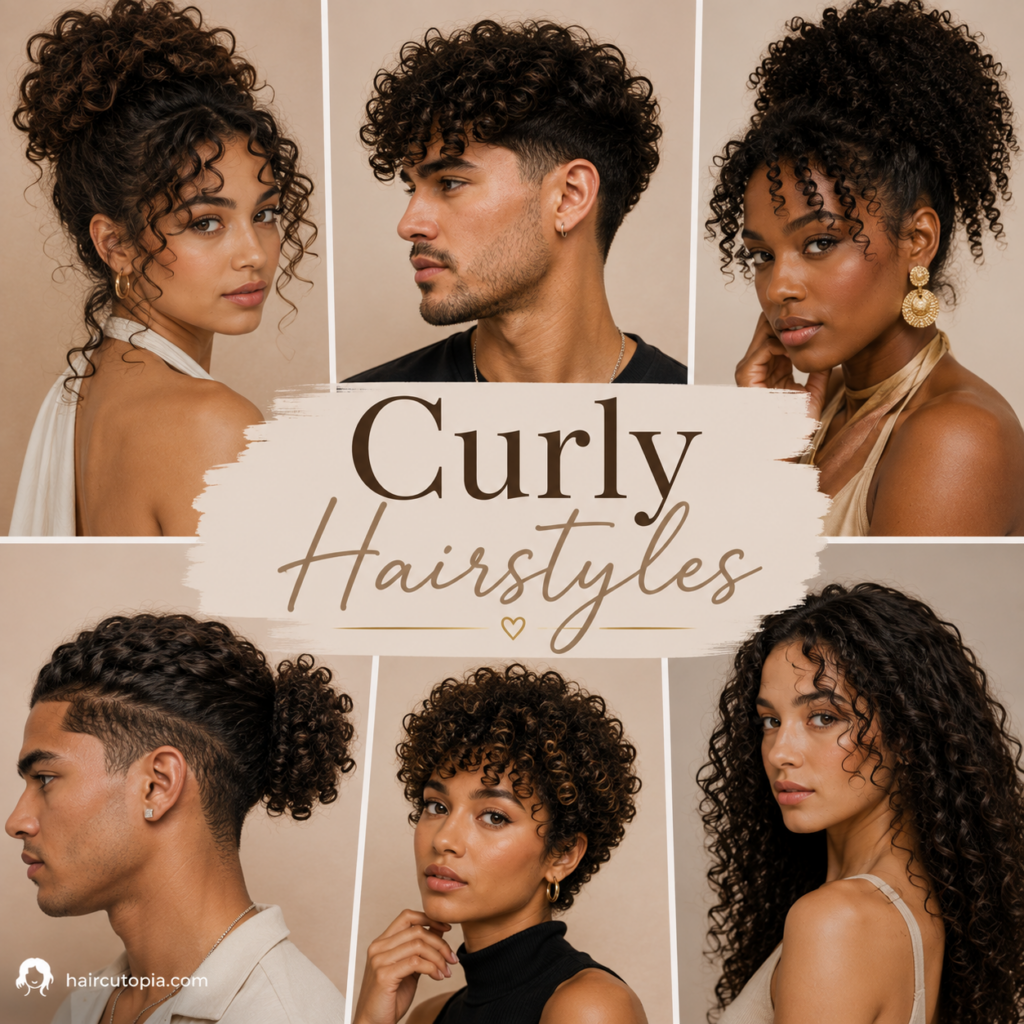
Curly hair gives you something naturally built into almost every hairstyle: texture. Whether your curls are loose and flowing, tight and springy, somewhere between wavy and curly, or part of a coily texture, that natural movement can completely change the way a haircut or hairstyle looks.
The challenge is that curls don’t always behave exactly the way you expect them to. Humidity can change the shape, one side may curl differently from the other, and a hairstyle that looks effortless on straight hair might require an entirely different approach on curls.
That’s also what makes curly hairstyles interesting.
You don’t have to force every curl into the same shape. Some of the best styles work with natural volume, definition, and even a little unpredictability.
From short curly cuts and shoulder-length styles to long curls, ponytails, buns, braids, and formal updos, there are plenty of ways to style curly hair while keeping its natural texture part of the look.
Understanding Your Natural Curls
Before choosing a curly hairstyle, it helps to understand how your own hair behaves.
Curl patterns are often grouped into broad categories ranging from wavy to curly and coily. You’ll commonly see these described as Types 2, 3, and 4, with additional A, B, and C classifications.
Those categories can be useful as a general reference, but real hair doesn’t always fit neatly into one box.
It’s completely normal to have several textures on the same head.
You might have tighter curls around the face, looser sections at the back, or areas that respond differently to humidity and styling products.
Instead of becoming too focused on identifying an exact curl number, pay attention to practical characteristics such as:
- How tightly your hair curls
- How much it shrinks as it dries
- How dense your hair is
- Whether individual strands are fine, medium, or coarse
- How easily your curls lose definition
- How your hair responds to moisture
- Where you naturally have the most volume
These details are often more useful when choosing a hairstyle.
Popular Curly Hairstyles
Curly hairstyles can range from completely loose and natural to highly structured updos.
Here are some of the most versatile options.
Defined Curls
Sometimes the hairstyle is simply your curls themselves.
Defined curls emphasize the natural curl pattern while reducing unwanted frizz and separation.
The finished look depends heavily on your individual texture. Defined curls might form loose spirals, springy ringlets, or tighter corkscrews.
The goal isn’t to make every curl identical. It’s to create enough definition that the overall shape feels intentional.
Voluminous Curls
Instead of maximizing definition, you can emphasize volume.
This style allows curls to expand and create a fuller silhouette.
Volume can be concentrated at the crown, distributed throughout the hair, or shaped around the face depending on the haircut.
For people who naturally have dense curly hair, embracing that fullness can create a dramatic look without requiring an elaborate hairstyle.
Side-Parted Curls
Changing your part is one of the simplest ways to change curly hair.
A deep side part can create additional height on one side and shift the overall shape of the hairstyle.
It works with short, medium, and long curls and doesn’t require changing the actual curl pattern.
Center-Parted Curls
A center part creates a more balanced shape around the face.
It can look especially striking with long curls or curly hair that has face-framing layers.
Because curly hair doesn’t always fall symmetrically, don’t worry if the two sides aren’t perfectly identical.
Side-Swept Curls
Gathering most of the hair toward one shoulder creates an easy way to make loose curls feel more styled.
Hidden pins can help keep the opposite side in place.
Side-swept curls work particularly well for formal occasions because they preserve the length and texture of the hair while creating a more deliberate silhouette.
Curly Hairstyles for Short Hair
Short curly hair can be incredibly expressive because the curl pattern becomes such a visible part of the haircut.
Curly Pixie Cut
A curly pixie combines short length with natural texture.
The sides and back may be cropped relatively close while additional length is left on top.
Depending on the cut, the top can be worn defined, tousled, forward, or with additional height.
Curly Bob
A curly bob generally falls somewhere around the jaw or slightly below it.
Because curls spring upward, the final dry length can be considerably shorter than the hair appears when wet.
A curly bob can be:
- Rounded
- Layered
- Blunt
- Side parted
- Center parted
- Tousled
- Highly defined
The right shape depends on your curl pattern and how much volume you want.
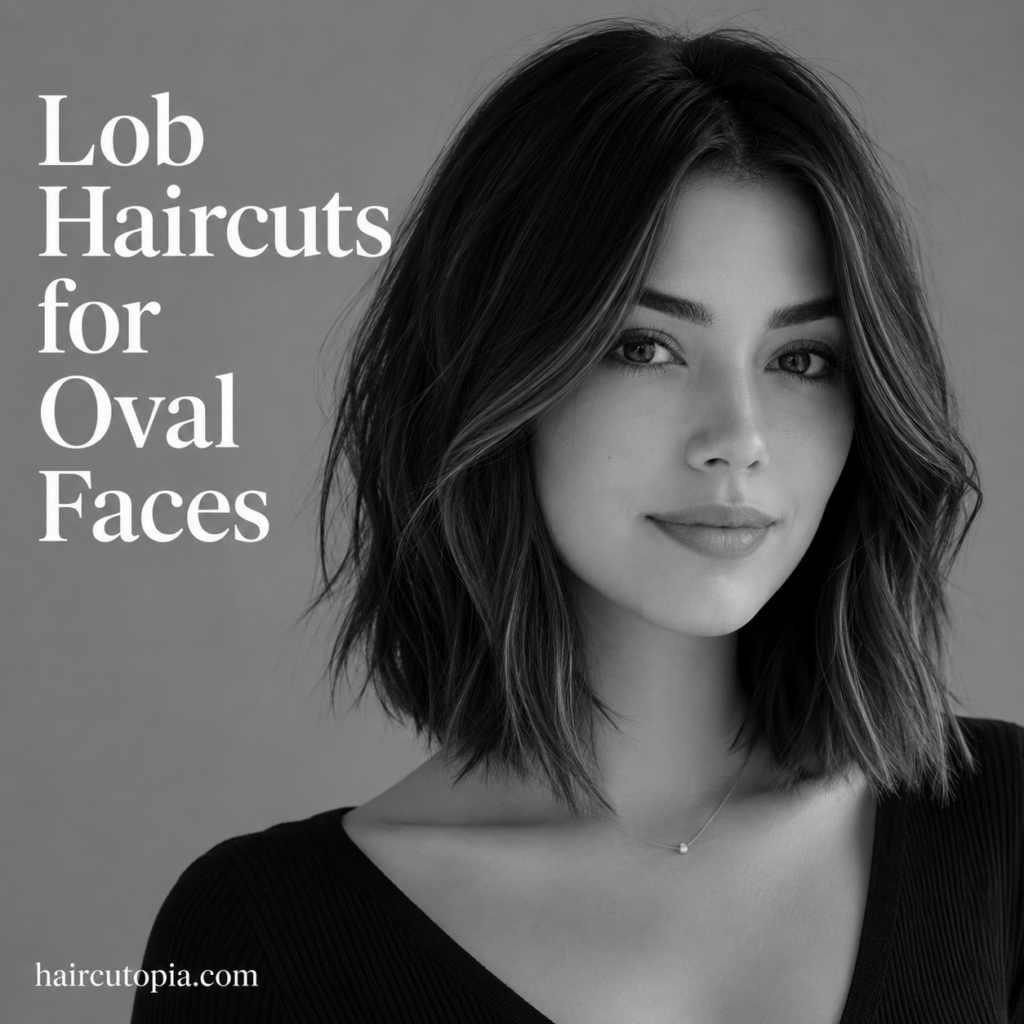
Curly Lob
A long bob, or lob, gives curls additional length while maintaining the recognizable shape of a bob.
It can be a useful middle ground if you want enough hair for occasional ponytails or half-up styles without maintaining long curls.
Short Curly Shag
A curly shag uses layers to create movement throughout the hair.
Shorter sections around the crown can encourage volume, while face-framing pieces help shape the front.
This style works particularly well when you want your curls to look intentionally textured rather than perfectly uniform.
Curly Hair With Bangs
Bangs can absolutely work with curly hair.
Curly bangs may be:
- Short and defined
- Long and face framing
- Wispy
- Full
- Side swept
The key is accounting for shrinkage.
Curly hair can appear significantly shorter once dry, so cutting bangs based only on their wet length can lead to an unexpectedly short result.
Curly Hairstyles for Medium-Length Hair
Medium curly hair offers enough length for plenty of styling while remaining relatively manageable.
Shoulder-Length Curls
Curls that fall around the shoulders create a versatile everyday length.
You can wear them completely down or pull them into ponytails, buns, and half-up styles.
Layers can help prevent the ends from becoming overly heavy while adding movement throughout the shape.
Layered Medium Curls
Layers can redistribute volume rather than allowing all of the hair to accumulate near the bottom.
Depending on the placement, layers can create:
- More crown volume
- Additional movement
- Face framing
- A rounder silhouette
- A more elongated shape
There’s no single layering pattern that’s best for every curly head.
Medium Curly Shag
A shag is especially compatible with curls because the haircut is designed around texture and movement.
Shorter crown layers can create lift while longer sections preserve overall length.
Curly bangs are often incorporated into the style.
Half-Up Medium Curls
Pulling back the upper section of medium-length curls keeps hair away from the face without hiding the texture.
This is one of the easiest ways to make everyday curls feel slightly more polished.
Curly Hairstyles for Long Hair
Long curly hair can create dramatic volume and movement.
It also provides enough length for a wide variety of hairstyles.
Long Layered Curls
Layers can help shape long curls and prevent all of the volume from collecting toward the ends.
The exact placement matters.
Long layers tend to preserve more weight, while shorter layers can produce greater volume through the upper sections.
Long Curls With Face-Framing Layers
Face-framing layers create shorter pieces around the front without dramatically changing the rest of the length.
These sections can help curls fall around the cheekbones, jawline, or shoulders rather than hanging in one continuous shape.
Long Curly Hair With Bangs
Long curls and curly bangs can create a strong combination of shape and texture.
Bangs can blend gradually into face-framing layers or create a more noticeable contrast with the longer hair.
Long Curls With a Deep Side Part
A deep side part can instantly change the distribution of long curls.
Moving more hair to one side often creates additional volume near the crown and produces an asymmetrical shape.
Curly Hairstyles for Men
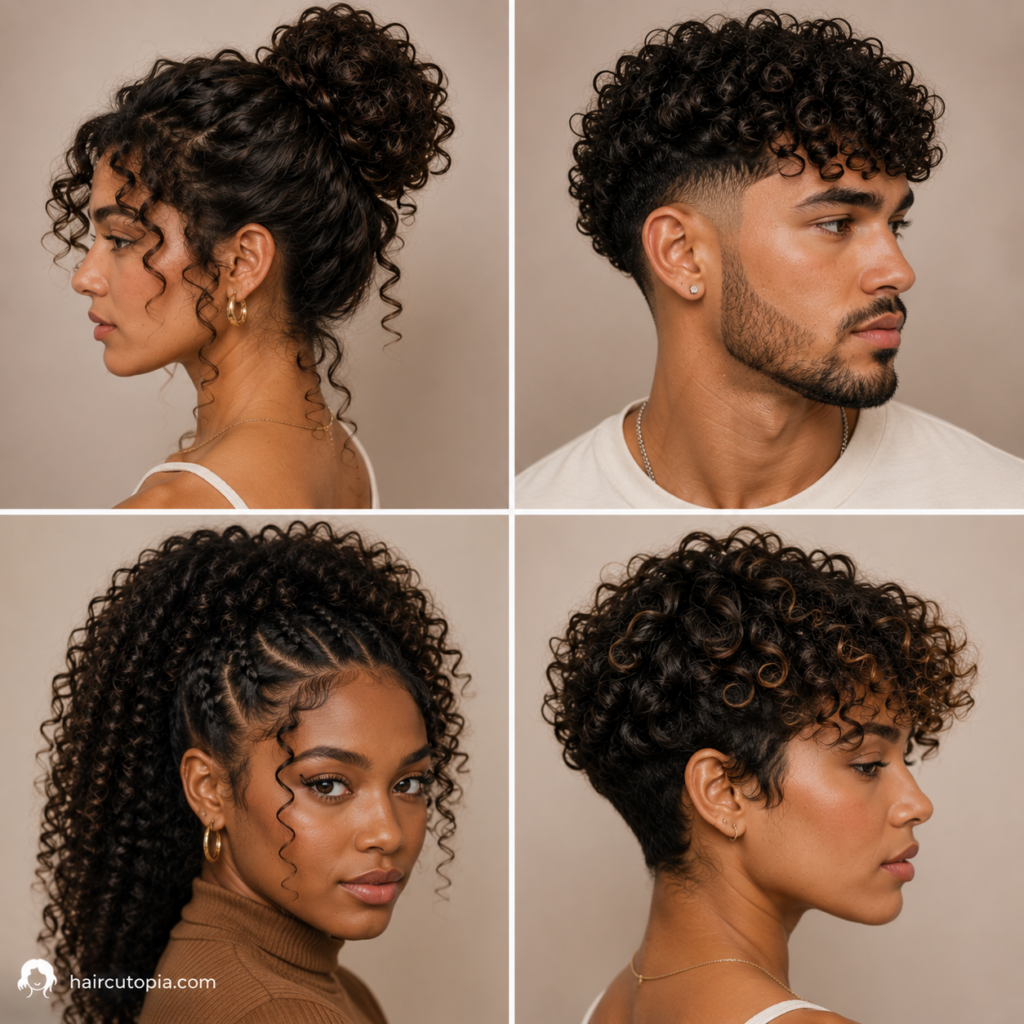
Men’s curly hairstyles can range from short and controlled to long and intentionally voluminous.
The curl pattern often provides much of the style naturally.
Curly Fade
A curly fade keeps the sides progressively shorter while preserving curls on top.
The contrast makes the top texture more prominent.
Depending on the desired effect, the fade may be low, mid, or high.
Curly Taper
A taper creates a more gradual transition around the sideburns and neckline while retaining additional length on the sides compared with many fades.
This can produce a softer overall silhouette.
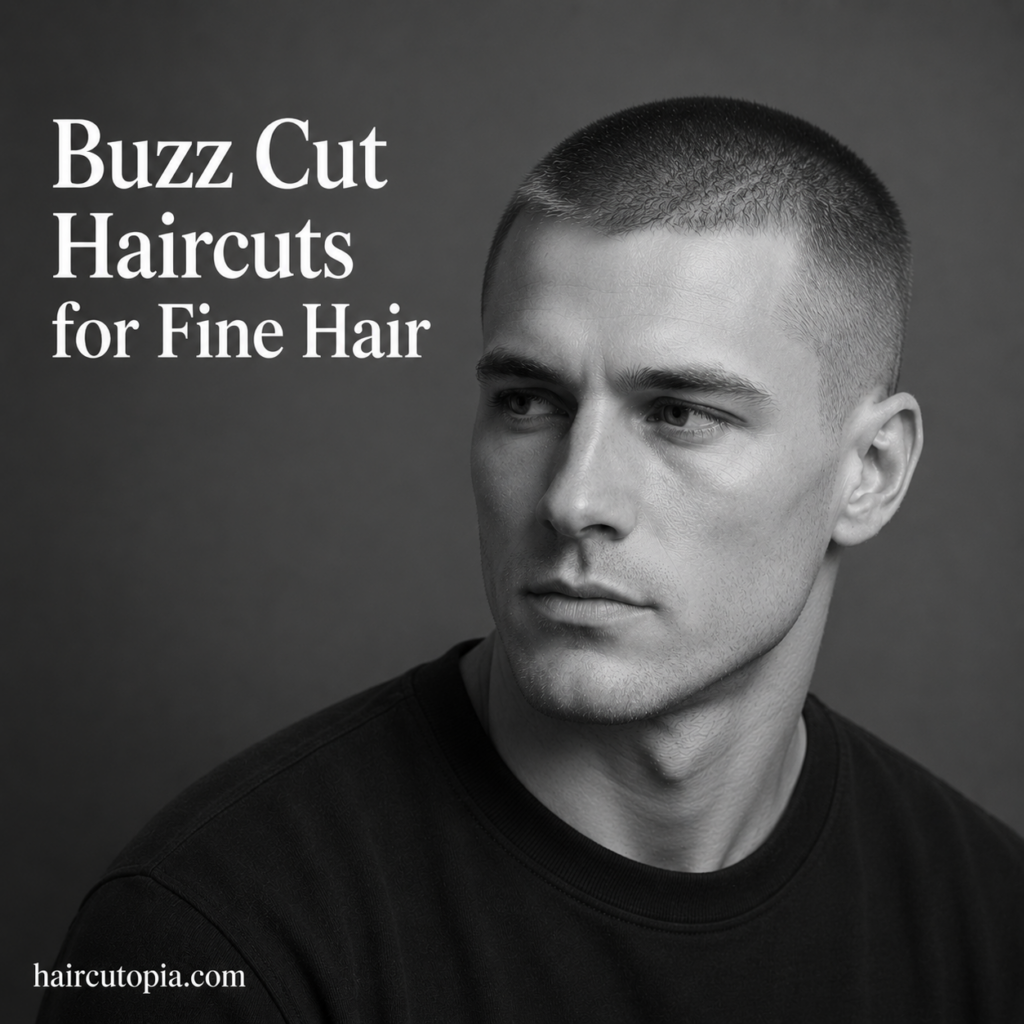
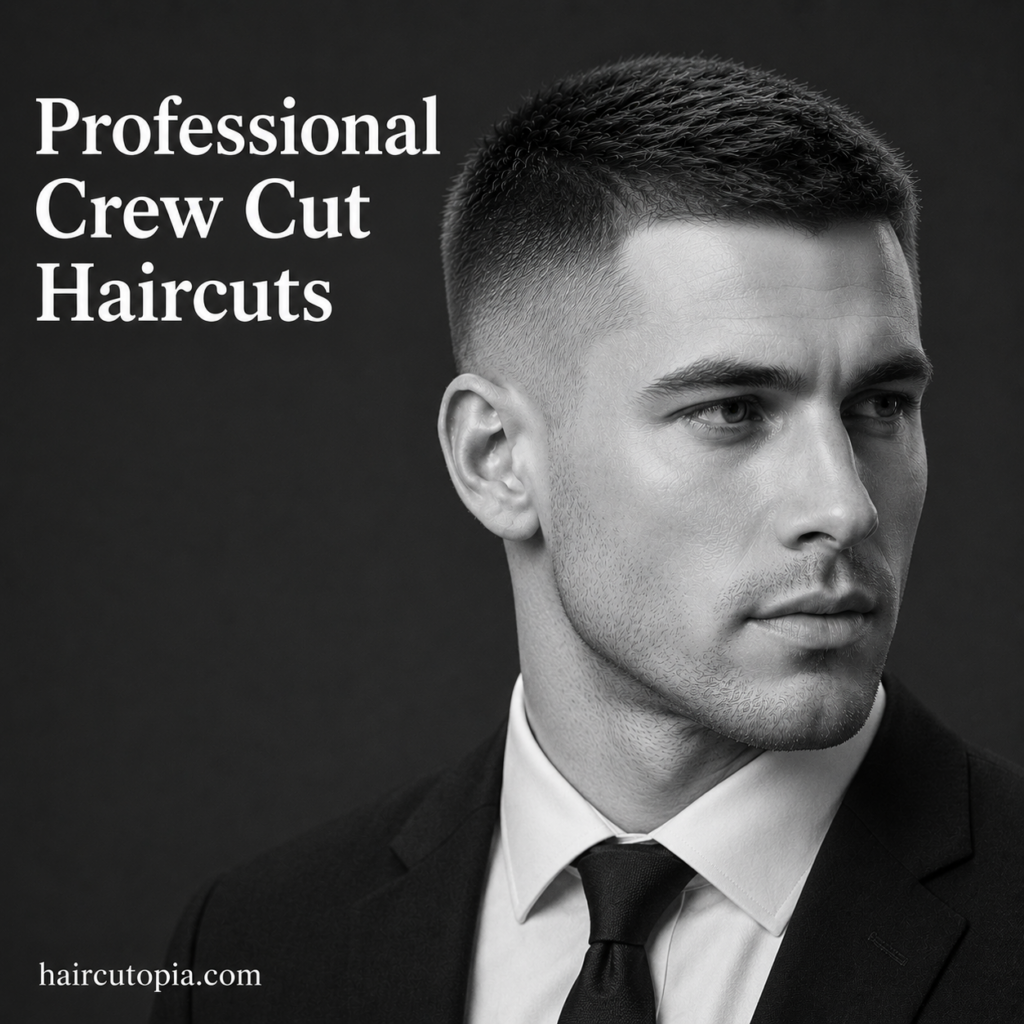
Short Curly Hair
Short curls are relatively easy to shape and can still show plenty of texture.
The top may be kept slightly longer while the sides are trimmed shorter for contrast.
Medium Curly Hair
Medium length allows curls to form more completely.
It can be worn forward, parted, pushed back, or allowed to fall naturally.
Long Curly Hair for Men
Long curls can be worn loose or pulled into practical styles such as:
- Ponytails
- Buns
- Half-up styles
- Braided styles
Long curly hair often benefits from a haircut that maintains a deliberate overall shape rather than simply allowing every section to grow to the same length.
Curly Hairstyles for Women
Curly hairstyles for women span virtually every length and style category.
Popular options include:
- Curly pixies
- Curly bobs
- Shoulder-length curls
- Long layered curls
- Curly shags
- Half-up curls
- Curly ponytails
- Curly buns
- Braided curly styles
- Formal curly updos
Instead of choosing a style simply because it’s labeled “for curly hair,” consider whether the shape works with your specific density, curl pattern, and preferred amount of volume.
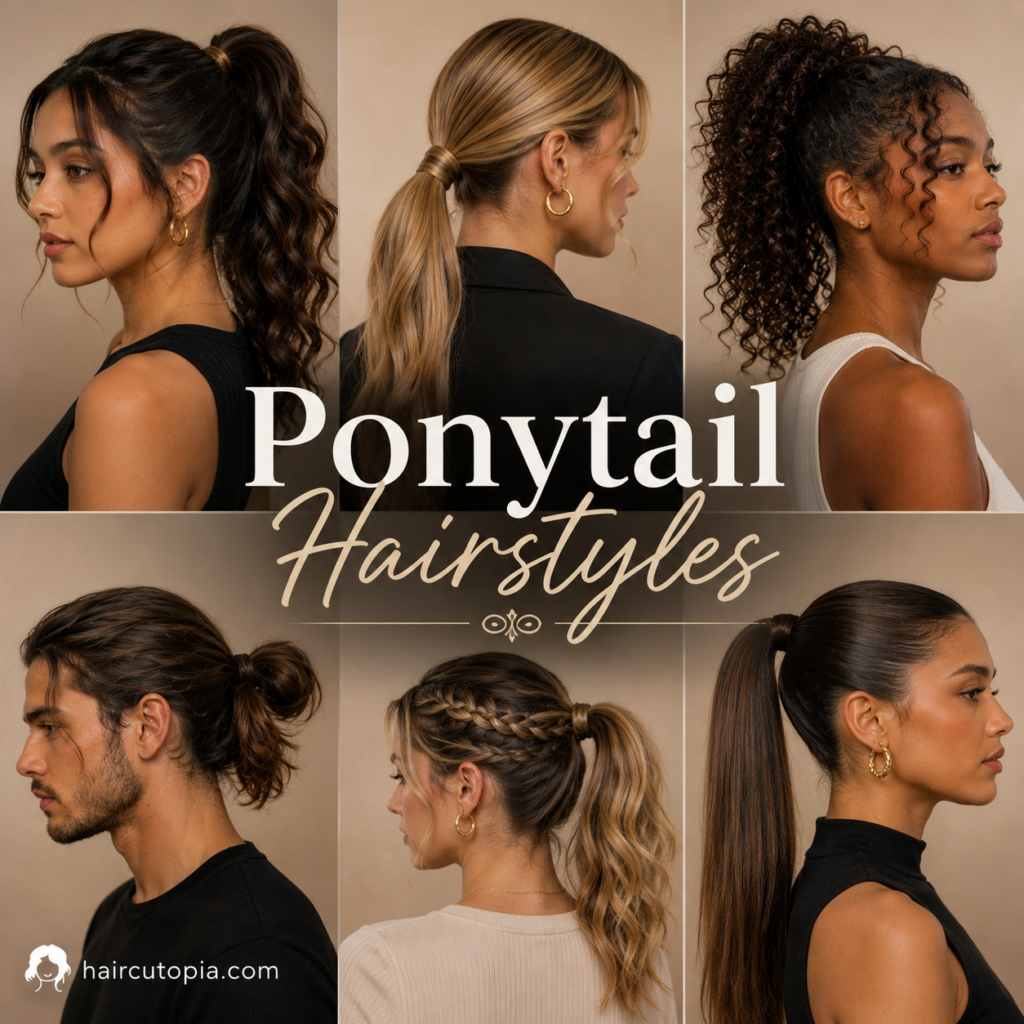
Curly Ponytail Hairstyles
Ponytail hairstyles are one of the easiest ways to style curls while keeping their natural texture visible, whether you wear them high, low, sleek, or intentionally voluminous.
High Curly Ponytail
A high ponytail places the curls near the crown, allowing them to fall around or behind the head.
The result can be playful, dramatic, or polished depending on how the front is styled.
Low Curly Ponytail
A low ponytail creates a softer silhouette.
You can leave the front smooth or allow a few curls to frame the face.
Wrapping a small section of hair around the elastic can create a more finished appearance.
Side Curly Ponytail
Positioning the ponytail toward one side lets the curls fall over the shoulder.
This can work particularly well for medium and long hair.
Sleek Curly Ponytail
A sleek curly ponytail combines controlled roots with textured ends.
The contrast between the smooth front and voluminous curls makes the curl pattern stand out even more.
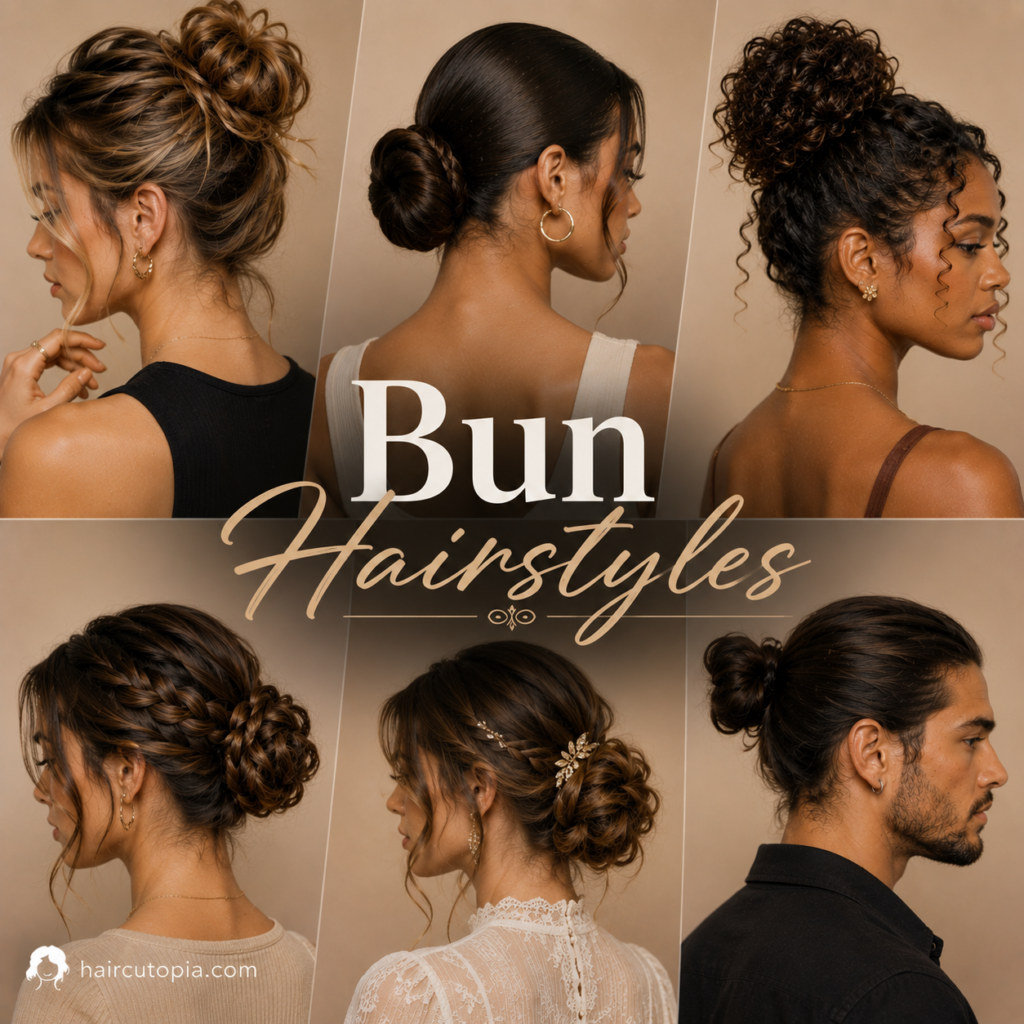
Curly Bun Hairstyles
Bun hairstyles are practical for curly hair, but they don’t need to hide your natural texture. Allowing some curls to remain visible can add dimension and softness to the finished style.
High Curly Bun
A high bun gathers curls toward the top of the head.
You can tuck everything into the bun for a cleaner shape or leave selected curls loose around the perimeter.
Low Curly Bun
Low buns work well when you want something understated or formal.
Natural texture can give the bun dimension without requiring every section to be perfectly smooth.
Messy Curly Bun
Curly hair naturally lends itself to textured buns.
Rather than trying to flatten every curl, allow some movement around the bun and face.
The style should still be securely pinned even when the finish is intentionally relaxed.
Space Buns With Curly Hair
Two buns positioned on either side of the head create a playful style that works particularly well with natural texture.
You can incorporate all of the hair or leave curls loose at the back.
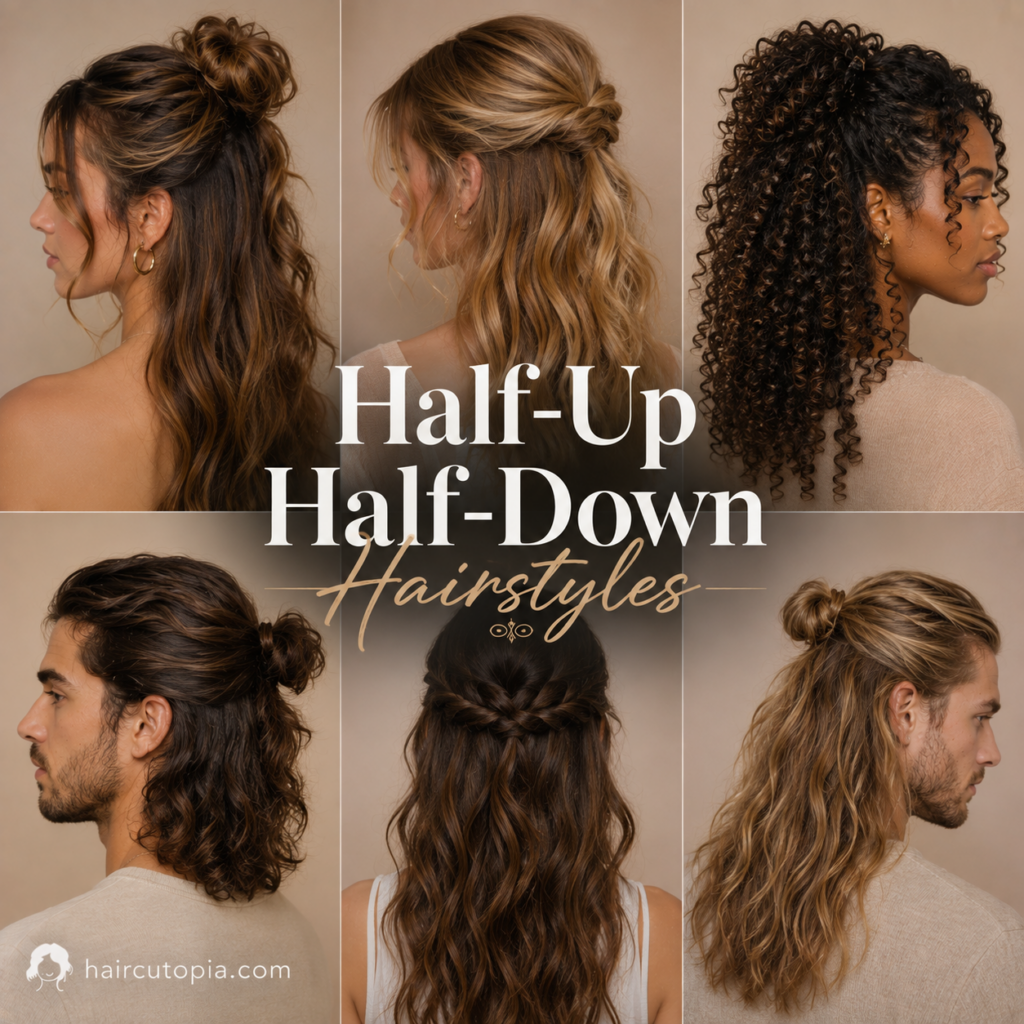
Half-Up Half-Down Curly Hairstyles
Half-up half-down hairstyles are particularly useful for curly hair because they provide control around the face without sacrificing the volume and texture of the curls left loose.
Popular variations include:
- Half-up ponytails
- Half-up buns
- Twisted half-up curls
- Braided half-up styles
- Claw-clip half-up styles
- Half-up curls with face-framing pieces
You can adjust how much hair is pulled back depending on how much volume you want to preserve.
Braided Hairstyles for Curly Hair
Braided hairstyles and curls create natural contrast, allowing you to add structure to selected sections while leaving the remaining curl pattern visible.
You can braid some of the hair while allowing the remaining curls to stay loose.
Ideas include:
- Small front braids
- Braided crowns
- Side braids
- Half-up braids
- Braids leading into a ponytail
- Braided buns
- Loose braids with curly ends
When detangling before braiding, work gently to avoid unnecessary pulling and breakage.
Curly Updo Hairstyles
Curly hair can create naturally dimensional updo hairstyles because the texture adds shape and movement even when the basic structure is relatively simple.
Curly Low Updo
Curls can be gathered loosely near the nape and pinned into place.
Allowing a few pieces to remain around the face creates a softer finish.
Curly High Updo
Gathering curls higher on the head creates additional height and keeps hair away from the neck.
This can be especially useful in warm weather or for formal occasions.
Twisted Curly Updo
Instead of braiding the hair, individual sections can be twisted and pinned.
The combination of twists and natural curls creates visual detail without requiring an elaborate braiding technique.
Easy Curly Hairstyles for Everyday Wear
Not every curly hairstyle needs a lengthy routine. Many easy hairstyles can be adapted to natural curls with simple ponytails, buns, half-up styles, clips, braids, and changes in parting.
For quick everyday styling, consider:
- A high ponytail
- A low ponytail with face-framing curls
- A loose high bun
- A half-up ponytail
- A half-up bun
- A claw-clip twist
- A deep side part
- Two small front braids
- A headband with loose curls
- A low bun with natural texture
Sometimes changing the placement of your hair is enough to create a completely different look.
Formal Curly Hairstyles
Curly hair works beautifully for weddings, proms, parties, and other special occasions, and many formal hairstyles can be created without straightening or concealing your natural texture.
Options include:
- Side-swept curls
- Curly chignons
- Textured low buns
- High curly updos
- Half-up curls
- Braided curly updos
- Sleek ponytails with curly lengths
- Defined curls worn completely down
You don’t necessarily need to straighten curly hair before creating a formal hairstyle.
Natural texture can become one of the defining elements of the finished look.
Curly Hairstyles for Weddings
Wedding hairstyles can highlight curls rather than concealing them, whether they’re worn completely down, half-up, gathered into a bun, or incorporated into a more elaborate bridal updo.
Popular choices include:
- Defined curls worn down
- Curly low buns
- Half-up curls
- Curly ponytails
- Braided curly updos
- Side-swept curls
- High curly updos
Decorative combs, flowers, pearls, pins, and other accessories can be positioned throughout the style.
If you’re using a veil, make sure the hairstyle provides a secure attachment point.
Curly Hairstyles for Prom
Prom hairstyles are a good opportunity to experiment with a more dramatic version of your everyday curls, whether that means additional volume, definition, braiding, or a more structured updo.
You might choose:
- Extra-defined curls
- Voluminous curls
- Half-up curls
- Curly ponytails
- Side-swept curls
- Textured buns
- Braided updos
Consider the neckline and back of your outfit when deciding whether to wear the hair up or down.
Curly Hairstyles With Accessories
Accessories can change curly hair without requiring much additional styling.
Try:
- Headbands
- Claw clips
- Barrettes
- Decorative pins
- Scarves
- Bows
- Hair cuffs
- Flowers
- Pearls
- Decorative combs
When using accessories, make sure they don’t snag or repeatedly catch individual curls.
How to Make Curly Hair Look More Defined
Curl definition depends on your natural pattern, hair condition, styling technique, and products.
A typical approach may involve:
- Starting with properly conditioned hair.
- Applying styling products while the hair has sufficient moisture.
- Distributing the product evenly.
- Encouraging curls to form using techniques appropriate for your texture.
- Allowing the hair to dry with minimal unnecessary disturbance.
- Separating or fluffing the curls once completely dry if additional volume is desired.
Some people prefer air drying, while others use a diffuser.
Experimentation is usually necessary because the same technique can produce very different results on different curls.
How to Add Volume to Curly Hair
Definition and volume sometimes work against each other.
Highly defined curl clumps can create less overall fullness, while separating curls increases volume but may also introduce more frizz.
If you want more volume, try:
- Drying with the roots lifted
- Using a diffuser
- Changing your part
- Gently lifting the roots after drying
- Separating selected curl clumps
- Choosing a haircut with appropriate layers
Avoid aggressively pulling apart curls before they’re dry if definition is important to you.
How to Reduce Frizz Without Flattening Curls
A completely frizz-free head of naturally curly hair isn’t always a realistic—or necessary—goal.
Some frizz contributes to volume and the natural appearance of curls.
If you want to reduce excessive frizz while maintaining shape, focus on gentle handling and adequate moisture.
It may help to:
- Avoid rough towel drying
- Detangle carefully
- Use styling products appropriate for your hair
- Minimize unnecessary touching while the hair dries
- Sleep on a smooth surface or use appropriate nighttime protection
- Refresh curls selectively instead of restyling everything
The goal can be controlled texture rather than eliminating every flyaway.
How to Refresh Curly Hair
Curls don’t always need a complete wash and restyle the next morning.
Depending on your hair and products, you may be able to refresh selected sections.
Start by identifying what actually needs attention.
If only a few curls have lost their shape, reworking the entire head may create unnecessary buildup and manipulation.
You might lightly dampen individual sections and reshape them or apply a small amount of appropriate styling product where needed.
How to Protect Curly Hairstyles Overnight
Nighttime movement can flatten or separate curls.
Depending on your length and texture, you might:
- Gather long curls loosely toward the top of the head
- Use a satin or silk bonnet
- Use a satin or silk scarf
- Sleep on a smooth pillowcase
- Protect a finished updo or braided style when practical
Avoid securing the hair so tightly that it creates unnecessary tension.
How Often Should Curly Hair Be Brushed?
There’s no single brushing schedule for every curly hair type.
Many people avoid brushing fully formed dry curls because it separates the curl pattern and creates additional volume or frizz.
Detangling is often easier when the hair has adequate slip, such as during conditioning, but the best method depends on your individual texture.
Use your fingers, a comb, or a brush designed for your preferred detangling method and work through knots gently.
Curly Hair and Humidity
Humidity can change how curly hair behaves because hair interacts with moisture in the surrounding air.
Some curls become larger and less defined. Others develop additional frizz or shrinkage.
If you live in a humid climate, choose hairstyles that can tolerate some movement rather than relying on a finish that needs to remain perfectly smooth.
Updos, ponytails, braids, and intentionally voluminous styles can sometimes be more forgiving in changing weather.
How to Choose a Curly Hairstyle
The best curly hairstyle depends on more than your curl pattern.
Consider:
Hair Length
Short curls may naturally favor styles centered around the haircut itself, while longer hair gives you additional options for ponytails, buns, braids, and updos.
Density
Dense curls can create substantial volume.
If your hair is lower density, strategic layers and styling techniques can help create the appearance of fullness without removing too much weight.
Shrinkage
Always consider how much shorter your curls become when dry.
This is especially important when choosing bangs and shorter haircuts.
Lifestyle
If you don’t enjoy spending much time styling your hair, choose a cut and routine that works with that preference.
A hairstyle isn’t low maintenance just because someone online describes it that way.
Desired Volume
Decide whether you prefer maximum definition, maximum volume, or something between the two.
That preference can influence everything from your haircut to your drying technique.
Common Curly Hair Styling Mistakes
Curly hair varies tremendously, so there are few absolute rules.
Still, several habits can make styling more difficult:
- Treating every curl pattern the same way
- Ignoring shrinkage when choosing a haircut
- Using excessive tension in ponytails and buns
- Applying more product every time curls need refreshing
- Constantly touching the hair while it dries
- Assuming all frizz is bad
- Choosing a haircut without considering its dry shape
- Expecting every section to curl identically
- Using techniques simply because they’re popular rather than because they work for your hair
A routine that produces great results for someone else isn’t automatically the right routine for you.
Frequently Asked Questions About Curly Hairstyles
What hairstyles look good on curly hair?
Curly hair works with a wide range of hairstyles, including layered cuts, bobs, shags, ponytails, buns, half-up styles, braids, and formal updos. The best option depends on your curl pattern, density, length, and desired amount of volume.
Are layers good for curly hair?
Layers can be very effective for curly hair because they can redistribute weight and change the overall shape. However, the length and placement of those layers should be chosen based on your specific curls and the silhouette you want.
Can curly hair have bangs?
Yes. Curly bangs can be full, wispy, short, long, or blended into face-framing layers. Shrinkage should be considered when determining the final length.
Is short or long hair better for curls?
Neither is inherently better. Short hair can emphasize volume and texture, while long hair provides more styling versatility and additional weight. The best length depends on your preferences and how your curls behave.
How can I make my curls look fuller?
Strategic layers, root lift, diffusing, changing your part, and gently separating some curls after drying can increase the appearance of volume.
Should I brush curly hair when it’s dry?
Brushing dry curls generally separates the curl pattern and increases volume or frizz. That may be desirable for some hairstyles, but if you want to preserve defined curl clumps, detangling at another stage of your routine may work better.
Can I wear curly hair to a formal event?
Absolutely. Natural curls can be worn loose, half-up, in ponytails, buns, braided styles, and elaborate updos for weddings, proms, and other formal events.
How do I know my curl type?
Curl charts generally classify wavy, curly, and coily patterns into Types 2, 3, and 4 with A-C subcategories. However, many people have multiple patterns. Knowing exactly which number describes your hair is less important than understanding how your own curls respond to cutting, moisture, products, and styling.
Finding the Right Curly Hairstyle for You
There isn’t one correct way to wear curly hair.
You can define every curl, brush your curls into soft volume, cut them short, grow them long, put them into a sleek ponytail, pile them into a loose bun, add braids, or leave them completely natural.
What matters most is understanding how your hair behaves.
Pay attention to shrinkage, density, volume, and the way different sections curl. Once you stop expecting every curl to look identical, styling becomes much less about controlling your hair and more about shaping what it already naturally does.
A great curly hairstyle doesn’t need to hide the texture.
More often than not, the texture is what makes the hairstyle interesting in the first place.